There are two ways to be fooled. One is to believe what isn’t true; the other is to refuse to believe what is true. —Soren Kierkegaard. "…truth is true even if nobody believes it, and falsehood is false even if everybody believes it. That is why truth does not yield to opinion, fashion, numbers, office, or sincerity–it is simply true and that is the end of it" – Os Guinness, Time for Truth, pg.39. “He that takes truth for his guide, and duty for his end, may safely trust to God’s providence to lead him aright.” – Blaise Pascal. "There is but one straight course, and that is to seek truth and pursue it steadily" – George Washington letter to Edmund Randolph — 1795. We live in a “post-truth” world. According to the dictionary, “post-truth” means, “relating to or denoting circumstances in which objective facts are less influential in shaping public opinion than appeals to emotion and personal belief.” Simply put, we now live in a culture that seems to value experience and emotion more than truth. Truth will never go away no matter how hard one might wish. Going beyond the MSM idealogical opinion/bias and their low information tabloid reality show news with a distractional superficial focus on entertainment, sensationalism, emotionalism and activist reporting – this blogs goal is to, in some small way, put a plug in the broken dam of truth and save as many as possible from the consequences—temporal and eternal. "The further a society drifts from truth, the more it will hate those who speak it." – George Orwell “There are two ways to be fooled. One is to believe what isn’t true; the other is to refuse to believe what is true.” ― Soren Kierkegaard
Many of the dechurched still hold key Christian beliefs
According to a recent survey, 40 million people have stopped going to church in the last 25 years. The authors of this new study, The Great DeChurching, which comprehensively polled 7,000 Americans, argue this is the largest religious shift in American history. There is much to lament in the decline in church attendance. It has and will continue to have a negative impact on human flourishing, polarization, and the vital social services churches provide.And yet, there are some surprising details in the data, compiled by sociologist Ryan Burge and two evangelical pastors, Jim Davis and Michael Graham. For instance, the right is dechurching faster than the left. This is likely because left-leaning religious bodies, particularly the mainline Protestant denominations, started seeing erosion well before this current moment and have few people left to lose.
Of the 40 million leavers, 15 million have stopped attending evangelical churches, and this is where the research might both surprise and encourage pastors. The two biggest cohorts are what the authors label “cultural Christians” and “mainstream evangelicals.” The former group comprises folks who identify as Christians and live in areas around the Bible Belt but who register low scores of belief in key Christian doctrines. There are around 8 million such people in our communities. Dean Inserra, a pastor in Florida, describes this cohort well in his book, The Unsaved Christian, “Self-proclaimed Christians who worship a god that requires no self-sacrifice, no obedience, no submission, and no surrender.” This group of folks leans right politically, and over half are open to returning to church if asked. There is a vast mission field here if we are willing to engage.
The second largest group of dechurched evangelicals are those who affirm orthodox Christian beliefs but who have stopped attending. It’s not surprising that mainstream evangelicals who no longer attend church still hold mostly right-of-center political views. What is interesting is how many—78 percent—have a high view of the evangelical church, and 100 percent would consider attending again. Many claim to stay home and watch church online. Imagine if churches invited these approximately two and a half million brothers and sisters to return home.
It could be that in our good and important work to evangelize and disciple the lost to our left, we should also consider ministry to those to our right, the blue-collar, perhaps right-wing people who also need Jesus.Both cultural Christians and mainstream evangelicals share surprisingly pedestrian reasons for leaving. Most admit getting out of the habit, experiencing a major life change, or leaving due to disruptions like COVID. As writer Jake Meador says, “Dechurching for them is either not a big deal because church was never a huge part of their life to begin with or they leave very quietly because they’re actually kind of embarrassed and feel ashamed—not necessarily because of what churchgoers will say, but because some part of them knows they should be going to church—and they don’t want to talk to anyone about it.”
What’s missing in the largest group of leavers is the narrative that dominates mainstream conversations about evangelicals: dissatisfaction due to evangelical engagement with conservative politics. To be sure, there is a cohort mentioned in the study of “exvangelicals” who have stopped attending due to unhealthy church environments, abuse, or partisan politics. Evangelicals should take seriously the problem of abuse and corruption in our midst and should be wary of an idolatrous, all-consuming politics.
Still, it is clear that the simplistic thesis explaining a decline in American church attendance because of evangelical voting patterns is just not true, despite the resilience of this self-flagellating theme in progressive evangelical discourse and despite a thriving publishing genre nearly as prolific as Amish fiction. Day after day, self-hating would-be prophets take this message to media outlets only too eager to evangelize the deplorable nature of everyday followers of Christ. Month after month, cut-and-paste jeremiads hit the bestseller list excoriating the church of one’s youth.
We always need prophets, but there are other more complicating social factors affecting America’s great shift in religious activity. There are also opportunities, if only we’d seize them. One more uncomfortable data point from The Great DeChurching shows that folks without college degrees are leaving much faster than those with education. Put it all together and it could be that in our good and important work to evangelize and disciple the lost to our left, we should also consider ministry to those to our right, the blue-collar, perhaps right-wing people who also need Jesus. Our Savior’s ministry reached all classes of society, from respected elites like Nicodemus to despised people whom most folks passed by, such as the man by the pool of Bethesda. The invitation into the family isn’t restricted by ZIP code.
The large number of people not attending church is cause for lament but also a catalyst for action. Maybe it’s time for us to stop imbibing the cynicism that has us not believing our own story. Maybe it’s time to stop passing by the mission fields in front of us. Perhaps it’s time to invite our neighbor to church.
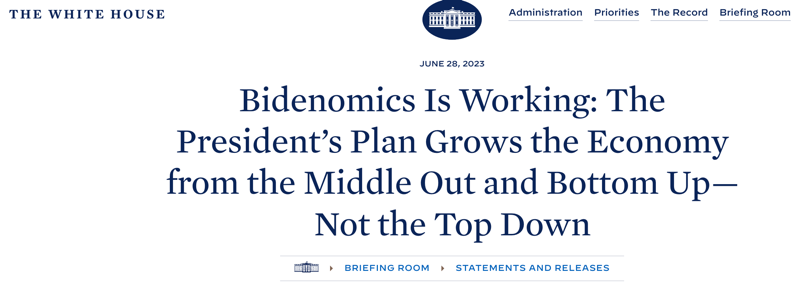
Amidst the chaos and disinformation being pumped out of the White House and echoed by corporate media cheerleaders, we all remember this headline:
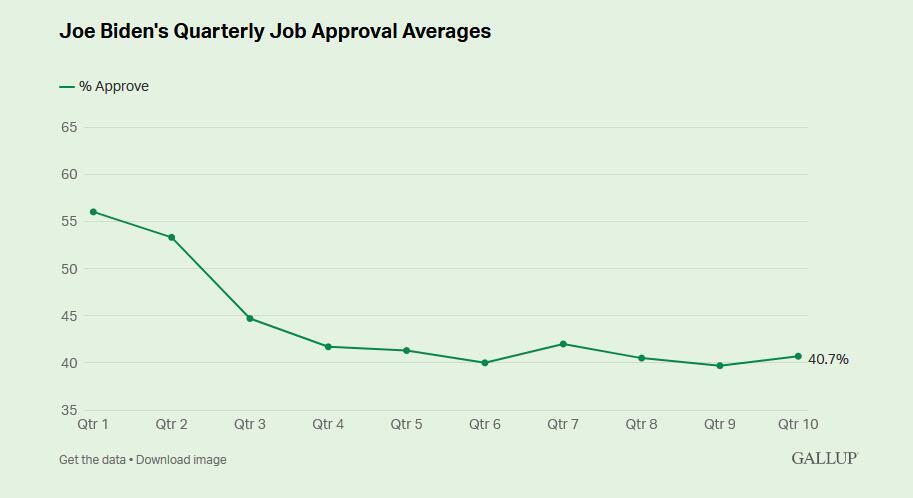
We all know every politician lies. Some tell half-truths, while others, such as the Biden administration, attempt to convince folks it is daylight while it’s midnight. An increasing number of Americans can see right through the propaganda, hence why Oliver Anthony’s blue-collar anthem “Rich Men North Of Richmond” continues to rank number one on Billboard Hot 100.
This leaves us with a Bloomberg report citing fintech startup Propel, an app aimed at Supplemental Nutrition Assistance Program (SNAP) recipients, that reveals an increasing number of Americans are struggling to pay rent and put food on the table.
Among households using the Supplemental Nutrition Assistance Program’s boosted pandemic benefits, 42% skipped meals in August and 55% ate less because they couldn’t afford food, more than double last year’s share, according to a Wednesday report from Propel Inc., a benefits software developer.
Bloomberg said:
The data also highlight that households were worse off in August from just a month ago. Since July, an increasing share of low-income households had utilities shut off, couldn’t afford the prior month’s utility bill or couldn’t afford rent. More than two-thirds of those surveyed who were receiving boosted SNAP payments said they had some form of debt.
Propel’s alarming report is an eye-opener, considering we’ve pointed out that mid/low tier consumers have depleted savings and racked up insurmountable credit card debt to make ends meet in the era of ‘Bidenomics’ inflation. Factor in a cooling labor market (read: Job Openings Crater, Prior Data “Unexpectedly” Revised Sharply Lower). These folks have limited safety nets as social support expires. Just wait until student loan payments kick in in several weeks.
China’s economic structure is getting increasingly unsustainable. Several indicators show that the world’s second-largest economy is standing on very shaky ground right now. A major meltdown is already in motion after the collapse of the country’s second-largest property developer Evergrande, whose shares collapsed by 80% on Monday.
But Evergrande’s bankruptcy is just one aspect of the historic crisis gripping the Eastern economic superpower. China’s growth is falling, production levels are rapidly declining, and dropping trading volumes suggest that economic activity is grinding to a halt. The pandemic recovery officials were expecting hasn’t materialized yet. Instead, new data suggests that it will take years before the economy gets back on its feet.
Even though many experts predicted that the Chinese economy would soon eclipse the American economy and replace the U.S. as the global hegemon, today, they say that when and if that scenario comes to fruition, it will be mostly due to our domestic policy failures rather than China’s success. The mistakes of our leaders may have given our adversaries in Beijing some leverage in the global market. However, the deleterious policies of the Chinese Communist Party have been destroying businesses, causing record unemployment, and stirring social unrest all over the nation.
With people’s purchasing power being squeezed, consumer prices are dropping for the first time in several years as demand continues to fall. While inflation is a major concern of the Federal Reserve, the People’s Bank of China is currently dealing with the opposite problem. Deflation – the trend of crashing prices throughout the economy – presents a particular threat to the Chinese economy, which carries a massive amount of debt. David Dollar, a senior fellow at the Brookings Institute’s China Center, explains that deflation means the real value of debt goes up.
Although inflation is certainly bad for any economy, it does help manage debt burdens over time. But deflation actually does the opposite. The crisis helps to explain China’s weak second-quarter GDP, which came in lower than expected at 6.3%.
The party’s corruption is eviscerating the private sector and putting the financial market in great danger as elitists take control of the system to obtain more and more wealth. Their goal of having absolute power is deteriorating the health of the population and the economy. Recent figures add to the anxiety that cascading failures will completely break down the Chinese economy. Earlier this year, JPMorgan’s analysts predicted that China risks a 1990-style “Japanification” if officials fail to address the housing market crash, financial imbalances, and aging demographics.
From an unstable economy to a debt-ridden property market to anti-business policies and demographic imbalances, Beijing is buried in problems right now. State officials must come up with better strategies than hiding negative information if they want to save the Chinese economy from the ongoing meltdown. The economic superpower is losing its strength and in danger of falling apart just as Japan did in 1990.
But if China goes down, the entire world will suffer repercussions. That outcome could push us into one of the biggest economic and financial crises in history, and the consequences of it will be absolutely destructive for the global market. In this video, we identified 10 signs that prove that China is in deep trouble as economic and social stability continues to erode across the country. So keep tuned until the end to understand what’s behind the downfall of the Chinese empire.
The property market is in shambles: One of the biggest drag downs for the Chinese economy in 2023 was the implosion of the nation’s $42.7 trillion property market.
The middle class is dying out faster than anyone anticipated.
Deflation is reaching crisis levels in 2023.
Debt-based growth is putting the country at risk.
Export volumes are falling off a cliff.
The Chinese government is killing private companies.
Unemployment is rampant.
China’s aging population is posing significant threats to economic and social stability.
The lack of transparency is keeping the population and businesses in the dark.
Worsening living conditions are exacerbating social unrest.
Many Americans have seen a “Schoolhouse Rock” video explaining how Congress operates, or they may have taken political science classes in school. But neither paints the full picture of how Congress “actually works,” Clint Brown says.
Take the introduction of bills in Congress as an example, says Brown, vice president of government relations at The Heritage Foundation. (The Daily Signal is Heritage’s multimedia news organization.)
“Members of Congress introduce thousands of bills every year,” Brown says, but many of them “are laying a marker for what they believe.”
“We call them messaging bills,” he adds, “because [lawmakers] want to talk about the issue, but they don’t intend it to pass.”
As in any office building, “there are conversations happening all the time,” Brown says, and lawmakers have their own “congressional version of the water cooler” and “talk over what they’re working on just like anybody else.”
“Sometimes there are the smoke-filled back rooms where they hatch plans, and it seems very scandalous and salacious,” he says. “But most of the time, it’s just normal conversation. And that’s how things get done, is you go talk to people about it.”
Virginia Allen: Clint Brown is vice president of government relations at The Heritage Foundation. Clint has served in the legal and political arena for more than a decade.
Before joining Heritage he was executive director of the Senate Steering Committee, chaired by Utah Sen. Mike Lee.
Clint, I think for all of our listeners, probably everyone’s taken a civics class. We all learn in school about politics and the three branches of government. But when you actually get into it, explain what you think are some of the most common misconceptions that people have, specifically about Congress.
Clint Brown: So, everybody’s seen “Schoolhouse Rock.” You see the bill sitting on the Hill. You know it’s a summary. And then you take your civics class, maybe take some political science classes in college, if you go to college. You see what’s happening on Fox News. There’s an idea of how things work.
When people start to interact with Congress is where I see the most misconceptions. So people who are active in local politics or state politics and just now getting into that, maybe they reach out to Congress and they think, “Oh yeah, an intern’s going to answer the phone and there’s maybe one or two people that work for the member of Congress.” Actually, some estimates have it at 18,500 staffers that work on Capitol Hill.
Allen: Wow.
Brown: Others have it closer to 10,000. I think that’s a disparity between committee staff and personal office staff.
So each member of Congress has a staff of their own, a chief of staff, a legislative director, legislative assistants, communications directors, press secretaries. There’s a whole army of people that keep them going.
And you’re not just talking to an intern who’s then going to go talk to the member of Congress. So you have to understand what’s going on there and who works there in order to interact well with Congress.
And those people are very important. They’re usually young. They’re here because they’re optimistic and they want to help the country, in most cases.
So understanding just how big the institution is, I think, is a major misconception … . It’s not nearly as big as the federal government, which it oversees. It should probably balance out a little bit, but it’s a large institution and members of Congress are very busy. Their schedules are very tight when they’re in town, which is about three and a half days a week. They have a scheduler who keeps them scheduled minute by minute.
Allen: It’s constant.
Brown: Constant.
Allen: And one of those roles that keeps them so busy that the Founders specifically gave them was this critical role in creating laws and in debating what our laws should be and talking about bills and legislation.
Talk us through just a little bit from beginning to end, a member of Congress seeking to pass a bill. What does that process look like?
Brown: Yeah, so, there’s the “Schoolhouse Rock” version, there’s advanced “Schoolhouse Rock” version—which we’ll call political science—and there’s how it actually works.
Allen: We want to know how it actually works.
Brown: But you have to understand the 101 to really understand how it actually works.
There are committees. Members are on committees. Those committees focus on specific federal agencies, specific areas of interest to Congress. An example’s, like, environmental. There’s committees on the environment and public works in the House and in the Senate, energy, the judiciary.
There’s committees on everything and the senators who are on those committees draft legislation that is considered in that committee, passes out of that committee, potentially, if it’s going to move forward.
Sometimes there’s amendments in the committee, goes to the floor of the House or the Senate and it can be amended there, theoretically, not really. We’ll get into that.
And then as it moves through that process, everybody has their opportunity to say what they think about the bill, make it better, improve it. Then it passes one chamber, goes to the other chamber.
It doesn’t start the process over again. Although it may have been considered in committee in that chamber as well, it doesn’t have to be. It’ll typically go straight to what we call the floor, which is where the whole chamber considers it. Passed there, gets signed by the president. Right? That’s the 101. What actually happens is significantly more complicated.
So going to the “Schoolhouse Rock” advanced, the political science, what you often hear is there’s just so much partisanship in Congress, nothing can get done because there’s partisanship in Congress. And spending 10 years there, that’s just not true.
Allen: How so?
Brown: At some level, it is true. There is a lot of partisanship and rhetoric, but 94%—don’t quote me on that exact number. It’s been a while since I’ve run it and the numbers change over time. But last time I checked, which was a couple years ago, about 94% of legislation that passes the Senate passes unanimously, not just bipartisan, unanimously. One hundred senators support it. You don’t get more bipartisan than that.
Allen: You also don’t really hear about that a lot.
Brown: You don’t hear about that. No. People don’t know that.
Now, sometimes these are renaming post offices, which, yes, in America takes an act of Congress, but not most of the time. That’s sometimes. Sometimes it’s actual legislation, it’s a real bill. There have been a number of major bills that have passed by unanimous consent.
So there’s 6% of bills that pass that are not considered unanimous consent. They all pass bipartisan, every single one of them in the Senate, because it takes 60 votes to pass something in the Senate.
And we haven’t had one party have a 60-vote majority for a number of years, maybe decades. I don’t remember the exact year. So they all are bipartisan.
So then what doesn’t get done is what the political scientists focus on, all these bills that don’t actually pass. They can’t pass because they’re not bipartisan. Do they need to get done? Did they ever intend to get done?
Members of Congress introduce thousands of bills every year and some of these bills they intend to pass. Some of these bills are laying a marker for what they believe. We call them messaging bills because they want to talk about the issue, but they don’t intend it to pass.
And it’s not because it’s not bipartisan, it’s because they haven’t necessarily built the support for it. And as I mentioned earlier, they have very busy schedules. They have to prioritize where they focus their efforts.
Now, at The Heritage Foundation, we would encourage them maybe sometimes to shift their priorities, but they have to prioritize what they talk to their colleagues about, what they get support behind, what they come talk to groups like us about, what they talk to the news about, in order to build that support, which takes years to pass a bill.
So just saying that there’s bipartisan logjams and things don’t pass is really not looking at the issue. They often point to funding bills. “Oh, there’s always a fight over funding or the debt ceiling.” Well, there’s a reason for that and it’s not partisanship.
This is how it actually works. This is where we’re getting into the real details of what actually happens. How you pass a bill in Congress is supposed to be that everybody has an opportunity to amend, have their input on legislation.
Until the late 2000s, this was pretty normal. This happened a lot and there were some logjams in there. I’ll get into why.
But now, in the Senate at least, there are very few opportunities to amend legislation and you think, “Oh, I voted for my senator. They’re going to come to Washington and have input on this bill and they’re going to change it and make it where it represents my interests.” That’s assuming they can amend the bill.
So what happens in the Senate, there’s a tradition. The Senate is governed by three things: tradition, rules, and precedent. The precedent is where the whole body looks at the rules and makes an interpretation, much like a court.
I can get into that a little bit more, but for our purposes right now, the other thing that governs is tradition. The Senate is a very traditional place—that shouldn’t be surprising to anyone—and one tradition is the right of first recognition for the majority leader.
So whoever’s in charge right now, that’s Chuck Schumer, as elected by the majority, Democrats, gets to go down to the Senate floor and the chair under tradition recognizes him to speak first. That’s really powerful because that means that he can introduce a bill, he can call it up, and then he can take all of the available opportunities for amendments.
So there’s a thing called the amendment tree. I won’t get into it, that’ll bore people to death, but just know there are certain opportunities for amendments. You can’t make unlimited amendments under the current way the Senate operates because it would be too unwieldy.
There’s an orderly process. That shouldn’t surprise anyone. The majority leader takes advantage of that orderly process. And this isn’t even a partisan statement. Sen. [Mitch] McConnell, when he was majority leader, did the same thing. In fact, he accelerated it.
They take every opportunity for an amendment. So no senator has the opportunity to file amendment, call it up, get it voted on, and have their input on the legislation. They do have some opportunity in committee sometimes.
How does this create logjam? Well, if you don’t have the opportunity to have your input on bills, your only option as a senator or a member of the House is to take leverage. When you have leverage is when they need to pass something. And they need to pass it usually quickly because things get held up along the way. There’s debate.
Oftentimes it’s the craziest thing. The majority leader will plan to introduce a spending bill at the last minute before everybody wants to go home for Christmas. It’s wild.
Allen: It’s intentional.
Brown: It’s a limited time window, though. So if you’re willing to be the Grinch, you can say, “We’re not moving this quickly. I have the power to hold this up and I’m going to hold it up until you give me an opportunity to amend it.”
And if that’s your only opportunity to get an amendment, you’re going to go big. You’re going to ask for something that you really want and it makes it look like there’s all this logjam and we can’t agree.
And there’s all this fear about a government shutdown and sometimes government shutdowns happen. It’s not the end of the world. But that is what’s actually going on there.
So if they actually followed the process and they were collegial, etc., etc., had amendments throughout the year, maybe they wouldn’t have this logjam.
It’s not partisanship. Although some would say, “Well, they’re doing that to keep partisan amendments off.” That may be the excuse, but the reality is they’re doing it because they don’t want to take tough votes. They don’t want to take tough votes on these amendments because groups will go run ads based on these votes against members.
And you can call that partisanship. I think at Heritage, we would probably call that informing the voters of the position that their member has.
There’s been a lot of debate recently about following the Republican presidential debate about exactly where do Democrats stand on abortion? Are they for abortion up until birth? Well, you can look at their voting record and see that they are. All the Democrats in the Senate voted for that.
So that’s why we have to get members on record. That’s why they don’t want to be on record. That’s why they use this mechanism. That’s why we have logjams.
Allen: OK, this is fascinating. All right. So when a bill is being considered, whether it’s an agricultural bill or whether it’s spending, how many conversations are happening behind closed doors between members in offices when it is those situations where there’s a narrow window and it has potential to be bipartisan, but it doesn’t necessarily look like it on the onset?
Brown: There are conversations happening all the time. These people work together. These are their co-workers. They meet at the congressional version of the water cooler and they talk over what they’re working on just like anybody else.
Sometimes there are the smoke-filled back rooms where they hatch plans and it seems very scandalous and salacious. That’s a real thing. But most of the time it’s just normal conversation.
And that’s how things get done, is you go talk to people about it. You say, “Hey, this is actually a great bill because of this. What are your concerns?” You hear their concerns and you address those.
Now, back to the amendments, that should be happening on the House and Senate floor. They should be saying, “Here’s my concern. Here’s an amendment to fix it in an orderly process,” and have that debate in the public. So if you don’t like smoke-filled rooms where people cut deals, you want amendments and you want an open amendment process.
Allen: Now, specifically, let’s touch a little bit deeper on the budget and the spending aspect because, obviously, Congress holds the power of the purse. We’re coming up as Congress comes back into session in September. There’s going to be a lot of fights about these appropriations bills and approval of the budget. Give us a little bit of a rundown of what this process looks like and when Congress can agree on a budget. When they’re not able to reach that consensus, what happens?
Brown: So, when we come back, when Congress comes back in session next week, they’ll start considering—well, they’ve already been considering, but they’ll really buckle down and start considering spending bills because government funding expires Sept. 30. That’s the congressional federal fiscal year.
Typically, what happens is they do what’s called a continuing resolution. We’re just going to continue using the funding from last year at the same levels for a few weeks or even a whole year. It can go for any amount of time.
What usually happens this time of year is they’ll do a couple weeks here and a couple weeks there until it gets to Christmas. And if you object, you’re the Grinch and you’re keeping all of your colleagues from going home for Christmas.
Now, I mean, you work with people for years. They’re away from their families. They’re away from their hometowns. Christmas is sacred to everybody. The holidays are sacred to everybody. But it’s especially sacred when you’re away from your family a lot.
So if you’re the Grinch that holds it up, you’re going to get a lot of hate from your colleagues and the one thing you need to get things done is not hate from your colleagues in Congress. So it really puts them in a weird position.
There are members in the House Freedom Caucus and some senators who have called for, “Let’s not do that. Let’s not do that this time. A number of members would support that. Let’s actually, if we can’t get the funding done by Sept. 30, let’s extend this beyond Christmas and work on it and figure it out.”
And here we are back to that leverage point.
The House Freedom Caucus recently issued a statement that they had some asks for what they would need in order to pass a continuing resolution. They don’t want it to be a short-term continuing resolution that just goes until right up until Christmas. They want it to fix the border and … they want to fix the woke and weaponized FBI.
These are great things that we at Heritage are encouraging them to do, but they’re having to use that leverage to get what they need.
So that’s what we expect to see play out. There will be some debate over what they can do on a CR to fix those issues.
Allen: Define what a CR is.
Brown: CR, continuing resolution. Sorry about that—congressional speak, it comes out sometimes. So that’s what we expect to see in the coming weeks.
This is how the process will play out. There will be meetings between members, these backroom discussions. There will be debate on the floor of the House and the Senate about this. You’ll see both.
Allen: All right. Clint, any final thoughts? Things that, as we’re watching, even just in the next several weeks as we’re watching a little bit of excitement play out in Congress, they’re coming back, they’re debating path forward, we’re looking at the end of the year, anything that you think the American people should be aware of as we’re watching some of this play out?
Brown: Definitely. There’s a lot they should be aware of, but in the limited time we have, I would highlight that the media is going to cling onto the dysfunction and say, “Oh look, the Republican House can’t get it together.”
They’ve said that before and the Republican House does get it together. They’ve said that a number of times this year. They said that on the Speaker [Kevin] McCarthy vote. “Oh, look how terrible this is. They can’t get it together.”
Actually, it was kind of awesome. All sides came to an agreement. Kevin McCarthy, I’ll give him props, he came to an agreement. The 20, we’ve praised them extensively here at Heritage and The Daily Signal has praised them extensively for the courage it took to make demands about how the process should work.
This is how Congress works. It’s an adversarial process in many ways. There’s conflict, there’s debate. Understand the world is not ending even if the government shuts down.
As far as I’m concerned, the conservatives in the House have pretty reasonable demands. These are not crazy. They’ve already passed HR 2. It got 45 votes in the Senate as well. HR 2 is the border security bill. It’s not crazy to demand that they move that again with a continuing resolution. This is easy. You’ve already done it.
So when the media says the sky’s falling, just be aware. This is how the process is supposed to work. They’re going to work it out and it’ll be fine.
Allen: It’ll be fine. I love that. It’s a good note to leave it on. Clint Brown, vice president of government relations at The Heritage Foundation. Thank you for your time. We really appreciate it.
Brown: Thanks so much for having me. Love to talk about Congress.
Have an opinion about this article? To sound off, please email letters@DailySignal.com, and we’ll consider publishing your edited remarks in our regular “We Hear You” feature. Remember to include the URL or headline of the article plus your name and town and/or state.
Tucker Carlson said the Nord Stream attack was the largest manmade CO2 emission in history in a question and answer session with Balazs Orban at a festival in Hungary. “The world is resetting completely,” Carlson said. “The post-war order is collapsing. NATO is going to collapse, obviously. You can’t have the driver of NATO, which is the United States, sabotage Germany‘s main source of cheap energy in Nord Stream. The Biden administration blew up Nord Stream. And the Germans are so self-hating they won’t say anything about it. They sort of put their head down, “No, I don’t want to talk about that!” Okay, but I do want to talk about it because it is important. First of all, it was the biggest act of industrial sabotage in history. Second, it was the largest manmade CO2 emission in history, which if you’re a global warming cultist is like the devil himself come to earth and the Biden administration did that. But third and most important it was an attack on Germany, which is the most powerful country in Western Europe and America’s last main ally and we just attacked our most important ally. NATO can not stand long term. At some point the Germans are going to wake up and be like, wait a second, we had chemical plants two years ago and now we don’t. You just wrecked our economy. I just don’t think it can continue after that. Maybe I am wrong. But I don’t see how it does.” Tucker Carlson Speech In Esztergom, Hungary
Fox News host Sean Hannity reacts to President Biden’s physical health and alleged pseudonym email revelations in his opening monologue. #foxnews #hannity
The current administration is a “corrupt mob” perpetrating a “disgusting scheme” against former President Donald Trump, according to Academy Award-winning actor Jon Voight, who warned of a “civil war” taking place against “all of us.”
In a slightly over two-minute clip posted Tuesday, the Hollywood legend — featured against the backdrop of an American flag — began by questioning if we have become a “nation of destructive behavior.” Warning that “this is now a war — a war against all of us,” Voight blasted the Biden administration, which he described as “a corrupt mob,” as well as the Obama administration which “fuels the cycle.” Video Player is loading.
Play Video
PlayMuteCurrent Time/DurationLoaded: 0%Stream Type LIVESeek to live, currently behind liveLIVERemaining Time -1xPlayback RateChapters Chapters Descriptions descriptions off, selected Captions captions settings, opens captions settings dialog captions off, selected Audio TrackPicture-in-PictureFullscreenThis is a modal window.No compatible source was found for this media.Beginning […]
Hollywood star James Woods is sounding the alarm about the desire of global powers to keep the world’s populace in extreme captivity, saying, “They want you in chains. Not visible, but in chains.”
In a message posted on X Wednesday, the actor specified examples of invisible shackles to keep people in bondage.
“Electric cars, that can be traced and turned off by them. Electric heat, electronic currency, traceable phones, ‘cookies,’ medical ‘passports,’ masks.”
Woods was commenting on a brief video he shared listing the so-called reasons and excuses given by government authorities and leftists for draconian lockdowns and restrictions related to the COVID pandemic.
They want you in chains. Not visible, but in chains. Electric cars, that can be traced and turned off by them. Electric heat, electronic currency, traceable phones, “cookies,” medical “passports,”masks pic.twitter.com/PLJwnYC1Tn
The video displays a short statements that the public was told about the coronavirus restrictions:
“It’s just a mask.
“It’s just two meters. (six feet)
“It’s just three weeks.
“It’s just non-essential businesses.
“It’s just non-essential workers.
“It’s just until we work it out.
“It’s just a bar.
“It’s just a restaurant.
“It’s just care homes.
“It’s just schools.
(U.S. Navy photo by Mass Communication Specialist 1st Class Daniel M. Young)
“It’s just to keep overwhelming medical services.
“It’s just until the cases go down.
“It’s just to flatten the curve.
“It’s just to keep others from being scared.
“It’s just for a few more weeks.
“It’s just gyms, salons, spas & sport.
“It’s just churches & mosques.
“It’s just singing.
“It’s just no happy birthday, no shared cakes.
“It’s just travel.
“It’s just three months of lockdown.
Once-thriving businesses at CityPlace in West Palm Beach, Florida, are boarded up and deserted amid the coronavirus pandemic on Jan. 30, 2021. (Photo by Joe Kovacs)
“It’s just some floor markings & temporary screens.
“It’s just a one-way system.
“It’s just until we get a vaccine.
“It’s just an app.
“It’s just for tracing.
“It’s just to let people know you’re safe to be around.
“It’s just to let others know who you’ve been in contact with.
“It’s just some areas.
“It’s just government guidelines.
“It’s just for your own good.
“It’s just for protecting others.
(U.S. Air Force photo by Trevor Cokley)
“It’s just fact-checking, not censorship.
“It’s just mandatory.
“It’s just … the law now.
“It’s just scientific fact.
“It’s just only these scientists, not those.
“It’s just because of the second wave.
“It’s just to save your granny.
“It’s just another lockdown.
“It’s just our more weeks.
“It’s just Christmas canceled.
“It’s just school, they can do it from home.
“It’s just almost a year, it will be better soon.
“It’s just a swab.
“It’s just for medical information.
“It’s just a jab.
Hospital Corpsman 2nd Class Dillon Leggett, left, administers the COVID-19 vaccine to Intelligence Specialist 2nd Class Tairis Jacofernandez aboard the USS Hershel ‘Woody’ Williams in Rijeka, Croatia, March 30, 2021. (U.S. Navy photo by Mass Communication Specialist 2nd Class Eric Coffer)
“It’s just a card to store your medical history.
“It’s just so you can travel.
“It’s just for your passport.
“It’s just so you can go into stores & pubs.
“It’s just so you can send your kids to school.
“It’s just so you can get your drivers license.
“It’s just so you can vote.
“It’s just so you can go to a concert.
“It’s just a facility, to keep you separate from the others.
“I’ve seen how this movie ends not getting on that train. Come & find me.”
“Total government control. They won’t stop until they have it.”
“The shackle-less slavery system. Why limit yourselves to just a part of the populace when you can have the whole thing?”
“Enslaved people inevitably break those chains. How long will Americans tolerate modern slavery?”
“Orwell 1984 is mild compared to this dystopian nightmare of cradle to grave government and cameras watching every move we make and nothing is sacred, and there would no secrets no privacy, and individual thinking is verboten. Scary times, but believers know Christ is coming back, and in the end, God wins.”
“Mr. Woods … This should be our new Emergency Broadcast Alert System to wake everyone up.”
“As we catapult into a future of digitization, we must not forget the invaluable price of our personal freedoms. We’re being sold a narrative of convenience and progress, but at what cost? Electric cars, digital currencies, traceable phones – these aren’t just advancements in technology, they’re potential chains that can bind us. ‘Cookies’ that track our every move online, medical ‘passports’ that dictate where we can go, masks that have become symbols of compliance rather than safety. We must resist the allure of this gilded cage. It’s time to question who truly benefits from these ‘advancements,’ and whether we’re prepared to trade our freedom for the illusion of progress.”
“What happens when the majority of humans tell them no we won’t comply?”
THEY CHANGED: Beth Ailes, widow of Fox News pioneer, the late Roger Ailes, joins Eric Bolling to reflect on the GOP primary debate as well as Tucker Carlson’s “Tucker on X” interview with Donald Trump in a news world in which she feels Fox News has abandoned its fans. Watch NEWSMAX, an independent news network with a conservative perspective, available in 100M+ U.S. homes.
“Once a government is committed to the principle of silencing the voice of opposition, it has only one way to go, and that is down the path of increasingly repressive measures, until it becomes a source of terror to all its citizens and creates a country where everyone lives in fear.” — President Harry S. Truman
Ever since Martin Luther King Jr. delivered his groundbreaking “I Have a Dream” speech during the March on Washington for Jobs and Freedom on Aug. 28, 1963, the Deep State has been hard at work turning King’s dream into a living nightmare.
The end result of the government’s efforts over the past 60 years is a country where nothing ever really changes, and everyone lives in fear.
Race wars are still being stoked by both the Right and the Left; the military-industrial complex is still waging profit-driven wars at taxpayer expense; the oligarchy is still calling the shots in the seats of government power; and the government is still weaponizing surveillance in order to muzzle anti-government sentiment, harass activists, and terrorize Americans into compliance.
This last point is particularly disturbing.
Starting in the 1950s, the government relied on COINTELPRO, its domestic intelligence program, to neutralize domestic political dissidents. Those targeted by the FBI under COINTELPRO for its intimidation, surveillance and smear campaigns included: Martin Luther King Jr., Malcom X, the Black Panther Party, John Lennon, Billie Holiday, Emma Goldman, Aretha Franklin, Charlie Chaplin, Ernest Hemingway, Felix Frankfurter, and hundreds more.
In more recent decades, the powers-that-be have expanded their reach to target anyone who opposes the police state, regardless of their political leanings.
Consider just a small sampling of the ways in which the government is weaponizing its 360 degree surveillance technologies to flag you as a threat to national security, whether or not you’ve done anything wrong.
Flagging you as a danger based on your phone and movements. Cell phones have become de facto snitches, offering up a steady stream of digital location data on users’ movements and travels. For instance, the FBI was able to use geofence data to identify more than 5,000 mobile devices (and their owners) in a 4-acre area around the Capitol on January 6. This latest surveillance tactic could land you in jail for being in the “wrong place and time.” Police are also using cell-site simulators to carry out mass surveillance of protests without the need for a warrant. Moreover, federal agents can now employ a number of hacking methods in order to gain access to your computer activities and “see” whatever you’re seeing on your monitor. Malicious hacking software can also be used to remotely activate cameras and microphones, offering another means of glimpsing into the personal business of a target.
Flagging you as a danger based on your behavior. Rapid advances in behavioral surveillance are not only making it possible for individuals to be monitored and tracked based on their patterns of movement or behavior, including gait recognition (the way one walks), but have given rise to whole industries that revolve around predicting one’s behavior based on data and surveillance patterns and are also shaping the behaviors of whole populations. One smart “anti-riot” surveillance system purports to predict mass riots and unauthorized public events by using artificial intelligence to analyze social media, news sources, surveillance video feeds and public transportation data.
Flagging you as a danger based on your spending and consumer activities. With every smartphone we buy, every GPS device we install, every Twitter, Facebook, and Google account we open, every frequent buyer card we use for purchases—whether at the grocer’s, the yogurt shop, the airlines or the department store—and every credit and debit card we use to pay for our transactions, we’re helping Corporate America build a dossier for its government counterparts on who we know, what we think, how we spend our money, and how we spend our time. Consumer surveillance, by which your activities and data in the physical and online realms are tracked and shared with advertisers, has become a $300 billion industry that routinely harvests your data for profit. Corporations such as Target have not only been tracking and assessing the behavior of their customers, particularly their purchasing patterns, for years, but the retailer has also funded major surveillance in cities across the country and developed behavioral surveillance algorithms that can determine whether someone’s mannerisms might fit the profile of a thief.
Flagging you as a danger based on your social media activities. Every move you make, especially on social media, is monitored, mined for data, crunched, and tabulated in order to form a picture of who you are, what makes you tick, and how best to control you when and if it becomes necessary to bring you in line. As The Interceptreported, the FBI, CIA, NSA and other government agencies are increasingly investing in and relying on corporate surveillance technologies that can mine constitutionally protected speech on social media platforms such as Facebook, Twitter and Instagram in order to identify potential extremists and predict who might engage in future acts of anti-government behavior. This obsession with social media as a form of surveillance will have some frightening consequences in coming years. As Helen A.S. Popkin, writing for NBC News, observed, “We may very well face a future where algorithms bust people en masse for referencing illegal ‘Game of Thrones’ downloads… the new software has the potential to roll, Terminator-style, targeting every social media user with a shameful confession or questionable sense of humor.”
Flagging you as a danger based on your social network. Not content to merely spy on individuals through their online activity, government agencies are now using surveillance technology to track one’s social network, the people you might connect with by phone, text message, email or through social message, in order to ferret out possible criminals. An FBI document obtained by Rolling Stone speaks to the ease with which agents are able to access address book data from Facebook’s WhatsApp and Apple’s iMessage services from the accounts of targeted individuals and individuals not under investigation who might have a targeted individual within their network. What this creates is a “guilt by association” society in which we are all as guilty as the most culpable person in our address book.
Flagging you as a danger based on your car. License plate readers are mass surveillance tools that can photograph over 1,800 license tag numbers per minute, take a picture of every passing license tag number and store the tag number and the date, time, and location of the picture in a searchable database, then share the data with law enforcement, fusion centers and private companies to track the movements of persons in their cars. With tens of thousands of these license plate readers now in operation throughout the country, affixed to overpasses, cop cars and throughout business sectors and residential neighborhoods, it allows police to track vehicles and run the plates through law enforcement databases for abducted children, stolen cars, missing people and wanted fugitives. Of course, the technology is not infallible: there have been numerous incidents in which police have mistakenly relied on license plate data to capture out suspects only to end up detaining innocent people at gunpoint.
Flagging you as a danger based on your political views. The Church Committee, the Senate task force charged with investigating COINTELPRO abuses in 1975, concluded that the government had carried out “secret surveillance of citizens on the basis of their political beliefs, even when those beliefs posed no threat of violence or illegal acts on behalf of a hostile foreign power.” The report continued: “Groups and individuals have been harassed and disrupted because of their political views and their lifestyles… Intelligence agencies have served the political and personal objectives of presidents and other high officials.” Nothing has changed since then.
Flagging you as a danger based on your correspondence. Just about every branch of the government—from the Postal Service to the Treasury Department and every agency in between—now has its own surveillance sector, authorized to spy on the American people. For instance, the U.S. Postal Service, which has been photographing the exterior of every piece of paper mail for the past 20 years, is also spying on Americans’ texts, emails and social media posts. Headed up by the Postal Service’s law enforcement division, the Internet Covert Operations Program (iCOP) is reportedly using facial recognition technology, combined with fake online identities, to ferret out potential troublemakers with “inflammatory” posts. The agency claims the online surveillance, which falls outside its conventional job scope of processing and delivering paper mail, is necessary to help postal workers avoid “potentially volatile situations.”
Now the government wants us to believe that we have nothing to fear from these mass spying programs as long as we’ve done nothing wrong.
Don’t believe it.
As Matthew Feeney warns in the New York Times, “In the past, Communists, civil rights leaders, feminists, Quakers, folk singers, war protesters and others have been on the receiving end of law enforcement surveillance. No one knows who the next target will be.”
The government’s definition of a “bad” guy is extraordinarily broad, and it results in the warrantless surveillance of innocent, law-abiding Americans on a staggering scale.
Moreover, there is a repressive, suppressive effect to surveillance that not only acts as a potentially small deterrent on crime but serves to monitor and chill lawful First Amendment activity, and that is the whole point.
Weaponized surveillance is re-engineering a society structured around the aesthetic of fear.
They definitely do not want us to engage in First Amendment activities that challenge the government’s power, reveal the government’s corruption, expose the government’s lies, and encourage the citizenry to push back against the government’s many injustices.
And they certainly do not want us to remember that we have rights, let alone attempting to exercise those rights peaceably and lawfully, whether it’s protesting police brutality and racism, challenging COVID-19 mandates, questioning election outcomes, or listening to alternate viewpoints—even conspiratorial ones—in order to form our own opinions about the true nature of government.
Dr. Shoemaker exposed that myocarditis, including vaccine-induced myocarditis, has a 75% death rate over 10 years. He said myocarditis has increased from about one case per million people to a rate as high as 150,000 cases per million. Cardiologist Peter McCullough said that two studies showed that said that 2.5% of people who took multiple COVID shots have heart damage. He explained how a scar from heart damage caused by COVID vaccines can cause death.
.
Summary by JW Williams
Dr. Chris Shoemaker said that 75% of people with myocarditis, including myocarditis from a COVID injection, will die within 10 years. The normal background rate of myocarditis is about one in a million. But the current rate now stands at 30,000 to 150,000 per million!
Donald Trump’s ‘foreign policy was the best one for the world in the last several decades. Call back Trump. That’s the only way out,’ Hungarian Prime Minister Viktor Orban said in an interview with Tucker Carlson.
International scientists have jointly signed a declaration dismissing the existence of a climate crisis and insisting that carbon dioxide is beneficial to Earth, contrary to the popular alarmist narrative.
Children take part in a climate change protest in Montreal on Sept. 26, 2020. (Graham Hughes/The Canadian Press)
“There is no climate emergency,” the Global Climate Intelligence Group (CLINTEL) said in its World Climate Declaration (pdf), made public in August. “Climate science should be less political, while climate policies should be more scientific. Scientists should openly address uncertainties and exaggerations in their predictions of global warming, while politicians should dispassionately count the real costs as well as the imagined benefits of their policy measures.”
A total of 1,609 scientists and professionals from around the world have signed the declaration, including 321 from the United States.
The coalition pointed out that Earth’s climate has varied as long as it has existed, with the planet experiencing several cold and warm phases. The Little Ice Age only ended as recently as 1850, they said.
“Therefore, it is no surprise that we now are experiencing a period of warming,” the declaration said.
Warming is happening “far slower” than predicted by the Intergovernmental Panel on Climate Change.
“Climate models have many shortcomings and are not remotely plausible as policy tools,” the coalition said, adding that these models “exaggerate the effect of greenhouse gases” and “ignore the fact that enriching the atmosphere with CO2 is beneficial.” For instance, even though climate alarmists characterize CO2 as environmentally-damaging, the coalition pointed out that the gas is “not a pollutant.”
Carbon dioxide is “essential” to all life on earth and is “favorable” for nature. Extra CO2 results in the growth of global plant biomass while also boosting the yields of crops worldwide.
CLINTEL also dismissed the narrative of global warming being linked to increased natural disasters like hurricanes, floods, and droughts, stressing that there is “no statistical evidence” to support these claims.
“There is no climate emergency. Therefore, there is no cause for panic and alarm. We strongly oppose the harmful and unrealistic net-zero CO2 policy proposed for 2050. Go for adaptation instead of mitigation; adaptation works whatever the causes are,” it said.
“To believe the outcome of a climate model is to believe what the model makers have put in. This is precisely the problem of today’s climate discussion to which climate models are central. Climate science has degenerated into a discussion based on beliefs, not on sound self-critical science. Should not we free ourselves from the naive belief in immature climate models?”
Climate Models and Sunlight Reflection
Among the CLINTEL signatories are two Nobel laureates—physicists John Francis Clauser from the United States and Ivan Giaever, a Norwegian-American.
Mr. Clauser has made a significant addition to climate models to dismiss the narrative of global warming: the visible light reflected by cumulus clouds which, on average, cover half of the earth.
Young demonstrators hold placards as they attend a climate change protest opposite the Houses of Parliament in central London on Feb. 15, 2019. (Ben Stansall/AFP via Getty Images)
Current climate models vastly underestimate this aspect of cumulus cloud reflection, which plays a key role in regulating the earth’s temperature. Mr. Clauser previously told President Joe Biden that he disagreed with his climate policies.
In May, Mr. Clauser was elected to the board of directors at the CO2 Coalition, a group focusing on the beneficial contributions of carbon dioxide in the environment.
“The popular narrative about climate change reflects a dangerous corruption of science that threatens the world’s economy and the well-being of billions of people,” Mr. Clauser said in a May 5 statement.
“Misguided climate science has metastasized into massive shock-journalistic pseudoscience. In turn, the pseudoscience has become a scapegoat for a wide variety of other unrelated ills.”
“It has been promoted and extended by similarly misguided business marketing agents, politicians, journalists, government agencies, and environmentalists. In my opinion, there is no real climate crisis.”
False Doomsday Predictions, a Presidential Issue
CLINTEL’s declaration against the climate change narrative counters propaganda spread by climate alarmists who have long predicted doomsday scenarios triggered by global warming—none of which have ever come true.
In 1970, some climate scientists predicted that the earth would move into a new ice age by the 21st century. Pollution expert James Lodge predicted that “air pollution may obliterate the sun and cause a new ice age in the first third of the new century,” according to The Boston Globe.
Participants hold placards as they take part in a demonstration demanding the government take immediate action against climate change in Sydney, Australia, on Jan. 10, 2020. (Mohammed Farooq/AFP via Getty Images)
In May 1982, Mostafa Tolba, then-executive director of the United Nations environmental program, said that if the world did not change course, it would face an “environmental catastrophe which will witness devastation as complete, as irreversible, as any nuclear holocaust” by 2000.
In June 2008, James Hansen, director of NASA’s Goddard Institute of Space Sciences, said that within five to 10 years, the Arctic would have no ice left in the summer.
As climate alarmists continue to spread propaganda about global warming, the topic has become an issue in the 2024 presidential race, with multiple candidates openly dismissing it.
In a July 13 post on X, Democrat presidential candidate Robert F. Kennedy Jr. said that climate change “is being used to control us through fear.”
“Freedom and free markets are a much better way to stop pollution. Polluters make themselves rich by making the public pay for the damage they do,” he said.
“The reality is, the anti-carbon agenda is the wet blanket on our economy. And so the reality is, more people are dying of bad climate change policies than they are of actual climate change,” he said.
High Temperatures, Biden’s Appliance Crackdown
Climate activists have insisted that global warming is responsible for the soaring temperatures across the United States, even claiming that temperatures are hitting record highs.
In a recent interview with The Epoch Times, John Christy, a climatologist and professor of atmospheric science at the University of Alabama in Huntsville, dismissed the narrative of record high temperatures.
“Regionally, the West has seen its largest number of hot summer records in the past 100 years, but the Ohio Valley and Upper Midwest are experiencing their fewest,” he said.
“For the conterminous U.S. as a whole, the last 10 years have produced only an average number of records. The 1930s are still champs.”
Climate change policies have been used to justify sweeping lifestyle changes across the United States by the Energy Department, like restricting home appliances, and sometimes, even outright banning them.
In June, the Energy Department proposed rules that would require ceiling fans to become more energy efficient, a development that could lead to manufacturers having to shell out $86.6 million per year in “increased equipment costs.”
In February, the DOE proposed energy efficiency rules targeting gas stoves that would affect half of all new models of such stoves sold in the United States while making most of the existing ones noncompliant.
In July, the U.S. Consumer Product Safety Commission proposed a policy that would remove nearly all existing portable gas generators from the market.
The Biden administration has already implemented a ban on incandescent light bulbs, which came into effect on Aug. 1.
Covid restrictions are back. Almost a year after President Joe Biden said “the pandemic is over,” several hospitals, businesses, and universities have reinstated mask mandates and social distancing requirements. Meanwhile, nearly sixty universities have announced that students must take a covid vaccine to attend for the fall 2023 semester.
Although these restrictions are still limited to only a handful of organizations, their implementation demonstrates that the destructive public health dogmas responsible for the devastation of the last three years are still with us. The American people must stop tolerating these ruinous policies and the totalitarian paradigm underlying them.
The current dominant SARS-CoV-2 variant is a subvariant of Omicron called EG.5. Informally, it’s been nicknamed Eris after the Greek goddess of strife. The strain was first identified back in February 2023. It overtook the previous dominant variant at the beginning of August. The symptoms of the Eris variant are those of a cold—a runny nose and a sore throat. There is no evidence that Eris is more contagious or severe than the previous dominant variant.
Another Omicron variant called BA.2.86, nicknamed Pirola, has also been detected, but the few confirmed cases have also been very mild.
In recent weeks, an uptick in covid has been detected in wastewater, indicating a rise in cases. The trend is the familiar “summer wave” in viral spread seen as people move indoors to escape the late-summer heat. Still, the case numbers are extremely low, and the virus has the severity of a cold.
And yet some institutions have reinstated restrictions on their customers and workers in response to Eris. On August 17, two New York hospitals reimposed mandatory face masking and covid testing. Then, on August 20, Morris Brown College in Atlanta reinstated its mask mandate and banned large gatherings. The school also reimplemented contact tracing, symptom monitoring, and general social distancing requirements. The next day, the movie studio Lionsgate instituted a mask mandate for its offices. Two days later, a San Francisco medical center followed suit.
Meanwhile, the Biden administration publicly urged people to get fall booster shots last Monday. Then, last Friday, the president said he was requesting funds for a new covid vaccine that he anticipates will be recommended to everyone. And, as of August 26, fifty-eight universities have notified their students that they are required to take the covid vaccine to attend classes this fall semester.
These developments are disturbing because they indicate that the paradigm underlying the totalitarian pandemic response is still very intact. That paradigm was laid out well by both Dr. Peter McCullough and Dr. Aaron Kheriaty in their lectures at the Mises Institute’s Medical Freedom Summit this year.
Dr. McCullough traced the origin of today’s medical totalitarianism to the Public Readiness and Emergency Preparedness (PREP) Act of 2005, which militarized the protocols for fighting a pandemic. Under this new philosophy, the government would mobilize the population to fend off a pathogen as if it were a foreign invader. War, be it on people or germs, breeds totalitarianism. As Randolph Bourne wrote over a century ago, it’s during times of war that “the State becomes what in peacetimes it has vainly struggled to become—the inexorable arbiter and determinant of men’s business and attitudes and opinions.”
Dr. Kheriaty went a bit further back and identified a national public health conference in 1997 as the origin of the government’s repressive approach to fighting viruses. At the conference, a subtle shift in pandemic policy’s emphasis occurred that led public health away from viewing viruses as the enemy to be combatted and toward viewing human beings as possible vectors of disease, as a danger to be controlled. In other words, the field’s priorities switched from working to care for sick people to the top-down control of entire populations.
This new paradigm of public health led to a “new paradigm of governance,” in the words of Dr. Kheriaty, that was rolled out in early 2020. For the first time in recorded human history, which is full of plagues and pandemics, quarantines were imposed on the entire population, not just the infected or those arriving from infected areas.
An overly sedentary population with concerning levels of mental illness was forced to stay inside and isolated from their friends, coworkers, classmates, and families. And to hide their faces from strangers when forced to go out. Six trillion dollars was quickly printed to try and delay the inevitable pain that results when millions of people stop producing the goods and services we all rely on.
The health and development of millions of young Americans have been harmed in ways that will take decades to fully comprehend. All in the name of halting a virus known early on to pose little risk to the young and healthy. And the virus still moved through nearly three-quarters of the American population anyway.
And yet the new public health paradigm is clearly still with us. It just lies dormant while case numbers remain low. The last few weeks have shown that it will resurface even when officials declare a virus low risk.
The doctrine of totalitarianism is too dangerous to be tolerated again. But unlike a pathogen, all this threat requires is our refusal.
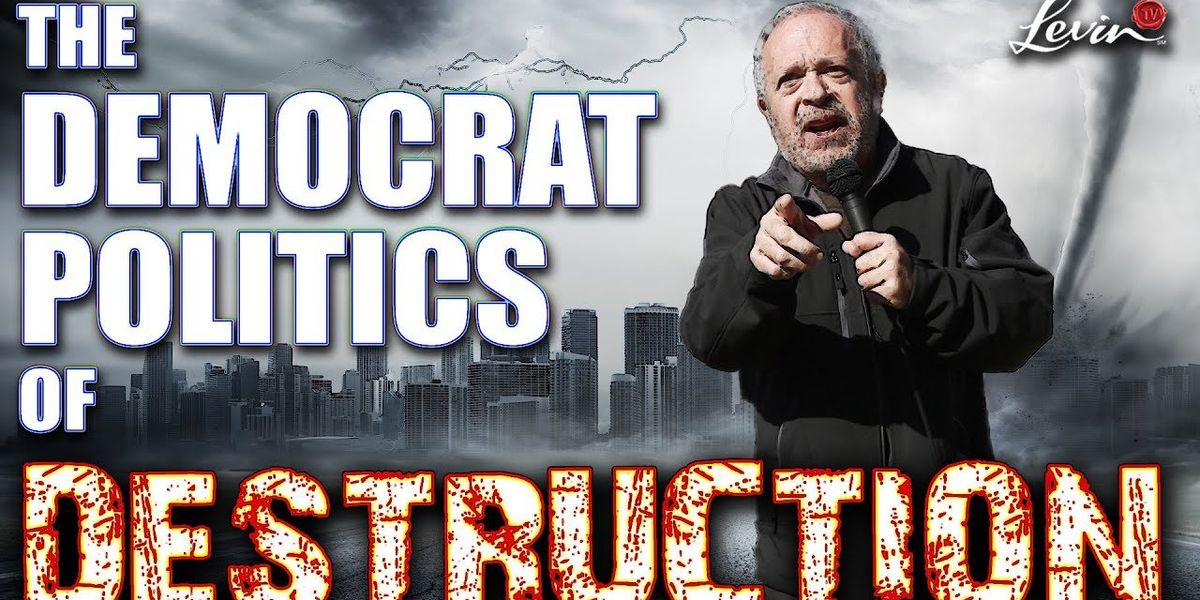
If you haven’t noticed, there’s a trend occurring among Marxists. And that is that they’re all a part of the Democrat Party.
“Every single Marxist is a Democrat,” Mark Levin, an avid critic of the Democrat Party and author of the upcoming book “The Democrat Party Hates America,” confirms.
“Reich is one of them, Bernie Sanders is another, AOC and the mob, that whole group. They worked within the Democrat Party, because the Democrat Party is perfectly comfortable with them,” he adds.
Robert Reich specifically has praised Joe Biden for revitalizing what he calls “democratic capitalism,” which is just another phrase for what Bernie Sanders calls “democratic socialism.”
“When they use these hyphenated things like democratic capitalism, what they’re trying to do is put a favorable and persuasive patina on top of economic socialism and cultural Marxism,” Levin explains, adding that what Democratic capitalism really means is “that the government controls the economy.”
This is the antithesis of what capitalism really is, which is “about you making your own decisions.”
“It’s about individualism, it’s about freedom and opportunity and all the rest of that stuff,” Levin adds.
George Orwell, the author of the dystopian novel “1984,” discussed the use of words like “democracy” at length.
Levin suggests Orwell knew that “the word democracy means nothing.”
“Communists use it. Fascists use it. Everybody uses it, so it has whatever meaning they want to apply to it.”
Tucker Carlson spoke with Adam Carolla for an interview that was posted on Wednesday. The interview covered a lot of ground, focusing on Carlson’s freedom after being fired from Fox News four months ago. Three subjects that stuck out are Carlson teasing an interview with Larry Sinclair, a man who in 2008 said he had sex and smoked crack with Barack Obama in 1999, Carlson’s fears that President Trump will be assassinated and his prediction that the U.S. will go to war with Russia within the next year.
Carlson said he believes Sinclair.
Screen image via the Adam Carolla Show/YouTube.
Video clip posted by Carlson biographer Chadwick Moore, “Tucker Carlson teases an upcoming interview with Larry Sinclair, a man who was ridiculed by the press after coming forward with allegations that he smoked crack and had sex with Barack Obama in 1999, when Obama was a state senator in Illinois.”
Tucker Carlson teases an upcoming interview with Larry Sinclair, a man who was ridiculed by the press after coming forward with allegations that he smoked crack and had sex with Barack Obama in 1999, when Obama was a state senator in Illinois. pic.twitter.com/bmlRuds7Cy
Collin Rugg posted a clip with Carlson talking about his fears (which he asked Trump about in their debate night interview), “BREAKING: Tucker Carlson suggests Donald Trump may be assassinated after the impeachments, indictments and slander campaigns all failed in hurting his popularity. Wow… “We’re speeding toward assassination, obviously, and no one will say that…” “They fabricated a lot about what happened on January 6th in order to impeach him again. It didn’t work. He came back, then they indicted him. It didn’t work. He became more popular. Then they indicted him three more times, and every single time his popularity rose.”
BREAKING: Tucker Carlson suggests Donald Trump may be assassinated after the impeachments, indictments and slander campaigns all failed in hurting his popularity.
Wow…
“We're speeding toward assassination, obviously, and no one will say that…”
“TheChiefNerd” posted a clip of Carlson talking about his prediction the U.S. will go to war with Russia in order to create conditions to win the 2024 elections (against Trump and MAGA), “”They can’t lose. They will do anything to win. So how do they do that? They’re not going to do COVID again…They’re going to go to war with Russia is what they’re going to do. There will be a hot war between the United States and Russia within the next year…They need to declare war footing in order to assume war powers in order to win. I believe that and I think all the evidence suggests that’s true.”
🚨 Tucker Carlson Says There Will Be a Hot War w/ Russia Within the Next Year
"They can't lose. They will do anything to win. So how do they do that? They're not going to do COVID again…They're going to go to war with Russia is what they're going to do. There will be a hot war… pic.twitter.com/SlVxQDtzeL
Carlson on network control of talent, ““They feel so bad about themselves they’re afraid to go anywhere,” Tucker Carlson tells @adamcarolla how TV news management keeps on-air talent submissive and feeble.”
“They feel so bad about themselves they’re afraid to go anywhere,” Tucker Carlson tells @adamcarolla how TV news management keeps on-air talent submissive and feeble. pic.twitter.com/c2K32Rq8K5
I have set before thee an open door, and no man can shut it. (Revelation 3:8)
Saints who remain faithful to the truth of God have an open door before them. My soul, thou hast resolved to live and die by that which the Lord has revealed in His Word, and therefore before thee stands this open door.
I will enter in by the open door of communion with God. Who shall say me nay? Jesus has removed my sin and given me His righteousness; therefore I may freely enter. Lord, I do so by Thy grace.
I have also before me an open door into the mysteries of the Word. I may enter into the deep things of God. Election, union to Christ, the Second advent-all these are before me, and I may enjoy them. No promise and no doctrine are now locked up against me.
An open door of access is before me in private and an open door of usefulness in public. God will hear me; God will use me. A door is opened for my onward march to the church above, and for my daily fellowship with saints below. Some may try to shut me up or shut me out, but all in vain.
Soon shall I see an open door into heaven: the pearl gate will be my way of entrance, and then I shall go in unto my Lord and King and be with God eternally shut in.











 Truth2Freedom's Blog