There are two ways to be fooled. One is to believe what isn’t true; the other is to refuse to believe what is true. —Soren Kierkegaard. "…truth is true even if nobody believes it, and falsehood is false even if everybody believes it. That is why truth does not yield to opinion, fashion, numbers, office, or sincerity–it is simply true and that is the end of it" – Os Guinness, Time for Truth, pg.39. “He that takes truth for his guide, and duty for his end, may safely trust to God’s providence to lead him aright.” – Blaise Pascal. "There is but one straight course, and that is to seek truth and pursue it steadily" – George Washington letter to Edmund Randolph — 1795. We live in a “post-truth” world. According to the dictionary, “post-truth” means, “relating to or denoting circumstances in which objective facts are less influential in shaping public opinion than appeals to emotion and personal belief.” Simply put, we now live in a culture that seems to value experience and emotion more than truth. Truth will never go away no matter how hard one might wish. Going beyond the MSM idealogical opinion/bias and their low information tabloid reality show news with a distractional superficial focus on entertainment, sensationalism, emotionalism and activist reporting – this blogs goal is to, in some small way, put a plug in the broken dam of truth and save as many as possible from the consequences—temporal and eternal. "The further a society drifts from truth, the more it will hate those who speak it." – George Orwell “There are two ways to be fooled. One is to believe what isn’t true; the other is to refuse to believe what is true.” ― Soren Kierkegaard
For the fruit of the Spirit is in all goodness and righteousness and truth; Proving what is acceptable unto the LORD.
EPHESIANS 5:9, 10
Many church groups have perished from too much organization, even as others from too little. Wise church leaders will watch out for both extremes. A man may die as a result of having extremely low blood pressure as certainly as from having too high, and it matters little which takes him off. He is equally dead either way.
The important thing in church organization is to discover the scriptural balance between two extremes and avoid both!
It is painful to see a happy group of Christians, born in simplicity and held together by the bonds of heavenly love, slowly lose their simple character, begin to try to regulate every sweet impulse of the Spirit and slowly die from within.
Yet that is the direction almost all Christian denominations have taken throughout history, and in spite of the warnings set out by the Holy Spirit and the Scriptures of truth it is the direction almost all church groups are taking today.
Churches and societies founded by saintly men with courage, faith and sanctified imagination appear unable to propogate themselves on the same spiritual level beyond one or two generations. In all our fallen life, there is a strong gravitational pull toward complexity and away from things simple and real. There seems to be a kind of sad inevitability back of our morbid urge toward spiritual suicide!1
The Lord Jesus loves his people so much, that every day he is still doing for them much that is analogous to washing their soiled feet. Their poorest actions he accepts; their deepest sorrow he feels; their slenderest wish he hears, and their every transgression he forgives. He is still their servant as well as their Friend and Master. He not only performs majestic deeds for them, as wearing the mitre on his brow, and the precious jewels glittering on his breastplate, and standing up to plead for them, but humbly, patiently, he yet goes about among his people with the basin and the towel. He does this when he puts away from us day by day our constant infirmities and sins. Last night, when you bowed the knee, you mournfully confessed that much of your conduct was not worthy of your profession; and even tonight, you must mourn afresh that you have fallen again into the selfsame folly and sin from which special grace delivered you long ago; and yet Jesus will have great patience with you; he will hear your confession of sin; he will say, “I will, be thou clean”; he will again apply the blood of sprinkling, and speak peace to your conscience, and remove every spot. It is a great act of eternal love when Christ once for all absolves the sinner, and puts him into the family of God; but what condescending patience there is when the Saviour with much long-suffering bears the oft recurring follies of his wayward disciple; day by day, and hour by hour, washing away the multiplied transgressions of his erring but yet beloved child! To dry up a flood of rebellion is something marvellous, but to endure the constant dropping of repeated offences—to bear with a perpetual trying of patience, this is divine indeed! While we find comfort and peace in our Lord’s daily cleansing, its legitimate influence upon us will be to increase our watchfulness, and quicken our desire for holiness. Is it so?1
• How do you conquer a sin like Pride? Ryan is looking for actionable strategies to deal with pride, unlike other more visible sins that have clear-cut battle plans.
• Do Christians need to keep Old Testament laws? An anonymous listener asks about the Hebrew Roots Movement and if Christians are biblically commanded to observe Old Testament laws and feasts.
Segment 2
• How nice is too nice for a home? An anonymous listener asks if there’s a line between enjoying God’s blessings and crossing into material excess while buying a house.
• Dealing with a constantly argumentative believer: A listener struggles with someone who is always contentious and resistant to advice. What’s the Christian approach?
Segment 3
• Waiting or moving on after a divorce: An anonymous listener faces a moral dilemma—should they wait for their divorced spouse to come back or consider remarriage?
• What happens to unsaved souls after judgment? David questions if the concept of souls being “totally destroyed” after the final judgment aligns with the Bible.
Segment 4
• Navigating a vulgar workplace: Cameron wants guidance on how to handle a workplace filled with inappropriate and shameful conversations without appearing self-righteous.
• Is the Earth flat? An anonymous listener seeks clarity on whether there’s any merit to the flat Earth theory.
• Halloween at church? A listener struggles to understand why their church is hosting a “spooky night” that resembles a haunted house and wants to know if it’s acceptable.
On today’s NEWSMAX Daily podcast:
[1:49] -Kamala Harris sidesteps questions on key issues including the border, Biden’s exit and her history of support for taxpayer-funded transgender surgery.
[8:10] -Anderson Cooper grills Harris about the Border Wall.
[9:15] -Greg Kelly: Kamala Harris laughs crazily at stuff that’s not funny. [Greg Kelly Reports]
[11:50] -GA Rep. Marjorie Taylor Greene speaks ahead of President Trump at Turning Point USA event.
[14:17] -Donald Trump Jr.: Desperate Dem hoax is all they have left to rescue ‘disaster’ Kamala Harris. [Finnerty]
[18:04] -Carl Higbie: John Kelly is mad because Trump fired him. [Carl Higbie Frontline]
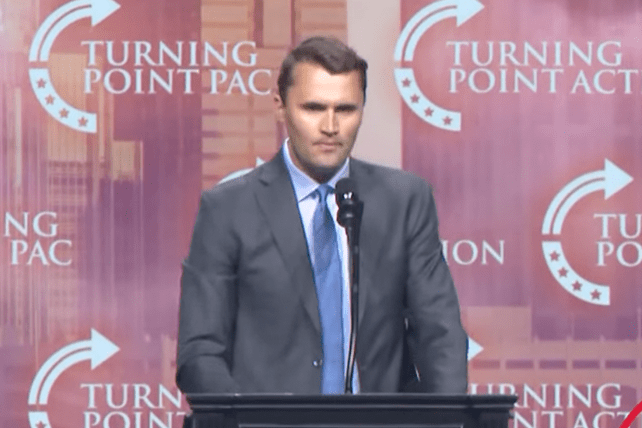
As election day looms, political activist Charlie Kirk made characteristically provocative remarks about the Democratic Party during a Trump rally in Deluth, Georgia, on Wednesday (Oct. 23). Looking directly into the camera, Kirk told American pastors what they should say in their next sermon.
“We are here in a state that is a very Christian state, a state that loves God and loves Jesus,” Kirk said. “If there was my biggest concern of this election, it is the faithful. It is the pastors that are not engaging right now in this election.”
“We have 12 days left,” Kirk continued, “and you need to lovingly challenge pastors that are silent that you have a biblical obligation to engage in this election, that you have a biblical obligation to fight evil and to exalt righteousness.”
“Donald Trump is the most pro-life president in American history as he was responsible for the reversal of Roe v. Wade,” Kirk went on to say.
Notably, Trump has softened his stance on abortion this election cycle, framing the issue as a matter of states’ rights while also criticizing states that have enacted strict abortion bans, including his home state of Florida.
“More than anything else, everybody, is on the other side: The Democrat Party supports everything that God hates,” Kirk said. “The Democrat Party is espousing the death of the unborn, the mutilation of our teenage kids, open borders, the destruction of our sovereignty, the elimination of our currency status.”
Kirk said that he believes “a spiritual battle” is taking place in America, and that pastors are vital for “spiritual victory.”
“Do not expect a spiritual victory if our own pastors do not engage,” Kirk said, adding that for Georgia to continue to be a “Christian state,” it needs the “the faithful” to rise up.
“We need those of you that have influence over your congregation to put pressure on you pastors,” Kirk said.
“And if you are a pastor watching this right now, I hope this touches you,” he continued. “I hope you have a Sunday sermon and you talk about how the Democrat party believes everything that God hates. I hope you tell your congregation how to biblically vote. I hope you challenge them and tell them to get into the arena.”
A number of American pastors have caused a stir online for doing exactly what Charlie Kirk has suggested. For example, a clip of an Oct. 6 sermon given by Tennessee Pastor Jonny Ardavanis has generated discussion on social media.
In the sermon, Ardavanis said, “The Democratic party is a demonic death cult under the power and influence of Satan.”
“To vote for the Democrats is to vote for a platform that is building their platform on everything God hates,” Ardavanis added. “I don’t see how you could be a Christian and vote for a party that promotes everything that God hates.”
Ardavanis further argued that refusing to vote is disrespectful both to the troops and to God. And regarding the candidates in this election, Ardavanis said that “it’s not a difficult decision for me.”
“You’re not voting for a pastor,” he said. “You’re voting for a guy, as best we have as an option, upholds righteousness in the land.”
Not all evangelical pastors are on board with this message, however. For example, Thabiti Anyabwile, who pastors in Washington D.C., said in a social media post earlier this week, “It’s okay if you’re a Christian and you vote for Trump. It’s okay if you’re a Christian and you don’t vote for Trump.”
“It’s okay if you are a Christian and you vote for Harris. It’s okay if you’re a Christian and you don’t vote for Harris,” Anyabwile continued. “It’s okay if you vote for neither.”
“It’s okay if you do not vote at all. It’s okay if you’re a Christian and you vote third party. It’s okay if you’re a Christian and you write in a candidate. It’s okay if you don’t vote for the top of the ticket but you do vote for state and local candidates,” he added. “It’s okay.”
“Obviously, we will all favor one of these voting actions and in this world on non-correspondent outcomes find ourselves disagreeing with someone else who is a Christian too. It’s okay,” Anyabwile went on to say. “Your conscience was never meant to be bound to mine or vice versa. It’s okay.”
“Things are serious. The choices are stark. The stakes are high. Truly. People are acting with the best information—or misinformation—they have. We are motivated by all kinds of factors—aware and unaware. We do not know the outcome [of] our choices,” he concluded. “But you know what? It’s okay.”
Kamala Harris and her campaign are going to close out this election season by offering joyful reasons why you should vote for the Democrat candidate by offering serious plans to fix all the problems caused by the… Biden-Harris administration.
Just kidding!
The last days of the Harris campaign will be focused on pushing lies about Trump, a speech at the National Mall designed to shine a light on January 6th (something people struggling to afford groceries, gas and energy bills just don’t care about), and hoping everybody gets distracted by their celebrity supporters.
Kamala Harris is now such a small part of her campaign that her handlers are making sure she’s not even the real headliner at her own rallies. Heck, sometimes Harris’ presence isn’t even required:
Harris was somewhere else that day, but she will be in attendance at a Beyonce rally tomorrow. The Democrat nominee barely qualifies to make the undercard at her own events:
Harris fans will squee but this is a campaign in all-out panic mode.
She’s probably more adept at those things than Harris, but that’s not saying much.
So has repeatedly calling Trump “worse than Hitler.”
For years already Democrats have tried to tarnish President Donald Trump by calling him a threat to democracy.
They contend that his challenges to the 2020 election results, which were the result of a vote process that raised multiple integrity questions, meant he was trying, and would continue to try, to overthrow the government.
Their rhetoric for the 2024 campaign has gone to extremes: They claim he’s “Hitler,” he’ll use the military to go after those he dislikes, he’d use the power of government to jail them, they say.
But their ideology hasn’t impressed the American public.
In fact, a polling shows that, “Voters in swing states believe that Trump is more likely to protect democracy than Kamala Harris, who is running on a ‘save democracy’ platform. The poll sampled 5,016 registered voters in Arizona, Georgia, Michigan, Nevada, North Carolina, Pennsylvania and Wisconsin. When asked whether Trump or Harris ‘would do a better job’ of “defending against threats to democracy,” 43% picked Trump while 40% picked Harris,” reported Jonathan Turley, the Shapiro professor of public interest law at George Washington University and the author of “The Indispensable Right: Free Speech in an Age of Rage.”
He explained, “The result was crushing for not just many in the Harris campaign but the press and pundits who have been unrelenting in announcing the end of democracy if Harris is not elected.”
He said there is a “growing hysteria among press and pundits proclaiming the imminent end of democracy if Kamala Harris is not elected. The predictions of mass roundups, disappearances, and tyranny ignore a constitutional system that has survived for over two centuries as the oldest and most stable democracy in the world.”
He noted that those who agree democracy is being threatened disagree with the Democrats’ claims on the source of that threat.
The polling, under the supervision of the Washington Post, found the “same result” as when Joe Biden was the nominee.
“While over half said that threats to democracy were important to them, the voters trusted Trump (44%) more than Biden (33%) in protecting democracy,” Turley reported.
He cited ex-Rep. Liz Cheney, representing Wyoming in Congress until voters tossed her from office following her alignment with Democrats who wanted to impeach and remove President Trump, and then blame him for the all factors of the January 6, 2021, riot in Washington.
She alleges that if Americans don’t vote for Harris, 2024 “may well be the last real vote you ever get to cast.”
Turley responded, “I have long criticized the apocalyptic, democracy-ending predictions of Biden, Harris and others as ignoring the safeguards in our system against authoritarian power. Nevertheless, Harris supporters have ratcheted up the rhetoric to a level of pure hysteria. Recently, Michael Cohen, a convicted felon and Trump’s disbarred former lawyer, told MSNBC that if Trump wins the election, he will ‘get rid of the judiciary and get rid of the Congress.’”
Television hosts have been talking about an enemies “list.”
Even in Congress, Rep. Alexandria Ocasio-Cortez, D-N.Y., claimed, “I wouldn’t be surprised if this guy threw me in jail.”
Turley noted that Congress, in fact, did make Biden president following that 2021 riot, and judges did rule against challenges.
“Our system was put through a Cat 5 stress test and did not even sway for a moment,” he said.
He noted the Democrats still trot out their well-known claims that democracy will die without Harris in the White House.
Jeremiah 49:23 — Hamath is an interesting city that nobody has heard of. It’s mentioned 39 times in the Old Testament and is the 4th largest city in modern Syria. It was a city-state that sent gifts to David (2 Samuel 8:9). Sennacherib had conquered them as he went towards Jerusalem (2 Kings 18:34). By Jeremiah’s time it was considered part of the Syrian lands.
Jeremiah 49:28 — Nebuchadnezzar was used by God, but Solomon knew that already (Proverbs 21:1). All we have is under the providence of God. I was just at Plymouth Plantation and a guide pointed out that the Pilgrims saw the providence of God in every action of life. God has a plan for His people.
Jeremiah 50:2 — Psalm 75:7 exemplifies this and the previous chapter. God exalts and brings down nations.
Jeremiah 50:19 — God is not done with Israel! He will return Israel to the land!
Jeremiah 50:34 — This is my Redeemer too!
Titus 1:2 — This isn’t a modern “hope I win the lottery” but a sure confidence because God cannot lie!
Titus 1:12 — Paul is quoting a pagan prophet. Paul was a Pharisee, skilled in the Jewish law, but also in pagan customs. He read greatly (2 Timothy 4:13).
Titus 1:13 — Rebuke them sharply! Paul is encouraging Titus in spite of the challenges in Crete:
“things that are wanting” (Titus 1:5)
“self-willed … angry … given to wine … striker … given to filthy lucre” (Titus 1:7)
“gainsayers” (Titus 1:9)
“unruly and vain talkers and deceivers” (Titus 1:10)
“teaching things which they ought not, for filthy lucre’s sake” (Titus 1:11)
“Jewish fables and commandments of men that turn from the truth” (Titus 1:14)
“their mind and conscience is defiled” (Titus 1:15)
“abominable and disobedient, and unto every good work reprobate” (Titus 1:16)
Psalm 97:9 — This is a key verse in understanding the nature of God in regards to His transcendence – “existence or experience beyond the normal or physical level.”
Psalm 98:3 — In Joshua 2:10-11, the Jerichoites heard about how God parted the Red Sea. We have a responsibility today to take His message to the ends of the earth (Matthew 28:19-20).
Proverbs 26:14 — Not just fools, but sloths. Those who prefer their bed will not be used to their fullness by the LORD.
Share how reading through the Bible has been a blessing to you! E-mail us at 2018bible@vcyamerica.org or call and leave a message at 414-885-5370.
During his “My Take,” Thursday, “Varney & Co.” host Stuart Varney discussed Kamala Harris’ performance during a CNN town hall, arguing the vice president is making the election about how bad Trump is, rather than how good a Harris presidency would be.
STUART VARNEY: Kamala Harris has signaled exactly what her message will be in the final days of the campaign.
Pile on Trump. Call him names. Make the election about Trump and how dangerous he is.
‘Varney & Co.’ host Stuart Varney argued Kamala Harris has reverted to calling Trump names rather than tell voters how good her presidency would be. #foxbusiness #shorts
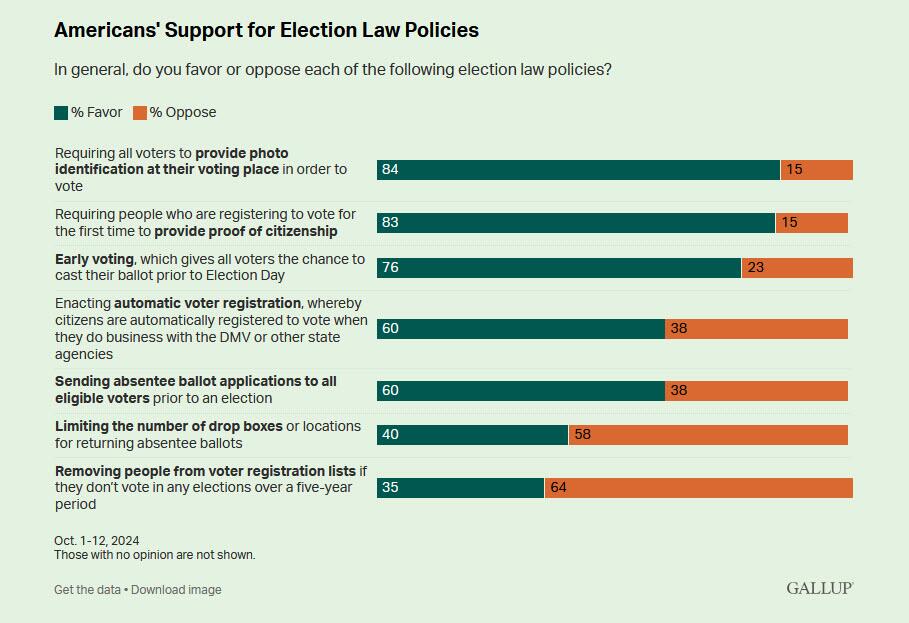
With less than two weeks to go in the presidential campaign and voting already underway in many states, 76% of U.S. adults favor the concept of early voting. Two other election law policies are supported by even more Americans — requiring photo identification to vote (84%) and providing proof of citizenship when registering to vote for the first time (83%).
Smaller majorities of Americans — 60% each — favor automatic voter registration, whereby citizens are registered when they do business with state agencies such as the Department of Motor Vehicles, and sending absentee ballot applications to all eligible voters. In contrast, majorities of Americans oppose removing people from voter registration lists if they haven’t voted in any elections in five years (64%) and limiting the number of drop boxes or locations for returning absentee ballots (58%).
Six of the seven election law policies measured in Gallup’s Oct. 1-12 poll were previously included in a July 2022 poll, and the public’s attitudes about all of them are similar now. The measure on views of requiring proof of citizenship for first-time registrants is new this year.
Forty-seven states and the District of Columbia offer early voting, and 36 states request identification of some kind to vote. All states offer voter registration at motor vehicle offices and other state agencies by federal mandate, while about half have implemented automatic registration, under which an interaction with a state government agency results in voter registration unless the person opts out. While states are required by federal law to maintain accurate voter rolls, which includes purging deceased and ineligible voters, implementation is left to the states, as are decisions about drop boxes for voting.
Requiring verification of citizenship to register to vote in federal elections has proven to be a contentious issue. While a handful of states have laws requiring proof of citizenship, they have faced legal challenges. The Republican-led U.S. House of Representatives passed a bill in July — mostly on partisan lines — that would mandate proof of citizenship, but the U.S. Senate has not voted on it.
Democrats More Likely to Favor Laws Expanding Voting
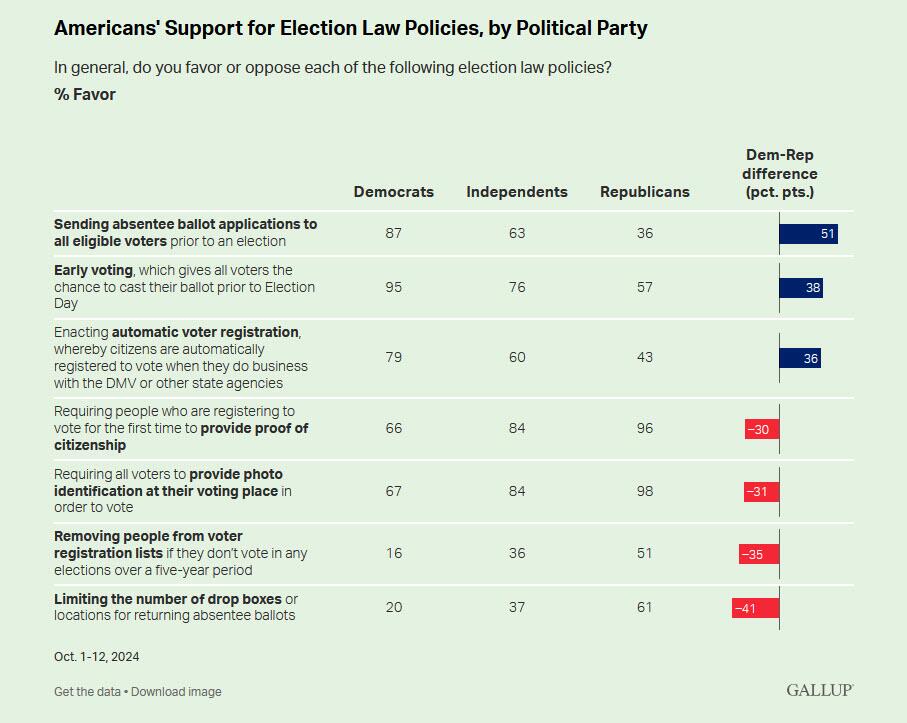
Partisans’ attitudes about all seven of the election law policies tested diverge significantly, with Democrats more supportive than Republicans of policies that make voting easier and more accessible. Democrats broadly support early voting, sending absentee ballot applications to all voters and automatic voter registration, while far fewer Republicans favor each. Of these three policies, only early voting garners majority-level backing from Republicans — but at 57%, Republicans’ support is 38 percentage points lower than Democrats’.
Republicans are more supportive of policies that would help ensure ineligible people don’t vote. Republicans nearly unanimously back requiring proof of citizenship to register to vote and photo identification when voting, but Democrats’ support for each policy is about 30 points lower (though still at the majority level). Smaller majorities of Republicans favor limiting drop boxes (61%) and purging voter rolls after five years of non-voting (51%). No more than one in five Democrats support either of these measures.
Independents’ views of each policy are on par with the national averages.
Partisans’ views of most of the election law policies are generally stable; however, Democrats’ and Republicans’ opinions have each shifted significantly on one of them. Democrats are now 14 points more likely than they were in 2022 to support requiring photo identification to vote, and Republicans’ current 57% support for early voting — while not significantly different from 2022 — is down from 74% in a 2016 survey.
Broader Voter Access Higher Among People of Color
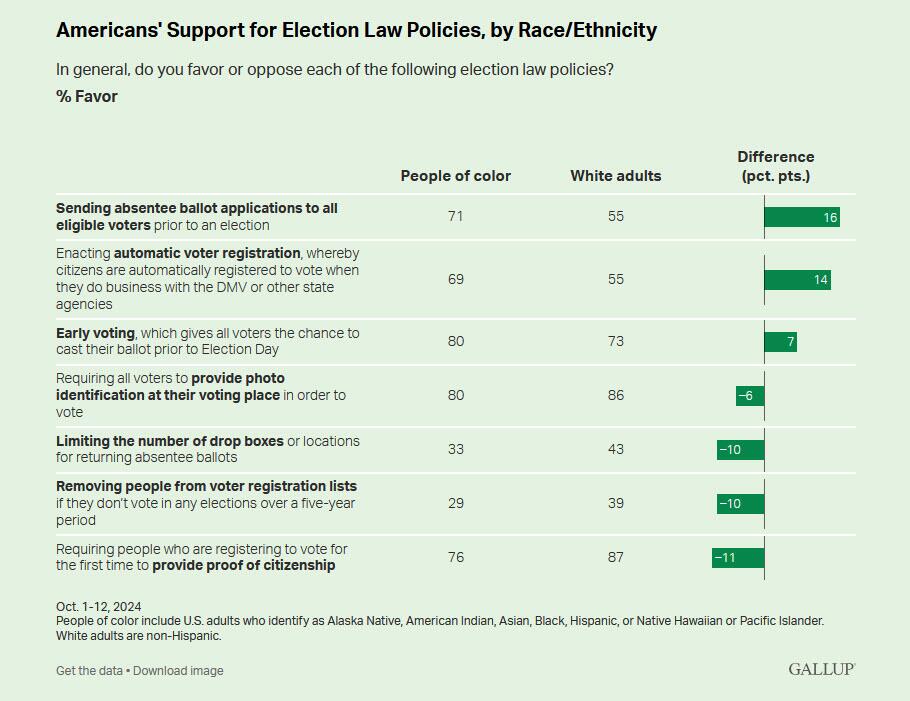
The ability of racial/ethnic minority groups to vote is a central concern of critics of restrictive election laws. People of color (those who identify as Black, Hispanic, Asian, Alaska Native, American Indian, or Native Hawaiian or Pacific Islander) are more likely than White adults to support certain policies that aim to increase access to voting, including sending absentee ballot applications to all eligible voters and enacting automatic voter registration.
Meanwhile, White adults are more likely than people of color to support limiting drop boxes, removing people from voter registration lists and requiring proof of citizenship to register to vote. The two broad racial/ethnic groups hold similar views on early voting and requiring photo identification when voting.
Bottom Line
Majorities of Americans favor a range of election law policies that expand voters’ access to the ballot box, including early voting, automatic voter registration and sending absentee ballot applications to all eligible voters. They also broadly support measures to limit fraud and ensure election integrity, including requiring photo identification to vote and providing proof of citizenship when first registering to vote. The public is much less supportive of two policies that would make it harder to vote, including limiting the number of drop boxes for absentee ballots and purging non-voters from voter registration lists.
CNN’s Dana Bash discusses Kamala Harris’s town hall
Kamala Harris on Wednesday night participated in a CNN town hall with undecided voters.
She completely bombed.
Kamala Harris did so bad that even CNN admitted she ‘didn’t close the deal’ with voters.
CNN moderator Anderson Cooper pointed out to Harris that there are voters out there who say that day one for her started almost four years ago.
Kamala Harris keeps promising to secure the border and bring down the price of groceries.
Anderson Cooper reminded Harris that she has been in office for nearly four years.
“Some voters though might ask, you’ve been in the White House for four years. You were Vice President, not the President, but why wasn’t any of that done in the last four years?” Anderson Cooper asked Harris.
Kamala Harris choked: “I’m pointing out things that need to be done that haven’t been done that need to be done.”
WATCH:
CNN: You've been in the White House for four years. Why haven't you done any of this already?
KAMALA: "I'm pointing out things that need to be done that haven't been done that need to be done."
Kamala Harris said one of her “weaknesses” is that she has a “team of very smart people around me who bring to my decision-making process different perspectives.”
Huh?
WATCH:
Kamala says one of her "weaknesses" is that she (allegedly) has a "team of very smart people around me who bring to my decision-making process different perspectives."
When it comes to social and political issues, it seems many congregants want their faith leaders to dive right in and help them understand cultural phenomena.
Plus, the vast majority of these parishioners — 91% — have total trust in the pastor of their church, which likely speaks to the reason they want to hear a preacher discuss current issues.
This isn’t about politics, though, as past polls show low percentages (35%) of Christians attending church at least monthly believing it’s appropriate to endorse political candidates during church services.
According to Lifeway Research Executive Director Scott McConnell, the thirst to hear pastors address cultural issues likely has to do with comprehending and understanding what’s unfolding in the world around us and how it comports with biblical truth.
“As American culture increasingly includes fewer overtly Christian elements and more non-Christian ideas, churchgoers are hungry to know what the Bible says about life’s issues,” McConnell said.
So, how frequently does this actually unfold? As it turns out, the majority of churchgoers (62%) said their pastor addresses cultural issues in sermons almost weekly, with an additional 23% noting it’s at least one time a month. Just 6% said it “rarely happens.”
McConnell said people are clearly noticing how pastors will explain the Bible’s context while also applying its “principles to issues and situations today,” which helps them navigate the world.
What’s perhaps most interesting is that younger churchgoers — those under the age of 50 — are more likely to hear contemporary topics in sermons each week.
“Those aged 18-34 (34%) and 35-49 (41%) are more likely than those 50-64 (25%) and 65 and older (17%) to say their pastor’s sermons address current issues every week,” Lifeway Research noted.
And those in churches with 500 or more people who attend were the most likely to report their pastors rarely address such issues, with 13% stating as much.
The data was collected Sept. 19-29, 2023, among 1,008 American Protestants. Read more here.





 Truth2Freedom's Blog