Daily Archives: November 21, 2025

Is the Bible the Word of God and Does it Have Authority?

12 There is a way which seems right to a man, But its end is the way of death. Proverbs 14:12 (LSB) 

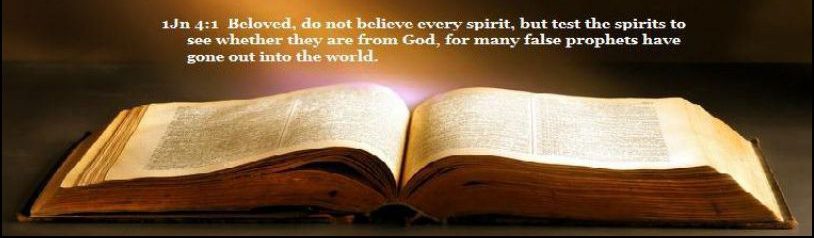
Several years ago I posted “Is there a war going on between God and His forces on one side and Satan and his forces on the other?” In that post I mentioned a link sent to me by a friend to a post on another blog called The Emergent Village. On that blog I could not help noticing a link to another post by another writer there titled “The Bible is NOT the WORD OF GOD: a polemic against Christendom“. What that fellow had to say is the centerpiece of “Christian Liberalism.” Denying The Bible as the Word of God, a gift from God to His people is the first step into apostasy. Once that step is taken all other truths are no longer held as absolute.

Without that God-given anchor into His absolute truth all else is up for grabs. Those like the fellow who wrote that article and those who agree with him are those who also have a problem with what Orthodox Christianity holds as the gospel, the sovereignty of God, election, the exclusivity of genuine discipleship, et cetera. Because of this “liberalism” they also force a man-centered perspective on God’s Word in one form or another. These same people lean towards a form of Christianity that is almost all experiential. Since their view of how the gospel works and how God works with Man is wrongly focused and the Word of God contains clear teachings about the sovereignty of God, these people conceive of their entire “Christian” paradigm from a philosophical and existential base rather than on the authority of Sacred Scripture. They have to do this since they deny that what we call Sacred Scripture has any authority. <Continue reading post>

Reflections on the Stars Above | Bible Apologetics – A DAILY DEVOTIONAL

Growing up in New York City, I rarely saw more than a few stars when I looked up at the night sky. But all of this changed for me on one amazing night over 50 years ago when I went on a high school trip as a senior to upstate New York. We must have drove on a chartered bus for seven or eight hours to St. Lawrence County, near the Canadian border on our field trip. I don’t remember much about the trip except for the moment we arrived and I looked up at the night sky. For it was then, as a 17 year-old atheist, I stood in awe at the hundreds of stars shining brightly above me. It wasn’t until about ten years later that I made the connection between the majesty of nature with that of our almighty God who puts these stars in their place.

Little did I realize on that special clear night that perhaps for the first time in my life, I was viewing God’s majesty on display, yet without knowing it. Back then this canopy of stars, while awesome, were to me just mindless points of light. It was only after I gave my life to Jesus in 1981 that I understood what Billy Graham meant when he said: “Look up on a starry night, and you will see the majesty and power of an infinite Creator.”1

When we read in Scripture: “The heavens declare the glory of God; the skies proclaim the work of his hands.” (Psalm 19:1), we can see how the stars are a true testament to the glory of God in two special ways.

First, while back in biblical times, we knew very little about the science of the stars. This, however, didn’t impact man’s awe at the sight of these distant bodies of light. In fact, mankind was so fascinated by the stars that he grouped them into constellations and marveled and pondered over their majesty. If the ancients only knew what we now know about stars, I believe their awe and fascination would be even greater.

The second aspect, that to me generates even greater amazement and awe, is our modern scientific knowledge of the stars. First, the ancients could never have imagined the sheer number of stars in our universe. Most modern astronomers believe that there are billions of galaxies just like our own Milky Way galaxy. If we were to estimate 100 billion galaxies each containing 100 billion stars, we would have 10,000,000,000,000,000,000,000 stars. Clearly it is not humanly possible to count these many stars. Second, biblical star gazers could never have fathomed how distant these stars in the night were to them. The stars they saw were so far away that they had to be measured in terms of light-years away. A light-year is equal to a distance of approximately 6 trillion miles, and the closet star to the earth, other than our sun, Proxima Centauri, is 4.3 light-years away. That would make it a mere 25 trillion miles away! And third, when it comes to speed, these objects of light are traveling at incredible speeds. Our sun, scientists tells us, along with all of its planets and their respective moons, is traveling at a speed of 600,000 miles per hour in a gigantic orbit through its galaxy, an orbit that requires over 2 million centuries to complete.

Clearly science tells us we have trillions upon trillions of heavenly bodies, weighing trillions upon trillions of tons, trillions upon trillions of miles away, moving at very high velocities. Our human minds can hardly grasp these incredibly large numbers. No wonder the psalmist proclaimed: “The heavens declare the glory of God.”

So, the next time you look up at the stars, I challenge you to meditate on just how they manifest the majesty and power of our infinite Creator.


1 Quote by Billy Graham: “Look up on a starry night, and you will see the…” (goodreads.com)

The post Reflections on the Stars Above appeared first on Bible Apologetics – A DAILY DEVOTIONAL.

Source: Reflections on the Stars Above

The Final Battle – Part 2 of 2 | Running To Win on Oneplace.com

Some feel indifferent about the end times, but others are anticipating Jesus’ second coming. According to biblical prophecy in Revelation, the future contains some dark days for planet Earth. In this message, Pastor Lutzer provides a clear vantage point of three grand finales of Christ’s return: His coming, His judgment, and His reign. God’s glory will be on display.

Source: The Final Battle – Part 2 of 2

How to Control Your Thought Life | Part 1 | Love Worth Finding on Oneplace.com

In this message, Adrian Rogers shares how to control your thought life, so that you may be victorious in the battle for your mind.

Source: How to Control Your Thought Life | Part 1

Back to Bethlehem – Part 1 | Pathway to Victory

download(size: 24 MB )

Every year at Christmas, the world pauses to celebrate the birth of Jesus Christ. But often, the busyness of the holiday season distracts us from its true meaning. Dr. Robert Jeffress takes this opportunity to reflect on the remarkable story of Jesus’ birth and the beauty of God’s plan to redeem mankind.

Source: Back to Bethlehem – Part 1

November 21 – Tempted to drift | Reformed Perspective

“Therefore we must pay much closer attention to what we have heard, lest we drift away from it.” – Hebrews 2:1 

Scripture reading: Deuteronomy 30:11-20

One of the board games our family likes to play still has the rule book in the box. We laughed when we finally got around to reading the rules. The rules tell players they can make up rules, if they are consistent with them, and they apply to all the players. That is, sometimes, how believers treat the Word of God. It is a wonderful instruction book for life; however, those who follow Jesus tweak the rules and decide which ones are important and which are not.

Paul warned the Hebrews not to drift. Drifting from the faith begins when believers play fast and loose with the commandments of God. What He has instituted are designed for the good of His sons and daughters. Some believers neglect to meet every Sunday, and soon they find going to church difficult. Other believers neglect to read the Bible as a family. The Word loses its power and authority. With that parental authority erodes as well. The whole family drifts.

The LORD spoke through Moses, offering His people tremendous clarity. The commandment of God is to keep the Word near to you. The Word of God directs you into life and keeps you in the way that is right. The duo references to life and good certainly foreshadows Jesus’ own words: “I AM the Way, the Truth and the Life”. In Him alone is all the adventure believers ever need. Anchor your mind and heart to Jesus through the reading of the Word, so that you never will drift away from Him.

Suggestions for prayer

Pray that you and your family members will be securely anchored to Jesus through Scripture reading, prayer and times of worship. Think about church members, or people you know who are drifting, and ask God to bring them back to Himself in love.

For over six years already, Rev. Vander Vaart has served as the Atlantic Region Representative of Redemption Prison Ministry. He does so as a Minister of the Word and Sacrament in the Associate Reformed Presbyterian Church. Get this devotional delivered directly to your phone each day via our RP App. This devotional is made available by the Nearer To God Devotional team, who also make available in print, for purchase, at NTGDevotional.com.

Source: November 21 – Tempted to drift

Why The Church Is Losing It’s Hold On This ONE Generation | Fortis Institute

Segment 1

• Gallup reports a growing exodus from church with a surprising population.

• Churches pour energy into kids and young families but neglect the elderly.

• Scripture calls the older generation essential — for wisdom, discipleship, and stability.

Segment 2

• Topical preaching isn’t always wrong, but it’s risky when it replaces text-driven sermons.

• The culture is catechizing your kids faster than the pulpit can.

• Polls reveal Gen Z’s distorted view of marriage, kids, and purpose.

Segment 3

• 690+ LGBT books in a single school district – this is cultural catechism in action.

• Drag queens, “gender play,” and normalization of sin are targeting children.

• The battle for your child’s worldview is being waged at story time.

Segment 4

• Churches split over silliness: beards and whether the worship leader’s eyes were open.

• Healthy churches handle conflict biblically—talk, forgive, reconcile.

• How your church argues says more about its health than its attendance numbers.

When Words and Witness Don’t Match | Elizabeth Prata

By Elizabeth Prata

SYNOPSIS
I lament rising social-media conflict, highlighting Beth Moore’s recent divisive comments as an example. Reflecting on Christian discernment, I emphasize that teachers’ actions must match their words and that pursuing long-term holiness, especially in speech and conduct, is essential for evaluating true faith and character.


I enjoyed Twitter (now called X) for a long while. There used to be more ladies on it who are encouraging, sweet, and talk of homelife or share scripture. Many of those have backed off or abandoned the social media platform altogether. I’m still hanging in there, as are some nice other ladies and gents, but I’m dismayed that the arguments have gotten out of hand. They’re daily now. Everyone seems to have a flashpoint set at zero.

I usually ignore the fights. This week though, Beth Moore piped up. I wasn’t aware at the time but Moore’s comment had set off a huge argument on X. She rebuked pastor Josh Howerton, butting into a thread that had nothing to do with her and chastising his comments on godly manhood.

Moore’s influence is still large. After inserting herself into a thread that had nothing to do with her, she rebuked and chastised the pastor who made the original comment. Her admonishment caused a furor. I am dismayed that her (negative) influence is still large enough after 40 years of public life to even cause a furor, but God knows best.

I thought about it for a long time. Moore’s behavior brought me to mind again of two critical items we should use when assessing whether a teacher who claims Jesus and teaches the Bible is false or not. These two items flow into each other. One of them it took me a while to understand, not just in Christian life but in secular life before salvation. And the other, I get a lot of pushback on. Here they are, in my opinion and experience:

1.What a person says and what they do must match up.
2.A Bible teacher’s life should be assessed as much as their doctrine.

I’m trusting. I used to take what people said to me at face value. I don’t see context clues, body language, or link current statements to past statements. I used to just take whatever they said currently, as genuine. The most extreme example of this that I can think of in secular life, which thankfully never happened to me, is when a man says “I love you” but slaps her around. His words are empty and meaningless if not followed up with loving action. Domestic violence isn’t loving.

This next example can be applied in secular life or in Christian life. Someone does or says something impolite or untoward to you, and you remark that it hurts your feelings, and they say “I’m sorry.” But they do it again, and again, and again. The “I’m sorry” or “I repent” has become meaningless. Sorrow for actions or statements must be followed up with genuine behavior change, or it is just an empty phrase.

Resource: Ligonier essay True Repentance

We look at their life as much as their doctrine. Let’s use the word holiness here, and a portion of one of JC Philpot‘s devotionals I read this morning. (JC Philpot- 1802-1869).

When a Bible teacher says “I am a Christian” or “I follow Christ” or “I love Jesus”, does their statement match with their words and actions? It’s easy to SAY “I am a Christian,” but do they pursue holiness over the long term? That’s the key. Here’s JC Philpot-

Holiness consists mainly of two points–

“1. being made a partaker of the spirit of holiness whereby, as born of God, we are made fit to be partakers of the inheritance of the saints in light; set our affections on things above, where Christ sits on the right hand of God; have our conversation in heaven; put on the new man which is renewed in knowledge after the image of him which created him; live a life of faith in the Son of God, and beholding, as in a mirror, the glory of the Lord, are changed into the same image from glory to glory, even as by the Spirit of the Lord.”

EPrata photo

Our job as Christians is to pursue holiness. Pursuing holiness is pursuing Christ. The Bible in its entirety but particularly the New Testament prescribes the standards of a Christian’s holiness and gives commands as to its pursuit. It also describes examples of holiness and lack of holiness. Going on to Philpot’s second point-

“2. The second branch of holiness is a life, conduct, and conversation agreeable to the precepts of the gospel; and the one springs out of the other. “Make the tree good,” said our blessed Lord, “and his fruit good, for the tree is known by his fruit.” Gospel fruit must grow upon a gospel tree, and thus the fruits of a holy and godly life must spring out of those divine operations of the Holy Spirit upon the heart of which we have just spoken. Thus to speak, live, and act is to be “holy in all manner of conversation,” that is in our daily walk.”

I like how Philpot said “life, conduct, and conversation…”

This brings me back to social media, our conduct on it, and Beth Moore as the negative example. Time and again, she speaks with irritation, rebukes men publicly, says things without knowledge (for example, slandering The Covington Boys in 2019) and demonstrates often that she is not in control of her tongue. She even called herself obnoxious in an interview. Examining Moore’s behavior with regard to speech, and comparing it to the Bible’s standards (and that standard is even higher for teachers) Moore’s speech is often unholy and fails the New Testament speech standards.

Moore stated that she ‘was “annoyed” when she initially made the comment and should have kept her opinion to herself’. (Source). ‘She said that she regretted posting it’. True, she should not have.

Moore eventually apologized to Howerton via posts on X for her comment. The funny thing is, the comment was made to men in general and was not even aimed at her, nor was Moore tagged…she just came across it and got annoyed. Succumbing to temptation one thing when we are in dialog with someone and it gets heated. It’s still a sin, but to be minding your own business and suddenly being annoyed with a random comment instead of scrolling on by, displays a massive lack of restraint and immaturity on the part of Moore, or anyone who inserts themself into a conversation where her entry point is already at annoyance levels.

Even a fool, when he keeps silent, is considered wise; When he closes his lips, he is considered prudent. (Proverbs 17:28).

When there are many words, wrongdoing is unavoidable, But one who restrains his lips is wise. (Proverbs 10:19).

When I assess a teacher, and their lifestyle comes up short of biblical standards, the pushback I receive when I state so is often dismaying. “But she says she loves Jesus!” “But she claims to be a believer!” are phrases I hear often. As President Ronald Reagan said regarding relations with the sometimes cunning and deceptive former Soviet Union, ‘Trust, but verify’.

PURSUE HOLINESS at all points.

What Beth Moore says and what she does, doesn’t match up.

And the tongue is a fire, the very world of unrighteousness; the tongue is set among our body’s parts as that which defiles the whole body and sets on fire the course of our life, and is set on fire by hell. (James 3:6).

Wow! Ponder the fierceness of that verse. And of course it is not the only verse. Many Proverbs talk of our words and our lips: of lying, slander, false witness, uncouth talk, gossip…the list is long in showing ways we stumble with our talk.

I wouldn’t advise rejecting a teacher or pastor you follow if they stumble in this area once. Give grace, but be watchful if this sin becomes a pattern. A pattern indicates their heart is defiled, and their words are giving evidence of it. (Matthew 15:18).

Let no unwholesome talk come out of your mouths, but only what is helpful for building up the one in need and bringing grace to those who listen. (Ephesians 4:29).

PURSUE HOLINESS at all points. Philpot: “Thus to speak, live, and act is to be “holy in all manner of conversation,” and is a fulfilling of the precept which God gave…

A Catechism on Human Sexuality | Tabletalk

The Western church presently lives in a time of much sexual confusion. Rev. Christopher Gordon has produced a helpful tool to assist Christians in becoming well-grounded in the biblical teaching on human sexuality. The New Reformation Catechism on Human Sexuality uses the time-tested method of catechesis to teach essential truths from God’s Word regarding sexual issues. The editors of Tabletalk interviewed Rev. Gordon shortly after the catechism was produced, as we believe it is a good tool for Christians to use as they endeavor to obey God’s Word.

Why did you write The New Reformation Catechism on Human Sexuality?

As a pastor, I was experiencing firsthand how the sexual revolution was affecting parents in the shepherding of their children. I took for granted that the most basic truths of creation and how God made us as male and female were understood, and I was alarmed at how these things were now being challenged in the Christian community.

Imagine a parent who has a young girl who comes home one day and expresses that though she was born as a female, she is convinced that her gender is male. This scenario is possible due to cultural peer pressure and social media influences that have mainstreamed the idea that someone’s inner desire to be the opposite sex is sovereign over their God-assigned biological sex. It doesn’t help that some Christian counselors are willing to recognize this distinction and, after a series of psychological tests, encourage gender reassignment therapy. These are the scenarios I was facing as a pastor.

Further, covenantal children now face living in a world where homosexuality is normalized and celebrated. Sadly, it is not uncommon, even for those who attend Christian schools, to see on a daily basis their classmates pursuing relationships with those of the same sex. Our Christian institutions seem to be governed by fear on these issues due to the societal consequences of exposure, and the biblical standard of holy sexuality is often marginalized in embarrassment because it feels so radically outside the new cultural norm.

Since Christians are not talking enough about God’s holy demands in the arena of human sexuality, our children are left with the impression that we have no right to make any judgments on these issues. They are confused as to why sexual preference really matters if, as it is assumed, the pursuance of happiness in sexuality is a personal matter and does not harm anyone else.

I wrote the catechism because Christians, especially parents, need clear, concise, biblical help on the core issues regarding human sexuality, that the next generation may be instructed well in God’s good, creational sexual ethic.

How is the book designed to be used?

The catechism is intended to be used devotionally around the table, providing an opportunity for parents to talk with their children about the issue of human sexuality. The catechism is also intended to provide opportunities for Bible studies, Sunday school classes, and sermon series for pastors in helping Christians enjoy the creational sexual ethic that God established from the beginning for our good.

What do you hope the book will achieve?

We cannot afford to take for granted in the Christian community the most basic distinctions with regard to creation, biblical anthropology, and how God made us as men and women. I hope the catechism will help Christians appreciate a biblical anthropology in the pursuit of God’s creational standard as something that glorifies Him and is good for the orderly development of society and of the human race. I also hope the catechism will be used as an evangelistic tool to give to those who are confused about the sexual revolution.

What can churches do to help their members navigate the times and maintain the historic Christian sexual ethic?

For too long, the church has been Victorian in our approach to sexuality. The culture has not been silent in its attempt to catechize us in its rebellion against God’s creational norms. Yet the church’s response has been weak compared to Satan’s vicious assault on marriage and sexuality.

The church has always corrected error through robust instruction in the truth of God’s Word. Churches need to devote serious attention to these issues, providing parents with resources to understand the sexual revolution and its consequences. Churches should be offering classes to help instruct parents in the training of their children. Further, great efforts should be given to instruct our young people and talk with them openly about the dangers of pornography, premarital sex, and God’s will for sexual pleasure as good and proper in marriage.

As we see the worst forms of sexual deviancy characterize our culture, I think what is most needed is to help Christians with starting points. Is the church holding the institution of marriage with great honor? Have we taken lightly the implications of the seventh commandment in addressing adultery? How are we helping couples grow in their marriages to love as Christ loves the church? In other words, we need to go back to the basic design of marriage and the family and ask how we are demonstrating to our children, and before the world, how high we hold God’s holy standard for human sexuality. The catechism is aimed to help with these issues.

What does identity have to do with sexuality?

Who we are as image bearers of God is not to be defined by our sinful desires. Nobody questions that we have desires as humans and that these desires are pursued in an attempt to find meaning, identity, and happiness in life. Everyone has an identity as created as male or female in the image of God. The culture is desperately attempting to convince people that the pursuit of sinful desires in human sexuality defines happiness and constitutes an identity. This is why any challenge to people pursing sinful desire is viewed as a direct attack on their person.

As fallen creatures, we need a new identity through the restorative work of the Spirit in our union with Christ. This means that any form of sexual impurity belongs to the old man. As new creatures in Christ, we are to take every thought and action, in mind and body, and make them obedient to Christ. Our sexuality according to the lusts and desires that characterize the old man is not our identity. Our identity is renewed in Christ as we glorify God in how He made us as men and women.

Which biblical doctrines are important for churches to recover if we are going to properly understand the biblical sexual ethic?

This is a crucial reason that I wrote the catechism. I work though the categories of creation, fall, redemption, and restoration, addressing the fundamental doctrines of the Heidelberg Catechism and applying them to the current challenges of human sexuality. The basic biblical doctrines under the original catechism’s headings of guilt, grace, and gratitude need fresh application to the current sexual revolution to help people celebrate a creational sexual ethic.

What advice would you give to parents who are seeking to help their children understand the biblical sexual ethic?

Parents, I can’t emphasize enough, please talk with your children about these issues, uncomfortable as these issues might be. Ask them directly about pornography, explaining its detrimental effects on the brain. Help them see in your marriages a healthy love that inspires them to the goodness of God’s design. Help them desire a life of repentance.

But please don’t forget to help them understand the gospel of Christ and the forgiveness of their sins, since there is a lot of guilt with sexual sin. Let your children be inspired by your faith in Christ and your desire to pursue a holy sexuality.

Why is catechetical training an effective way to pass on the truths of the faith?

At the time of the Reformation, catechetical training was one of the most effective means of spreading the truth for those who needed help in the basics of the Christian faith. This catechism was written with the goal that the church would help the next generation with the unique challenges they are facing in a sex-crazed culture. Our children have questions. Hopefully, I’ve written some of them out for you to help answer their present struggles.

I pray that the Lord will use this effort to equip a new generation to appreciate, with great value and love, the biblical sexual ethic that God established from the beginning for our good.


Editor’s Note: This post was originally published on April 26, 2023.

Source

Christianity Today Appoints Woke Woman as New President and CEO | Protestia

Here is the cleaned-up version with corrected spelling, grammar, and punctuation:Christianity Today has appointed Dr. Nicole Massie Martin as its new President & CEO, ensuring the storied magazine will continue its progressive trajectory for years to come.

Martin is an internal hire, having served as the magazine’s Chief Impact Officer since 2023 and most recently as Chief Operating Officer. She is replacing outgoing President and CEO Timothy Dalrymple.

CT has gone through several changes in recent years, including admitting in 2022 that sexual harassment had gone unchecked at the organization for a decade. Most recently, the company named Marvin Olasky as the new Editor-in-Chief, replacing Russell Moore, and saw the departure of Senior News Editor Daniel Silliman, who resigned after revealing he had “significant disagreements with the new leadership, both practical and philosophical.” In September, CT implemented a restructuring that resulted in about a dozen people being laid off.

First, she voted for Kamala Harris, writing in an Op:Ed::

In her CT article The Latest Black Tragedy Is My Trauma Too, Martin recounts getting pulled over for a traffic infraction, painting a picture of panicked PTSD while fearful for her life, for no good reason.

Without warning, my hands began to tremble, my breathing quickened, and my legs started to shake. I called my husband and told him what was happening. My body was going into full-fledged panic mode.

As the officer approached, I could barely catch my breath. Images of Black men and women shot for minor offenses raced through my mind. Would I be labeled as a criminal who broke the law, or as a mother, wife, and minister who served the Lord?

Would I be lumped into the countless names of Black people who have died for misdemeanors, or would I be among the privileged few who escaped alive?

By the time the officer came near to my car, I could barely see. He stood at a short distance, asked me to breathe, and helped me to calm down. With my husband still on speaker phone, I finally found the words to say, “I’m sorry.”

What followed in my mind was, “Please don’t hurt me.” In that moment of panic, I could not distinguish the kind officer in front of me from everything I had seen on the news.

My traffic citation gave the other offending cars an opportunity to drive off and, when he finally left, I began to cry. I cried for all of the Black men and women who begged for their lives and still died. I cried for Manuel Ellis, Philando Castile, George Floyd, Breonna Taylor, Alton Sterling, and so many more.”

Among her many accomplishments, however, is that she’s also a pastor at Kingdom Fellowship AME Church, a progressive congregation where she frequently preaches

In September 2024, Kingdom AME Church had Rev. Raphael Warnock preach at the 9 am service, where leadership praised and lauded him and all but begged their congregation to vote for him.

They also had the infamous race-baiting Rev. Al Sharpton preach at the 11 am service.

Notably, Warnock is a notoriously pro-abortion, pro LGBTQ minister and senator who Planned Parenthood has endorsed.


They also hosted Bishop Vashti Murphy McKenzie, who supports women having greater acess to abortion and who is looking forward to her congregation becoming LGBTQ-affirming.


Simply put, Under her leadership, we fully expect her to continue to drive Christianity Today further and further left .


To read some of the problems with Christianity Today:

Report: ‘Christianity Today’ Staffers Donate Exclusively to Democrats
Christianity Today Calls Pro-LGBTQ ‘Respect for Marriage Act’ a “Win for the Common Good”
‘Christianity Today’ Rocked By Scandal, Say ‘Sexual Harassment Went Unchecked’ at Company For Decade
Christianity Today Promotes Gay-Affirming Ministry (with Ties to North Point Church)
‘Christianity Today’ Compares Having In-Person Church To Snake Handling

Christianity Today Roundly Mocked for Claiming Jesus Was ‘Asian’
Christianity Today Bashes White Christians as Racists who Commit Violence Against Black People by Voting GOP
Christianity Today Lays Responsibility For Violence at Feet of ‘White American Church’
Lies Abound in Liberal Christianity Today’s Rehashed Smear Piece on John MacArthur

Christianity Today Appeals to Non-Profit Status While Bringing in over $10,000,000
Christianity Today Promotes the Installation of Solar Panels on Churches as a “Gospel Issue’
Former Christianity Today Editor and Trump Critic Mark Galli Converts to Roman Catholicism
‘Christianity’ Today Warns Christians Not to Vote Because “Voting is Important”
Christianity Today Makes Pathetic Attack Against John MacArthur Over MLK Criticism
Christianity Today Gets Torched for ‘Pro-Personal Pronoun’ Article

The post Christianity Today Appoints Woke Woman as New President and CEO appeared first on Protestia.

5 Urgent Evangelical Challenges in the Coming Years | ChurchLeaders

evangelical challenges

As the church continues to navigate an increasingly post-Christian culture, we have to ask ourselves if we are willing to face some truths and change some behaviors to reach the world with the message of the Gospel.

Many say it’s been a tough decade for us evangelical Christians. The media say that Christianity is in great decline. We hear that most young adults dropped out of evangelical churches and that everyone hates us. The actual numbers tell a different story. The American Religious Identification Survey pointed to an overall decline of self-identified Christians. But although those numbers show a steep decline among mainline Christians, they also show a growth pattern for evangelicals Even so, these are evangelical challenges that call for reassessment.

5 Urgent Evangelical Challenges in the Coming Years

1. A clear understanding of the Gospel.

The Gospel is not you do, it’s Jesus did. People don’t need to be taught to turn over a new leaf — they need to receive and live out a new life. That new life is from Jesus’ death on the cross, for our sin and in our place. Don’t build a message that would still be true if Jesus had not died on the cross.

2. A stronger focus on discipleship.

God grows us as we are in a position to receive that growth. This can only happen through intentional awareness and leadership on the part of both leaders and church members. In LifeWay Research’s Transformational Discipleship project, the largest statistical study of its kind, we found that discipleship was both lacking and simple — we just needed to remind people to live out who God has made us in Christ.

RELATED: State of the Church 2025

3. A greater passion for mission.

We need to stand up against the clergification in the modern-day church — the tendency to look at those who are professional ministers and say that they are the ones who are called to the mission, while the people in the pews are merely consumers of religious goods and services. We need to see all of God’s people engaged in God’s mission, from their respective neighborhoods all the way to the nations.

4. Evangelism in the age of the “nones.”

Churches that once focused their energies and efforts toward targeting seekers are finding it more difficult to appeal to a constituency with little to no religious memory. Churches will have to find new ways to lead their people to reach out to their neighbors — not just attractional evangelism, but incarnational evangelism — being, doing and telling good news where we live and work.

RELATED: Gavin Adams on the Challenges Ahead

5. New thinking in developing best practices.

God often uses tools for his ends. Think of bus ministry in the ‘70s or radio ministry in the ‘50s. That’s still true today. As believers, we can and must be good stewards of our ministry and utilize tools wisely — like multisite churches, viral church planting and finding new ways to serve those who are hurting and in need.

As the church continues to navigate an increasingly post-Christian culture, we have to ask ourselves if we are willing to face some truths and change some behaviors to reach the world with the message of the Gospel.

I’ve read the end of the Book, and I know what you know: Jesus wins. I just want to be a part of what His team is doing before He returns.

Video: Is Mary Co-Mediator With Jesus? | The Heidelblog

In the statement, Mater Populi Fidelis, the Roman Catholic Church clarifies and modifies some of its language about Mary. As a Protestant, Pastor Adriel Sanchez shares what he appreciates, and where he still pushes back, on Marian Catholic teaching.

Revival That Starts in the Heart | Servants of Grace

Theme: Testing the Spirits, True and False Revival

Introduction

Welcome back to Contending for the Word. If there is one truth that separates true revival from counterfeit movements, it is this: real revival does not begin with excitement, energy, emotion, or even the desire for spiritual power. True revival begins with repentance.

Repentance is not simply feeling sorry.
Repentance is returning to God with the whole heart.

Before there is joy, there is brokenness.
Before there is renewal, there is confession.
Before God revives His church, He humbles His people.

This is God’s timeless pattern for awakening.

The Question

Why does all true revival begin with repentance from the heart?

The Call of Scripture

The prophet Joel declares,

“Yet even now, declares the Lord, return to me with all your heart, with fasting, with weeping, and with mourning, and rend your hearts and not your garments.”

Joel 2:12–13

God is not moved by outward displays, emotional showmanship, or dramatic gestures. He desires the heart. He calls His people to return to Him in humility, honesty, and dependence.

True repentance is a work of God in the soul, not a performance for others to witness.

What Repentance Looks Like in Revival

True repentance brings:

  • Conviction of sin, not the celebration of self
  • Brokenness over rebellion, not excuses for compromise
  • Humility before God, not pride in spiritual experience
  • Confession and turning from sin, not hiding it
  • Renewed obedience, not mere emotion

Revival is not first a public movement.
It is first a private humbling.

Revival begins not on a stage, but in the quiet place where a believer bows low before a holy God.

The Mercy of God in Repentance

Repentance is not a curse. It is a gift. Joel continues,

“He is gracious and merciful, slow to anger, and abounding in steadfast love.”

Repentance is an invitation to grace.
It is a doorway into deeper joy.
It is how God restores His people.

Emotional revivalism stirs crowds, but repentance cleanses hearts. Counterfeit movements spark excitement that quickly fades. True revival produces humility, purity, love for truth, and lasting obedience.

Call to Return

Christian, do not fear repentance. Embrace it.
Do not cling to pride. Bow low before Christ.

True revival begins when we stop hiding and start confessing. If you long for revival in your life, your home, or your church, begin where God begins, in humble repentance before His Word.

For more from Contending for the Word Q&A please visit our page at Servants of Grace or at our YouTube.

Source: Revival That Starts in the Heart

The Scottish Confession: ‘Faith in the Holy Ghost’ | Morning Studies

Posted at Reformed Standards:

First published in 1560

12. Faith in the Holy Ghost

This our faith and the assurance of the same proceeds not from flesh and blood a, that is to say, from no natural powers within us, but is the inspiration of the Holy Ghost b, whom we confess God equal with the Father and with the Son, who sanctifies us and brings us in all verity by His own operation, without whom we should remain forever enemies to God and ignorant of His Son, Christ Jesus. For by nature we are so dead, so blind, and so perverse that neither can we feel when we are pricked, see the light when it shines, nor assent to the will of God when it is revealed, unless the Spirit of the Lord Jesus quicken that which is dead, remove the darkness from our minds, and bow our stubborn hearts to the obedience of His blessed will. And so as we confess that God the Father created us when we were not; as His Son our Lord Jesus redeemed us when we were enemies to Him c; so also do we confess that the Holy Ghost does sanctify and regenerate us without all respect of any merit proceeding from us, be it before or be it after our regeneration. To speak this one thing, yet in more plain words, as we willingly spoil our selves of all honor and glory of our own creation and redemption, so do we also of our regeneration and sanctification, for of our selves we are not sufficient to think any good thought d. But He who has begun the good work in us is only He that continues us in the same to the praise and glory of His undeserved grace.

a: Matthew 16
b: John 14:-16
c: Romans 5
d: 2 Corinthians 7

https://rchstudies.christian-heritage-news.com/2025/11/the-scottish-confession-faith-in-holy.html

Is prayer to saints or Mary biblical? | GotQuestions.org

While many Roman Catholics pray to Mary, calling her a “most gracious advocate” and “our life, our sweetness, and our hope,” we must ask what the Bible teaches. The Catholic Catechism even states “we can pray with and to her.” But if the Bible says there is “one God and one mediator between God and mankind, the man Christ Jesus,” how can this be? With Jesus and the Holy Spirit already interceding for us, and Scripture giving us direct access to “approach the throne of grace with confidence,” you need to see why the practice of petitioning the dead or asking saints for their prayers has no biblical basis whatsoever.

Source: https://www.gotquestions.org/prayer-saints-Mary.html

Source: Is prayer to saints or Mary biblical? | GotQuestions.org

The Creation Out of Nothing | FORGET NONE OF HIS BENEFITS

FORGET NONE OF HIS BENEFITS
volume 24, number 47, November 20, 2025

In the beginning God created the heavens and the earth, Genesis 1:1. 

Astronomers tell us that our galaxy, the Milky Way, has over three billion stars, that it is one thousand light years deep, that it is one hundred thousand light years across. One light year is the speed of light which is one hundred and eighty-six thousand miles per  second multiplied by every second in one year. They also say that there are one hundred billion galaxies in our universe. These figures are incomprehensible to us, but they proclaim a God of immeasurable glory and immensity, One who fills up every inch of His creation with His omnipresence, omnipotence, and omniscience. 

The debate today is between naturalists and creationists of every stripe. Whether they believe in an old earth through a Steady State view of the universe (as did Carl Sagan who said “The cosmos is all there was, is, or ever will be”), or through the Framework hypothesis or Gap theory, or a young earth through a literal twenty-four hour, six day creation, this debate hinges on philosophy or theology. There is no conflict between true science and Biblical faith. Notice that I said “true science”, for it recognizes its limitations. True science works by observing certain phenomena and arriving at hypotheses based on that research. Since no human being was present on the first day of creation we are unable to observe the origin of the universe. True science is no better than theology at suggesting “how it all began.” Robert Jastrow of NASA famously said that for cosmologists, this is ending as a bad dream. For years they have been scaling the mountains of ignorance, thinking they finally have topped the summit, expecting to discover how it began, only to find the theologians sitting there for centuries. So the Christian has no reason to fear true science. We welcome scientific research, based on the scientific method. And we do not denigrate the suppositions scientists make on any range of observable and verifiable subjects. The conflict, however, arises when they become metaphysicians, philosophers, or theologians. 

The grand declaration, that God created all things out of nothing (Genesis 1:1, John 1:1-3, Acts 17:24, Romans 1:20, Hebrews 11:3) is the most profound and far reaching statement in all of Scripture. It says volumes about God. It tells us that He is self-existent (Isaiah 45:5ff), incomprehensible (Romans 11:33), and sovereign (Psalm 115:3). He does not need us. He was not lonely before creation. This speaks of His aseity. He was perfectly content and fulfilled in His Triune fellowship. He does not enhance His being or attributes by condescending to our helplessness. We are unable ever to mine the depths of His wisdom, power, holiness, justice, goodness, or truth. He does as He pleases. He foreordains everything that comes to pass. There are no mistakes, no accidents. Nothing catches Him by surprise. Our problems stem from our truncated, paltry view of God. Our thinking about God tends to be far too small.

I aim, over the next several weeks, to take up the issue of God’s creation and some of the implications this has for us. Some of you are aware of the debate between Bible believing expositors and theologians concerning the early chapters of Genesis. Some believe in what is called the “Framework Hypothesis”, others believe in a literal twenty-four hour, six day creation. I would not call the Framework exegetes heretics though I believe they are very wrong in their view with massive negative implications. They say that they believe in creatio ex nihilo, creation out of nothing. However they believe that Moses never meant Genesis 1 to be taken literally. They say it is poetical, that the six days of creation are not chronological, that Moses meant the first three days to refer, as it were, to kingdoms and the last three days to refer to various kings in those kingdoms. In their view day one corresponds to day four, day two to day five, and day three to day six. This view allows for an old earth, perhaps billions of years old, and this fits very well with the vast majority of cosmologists who believe in a Big Bang theory of how it all began. 

I reject the Framework hypothesis for several reasons. First, the Hebrew text has fifty-one “vav” consecutives in Genesis 1 alone, The “vav” consecutive is a Hebrew verb form that is used in historical narrative, not in poetry. Secondly, the language in Genesis 1 is not symbolic. There are no metaphors or tropes in it. Thirdly, it does not make use of parallelism which is so prevalent in Hebrew poetry. See the Psalms and much of Isaiah. Psalm 19:1 is an example of Hebrew poetry (notice the parallelism), “The heavens are telling of the glory of God, and their expanse is declaring the work of His hands.” And fourthly, the New Testament makes at least one hundred references to Genesis 1-11 and none of these give any indication that they view it poetically. They are all stated historically, that these things really happened in time in the ancient world.

I freely admit that this causes many to view the Bible to be in serious conflict with science. Most who believe in a literal twenty-four hour, six day creation believe the earth is less than ten thousand years old, and most cosmologists simply laugh at that. I will have more to say about this in the future, but as it stands right now, may I suggest that we have one of two ways to go in this debate. Either we begin with science and then try to fit Scripture into a reasonable model of cosmology; or we begin with Scripture and wait for science to make sense of the apparent discrepancy. As an evangelist and exegetical preacher I say we must begin with Scripture. After all, no one was there at the beginning. No one knows how it all began. For a scientist or cosmologist to speak as though he knows, is to move from science to metaphysics, philosophy, or theology. Would it not make sense, therefore, to begin with Scripture, to admit that we don’t know how it all began, but trust the Bible, that it clearly  teaches a literal twenty-four hour, six day creation? Perhaps many scientists may one day, through research, find the Bible’s explanation acceptable.

This all means that we ought to deny atheism, agnosticism, pantheism, polytheism, and naturalism. If you take the Genesis 1 account seriously, then this leaves no room for any of these isms—including naturalism in the form of evolution or theistic evolution. These views all contradict the Scriptures. It means that we must affirm the worship of the God of Scripture. One of the Hebrew words for worship in the Old Testament means literally to bow down with one’s face to the ground in utter reverence before the Creator Redeemer. It means that everyone’s life has purpose and meaning, and that’s because we are the crown of His creation. No one is unimportant. And it means that creation is a paradigm for re-creation. God recreates us in Christ, giving us a new heart to love and serve Him; and He one day will re-create the heavens and earth, restoring them to their pre-fallen glory and majesty. I pray your vision for God will expand so that you may worship in awe. 

Agnosticism Is Not an Option: Ultimately with R.C. Sproul

Agnostics claim there is a lack of evidence for the existence of God even as all creation continually proclaims His glory. Today, R.C. Sproul warns that ignorance will excuse no one’s unbelief on the day of judgment.

Study Reformed theology with a free resource bundle from Ligonier Ministries: https://grow.ligonier.org/?utm_source=youtube&utm_medium=description&utm_campaign=get-started

Hear more from Ultimately with R.C. Sproul: https://www.youtube.com/playlist?list=PL30acyfm60fWxph9skWjvcCF41XqShypw

Source: Agnosticism Is Not an Option: Ultimately with R.C. Sproul

J. C. Ryle on True Heart Religion and Counterfeit Faith | Crossway

Heart Religion

One of the keynotes of Victorian evangelical piety was “heart religion.” It aimed to be experiential, personal, and emotionally engaged, set in contrast to Christian legalism, nominalism, formalism, and barren orthodoxy. The movement drew deeply from the language of the “heart” that pervades The Book of Common Prayer, and from Puritan devotional literature, as well as from famous Evangelical Revival texts, such as Jonathan Edwards’ A Treatise Concerning Religious Affections (1746) and John Newton’s Cardiphonia: or the Utterance of the Heart (1781), which were republished in multiple editions during the nineteenth century.1 These ideas blossomed in evangelical hymnody, poetry, preaching, devotional aids, evangelistic tracts, and conversion narratives. Ryle stood within this affective tradition and frequently brought a heart-centered emphasis to his writings.

Heart religion was a central motif, for example, in Ryle’s tract Lot’s Wife (1855). He suggested that the religious participation of Lot’s wife was “kept up for fashion’s sake and not from feeling. It was a cloak worn for the sake of pleasing her company, but not from any sense of value.” Outwardly, she conformed to her husband’s faith and “allowed herself to be passively towed along in his wake. But all this time her heart was wrong in the sight of God. The world was in her heart, and her heart was in the world.” Ryle warned that, like Lot’s wife, someone can enjoy many spiritual privileges and yet remain unconverted. “The same fire which melts the wax hardens the clay. . . . Nothing so hardens the heart of man as a barren familiarity with sacred things.” His readers might have been raised by Christian parents and taught the gospel from infancy, or be members of evangelical congregations with excellent preaching, or be employed as servants by Christian families “in a house where the fear of God reigns” and household prayers were conducted daily. Yet these spiritual advantages counted for nothing without a changed heart. “After all, what have you got in your heart?” he asked. “Have you yet received the Holy Ghost? If not, you are no better than Lot’s wife.”2

This theme was expounded at greater length in Is Thy Heart Right?, Ryle’s annual address for New Year 1860. Like many of his tracts, it was marketed for wide distribution, priced at one shilling and six pence per dozen (that is, one and a half pence each), to be bought in bulk.3 “I do not ask about your head,” he began. “You may know the whole truth as it is in Jesus, and consent that it is good. You may be clear, correct, and sound in your religious opinions.” Nor was he enquiring about his readers’ outward behavior. “It may be moral, decent, respectable, in the eyes of men. Your minister, and friends, and neighbours, may see nothing very wrong in your general conduct. But all this time you may be hanging on the brink of everlasting ruin.”4 What God demands, first and foremost, Ryle insisted, is the heart: “We may give God a bowed head and a serious face, our bodily presence in His house, and a loud amen. But until we give God our heart, we give Him nothing at all.”5

For analogies, Ryle turned first to modern technology. A pocket watch might be expensive and beautiful—with skillfully designed face and hands—but it would not work if the mainspring was broken. A steam engine might be expertly built—with every joint, crank, and rod in the correct place—but it would not operate if the furnace was cold. Next, Ryle turned to the Old Testament idea of a “stony heart” (Ezek. 11:19), approaching the metaphor from different angles.

First, a stone is hard. He spoke of the granite rocks on the Cornish coast, pummeled by the waves of the Atlantic Ocean for thousands of years but standing unbroken. “It is just the same with the natural heart. Afflictions, mercies, losses, crosses, sermons, counsels, books, tracts, speaking, writing—all, all are unable to soften it. Until the day that God comes down to change it, it remains unmoved.”6

Second, a stone is cold. Helmingham parish church where Ryle was rector is a small building dominated by impressive memorial statues to the Tollemache family of Helmingham Hall. Next to the pulpit is a monument to the first baronet, Sir Lionel Tollemache (1562–1612), knighted by James I, and his three Tollemache predecessors, each portrayed in a formal pose, kneeling in a row, wearing beards and ruffs, and swords at their hips. Immediately opposite the pulpit is a statue of the second baronet, another Sir Lionel Tollemache (1591–1640), a member of Parliament during the reign of Charles I, portrayed lying on his side, in his armor, with his head resting on his hand and a fixed gaze. Ryle observed:

The old marble statues in Helmingham church have heard the substance of every tract I have ever written. Yet they never show any feeling. Not a muscle of their marble faces ever shrinks or moves. It is just the same with the natural heart. It is utterly destitute of spiritual feeling. It cares less for the story of Christ’s death on the cross, than it does for the last new novel, or the last debate in Parliament, or the account of a railway accident, or a shipwreck, or an execution. Until God sends fire from heaven to warm it, the natural heart of man has no feeling about religion.

Third, a stone is barren. Turning to agriculture, Ryle reminded his East Anglian audience that farmers could reap a good harvest from Norfolk sands, Cambridgeshire fens, or Suffolk clay but would never manage to grow crops on the summit of Mount Snowdon or Ben Nevis, the highest mountains in Wales and Scotland. “You will never reap wheat on granite or slate—on lime-stone or trap-stone—on oolite or sandstone—on flint or on chalk.” It is the same with the natural heart, Ryle explained, bearing no fruit.7

Fourth, a stone is dead, without growth or movement. Ryle pointed to Bass Rock, an uninhabited volcanic island in Scotland’s Firth of Forth, and to Mont Blanc in the Alps, unchanged for thousands of years. In the same way, the natural heart “has not a spark of spiritual life about it. Until God plants the Holy Ghost in it, it is dead and motionless about real religion.”8

He urged in conclusion: “You may go to the best church on earth, and hear the best of preachers. You may be the best of churchmen, or the soundest member of a chapel. But all this time if your heart is not right in the sight of God, you are on the high road to destruction.”9

Until we give God our heart, we give him nothing at all.

Counterfeit Faith

Ryle explicitly linked conversion of the heart with religious integrity. “There is nothing about it of falsehood, hypocrisy, or part-acting,” he observed in Is Thy Heart Right? “Its religion will be real, genuine, thorough, and sincere.”10 This particular aspect of heart religion was the focus of Ryle’s tract for New Year 1862, entitled Is It Real? Piling up synonyms, he warned against a Christianity that was “base, and hollow, and formal, and false, and counterfeit, and sham, and nominal.”

Real religion is not mere show, and pretence, and skin-deep feeling, and temporary profession, and outside work. It is something inward, solid, substantial, intrinsic, living, lasting. You know the difference between base coin and good money—between solid gold and tinsel—between plated metal and silver—between real stone and plaster imitation.

Ryle suggested that the 1860s in British culture was “universally an age of base metal and alloy,” full of cheap imitations.11 As he protested in another tract: “We live in an age of shams, cheats, deceptions, and impositions . . . of white-wash, varnish, lacquer, and veneer . . . of plaster, compo, plating, gilding, and electrotyping . . . of adulterated food, paste diamonds, false weights and measures, unsound timber, and shoddy clothing.”12 This wider Victorian phenomenon had also infiltrated the churches, Ryle believed. “If we measure the religion of the age by its apparent quantity, there is much of it. But if we measure it by its quality, there is very little indeed. On every side we want more reality.”13

Reflecting on Jesus’s rebukes to the scribes and Pharisees despite their external moral behavior, Ryle emphasized “the exceeding abominableness of false profession and mere outward religion in God’s sight. Open profligacy and willful obedience to fleshly lusts are no doubt ruinous sins, if not given up. But there seems nothing which is so displeasing to Christ as hypocrisy and unreality.”14 He asserted that in every age of the Christian church, since the days of Judas Iscariot and Simon Magus in the New Testament, there had been “a vast amount of unreality and mere nominal religion among professing Christians.” There was abundant evidence of this in the mid-nineteenth century, he suggested. Beginning with his own denomination, the Church of England, Ryle lamented that for many parishioners their religion was not “real Christianity” but “Churchianity.” “They are baptized at her fonts, married at her communion rails, buried in her churchyards, preached to on Sundays by her ministers,” but the great doctrines of apostolic Christianity as laid down in The Book of Common Prayer and the Thirty-Nine Articles had no influence on their lives. Turning next to Nonconformity, he likewise maintained that for many their religion was mere “Dissentianity.” “Their Christianity is as sapless and fruitless as a dead tree, and as dry and marrow-less as an old bone.” He lamented that Victorian Nonconformists were often “utterly destitute” of the “experimental and practical piety” of their famous Puritan predecessors like John Owen, Thomas Manton, Thomas Goodwin, Richard Baxter, and Robert Traill.15

The same was true of particular theological traditions in the Church of England. Ryle rebuked Tractarianism—revised to “Ritualism” in the compilation version of his tract16—for breeding unreality: “You will sometimes see men boiling over with zeal about vestments, and gestures, and postures, and church decorations, and daily services, and frequent communions, while their hearts are manifestly in the world.” Their Christianity was false, “a mere name.” Yet Ryle reserved his fiercest strictures for evangelicalism. He lamented that although evangelicals professed “great affection for the pure ‘Gospel,’ ” they often did that gospel great damage:

They will talk loudly of soundness in the faith, and have a keen nose for heresy. They will run eagerly after popular preachers, and applaud protestant speakers at public meetings to the very echo. They are familiar with all the phrases of evangelical religion, and can converse fluently about its leading doctrines. . . . And yet these people in private will sometimes do things of which even some heathens would be ashamed.

Ryle criticized the dishonesty, injustice, anger, selfishness, pride, and unkindness often revealed in evangelical circles. “And is such Christianity as this real? It is not. It is a miserable imposture, a base cheat and caricature.” When surveying contemporary Christianity, he concluded sorrowfully that “the abounding want of reality . . . is to be seen on every side.”17

Genuine Christian faith, Ryle argued, is rooted in the heart. It must not be merely intellectual: “You may know the truth, and assent to the truth, and believe the truth, and yet be wrong in God’s sight.” Nor merely verbal: “You may repeat the creed daily. You may say ‘amen’ to public prayer in church, and yet have nothing more than an outward religion.” Nor merely emotional: “You may weep under preaching one day, and be lifted to the third heaven by joyous excitement another day, and yet be dead to God.” The ultimate test is the Christian’s heart.

Your religion, if it is real, and given by the Holy Ghost, must be in your heart. It must occupy the citadel. It must hold the reins. It must sway the affections. It must lead the will. It must direct the tastes. It must influence the choices and decisions. It must fill the deepest, lowest, inmost seat in your soul.18

Unreal Christianity, Ryle declared, is particularly abhorrent to God. It would therefore be preferable “to be found an ignorant heathen at the last day, than to be found with nothing better than a nominal religion.” “Cease from all trifling and playing with religion,” he urged his readers; “become honest, thorough-going, wholehearted followers of the Lord Jesus Christ.”19

Notes:

  1. John Corrigan, Business of the Heart: Religion and Emotion in the Nineteenth Century(University of California Press, 2002); Phyllis Mack, Heart Religion in the British Enlightenment: Gender and Emotion in Early Methodism (Cambridge University Press, 2008); John Coffey, ed., Heart Religion: Evangelical Piety in England and Ireland, 1690–1850 (Oxford University Press, 2016).
  2. J. C. Ryle, Lot’s Wife: Being Thoughts on Luke xvii. 32 (Ipswich, 1855), 6–8.
  3. “Rev J. C. Ryle’s Annual Addresses for Christmas and the New Year,” advertisement, British Standard, December 16, 1859, 1.
  4. J. C. Ryle, Is Thy Heart Right? A Question for Everybody (Ipswich, 1860), 3.
  5. Ryle, Is Thy Heart Right?, 6.
  6. Ryle, Is Thy Heart Right?, 7, 9–10.
  7. Ryle, Is Thy Heart Right?, 10.
  8. Ryle, Is Thy Heart Right?, 11.
  9. Ryle, Is Thy Heart Right?, 16.
  10. Ryle, Is Thy Heart Right?, 14.
  11. J. C. Ryle, Is It Real? A Question for the Times (Ipswich, 1862), 3–4.
  12. J. C. Ryle, Are You Converted? A Question for 1864 (London, 1864), 6–7.
  13. Ryle, Is It Real?, 4.
  14. Ryle, Is It Real?, 7.
  15. Ryle, Is It Real?, 9–11.
  16. J. C. Ryle, “Reality,” in Practical Religion: Being Plain Papers on the Daily Duties, Experience, Dangers, and Privileges of Professing Christians (London, 1878), 54.
  17. Ryle, Is It Real?, 11–13.
  18. Ryle, Is It Real?, 14
  19. Ryle, Is It Real?, 19

This article is adapted from Ryle on the Christian Life: Growing in Grace by Andrew Atherstone.


Andrew Atherstone (DPhil, University of Oxford) is professor of Modern Anglicanism at the University of Oxford and Latimer Research Fellow at Wycliffe Hall, Oxford. He has published widely on the history of evangelicalism, Anglicanism, fundamentalism, and charismatic renewal.


Related Articles

Faith Requires Fighting

J. C. Ryle

March 17, 2022


The true Christian is called to be a soldier, and must behave as such from the day of his conversion to the day of his death.

Source: J. C. Ryle on True Heart Religion and Counterfeit Faith

7 Ways Being Thankful Changes Everything

Gratitude isn’t for the good days—it’s for the hard ones. Discover 7 powerful reasons giving thanks might be the most radical spiritual move you make this year.

Source: 7 Ways Being Thankful Changes Everything

Friday Prayer Guide

Adoration

How great You are, O Sovereign Lord! There is no one like You, and there is no God besides You, according to all that I have heard with my ears. (2 Samuel 7:22; 1 Chronicles 17:20)

O Lord, the God of our fathers, are You not the God who is in heaven? Are You not the ruler over all the kingdoms of the nations? Power and might are in Your hand, and no one is able to withstand You. (2 Chronicles 20:6)

For with You is the fountain of life;
In Your light we see light. (Psalm 36:9)

O come, let us sing to the Lord;
Let us shout joyfully to the Rock of our salvation.
Let us come before His presence with thanksgiving;
Let us shout for joy to Him with psalms.
The Lord is the great God,
The great King above all gods.
O come, let us worship and bow down,
Let us kneel before the Lord our Maker.
He is our God and we are the people of His pasture
And the sheep under His care. (Psalm 95:1–3, 6–7)

I will sing to the Lord as long as I live;
I will sing praise to my God while I have my being.
May my meditation be pleasing to Him;
I will be glad in the Lord. (Psalm 104:33–34)

Pause to express your thoughts of praise and worship.

Confession

Out of the depths I have called to You, O Lord.
O Lord, hear my voice,
And let Your ears be attentive
To the voice of my supplications.
If You, Lord, should mark iniquities,
O Lord, who could stand?
But there is forgiveness with You,
That You may be feared. (Psalm 130:1–4)

You have been just in all that has happened to me; You have acted faithfully, while I did wrong. (Nehemiah 9:33)

I return to the Lord my God,
For I have stumbled because of my iniquity.
I take words with me and return to the Lord,
Saying, “Take away all iniquity and receive me graciously,
That I may offer the fruit of my lips.” (Hosea 14:1–2)

Ask the Spirit to search your heart and reveal any areas of unconfessed sin. Acknowledge these to the Lord and thank Him for His forgiveness.

The Lord is compassionate and gracious,
Slow to anger, and abounding in lovingkindness.
God will not always strive with us,
Nor will He harbor His anger forever;
He does not treat us as our sins deserve
Or repay us according to our iniquities.
For as high as the heavens are above the earth,
So great is His love for those who fear Him;
As far as the east is from the west,
So far has He removed our transgressions from us.
As a father has compassion on His children,
So the Lord has compassion on those who fear Him.
You know how I am formed;
You remember that I am dust. (Psalm 103:8–14)

Renewal

Lord, renew me by Your Spirit as I offer these prayers to You:

Who is the faithful and wise servant, whom the master has put in charge of his household to give them their food at the proper time? Blessed is that servant whom his master finds so doing when he comes. (Matthew 24:45–46)

May I watch and pray so that I will not fall into temptation; the spirit is willing, but the flesh is weak. (Matthew 26:41)

May I abide in Christ, so that when He appears, I will have confidence and not be ashamed before Him at His coming. (1 John 2:28)

May I be ready, for the Son of Man will come at an hour when I do not expect Him. (Matthew 24:44; Luke 12:40)

Pause to add your own prayers for personal renewal.

Petition

Father, using Your word as a guide, I offer You my prayers concerning my need for wisdom.

May God grant me, according to the riches of His glory, to be strengthened with power through His Spirit in my inner being, so that Christ may dwell in my heart through faith. And may I, being rooted and grounded in love, be able to comprehend with all the saints what is the width and length and height and depth of the love of Christ, and to know this love that surpasses knowledge, that I may be filled to all the fullness of God. (Ephesians 3:16–19)

If I have found grace in Your sight, teach me Your ways, so I may know You and continue to find favor with You. (Exodus 33:13)

Whatever I do, may I do all to the glory of God. (1 Corinthians 10:31)

May I not let Your word depart from my mouth, but meditate on it day and night, so that I may be careful to do according to all that is written in it; for then I will make my way prosperous, and I will act wisely. (Joshua 1:8)

May I meditate on Your precepts
And consider Your ways.
May I delight in Your statutes,
And not forget Your word.
Deal bountifully with Your servant,
That I may live and keep Your word.
Open my eyes that I may see
Wonderful things from Your law. (Psalm 119:15–18)

Let me be quick to hear, slow to speak, and slow to anger, for the anger of man does not produce the righteousness of God. (James 1:19–20)

May I guard my heart with all diligence,
For out of it flow the issues of life.
May I put away perversity from my mouth
And keep corrupt talk far from my lips.
May I let my eyes look straight ahead,
And fix my gaze straight before me.
May I ponder the path of my feet
So that all my ways will be established.
May I not turn to the right or to the left
But keep my foot from evil. (Proverbs 4:23–27)

Let my light shine before men, that they may see my good deeds and praise my Father in heaven. (Matthew 5:13–16)

May I do all things without complaining or arguing, so that I may become blameless and pure, a child of God without fault in the midst of a crooked and perverse generation, among whom I shine as a light in the world, holding fast the word of life. (Philippians 2:14–16)

May I clothe myself with humility toward others, for God opposes the proud but gives grace to the humble. May I humble myself under the mighty hand of God, that He may exalt me in due time, casting all my anxiety upon Him, because He cares for me. (1 Peter 5:5–7)

Pause here to express any additional personal requests, especially concerning family and ministry:Family Ministry Sharing Christ with others Helping others grow in Him Career

My activities for this day
Special concerns

Intercession

Lord, I now prepare my heart for intercessory prayer for missions.

Finally, brethren, pray for us that the word of the Lord may spread rapidly and be glorified, just as it is with you, and that we may be delivered from perverse and evil men, for not all have faith. (2 Thessalonians 3:1–2)

The harvest is plentiful, but the workers are few. Therefore, I will pray that the Lord of the harvest will send out workers into His harvest. (Matthew 9:37–38; Luke 10:2)

In the spirit of these passages, I pray for:Local missions National missions World missions The fulfillment of the Great Commission Special concerns

Affirmation

Feed my mind and heart, O Lord, as I affirm these truths from Your word concerning my hope as a follower of Christ:

I do not lose heart; even though my outward man is perishing, yet my inner man is being renewed day by day. For this light affliction which is momentary is working for me a far more exceeding and eternal weight of glory, while I do not look at the things which are seen but at the things which are unseen. For the things which are seen are temporary, but the things which are unseen are eternal. (2 Corinthians 4:16–18)

Peace You leave with me; Your peace You give to me. Not as the world gives, do You give to me. I will not let my heart be troubled nor let it be fearful. (John 14:27)

Those who wait for the Lord
Will renew their strength;
They will mount up with wings like eagles;
They will run and not grow weary;
They will walk and not be faint. (Isaiah 40:31)

I am always of good courage and know that as long as I am at home in the body, I am away from the Lord. For I live by faith, not by sight. I am of good courage and would prefer to be absent from the body and to be at home with the Lord. (2 Corinthians 5:6–8)

Since I am a child of God, I am an heir of God and a joint heir with Christ, if indeed I share in His sufferings in order that I may also share in His glory. For I consider that the sufferings of this present time are not worth comparing with the glory that will be revealed to me. (Romans 8:17–18)

Pause to reflect upon these biblical affirmations.

Thanksgiving

For who You are and for what You have done, accept my thanks, O Lord:

I will praise You, O Lord, with all my heart;
I will tell of all Your wonders.
I will be glad and rejoice in You;
I will sing praise to Your name, O Most High. (Psalm 9:1–2)

We give thanks to You, Lord God Almighty, the One who is and who was, because You have taken Your great power and have begun to reign. (Revelation 11:17)

I will sing of Your strength,
Yes, I will sing of Your mercy in the morning,
For You have been my stronghold,
My refuge in times of trouble.
To You, O my Strength, I will sing praises,
For God is my fortress, my loving God. (Psalm 59:16–17)

Pause to offer your own expressions of thanksgiving.

Closing Prayer

Teach me to number my days,
That I may gain a heart of wisdom. (Psalm 90:12)

Better is one day in Your courts than a thousand elsewhere;
I would rather be a doorkeeper in the house of my God
Than dwell in the tents of the wicked.
For the Lord God is a sun and shield;
The Lord will give grace and glory;
No good thing does He withhold
From those who walk in integrity.
O Lord of hosts,
Blessed is the man who trusts in You! (Psalm 84:10–12)

To the King eternal, immortal, invisible, the only God, be honor and glory forever and ever. (1 Timothy 1:17)

Boa, K. (1993). Handbook to prayer: praying scripture back to God. Atlanta: Trinity House.