There are two ways to be fooled. One is to believe what isn’t true; the other is to refuse to believe what is true. —Soren Kierkegaard. "…truth is true even if nobody believes it, and falsehood is false even if everybody believes it. That is why truth does not yield to opinion, fashion, numbers, office, or sincerity–it is simply true and that is the end of it" – Os Guinness, Time for Truth, pg.39. “He that takes truth for his guide, and duty for his end, may safely trust to God’s providence to lead him aright.” – Blaise Pascal. "There is but one straight course, and that is to seek truth and pursue it steadily" – George Washington letter to Edmund Randolph — 1795. We live in a “post-truth” world. According to the dictionary, “post-truth” means, “relating to or denoting circumstances in which objective facts are less influential in shaping public opinion than appeals to emotion and personal belief.” Simply put, we now live in a culture that seems to value experience and emotion more than truth. Truth will never go away no matter how hard one might wish. Going beyond the MSM idealogical opinion/bias and their low information tabloid reality show news with a distractional superficial focus on entertainment, sensationalism, emotionalism and activist reporting – this blogs goal is to, in some small way, put a plug in the broken dam of truth and save as many as possible from the consequences—temporal and eternal. "The further a society drifts from truth, the more it will hate those who speak it." – George Orwell “There are two ways to be fooled. One is to believe what isn’t true; the other is to refuse to believe what is true.” ― Soren Kierkegaard
For the wonderful and mysterious incarnation of the Son of God and his coming into the world.
I bless you that when the fullness of time had come, you sent forth your Son, born of woman, born under the law, to redeem those who were under the law, that your people might receive adoption as sons. Galatians 4:4-5(ESV)
That the eternal Word became flesh and dwelt among men, and there were those who saw his glory, glory as of the only Son from the Father, full of grace and truth. John 1:14(ESV) Great indeed, I confess, is the mystery of godliness, that God was manifested in the flesh. 1 Timothy 3:16(ESV)
I bless you that for this purpose he was born and for this purpose he came into the world, to bear witness to the truth; John 18:37(ESV) and I believe and have come to know that he is the Christ, the Holy One of God; John 6:69(ESV) that it is he who should come, and I am to look for no other.
I bless you that the Son of Man has come to seek and to save the lost; Luke 19:10(ESV) that he has come that I might have life and have it abundantly; John 10:10(ESV) and that the reason the Son of God appeared was to destroy the works of the devil. 1 John 3:8(ESV)
Lord, I receive the saying as trustworthy and deserving of full acceptance, that Christ Jesus came into the world to save sinners, even the foremost. 1 Timothy 1:15(ESV)
I bless you that since the children share in flesh and blood, he himself likewise partook of the same things. Hebrews 2:14(ESV) That it is not angels that he helps, but his people; and that he was made like his brothers in every respect, so that he might become a merciful and faithful High Priest in the service of God, to make propitiation for the sins of the people; Hebrews 2:16-17(ESV) and that he is not ashamed to call them brothers. Hebrews 2:11(ESV)
And that the firstborn was brought into the world with a charge given to all the angels of God to worship him. Hebrews 1:6(ESV)
LTRP Note: Lighthouse Trails believes that one of the reasons so many proclaiming Christians are turning to contemplative mysticism is because they have been following a non-biblical “Gospel” that has kept them from a true born of the Spirit (born-again) relationship with Jesus Christ. Thus, mystically-induced experiences take the place of that relationship. The following article by Harry Ironside explains what repentance (“except ye repent” – Luke 13:3-5) entails. It may surprise some people when they discover what repentance really is.
By Harry Ironside (From his book, Except Ye Repent)
More and more it becomes evident that ours is, as once expressed, an “age of sham.” Unreality and specious pretense abound in all departments of life. In the domestic, commercial, social, and ecclesiastical spheres, hypocrisy is not only openly condoned, but recognized as almost a necessity for advancement and success in attaining recognition among one’s fellows.
Nor is this true only where heterodox religious views are held. Orthodoxy has its shallow dogmatists who are ready to battle savagely for sound doctrine, but who manage to ignore sound living with little or no apparent compunction of conscience.
God desires truth in the inward parts. The blessed man is still the one “in whose spirit there is no guile.” It is forever true that “He that covereth his sins shall not prosper: but whoso confesseth and forsaketh them shall have mercy.” It can never be out of place to proclaim salvation by free, unmerited favor to all who put their trust in the Lord Jesus Christ. But it needs ever to be insisted on that the faith that justifies is not a mere intellectual process — not simply crediting certain historical facts or doctrinal statements; but it is a faith that springs from a divinely wrought conviction of sin which produces a repentance that is sincere and genuine. Our Lord’s solemn words, “Except ye repent, ye shall all likewise perish,” are as important today as when first uttered.
No sacrificial observances, nor ritual service, nor works of law ever had any part in justifying the ungodly. Nor were any sinners ever saved by grace until they repented. Repentance is not opposed to grace; it is the recognition of the need of grace. “They that be whole need not a physician, but they that are sick.” “I came not,” said our blessed Lord, “to call the righteous but sinners to repentance.”
One great trouble in this shallow age is that we have lost the meaning of words. We bandy them about until one can seldom be certain just how terms are being used. Two ministers were passing an open grocery and dairy store where, in three large baskets, eggs were displayed. On one basket was a sign reading, “Fresh eggs, 24 cents a dozen.” The second sign read, “Strictly fresh eggs, 29 cents a dozen.” While a third read, “Guaranteed strictly fresh eggs, 34 cents a dozen.” One of the pastors exclaimed in amazement, “What does that grocer understand ‘fresh’ to mean?” It is thus with many Scriptural terms that to our forefathers had an unvarying meaning but like debased coins have today lost their values.
Grace is God’s unmerited favor to those who have merited the very opposite. Repentance is the sinner’s recognition of and acknowledgment of his lost estate and, thus, of his need of grace. Yet, there are not wanting professed preachers of grace who, like the antinomians of old, decry the necessity of repentance lest it seem to invalidate the freedom of grace. As well might one object to a man’s acknowledgment of illness when seeking help and healing from a physician, on the ground that all he needed was a doctor’s prescription.
Shallow preaching that does not grapple with the terrible fact of man’s sinfulness and guilt, calling on “all men everywhere to repent,” results in shallow conversions; and so we have a myriad of glib-tongued professors today who give no evidence of regeneration whatever. Prating of salvation by grace, they manifest no grace in their lives. Loudly declaring they are justified by faith alone, they fail to remember that “faith without works is dead”; and that justification by works before men is not to be ignored as though it were in contradiction to justification by faith before God. We need to reread James 3 and let its serious message sink deep into our hearts, that it may control our lives. “If I regard iniquity in my heart, the Lord will not hear me.” No man can truly believe in Christ, who does not first repent. Nor will his repentance end when he has saving faith, but the more he knows God as he goes on through the years, the deeper will that repentance become. A servant of Christ said: “I repented before I knew the meaning of the word. I have repented far more since than I did then.”
Undoubtedly one great reason why some earnest Gospel preachers are almost afraid of, and generally ignore, the terms “repent” and “repentance” in their evangelizing is that they fear lest their hearers misunderstand these terms and think of them as implying something meritorious on the part of the sinner.
But nothing could be wider off the mark. There is no saving merit in owning my true condition. There is no healing in acknowledging the nature of my illness. And repentance, as we have seen, is just this very thing. But in order to clarify the subject, it may be well to observe carefully what repentance is not and then to notice briefly what it is.
What Repentance Is Not
First, then, repentance is not to be confounded with penitence, though penitence will invariably enter into it. But penitence is simply sorrow for sin. No amount of penitence can fit a man for salvation. On the other hand, the impenitent will never come to God seeking His grace. But godly sorrow, we are told, worketh repentance not to be repented of. There is a sorrow for sin that has no element of piety in it— “the sorrow of the world worketh death.” In Peter’s penitence, we see the former; in the remorse of Judas, the latter. Nowhere is man exhorted to feel a certain amount of sorrow for his sins in order to come to Christ. When the Spirit of God applies the truth, penitence is the immediate result and this leads on to repentance, but should not be confounded with it. This is a divine work in the soul.
Second, penance is not repentance. Penance is the effort in some way to atone for wrong done. This, man can never do. Nor does God in His Word lay it down as a condition of salvation that one first seek to make up to either God or his fellows for evil committed. Here the Roman Catholic translation of the Bible perpetrates a glaring deception upon those who accept it as almost an inspired version because bearing the imprimatur of the great Catholic dignitaries. Wherever the [King James version] has “repent,” the Douay-Rheims translation reads, “Do penance.” There is no excuse for such a paraphrase. It is not a translation. It is the substituting of a Romish dogma for the plain command of God. John the Baptist did not cry, “Do penance, for the kingdom of God is at hand.” Our Lord Jesus did not say, “Do penance and believe the gospel,” and, “Except ye do penance ye shall all likewise perish.” The apostle Peter did not tell the anxious multitude at Pentecost to “Do penance and be converted.” Paul did not announce to the men at Athens that “God commandeth all men everywhere to do penance” in view of a coming judgment day. No respectable Greek scholar would ever think of so translating the original in these and many other instances.
On the contrary, the call was to repent; and between repenting and doing penance, there is a vast difference. But even so, we would not forget that he who truly repents will surely seek to make right any wrong he has done to his fellows, though he knows he never can make up for the wrong done to God. But this is where Christ’s expiatory work comes in. As the great Trespass Offering, He could say, “Then I restored that which I took not away” (Psalm 69). Think not to add penance to this—as though His work were incomplete and something else were needed to satisfy God’s infinite justice.
In the third place, let us remember that reformation is not repentance, however closely allied to, or springing out of it. To turn over a new leaf, to attempt to supplant bad habits with good ones, to try to live well instead of evilly, may not be the outcome of repentance at all and should never be confounded with it. Reformation is merely an outward change. Repentance is a work of God in the soul. . . . What the unsaved man needs is not a repairing of his life. He needs a new life altogether, which comes only through a second birth.
Need I add that repentance then is not to be considered synonymous with joining a church or taking up one’s religious duties, as people say. It is not doing anything.
Metanoia
What then is repentance? So far as possible I desire to avoid the use of all abstruse or pedantic terms, for I am writing not simply for scholars, but for those Lincoln had in mind when he said, “God must have thought a lot of the common people, for He made so many of them.” Therefore, I wish, so far as possible, to avoid citing Greek or Hebrew words. But here it seems almost necessary to say that it is the Greek word metanoia, which is translated “repentance” in our English Bibles, and it literally means a change of mind. This is not simply the acceptance of new ideas in place of old notions. But it actually implies a complete reversal of one’s inward attitude.
How luminously clear this makes the whole question before us! To repent is to change one’s attitude toward self, toward sin, toward God, toward Christ. And this is what God commands. John came preaching to publicans and sinners, hopelessly vile and depraved, “Change your attitude, for the kingdom is at hand.” To haughty scribes and legalistic Pharisees came the same command, “Change your attitude,” and thus they would be ready to receive Him who came in grace to save. To sinners everywhere the Savior cried, “Except ye change your attitude, ye shall all likewise perish.”
And everywhere the apostles went they called upon men thus to face their sins—to face the question of their helplessness, yet their responsibility to God—to face Christ as the one, all-sufficient Savior, and thus by trusting Him to obtain remission of sins and justification from all things.
So to face these tremendous facts is to change one’s mind completely, so that the pleasure lover sees and confesses the folly of his empty life; the self-indulgent learns to hate the passions that express the corruption of his nature; the self-righteous sees himself a condemned sinner in the eyes of a holy God; the man who has been hiding from God seeks to find a hiding place in Him; the Christ-rejector realizes and owns his need of a Redeemer, and so believes unto life and salvation.
Which comes first, repentance or faith? In Scripture, we read, “Repent ye, and believe the gospel.” Yet, we find true believers exhorted to “repent, and do the first works.” So intimately are the two related that you cannot have one without the other. The man who believes God repents; the repentant soul puts his trust in the Lord when the Gospel is revealed to him. Theologians may wrangle over this, but the fact is, no man believes the Gospel and rests in it for his own salvation until he has judged himself as a needy sinner before God. And this is repentance.
Perhaps it will help us if we see that it is one thing to believe God as to my sinfulness and need of a Savior, and it is another thing to trust that Savior implicitly for my own salvation.
Apart from the first aspect of faith, there can be no true repentance. “He that cometh to God must believe that he is, and that he is a rewarder of them that diligently seek him” (Hebrews 11:6). And apart from such repentance there can be no saving faith. Yet the deeper my realization of the grace of God manifested toward me in Christ, the more intense will my repentance become.
It was when Mephibosheth realized the kindness of God as shown by David that he cried out, “What is thy servant, that thou shouldest look upon such a dead dog as I am?” (2 Samuel 9:8). And it is the soul’s apprehension of grace which leads to ever lower thoughts of self and higher thoughts of Christ; and so the work of repentance is deepened daily in the believer’s heart.
“Let not conscience make you linger, Nor of fitness fondly dream, All the fitness He requireth Is to feel your need of Him. This He gives you, ‘Tis the Spirit’s rising beam.”
The very first evidence of awakening grace is dissatisfaction with one’s self and self-effort and a longing for deliverance from chains of sin that have bound the soul. To own frankly that I am lost and guilty is the prelude to life and peace. It is not a question of a certain depth of grief and sorrow, but simply the recognition and acknowledgment of need that leads one to turn to Christ for refuge. None can perish who put their trust in Him. His grace superabounds above all our sin, and His expiatory work on the cross is so infinitely precious to God that it fully meets all our uncleanness and guilt.”
(Dr. Harry Ironside’s writings are in the public domain. You may read more articles by him at: www.harryironside.com).
27. What do you understand by the Providence of God?
It is the almighty everywhere present power of God,1 whereby, as with His hand, He still upholds heaven and earth, and all creatures;2 and so governs them, that leaf and grass, rain and drought, fruitful and barren years, food and drink, health and sickness, riches and poverty, indeed, all things come not by chance, but by His fatherly hand.
1 Jer 23:23-24; Acts 17:24-28; 2 Heb 1:3; 3 Jer 5:24; Acts 14:15-17; Jn 9:3; Prov 22:2; 4 Prov 16:33; 5 Mt 10:29
28. How does it benefit us to know that God has created all things and still upholds them by His providence?
That we may be patient in adversity;1 thankful in prosperity;2 and for the future we can have a firm confidence in our faithful God and Father, that no creature shall separate us from His love;3 since all creatures are so in His hand, that without His will they cannot so much as move.4
Lord, grant that I may meet the coming day with spiritual tranquility. Grant that in all things I may rely upon your holy will. In each hour of the day, reveal your will to me. Whatever news may reach me this day, teach me to accept it with a calm soul, knowing that all is subject to your holy will. Direct my thoughts and feelings in all my words and actions. In all unexpected occurrences, do not let me forget that all is sent down by you. Grant that I may deal firmly and wisely with every member of my family and all who are in my care, neither embarrassing nor saddening anyone. Give me the strength to bear the fatigue of the coming day with all that it shall bring. Direct my will and teach me to pray, to believe, to hope, to be patient, to forgive and to love. Amen.
Christ has no body now on earth but yours, no hands but yours, no feet but yours, Yours are the eyes through which to look out Christ’s compassion to the world; Yours are the feet with which He is to go about doing good; Yours are the hands with which He is to bless others now. Amen
Lord, Make Me an Instrument of Your Peace ~ Prayer attributed to Saint Francis of Assisi link
Lord, make me an instrument of Your peace Where there is hatred, let me sow love where there is injury, pardon where there is doubt, faith where there is despair, hope where there is darkness, light and where there is sadness, joy
O, Divine Master, grant that I may not so much seek to be consoled as to console to be understood as to understand to be loved as to love for it is in giving that we receive it is in pardoning that we are pardoned and it is in dying that we are born to eternal life Amen
Now, wherever we are, and in every place, and at every hour, throughout each time of each day, may all of us honestly and humbly believe, holding in our hearts to love, honor, adore, serve, praise, bless, glorify, exalt, magnify, and give thanks to the Most High and Eternal God, Trinity, and Unity. Amen.
5 Agur affirms that God’s word is pure (ṣerûpâ; “flawless,” NIV). The point of the predicate, used elsewhere of purifying metal, is that God’s word is trustworthy; there is nothing deceitful or false in it. The second half of the verse explains this meaning; it is safe to take refuge in the Lord (see Pss 12:6; 18:31).
Ross, A. P. (2008). Proverbs. In T. Longman III, Garland David E. (Eds.), The Expositor’s Bible Commentary: Proverbs–Isaiah (Revised Edition) (Vol. 6, p. 235). Zondervan.
30:5. Every word of God is tested; He is a shield to those who take refuge in Him. Into Agur’s dark despair of ever finding and knowing God (vv. 2–4) now breaks the brilliant rays of divine revelation. There is no finding and knowing God on man’s terms (vv. 2–4), but God has revealed Himself to man. No knowledge of God is possible apart from His condescension to reveal Himself. Gladly, God has done this through the ‘word of God.’ Whoever Agur was, he was apparently acquainted with the Scriptures, for this is a virtual quotation of David’s words in Psalm 18:30 and 2 Samuel 22:31. We have transitioned from ‘The words of Agur’ (v. 1) to the ‘word of God.’ The word for ‘God’ is ’ělōah, a name of disputed origin. It is found in Job forty-one times. It is found only here in Proverbs. It appears to be a very ancient term, being found in some of the oldest Scriptural poetry (Deut. 32:15, 17; Job). It is used sparingly in the rest of the Old Testament (e.g. Isa. 44:8; Hab. 3:3) and is then picked up later in post-exilic books like 2 Chronicles (32:15), Nehemiah (9:17) and Daniel (11:37–39). The emphasis of the first line is upon ‘every word of God’ (cf. 2 Tim. 3:16). Each and every word in each and every line is ‘tested’ and found true. The Hebrew word describes the process of testing and purifying metal through the smelting process. Being found thus purified and proven, God’s word is trustworthy in its revelation of Himself and His truth.11 ‘The words of the LORD) are pure words; As silver tried in a furnace on the earth, refined seven times’ (Ps. 12:6). ‘Thy word is very pure, Therefore Thy servant loves it’ (Ps. 119:140). ‘The commandment of the LORD is pure, enlightening the eyes … They are more desirable than gold, yes, than much fine gold’ (Ps. 19:8b, 10a). To one desperate to know God, how precious His word is! God’s word is marvelous, not simply for the knowledge it imparts, but for the One it reveals! This God-who-speaks ‘is a shield to those who take refuge in Him.’ Our trust must be seen in active obedience (‘takes refuge,’ cf. Prov. 16:20). When God is thus trusted and obeyed, He is a ‘refuge’ that not even death can overcome (Prov. 14:32). ‘But Thou, O LORD, art a shield about me’ (Ps. 3:3a). ‘For the LORD God is a sun and a shield’ (Ps. 84:11a). ‘He is a shield to those who walk in integrity’ (Prov. 2:7b).
Kitchen, J. A. (2006). Proverbs: A Mentor Commentary (pp. 681–682). Mentor.
Then shalt thou walk in thy way of safety, and thy foot shall not stumble. (Proverbs 3:23)
That is to say, if we follow the ways of wisdom and holiness we shall be preserved in them. He who travels by daylight along the highway is under some protection. There is a way for every man, namely, his own proper calling in life, and if we devoutly walk therein in the fear of God He will preserve us from evil. We may not travel luxuriously, but we shall walk safely. We may not be able to run like young men, but we shall be able to walk like good men.
Our greatest danger lies in ourselves: our feeble foot is so sadly apt to stumble. Let us ask for more moral strength that our tendency to slip may be overcome. Some stumble because they do not see the stone in the way: divine grace enables us to perceive sin and so to avoid it. Let us plead this promise and trust in Him who upholds His chosen.
Alas! Our worst peril is our own carelessness, but against this the Lord Jesus has put us on our guard, saying, “Watch and pray.”
Oh, for grace to walk this day without a single stumble! It is not enough that we do not actually fall; our cry should be that we may not make the smallest slip with out feet but may at the last adore Him “who is able to keep us from stumbling.”
Wherefore, if God so clothe the grass of the field, which today is, and tomorrow is cast into the oven, shall he not much more clothe you, O ye of little faith? (Matthew 6:30)
Clothes are expensive, and poor believers may be led into anxiety as to where their next suit will come from. The soles are thin; how shall we get new shoes? See how our thoughtful Lord has provided against this care. Our heavenly Father clothes the grass of the field with a splendor such as Solomon could not equal: will He not clothe His own children? We are sure He will. There may be many a patch and a darn, but raiment we shall have.
A poor minister found his clothes nearly threadbare, and so far gone that they would hardly hold together; but as a servant of the Lord he expected his Master to find him his livery. It so happened that the writer on a visit to a friend had the loan of the good man’s pulpit, and it came into his mind to make a collection for him, and there was his suit. Many other cases we have seen in which those who had served the Lord have found Him considerate of their wardrobe. He who made man so that when he had sinned he needed garments, also in mercy supplied him with them; and those which the Lord gave to our first parents were far better than those they made for themselves.
From Abraham to the present day, the history of Israel is a striking testimony to the Lord’s providential governing of redemptive history. In this sermon, R.C. Sproul surveys God’s preservation of an elect remnant, or group of people, in every age.
Sound Theology & Discernment with Justin Peters • Recorded October 19, 2025 • Kewanee Community Church (Sandpoint, ID)
Justin Peters | Sound Theology & Discernment
Show Summary
In this message, Justin Peters evaluates Roman Catholicism through the Five Solas of the Reformation, grace alone, faith alone, Christ alone, Scripture alone, to the glory of God alone. The sermon surveys imputed righteousness, the once-for-all atonement of Christ, the Mass and purgatory, and the authority of Scripture. The aim is pastoral clarity, helping believers speak the truth in love to Roman Catholic friends and family.
“If it is by grace, it is no longer on the basis of works, otherwise grace is no longer grace.” Romans 11:6
“For by one offering He has perfected for all time those who are sanctified.” Hebrews 10:14
Share and Follow
If this message served you, consider sharing it with someone wrestling with these issues.
Subscribe on YouTube for more biblical teaching and discernment resources from Justin please visit his page at Servants of Grace.
How can Christians discern between the Spirit of truth and the spirit of error when evaluating modern movements that claim to be revivals?
The Call to Discernment
Every generation faces movements that claim to be a fresh outpouring of the Holy Spirit. Some truly are, leading to repentance, deeper devotion to God’s Word, and genuine love for Christ. Others are counterfeit, driven by emotionalism, personality, spectacle, or unbiblical teaching. Scripture calls believers to “test the spirits to see whether they are from God” (1 John 4:1).
John’s concern in his epistle was pastoral. False teachers were infiltrating the church and distorting the gospel.
They claimed new revelations that contradicted the apostolic message. His instruction remains essential for us today. The Holy Spirit never contradicts the Word He inspired.
The Marks of the Spirit of Truth
In 1 John 4:6 the apostle writes, “We are from God. Whoever knows God listens to us. Whoever is not from God does not listen to us. By this we know the Spirit of truth and the spirit of error.”
The “we” refers to the apostles, whose authoritative teaching is preserved in Scripture. Therefore, the Spirit of truth always:
Aligns perfectly with the written Word of God
Exalts Jesus Christ as Lord and Savior
Produces repentance, humility, and obedience
Promotes sound doctrine and holy living
Wherever the Word of God is central, the Spirit of God is active. Where the Word is sidelined or reinterpreted to fit
a movement’s agenda, another spirit is at work.
The Marks of the Spirit of Error
The spirit of error distorts truth and shifts the focus away from Christ. It elevates emotional experience above biblical conviction, personality above purity, and human achievement above divine grace.
Counterfeit revival creates excitement but lacks endurance. It multiplies noise rather than repentance, spectacle rather than sanctification, and feelings rather than faith. It may claim power, but it lacks the truth that frees sinners.
Testing the Spirits Today
To discern genuine revival, believers must return to Scripture and ask searching questions:
Does this movement exalt Christ or man?
Does it lead to repentance and holiness?
Does it uphold the authority and sufficiency of God’s Word?
Does it produce lasting fruit or only fleeting enthusiasm?
The Spirit of truth always draws people toward Christ, not away from Him.
Conclusion, Stand Firm in the Truth
True revival is not man made, it is God’s work. The Spirit of God works through the Word of God to awaken the people of God. Counterfeit revival may stir the emotions, but genuine revival transforms the heart, restores holiness, and magnifies the glory of Christ.
Believers are called to “test everything, hold fast what is good” (1 Thessalonians 5:21). When the Holy Spirit moves, He always leads us deeper into Scripture and closer to the Savior.
For more from Contending for the Word Q&A please visit our page at Servants of Grace or at our YouTube.
Then the disciples came to Jesus privately and said, “Why could we not cast it out?” And He said to them, “Because of the littleness of your faith; for truly I say to you, if you have faith as a mustard seed, you shall say to this mountain, ‘Move from here to there,’ and it shall move; and nothing shall be impossible to you. [But this kind does not go out except by prayer and fasting.]” (17:19–21)
Jesus’ purpose in the miracle went beyond the healing of the demonized boy, important as that was. The healing not only brought health to the boy and great joy to his father, but glory to God. But for the disciples the important lesson of that event was yet to be learned. It is not surprising that they questioned Jesus privately-in a house, Mark tells us (9:28), perhaps the home of one of the disciples. They were embarrassed at their own failure and were perplexed as to why they themselves could … not cast it out. Why was He able to accomplish with a word what they had not been able to accomplish with great effort? “You commissioned and empowered us to heal and to cast out demons,” they said, in effect. “And we have been successful before. Why did we fail this time?” They probably went about the act of casting out the demon in the same way they had on earlier occasions. They probably invoked the Lord’s name, commanded the demon to leave, and awaited his departure. But this time nothing happened. “The reason should be obvious,” Jesus implied. “You failed because of the littleness of your faith.” It was not because of total lack of faith but because of … littleness of … faith that they were powerless. They had saving faith, which they could not lose. And they had trusting faith to some degree, or they would not have attempted to heal the boy. But they lacked sufficient faith to employ the power Jesus had given to them. Having littleness of … faith was a somewhat typical condition of the disciples. Soon after Jesus called them into His service, they sat among the crowd on the mountainside whom He charged with being anxious because of their little faith in God to provide for their physical needs (Matt. 6:25–34). When during the fierce storm on the Sea of Galilee they despaired of their lives, Jesus rebuked them before He rebuked the waves, saying “Why are you timid, you men of little faith?” (8:26). When Peter started to walk on the water but became afraid and began sinking, “Jesus stretched out His hand and took hold of him, and said to him, ‘O you of little faith, why did you doubt?’ ” (14:31). Shortly before healing the demonized boy, Jesus had again charged the disciples with having little faith in not expecting Him to be able to feed the multitude near Magadan (16:8). Those incidents illustrate that little faith is the kind of faith that believes in God when you have something in your hand, when His provision is already made. When things were going well with the disciples and everything seemed under control, they found it easy to trust their Lord. But as soon as circumstances became uncertain or threatening, their faith withered. Their faith was like the faith of most believers in all ages. When they are healthy and have the necessities of life, their faith is great and strong, but when they are in need, their faith is small and gives way to doubt. Great faith trusts God when there is nothing in the cupboard to eat and no money to buy food. Great faith trusts in God when health is gone, work is gone, reputation is gone, or family is gone. Great faith trusts God while the windstorm is still howling and persecution continues. The Lord was giving the disciples a sample of what their lives would be like once He had returned to heaven, when they could no longer see Him or touch Him or talk with Him in the way they were used to doing. He was also teaching them persistence. We do not know how often they tried to cast the demon out of the boy, but at some point they gave up. When Jesus first sent the disciples out, their success at healing and casting out demons was immediate. But Jesus had not promised that that would always be the case. The Twelve had to learn that, unlike the Lord’s power, theirs was not inherent in themselves. It came only from Him, by His divine provision and will. It is encouraging to realize that even the apostles, with their unique calling and miraculous gifts, always had to rely on Jesus to minister effectively. To strengthen their faith and sense of dependence, the Lord sometimes made them wait-just as He often does with believers today. To help strengthen our faith, He may sometimes make us wait a long time for an answer to prayer. Just as an athlete grows stronger by gradually lifting heavier weights or by running longer distances, so a believer grows stronger in faith by facing ever-increasing challenges that expose his own weakness and drive him to the Lord. Continuing the lesson on faith, Jesus said, “For truly I say to you, if you have faith as a mustard seed, you shall say to this mountain, ‘Move from here to there,’ and it shall move; and nothing shall be impossible to you.” Jesus seems to contradict Himself, first rebuking the disciples for having small faith and then telling them that even the smallest faith can move mountains. But as He made clear in the parable of the mustard seed, the seed does not represent littleness as such but rather littleness that grows into greatness. “When it is full grown,” He explained, “it is larger than the garden plants, and becomes a tree” (Matt. 13:32). Small faith can accomplish great things only if, like a mustard seed, it grows into something greater than it was. Only when small faith grows into great faith can it move a mountain. Mustard seed faith is persistent faith. It continues to grow and become productive because it never gives up. It is the sort of faith exercised by the importunate man who kept knocking on his neighbor’s door late at night until he got a response. “I tell you,” Jesus said, that “even though he will not get up and give him anything because he is his friend, yet because of his persistence he will get up and give him as much as he needs” (Luke 11:8). Jesus also illustrated mustard seed faith in the parable of the oppressed widow, a parable He gave specifically “to show that at all times [the disciples] ought to pray and not to lose heart” (Luke 18:1). When the widow would not take no for an answer, the godless, indifferent judge finally gave her “legal protection, lest,” he said, “by continually coming she wear me out” (v. 5). “Hear what the unrighteous judge said,” Jesus went on to explain; “now shall not God bring about justice for His elect, who cry to Him day and night, and will He delay long over them? I tell you that He will bring about justice for them speedily” (vv. 6–8). It must also be clearly understood that Jesus was not talking about moving a literal mountain. Neither the apostles nor the Lord Himself ever performed such a feat-nor has anyone else in the nearly 2,000-year history of the church. That would have been the sort of grand but pointless miracle the scribes and Pharisees expected of the Messiah but which Jesus refused to perform (Matt. 12:38–39). The expression “able to move mountains” was a common figure of speech in that day that represented the ability to surmount great obstacles. As William Barclay has observed,
A great teacher, who could really expound and interpret Scripture and who could explain and resolve difficulties, was regularly known as an uprooter or even a pulverizer of mountains. To tear up, to uproot, to pulverize mountains were all regular phrases for removing difficulties. Jesus never meant this to be taken physically and literally. After all, the ordinary man seldom finds any necessity to remove a mountain. What He meant was: “If you have faith enough, all difficulties can be solved, and even the hardest task can be accomplished. Faith in God is the instrument that allows men to remove the hills of difficulty which block their path. (The Gospel of Matthew [Philadelphia: Westminster, 1959], pp. 184–85)
Jesus was talking figuratively about mountain-size difficulties, such as the nine disciples had just experienced in not being able to cure the demonized boy. The promise nothing shall be impossible to you is conditional, valid only within the framework of God’s will. Mountain-moving faith is not faith in oneself, much less faith in faith, but faith in God. It is not faith itself, no matter how great, that moves mountains, but the God in whom the faith is grounded. Faith has only as much power as its object. When Jesus said to the Samaritan leper and the blind man of Jericho, “your faith has made you well” (Luke 17:19; 18:42), He did not mean that their faith in itself healed them. That would mean they healed themselves, which, of course, they did not do. Jesus’ point was that “nothing shall be impossible to you when you prayerfully and persistently trust in Me.” The disciples could not heal the demonized boy, even though they had Jesus’ commission and promised power, because they did not persist in dependent prayer. Throughout the ages believers often have failed to receive God’s promised joy, freedom, forgiveness, guidance, fruitfulness, protection, wisdom, and countless other blessings simply because, like those disciples, they have not persisted in prayer. “This kind of demon does not go out except by prayer,” Jesus declared. Although that phrase is not found in the best manuscripts of Matthew (indicated by brackets in some versions), it is a genuine saying of Jesus and is found in Mark’s account (9:29), from which an early scribe probably picked it up and added it to Matthew. However, the last two words of the verse, and fasting, are not found in the best manuscripts of any gospel. Jesus’ emphasis was clearly on prayer. As James wrote some years later, “The effective prayer of a righteous man can accomplish much” (James 5:16). Dedicated, fervent, passionate, persistent prayer gets results, because such prayer is honored by God. During one point of his ministry, the nineteenth-century Christian leader George Mueller began to pray for five personal friends. It was not until five years later that the first one of them came to Christ. After five more years, two more of them became Christians, and after twenty-five years the fourth man was saved. He prayed for the fifth friend until the time of his death, a few months after which the last friend came to salvation. For that friend George Mueller had prayed more than fifty years!
MacArthur, J. F., Jr. (1985–1989). Matthew (Vol. 3, pp. 78–81). Moody Press.
17:19, 20 Puzzled by their powerlessness, the disciples privately asked the Lord for an explanation. His answer was straightforward: unbelief. If they had faith the size of a mustard seed (the smallest of seeds), they could command a mountain to be cast into the sea and it would happen. Of course, it should be understood that true faith must be based upon some command or promise of God. Expecting to perform some spectacular stunt in order to gratify a personal whim is not faith but presumption. But if God guides a believer in a certain direction or issues a command, the Christian can have utmost confidence that mountainous difficulties will be miraculously removed. Nothing is impossible to those who believe.
MacDonald, W. (1995). Believer’s Bible Commentary: Old and New Testaments (A. Farstad, Ed.; p. 1271). Thomas Nelson.
Texas town votes unanimously to become latest ‘sanctuary for the unborn’ in US The ordinance passed 5-0, making Wolfforth the fifth city in Lubbock County, 68th city in Texas, and the 85th city nationwide to become a sanctuary for the unborn. Wolfforth, Texas became America’s 85th sanctuary city for preborn babies Monday, declaring nearly all abortions illegal within its boundaries. Ordinance No. 2025-017 declares that “Human life begins at conception;” “Abortion is a murderous act of violence that purposefully and knowingly terminates an unborn human life;”
Drone alert in the Netherlands – airport closed Eindhoven Airport in the southern Netherlands has been temporarily closed after several drones were observed in the airspace on Saturday evening, local media reports. “Civil and military air traffic has therefore been suspended. The defense’s anti-drone resources are ready to intervene,” writes the country’s Defense Minister Ruben Brekelmans on X.
Trump opens up for changes to peace proposal When asked by a reporter on Saturday whether the draft is a final offer to Ukraine, US President Donald Trump replied: No, not my last offer, he says, adding that the war must end “one way or another.”US Secretary of State Marco Rubio, envoy Steve Witkoff and Army Secretary Daniel Driscoll are expected to arrive in Geneva on Sunday for discussions on Trump’s plan to end the war, a US government source confirmed to AFP. Britain, France and Germany are also participating in the talks, according to Ukrainian President Volodymyr Zelensky.
Daughter of Hamas breaks free from cult of death to seek new life “My father and my mom, they raised us to hate Israel, and to hate Jewish, hate Christian, and even hate the Muslim Shia, and everyone who’s not belonging to Hamas,” “I was born and raised in Qatar, and my father is one of the founders of Hamas,” she explained. The Christian Broadcasting Network (CBN) recently showcased the remarkable testimony of al Qawasmi, who came from a top Hamas family and was married to one of the members of the terror group. Islam does not give you peace and you’re always scared something wrong will happen,” she explained,
Amid ongoing regional threats, Israel ramps up Iron Dome production, prepares for operational Iron Beam The director-general of the Israeli Ministry of Defense, Maj.-Gen. (res.) Amir Baram signed a procurement order with the Israeli company Rafael Advanced Defense Systems to accelerate the production of the Iron Dome defense system. According to the agreement, Rafael will deliver “a substantial quantity of Iron Dome interceptors” to the Defense Ministry and the Israeli military.
Israel Recovers Fallen Soldier’s Remains as IDF Destroys Hamas Tunnels and Expands Control in Judea and Samaria Israel Receives Remains of Fallen Soldier Hadar Goldin After 11 Years After 4,118 days in Gaza, the remains of Lt. Hadar Goldin were finally returned to Israel, the Prime Minister’s Office announced on Sunday. Goldin, a 23-year-old officer in the Givati Brigade Reconnaissance Battalion, was killed and taken by Hamas during a cease-fire in Rafah in 2014. His return ended more than a decade of anguish for his family.
Trump remains silent as Mamdani accuses Israel of genocide We’ve spoken about the Israeli government committing genocide and I’ve spoken about our government funding it.” President Trump did not respond to those remarks during the meeting with reporters. When Mamdani was asked about the president’s efforts to advance agreements in the Middle East, he replied “I appreciate all efforts toward peace.
Report: Regime Change Not Ruled Out as US Mulls Escalation Against Venezuela The United States is poised to launch a new phase of Venezuela-related operations in the coming days, as the US administration of President Donald Trump ratchets up pressure on President Nicolas Maduro’s government, Reuters reported Saturday citing four officials familiar with the matter. An escalation that would go so far as overthrowing Maduro’s dictatorial regime could not be ruled out, it is understood.
Gaza, Lebanon and Iran: Israel prepares for renewed conflict and questions US grasp of stakes On paper, Israel is under ceasefire arrangements with Hamas in the Gaza Strip and Hezbollah in Lebanon. In practice, both fronts saw significant attacks Saturday, including an Israeli strike that killed a senior Hamas military operative in Gaza and airstrikes deep inside Lebanon’s Bekaa Valley. A third front — Iran — continues to loom, with Israeli officials increasingly concerned that Tehran is preparing for the next round of confrontation.
Evidence Over Ideology: HHS Says Medical Community ‘Betrayed Their Oath To Do No Harm’ With Trans Procedures For Minors The original report, released in May through the Office of the Assistant Secretary for Health, reviewed the standards for treating children with gender dysphoria and concluded that the use of puberty blockers, cross-sex hormones and surgeries risk serious long-term health consequences such as “infertility/sterility, sexual dysfunction, impaired bone density accrual, adverse cognitive impacts, cardiovascular disease and metabolic disorders, psychiatric disorders, surgical complications, and regret.” Nine different experts—including physicians, researchers, and ethicists—analyzed the report and found no major faults in the report.
Emmanuel Macron Met With Palestinian Authority Mahmoud Abbas In Paris To Discuss The “Full Implementation” Of US-Brokered Gaza Peace Plan Macron has been a busy little boy, meeting with Mahmoud Abbas to create a panel to draft a new Constitution of Palestine. A state of Palestine is absolutely coming, your King James Bible tells you so. That’s the memo. On one side, you have who we say is the biblical man of sin, Emmanuel Macron, and he’s working tirelessly to create a state of Palestine. On the other side, you have Donald Trump in America, who more and more people are starting to think just might be the Antichrist,
Father Calls Calvary Chapel A ‘Cult’ In Attempt To Stop Mother From Taking Their Child To Church In a filing with the Maine Supreme Judicial Court, attorneys for Liberty Counsel elaborated: “Contending that [the mother’s] religious beliefs, which include prayer, reading the Bible, attending a mainstream Christian church that teaches from the Bible, that teaches there is a path to salvation, and that believes in objective truth is psychologically harmful to a minor is, quite simply, outside the realm of judicial authority. The order explicitly…forces the mother to remain away from church against her will, punishes the mother for professing certain religious beliefs, and punishes the mother for church attendance solely on the basis of the religious beliefs that are professed at that church.”
Oysters are dying off in huge numbers in Japan Japan’s oyster industry is facing a severe crisis due to mass die-offs in the Hiroshima region, the country’s top oyster-producing area. Farmers report that 80-90% of oysters in some locations are dead, impacting their livelihoods. The exact cause remains unclear, but potential factors could include high seawater temperatures, salinity changes, pathogens, harmful algal blooms or low oxygen levels.
Children’s Book Describes Abortion as a ‘Uniquely Human Superpower,’ Marketed to 5 to 8-Year-Olds A new children’s book aimed at readers as young as 5 years old is drawing widespread attention after describing abortion as a “uniquely human superpower.” The book, titled Abortion Is Everything, was created by activist Amelia Bonow, founder of the “Shout Your Abortion” campaign. The book was promoted on the group’s social media platforms.
On The Brink Of Disaster: Did Iran’s Venomous Hatred For Israel Cause The Nation’s Water Crisis? “Iran is facing a mounting crisis, one that is driving their nation to the brink of disaster. This disaster is not the result of Israel or the United States dropping bombs on Iran, nor the result of crippling sanctions. The catastrophe Iran is facing is an unprecedented drought. The skies are shut up, the clouds are dry, the reservoirs are empty, the land is parched, and catastrophe looms. Here are some of the sobering facts about this deepening crisis, which constitutes the worst drought in the nation’s recorded history.”
US accelerates formation of int’l Gaza force, first troops expected early 2026 According to a senior U.S. official who spoke to i24NEWS, the first troops in the multinational force are expected to arrive in the Gaza Strip in early 2026, signaling the beginning of the most significant international security mission in Gaza’s history.
Chicago’s Revolving Door Of Doom: 72 Prior Arrests Revealed For Train Torcher Fresh court revelations have ripped the scab off Chicago’s festering wound of criminal coddling. The 50-year-old predator accused of dousing a 26-year-old woman with gasoline and igniting her on a Blue Line train this week had racked up at least 72 prior arrests before this horrifying crime.
Providence Baptist Church on RSBN featuring Pastor Dr Rusty Sowell live from Providence Baptist Church in Beauregard, AL Sunday Morning Worship 11/23/25
The federal government ground to a halt when Senate Democrats refused to pass a continuing resolution unless it included billions in health care subsidies. Fourteen attempts failed to reach the 60-vote threshold needed to keep the lights on.
This record-breaking shutdown hurt not only federal workers but also the contractors who depend on those jobs. Air-traffic safety was compromised, paychecks vanished, and families relying on government assistance faced uncertainty.
What started as a demand for taxpayer-funded healthcare benefits, including illegal immigrants, became a national self-inflicted wound. The Democrats played politics with people’s livelihoods, and everyone lost. But Democrats refuse to take responsibility.
It’s a timeless truth: what government gives, it can also take away. Democrats and their media allies spun the shutdown as a Republican failure, claiming the GOP refused to help the poor. In reality, Democrats engineered the shutdown to protest Donald Trump’s policies, knowing full well the hardship it would cause.
They used the chaos to blame Republicans for cutting off food stamps, delaying flights, and withholding healthcare. It was an old political trick: cause the pain, then accuse your opponents of being heartless. Meanwhile, the media parroted every talking point, fueling public outrage and fear. And the general public, trusting what they heard, believed the very architects of the crisis. Mission accomplished.
The damage was real. Consumer confidence sank to a three-year low. Air travel delays mounted. Grocery bills climbed while federal nutrition programs froze. As Forbes reported, “Delays in federal payments and projects disrupt $183 billion in small-business contracts nationwide.” Tens of thousands of everyday Americans lost wages they’ll never recover.
This wasn’t about protecting healthcare—it was about power. The left gambled that pain and confusion would erode support for the GOP and for President Trump. Yet after all the bluster, the government reopened with no new funding for the Democrat demands, leaving taxpayers to foot the bill for an expensive temper tantrum that achieved absolutely nothing, but anger.
Moreover, this should be a lesson to every American. First, that the Democratic Party is not “for the little guy.” And second, if you depend on the government for your well-being, you will be sorely disappointed.
Proverbs 22:7 says, “The rich rule over the poor, and the borrower is servant to the lender.”
Dependence on government is dependence on a fickle master. The same hand that gives can just as easily close its fist. This shutdown is another warning that misplaced faith in political power leads to bondage, not blessing. Freedom begins when we stop expecting Washington to provide what only God can sustain. This is yet another example of how things go awry when people like the Democrats and their followers try to show that government is greater than God, a concept that is worse than, say it with me, Stupidocrisy.
Family of slaves at the Gaines house – wikimedia commons
The more things change – the more they stay the same.
On November 22, 1865, Mississippi Democrats passed black codes to impose near slavery on African Americans in the state.
Democrats didn’t want those blacks to see any success in life. Today Democrats do that by “representing” blacks in political office but doing nothing to improve their lives in the hood.
According to these Democrat laws, African-Americans could not:
• vote
• serve on juries
• testify against white people
• own guns
• travel without permission
• assemble for political purposes
• own farmland
• be outdoors at night
• change jobs without permission
Democrats decreed that all African-Americans had to:
•sign annual labor contracts with white masters
• be deferential to all white people
• be apprenticed (in practice, enslaved) to white masters until adulthood
• work only in agriculture and a few other occupations
Fortunately, after winning a two-thirds majority in Congress, Republicans swept away these black codes.
Democrats have always worked to keep the black man down.
When the Civil War ended, and after Republican President Abraham Lincolnliberated the slaves, Democrats initiated black codes and later Jim Crow laws to punish blacks. Democrats discriminated against blacks. In fact, the KKK was founded as the terrorist wing of the Democratic Party.
The Ku Klux Klan assassinated many Republicans, including Republican Representative James M. Hinds (December 5, 1833—October 22, 1868) of Little Rock. Hinds represented Arkansas in the United States Congress from June 24, 1868, through October 22, 1868, before his violent death.
Republican Representative James Hinds was murdered by KKK Democrats in the closing weeks of the 1868 election. Hinds supported voting rights for former slaves
Here is a brief history of the end of slavery and emancipation in the United States. Via Michael Zak at Grand Old Partisan and later reposted at Free Republic:
September 22, 1862: Republican President Abraham Lincoln issues preliminary Emancipation Proclamation
January 1, 1863: The Emancipation Proclamation, implementing the Republicans’ Confiscation Act of 1862, takes effect
The Democratic Party continues to Support Slavery.
February 9, 1864: Susan B. Anthony and Elizabeth Cady Stanton deliver over 100,000 signatures to U.S. Senate supporting Republicans’ plans for constitutional amendment to ban slavery
June 15, 1864: Republican Congress votes equal pay for African-American troops serving in U.S. Army during Civil War
June 28, 1864: Republican majority in Congress repeals Fugitive Slave Acts
October 29, 1864: African-American abolitionist Sojourner Truth says of President Lincoln: “I never was treated by anyone with more kindness and cordiality than were shown to me by that great and good man”
January 31, 1865: 13th Amendment banning slavery passed by U.S. House with unanimous Republican support, intense Democrat opposition
Republican Party Support: 100% Democratic Party Support: 23%
March 3, 1865: Republican Congress establishes Freedmen’s Bureau to provide health care, education, and technical assistance to emancipated slaves
April 8, 1865: 13th Amendment banning slavery passed by U.S. Senate
Republican support 100% Democrat support 37%
June 19, 1865: On “Juneteenth,” U.S. troops land in Galveston, TX to enforce ban on slavery that had been declared more than two years before by the Emancipation Proclamation
November 22, 1865: Republicans denounce Democrat legislature of Mississippi for enacting “black codes,” which institutionalized racial discrimination
1866: The Republican Party passes the Civil Rights Act of 1866 to protect the rights of newly freed slaves
December 6, 1865: Republican Party’s 13th Amendment, banning slavery, is ratified
*1865: The KKK launches as the “Terrorist Arm” of the Democratic Party
February 5, 1866: U.S. Rep. Thaddeus Stevens (R-PA) introduces legislation, successfully opposed by Democrat President Andrew Johnson, to implement “40 acres and a mule” relief by distributing land to former slaves
April 9, 1866: Republican Congress overrides Democrat President Johnson’s veto; Civil Rights Act of 1866, conferring rights of citizenship on African-Americans, becomes law
April 19, 1866: Thousands assemble in Washington, DC to celebrate Republican Party’s abolition of slavery
May 10, 1866: U.S. House passes Republicans’ 14th Amendment guaranteeing due process and equal protection of the laws to all citizens; 100% of Democrats vote no
June 8, 1866: U.S. Senate passes Republicans’ 14th Amendment guaranteeing due process and equal protection of the law to all citizens; 94% of Republicans vote yes and 100% of Democrats vote no
July 16, 1866: Republican Congress overrides Democrat President Andrew Johnson’s veto of Freedman’s Bureau Act, which protected former slaves from “black codes” denying their rights
July 28, 1866: Republican Congress authorizes formation of the Buffalo Soldiers, two regiments of African-American cavalrymen
July 30, 1866: Democrat-controlled City of New Orleans orders police to storm racially-integrated Republican meeting; raid kills 40 and wounds more than 150
January 8, 1867: Republicans override Democrat President Andrew Johnson’s veto of law granting voting rights to African-Americans in D.C.
July 19, 1867: Republican Congress overrides Democrat President Andrew Johnson’s veto of legislation protecting voting rights of African-Americans
March 30, 1868: Republicans begin impeachment trial of Democrat President Andrew Johnson, who declared: “This is a country for white men, and by God, as long as I am President, it shall be a government of white men”
May 20, 1868: Republican National Convention marks debut of African-American politicians on national stage; two – Pinckney Pinchback and James Harris – attend as delegates, and several serve as presidential electors
1868 (July 9): 14th Amendment passes and recognizes newly freed slaves as U.S. Citizens
Republican Party Support: 94% Democratic Party Support: 0%
September 3, 1868: 25 African-Americans in Georgia legislature, all Republicans, expelled by Democrat majority; later reinstated by Republican Congress
September 12, 1868: Civil rights activist Tunis Campbell and all other African-Americans in Georgia Senate, every one a Republican, expelled by Democrat majority; would later be reinstated by Republican Congress
September 28, 1868: Democrats in Opelousas, Louisiana murder nearly 300 African-Americans who tried to prevent an assault against a Republican newspaper editor
October 7, 1868: Republicans denounce Democratic Party’s national campaign theme: “This is a white man’s country: Let white men rule”
October 22, 1868: While campaigning for re-election, Republican U.S. Rep. James Hinds (R-AR) is assassinated by Democrat terrorists who organized as the Ku Klux Klan
November 3, 1868: Republican Ulysses Grant defeats Democrat Horatio Seymour in presidential election; Seymour had denounced Emancipation Proclamation
December 10, 1869: Republican Gov. John Campbell of Wyoming Territory signs FIRST-in-nation law granting women right to vote and to hold public office
February 3, 1870: The US House ratifies the 15th Amendment granting voting rights to all Americans regardless of race
Republican support: 97% Democrat support: 3%
February 25, 1870: Hiram Rhodes Revels becomes the first Black seated in the US Senate, becoming the First Black in Congress and the first Black Senator.
May 19, 1870: African American John Langston, law professor and future Republican Congressman from Virginia, delivers influential speech supporting President Ulysses Grant’s civil rights policies
May 31, 1870: President U.S. Grant signs Republicans’ Enforcement Act, providing stiff penalties for depriving any American’s civil rights
June 22, 1870: Republican Congress creates U.S. Department of Justice, to safeguard the civil rights of African-Americans against Democrats in the South
September 6, 1870: Women vote in Wyoming, in FIRST election after women’s suffrage signed into law by Republican Gov. John Campbell
December 12, 1870: Republican Joseph Hayne Rainey becomes the first Black duly elected by the people and the first Black in the US House of Representatives
In 1870 and 1871, along with Revels (R-Miss) and Rainey (R-SC), other Blacks were elected to Congress from Alabama, Florida, Georgia, Louisiana, Mississippi, North Carolina and Virginia – all Republicans.
A Black Democrat Senator didn’t show up on Capitol Hill until 1993. The first Black Congressman was not elected until 1935.
February 28, 1871: Republican Congress passes Enforcement Act providing federal protection for African-American voters
March 22, 1871: Spartansburg Republican newspaper denounces Ku Klux Klan campaign to eradicate the Republican Party in South Carolina
April 20, 1871: Republican Congress enacts the (anti) Ku Klux Klan Act, outlawing Democratic Party-affiliated terrorist groups which oppressed African-Americans
This is just a partial list.
It is funny how the legacy media and our history books never mention these historical facts!
God is answering our prayers! A recent report from Planned Parenthood showed that the abortion giant was forced to shut down 50 clinics this year, citing the government’s withdrawal of Medicaid funding.
According to the report, Planned Parenthood says that since the beginning of 2025, 50 clinics have been forced to shut down. The organization links 20 of those closures to President Donald Trump’s signing of the “One Big Beautiful Bill’s” provision banning Medicaid funding to abortion facilities for one year.
“Since July 4, when President Trump signed the ‘defund’ provision into law, 20 health centers have been forced to close,” states the report written by Planned Parenthood.
“Since the beginning of 2025, nearly 50 Planned Parenthood health centers have been forced to close following the loss of Title X funds and Medicaid reimbursements.”
When our lawmakers finally passed the One Big Beautiful Bill earlier this year, we prayed about its provision stripping Medicaid funding from Planned Parenthood. This report shows that the Lord definitively answered our prayers.
This blow also comes as many states are passing restrictions on Planned Parenthood. As LIfeSiteNews notes, Nebraska Governor Jim Pillen signed an executive order recently cutting state funding of the organization. Across the nation, God is pushing back against Planned Parenthood in many different ways.
Planned Parenthood may be struggling, but we should be careful in celebrating. Abortion still exists in our nation, and abortion clinics shutting down will only save so many babies. Let’s pray for a complete and total end to abortion in America!
Share your prayers and praises in the comments below.
(Excerpt from LifeSiteNews. Photo Credit: Kayla Bartkowski/Getty Images)
What really happened at the first Thanksgiving, and why does it still matter today? This week on Truths That Transform, Dr. Rob Pacienza sits down with historian Bill Federer to uncover the Pilgrims’ deep faith, their covenant vision for liberty, and how gratitude shaped the foundation of America. You’ll also hear from Dr. Paul Jehle of The Plymouth Rock Foundation and see Pastor Rob’s special message preached from historic Plymouth: A City on a Hill.
Americans will eat nearly 30 million turkeys this Thanksgiving, the National Turkey Federation estimates.
A flock of white turkeys in a shelter as part of an effort to prevent exposure to avian influenza on a farm in Townsend, Del., on Nov. 14, 2022. Nathan Howard/Getty Images
That’s almost as many turkeys as there are people in Texas, the country’s second most populous state.
Although turkey continues to take center stage on the Thanksgiving table, American turkey farmers are challenged this holiday season by a drop in demand, accompanied by ongoing outbreaks of bird flu, which disrupts supplies, drives up prices, and threatens farm livelihoods.
Rise and Fall of Turkey in America
Turkey consumption in the United States has followed an arc over the past century, driven by agricultural, technological and health trends.
According to the USDA Economic Research Service, the average person in the United States ate less than three pounds of turkey a year in the 1930s and 1940s. By 1960, that number had doubled, as producers introduced specialized bird breeds that yielded more meat.
Advances in production and the introduction of processed products such as luncheon meats, ground turkey, and deli items drove turkey’s popularity in the 1980s. Marketing campaigns promoted the bird as a healthy, low-fat meat.
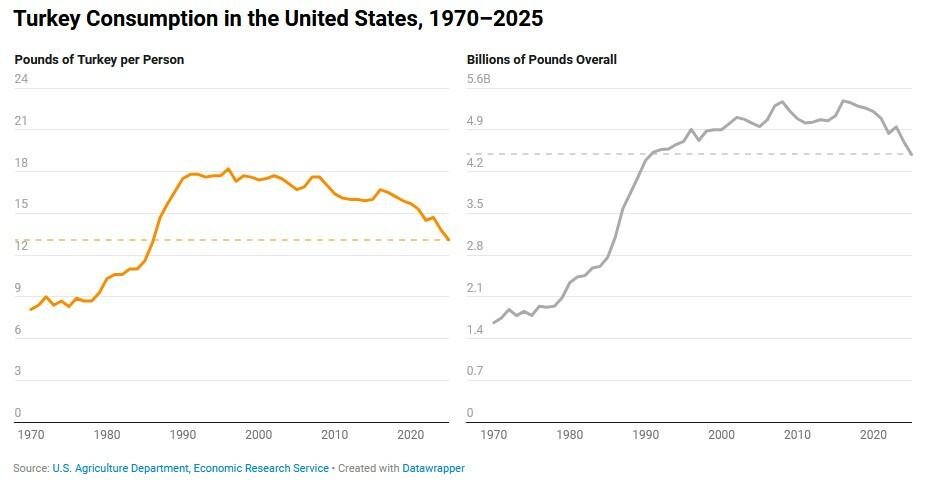
Annual turkey consumption rose from an average of about 10 pounds per person in 1980, to a peak of 18 pounds per person in 1996.
Since that time, however, consumers have been steadily eating less turkey. In 2025, average turkey consumption is projected to be just over 13 pounds per person, a nearly 40 year low.
In total, the USDA projects 4.5 billion pounds of turkey will be eaten in 2025—the lowest amount since 1990, according to the latest World Agricultural Supply and Demand Estimates (WASDE) report.
The USDA estimates 195 million turkeys were raised in 2025, the lowest number in 40 years. This is the second consecutive annual decline, with production falling about 3 percent from 2024 and around 11 percent from 2023.
The 30 million turkeys Americans will eat this Thanksgiving represents 15 percent of the total number of turkeys raised in the United States this year. It also represents a 35 percent drop from the 46 million turkeys consumed during the Thanksgiving holiday in 2016, according to the U.S. Department of Agriculture (USDA).
While health-conscious consumers and dieters propelled turkey’s rise, health concerns about processed foods are now one factor causing turkey consumption to drop.
Consumers are “steering a bit away from highly processed meat,” Heidi Diestel told The Epoch Times. Diestel’s family has raised turkeys in Sonora, California, for four generations.
Bird Flu
Since February 2022, highly pathogenic avian influenza (HPAI)—also known as bird flu—has resulted in the death of almost 21 million turkeys, or about one-tenth of the current U.S. turkey flock.
The wave of infections continued in November; the Animal and Plant Health Inspection Service confirmed eight turkey operations were affected in Michigan, North Dakota, and South Dakota, impacting 431,300 birds.
Farmers are also taking a hit from Avian respiratory virus, or aMPV—an upper respiratory tract viral infection that affects all types of poultry but is most harmful to turkeys.
HPAI is nearly 100 percent fatal to exposed birds, according to former National Turkey Federation chairman John Zimmerman. Although its symptoms are generally milder, aMPV is equally devastating.
Packages of turkey under Amazon’s private-label Amazon Saver brand are displayed at an Amazon Fresh grocery store in Federal Way, Wash., on Dec. 12, 2024. The National Turkey Federation estimates that Americans will eat nearly 30 million turkeys this Thanksgiving. David Ryder/Getty Images
In addition to the flocks impacted by HPAI, an estimated 60 percent to 80 percent of turkey flocks were affected by aMPV in 2024, according to Zimmerman, a Minnesota turkey farmer, who testified before the House Agriculture Committee in March.
The highly contagious respiratory illness is also known as turkey rhinotracheitis, or swollen head syndrome. It’s responsible for high death rates in commercial flocks and reduces egg production in breeder stock.
“Together, these two respiratory viruses have exponentially increased volatility, supply shortages and market uncertainty,” Zimmerman said.
The H5N1 strain of bird flu, present in wild birds worldwide and primarily responsible for HPAI outbreaks in U.S. domestic birds and dairy cattle, originated in Guangdong, China.
From its first outbreak in 1996, it spread across Asia to Africa, Europe, and then to the United States. The first U.S. case was detected in early 2022, according to the Centers for Disease Control and Prevention.
Known for infecting cattle and ravaging poultry flocks, the virus is also feared for its potential to infect humans. Worldwide, since 2003, more than 890 human H5N1 infections have been reported in 23 countries, according to the CDC’s September update.
In the United States, the CDC has reported 71 cases of human H5N1 infection since 2024, including one death in Louisiana in January.
On Nov. 14, Washington state’s health department confirmed the nation’s first human case of the H5N5 strain of HPAI.
Milk samples await testing at the Cornell Teaching Dairy Barn at Cornell University in Ithaca, N.Y., on Dec. 11, 2024. U.S. turkey farmers face falling demand amid ongoing bird flu outbreaks that disrupt supply, raise prices, and threaten livelihoods. Michael M. Santiago/Getty Images
Turkey Prices
The USDA recently projected that wholesale prices for frozen whole turkey hens will reach $1.32 per pound in 2025. That’s a 40 percent increase from 2024’s price of 94 cents per pound.
“The 2025 rise in price is a response to lower production with HPAI pressures combined with steady demand,” according to a report from the American Farm Bureau Federation.
Despite this year’s jump in turkey wholesale prices, economist Bernt Nelson noted in the report that “prices are still 32 percent lower than just three years ago.”
The most recent USDA Agricultural Marketing Service data show the average per-pound feature price for whole frozen turkeys decreased during the second week of November.
“It’s encouraging to see some relief in the price of turkeys, as it is typically the most expensive part of the meal,” Farm Bureau economist Faith Parum said in a Nov. 19 news release.
Total cash receipts from turkeys in 2025 are forecast at $4.8 billion in the USDA’s September projection. This represents a 30.6 percent increase over turkey receipts of $3.7 billion in 2024, yet it remains 33.3 percent lower than the peak of $7.12 billion in 2022, when the current HPAI outbreak began.




 Truth2Freedom's Blog