There are two ways to be fooled. One is to believe what isn’t true; the other is to refuse to believe what is true. —Soren Kierkegaard. "…truth is true even if nobody believes it, and falsehood is false even if everybody believes it. That is why truth does not yield to opinion, fashion, numbers, office, or sincerity–it is simply true and that is the end of it" – Os Guinness, Time for Truth, pg.39. “He that takes truth for his guide, and duty for his end, may safely trust to God’s providence to lead him aright.” – Blaise Pascal. "There is but one straight course, and that is to seek truth and pursue it steadily" – George Washington letter to Edmund Randolph — 1795. We live in a “post-truth” world. According to the dictionary, “post-truth” means, “relating to or denoting circumstances in which objective facts are less influential in shaping public opinion than appeals to emotion and personal belief.” Simply put, we now live in a culture that seems to value experience and emotion more than truth. Truth will never go away no matter how hard one might wish. Going beyond the MSM idealogical opinion/bias and their low information tabloid reality show news with a distractional superficial focus on entertainment, sensationalism, emotionalism and activist reporting – this blogs goal is to, in some small way, put a plug in the broken dam of truth and save as many as possible from the consequences—temporal and eternal. "The further a society drifts from truth, the more it will hate those who speak it." – George Orwell “There are two ways to be fooled. One is to believe what isn’t true; the other is to refuse to believe what is true.” ― Soren Kierkegaard
For his holy life, his excellent doctrine, and the glorious miracles he wrought to confirm his doctrine.
I bless you for the assurance I have that he is a teacher come from God, since no one could do those signs that he did unless God was with him. John 3:2(ESV)
That you have in these last days spoken by your Son, Hebrews 1:2(ESV) whose teaching was not his, but his who sent him; John 7:16(ESV) and he spoke as one having authority; Matthew 7:29(ESV) and that I am encouraged to come and learn from him, because he is gentle and lowly in heart, and in learning of him I will find rest for my soul. Matthew 11:29(ESV)
I bless you that he has left me an example, so that I might follow in his steps, in that he committed no sin, neither was deceit found in his mouth; and when he was reviled, he did not revile in return; 1 Peter 2:21-23(ESV) and his food and drink was to do the will of his Father, John 4:34(ESV) in that he was holy, innocent, unstained, separated from sinners. Hebrews 7:26(ESV) O that I may be armed with the same way of thinking, 1 Peter 4:1(ESV) and that as he was, so also may I be in this world; 1 John 4:17(ESV) and that I may walk in the same way in which he walked. 1 John 2:6(ESV)
I bless you that the works which he did bear witness about him, that the Father has sent him; John 5:36(ESV) that by his power the blind received their sight, the lame walked, lepers were cleansed, the deaf heard, the dead were raised up, and the poor had good news preached to them, Matthew 11:5(ESV) and even winds and sea obeyed him, Matthew 8:27(ESV) for which I glorify the God of Israel. Matthew 15:31(ESV) Doubtless this was the Son of God. Matthew 27:54(ESV)
Psalm 1 In these lessons we see that our growth in holiness is dependent upon our being grounded in the Word of God, which points us to the Lord Jesus Christ as the only source of salvation and sanctification.
Theme
The Way of the Wicked
The psalmist says two important things about the man who walks according to his sinful dispositions.
First, the course of the wicked man is always downhill. He is caught in a downward progression. This is a very important thing to see about sin. We see it in somebody else and say, “Look how sin has caught that person and dragged him down.” But we add, “That won’t happen to me. I’m going to do just this one little thing. Then I’ll draw the line and I won’t go any further.” But sin is not like that. Sin catches us and draws us along. You cannot sin “just a little bit.” Sin is a maelstrom which drags us down.
That is what Psalm 1 describes.
It does it through a progression of images. The obvious ones are in the verbs of verse 1: “Blessed is the man who does not walk in the counsel of the wicked, or stand in the way of sinners, or sit in the seat of mockers.” It is the picture of a man who is walking along and passes those who are ungodly. They say, “Come along with us. We’ll talk a little bit.” So the man walks along in that kind of company. Then the wicked say, “Let’s stop a minute.” When he does, he has lost his mobility. At this point he cannot even walk on by. Finally, he sits down and is caught in the sin’s meshes.
The same progression is in the nouns that go with the verbs. First, “Blessed is the man who does not walk in the counsel of the wicked.” As our man walks along, the wicked are talking about how wonderful sin is. Next is says that the blessed man does not “stand in the way of sinners.” Now it is not merely wicked counsel that is warned against, but it is a sinful way of life. Finally the psalm speaks of the one who does not “sit in the seat of mockers.” At this point sin has become a fixed, permanent thing from which one cannot escape.
Lot, Abraham’s nephew, is an example of this downward progression. First, he looked toward Sodom. Next, he pitched his tents near Sodom. Finally we find that he was actually living in the city and sitting in the gate, as one of the prominent men of this pre-eminently corrupt city of the ancient world.
The psalm says a second thing about the man who walks in sin’s way. Not only does he get caught in sin’s downward progression, but he is also unable to stand in the day of God’s judgment. Verse 5 expresses it this way: “Therefore the wicked will not stand in the judgment nor sinners in the assembly of the righteous.”
What does it mean, “not to stand”? It means that the man who lives like this has not been justified and will be condemned in God’s judgment. The word is used in Romans 5, for example, where the fruits of justification are described. “Therefore, since we have been justified through faith, we have peace with God through our Lord Jesus Christ, through whom we have gained access by faith into this grace in which we now stand” (Rom. 5:1, 2). To stand in grace is to be justified before God. So what the psalm is saying is that the wicked are not justified. On the contrary, they are condemned and become, as it says in verse 4, like “chaff that the wind blows away.”
In the ancient world there were no threshing machines. Threshing was done by hand. Workers poured the rough grain onto a threshing floor. Then animals, generally oxen, were walked around on it to break the wheat loose from the chaff. Finally, when the grain was broken apart the workers would come with pitchforks and throw the mixture of grain and chaff up into the air. The chaff, which was light, would be blown away. The grain, which was heavier, would fall back onto the floor. The psalmist is saying that the day of judgment is going to be like that. God is going to enter His threshing floor and separate the wheat from the chaff. On that day the chaff will be blown away. But the grain will remain.
John the Baptist had a message concerning judgment, saying that when God comes to do His threshing He is going to bring His fan with Him (Matt. 3:12). What does that mean? Well, when the ancient farmers wanted to winnow grain they had to wait for the right kind of day. If the day was too windy and they threw that mixture of grain and chaff up into the air, the wind would blow the grain away with the chaff. They would lose it all. Or if there was not enough wind, the grain and chaff would fall back down together. They had to wait for the right kind of wind. But John the Baptist said that when Jesus comes in judgment, He is not going to have to wait for the wind. He is going to bring His own fan. He will make the wind right and will be sure that all of the chaff will be blown away.
We do not hear much about judgment today, but we need to hear about judgment simply because it is a pervasive theme throughout the Word of God. God does not tell us about judgment because He delights in telling us frightening stories. The message is told for our good, as a warning. God says, “I am a just God. This is a moral universe. I am going to punish sin.” God tells us that so we might turn from sin to the way of salvation in Christ.
Study Questions
What is the first thing we learn about the one who walks in his sinful tendencies? How does the psalm demonstrate this point?
What is the second point about the one who follows after sin?
We do not seem to hear very much in the church about judgment these days, at least not as much as in earlier generations of Christian witness. Why do you think that is?
Application
Reflection: How have you seen sin take people in a downhill course?
Prayer: Ask the Lord to make you aware of temptations to sin, and for strength to withstand such temptations and go in the way of righteousness and holiness.
For Further Study: To learn more about the Bible’s teaching on the two ways, download for free and listen to James Boice’s message, “Two Ways Only.” (Discount will be applied at checkout.)
In the first article of this “Christ in the Pentateuch” series, Keith Kauffman excellently instructs us: “ … it is helpful to think of two broad categories of Christology in the Pentateuch (and the rest of the Old Testament as well): prophecy and prefigurement (typology).” This article focuses on the latter in relation to the persons of the Patriarchs: Abraham, Isaac, and Jacob.
An important Scripture Kauffman cites is Luke 24:24, 27, where Christ says that the Law of Moses, the Psalms, and the Prophets are all about Him. Also relevant is Jesus proclaiming Himself as salvation in John 5:39, for the Hebrew scriptures “are they which testify of me.”
Typology—the study of the prefiguring of Christ in the Old Testament, is seen in Romans 5:14 where Adam is referred to as a “figure” of Christ, the Greek word being tupos, meaning example, sign, type, image, or pattern. In this case, Adam is a type of Christ in terms of his federal headship.[1]
Gregory K. Beale explains that for something to be a type, it must have 1) close analogical correspondence of truths about people, events, or institutions; 2) historicity; 3) a pointing-forwardness; 4) escalation in meaning between correspondences; and 5) retrospective.[2] The New Testament also describes Old Testament types as “shadows of things to come” (Colossians 2:17; Hebrews 10:1); or, a “pattern” per Hebrews 8:5 with the Greek word there also being tupos. As it relates to “Typical Persons,” Milton Terry notes such will be recognized “because of some character or relation which they sustain in the history of redemption.”[3]
In his History of Redemption, Jonathan Edwards writes:
… it was needful that there should be a particular nation separated from the rest of the world, to receive the types and prophecies that were needful to be given of Christ, to prepare the way for his coming … These ends could not be well obtained, if God’s people, through all these two thousands years, had lived intermixed with the heathen world. So that this calling of Abraham may be looked upon as a kind of a new foundation laid for the visible church of God, in a more distinct and regular state, to be upheld and built up on this foundation from henceforward, until Christ should actually come, and then through him to be propagated to all nations.[4]
Similarly, Nicholas T. Batzig shares, “Abraham was a type of Christ in that he was the prototypical stranger and foreigner … the federal head of the Covenant … the father of many nations. Jesus is the “Everlasting Father” (Isaiah 8:18, 9:6; Psalm 45:16; Hebrews 2:13) … who federally represented His people from every tongue, tribe, nation and language.[5]
The Topical Encyclopedia says of Jacob that “His life and experiences serve as a type of Christ, prefiguring aspects of the Messiah’s life and mission” [and] can be discerned through his birth and election, name change to Israel, ladder to heaven vision, blessing of the nations, and suffering and triumph.[6]
Isaac was a type of Christ extraordinaire.[7]In Genesis 22:1-19, God put Abraham through the utmost test of faith as a picture of what would be God’s ultimate proof of love: both fathers hold nothing back, not even their only sons. Hebrews 11:17-19 says, By faith Abraham, when he was tried, offered up Isaac: and he that had received the promises offered up his only begotten son, Of whom it was said, That in Isaac shall thy seed be called: Accounting that God was able to raise him up, even from the dead; from whence also he received him in a figure.
Verse 19 says that Isaac is a “figure,” a different Greek word than tupos but the same idea here. Highlights of the scene demonstrate the heightened typology of Christ in Isaac:
A man in his 30s obeying his father to be an offering;
Wood for his self-sacrifice on his back;
Bound upon the place of offering;
Looks up and sees the hand of his father raised to kill him;
Abraham held nothing back from God, not even his own son, to typify how God would not hold back His only begotten Son for our salvation. And neither Isaac nor Jesus held back even their own selves. In return, may Christians Hold Nothing Back from Jesus.[9]
[1] But it is not simply analogical or of parallel comparison and not all things of both are compared. See the authors discussion on important distinctions of typology with Adam and Christ in his article placefortruth.org/could-adam-have-earned-eternal-life under the subheading, “Adam was a Typological Figure of the Second Adam—Only He Could and Would Earn Eternal Life.”
[2] Gregory K. Beale, Handbook of the New Testament Use of the Old Testament: Exegesis and Interpretation (Grand Rapids: Baker Academic, 2012), 19. See also Walter C. Kaiser, Jr., The Uses of the Old Testament in the New (Eugene, OR: Wipf & Stock Publishers, 2001), 232: To be a type, there must be “1. Historical correspondence 2. Escalation in the antitype (in the NT) 3. Divine intent and designation (in the Old Testament) 4. Prefiguration of a devoiretre quality.” Milton Terry directs that, “There must be some notable point of resemblance … [Rom. v, 14-20] … Moreover, we always expect to find in the antitype something higher and nobler than in the type … (Heb. iii, 3) … The type must prefigure something in the future. It must serve in the divine economy as a shadow of things to come … The points of difference and of contrast between type and antitype should also be noted by the interpreter.” Milton S. Terry, Biblical Hermeneutics: A Treatise on the Interpretation of the Old and New Testaments (Eugene, Oregon: Wipf and Stock, 1999), 247, 248, 252
[3] Milton, 248. Regarding typological relations, he notes that“Abraham’s faith in God’s word, and consequent justification (Gen. xv, 6), while yet in uncircumcision (Rom. iv, 10), made him a type of all believers who are justified by faith ‘apart from works of law’ (Rom. iii, 28). His offering of Isaac, at a later date (Gen. xxii), made him a type of working faith, showing how ‘a man is justified bye works and not by faith only’ (James ii, 24).”
[4] Jonathan Edwards, The History of Redemption (Grand Rapids: Associated Publishers and Authors Inc., Date?), 56. He continues: “So that Abraham being the person in whom this foundation is laid, is represented in scripture as though he were the father of all the church, the father of all them that believe ; as it were a root whence the visible church thenceforward through Christ, Abraham’s foot and offspring, rose as a tree, distinct from all other plants ; of which tree Christ was the branch of righteousness ; and from which tree, after Christ came, the natural branches were broken off, and the Gentiles were grafted into the same tree. So that Abraham still remains the father of the church, or root of the tree, through Christ his seed. It is the same tree that flourishes from that small beginning, that was in Abraham’s time, and has in these days of the gospel spread its branches over a great part of the earth, and will fill the whole earth in due time, and at the endif the world shall be transplanted from an earthly soil into the paradise of God.” 56-67. Related, see how Stephen calls Abraham’s seed as the growing Old Testament nation with Moses as the “church” in Acts 7:38 (the context speaking of Christ as the one there and of Whom Moses prophecies of in Deuteronomy 18:18).
[6] “In these ways, Jacob serves as a type of Christ, illustrating through his life the themes of election, redemption, mediation, transformation, blessing, and triumph that are ultimately fulfilled in Jesus Christ.” biblehub.com/topical/ttt/t/types_of_christ–jacob.htm
[8] God also provided another type with the ram (vs. 13, “in the stead of”). So Jesus Christ died in our stead as the Lamb of God who takes away the sins of the world (John 1:29; Isaiah 53;7). Unlike Abraham of Isaac, Christ’s Father did not answer but struck Him with His wrath, so that Jesus would truly die and rise from the dead to offer the Good news to us (Psalm 22:1; Matthew 27:46; John 3:16-17; 1 Peter 1:18-21; Romans 8:32).
Pervasive dishonesty has a corrosive effect on society. Trust in interpersonal relationships demands that the stories we share with and about our friends are accurate, and we expect that when reports come from news broadcasting organisations they are factually correct. Over the past decade, however, we have needed to be less trusting when it is reported on the BBC that women have committed certain crimes (when in fact it was men calling themselves women), or that children can achieve happiness only through trying to become the opposite sex. We need a lot of scepticism when stories are repeated against Jewish people and even when crimes are alleged against the state of Israel. It has also been exposed that footage from two separate messages by Donald Trump was spliced together to make it seem that he was saying the opposite of what he really said. One of the ten commandments forbids “bearing false witness against our neighbour.” God takes enough interest in our neighbour’s reputation to forbid us from speaking falsehoods and demand us to speak the truth. He is the God of truth and as part of the moral law, the obligation to be truthful is not only for Christians but for everyone everywhere at all times. When James Durham started to explore the ninth commandment, he set out the many ways that it can be broken. The following updated extract is unflinching in exposing the many ways we can sin against God’s requirement to speak the truth and earnestly warns us away from dishonesty in all its forms.
The ninth commandment, “Thou shalt not bear false witness against thy neighbour,” requires truth in our words, both as to what we say and the manner in which we say it. Whether our words are only spoken words, or also put in writing, it’s in our words that our conformity (or lack of conformity) to the truth is most clearly apparent.
There are different kinds of lies
Lies are commonly divided into three sorts, according to their intended purposes.
There is mendacium perniciosum, a malicious or pernicious lie, when it is intended to bring hurt to someone else. These were the lies of those who bore witness against Christ, and the lies which Ziba told against Mephibosheth.
There is officiosum mendacium, or an officious lie, when it is for a good end. Such was the midwives’ lie (Exodus 1:9). The denying of a thing to be, even when the granting of it would infer hurt and damage to another, is contrary to truth, and we ought not to do evil in order that good may come of it. It overturns the end for which speaking was appointed, when we declare a thing to be otherwise than we know or think it to be. As no one can lie for himself for his own safety, so he cannot lie for another’s safety. To lie even for God is a fault, and accounted to be talking deceitfully and wickedly for Him, when, to avoid what we think is dishonourable to Him, we will assert that He may or may not do a certain thing, when yet the contrary is true (Job 13:4, 7).
There is jocosum mendacium, when it is for fun, to make others laugh. As it is sinful in itself, it cannot be a matter of lawful entertainment.
We may add one more, and that is mendacium temerarium, when people lie for no particular reason, but, through inadvertency and habitual carelessness, they speak otherwise than the thing is. This is called “the way of lying” (Psa. 119:29) and is certainly sinful. For example, when Amnon was killed, they told David that all the king’s sons were killed, but they were too hasty in jumping to a conclusion before checking the facts.
Humans have a natural propensity to being judgmental. It is related to the knowledge of good and evil that we acquired. Is there a difference between judging and judgment? Yes there is, and its important that we explore it. Syda Productions/AdobeStock
Colliding truths are always fascinating. Try this one. We are not supposed to judge others, but exercising good judgment is a crucial part of living a good life. Should we be moral watchdogs, evaluating the behavior and lifestyles of others, or should we simply adopt a live and let live attitude, generously passing off differences with the attitude of “it takes all sorts to make a world” or “if it works for you, it works for you—so that’s fine”?
Those in favor of disinterest in the behavior of others might quickly quote the words of Jesus from Matthew 7:1-2 “Do not judge, or you too will be judged. For in the same way you judge others, you will be judged, and with the measure you use, it will be measured to you.”
When is silence irresponsible?
Take that literally, and if your neighbor starts yet another adulterous affair, or drives drunkenly through the suburb, or screams endless abuse at their spouse and children, like the three wise monkeys you will block eyes, ears and mouth, and see, hear and speak no evil. But is that really OK? When is silence irresponsible? When does silence facilitate abuse? Aren’t we supposed to judge some things?
Of course, while Jesus tells us not to judge others in Matthew 7, in John 7:24 he softens that with his instruction to “Stop judging by mere appearances, and make a right judgement.” Is there a difference between judging and judgment? Yes there is. Let’s think about it.
You and I are assuredly not God.
Judging others means… well, judging others! It presupposes that we are in a position to do this, and presumably, then, that we can see all their motives, understand everything about them, and interpret their position accurately. The trouble is, only God has access to the full range of information—and you and I are assuredly not God. When we judge we operate with far too many assumptions, a fair number of which will almost always be wrong.
Have you ever been in the situation where you have felt critical of someone, and essentially written them off? I have. And then I have discovered something that has changed that perception, and has made me see them in a new light. Some have become good friends.
There is an old saying that to know all is to forgive all.
There is an old saying that to know all is to forgive all. While I am not sure it is always true, it often is. Sometimes the more you know the less acceptable something becomes. Some information makes you say “Well that’s even worse then!”. But even when it isn’t true, the thrust of Jesus’ command In Matthew 7 is that we all need forgiveness.
When we are outraged by another, are we forgetting the shadow inside of us? That shadow should make us pause before we rush towards a verdict. We might like to think of ourselves when we are at our best, but others might have experienced us when we were at our worst. Their assessment might be very different!
An assessment of the likely outcome of certain actions.
Instead of judging others, Jesus urges “right judgment”. What’s that? Well, it’s right judgment. It is not about the moral worth of another, but an assessment of the likely outcome of certain actions.
📱 Get Breaking News on WhatsApp
Join our WhatsApp channel for instant updates on Christian news worldwide
Our judgment might well be that if someone travels a particular path no good will come from it. That’s simply being wise. And part of being wise is also to decide if it’s appropriate to share your judgment with the other.
I have had people say to me “I’m a little worried about you. I think if you continue doing (whatever), you will (burn yourself out / become jaded / offend people unnecessarily etc).” It’s a judgment they have made and most often I have valued it— largely because I don’t feel judged but cared for. Someone else’s “right judgment” of your position could be extremely helpful for you.
Jesus also stresses that a prerequisite of right judgment is not being convinced by “mere appearances”. The wider context of John 7:24 was a dispute over Sabbath laws, which Jesus was accused of violating. On the basis of “mere appearances” the accusation was valid, but dig a little deeper, and you realize that he was upholding the deepest intent of the Sabbath laws.
What is it that really matters here?
Right judgment is willing to ask the “what is it that really matters here” question. That’s often not easy to answer, but it begins with curiosity.
Behind every law and instruction in the Bible is a “why”—and it’s important to ask the why question. Naturally we should ask as humble inquirers. We may think we know why and be completely wrong, but that doesn’t mean our curiosity is misguided.
Right judgement often leads to great compassion. Instead of a hasty “what a disgusting person” we may see something far deeper—a quiet despair born from too many disappointments, or never having a better way modeled, or having no windows on life and the world.
Right judgment might even leave us with a responsibility.
Instead of failure we might see unreached potential. Right judgment might even leave us with a responsibility. We might hear the Spirit prompt us help them reach that God given potential – to paint a picture not of judgment but of possibility.
There is another dimension which we find in John 16:8, where Jesus informs us that it is the role of the Spirit to convict of sin. That is liberating! You and I are not the Spirit. I have sometimes heard Christians come across as shrill, judgmental judges. Ask them why, and they will say something like, “The stakes are high. If they don’t repent of their sins they will not be forgiven. And you know as well as I do that what they are doing is wrong, so of course I’m judging them.”
The Spirit does what only the Spirit can do, and creates a deep hunger for God, and conviction of sin, and a desire for forgiveness and new life.
Jesus suggested another way. In John 13:34-35 Jesus unpacks his new commandment—an instruction to love each other in such a way that a watching world knows that we are most truly followers of Jesus the Christ. And my experience has been that when people see that, the Spirit does what only the Spirit can do, and creates a deep hunger for God, and conviction of sin, and a desire for forgiveness and new life.
Our role is to love in a radically new way. We can trust the Spirit to do any convicting that is needed. Actually, I have often started out wondering why the Spirit wasn’t convicting someone else about what clearly seemed to me to be wrong, and then found that the Spirit was convicting me of my sin—my pride and lack of a deeper and more perceptive love.
As you go into all the world, judge not… but use right judgement. Right judgement sees beyond mere appearances, asks curious questions, is shaped by love, and remembers its own shadow. Right judgement is grateful that God is God, and it is content to watch as the Spirit works in the world to do what only the Spirit of God can do.
Originally published by on Brian Harris’ Blog. Republished with permission.
Dr Brian Harris, is based in Perth Australia. After decades of church pastoring and 17 years leading a theological college, he now directs the Avenir Leadership Institute, a future-focused consultancy which helps to shape the kinds of leaders the world needs. Brian is the author of seven books, the latest of which are: Why Christianity is Probably True (Paternoster, 2020) and Stirrers and Saints: Forming Spiritual Leaders of Skill, Depth and Character (Paternoster, 2024).
For the Son of God, Christ Jesus, who was preached among you by us—by me and Silvanus and Timothy—was not yes and no, but is yes in Him. For as many as are the promises of God, in Him they are yes; therefore also through Him is our Amen to the glory of God through us. (1:19–20)
Throughout the history of the church, heretics have always assaulted the nature of Christ, and the false apostles at Corinth appear to be no exception in their effort to diminish Him. Having slanderously accused Paul of being untrustworthy because of his change in travel plans, they also alleged that his teaching on the Lord Jesus was untrustworthy. Responding to their attack on his Lord, Paul emphasized Christ’s nature as the God-man by using the full, rich title the Son of God, Christ Jesus. Paul was not the only one who preached the truths of the Son of God to the Corinthians; Silvanus and Timothy had preached the message to them. Silvanus (Silas) was a prominent leader in the Jerusalem church. The Jerusalem Council entrusted him to carry its decision to the church at Antioch (Acts 15:22). He later became Paul’s companion on the apostle’s second missionary journey, replacing Barnabas (Acts 15:39–40). Timothy was Paul’s beloved son in the faith. As the son of a Jewish Christian mother and a pagan Gentile father (Acts 16:1), he was uniquely qualified to minister alongside the apostle. Both Silvanus and Timothy had ministered with Paul at Corinth (Acts 18:5). Their preaching was not untrustworthy, it was not yes and no, but was a firm, unwavering, resounding yes to God’s truth in Jesus Christ. Then Paul sums up the glory of Christ by reminding the Corinthians that as many as are the promises of God, in Him they are yes. All of God’s salvation promises—of blessing, peace, joy, goodness, fellowship, forgiveness, strength, and hope of eternal life—are yes, meaning they all come true, in Christ. They are all made possible by His person and work. After His resurrection, Jesus told His disciples, “All things which are written about Me in the Law of Moses and the Prophets and the Psalms must be fulfilled” (Luke 24:44). In 1 Corinthians 1:30 Paul declared that “Christ Jesus … became to us wisdom from God, and righteousness and sanctification, and redemption.” To the Colossians he wrote, “For it was the Father’s good pleasure for all the fullness to dwell in Him.… For in Him all the fullness of Deity dwells in bodily form” (Col. 1:19; 2:9). It was the realization of “the surpassing value of knowing Christ Jesus [as his] Lord” that made Paul willing to suffer “the loss of all things, and count them but rubbish so that [he might] gain Christ” (Phil. 3:8). Then Paul drove home the point of his argument by reminding the Corinthians, Therefore also through Him is our Amen to the glory of God through us. Amen is a solemn affirmation of the truthfulness of a statement (cf. Rom. 1:25; 9:5; 11:36; 15:33; 16:27; Gal. 1:5; Eph. 3:21; Phil. 4:20; 1 Tim. 1:17; 6:16; 2 Tim. 4:18; Heb. 13:21; 1 Peter 4:11; 5:11; 2 Peter 3:18; Jude 25; Rev. 1:6; 7:12). When Paul, Silas, and Timothy preached the gospel, it was all about Christ, who by His glorious work brings to pass all salvation realities. The Corinthians probably even had joined in saying Amen to the glory of God. The congregation had affirmed that the preachers reliably spoke God’s truth about Christ when they believed the gospel message Paul and his companions preached, and it transformed their lives. How utterly absurd, Paul argued, to accept and experience the gospel message as reliable, but consider those who preached it unreliable. How ridiculous to trust Paul’s word about eternal things, but not about mundane things like travel plans. The apostle who was exacting in communicating the true gospel of Christ was also exacting in the lesser matters of life. God did not choose an unstable, unreliable apostle to preach His truth.
MacArthur, J. F., Jr. (2003). 2 Corinthians (pp. 43–44). Moody Publishers.
19, 20 Paul now elaborates this last point. The message originally proclaimed at Corinth (Acts 18:5) by the threefold testimony (cf. 13:1; Deut 19:15) of Paul, Silvanus, (= Silas) and Timothy centered in none other than God’s Son in whom inconsistency and indecision had no place. So Paul draws a contrast between the humanity of the messengers and the divinity of the Person who was the essence of their message (the unusual position of gar, “for,” emphasizes tou theou, “of God,” v. 19). Indeed, in and through him (en autō) the divine “Yes” has come into effect as a permanent reality (gegonen, perfect tense, v. 19), because all God’s promises (cf. 7:1; Rom 9:4; 15:8), whatever their number, find their fulfillment or affirmative in him (v. 20a). “They are ‘Yes’ in Christ,” since he forms the climax and summation of the divine self-revelation. That is why (dio kai), in their corporate worship offered to God through Christ, Christians joyfully utter the “Yes” or “Amen” of agreement and consecration (cf. Rev 1:7; 3:14; 22:20). Such a response enhances God’s glory (v. 20b). The Corinthians’ “Amen” to the gospel declaration itself validated the apostolic preaching (cf. 1 Cor 1:6; 2 Cor 3:2, 3; 13:5, 6). With his consistency confirmed here, was it likely that Paul would act in a worldly manner in relatively trivial affairs? How could they distrust the apostle who himself had taught them to affirm the trustworthiness of God by repeating the “Amen”? This is a potent a fortiori argument.
Harris, M. J. (1976). 2 Corinthians. In F. E. Gaebelein (Ed.), The Expositor’s Bible Commentary: Romans through Galatians (Vol. 10, pp. 324–325). Zondervan Publishing House.
For as many promises of God as there are, in him they are Yes. Wherefore also through him we say Amen to God for his glory. a. “For as many promises of God as there are.” Paul reflects on the numerous promises God has given his people. He knows that ultimately all of them have been and are being fulfilled in the Son of God. Replete with God’s promises, the Old Testament points to their fulfillment in Christ. Peter mentions that the prophets were “trying to find out the time and circumstances to which the Spirit of Christ in them was pointing when he predicted the sufferings of Christ and the glories that would follow” (1 Peter 1:11). The Old Testament message is that God who makes promises ultimately fulfills them through the coming of the Messiah. b. “In him they are Yes.” The entire New Testament is a testimony that God’s promises have been and are being fulfilled in Jesus Christ. Jesus came to fulfill the Law and the Prophets (Matt. 5:17–18), to remove the curse of the law (Gal. 3:13), to grant the gift of righteousness (Matt. 6:33), to give eternal life (John 17:3), and through the Father to send the Holy Spirit (John 14:16, 26; 15:26). In Jesus Christ God’s promises have been realized, and the Corinthians will have to acknowledge the truth of this matter. c. “Wherefore also through him we say Amen to God for his glory.” The Greek construction of this part of verse 20 is cumbersome if we provide a literal translation and follow the sequence of the verse: “Wherefore also through him the Amen to God for glory through us.” But the word Amen is uttered “through us,” and this affirmation serves to glorify God. When we understand that the phrase through us carries the meaning of the verb we say, the subsequent translation is smooth. This is how, in the first few centuries, some Christians whose native tongue was Syriac, a sister dialect of Aramaic, understood the text. Writing “yes” and “Amen” in this passage, Paul is expressing a parallelism that was current in his day. Among speakers who were conversant in both Greek and Aramaic, the “yes” and the “Amen” meant the same thing. When Paul, his associates, and the Corinthians say “yes and amen” through Jesus Christ to God, no one legitimately can accuse Paul of vacillating. Those who attest to the veracity of God’s Word respect one another’s personal integrity. As Paul indicates, when believers say “Amen” to the promises of God in Christ, they glorify God.
Kistemaker, S. J., & Hendriksen, W. (1953–2001). Exposition of the Second Epistle to the Corinthians (Vol. 19, p. 62). Baker Book House.
But the Lord is faithful, who shall stablish you, and keep you from evil. (2 Thessalonians 3:3)
Men are often as devoid of reason as of faith. There are with us still “unreasonable and wicked men.” There is no use in arguing with them or trying to be at peace with them: they are false at heart and deceitful in speech. Well, what of this? Shall we worry ourselves with them? No; let us turn to the Lord, for He is faithful. No promise from His Word will ever be broken. He is neither unreasonable in His demands upon us nor unfaithful to our claims upon Him. We have a faithful God. Be this our joy.
He will stablish us so that wicked men shall not cause our downfall, and He will keep us so that none of the evils which now assail us shall really do us damage. What a blessing for us that we need not contend with men but are allowed to shelter ourselves in the Lord Jesus, who is in truest sympathy with us. There is one true heart, one faithful mind, one never changing love; there let us repose. The Lord will fulfill the purpose of His grace to us, His servants, and we need not allow a shadow of a fear to fall upon our spirits. Not all that men or devils can do can hinder us of the divine protection and provision. This day let us pray the Lord to stablish and keep us.
The essay reflects on biblical gratitude, highlighting the lone thankful leper as a model for believers. It contrasts outward blessings with deeper spiritual gifts and reminds Christians to thank Jesus not only for physical provision but also for salvation and enduring spiritual blessings, especially at Thanksgiving (and always).
We should (and do) thank Jesus every day, but the holiday of Thanksgiving is a particular reminder that we above all people are grateful to Jesus for our salvation and for His active involvement in the world.
There are many people in the Bible who used thanks-like words in their prayers and songs. Miriam, Hannah, David, Solomon, Mary to name just a few examples, all used words that expressed their gratitude to God. I began to wonder about the specifics of those who had been delivered or healed, if they explicitly thanked Jesus. The ten lepers situation came to mind.
While He was on the way to Jerusalem, He was passing between Samaria and Galilee. And as He entered a village, ten men with leprosy who stood at a distance met Him; and they raised their voices, saying,
“Jesus, Master, have mercy on us!” When He saw them, He said to them, “Go and show yourselves to the priests.” And as they were going, they were cleansed. Now one of them, when he saw that he had been healed, turned back, glorifying God with a loud voice, and he fell on his face at His feet, giving thanks to Him. And he was a Samaritan. But Jesus responded and said, “Were there not ten cleansed? But the nine—where are they? Was no one found who returned to give glory to God, except this foreigner?” And He said to him, “Stand up and go; your faith has made you well.”
If you think about ‘the numbers’ in scripture, the outlook is not good. Out of all the world, only 8 survived the Flood on the Ark. Out of all the millions rescued from Pharaoh, only 2 could enter the Promised Land. Out of the 4 soils, only one was good for nurturing the seed. “Many” will fail to find the narrow path and only “a few” find it.
Here, we have ten healed outwardly, but only one thanked their Healer and gave Him proper worship and thanks.
Matthew Henry says,
17:11-19 A sense of our spiritual leprosy should make us very humble whenever we draw near to Christ. It is enough to refer ourselves to the compassions of Christ, for they fail not. We may look for God to meet us with mercy, when we are found in the way of obedience. Only one of those who were healed returned to give thanks. It becomes us, like him, to be very humble in thanksgivings, as well as in prayers. Christ noticed the one who thus distinguished himself, he was a Samaritan. The others only got the outward cure, he alone got the spiritual blessing.
The Pharisee thanked God but we know that was an improper expression of gratitude, because he was really thanking himself. (Luke 18:11).
I looked up the word “thank” in scripture and repeatedly the person thanking God most frequently was Jesus.
Though the word ‘praise’ is used, we find that Jesus specifically thanked the father seven times in the New Testament. He gave thanks for food, a LOT. He thanked the Father before feeding the 4000 and also the 5000. He gave thanks that the Father had revealed truth to childlike people (Matthew 11:25). He thanked the Father for hearing His prayer before raising Lazarus from the dead. (John 11:41). He thanked God at His last Passover when He ate the bread and drank the wine, (Matthew 26:27). This was amazing since He knew He was going to die excruciatingly the next day.
Too often I am like the 9 lepers, thanking Jesus for a fleshly blessing but neglecting to thank Him for the spiritual blessings He gives us daily, sustaining us until eternity.
There are many spiritual blessings He gives us. So many to count but here are a few- our salvation! Adoption into His family.Mercy. Patience with our sin. Union with Him. Angels sent to us unknowingly. The ability to pursue holiness so as to please Him. Worshiping Him in truth. The security of our eternity in bliss in heaven. The Spirit indwelling us as a deposit of the guarantee. I could go on!
As we gather around the Thanksgiving table, let us be like the one leper, who obeyed Jesus to go and present himself to the Temple to satisfy the fleshly miracle, but remembered to thank Him worship Him properly, which is a spiritual obedience. We receive common gifts every day the same as the pagans do, who do not thank Him (Romans 1:21). But uniquely, we believers receive the spiritual blessings, which are much greater and are eternal.
Here’s your Bible Gateway verse-of-the-day calendar for the month of December! Click each link below to read the verse in your preferred translation — or download the image (or PDF) of all verse references.
You can also subscribe to get Bible Gateway’s Verse of the Day right in your inbox every day — in your preferred translation (or multiple translations)!
Get the most out of your Bible reading — including each of the above verses — with a free trial of Bible Gateway Plus. Access dozens of Study Bibles, dictionaries, commentaries, and other resources to go deeper into every aspect of God’s Word. Try it today!
I’ve just been in a funk, lately. Nothing out of the ordinary is wrong, but it’s been raining for eleventy two days in a row, and the constant darkness and dreariness seems to have wormed its way into my psyche and, I noticed recently, even into my prayer life.
A couple of days ago, I started out my prayer time with a huge sigh followed by a bunch of wimpering and whining about nothing of consequence. I was just moody. And I didn’t feel like praying.
And then God graciously brought a lovely little snippet of Scripture to my mind:
give thanks in all circumstances; for this is the will of God in Christ Jesus for you. 1 Thessalonians 5:18
Want to know God’s will for your life? There it is: give thanks in all circumstances. When you get a new car. When you catch your spouse cheating on you. When you’re on a glorious vacation. When you get laid off from work. When you’re happy. When you’re sad. When you’re in the mood, and when you’re not in the mood.
Give thanks in – not necessarily for, but in – all circumstances.
Well, this was certainly a circumstance. Why not give gratitude a try? I was in the car headed to pick up my boys from school, and I decided to spend the entire twenty minute drive just thanking God for things.
I started with the big stuff: salvation, forgiveness for my sin, times when God has miraculously provided, specific answers to prayer…
How often do we forget to thank God for all the (in our eyes) tiny little unnoticed things He does for us every day?Tweet
I was starting to slow down and I still had about half the drive left. Surely there was more to be thankful for! And that’s when it struck me. How often do we forget to thank God for all the (in our eyes) tiny little unnoticed things He does for us every day? We thank Him for the miracles, but what about the mundane? What “little things” had I forgotten to thank God for?
1. Air conditioning. I live in the South. Enough said.
2. I know where my next meal is coming from.
3. Social media and e-mail. I can keep up with far off loved ones, and I’ve “met” some awfully nice people.
4. I can see. I can hear. I can think clearly. I can walk.
5. I live in a country where Christianity is not yet against the law.
6. Sunsets.
7. Cute baby animals.
8. I can read and write. That’s not the case for women, globally.
9. I was able to conceive and carry my children to term.
10. Warm quilts on cold nights.
11. The Bible is available in my native language, and I have several copies of it.
12. I have no fear of suicide bombers in my community.
13. The beach.
14. A crawfish boil with friends.
15. Reliable electricity.
16. Hearing my children sing when they think no one is listening.
17. My husband is a Believer and is good to me.
18. Mountains. I miss mountains.
19. Indoor plumbing and clean drinking water.
20. Laughing hysterically with my family.
21. Level-headed discernment ministries.
22. Peanut butter and chocolate ice cream.
23. A roof over my head.
24. Home schooling.
25. People who are kind (or crazy) enough to read my blog articles all the way to the end.
Well, that was my list, and I think I’ll keep looking for things to add to it. Thanking God for the “little things,” realizing they might be big things to others, and recognizing the pervasiveness of God’s blessings and provision cheered me up and was truly a worship experience.
We thank Him for the miracles, but what about the mundane?Tweet
By Robb Brunansky – Posted at The Cripplegate:The first thanksgiving took place in 1621 in Plymouth, Massachusetts, as the Puritans held a feast to thank God for His blessings. Throughout our time as British colonies, we celebrated thanksgiving at various times and for different reasons. The first national Thanksgiving Day was observed December 18, 1777, after the Americans won a significant battle against the British in Saratoga, New York. Similar proclamations were made annually through 1784.
After 1784, the next annual Thanksgiving Day was celebrated on Thursday, November 26, 1789, after the ratification of the Constitution. President George Washington issued a proclamation that Americans ought to give thanks to God for the blessings of the Almighty on this nation. The proclamation is truly a model future presidents and national leaders should follow. Read what Washington wrote:
By the President of the United States of America. A Proclamation. Whereas it is the duty of all nations to acknowledge the Providence of Almighty God, to obey His will, to be grateful for His benefits, and humbly to implore His protection and favor: And whereas both Houses of Congress have, by their joint committee, requested me ‘to recommend to the People of the United States, a Day of public Thanksgiving and Prayer, to be observed by acknowledging with grateful hearts the many and signal favors of Almighty GOD, especially by affording them an opportunity peaceably to establish a form of government for their safety and happiness.” Now therefore, I do recommend and assign Thursday the twenty-sixth day of November next, to be devoted by the people of these states, to the service of that great and glorious Being, who is the beneficent Author or all the good that was, that is, or that will be: That we may then all unite in rendering unto Him our sincere and humble thanks for His kind care and protection of the people of this country previous to their becoming a nation; – for the signal and manifold mercies, and the favorable interpositions of His Providence in the course and conclusion of the late war; – for the great degree of tranquility, union and plenty, which we have since enjoyed; for the peaceable and rational manner in which we have been enabled to establish constitutions of government for our safety and happiness, and particularly the national one now lately instituted; for the civil and religious liberty with which we are blessed, and the means we have of acquiring and diffusing useful knowledge; and in general, for all the great and various favors which He hath been pleased to confer upon us. And also, that we may then unite in most humbly offering our prayers and supplications to the great Lord and Ruler of Nations, and beseech Him to pardon our national and other transgressions; – to enable us all, whether in public or private stations, to perform our several and relative duties properly and punctually – to render our national government a blessing to all the people, by constantly being a Government of wise, just, and constitutional laws, discreetly and faithfully executed and obeyed – to protect and guide all Sovereigns and Nations (especially such as have shewn kindness onto us) and to bless them with good government, peace, and concord – To promote the knowledge and practice of true religion and virtue, and the increase of science among them and us – and generally to grant unto all Mankind such a degree of temporal prosperity as He alone knows to be best. Given under my hand at the City of New York the third day of October in the year of our Lord 1789. George Washington Thanksgiving, thus, was not to be simply a time of generic giving of thanks, but a true day of national acknowledgment for God’s many blessings and prayer for His continued care.
20 This “woe” has a link with the previous one (v. 18), for there “deceit” is expounded as skepticism about the ways of God. Unhappily it is an easy journey from such skepticism to the total reversal of values that this verse demonstrates, for God is the source of all values. If we are wrong about him, we can soon be wrong about everything. The Pharisees’ rejection of Christ showed itself in the same way, for they attributed the works of the Holy Spirit to Beelzebub (Mk 3:22–30).
Grogan, G. W. (2008). Isaiah. In T. Longman III, Garland David E. (Eds.), The Expositor’s Bible Commentary: Proverbs–Isaiah (Revised Edition) (Vol. 6, p. 502). Zondervan.
The moral code has been rewritten. People no longer feel guilty when they depart from what was once considered right. Just as ‘one man’s meat is another man’s poison’, so personal taste now rules supreme; if a course of behaviour seems bitter or sweet to someone, then that’s what it is.
Motyer, J. A. (1999). Isaiah: an introduction and commentary (Vol. 20, p. 74). InterVarsity Press.
20 The fourth ‘woe’ concerns the ability of the people to make good moral decisions. When it comes to ‘good’, ‘light’ and ‘sweet’, they simply reverse the concepts and call them ‘evil’, ‘darkness’ and ‘bitter’ respectively. The reference to ‘light’ may have a connection to what Isaiah’s contemporary Amos said about the people’s misapprehension concerning the day of the LORD: ‘Why do you long for the day of the LORD? That day will be darkness, not light’ (Amos 5:18). The whole point of the complaint against the people is that their perversity shows in their utter distortion of all moral values, or the ways of God.
Harman, A. (2005). Isaiah: A Covenant to Be Kept for the Sake of the Church (p. 68). Christian Focus Publications.
5:20. Some people lead others astray by their perverted values. Evil-for example, adultery, idolatry, materialism, murder, and many other sins forbidden in the Scriptures-is often held up as being good. Those who say such things are under the threat (woe) of God’s judgment.
Martin, J. A. (1985). Isaiah. In J. F. Walvoord & R. B. Zuck (Eds.), The Bible Knowledge Commentary: An Exposition of the Scriptures (Vol. 1, p. 1043). Victor Books.
5:20 — Woe to those who call evil good, and good evil; who put darkness for light, and light for darkness; who put bitter for sweet, and sweet for bitter! When God in His Word calls something evil, it is evil. When He labels a thing bitter, no multitude of religious authorities can make it sweet through their solemn declarations. God is our absolute authority.
Stanley, C. F. (2005). The Charles F. Stanley life principles Bible: New King James Version (Is 5:20). Nelson Bibles.
“Laws are made for men of ordinary understanding and should, therefore, be construed by the ordinary rules of common sense. Their meaning is not to be sought for in metaphysical subtleties which may make anything mean everything or nothing at pleasure.” —Thomas Jefferson (1823)
AI and DOE: On Monday, President Donald Trump signed an executive order establishing the “Genesis Mission,” which directs the Department of Energy and the Office of Science and Technology Policy to work with private companies to accelerate the development of Artificial Intelligence. “The private sector has launched artificial intelligence at huge scale,” Energy Secretary Chris Wright explained, “but with a little bit different focus — on language, on business, on processes, on consumer services. What we’re doing here is just pivoting those efforts to focus on scientific discovery, engineering advancements. And to do that, you need the data sets that are contained across our national labs.” The EO also directs the DOE to create an integrated platform for fast-tracking scientific advancements via AI, an aim that Trump recently described as the U.S. working “to build the largest, most powerful, most innovative AI ecosystem in the world.”
Ukraine agrees to peace deal: U.S. officials and Ukraine’s national security adviser, Rustem Umerov, report that Ukraine has “agreed to a peace deal” to end the four-year Russian assault. President Volodymyr Zelensky would need to travel to Washington to finalize his end of the deal, which could happen before the end of the month. U.S. Army Secretary Dan Driscoll was in Abu Dhabi meeting with Russian officials as news of Ukraine’s agreement broke; further developments to end the war may come very quickly at this point. Umerov said there are still details to be worked out, but a “common understanding on the core terms” has been reached. The leaks of the proposed deal show Ukraine surrendering the entirety of the Donetsk region but securing a security guarantee from the United States similar to NATO’s Article 5. Russian President Vladimir Putin has yet to agree to the deal.
Senator Mark Kelly probed: Secretary of War Pete Hegseth announced on X that while five of the “Seditious Six” Democrats who urged service members to defy orders are not subject to the Uniform Code of Military Justice, Senator Mark Kelly is. Actions that are intended to interfere with “the loyalty, morale, or good order and discipline of the armed forces” are prohibited under the UCMJ, and retired service members such as Kelly are still subject to the UCMJ under 10 U.S.C. § 688 and other applicable regulations. Therefore, Hegseth announced that the allegations against Kelly are coming under a thorough review that will determine further actions, possibly including recalling Kelly to active duty for court-martial. Kelly responded that if these actions are meant to intimidate and prevent him from “holding this administration accountable, it won’t work.”
Trump designates Muslim Brotherhood as an FTO: Certain chapters of the Muslim Brotherhood will be designated as Foreign Terrorist Organizations and Specially Designated Global Terrorists per an executive order signed by President Trump on Monday. The Muslim Brotherhood was founded in 1928 in Egypt as a Sunni Islamic organization aiming to gain political power. It exists today as a collection of loosely affiliated Islamic chapters, some directly associated with other Islamic terrorist organizations such as Hamas. Designating the Muslim Brotherhood as an FTO allows the U.S. to go after the organization’s U.S.-based finances, conduct military intel, and prosecute those who offer “material support” to the Muslim Brotherhood.
Rubio rolls back DEI, State employees cheer: Despite the negative reporting surrounding Secretary of State Marco Rubio’s efforts to expunge woke DEI ideology from the State Department, it turns out that even the department’s leftist employees appreciate a commitment to meritocracy over race-based favoritism. Since Rubio has thrown out the Biden-era DEIA category for evaluating overall work proficiency and offered restitution to some 295 employees who were marked down for failing to show they would “seek diversity in staff,” and thereby denied promotion, a number of employees who self-identify as “leftist” have praised Rubio. As one employee wrote, “I am very happy for everyone who is getting promoted after throwing out the ludicrous DEIA score. It is well deserved.”
Meta and sex-trafficking minors: “You could incur 16 violations for prostitution and sexual solicitation, and upon the 17th violation, your account would be suspended,” testified Instagram’s former head of safety and well-being, Vaishnavi Jayakumar, in a recently unsealed court filing. The plaintiffs in the case against Meta allege that the company was well aware that its products were being used by adult strangers to contact minors, yet downplayed the issue and refused to take corrective action. The problem has been made public before; while testifying before Congress last year, Meta CEO Mark Zuckerberg faced the audience and apologized to the victims of child exploitation on his platform after being berated by Senator Josh Hawley. The current lawsuit alleges that Meta “pursued a strategy of growth at all costs,” ignoring the issue and possibly lying to Congress about its knowledge of it.
2028 Dem primary and ranked-choice voting: A number of Democrats are promoting the dubious ranked-choice voting scheme following its success in making Zohran Mamdani the Democrat candidate in the New York City mayoral race. Some Democrats are advocating for adopting ranked-choice voting for the 2028 presidential primaries. They see it as a popular way to get out the vote, claiming it helps prevent the perception that people’s votes are “wasted.” Not everyone is sold, however, as a number of states and municipalities that have experimented with ranked-choice have since reverted to the fairer single-vote method. For the DNC to adopt ranked-choice voting, it would require a majority of the 450-member body to approve new rules and bylaws. Furthermore, individual state parties would need to approve the change, and on top of that, a number of state governments would have to amend their election laws.
WV senator to pay $5M in back taxes: Senator Jim Justice agreed to pay $5.1 million to the federal government after the Department of Justice brought a lawsuit over his failure to pay debts dating back to his 2009 filings. The former governor of West Virginia, Justice replaced former Senator Joe Manchin following his retirement. Justice inherited the Bluestone Coal Corporation from his father and was once a billionaire before hard times reduced his net worth to a reported $664 million. At one point, debts of over $1 billion led to Justice being declared “broke.”
China’s state media calls for nuke strikes against Japan: The Chinese Communist Party-controlled online outlet Guancha, Chinese for Observer, is calling for nuclear missile strikes to end what it deems to be Japanese “militarism.” This follows remarks by Japan’s newly elected Prime Minister Sanae Takaichi, who told the Japanese legislature that a Chinese attack on Taiwan would pose a survival threat to Japan, requiring military intervention. Chinese Foreign Minister Wang Yi said Sunday that Japan “crossed a red line” by suggesting military involvement. Despite the threats, the Japanese Self-Defense Forces are “steadily moving forward” with the deployment of a medium-range surface-to-air missile unit at a military base on Yonaguni Island, about 68 miles from the east coast of Taiwan. Taiwan says the move would strengthen security in the Taiwan Strait, and Japan insists it will help prevent an attack on its own country.
Headlines
Core wholesale prices rose less than expected in September; retail sales gain (CNBC)
Shoppers curtail Black Friday plans to stretch spending (CNBC)
House Education and Workforce Committee launches nationwide investigation into anti-Semitism in K-12 schools (House.gov)
North Dakota Supreme Court restores near-total ban on abortion (RedState)
UK okays state experiment with puberty blockers and children (Hot Air)
Humor: Average IQ in Congress expected to rise significantly after MTG resigns (Babylon Bee)
First things first: James Comey and Letitia James are sleazy, scummy, hyperpolitical thugs who disgraced their offices, betrayed the public trust, and flipped their middle fingers to the electoral will of the American people. If you disagree with this assessment, then you’re likely in the throes of Trump Derangement Syndrome.
There. Now that I have that off my chest, let’s proceed.
Yesterday, a Clinton-appointed judge waved her hand and dismissed the Justice Department’s grand jury indictments against both Comey and James on the same debatable technicality — namely, that President Donald Trump’s federal prosecutor in the cases, Lindsay Halligan, wasn’t properly appointed to her post. As Judge Cameron Currie wrote:
I agree with Mr. Comey that the Attorney General’s attempt to install Ms. Halligan as Interim U.S. Attorney for the Eastern District of Virginia was invalid. And because Ms. Halligan had no lawful authority to present the indictment, I will grant Mr. Comey’s motion and dismiss the indictment without prejudice.
At issue is a legal obscurity called Section 546, which sets the boundaries for interim U.S. attorney appointments by the attorney general. As Ed Morrissey writes at Hot Air, “Today’s dismissals are based on the Trump administration’s failure to get a US Attorney appointed and confirmed in time. They appointed an interim US Attorney early on, but federal law only allows interim appointments to continue for 120 days. After that, the judicial circuit appoints an interim US Attorney, an issue that the White House is already fighting in other jurisdictions. Currie refuses to accept any indictments from a second interim US Attorney appointed by Trump, calling it ‘defective.’”
“Defective,” huh? Where on earth were these high-minded sticklers for judicial process during the past nine years, when the Democrats’ lawfare apparatus was maliciously raking Donald Trump and his supporters through the coals?
“We’ll be taking all available legal action,” said Attorney General Pam Bondi yesterday, “including an immediate appeal, to hold Letitia James and James Comey accountable for their unlawful conduct.” She added, “I’m not worried about someone who has been charged with a very serious crime. His alleged actions were a betrayal of public trust.”
That’s all well and good, Madame AG, but I think it’s safe to say that Comey and James — and Barack Obama and Hillary Clinton and John Brennan and James Clapper and Andrew McCabe and Peter Strzok and Chris Wray and the rest of those weaponizing dirtbags — are laughing their butts off right about now, along with the leftist scribes at The Washington Post.
As our Mark Alexander put it: “This was an incredibly careless way to bring charges, now dismissed on a technicality and likely to be reinstated, and in no way exonerates Comey. Comey is a corrupt thug, and I have heard no bigger lie come out of his mouth in the last decade than this: ‘A message has to be sent that the president of the United States cannot use the Department of Justice to target his political enemies.’”
That’s pretty rich coming from the guy who exonerated Crooked Hillary Clinton for recklessly sending top-secret communications via an unsecure home-brew server. Pretty rich coming from the guy who seven years ago said “I don’t remember” 73 times, “I don’t know” 161 times, and “I don’t recall” eight times during his closed-door testimony before Congress. Pretty rich for the guy who helped weaponize the DOJ to go after Donald Trump and the rest of the Democrats’ political enemies.
To be fair, there’s a Beria-esque “show me the man and I’ll show you the crime” component to Tish James’s bank fraud case. But a crime is a crime, right? And as for Comey: a former FBI director lying before Congress? I mean, we all knew he was lying when he was doing it.
Further complicating the cases against Comey and James — and the lying senator from California, Adam Schiff — is the president’s plain-as-day animus toward the Democrats who were trying to ruin his life. It goes to the charge of retributive justice, which was the second argument that Comey and James made, and it’s embodied in a Truth Social post that Trump directed toward Attorney General Pam Bondi — a post that he subsequently yanked down, no doubt on the advice of his legal team:
Pam: I have reviewed over 30 statements and posts saying that, essentially, “same old story as last time, all talk, no action. Nothing is being done. What about Comey, Adam “Shifty” Schiff, Leticia??? They’re all guilty as hell, but nothing is going to be done.“ Then we almost put in a Democrat supported U.S. Attorney, in Virginia, with a really bad Republican past. A Woke RINO, who was never going to do his job. That’s why two of the worst Dem Senators PUSHED him so hard. He even lied to the media and said he quit, and that we had no case. No, I fired him, and there is a GREAT CASE, and many lawyers, and legal pundits, say so. Lindsey Halligan is a really good lawyer, and likes you, a lot. We can’t delay any longer, it’s killing our reputation and credibility. They impeached me twice, and indicted me (5 times!), OVER NOTHING. JUSTICE MUST BE SERVED, NOW!!! President DJT
These are strong, hard-nosed, prejudicial opinions that a regular schlub like me can rightly and publicly express, but they tend to complicate legal cases when they’re uttered by the leader of our nation’s executive branch, by the man to whom our nation’s attorney general answers.
One of Donald Trump’s most appealing traits is his candor, his straight talk, his willingness to say precisely what’s on his mind. He’s taken a blowtorch to the mealy-mouthed way that business is conducted in our nation’s capital, and we should all be thankful for it.
Unfortunately, as it pertains to these two criminal cases, the president’s straight talk appears to be a pre-holiday gift to a pair of sleazy Trump-deranged hacks who sure seem to be “guilty as hell.”
Nate Jackson: The DOGE Postmortem — Donald Trump’s famed government-cutting agency, once headed by Elon Musk, is effectively no more. What did it accomplish, and where do things go from here?
Emmy Griffin: College Grads Have Little to Show for Grade Inflation — Cushiony marks are being handed out by professors like candy. As a result, students aren’t ready for the workforce and are left with little to no hope.
Jack DeVine: A New Low in Political Messaging — Six Democrat members of Congress want U.S. military service members to be on-the-spot arbiters of all directives from their commander-in-chief. How will that work?
Michael Smith: The Age of Selective Legality — From street protests to courtroom disparities, Americans are witnessing the slow undoing of a stable legal order.
Editor’s Note: Each week we receive hundreds of comments and correspondences — and we read every one of them. Click here for a few thought-provoking comments about specific articles. The views expressed therein don’t necessarily reflect those of The Patriot Post.
Bill Maher Leaves Woke Comedian Speechless — Patton Oswalt claimed the Left is more “scientific” on Bill Maher’s podcast. Maher brings up gender ideology and leaves him speechless.
Just When You Think Journalists Can’t Stoop Any Lower… — Journalists have become out-of-touch elites, so committed to the destructive lies of leftism that their minds have become gnarled and packed with hatred of everyday Americans.
No, It’s Not ‘Man Keeping’ — Vice is rebranding being loved and cared for in a relationship as “man keeping.” No wonder men are opting out of dating and the gender divide is wider than ever.
Going Viral for Hiring the Worst Substitute Teacher — A substitute teacher recorded this footage at a high school, and now it’s going viral. Warren Smith thinks it exposes what’s really happening in our schools.
“I have too much self-respect and dignity, love my family way too much, and do not want my sweet district to have to endure a hurtful and hateful primary against me by the president we all fought for.” —Rep. Marjorie Taylor Greene (R-GA)
Shot/Chaser
Q: “Do you believe President Trump has issued any illegal orders?” —ABC News’s Martha Raddatz
A: “To my knowledge, I am not aware of things that are illegal.” —Sen. Elissa Slotkin (D-MI)
“If the president hasn’t issued illegal orders, then members of Congress telling the military to defy the president is by definition illegal.” —JD Vance
Demagogue
“It is time for Democrats to embrace a sweeping, aggressive, unvarnished, unapologetic, and altogether unmistakable platform of pure economic rage. This is our only way out of the abyss.” —Democrat strategist James Carville
Leftist Lunacy
“Minnesota is a better place because Somalians chose to live here. We are stronger because of it.” —Gov. Tim Walz (D)
Pearl-Clutching
“I want to drag every single ICE agent that’s been wearing a mask in front of a Senate subcommittee, make them take their mask off, and explain to the American people what the hell they’ve been up to. … Organizations that are used to kidnap Americans are not organizations that should exist in the future.” —Senate candidate Graham Platner (D-ME)
Fact-Check: True
“If an entire job site disappears in Charlotte the second ICE shows up, it’s because the companies chose illegal, cheap labor over hiring Americans, and now they’re finally paying for it. Hire actual Americans, and the projects won’t be collapsing.” —Stephen Crowder
And Last…
“If you aren’t from this country: We don’t care what you think about American politics. We don’t care what you think about American culture. We don’t care what you think about American elections. Your grift is over. Focus on your own problems.” —Matt Walsh commenting on the exposure of grifters now that X identifies a user’s country of origin
President Trump signed an executive order Monday directing the U.S. Secretaries of State and Treasury to submit a report within 30 days on the Muslim brotherhood. Nigeria is one of the most dangerous places in the world for Christians. It’s facing a new crisis, as mass kidnappings of Christian schoolchildren draws sharp condemnation. Severe weather affecting parts of Texas as tornadoes left a path of destruction. 82 million people are estimated to travel for thanksgiving by train, automobile, or plane. The FAA is projecting a spike in flights with more than 52,000 scheduled today alone. Traditionally, flying your nation’s flag is seen as an expression of patriotism. in today’s Britain, displaying the union jack is attacked as hateful and extreme. This time of year, many of us are feeling the holiday rush, complete with all the stress that brings.
Her life has been changed forever because of asinine Democrats and liberal judges who refuse to do the right thing;
Once upon a time, a long, long time ago, even someone who declared themselves to be liberal still possessed the ability to be reasonable. Those days came and went, and being liberal now means hating everything that America stands for, even justice.
Lawrence Reed is a 50-year-old criminal psychopath who has been arrested 72 times over 30 years. Federal prosecutors highlighted his extensive criminal history, including 15 convictions: eight felonies and seven misdemeanors. The charges varied from driving with a suspended license and drug possession to aggravated battery and arson.
In August, while inside a locked psychiatric ward at MacNeal Hospital, Reed violently struck a social worker. At that time, prosecutor Jerrilyn Gumila described how Reed could be seen on surveillance video flying off the handle as the social worker was speaking with him.
“He became irate and slapped the victim in the face with an open palm. Her vision went black, and she lost consciousness for several seconds. One of the victim’s co-workers rushed over and helped the victim walk down to her office, and the victim was then taken to the emergency room.”
Gumila added that the social worker’s injuries included a cut on the cornea of her eye, possible optic nerve bruising, a concussion that caused her nausea and memory loss, and a chipped tooth.
He went on to explain Reed’s extensive criminal history, which included a 2020 arson conviction for setting a fire outside a Chicago building.
“The defendant poses a real and present threat to the safety of, especially this victim, whoever else was working in the hospital that day, and the community as a whole.”“The defendant randomly and spontaneously became irate in this situation where the victim was just attempting to do her job as a social worker, and now, as a result, suffered injuries so severe that she still has side effects on a daily basis.”
Reed’s attorney, Nicholas Yannias, said his client’s behavior was caused by his 26-year-long struggle with a mental illness that makes him “paranoid.”
Yannias, a public defender, said Reed had been treated at the same hospital for 17 years and that he’d gotten back on the correct dose of his medications since the assault.
We see judges pulling this type of judicial misconduct all the time
“Mr. Reed needs services; he does not need to be incarcerated for being mentally ill and acting in accordance with his mental illness.”
After hearing the facts of the case, County Judge Teresa Molina-Gonzalez freed Reed on a felony aggravated battery charge for attacking the social worker, because at the time, the assault was classified as a misdemeanor battery and later upgraded.
Gonzalez is trying to hide behind the nonsensical Illinois’ Pretrial Fairness Act. Under this ridiculous rule, judges supposedly can’t hold a defendant in jail unless they are charged with a felony and meet a slew of other criteria, including having a criminal history, posing a risk of endangering the community, or being a flight risk.
Gonzales can say whatever she wants, but we see judges pulling this type of judicial misconduct all the time. There is no way anyone of good conscience should have allowed this animal back onto the street. It’s evident that this is just the latest in a long line of liberal rulings for Reed. How can anyone be arrested 72 times over 30 years and have only 15 convictions?
In this case, Gonzales, with her liberal point of view, could have detained Reed, but chose not to do so and instead is hiding because of an act that favors the criminals over the victims. Is it any wonder that Chicago and other cities in the state have become so consistently violent?
According to CWB Chicago, Gumila repeatedly warned Gonzalez that releasing Reed with only electronic monitoring would be “wholly insufficient.” According to a transcript of the hearing that took place on August 22nd, Gumila told Gonzalez that by releasing Reed:
“It could not protect the victim or the community from another vicious, random, and spontaneous attacks.”
That said, Gonzalez was unmoved, telling Gumila:
“I understand your position, but I can’t keep everybody in jail because the state’s attorney wants me to, but I understand and respect your position.”
She ordered Reed to stay away from the hospital unless he had “a medical emergency”. She told him he would be monitored electronically “because of your ridiculous criminal history and lengthy criminal history.”
Gonzalez allowed Reed to leave his home 40 hours a week, 24 hours more than the 16 allotted under the state’s SAFE-T Act, which permits defendants with electronic monitoring to leave home 16 hours a week for “essential” activities.
A few weeks later, on September 12, Judge Ralph Meczyk approved Yannias’ request to allow Reed to have different hours for church activities, according to a transcript of the hearing.
Really, church activities.
Less than three months later, Reed filled a bottle with gasoline. Twenty minutes later, he entered the Chicago L train and approached an unidentified 26-year-old woman seated with her back to Reed, scrolling through her phone.
According to the complaint, “Reed then took the cap off the bottle and poured a liquid from the bottle all over the victim’s head and body.”
According to the complaint, Reed attempted to ignite the liquid, but the victim fought him off and ran toward the front of the train. Reed then reportedly lit the bottle, dropped it, and subsequently picked it up again while it was on fire, using it to set the victim ablaze.
“Reed then ran to the front of the train car and stood watching Victim A as her body was engulfed in flames.”
‘Burn b*tch’ and ‘burn alive b*tch'”
The victim, who was almost completely engulfed in flames, attempted to extinguish herself by rolling on the floor of the train car. Afterward, she exited the train while still on fire when it arrived at the Clark and Lake Street Blue Line platform. There, two good Samaritans helped put out the flames.
Chicago police arrested Reed on Tuesday, and he was still wearing the same clothes as seen in the attack footage, along with having fire-related injuries to his right hand.
While he was being transported, he reportedly made “repeated spontaneous and unprompted utterances, specifically yelling, ‘burn b*tch’ and ‘burn alive b*tch.'”
Court papers filed on Wednesday in the state case against Reed for the train attack indicate that he had violated his curfew several times in November, including on the day of the attack. He exceeded his curfew on November 9, 12, 13, 14, 15, and on that fateful Monday, the 17th. Court records indicate that some of those days had an “escalated alert.”
Reed has been charged with committing a terrorist attack against a mass transportation system, the U.S. Attorney’s Office for the Northern District of Illinois said. Andrew Boutros, U.S. Attorney for the Northern District, issued a statement saying:
“This horrific attack was not just a barbaric assault on an innocent woman riding a train, but an act of terrorism that strikes at the core of our American way of life.”
During a press briefing, Chris Amon, special agent in charge of the ATF’s Chicago Field Office, reiterated that the “horrific act of violence” was unprovoked.
“Lawrence Reed had no business being on the streets, given his violent criminal history and his pending criminal cases. Reed had plenty of second chances by the criminal justice system, and as a result, you have an innocent victim in the hospital fighting for her life.”
If convicted, Reed faces a maximum sentence of life in federal prison. That is little consolation for the 26-year-old, who is in critical condition, lying in a hospital burn unit. Her life has been changed forever because of asinine Democrats and liberal judges who refuse to do the right thing.
View Comments
Milt Harris——Bio and ArchivesMilt spent thirty years as a sales and operations manager for an international manufacturing company. He is also a four-time published author on a variety of subjects. Now, he spends most of his time researching and writing about conservative politics and liberal folly.
Fox News contributor and former FBI special agent Nicole Parker joins ‘Mornings with Maria’ to say that the dismissal of James Comey’s case exposes a two-tiered system of justice and deep corruption inside the bureau.
It was supposed to be a brave stand against common-sense immigration regulations. It ended up being yet another example of Democratic Rep. Ilhan Omar highlighting why she’s a leftist leper. […] The post appeared first on The Western Journal .
This post was originally published near Independence Day. Perhaps, now, a piece that is a little more religion-friendly than some droning documentaries could provide perspective for you and your family as the holiday arrives. To be sure, we jump started the celebration of America’s quarter-millennial birthday last July with a series called “Declaration 249.” These posts are collected in a small volume, Declaring Independence: Revealing Dependence(2025) if you or friends wish to have the series as a package. But also, rather than digesting the whole feast, feel free to snack on one frequently overlooked aspect of our documentary history.
Thanksgiving Proclamations
Thanksgiving proclamations of the Continental Congress strummed the same strings, the first having been signed by George Washington and forwarded to the individual states. In November 1777, the Congress combined elements of thanksgiving “to their divine benefactor” with notes of contrition, making “penitent confession of their manifold sins.” This Thanksgiving proclamation also pled for forgiveness “through the merits of Jesus Christ.” They viewed ministerial training academies as “necessary for cultivating the principles of true liberty, virtue and piety . . . to prosper the means of religion for the promotion . . . of that kingdom which consisteth ‘in righteousness, peace, and joy in the Holy Ghost,’” a clearly Trinitarian reference.[1] No attempt was ever made in any of these to express pluralism (e.g., by citing the Koran) or to invoke any other sacred canon. A Genevan-like Sabbath was declared again by the 1777 proclamation.
On occasion Congress even interrupted its proceedings, as it did on July 5, 1778, to attend divine worship as a group, with chaplains officiating and preaching to the assembled representatives.[2] Later, on October 12, 1778, Congress entertained a resolution (which was defeated) endorsing that “true religion and good morals are the only solid foundations of public liberty and happiness.”[3] In view of the earlier and manifold references to theology, this defeat may have been an exception to the rule, for the following month they once again endorsed God’s “overruling providence” and called for “penitent confession of our sins, and humble supplication for pardon, through the merits of our Savior.”
The next Thanksgiving proclamation (October 1779) urged that God “grant to his church the plentiful effusions of divine grace and pour out his holy spirit on all ministers of the gospel.” It urged support for education as a means to this end: to “spread the light of Christian knowledge through the remotest corners of the earth.” This Congress asked for God’s mercy and prayed that these states would be established “upon the basis of religion and virtue.”
The Thanksgiving proclamation of 1781, authored by Presbyterian minister John Witherspoon, again invoked the blessing of Isaiah 11:9 and pleaded with “the God of all grace” (1 Peter 5:10) to “incline our hearts . . . to keep all his laws.” It was not civil law alone that guided, but God’s law. The next year, the Scotsman of Knoxian descent would also lead the Congress in committing to “a cheerful obedience to his laws” and the practice of “true and undefiled religion [James 1:27] which is the great foundation of public prosperity and national happiness.”
This evangel was the settled faith of the vast majority, and nowhere did it seek to repudiate the legacy of Calvinism. In October 1783, a New Jersey student of Witherspoon, Elias Boudinot (of Huguenot lineage), led the Congress in affirming “our dependence on that Almighty Being,” who was yet again asked to “smile upon our seminaries and means of education to cause pure religion and virtue to flourish, to give peace to all nations, and to fill the world with his glory.” Instrumental in achieving these great ends was the continuation, for which Congress was grateful, of “the light of the blessed gospel.”
Toward the end of Revolutionary hostilities, Congress called for a day of prayer and thanksgiving in which people would “assemble in their respective churches and congregations” to celebrate the “mercies and praises of their all-bountiful Creator, most holy and most Righteous, for his innumerable favors and mercies.” In words that reflected the sincere piety of the day, this declaration of August 1784 also asked support of the seminaries for the following purposes: “to raise up from among our youth, men eminent for virtue, learning, and piety to his service in church and state; to cause virtue and true religion to flourish; to give to all nations amity, peace and concord, and to fill the world with his glory.” Prior to 1784, all American seminaries taught some form of Calvinistic thought.[4]
Late into the eighteenth century, the groundbreaking interpretations of Calvin and his intellectual descendants were still being popularized in American sermons, with not a few given in official contexts. On December 11, 1783, Congress had appointed a day of thanksgiving “for the restoration of Peace and establishment of our Independence, in the Enjoyment of our Rights and Privileges.” In a service for that occasion at the Third Presbyterian Church in Philadelphia, George Duffield (who was a Chaplain of Congress as well as pastor of the church) referred to an Old Testament passage (Is. 66:8) to make this point about God’s providence extended to America: “Nor was military prowess only given. He that put of the Spirit of Moses on the elders of Israel [see Ex. 18] raised up Senators and guided them in council to conduct the affairs of his chosen American tribes.” Clearly, the biblical basis for republicanism and the institution of a “senate” was the same for Duffield as it had been for Calvin and Beza centuries earlier.
Likewise, in a Thanksgiving Day sermon in 1787, Witherspoon’s student, Joseph Lathrop, stated: “All the measures of civil policy ought to be founded on the great principles of religion; or, at the least, to be perfectly consistent with them: otherwise they will never be esteemed, because they will be contrary to that moral sense of right and wrong which God has implanted in the breast of every rational being.”[5] Lathrop also argued from his Boston pulpit for proper resistance to civil government under the following conditions: “when rulers usurp a power oppressive to the people, and continue to support it by military force in contempt of every respectful remonstrance . . . the body of the people have a natural right to unite their strength for the restoration of their own constitutional government. And, for the same reason, if a part of the people attempt by arms to control or subvert the government, the rulers, who are the guardians of the constitution, have a right to call in the aid of the people to protect it. If the people may use force to suppress an armed usurpation of unconstitutional authority, rulers may, on the same principle, use force to suppress an armed insurrection against constitutional authority.”[6]
Lest one posit a dubious schizophrenia, the Congressional proclamations adopted within a few years of the 1776 Declaration should be prime interpreters of original intent. Moreover, the argument from the paragraph above was 200 years old, having been featured prominently by Calvinistic disciples in the Vindiciae contra tyrannos.
[2] Similarly, in October 1781, Congress proceeded to worship collectively in a Dutch Lutheran church to thank God for the surrender of the British army.
[3] In April 1785, an attempt was thwarted to set aside a section in every town, “immediately adjoining [the school] to the northward for the support of religion.” Although supported by some delegates, mainly from Rhode Island, Maryland, and New York, the motion to set aside a locale for a religious center in every town failed.
[4] The early confederation permitted much leeway for the expression of religion, and it also limited, in good Calvinistic fashion, terms of service in the Congress to no more than three out of any six years. States were given considerable control over their own affairs, and there was very little centralized interference. Behind the various Thanksgiving Day proclamations was a decidedly “conservative Protestant perspective” and the “covenant idea.” See Charles W. Dunn, ed., American Political Theology (New York: Prager, 1984), 13.
[5] Ellis Sandoz, ed., Political Sermons of the American Founding Era, 1730-1805 (Indianapolis: Liberty Press, 1991), 839.
[6] Ellis Sandoz, ed., Political Sermons of the American Founding Era, 1730-1805, 872.
The survey was of 36,908 adults, conducted July 2023 to March 2024, with religiousness based on prayer frequency, attendance at religious services, belief in God, and the importance of religion in life.
Which U.S. States are the Most Religious?
Mississippi leads as America’s most religious state, with 50% of adults surveyed categorized as highly religious.
The table below shows the share of residents in each U.S. state who are considered highly religious:
South Carolina follows Mississippi with 46% of adults highly religious, with South Dakota and Louisiana tied next at 45%.
The data highlights a strong concentration of religious adherence in the American South. States like Tennessee (44%), North Carolina (41%), and Arkansas (40%) demonstrate the cultural legacy of the “Bible Belt,” where Christianity remains woven into America’s religiosity.
The Least-Religious States in America
In contrast, the Northeast and much of the West Coast are markedly less religious.
New England stands out for its secularism with the three least-religious states in America: Vermont (13%), New Hampshire (15%) and Maine (17%).
Alongside New England, western states like Nevada (20%) and Oregon (21%) show lower levels of religious engagement, with California only slightly higher at 24%.
Overall, the national average of highly religious adults sits at 31%, with the difference between the top and bottom states—Mississippi’s 50% versus Vermont’s 13%—illustrating just how much religiosity varies across the United States.
To learn more about religion around the world, check out this graphic which shows the world’s most popular religions.
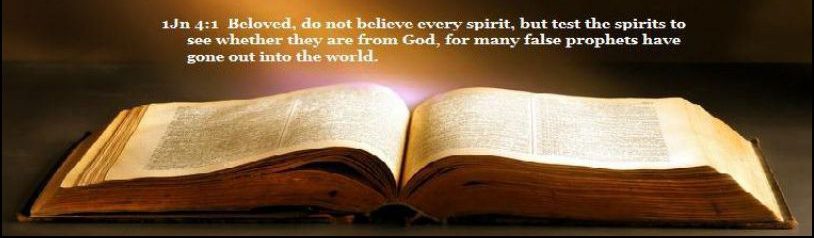






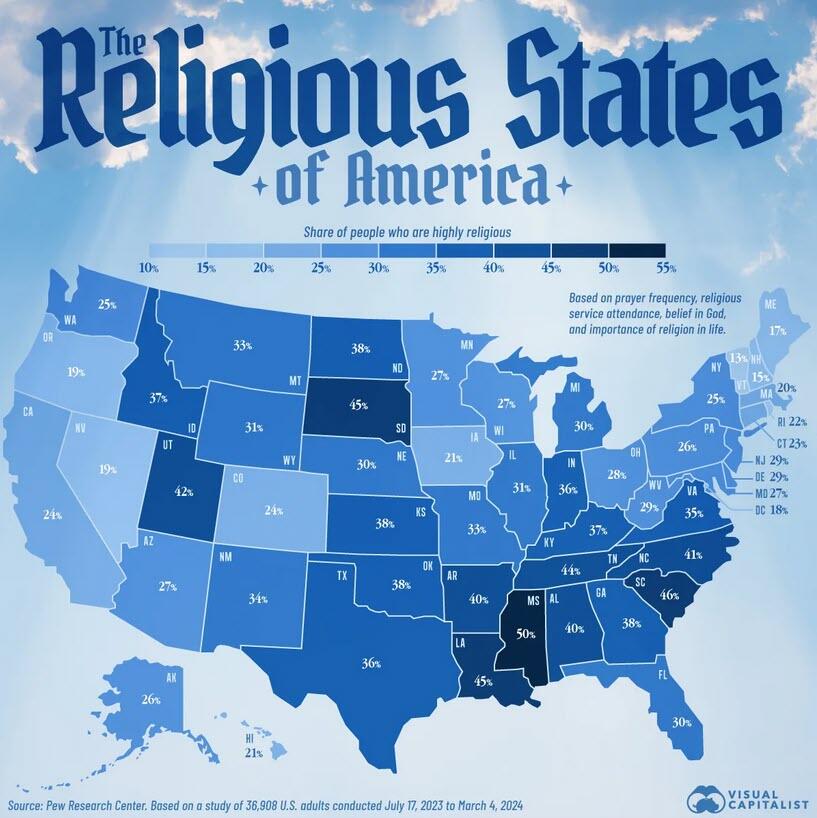
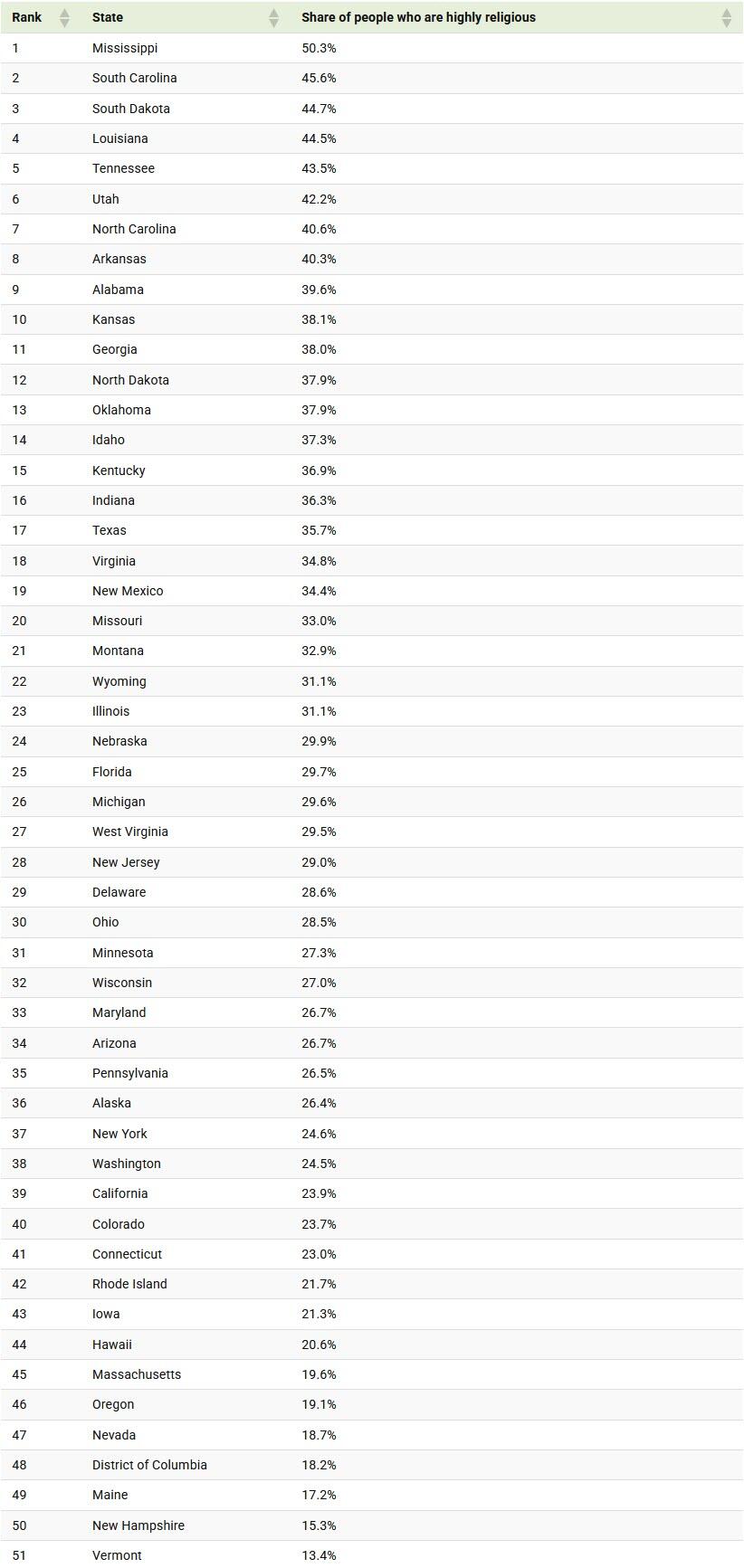
 Truth2Freedom's Blog