There are two ways to be fooled. One is to believe what isn’t true; the other is to refuse to believe what is true. —Soren Kierkegaard. "…truth is true even if nobody believes it, and falsehood is false even if everybody believes it. That is why truth does not yield to opinion, fashion, numbers, office, or sincerity–it is simply true and that is the end of it" – Os Guinness, Time for Truth, pg.39. “He that takes truth for his guide, and duty for his end, may safely trust to God’s providence to lead him aright.” – Blaise Pascal. "There is but one straight course, and that is to seek truth and pursue it steadily" – George Washington letter to Edmund Randolph — 1795. We live in a “post-truth” world. According to the dictionary, “post-truth” means, “relating to or denoting circumstances in which objective facts are less influential in shaping public opinion than appeals to emotion and personal belief.” Simply put, we now live in a culture that seems to value experience and emotion more than truth. Truth will never go away no matter how hard one might wish. Going beyond the MSM idealogical opinion/bias and their low information tabloid reality show news with a distractional superficial focus on entertainment, sensationalism, emotionalism and activist reporting – this blogs goal is to, in some small way, put a plug in the broken dam of truth and save as many as possible from the consequences—temporal and eternal. "The further a society drifts from truth, the more it will hate those who speak it." – George Orwell “There are two ways to be fooled. One is to believe what isn’t true; the other is to refuse to believe what is true.” ― Soren Kierkegaard
For the intercession which he ever lives to make in the virtue of his satisfaction.
I thank you that having bore the sin of many, Christ makes intercession for transgressors, Isaiah 53:12(ESV) and prays, not only for those who were given to him when he was on earth, but also for all those who will believe in him through their word; that they may all be one. John 17:20-21(ESV)
That I have an Advocate with the Father, even Jesus Christ the righteous, 1 John 2:1(ESV) who is therefore able to save to the uttermost all those who draw near to God as a Father, through him as a Mediator, since he always lives to make intercession for his people. Hebrews 7:25(ESV)
That I have a High Priest chosen from among men and appointed to act on behalf of men in relation to God, to offer gifts and sacrifice for sin, who can deal gently with the ignorant and wayward; Hebrews 5:1-2(ESV) and that he has become the source of eternal salvation to all who obey him. Hebrews 5:9(ESV)
Romans 3 From this week’s lessons we learn that Romans 3 can be considered the heart of the Bible because of the clear and comprehensive way it shows us the depth of our sin, and what the Lord Jesus Christ has done to save us from it.
Theme
Three Views of the Human Condition
Somewhere in my library I have a pamphlet by Donald Grey Barnhouse entitled How to Mark Your Bible. This pamphlet contains suggestions for using Bible markings as an aid to Bible study, and it contains sample pages from a Bible Barnhouse used and marked thoroughly. I think of this now because at Romans 3:21 and following, Barnhouse had written the picture of a heart in the margin of his Bible. That was to remind him, as he came to this passage, that Romans 3:21-27 is the heart of the Word of God. In this respect Romans 3 compares favorably with Genesis 3. All the great doctrines of the faith are found in Genesis 3 in rudimentary form: original righteousness, the Fall, judgment, the promise of a redeemer, a response to that promise by faith, and finally a dramatization of justification by faith in his clothing of the man and the woman with the skin of animals. All of that in one chapter!
In the same way, we have this in Romans 3. We do not have quite the same scope of doctrines. There is no mention of an original righteousness. To the contrary, Romans 3 shows that we have no righteousness at all. It talks about our sin. However, it does talk about the work of God in Christ to save us from our sin, and it emphasizes the need for response to what God has done, namely, the response of faith, without which there is no salvation.
So far as I know, in the whole history of the human race there have only been three basic views of the spiritual condition of men and women. One is the view that they are well. The second is that they are sick. The third is that they are dead.
The idea that men and women are well is quite popular. This is the view of our modern world, of secularism. It says that everything is all right; and if things are not absolutely perfect, well, that is only a slight deviation from the norm. If things are all right, we do not need any help. We do not need a Savior. Above all, we do not need God. Unfortunately, like a wrong medical diagnosis, this view leads to all sorts of other problems; because if you do not recognize the problem, you are not going to seek a cure. This is the state of many people today. Things are very wrong with them, but they will not face the fact that they are wrong. So they are unwilling to seek the solution God provides.
The second view is that men and women are sick. It is a little closer to the truth, but it is not close enough. Unfortunately, it is the view of most Christians in the United States today. It says that we certainly need a physician. We are not well. We are “under the weather,” as it were. In some cases we may not be faring at all well. As a matter of fact, some would say that we are so sick that we are going to die eventually. But there is hope! We need a physician, and we have one in Christ. He can cure us. As I said, this view is closer to the truth, but it is not the full biblical picture.
In these verses Paul expounds the third view, saying that so far as our ability to find or please God is concerned, we are dead—just as dead spiritually as a corpse is dead physically. A corpse cannot do anything to help itself. It just lies there. And, spiritually speaking, that is what Paul says is true of us. We are unable to please God, choose God, seek God, or find God.
Study Questions
Why can Romans 3:21-27 be called the heart of the Bible?
What are the three basic views of one’s spiritual condition?
How would you describe each of them?
Application
Prayer: Give praise to God for opening your heart and mind to understand the depth of your sin, and for the grace to repent of it and to trust in Christ for salvation.
For Further Study: At the center of God’s gracious action in the Gospel is the person and work of the Lord Jesus Christ. Download for free and listen to James Boice’s message, “God’s Greatest Gift.” (Discount will be applied at checkout.)
J. Warner explains why following God often feels difficult, focusing on the tension between obedience, mystery, and the process of spiritual growth. He uses a powerful analogy to describe the lifelong journey of faith, highlighting how God’s wisdom guides believers through the challenges of justification, sanctification, and eventual glorification.
As Paul said, “We are not ignorant of his devices” (2 Corinthians 2:11). We know how he works. And here are some of the lies we have noticed pouring out of his factory, all geared toward destroying confidence in God’s Word.
(The devil) was a murderer from the beginning, and does not stand in the truth, because there is no truth in him. Whenever he speaks a lie, he speaks from his own nature, for he is a liar, and the father of lies. – John 8:44
If I were the devil, I would do everything in my power to keep you from the Word of God. I would say anything I could think of, anything I thought you would believe, anything that works, to get you to read other things.
As Paul said, “We are not ignorant of his devices” (2 Corinthians 2:11). We know how he works. And here are some of the lies we have noticed pouring out of his factory, all geared toward destroying confidence in God’s Word.
15 of Satan’s Sneakiest Lies about Scripture
Lie #1: “You already know it, so don’t read it.”
He’s lying to you. You do not know it. I’ve studied the Bible all my life and in no way could I say I “know” it. I know a great deal about it, but there is so much more. For the typical church member to shun the Bible because “I’ve been there and done that” is laughable.
Lie #2: “No one can understand it, so don’t read it.”
He’s lying. Even a child can understand a great deal of Scripture. Meanwhile, the Ph.D. will find plenty to challenge his thinking. Only a book from the Almighty could touch so many at every level of their existence.
Lie #3: “It’s boring. So don’t read it.”
He’s lying. The Bible is a lot of things, but boring is not one of them.
We’re boring, and that’s the problem.
Lie #4: “It’s better left to the professionals. So, don’t read it.”
He’s lying, using a lie he once sold to the Catholic church during the Middle Ages. By keeping the Holy Scriptures in the Latin (and not in the language of the people) the church could give it whatever slant they chose. Some hardy individuals paid for the right for us to own Scriptures in our own tongue with their very lives. We must not take lightly the privilege we have to own a copy of the very Word of God in our own language.
Lie #5: “You need to know Greek and Hebrew to know what it really means. So, don’t bother reading it.
He’s lying. The English conveys very well the meanings of Scripture in their original languages. However, reading the Bible in its original forms is still thrilling, and we encourage people to study Hebrew and Greek if possible.
Lie #6: “The English Bible was not translated correctly. If you doubt that, listen to preachers say, ‘The translators got this wrong. What it really says is…’ So, don’t read it.”
The devil is lying, and half the time those preachers are misrepresenting the truth too. Just read it.
Lie #7: “It’s contradictory. So don’t read it.”
He’s got a half-truth here, but he’s still lying. There are no contradictions in Scripture regarding any doctrine or teaching of consequence. There are places where one writer says 100 people were killed and another writer said it was 1000…that sort of thing. Scholars often have explanations for this. To me personally, I love those little shades of differences. They are the very answer to the charge that the church tampered with the Bible to make it say what they want. If so, they would have cleaned up those loose ends! (Smiley-face goes here.)
Lie #8: “Experts disagree on what it means. So, don’t read it.”
He’s lying. The Christian church, no matter what denomination, agrees with 90 percent of the Scripture message. Or even more.
Lie #9: “The Bible is outdated. Not for our modern times. So, don’t read it.”
He’s lying. It’s as contemporary as this morning’s paper. Or even more so. And as C. S. Lewis once asked, “What does today’s date have to do with anything?”
Lie #10: “The Bible is just a bunch of rules. So, don’t read it.”
He’s lying once again. Scripture is anything but that. It contains the greatest stories, most inspiring teachings, and blessed insights imaginable.
Lie #11: “You are so far beyond that. The Bible has nothing for you. So, don’t read it.”
He’s lying. And the best response to this is: “Well, I’ll see for myself,” as you open it up.
Lie #12: “Men wrote it. So, forget about it being divine. Don’t waste your time reading it.”
Another half-truth that is a whole lie. True: “Holy men of old wrote as they were moved by the Holy Spirit,” said the apostle in 2 Peter 1:21. God used men and women to write the Scripture; it did not drop to earth fully written.
Lie #13: “Reading the Bible will turn you into a religious fanatic. And you don’t want people thinking you’re a nut. Do not risk that by reading the Bible.”
He’s lying. They say that “a fanatic is someone who loves Jesus more than you do.” What reading the Bible will do is introduce you to the Savior, teach you about salvation, and nourish your soul. Anything that can do that is your friend and, instead of making you weird will make you whole. See 2 Timothy 3:15-17. Once again, Satan is lying.
Lie #14: “No one with intelligence reads the Bible anymore. Only religious fundamentalists and extremists. So, don’t read it.”
He’s lying. Some of the smartest people on the planet—including scientists and professors and philosophers and my neighbor down the street—read and love the Holy Bible. And they are among the sanest people on the planet.
Lie #15: “You’re too busy. You can read it some other time when you are feeling spiritual, when you have plenty of time, when you’re older. Just don’t read it now.”
He’s lying. You are not too busy; maybe too lazy. Or too worldly, too unbelieving, or too lost. To wait until you are “feeling spiritual” (whatever that means) is a fool’s errand, and you should not fall for that. To wait until you are older is another ploy he uses on the simple-minded. Many a person has gone out into eternity lost who had planned to take care of these matters down the road when they were elderly. The only problem is they didn’t live to become elderly. Don’t let it happen to you.
Anyone see a trend here? The enemy will say anything to keep you from reading the Bible.
Are you playing into his hands? Are you believing his lies?
You do so to your own detriment, friend.
10 Steps to Fight Satan: Get Your Bible and Get Started
Here’s how…
1. Open to the Gospel of Matthew.
That’s page one of the New Testament. You can read all 28 chapters of this short volume in an hour or so.
2. Keep reading.
You will read three other gospels similar to Matthew—Mark, Luke, and John—but different, on the life and ministry of Jesus. Each writer has something unique to offer.
3. Keep reading.
Acts of the Apostles tells what happened after Jesus left.
4. And yes, keep on reading.
You are now to the “epistles,” a fancy word for “letters,” most of them from the Apostle Paul to churches in various locales. You won’t understand everything, but you can grasp a great deal.
5. Don’t worry about what you cannot understand.
Treasure all that you do understand, because there is a great deal of it.
6. Read it consecutively.
Not just jumping around. And, in large sections, at least one hour at a time.
7. When you finish, go back and start again.
You will get more the second time through than you did the first.
8. Pray.
Each time you open the Bible, say this: “Father, help me to understand this and to get what You want me to see. Thank you for hearing my prayer.”
9. Get help.
After you have read it through a few times, ask a pastor if there is a Bible study class you could attend. To hear a good teacher teach about what you have been reading can be a privilege.
10. Obey it.
In John 13:17, Jesus said, “If you know these things, blessed are you if you do them.” Also, see James 1:22. The blessing comes from obeying His teachings, not from reading or learning them.
Eventually, you will be able to say what Job did:
I have esteemed the words of Thy mouth more than my necessary food – Job 23:12
Anyone who gets you reading the Bible has done you an incredibly wonderful favor. I’d love to be the one.
Joe McKeever has been a disciple of Jesus Christ more than 65 years, been preaching the gospel more than 55 years, and has been writing and cartooning for Christian publications more than 45 years. He blogs at www.joemckeever.com.
“Salvation is found in no one else, for there is no other name under heaven given among men by which we must be saved.” We make these observations: a. Salvation proclaimed. “Salvation is found in no one else.” This text is among the well-known and cherished passages in Acts. Peter challenges his immediate audience but at the same time speaks to all people who seek salvation. He addresses learned and influential men in the Sanhedrin whose work consisted of showing the people of Israel the way of salvation. They did so by telling the Jews to perform works that would earn them salvation. But Peter preaches that salvation can be obtained in no way other than through the name of Jesus Christ. The salvation he preaches comprises both physical and spiritual healing. They see the evidence of physical healing in the man who used to be a cripple. But they must understand that spiritual well-being includes forgiveness of sin and a restored relationship with God. No one in Peter’s audience is able to point to any person who grants salvation, because everyone needs salvation himself. Hence, they should realize that they can have peace with God only through Jesus Christ. b. Name given. “There is no other name under heaven given among men.” The name Jesus reveals the task of the Savior, because the name means “he will save his people from their sins” (Matt. 1:21). That is, he heals people physically from the effect of sin, but more than that, he removes sin itself so that people can stand before the judgment seat of God as if they had never sinned at all. Jesus makes them spiritually whole by restoring them in true relation to God the Father. Jesus says, “No one comes to the Father but through me” (John 14:6). No person but Jesus has the ability to provide remission of sin. “Through his name everyone who believes in him receives forgiveness of sins” (10:43). Peter resorts not to an overstatement but rather to a descriptive idiom when he says that there is no other name under heaven than the name Jesus. Nowhere in the entire world is man able to find another name (i.e., person) that offers the salvation Jesus provides. Religions other than Christianity fail because they stress salvation by works and not by grace. The name Jesus has been given to men by God himself to show that salvation has its origin in God. c. Believers saved. “[No other name] by which we must be saved.” The Greek text is specific. It does not say that we can be saved, for this would indicate that man has inherent ability to achieve salvation. Nor does it say that we may be saved, for then the clause would convey uncertainty. The text is definite. It says: “by which we must be saved.” The word must reveals a divine necessity which God has established, according to his plan and decree, to save us through the person and work of Jesus Christ. Furthermore, this word signifies that man is under moral obligation to respond to the call to believe in Jesus Christ and thus gain salvation. He has no recourse to salvation other than through the Son of God.
Kistemaker, S. J., & Hendriksen, W. (1953–2001). Exposition of the Acts of the Apostles (Vol. 17, pp. 155–156). Baker Book House.
4:12. The word salvation goes back to Psalm 118 which Peter had just quoted, for it is a prominent theme there. Verses 22–29 in that psalm anticipate millennial deliverance. In Acts 4:12 Peter was speaking not only of individual justification, but also of national salvation, predicted in Psalm 118. The rulers were thus put on the defense! They had rejected the only Savior of Israel and they were preventing the completion of God’s building. Thus no other way of salvation is available to people (cf. John 14:6; 1 Tim. 2:5).
Toussaint, S. D. (1985). Acts. In J. F. Walvoord & R. B. Zuck (Eds.), The Bible Knowledge Commentary: An Exposition of the Scriptures (Vol. 2, p. 363). Victor Books.
4:12. God has tied all salvation exclusively, uniquely, and absolutely to belief in Jesus. Therefore Peter proclaimed “nor is there salvation in any other.” An unassailable rationale undergirded his assertion: God had provided “no other name under heaven given among men.” Thus through Jesus “we must be saved.” Peter’s declaration fits perfectly with his message on the Day of Pentecost (cf. 2:40).
Valdés, A. S. (2010). The Acts of the Apostles. In R. N. Wilkin (Ed.), The Grace New Testament Commentary (pp. 500–501). Grace Evangelical Society.
4:12 — “Nor is there salvation in any other, for there is no other name under heaven given among men by which we must be saved.” If God knew that Jesus really did not have to die, then He is an uncaring monster for sending Him to the cross. And if He thought Jesus had to die when He really didn’t, then He wouldn’t be God.
Stanley, C. F. (2005). The Charles F. Stanley life principles Bible: New King James Version (Ac 4:12). Nelson Bibles.
4:12 Christianity is the one true faith because Jesus, the only source of salvation, rescues us from the evil one. He delivers all people from a verdict of damnation and heals ills of body and soul. “Christ’s name is received only by faith. Therefore, we are saved by confidence in Christ’s name, and not by confidence in our works. For ‘the name’ here means the cause that is mentioned, because of which salvation is gained. To call upon Christ’s name is to trust in His name as the cause, or price, because of which we are saved” (Ap IV 98). Luth: “We should learn to magnify and extol our blessings, which are incomparably greater and more illustrious than the blessings of the fathers. We have the Keys, the Gospel, the sacraments, and the forgiveness of sins and life richly offered to us in many ways” (AE 8:312–13).
Engelbrecht, E. A. (2009). The Lutheran Study Bible (p. 1839). Concordia Publishing House.
4:12 no other name. This refers to the exclusivism of salvation by faith in Jesus Christ. There are only two religious paths: the broad way of works salvation leading to eternal death, and the narrow way of faith in Jesus, leading to eternal life (Mt 7:13, 14; cf. Jn 10:7, 8; 14:6). Sadly, the Sanhedrin and its followers were on the first path.
MacArthur, J. F., Jr. (2006). The MacArthur study Bible: New American Standard Bible. (Ac 4:12). Thomas Nelson Publishers.
4:12 Peter’s statement that there was salvation in no other name was an implicit invitation to the Sanhedrin to place their faith in Jesus. It was Jesus’ name that brought physical deliverance to the lame man (3:1–10)—the same powerful and exclusive name that brings eternal salvation to all who call upon him. Peter emphasizes this by saying that it is the only name under heaven (that is, throughout the whole earth) by which a person can be saved. Further, there is no other name among men (that is, in all of human society) that saves. On Christ as the exclusive way of salvation, see also Matt. 11:27; John 3:18; 14:6; 1 John 5:12. This verse also suggests that salvation comes only through conscious faith in Jesus.
Crossway Bibles. (2008). The ESV Study Bible (p. 2088). Crossway Bibles.
4:12 salvation in no one else Salvation refers to deliverance from God’s wrath and to enjoyment of His favor. This is only given through faith in Jesus, who grants new life to all who follow him and embrace the message of His death and resurrection for the forgiveness of their sins (Acts 3:19–21).
Barry, J. D., Mangum, D., Brown, D. R., Heiser, M. S., Custis, M., Ritzema, E., Whitehead, M. M., Grigoni, M. R., & Bomar, D. (2012, 2016). Faithlife Study Bible (Ac 4:12). Lexham Press.
4:12 no other name. Just as the name of Jesus had been the only hope for physical healing of the man crippled from birth, so also the name of Jesus is the only hope for the spiritual healing of mankind. This exclusive and total reliance upon Christ for salvation is the clear teaching of both Jesus and the New Testament generally (John 14:6; 1 Tim. 2:5). See theological note “Salvation” at 2 Cor. 6:5.
Sproul, R. C., ed. (2005). The Reformation Study Bible: English Standard Version (p. 1565). Ligonier Ministries.
4:12 The statement that there is no salvation “in any other” reveals the exclusive nature of the theology of the early church. There was, and there is, “no other name” through which men can be saved than the name of Jesus. YAHWEH does not operate with two standards or avenues for salvation, one for the Jews and one for the believers in Christ. Only faith in Jesus of Nazareth saves Jew or Gentile (Rom. 4:16ff.). Two standards would require two scarlet threads instead of the one made crimson by the blood of Christ. In an era of religious pluralism, this verse indicts the modern spirit and requires a reassessment of dangerous trends which undermine the basis for global evangelism.
Criswell, W. A., Patterson, P., Clendenen, E. R., Akin, D. L., Chamberlin, M., Patterson, D. K., & Pogue, J., eds. (1991). Believer’s Study Bible (electronic ed., Ac 4:12). Thomas Nelson.
The wayfaring men, though fools, shall not err therein. (Isaiah 35:8)
The way of holiness is so straight and plain that the simplest minds cannot go astray if they constantly follow it. The worldly wise have many twists and turns, and yet they make terrible blunders and generally miss their end. Worldly policy is a poor, shortsighted thing, and when men choose it as their road, it leads them over dark mountains. Gracious minds know no better than to do as the Lord bids them; but this keeps them in the King’s highway and under royal protection.
Let the reader never for a moment attempt to help himself out of a difficulty by a falsehood or by a questionable act; but let him keep in the middle of the high road of truth and integrity, and he will be following the best possible course. In our lives we must never practice circular sailing nor dream of shuffling. Be just and fear not, Follow Jesus and heed no evil consequences. If the worst of ills could be avoided by wrongdoing, we should, in the very attempt, have fallen into an evil worse than any other ill could be. God’s way must be the very best way. Follow it though men think you a fool, and you will be truly wise.
Lord, lead Thy servants in a plain path because of their enemies.
Luke 2 enjoys the spotlight at this time of year. Students recite these verses at Christmas programs. Many of us memorized these verses. Pastors preach multiple sermons from Luke 2. We sing Christmas hymns inspired by this passage: Once in Royal David’s City; Angels, We Have Heard on High; Hark! The Herald Angels Sing; While Shepherds Watched Their Flocks by Night; Go, Tell it on the Mountain; Silent Night; and Angels from the Realms of Glory; to name a few.
Over the centuries this account has been embellished. As we read Luke 2, an image pops into our heads, of a cozy-looking barn, with a clean layer of straw, Joseph and Mary hovering over a manger with baby Jesus with a halo around his head, a group of shepherds kneeling with their lambs around them, a donkey, a cow and a star shining bright above the barn. The three wisemen are also there, offering the newborn king one of the three gifts. Do you see what I see?
As a preacher, I confess that as Christmas approaches, I sometimes turn to the much-worked-over, embellished Luke 2 and think, “Do I really want to preach through this passage again?”
Yes, I do! I may not preach it every year, but I routinely return to it. In Luke 1-2, Luke has given us the most detailed account of the birth of Jesus, a tremendous gift to the church. It is an edifying rhythm, to return to this account.
For this reason, I have chosen to lead you through Luke 2:1-40 over the month of December. Together, we will hear the good news of great joy for all people. We will ponder anew what the Almighty can do (has done) in sending his Son in the fullness of time to be born in humble circumstances on the fringe of the mighty Roman Empire. May Christ himself, by the power of his Spirit, meet us in the verses of Luke 2 and move us to rejoice and respond as the shepherds, Simeon and Anna did.
In those days
“In those days, a decree went out from Caesar Augustus that all the world should be registered.” – Luke 2:1
Scripture reading:Psalm 33:6-11
Luke 2 doesn’t begin in Bethlehem. It begins in Rome. It doesn’t begin with Christ Jesus. It begins with Caesar Augustus. “In those days, a decree went out from Caesar Augustus…”
In those days, all eyes were on Rome, not Bethlehem. Caesar’s decrees dominated headlines and news feeds. Caesar’s dictates impacted the daily lives of God’s people, just as they did the lives of others.
These days, decrees go out from President Trump and Prime Minister Carney. All eyes are on Washington and Ottawa. Their decrees dominate headlines and news feeds. Their dictates impact our daily lives.
Are your eyes so fixed on Washington or Ottawa that you’ve lost sight of Bethlehem? Do you fret excessively over decrees from Washington or Ottawa, leading you to sin? Conversely, do you rejoice excessively that your man is on the throne? Have you put “your trust in princes, in a son of man, in whom there is no salvation?” (Psalm 146:3).
If your answer is ‘Yes’ to any of these questions, your ‘gut theology’ proclaims ‘Caesar is Lord,’ not ‘Christ is Lord.’ It is time to refocus our eyes and hearts on Bethlehem where the real action is. In those days, the birth of a baby in Bethlehem did not fill the headlines or news feeds. No doubt, Caesar did.
We, however, walk by faith, not by sight (2 Corinthians 5:7). “The counsel of the LORD stands forever, the plans of his heart to all generations” (Psalm 33:11).
Suggestions for prayer
Thank God that His counsel stands forever, regardless of what happens in Washington and Ottawa. Pray that the Lord will give you grace to walk by faith and not by sight.
Rev. Richard Zekveld is the pastor of Covenant Fellowship Church (PCA) in South Holland, Illinois, a Chicagoland suburb. Rev. Zekveld, his wife Nancy, and their five children have lived in the community of South Holland for seventeen years. Get this devotional delivered directly to your phone each day via our RP App. This devotional is made available by the Nearer To God Devotional team, who also make available in print, for purchase, at NTGDevotional.com.
Which Bible verses did people read most in 2025? How did the list change since 2024? (Was Psalm 91 still the reigning champion?) What articles did people read the most? And what does it all say about people’s Bible interests this year?
We gathered the data to help us answer these questions and more.
There were no huge surprises this year; most verses only shuffled a few points in one direction or another. Psalm 91 continued its ascent (pushing John 3:16 all the way down to #24), as did Psalm 121. Isaiah added a few verses this year, and Revelation (which did not appear at all last year) resurfaced with a few verses toward the bottom, knocking Ephesians’ “armor of God” verse off the list altogether.
You can see the full list below (and compare it to last year’s), but first let’s take a bird’s-eye look at the data.
Top Bible Verses, by the Numbers
Of the top 100 Bible verses read on Bible Gateway in 2025 …
The most popular book (by far) was again the Psalms, claiming well over a third (40) of the top 100 verses (mostly thanks to Psalms 23, 91, and 121, as mentioned above) — one more verse than last year, and six more than 2023.
The second most popular book was a three-way tie at 1 Corinthians, Matthew, and Isaiah, with six verses each (Isaiah gained two over last year, while Matthew gained one).
The most popular chapters (also by far) remained Psalm 23, which retained its claim to the first six verses on the list, and Psalm 91, with all 16 verses still in the top 25. (This suggests readers are usually reading these entire psalms, rather than isolated verses. See the Methodology section below for more on how we process that data.)
The most popular New Testament chapter was again tied between 1 Corinthians 13 and Philippians 4, also typically read as a block, both with five verses in the top 100. Paul was again well represented, with 31 verses from Pauline epistles (though not the same 31 as last year).
The top 100 is divided almost evenly between Old and New Testaments, with the Old Testament taking 51 of the top 100 verses, including the first #1 through #23. Remember, though, that 40 of those OT verses are from the Psalms, and another six are from Isaiah, leaving only five verses from the rest of the Old Testament books.
With Psalms and Paul combined totaling over one-third of the top 100, that leaves only 29 verses from the entire rest of the Bible combined. Eleven of those verses are from the Gospels (Matthew and John, to be precise; neither Mark nor Luke made the list), so that’s only 18 verses from the remaining 50 books of the Bible!
Top 100 Bible Verses at BibleGateway.com
Here are the top 100 most viewed Bible verses on BibleGateway.com. All are quoted from the NIV; click through to the verse to read it in your preferred translation.
Psalm 23:4 — Even though I walk through the darkest valley, I will fear no evil, for you are with me; your rod and your staff, they comfort me.
Psalm 23:1 — The LORD is my shepherd, I lack nothing.
Psalm 23:6 — Surely your goodness and love will follow me all the days of my life, and I will dwell in the house of the LORD forever.
Psalm 23:5 — You prepare a table before me in the presence of my enemies. You anoint my head with oil; my cup overflows.
Psalm 23:3 — he refreshes my soul. He guides me along the right paths for his name’s sake.
Psalm 23:2 — He makes me lie down in green pastures, he leads me beside quiet waters,
Jeremiah 29:11 — “For I know the plans I have for you,” declares the Lord, “plans to prosper you and not to harm you, plans to give you hope and a future.” [See Becky Kiser’s commentary on this verse.]
Psalm 91:1 — Whoever dwells in the shelter of the Most High will rest in the shadow of the Almighty.
Psalm 91:4 — He will cover you with his feathers, and under his wings you will find refuge; his faithfulness will be your shield and rampart.
Psalm 91:2 — I will say of the Lord, “He is my refuge and my fortress, my God, in whom I trust.”
Psalm 91:12 — they will lift you up in their hands, so that you will not strike your foot against a stone.
Psalm 91:7 — A thousand may fall at your side, ten thousand at your right hand, but it will not come near you.
Psalm 91:10 — no harm will overtake you, no disaster will come near your tent.
Psalm 91:15 — He will call on me, and I will answer him; I will be with him in trouble, I will deliver him and honor him.
Psalm 91:14 — “Because he loves me,” says the Lord, “I will rescue him; I will protect him, for he acknowledges my name.”
Psalm 91:16 — “With long life I will satisfy him and show him my salvation.”
Psalm 91:9 — If you say, “The Lord is my refuge,” and you make the Most High your dwelling,
Psalm 91:5 — You will not fear the terror of night, nor the arrow that flies by day,
Psalm 91:8 — You will only observe with your eyes and see the punishment of the wicked.
Psalm 91:3 — Surely he will save you from the fowler’s snare and from the deadly pestilence.
Psalm 91:13 — You will tread on the lion and the cobra; you will trample the great lion and the serpent.
Psalm 91:6 — nor the pestilence that stalks in the darkness, nor the plague that destroys at midday.
John 3:16 — For God so loved the world that he gave his one and only Son, that whoever believes in him shall not perish but have eternal life.
Romans 8:28 — And we know that in all things God works for the good of those who love him, who have been called according to his purpose. [Read how Romans 8 can help with our relationships.]
Isaiah 41:10 — So do not fear, for I am with you; do not be dismayed, for I am your God. I will strengthen you and help you; I will uphold you with my righteous right hand.
Romans 12:2 — Do not conform to the pattern of this world, but be transformed by the renewing of your mind. Then you will be able to test and approve what God’s will is—his good, pleasing and perfect will. [Learn how to avoid conforming to the patterns of this world.]
Matthew 6:33 — But seek first his kingdom and his righteousness, and all these things will be given to you as well. [Take a deep dive into Jesus’ most famous speech, the Sermon on the Mount.]
Joshua 1:9 — “Have I not commanded you? Be strong and courageous. Do not be afraid; do not be discouraged, for the LORD your God will be with you wherever you go.”
Philippians 4:7 — And the peace of God, which transcends all understanding, will guard your hearts and your minds in Christ Jesus.
John 14:6 — Jesus answered, “I am the way and the truth and the life. No one comes to the Father except through me.”
Philippians 4:6 — Do not be anxious about anything, but in every situation, by prayer and petition, with thanksgiving, present your requests to God. [Read Curtis Chang’s analysis of this verse and chapter.]
Ephesians 6:12 — For our struggle is not against flesh and blood, but against the rulers, against the authorities, against the powers of this dark world and against the spiritual forces of evil in the heavenly realms. [Learn more about demons in the Bible.]
Philippians 4:13 — I can do all this through him who gives me strength.
Philippians 4:8 — Finally, brothers and sisters, whatever is true, whatever is noble, whatever is right, whatever is pure, whatever is lovely, whatever is admirable—if anything is excellent or praiseworthy—think about such things.
John 16:33 — “I have told you these things, so that in me you may have peace. In this world you will have trouble. But take heart! I have overcome the world.”
Isaiah 40:31 — but those who hope in the LORD will renew their strength. They will soar on wings like eagles; they will run and not grow weary, they will walk and not be faint.
Proverbs 3:6 — in all your ways submit to him, and he will make your paths straight.
Psalm 121:1 — I lift up my eyes to the mountains—where does my help come from?
Psalm 121:4 — indeed, he who watches over Israel will neither slumber nor sleep.
2 Timothy 1:7 — For the Spirit God gave us does not make us timid, but gives us power, love and self-discipline.
2 Corinthians 12:9 — But he said to me, “My grace is sufficient for you, for my power is made perfect in weakness.” Therefore I will boast all the more gladly about my weaknesses, so that Christ’s power may rest on me.
Psalm 121:5 — The Lord watches over you—the Lord is your shade at your right hand;
John 14:27 — Peace I leave with you; my peace I give you. I do not give to you as the world gives. Do not let your hearts be troubled and do not be afraid.
Psalm 121:6 — the sun will not harm you by day, nor the moon by night.
Galatians 5:22 — But the fruit of the Spirit is love, joy, peace, forbearance, kindness, goodness, faithfulness,
Isaiah 54:17 — “no weapon forged against you will prevail, and you will refute every tongue that accuses you. This is the heritage of the servants of the LORD, and this is their vindication from me,” declares the LORD.
John 10:10 — The thief comes only to steal and kill and destroy; I have come that they may have life, and have it to the full.
Psalm 1:3 — That person is like a tree planted by streams of water, which yields its fruit in season and whose leaf does not wither— whatever they do prospers.
1 Corinthians 13:5 — It does not dishonor others, it is not self-seeking, it is not easily angered, it keeps no record of wrongs.
Galatians 5:23 — gentleness and self-control. Against such things there is no law.
Romans 12:1 — Therefore, I urge you, brothers and sisters, in view of God’s mercy, to offer your bodies as a living sacrifice, holy and pleasing to God—this is your true and proper worship.
Ephesians 3:20 — Now to him who is able to do immeasurably more than all we ask or imagine, according to his power that is at work within us,
1 Corinthians 13:6 — Love does not delight in evil but rejoices with the truth.
1 Thessalonians 5:18 — give thanks in all circumstances; for this is God’s will for you in Christ Jesus.
Psalm 1:2 — but whose delight is in the law of the LORD, and who meditates on his law day and night.
2 Timothy 3:16 — All Scripture is God-breathed and is useful for teaching, rebuking, correcting and training in righteousness,
1 John 1:9 — If we confess our sins, he is faithful and just and will forgive us our sins and purify us from all unrighteousness.
Psalm 46:10 — He says, “Be still, and know that I am God; I will be exalted among the nations, I will be exalted in the earth.”
2 Corinthians 10:5 — We demolish arguments and every pretension that sets itself up against the knowledge of God, and we take captive every thought to make it obedient to Christ.
Psalm 1:1 — Blessed is the one who does not walk in step with the wicked or stand in the way that sinners take or sit in the company of mockers,
Ephesians 2:10 — For we are God’s handiwork, created in Christ Jesus to do good works, which God prepared in advance for us to do.
Hebrews 4:12 — For the word of God is alive and active. Sharper than any double-edged sword, it penetrates even to dividing soul and spirit, joints and marrow; it judges the thoughts and attitudes of the heart.
Galatians 6:9 — Let us not become weary in doing good, for at the proper time we will reap a harvest if we do not give up.
Colossians 3:23 — Whatever you do, work at it with all your heart, as working for the Lord, not for human masters,
Isaiah 53:5 — But he was pierced for our transgressions, he was crushed for our iniquities; the punishment that brought us peace was on him, and by his wounds we are healed.
Ephesians 2:8 — For it is by grace you have been saved, through faith—and this is not from yourselves, it is the gift of God—
Matthew 11:29 — Take my yoke upon you and learn from me, for I am gentle and humble in heart, and you will find rest for your souls.
Revelation 21:2 — I saw the Holy City, the new Jerusalem, coming down out of heaven from God, prepared as a bride beautifully dressed for her husband.
1 Corinthians 10:13 — No temptation has overtaken you except what is common to mankind. And God is faithful; he will not let you be tempted beyond what you can bear. But when you are tempted, he will also provide a way out so that you can endure it.
Romans 5:8 — But God demonstrates his own love for us in this: While we were still sinners, Christ died for us. [What does it mean that Christ “died for all”?]
Revelation 21:1 — Then I saw “a new heaven and a new earth,” for the first heaven and the first earth had passed away, and there was no longer any sea.
2 Chronicles 7:14 — if my people, who are called by my name, will humble themselves and pray and seek my face and turn from their wicked ways, then I will hear from heaven, and I will forgive their sin and will heal their land.
Psalm 100:4 — Enter his gates with thanksgiving and his courts with praise; give thanks to him and praise his name.
Matthew 5:16 — In the same way, let your light shine before others, that they may see your good deeds and glorify your Father in heaven.
1 Peter 2:9 — But you are a chosen people, a royal priesthood, a holy nation, God’s special possession, that you may declare the praises of him who called you out of darkness into his wonderful light. [Read J.D. Walt’s commentary on this verse.]
Genesis 1:27 — So God created mankind in his own image, in the image of God he created them; male and female he created them. [What does it mean to be bearers of God’s image?]
Psalm 139:14 — I praise you because I am fearfully and wonderfully made; your works are wonderful, I know that full well.
Isaiah 43:19 — See, I am doing a new thing! Now it springs up; do you not perceive it? I am making a way in the wilderness and streams in the wasteland.
Philippians 4:19 — And my God will meet all your needs according to the riches of his glory in Christ Jesus.
Romans 3:23 — for all have sinned and fall short of the glory of God,
1 Corinthians 13:8 — Love never fails. But where there are prophecies, they will cease; where there are tongues, they will be stilled; where there is knowledge, it will pass away.
Galatians 2:20 — I have been crucified with Christ and I no longer live, but Christ lives in me. The life I now live in the body, I live by faith in the Son of God, who loved me and gave himself for me.
Hebrews 12:2 — fixing our eyes on Jesus, the pioneer and perfecter of faith. For the joy set before him he endured the cross, scorning its shame, and sat down at the right hand of the throne of God.
Psalm 1:6 — For the Lord watches over the way of the righteous, but the way of the wicked leads to destruction.
Psalm 1:4 — Not so the wicked! They are like chaff that the wind blows away.
Isaiah 9:6 — For to us a child is born, to us a son is given, and the government will be on his shoulders. And he will be called Wonderful Counselor, Mighty God, Everlasting Father, Prince of Peace.
Psalm 27:14 Wait for the Lord; be strong and take heart and wait for the Lord.
Top 5 Verses from the Apocrypha
Although the Deuterocanonical or Apocryphal books get significantly fewer views than the core 66 books (which makes sense given that they are accepted only by Catholics, Orthodox, and some Anglicans and Lutherans, while nearly all Christians accept the rest), we thought it would be interesting to see which of them get the most looks, too.
Since these are not translated in the NIV, we use the NRSVUE.
Like the main list, the top five verses from the Apocrypha are claimed by two chapters that are usually read as a block. Interestingly, the top verse last year (1 Maccabees 3:19) dropped not only out of the top 5, but all the way down to #35 (not shown).
2 Maccabees 12:45 — But if he was looking to the splendid reward that is laid up for those who fall asleep in godliness, it was a holy and pious thought. Therefore he made atonement for the dead, so that they might be delivered from their sin.
Sirach 6:14 — Faithful friends are a sturdy shelter; whoever finds one has found a treasure.
2 Maccabees 12:44 — For if he were not expecting that those who had fallen would rise again, it would have been superfluous and foolish to pray for the dead.
Sirach 6:15 — Faithful friends are beyond price; no amount can balance their worth.
Sirach 6:16 — Faithful friends are life-saving medicine, and those who fear the Lord will find them.
Top 10 Articles on Bible Gateway: News & Knowledge
To compile the list of our most viewed Bible verses, we crunched Google Analytics data of page views for every translation in every language. We also controlled for verse ranges: for example, if 10 verses are viewed, each verse receives 0.1 view.
This accounts for why a few passages have several verses on this list, sometimes (but not always) side by side. Often, those verses are viewed as a single unit; but sometimes individual verses are searched instead, which elevates them above the rest of their group.
Conclusion: The World’s Most Popular Bible Verses?
Bible Gateway data is of course not all Bible data. Still, Bible Gateway received hundreds of billions of views last year, in many different languages, all around the globe. So this is a pretty good sampling of the most popular Bible verses in the world.
That said, verses are always best read in context. While a Bible verse every day is a great way to make Bible reading less daunting if you don’t know where to start, we prayerfully encourage you to do a deeper dive into these popular verses by exploring the passages and books they are situated in, so you can get a fuller picture of God’s grand story — and your own role to play in it.
We’re in the section of the 30-day Advent flow of the prophecies of Jesus’ coming, his arrival, and his early life. Yesterday’s scripture picture was “The Babe has arrived” and the scripture was from Luke 2.
How can we go any further without pondering that He, the King of Glory, the Infinite, left glory in heaven to be wrapped in human flesh and dwell among sinners? To seek and save the lost, humbling himself not only as a God-Man, but departing His heavenly home of glory where He constantly received His due worship… To be rejected, despised among men, and killed. All for us, rotten sinners.
Our God is truly AMAZING!
To Know the Love of Christ, by Arthur W. Pink (1886-1952) “Consider Jehovah’s condescending to take upon Him a nature that was inferior to the angelic, so that when the Word became flesh His divine glory was almost completely eclipsed. Contemplate the unspeakable humiliation into which the Son of God descended, a humiliation which can only be gauged as we measure the distance between the throne of heaven and the manger of Bethlehem.”
Further information-
God’s Glory: Ligonier Devotional “We turn today to the first verse of the second chapter of James, wherein the apostle refers to Jesus as “the Lord of glory.” Even though this is an acceptable translation of the original Greek text, it is not necessarily the most accurate way to render the verse in English. As the note in the Reformation Study Bible indicates, it is also possible to translate “the Lord of glory” as simply “the glory.” In reality, it does not really matter which one we choose because the two translations are synonymous. However, to say Jesus is “the glory” is a good way to encapsulate a portion of the New Testament’s description of the majesty of Christ.”
Thinking about Jesus: Owen on meditating on Christ’s glory In his devotional work, The Glory of Christ, John Owen provided five useful helps to meditate on Christ as a divine/human Person. I pass these meditations along to you, hoping that they will increase your devotion to Christ (you can read the full section in Owen’s Works, 1:312-322). John Owen’s quotes on Jesus’ glory (Goodreads) “No man shall ever behold the glory of Christ by sight hereafter who does not in some measure behold it here by faith.”
Hearts Aflame: 5 minute devotional from the Puritans by Dustin Benge. Today: The Glory of Christ by John Owen
Time is a resource we cannot renew. God has set the number of our days, and for Christians, how we use our time determines our effectiveness for God. In this message, Pastor Lutzer shares three commands about time in the Bible. What if we denied distractions to pursue priorities with lasting value?
THE MANIFESTATION OF SUPERNATURAL KNOWLEDGE AND CONTROL
After this, Jesus, knowing that all things had already been accomplished, to fulfill the Scripture, said, “I am thirsty.” A jar full of sour wine was standing there; so they put a sponge full of the sour wine upon a branch of hyssop and brought it up to His mouth. Therefore when Jesus had received the sour wine, He said, “It is finished!” And He bowed His head and gave up His spirit. (19:28–30)
After tenderly establishing His mother’s care, Jesus, knowing that all things had already been accomplished, to fulfill the Scripture, said, “I am thirsty.” In His omniscience, Jesus knew there was only one remaining prophecy to be fulfilled. In Psalm 69:21 David wrote, “They also gave me gall for my food and for my thirst they gave me vinegar (the Septuagint uses the same Greek word translated sour wine in v. 29) to drink.” Jesus knew that by saying “I am thirsty” He would prompt the soldiers to give Him a drink. They, of course, did not consciously do so to fulfill prophecy, still less to show compassion. Their goal was to increase the Lord’s torment by prolonging His life. From a jar full of sour wine that was standing nearby, one of the bystanders (probably one of the soldiers; or at least someone acting with their approval) put a sponge full of the sour wine upon a branch of hyssop (cf. Ex. 12:22) and brought it up to His mouth. This was the cheap, sour wine that the soldiers commonly consumed. It was not the same beverage that the Lord had earlier refused (Matt. 27:34). That beverage, which contained gall, was intended to help deaden His pain so He would not struggle as much while being nailed to His cross. Jesus had refused it, because He wanted to drink the cup of the Father’s wrath against sin in the fullest way His senses could experience it. Having received the sour wine, Jesus said, “It is finished!” (Gk. tetelestai). Actually, the Lord shouted those words with a loud cry (Matt. 27:50; Mark 15:37). It was a shout of triumph; the proclamation of a victor. The work of redemption that the Father had given Him was accomplished: sin was atoned for (Heb. 9:12; 10:12;), and Satan was defeated and rendered powerless (Heb. 2:14; cf. 1 Peter 1:18–20; 1 John 3:8). Every requirement of God’s righteous law had been satisfied; God’s holy wrath against sin had been appeased (Rom. 3:25; Heb. 2:17; 1 John 2:2; 4:10); every prophecy had been fulfilled. Christ’s completion of the work of redemption means that nothing needs to be nor can be added to it. Salvation is not a joint effort of God and man, but is entirely a work of God’s grace, appropriated solely by faith (Eph. 2:8–9). His mission accomplished, the time had come for Christ to surrender His life. Therefore, after “crying out with a loud voice … ‘Father, into Your hands I commit My spirit” (Luke 23:46), He bowed His head and gave up His spirit. Jesus voluntarily chose to surrender His life by a conscious act of His own sovereign will. “No one has taken it away from Me,” He declared, “but I lay it down on My own initiative. I have authority to lay it down, and I have authority to take it up again. This commandment I received from My Father” (10:18). That He still had the strength to shout loudly shows that He was not physically at the point of death. That He died sooner than was normal for someone who had been crucified (Mark 15:43–45) also shows that He gave up His life of His own will. No human words, no matter how eloquent, can adequately express the meaning of Christ’s death. But the words of the familiar hymn “At Calvary” express the gratitude every believer feels:
Years I spent in vanity and pride,
Caring not my Lord was crucified,
Knowing not it was for me He died
On Calvary.

  Mercy there was great, and grace was free;
  Pardon there was multiplied to me;
  There my burdened soul found liberty,
  At Calvary.

By God’s Word at last my sin I learned,
Then I trembled at the law I’d spurned,
Till my guilty soul imploring turned
To Calvary.

Now I’ve giv’n to Jesus ev’rything;
Now I gladly own Him as my King;
Now my raptured soul can only sing
Of Calvary.

O, the love that drew salvation’s plan!
O, the grace that brought it down to man!
O, the mighty gulf that God did span
At Calvary!
MacArthur, J. F., Jr. (2008). John 12–21 (pp. 356–357). Moody Publishers.
No Death like Jesus’ Death
John 19:30
When he had received the drink, Jesus said, “It is finished.” With that, he bowed his head and gave up his spirit.
If Christ is Christianity and if the final week of Christ’s life is its center, then the center of that week is certainly the moment of Christ’s death on Calvary. That moment is therefore the focal point of all history, and the words “It is finished” are an important expression of it. The importance of those words, the sixth in the series of seven spoken from the cross, is that they point to Christ’s death as an achievement. Elsewhere in the Gospels we are told that Jesus uttered a loud cry just before his death (Matt. 27:50; Mark 15:37; Luke 23:46); since two of the Gospels also tell us that Jesus had been given a drink just before this, it would seem that this was Christ’s cry. In other words, Christ’s words were not the final gasping sob of a defeated man or even the firm deliberate declaration of one who was resigned to his fate. They were a triumphant declaration that the turning point in history had been reached and that the work that Jesus had been sent into the world to do had been done. It is this that makes Christ’s death unique. As an example of patient endurance of abuse and suffering, it may perhaps be matched by other deaths. As a fitting end for One who, like the prophets, bore a faithful witness to God’s truth even when that truth was rejected, it may perhaps be paralleled. But Christ’s death cannot be matched in its fullest sense, because Jesus (and no other) achieved our salvation by his suffering. The apostle Paul speaks of it, saying, “But when the time had fully come, God sent his Son, born of a woman, born under law, to redeem those under law, that we might receive the full rights of sons” (Gal. 4:4–5). Again he writes, “But now a righteousness from God, apart from law, has been made known, to which the Law and the Prophets testify. This righteousness from God comes through faith in Jesus Christ to all who believe. There is no difference, for all have sinned and fall short of the glory of God, and are justified freely by his grace through the redemption that came by Christ Jesus. God presented him as a sacrifice of atonement, through faith in his blood. He did this to demonstrate his justice, because in his forbearance he had left the sins committed beforehand unpunished—he did it to demonstrate his righteousness at the present time, so as to be just and the one who justifies those who have faith in Jesus” (Rom. 3:21–26). Because Christ’s atonement is so important, we need to consider it at some length. In this and the following studies we will look at the nature, necessity, perfection, and extent of the atonement.
Christ’s Death a Sacrifice
When we consider the nature of the atonement we immediately find ourselves in the midst of a world of biblical ideas and imagery without which its nature cannot really be understood. Central to this world of ideas and imagery is the notion of sacrifice and the accompanying thought of substitution. Sacrifice has to do with the death of an innocent victim, usually an animal. Substitution means that this death was in place of the death of someone else. The background of this concept lies in the truth that all who have ever lived are sinners, having broken God’s law, and that the penalty for sin is death. The Bible declares, “There is no one righteous, not even one; there is no one who understands, no one who seeks God. All have turned away, they have together become worthless; there is no one who does good, not even one” (Rom. 3:10–12). Moreover the Bible declares that the penalty for sin is death. It says, “The soul that sins will die” (Ezek. 18:4). This death is not merely physical death, though it is that. It is spiritual death as well. Death is separation. Physical death is the separation of the soul and spirit from the body. Spiritual death is the separation of the soul and the spirit from God. This is what we deserve as a consequence of our sin. But Jesus took that death to himself by his sacrifice. He became our substitute by experiencing both physical and spiritual death in our place. There is a very vivid illustration of this principle in the early chapters of Genesis. In these chapters Adam and Eve had sinned and were now in terror of the consequences. God had warned them. He had said, “You are free to eat from any tree in the garden; but you must not eat from the tree of the knowledge of food and evil, for when you eat of it you will surely die” (Gen. 2:16–17). At this point they probably did not have a very clear idea of what death was, but they knew it was serious. Consequently, when they had sinned through disobedience and then later had heard God walking toward them in the garden, they tried to hide. They could not hide from God. No one can. So we are told that God called them out of hiding and began to deal with their transgression. What should we expect to happen as a result of this confrontation? Here is God who has told our first parents that in the day they sinned they would die. Here also are Adam and Eve who have sinned. In this situation we should expect the immediate execution of the sentence. They had sinned. So if God had put them to death in that moment, both physically and spiritually, banishing them from his presence forever, it would have been just. But that is not what we find. Instead, we have God first rebuking the sin and then, wonder of wonders, performing a sacrifice as a result of which Adam and Eve were clothed with the skins of those animals. This was the first death that anyone had ever witnessed. It was enacted by God. As Adam and Eve looked on they must have been horrfied. “So this is death,” they must have said. “How horrible!” Yet even as they recoiled from the sacrifice, they must have marveled as well, for what God was showing was that although they themselves deserved to die it was possible for another, in this case two animals, to die in their place. The animals paid the price of their sin. Moreover, they were now clothed in the skins of the animals as a reminder of that fact. This is the meaning of sacrifice: substitution. It is the death of one on behalf of another. And yet we must say, as the Bible teaches, that the death of animals could never take away the penalty of sin (Heb. 10:4). These were a symbol of how sin was to be taken away, but they were only a symbol. The real and effective sacrifice was performed by Jesus Christ. We sometimes read in theological literature that the ideas of sacrifice and substitution are alien to our culture and therefore that we cannot use these terms to speak of the meaning of Christ’s death anymore, at least if we want to be understood. But we must not think that it was any easier for those who lived in earlier stages of the world’s history to understand them. These concepts have always been difficult; that is why God took so much time and such elaborate means to teach them.
Stilling God’s Wrath
A second word for understanding the meaning of Christ’s death is propitiation (Rom. 3:25). Propitiation also relates to the world of sacrifices. But unlike substitution, which refers primarily to what Jesus did in reference to us (he died in our place), propitiation describes that death in terms of its bearing upon God. The background for this term is the wrath of God which is directed against all sin. Propitiation refers to the work of the Lord Jesus Christ in which the justified wrath of God against the sinner was stilled or turned aside and the love of God was enabled to go out to save him. An Old Testament illustration is helpful. It is the ark of the covenant and the sacrifice which involved it. The ark of the covenant was one of the pieces of furniture for Israel’s wilderness tabernacle. It was a chest about a yard long, covered with gold and closed by a solid gold covering known as the mercy seat. The mercy seat had two figures of cherubim standing on either end looking inward. The cherubim had wings which stretched out over the ends of the ark and then came together over the top. The stone tables of the law of Moses were kept within this ark, and the ark itself was kept within the Holy of Holies, the most sacred part of the tabernacle. The most significant thing about the ark of the covenant is that it was thought of symbolically as being the earthly dwelling place of God. God was thought to dwell in the space between the outstretched wings of the cherubim above the mercy seat. And of course, this is why no one but the high priest was ever to enter the Holy of Holies, and even he was to enter only once a year on the Day of Atonement. God was holy, and sinful men and women who came into his presence would be consumed. The picture of that ark is a terrible picture, as it was meant to be. There we see God dwelling between the outstretched wings of the cherubim. There we see the law, which we have broken. As God looks down upon the affairs of men this is what he sees—the broken law. So the picture tells us that God in his holiness must judge sin and that sinners are subject to his judicial wrath. But that is not all, for now the Day of Atonement comes, and on that day the high priest takes the blood of a sacrifice and, bearing it carefully according to all the regulations for this ceremony (for violation of these regulations entailed death), enters the Holy of Holies where it is now sprinkled upon the mercy seat between the presence of God and the law. What is symbolized now? Gloriously, the picture is now no longer of wrath directed against the violators of God’s law but rather a picture of mercy in which the wrath of God against sin is satisfied and the sinner is spared. Now when God looks down from between the wings of the cherubim he sees, not the law we have broken, but the blood of the sacrifice. An innocent has died. He has borne our penalty. Thus, we can live. In discussing sacrifice, I pointed out that the blood of animals could not actually take away sin but that these pointed forward pedagogically to the work of Christ on Calvary. That also applies here. The blood of the sacrifice sprinkled upon the mercy seat by the high priest did not remove sin, but it pointed forward to the One whose death would remove it: Jesus Christ. When he died God’s wrath against sin was literally propitiated, which God himself demonstrated by tearing the veil of the temple, separating the Holy Place from the Holy of Holies, in two from top to bottom. Thus did God show that the way into his presence was now open for all who should believe in Jesus. An interesting sidelight on this meaning of God’s death is the speed with which blood sacrifices disappeared in the ancient world once the gospel of Christ was proclaimed. At the time of Christ’s death sacrifices were performed everywhere—in the Roman and barbarian worlds as well as within Judaism. But, as Adolf Harnack once pointed out in a striking passage, “Wherever the Christian message … penetrated, the sacrificial altars were deserted and dealers in sacrificial beasts found no more purchasers.… The death of Christ put an end to all blood-sacrifices.” Why did this happen? Harnack explains, “His death [Christ’s] had the value of an expiatory sacrifice, for otherwise it would not have had strength to penetrate into that inner world in which the blood-sacrifices originated.” Sacrifices ceased because the death of Christ alone met the need they were supposed to satisfy.
Reconciliation
A third word used for describing the effects of Christ’s death is reconciliation. Second Corinthians 5:18–19 provides us with a key passage: “All this if from God, who reconciled us to himself through Christ and gave us the ministry of reconciliation: that God was reconciling the world to himself in Christ, not counting men’s sins against them. And he has committed to us the message of reconciliation.” Reconciliation means “to make one,” so the background for this term is the broken relationship between ourselves and God because of sin. We have already seen one example of this in Genesis, for when Adam and Eve sinned and God came to them in the Garden, our first parents hid from God. This had not been the case before their disobedience. Before there had been openness. They had talked with God joyously. Now the relationship that they had enjoyed was broken, and they showed their deep psychological awareness of this by hiding. In a sense men and women have been hiding ever since. We hide through a self-imposed ignorance of spiritual things, through our supposed sophistication or culture, or even (strange as it may seem) through religion—for many religious experiences are attempts to get away from God rather than attempts to find him. But God comes to us; that is the glory of the gospel. Moreover, when he comes he does what is necessary to heal the broken relationship and bridge the gap. In Eden it was the inauguration of sacrifices. On Calvary it was the ultimate bridge to which the earlier sacrifices pointed. Paul writes, “For there is one God and one mediator between God and men, the man Christ Jesus” (1 Tim. 2:5). He means that it is on the basis of Christ’s death that the reconciliation takes place.
Bought with a Price
The final word of those most significant for describing the death of Christ is “redemption.” “Redemption” is derived from two Latin words: re, meaning “again,” and emere, meaning “to buy.” So redemption means “buying again” or “buying back,” as in redeeming something that has been pawned or mortgaged. We use the word of material things. The Bible uses the word to signify that we are God’s, but have nevertheless fallen into bondage as a result of our sin and now must be purchased out of that bondage by Christ’s sacrifice. Our bondage is to sin’s penalty and power. Christ’s death frees us from both. On this subject John Murray writes, “Just as sacrifice is directed to the need created by our guilt, propitiation to the need that arises from the wrath of God, and reconciliation to the need arising from our alienation from God, so redemption is directed to the bondage to which our sin has consigned us. This bondage is, of course, multiform. Consequently redemption as purchase or ransom receives a wide variety of reference and application. Redemption applies to every respect in which we are bound, and it releases us unto a liberty that is nothing less than the liberty of the glory of the children of God.” Paul speaks of that redemption in Romans: “justified freely by his grace through the redemption that came by Christ Jesus” (Rom. 3:24). Peter speaks of it in even more explicit terms: “For you know that it was not with perishable things such as silver or gold that you were redeemed from the empty way of life handed down to you from your forefathers, but with the precious blood of Christ, a lamb without blemish or defect” (1 Peter 1:18–19). “It is finished,” Christ’s declaration from the cross, is particularly appropriate for understanding his death as redemption; for one of the meanings of the Greek word tetelestai, which underlies it, is “Paid in full!” The word was used in this way in secular business transactions. Here we come back to the point with which we began. What makes the death of Christ so unique and indeed marks it out as the focal point of history is that it accomplished precisely what needed to be accomplished in regard to our salvation. We deserved to die for sin; Christ died for us. We were under the just wrath of God by reason of our transgressions; Christ bore that wrath in our place. We were alienated from God; Christ reconciled us to him. We were sold under sin; Christ bought our freedom by paying sin’s price. From one perspective all this is spiritual. It has to do both with moral matters and with spiritual relationships. But from another point of view, this is as concrete and historical as the birth of Julius Caesar or the death of Socrates.
Why Did Jesus Die?
John 19:30
When he had received the drink, Jesus said, “It is finished.” With that, he bowed his head and gave up his spirit.
Those who know anything at all about Christianity know that Jesus died to save us from sin, and they know that the source of the decision to save us from sin was God’s love. “For God so loved the world that he gave his one and only Son, that whoever believes in him should not perish but have eternal life” (John 3:16). But why was it necessary for the love of God to achieve its end in this way? Why Jesus? And why the cross? This was the question raised by Anselm of Canterbury in his famous essay Cur Deus Homo? (“Why God Became Man”), in which he asked, “For what reason or necessity did God become man and, as we believe and confess, by his death restore life to the world, when he could have done this through another person (angelic or human), or even by a sheer act of will?” Was the cross necessary, or could God have saved the human race through another person or even by a sheer act of will? One writer puts it like this: “If we say that he could not, do we not impugn his power? If we say that he could but would not, do we not impugn his wisdom? Such questions are not scholastic subtleties or vain curiosities. To evade them is to miss something that is central in the interpretation of the redeeming work of Christ and to miss the vision of some of its essential glory. Why did God become man? Why, having become man, did he die? Why, having died, did he die the accursed death of the cross?”
Two Necessities
In the history of Christian doctrine there have traditionally been two ways in which the necessity of the death of Jesus has been spoken of. One is what we might call circumstantial necessity. The other is absolute necessity. Let me explain. The view that we call circumstantial necessity maintains that God, being free and infinite, always has an infinite number of possibilities open to him. Consequently, although he chose to save men and women by the death of Christ, he did not need to do so and could actually have saved them in an infinite number of other ways. If we ask at that point how we can then speak of a “necessity” in the atonement at all, the answer is that because of the circumstances under which God operated, this was the way (chosen out of many ways) that the greatest number of advantages would occur, including the greatest possible glory being given to God. God could have saved us without Christ’s having died. But he could not have done so and yet have showed the greatest measure of wisdom and love in the circumstances. When we read that “without the shedding of blood there is no forgiveness” of sins (Heb. 9:22), that is indeed true. But it is true only because God has chosen to do things that way. He could have saved us without blood shedding. The other way to talk about the necessity of Jesus’ death is to see it as an absolute necessity. This means literally that, having elected to save some of Adam’s fallen race, God had no other means at his disposal than the sacrifice of his beloved Son. This does not mean that God had to send Jesus. He could have elected not to save anyone. But having elected to save them, he was under the necessity of accomplishing this by the death of his Son, a necessity arising out of the perfections of his own nature. At first glance it might be thought presumptuous for us to speak thus of something being absolutely necessary for God. “After all,” someone might object, “who are we to tell God what he can or must do?” But this is not the way in which this statement is made. Obviously we cannot tell God to be or do anything. Yet he has revealed something of his nature in Scripture, and it is not impudent or improper to inquire on the basis of that revelation whether God can or cannot do a thing, particularly when it is as central to the Christian faith as the atonement. For example, is it possible for God to lie or speak falsehood? If we answer no, as we should, we are not limiting God by telling what he can or cannot do. We are simply acknowledging that deceit is impossible for one who is characterized by utter truth, as God declares himself to be. Far from dishonoring him in this, we actually honor him. Moreover, we are led to a valuable conclusion; for, on the basis of God’s inability to lie, we perceive that he can always be trusted. It is not improper or even impractical to conclude that God was under an absolute necessity in the matter of Christ’s death. He may not have been. But the answer to whether he was or not is to be determined solely by the teaching of the Scripture and not by any prior conclusions as to what is required by our understanding of God’s freedom.
The Divine Necessities
When we turn to the Bible we find a number of necessities pertaining to God which bear upon our subject. They are like the necessity for God to speak truth, being Truth, but they relate primarily to the matter of salvation. The first of these necessities is the hatred of God for sin, which we may express by saying that God must hate sin if he is to be as he declares himself to be in Scripture. The background for this necessity is the holiness of God. In Scripture God is more often called holy than anything else. This is the epithet most often affixed to his name, for instance. We do not often read of his “loving name,” “mighty name,” or “eternal name.” But we are often reminded of his “holy name.” Moreover, this is the attribute of God which is invariably mentioned in any vision men have of him. Isaiah, in his great vision of the Lord “high and lifted up,” stressed the holiness of God more than any other attribute. “Holy, holy, holy is the LORD Almighty,” cry the seraphim. Isaiah’s immediate reaction was to bemoan his own sinful condition: “Woe is me! I am ruined! For I am a man of unclean lips, and I dwell among a people of unclean lips, and my eyes have seen the King, the LORD Almighty” (Isa. 6:5; cf. vv. 1–6). The holiness of God lies at the core of his being, then, and the dismay of Isaiah was the recognition that in his holiness God cannot be indifferent to anything which opposes it. Holiness involves the elements of majesty and will. When we ask, “What is that will primarily set on?” the answer is: God’s majesty. Thus, God’s will is inevitably directed against anything which would attempt to diminish that majesty or flaunt it. That is what sin tries to do. So God is against sin; he is wrath toward it. Many people today do not like the idea of wrath. But like it or not, Scripture teaches that it is a necessary aspect of God’s nature in relation to sin. The Old Testament alone has nearly six hundred important passages concerning God’s wrath. His wrath is directed against injustice, corruption, and offenses against his own glory and majesty. The New Testament has equally important passages. Romans 1, for example, speaks of God’s wrath revealed “against all the godlessness and wickedness of men who suppress the truth by their wickedness” (v. 18). Other passages speak boldly of “the wrath to come” (1 Thess. 1:10; 2:16; cf. 5:9; Rom. 2:5). The teaching of these passages is that God will not and cannot look with indifference upon the unrighteous. A second necessity of the divine nature relating to the matter of salvation is the obligation of God to do right. This obligation is based upon God’s role as ruler and judge of creation. “Will not the Judge of all the earth do right?” asked Abraham rhetorically on the occasion of God’s revelation to him of the pending judgment of Sodom (Gen. 18:25). The answer was obvious: the Sovereign must do right. In fact, Abraham used this necessity to plead for the salvation of Sodom. God had told Abraham that he would destroy Sodom, and Abraham remonstrated, “Will you destroy the righteous with the wicked? Suppose there are fifty righteous within the city: will you also destroy and not spare the place for the fifty righteous that are in it? Far be it from you to do this, to slay the righteous with the wicked. Will not the Judge of all the earth do right?” Here are two divine necessities pertaining to salvation: first, that God must hate sin, and second, that the Judge of the earth must do right. What is right where sin is concerned? The answer is judgment, as the destruction of Sodom indicates. True, we do not see the fullness of that judgment now, for God has largely withheld his judgment. Yet it must come. It must come later if not sooner; and when it comes, it must result in the eternal destruction of the sinner.
The Divine Solution
We know from the biblical record that God elected not to destroy every sinner. Out of his great love he decided to elect a great company to salvation. But the question arises: How can he do this without violating these two necessities of his very nature? How can he save those who actually deserve his just judgment? There is only one way: another must suffer the judgment in place of those who stand condemned. We hear that answer, and we are momentarily relieved. But then we ask, “Who?” and despair settles on us once again. Who is equal to such a task? Who is willing to do it? The answer is: God’s own Son; the only One both able and willing to become man and to die for sinners. Anselm, whom we mentioned earlier, put it like this: First, he said, salvation had to be achieved by God, for no one else could achieve it. Certainly men and women could not achieve it, for we are the ones who have gotten ourselves into trouble in the first place. We have done so by our rebellion against God’s just law and decrees. Moreover, we have suffered from the effects of sin to such a degree that even our will is bound, and therefore we cannot even choose to please God, let alone actually please him. Our only hope is God, who alone has both the will and power to save. Second, said Anselm, apparently contradicting this first point, salvation must also be achieved by man, for man is the one who has wronged God and must therefore make the wrong right. Given this situation, salvation can be achieved only by one who is both God and man, that is, Jesus. Anselm put the argument in these words: “It would not have been right for the restoration of human nature to be left undone, and … it could not have been done unless man paid what was owing to God for sin. But the debt was so great that, while man alone owed it, only God could pay it, so that the same person must be both man and God. Thus it was necessary for God to take manhood into the unity of his person, so that he who in his own nature ought to pay and could not should be in a person who could.… The life of this man was so sublime, so precious, that it can suffice to pay what is owing for the sins of the whole world, and infinitely more.” Only thus was it possible for God to be both “just and the one who justifies those who have faith in Jesus” (Rom. 3:26). This is the ultimate necessity indicated in those well-known verses in John’s Gospel. “Just as Moses lifted up the snake in the desert, so the Son of Man must be lifted up, that everyone who believes in him may have eternal life. For God so loved the world that he gave his one and only Son, that whoever believes in him shall not perish but have eternal life. For God did not send his Son into the world to condemn the world, but to save the world through him” (3:14–17). These verses say that apart from the death of Christ and faith in him, the race is lost. Given the desire of God to save us, there was just no other option.
Curse of the Cross
Yet there is still one matter. At the start of this chapter we asked, “Why was it necessary for the love of God to achieve its end in this way? Why Jesus? And why the cross?” Thus far we have answered the first half of that question; we have seen why it was necessary for the price of our salvation to be paid by Jesus. But we still have not answered why that sacrifice had to be made on Calvary. Why this death? Why this particularly horrible form of suffering? The answer to that question is given in the Book of Galatians, in which Paul says, “Christ redeemed us from the curse of the law by becoming a curse for us; for it is written: ‘Cursed is everyone who is hung on a tree’ ” (Gal. 3:13). What does this mean? Well, it is the Bible’s answer to an objection to God’s way of salvation that we might still make even after we have understood the nature and necessity of the atonement. We might understand that Jesus was the innocent Son of God and that he was therefore the only One who could take our place on Calvary, the just for the unjust. We might understand that God judged him in our place. “But that is still not right,” we might argue. “Even if Jesus died willingly, it was still not right for God to punish one who was innocent of all wrongdoing.” At this point Paul’s answer comes in, for he points out that in the Old Testament there is a verse (Deut. 21:23) that pronounces a curse on anyone hanged on a tree as a means of execution. This may not have meant much to those who lived in that day, but it was part of the law of Israel. Thus, when the Lord Jesus Christ was taken and hanged on a tree, he thereby became a technical violator of the whole law (though through no fault of his own) and could be justly punished. In this way God remained just in his execution of Christ, and Christ remained innocent.
God’s Love Commended
The conclusion to this study is that the achievement of our salvation at such cost flows from the love of God and that the love of God is thereby commended to us so that we might believe on Jesus. To save us it was necessary to pay this cost. Yet God did not hesitate to provide the sacrifice of his Son, so great was his love for us. Can we despise that love? Can we ignore it? The Bible says, “But God demonstrates his own love for us in this: While we were still sinners, Christ died for us” (Rom. 5:8). This, of course, is the bottom line of the entire discussion, and it is this that makes it meaningful. Our discussion of the necessity of the atonement has involved us in some careful theological distinctions, and some of this is admittedly difficult for some people, for not all are theologians. Yet the bottom line is not difficult at all. Let me put it like this. The week before I first preached this material in my regular exposition of John on Sunday mornings at Tenth Presbyterian Church, I was discussing these themes at the dinner table to see how the people who were there would react to them. They did very well. But at the end a ten-year-old friend of one of my daughters asked, “What is the main point of your sermon?” It was a question her parents had been teaching her to ask so she could follow the messages better, and (I think) she wanted to get a head start. I replied that the answer was a simple one; for although the theology is difficult, the point itself is not. It is simply this:
  There was no other good enough
     To pay the price of sin;
  He only could unlock the gate
     Of heav’n and let us in.
  O dearly, dearly has He loved!
     And we must love Him too,
  And trust in His redeeming blood,
     And try His works to do.
Christ has loved us so much that he did not hold back from doing what needed to be done. Because of this we, on our part, should serve him without reservation.
“It Is Finished”
John 19:30
When he had received the drink, Jesus said, “It is finished.” With that, he bowed his head and gave up his spirit.
One of the goals of Greek oratory, to which the Greek language generally lends itself, is to say much in few words—“to give a sea of matter in a drop of language.” That goal is reached in the sixth of Christ’s sayings from the cross: “It is finished!” In English this is only three words, in Greek just one. Yet this word sums up the greatest work that has ever been done. Spurgeon said, “It would need all the other words that ever were spoken, or ever can be spoken, to explain this one word. It is altogether immeasurable. It is high; I cannot attain to it. It is deep; I cannot fathom it.” We have been trying to study it, however, and to that end we have looked at, first, the nature and, second, the necessity of the atonement. In this chapter we deal with its perfection, the aspect of Christ’s death that is perhaps more directly suggested by this word than any other. Pink writes, “This was not the despairing cry of a helpless martyr; it was not an expression of satisfaction that the termination of his sufferings was now reached; it was not the last gasp of a worn-out life. No, rather was it the declaration on the part of the Divine Redeemer that all for which he came from heaven to earth to do, was now done; that all that was needed to reveal the full character of God had now been accomplished; that all that was required by the law before sinners could be saved had now been performed; that the full price of our redemption was now paid.” To be sure, as Jesus spoke these words he was not yet dead. But his death was only moments away, and in any case he here speaks anticipatively of the work now done. What did this dying utterance of the Lord mean? What was finished? How does this relate to us and our salvation?
Christ’s Work Done
There are a number of things we can point to as having been finished in the moment of Christ’s death. The first and most obvious one is Christ’s sufferings. These had not taken him by surprise. Long before this the Lord had said, “I have a baptism to undergo, and how distressed I am until it is completed!” (Luke 12:50). Centuries before, Isaiah had written of him, “He is despised and rejected by men, a man of sorrows and acquainted with grief” (Isa. 53:3). Suffering marked Christ’s life. He had thirsted and hungered. He had ministered for three years without even a place to lay his head. He was scorned, accused, beaten, and now subjected to the horror and indignities of the cross. No one ever suffered as Jesus did. Yet now it is finished. No snarling enemies will spit in his face again. No soldiers will ever scourge him again. No priests will mock him. It is finished; he sits on heaven’s throne, waiting until all his enemies are made his footstool. Spurgeon wrote: “Now Judas, come and betray him with a kiss! What, man, dare you not do it? Come, Pilate, and wash your hands in pretended innocency, and say now that you are guiltless of his blood! Come, ye scribes and Pharisees, and accuse him; and oh, ye Jewish mob and Gentile rabble, newly-risen from the grave, shout now, ‘Away with him! Crucify him!’ But see! they flee from him; they cry to the mountains and rocks, ‘Fall on us, and hide us from the face of him that sitteth on the throne!’ Yet that is the face that was more marred than any man’s, the face of him whom they once despised and rejected.”
  The head that once was crowned with thorns
     Is crowned with glory now;
  A royal diadem adorns
     The mighty Victor’s brow.
  The highest place that heav’n affords
     Is his, is his by right,
  The King of kings, and Lord of lords,
     And heav’n’s eternal Light.
How glad we must be that none can despise him, that the sufferings of which the Savior’s life were once full are finished. The second thing we can point to as finished in the moment of our Lord’s death was his work, that which he had been sent into the world to do. This work centered in the atonement, which we will come to in a moment, but it was more than this. It was also his entire life, undergirded by his utter obedience to the Father and filled with teachings and good works. This work was before him constantly. We are told by the author of Hebrews that on the occasion of his coming into the world he said, “Sacrifice and offering you did not desire, but a body you prepared for me; with burnt offerings and sin offerings you were not pleased. Then I said, ‘Here I am—it is written about me in the scroll—I have come to do your will, O God’ ” (Heb. 10:5–7). In John 4:34 we read, “My food is to do the will of him who sent me and to finish his work.” He spoke of the works that God had given him to do (John 5:36) and of the words that God had given him to speak (John 8:26; 14:24). He said, “The words I say to you are not just my own. Rather, it is the Father, living in me, who is doing his work” (John 14:10). Then, in his great high priestly prayer recorded in John 17, he said, “I have brought you glory on earth by completing the work you gave me to do” (v. 4). Throughout his lifetime Jesus had this work in mind, and he devoted himself to doing it. Now it is done, and he points with satisfaction: “It is finished!” None of us can say that fully of our work, but Jesus said it of his. His work was done perfectly. The third area to which these words apply is the prophecies of his first coming. We cannot say that all the prophecies concerning the Lord are finished, for some pertain to work he is yet to do—at his second coming. But those that refer to his Gospel ministry are finished. In fact, it is in direct connection with one such prophecy that these words were spoken. Psalm 69:21 speaks of vinegar being given to the dying Messiah in his thirst. So Jesus, noticing that this had not been fulfilled, said, “I thirst,” and thus provoked its fulfillment as soldiers rushed to offer him a vinegar-wine solution. Immediately afterward we read, “When he had received the drink, Jesus said, ‘It is finished’ ” (John 19:30). It had been prophesied that the Messiah was to be born of a woman without benefit of a human father (Isa. 7:14; Gal. 4:4). This was completed. It had been foretold that he was to be the seed of Abraham and of the line of David (Gen. 22:18; 2 Sam. 7:12–13), that he should be born in Bethlehem (Micah 5:2), and he was so born. Old Testament writers had spoken of his flight into Egypt and a subsequent return to his own land (Hosea 11:1; cf. Isa. 49:3, 6). It so happened. Christ’s appearance was to be preceded by that of one like Elijah (Mal. 3:1). John the Baptist filled this role. Christ’s miracles were foretold—that “the eyes of the blind” should be opened, “the ears of the deaf” unstopped, “the lame man leap as an hart, and the tongue of the dumb sing” (Isa. 35:5–6). Jesus performed all these miracles. His triumphal entry into Jerusalem had been foretold (Zech. 9:9). He was to be hated (Ps. 69:4) and rejected by his own people (Isa. 8:14). A friend would betray him (Ps. 41:9). He was to be numbered with the transgressors (Isa. 53:12), pierced through hands and feet (Ps. 22:16). Soldiers were to divide his garments and cast lots for his outer cloak (Ps. 22:18). All this had been completed. There was nothing of all that had been written of him that was left undone. Moreover, this is not just a conclusion based on our own imperfect knowledge of the Old Testament texts. This is the teaching of Scripture itself. Three times in Scripture the very word that is used in John 19:30, translated “it is finished” (teleō), is used of this fulfillment. Luke 18:31—“Jesus took the Twelve aside and told them, ‘We are going up to Jerusalem, and everything that is written by the prophets about the Son of Man will be fulfilled.’ ” Luke 22:37—“I tell you that this must be fulfilled in me.” Acts 13:29—“When they had carried out all that was written about him, they took him down from the tree and laid him in a tomb. But God raised him from the dead.” Certainly, nothing that was to be fulfilled in the life and ministry of the Messiah was left lacking in Jesus.
A Perfect Atonement
Having said all this, we must nevertheless add that the primary reference of these words is to the atonement. This was the acme of his sufferings, the chief of his works, and the primary focus of the prophecies. Moreover, this has major doctrinal significance; for if the work of the atonement is finished, then salvation is secured for us by God and there is nothing that we can add or hope to add to it. Indeed, we dare not attempt to add anything if we would be saved. This is the point of the atonement that has always figured prominently in Protestant presentations of the meaning of the death of Christ, as over against Roman Catholic theology. The Roman church (and many unsound protestant churches too, for that matter) maintains that the death of Christ does not relieve the believer in Christ of making satisfaction for sins he has committed. More precisely, it distinguishes between sins committed before and after baptism, and between temporal and eternal punishment for those sins. So far as sins committed before baptism are concerned, both the temporal and eternal punishment are blotted out through the application of the benefits of Christ’s death to the individual through the baptismal rite. So far as sins committed after baptism are concerned, the eternal punishments are blotted out. But the temporal punishments require the making of satisfaction by the individual himself either in this life (through a faithful use of the sacraments and by a meritorious life) or else in purgatory. While this system of salvation allows the greater part of the work to be God’s and even acknowledges that the faithfulness and merit of the believer are attained only through the prevenient grace of God, it nevertheless requires the individual to contribute to his own salvation in some measure. So it is not possible to say that the work of Christ is finished. More is needed. This outlook is evident in the Mass, in which the sacrifice of Christ is reenacted constantly. Thus, Protestant thought has always contended rightly that “the satisfaction of Christ is the only satisfaction for sin and is so perfect and final that it leaves no penal liability for any sin of the believer.” True, the believer often experiences chastisement for sins done in this life (though never in full measure to what he has deserved). But this is not satisfaction. It is discipline only; it is given to help us grow. Even in times of severe chastisement it is still true that “there is now no condemnation for those who are in Christ Jesus” (Rom. 8:1). This is the burden of the Book of Hebrews, to give just one other biblical example. For, having demonstrated the uniqueness of Christ’s person, office, and mission, the author of that book states, “But when this priest had offered for all time one sacrifice for sins, he sat down at the right hand of God. Since that time he waits for his enemies to be made his footstool, because by one sacrifice he has made perfect forever those who are being made holy” (Heb. 10:12–14). What can be clearer than that? What can be greater? “From whatever angle we look upon his sacrifice we find its uniqueness to be as inviolable as the uniqueness of his person, of his mission, and of his office. Who is God-man but he alone? Who is great high priest to offer such sacrifice but he alone? Who shed such vicarious blood but he alone? Who entered in once for all into the holy place, having obtained eternal redemption, but he alone?” In light of those qualities and achievement it is arrogant to think that we can add anything.
  Jesus paid it all,
  All to him I owe;
  Sin had left a crimson stain;
  He washed it white as snow.
“But then, what is left for us to do?” someone asks. Nothing but to believe in God’s Word and trust Jesus! Jesus himself said it. When some of the Galileans asked him on the occasion of his multiplication of the loaves and fish, “What must we do to do works of God?” Jesus replied, “The work of God is this: to believe in the one he has sent” (John 6:28–29). Pink tells a story that may be helpful in this regard. A Christian farmer, deeply concerned over an unsaved neighbor, who was a carpenter, was trying to explain the gospel, especially the sufficiency of the finished work of Christ. But the carpenter persisted in believing that he had to do something himself. One day the farmer asked his friend to make a gate for him, and when it was finished he came for it and carried it away in his wagon. He hung it on a fence in his field and then arranged for the carpenter to stop by and see that it was hung properly. The carpenter came. But when he arrived he was surprised to see the farmer standing by with a sharp axe in his hand. “What is that for?” he asked. “I’m going to add a few strokes to your work,” was the answer. “But there’s no need to do that,” the carpenter protested. “The gate is perfect as it is. I did everything that was necessary.” The farmer took his axe and began to strike the gate anyway, keeping at it until in a short while it was ruined. “Look what you’ve done,” cried the carpenter. “You’ve ruined my work!” “Yes,” said his friend. “And that is exactly what you are trying to do. You are trying to ruin the work of Christ by your own miserable additions to it.” God used this lesson to show the carpenter his mistake, and he was led to cast himself upon what Christ had done for him.
What Work for Jesus?
Yet I must not leave the impression that, having believed on Christ, there is then nothing for the Christian to do or that his conduct after he has become a believer in Christ does not matter. Let us say clearly that nothing we have done or ever will do can enter into the satisfaction that Christ made on the cross. His work is perfect; the atonement is done. But what do we say in that case? Do we say, “Well, if Christ has finished it, I will fold my hands and do nothing”? Not at all! Rather do we say, “If Jesus has finished such a great work for me, tell me quickly what work I can do for him.” Do we need a biblical example? We find one in Saul of Tarsus. When he was struck down on the road to Damascus, his first question concerned the identity of the One who was revealing himself to him. He asked, “Who are you, Lord?” But as soon as he had learned the answer—“I am Jesus, whom you persecute”—and had believed on the One who spoke, Paul’s next question was: “Lord, what do you want me to do?” (Acts 9:5–6). Christ had a work for him to do. He was to be an apostle to bear the name of Christ “before the Gentiles, and kings, and the children of Israel” (v. 15). This will not necessarily be your task. You are not an apostle, nor am I. But we each have a work to do. If we have been put in this world by Jesus and have not yet been taken home to be with him, we may be certain that we have not yet finished that work. So get on with it. Did he finish his work? Then you and I must finish our work too. Of course, there are discouragements. Of course, there is suffering and weakness and disappointment. But we must not give in to these. We must keep on until that moment when we, upon our deathbed, can say as did Paul, “I have fought the good fight, I have finished the race, I have kept the faith. Now there is in store for me the crown of righteousness, which the Lord, the righteous Judge, will award to me on that day—and not only to me, but also to all who have longed for his appearing” (2 Tim. 4:7–8). I leave you this challenge from the pen of Spurgeon: “As long as there is breath in our bodies, let us serve Christ; as long as we can think, as long as we can speak, as long as we can work, let us serve him, let us serve him with our last gasp; and, if it be possible, let us try to set some work going that will glorify him when we are dead and gone.”
For Whom Did Christ Die?
John 19:30
When he had received the drink, Jesus said, “It is finished.” With that, he bowed his head and gave up his spirit.
For whom did Christ die? Did he die for all human beings, and thus all will be saved (the view of universalism)? Did he die for all, but, for whatever reason, not all will be saved (the view of Arminianism)? Or did he die only for certain individuals, all of whom will be saved (the view of Calvinism)? Each of these views involves problems, so that many people would rather not deal with the question. But we cannot avoid it, at least in this series of studies. It is an area of the atonement with which theology has always dealt. Besides, it is suggested by our text and by the gospel. Our text contains Christ’s sixth cry from the cross, “It is finished.” But what was finished? In our last study we answered that it was, above all, the atonement. But what was the atonement? Was it the actual payment of the price for the sins of some or of all people, as the result of which they are saved? Or was it potential atonement only, that is, something that makes it possible for people to be saved but that in itself saves no one? The Gospel of John gives us the most difficult answer, for it (perhaps more than any other Gospel) presents that view of Christ’s work generally known as “limited atonement.” We think of John 10, in which Jesus says, “I am the good shepherd. The good shepherd gives his life for the sheep” (v. 11). A few verses later he explicitly excludes certain of his hearers from that number—“You are not my sheep” (v. 26). Similarly, in John 17 the Lord explicitly prays for those “you have given me,” a phrase repeated six times with only slight variations. This phrase does not include everyone because those who have been given to Christ are carefully distinguished from “the world” (vv. 6, 9, 11–18). It would be easier to skip this subject; but as in the matter of the necessity of the atonement, we would do so to our own hurt. Actually the subject is important and profitable; for what is at stake is nothing other than the nature of the atonement itself, as we will see when we study it.
“The World” and “All Men”
But first we must deal with a primary matter. This is the view that the whole discussion is wrongheaded simply because, so it is said, the Bible gives a clear answer to the question. Is it not true, one might ask, that the Bible often uses universal terms when speaking of Jesus’ death? Take Isaiah 53:6. It says, “We all, like sheep, have gone astray, each of us has turned to his own way; and the Lord has laid on him the iniquity of us all.” Does this not say that all have sinned and that it is for these, all of them, that Christ died? Again, there is Hebrews 2:9, “But we see Jesus, who was made a little lower than the angels, now crowned with glory and honor because he suffered death, so that by the grace of God he might taste death for everyone.” Or perhaps 1 John 2:2, which seems even more unmistakable. “He is the atoning sacrifice for our sins, and not only for ours but also for the sins of the whole world.” Do these verses not teach unambiguously that Jesus died for everyone? Not necessarily. The reason this is not necessarily the case is that the Bible habitually uses these terms in less than an inclusivistic sense. For instance, the word “world” is sometimes used of the whole fabric of heaven and earth (Job 34:13). Sometimes it refers only to the earth (Ps. 24:1; 98:7), or only to the heavens (Ps. 90:2). There are texts in which it does mean every single human being (Rom. 3:6, 19). But again, it sometimes refers only to one large group (Matt. 18:7; John 4:42; 1 Cor. 4:9; Rev. 13:3). This last is probably the dominant meaning, just as it is in our use of the same word in English. To give an example, when the Pharisees say among themselves, “Look how the world has gone after him” (John 12:19), meaning Christ, they do not mean every person on earth or even every person in Israel. They only mean a very large group of the citizens of Jerusalem. If we insist that “world” always means “every human being,” we are going to have trouble explaining how under Caesar Augustus “all the world” went to be taxed. Did everyone go—barbarians, prisoners, slaves, or others outside the Roman sphere of influence? The point we are making is that the use of words like “all men,” “the whole world,” and “us all” does not in itself settle the matter. Rather, the meaning of each phrase must be determined from the context. Thus, in the case of Isaiah 53:6, it can be argued very cogently that the passage is written of God’s people, all of whom certainly have gone astray (which is also true of those who are not God’s people) and have been redeemed (which is not true of those who are not God’s people). Similarly, in Hebrews 2:9, the reference is to the “many sons” who shall be brought to glory, as specified in the very next verse. Believers in particular redemption have usually explained 1 John 2:2 in terms of John’s emphasis in writing. He is trying to show that the propitiation Christ made was not for Jews only, which might be expected, but for Gentiles as well. The point here is not whether this particular interpretation of these verses is the correct one, though I believe it is. The point is only that they may be so interpreted. Consequently, the matter of limited versus unlimited atonement must be resolved on other grounds.
The Central Question
The central question in this entire discussion is not how many verses may be lined up on one side or the other or even whether or not Christ’s death has sufficient value to atone for the sins of the world. The answer to the last question is obvious: Christ’s death has sufficient value to atone not only for a million worlds such as ours but more besides. The question is only: Did Christ’s death actually atone for the sins of anyone? Did it actually propitiate the wrath of God toward any specific group of individuals? Did it actually reconcile any single person to God? Did it redeem anyone? If it did, whom? When the question is asked in this way we can see that there are only three possible answers:
      1.      Christ’s death was not an actual atonement but rather that which makes atonement possible. It becomes actual when the sinner repents of sin and believes on Jesus.
      2.      It was an actual atonement for the sins of God’s elect, with the result that these are saved.
      3.      It was an actual atonement for the sins of all human beings, so that all are saved.
We can dismiss the third possibility immediately, for the Bible clearly teaches that not all human beings are saved and conversely that some specifically are lost. Pharaoh is an example. So is Judas. So is the rich man in Christ’s parable of the rich man and Lazarus. In Revelation we have descriptions of God’s final judgment on such persons. With this possibility eliminated, the choice is between numbers one and two—an actual atonement for the specific sins of the elect and an indefinite atonement for no sins in particular. What, then, is the way in which the Bible speaks of Christ’s sacrifice? The answer has already been given in our earlier studies. We talked of sacrifice and substitution, and the point was that Christ actually became a sacrifice and substitute on the basis of which those who were appointed to salvation were saved. We talked of propitiation, reconciliation, and redemption. Each of these points to a specific aspect of that which Christ accomplished. Christ did not come to make propitiation possible; he came to propitiate God’s wrath against sin. He did not come to make reconciliation possible; he came to make reconciliation. He did not come to make redemption possible; his shed blood was the price of redemption. John Murray poses the issue like this: “The very nature of Christ’s mission and accomplishment is involved in this question. Did Christ come to make the salvation of all men possible, to remove obstacles that stood in the way of salvation, and merely to make provision for salvation? Or did he come to secure the salvation of all those who are ordained to eternal life? Did he come to make men redeemable? Or did he come effectually and infallibly to redeem? The doctrine of the Atonement must be radically revised if, as atonement, it applies to those who finally perish as well as to those who are the heirs of eternal life. In that event we should have to dilute the grand categories in terms of which the Scripture defines the Atonement and deprive them of their most precious import and glory. This we cannot do. The saving efficacy of expiation, propitiation, reconciliation, and redemption is too deeply embedded in these concepts, and we dare not eliminate this efficacy. We do well to ponder the words of our Lord himself: ‘I have come down from heaven, not to do my own will but the will of him who sent me. And this is the will of him who sent me, that of everything which he hath given to me I should lose nothing, but should raise it up in the last day’ (John 6:38–39). Security inheres in Christ’s redemptive accomplishment. And this means that, in respect of the persons contemplated, design and accomplishment and final realization have all the same extent.” This is called “limited atonement.” But this is not a good designation, for all theologians limit it in one way or another. The Calvinist limits its scope. The Arminian limits its power. The question is rather: How does the Bible portray Christ’s sacrifice? The answer is that it is portrayed as actually accomplishing that for which God ordained it. It is because it was actual that Christ looked upon “the suffering of his soul” and was “satisfied” (Isa. 53:11).
Belief and Unbelief
I can see only one possible way of avoiding this conclusion, and even that is not actually a possibility when it is once examined. It may be argued by someone that the atonement is actual and also for the sins of the whole world but that all are not saved, not because their sins are not atoned for, but because they do not believe in Christ and hence will not accept the gospel. “It is like a gift,” the person might say. “It has been selected and paid for, but no one can be forced to take a gift. The world has been saved, but many persons will not be saved simply because they do not believe in Jesus.” Does that sound reasonable? It does until you ask about the nature of unbelief. Is it merely the morally neutral choice of deciding not to accept salvation? Or is it a sin? The answer is: a sin. In fact, it is the most damning of all sins. And this means simply that if Christ died for all sin and if this includes even the sin of unbelief (as it must if he truly died for all sin), then all are saved whether they respond to the gospel or not. Pharaoh, Judas, Muslims, Hindus, pagans will all be in heaven. John Owen, the greatest of the Puritan theologians, who did for this doctrine what Anselm did for the necessity of the atonement, wrote: “You will say, ‘Because of their unbelief; they will not believe.’ But this unbelief, is it a sin, or not? If not, why should they be punished for it? If it be, then Christ underwent the punishment due to it, or not. If so, then why must that hinder them more than their other sins for which he died from partaking of the fruit of his death? If he did not, then did he not die for all their sins. Let them choose which part they will.” If Jesus died for all the sin of the whole human race, unbelief included, then all are saved, which the Bible denies. If he died for all the sin of the race, unbelief excluded, then he did not die for all the sins of anyone and all must be condemned. The only viable position is that he died for the sin of the elect only. And, of course, this is what the Bible teaches.
Matthew 1:21—“You are to give him the name Jesus, because he will save his people from their sins.”
Matthew 20:28—“The Son of man did not come to be served, but to serve, and to give his life a ransom for many.”
John 13:1—“It was just before the Passover Feast. Jesus knew that the time had come for him to leave this world and go to the Father. Having loved his own who were in the world, he now showed them the full extent of his love.”
Galatians 3:13—“Christ redeemed us from the curse of the law by becoming a curse for us.”
Ephesians 5:25—“Husbands, love your wives, just as Christ loved the church and gave himself up for her.”
Romans 8:28–32—“And we know that in all things God works for the good of those who love him, who have been called according to his purpose. For those God foreknew he also predestined to be conformed to the likeness of his Son, that he might be the firstborn among many brothers. And those he predestined, he also called; those he called, he also justified; those he justified, he also glorified. What, then, shall we say in response to this? If God is for us, who can be against us? He who did not spare his own Son, but gave him up for us all—how will he not also, along with him, graciously give us all things?”
Repent and Believe the Gospel
Some will argue that if Christ did not take away the sins of all the world, then it is not possible for Christians to offer salvation to all indiscriminately. In fact, it is not possible to offer salvation to anyone, since we do not know whether the person is one for whom Christ died. There are two answers. First, we are to offer salvation to everyone because we are told to do it and because we have ample biblical examples to that effect. We must say as Ezekiel, “As surely as I live, declares the Sovereign LORD, I take no pleasure in the death of the wicked, but rather that they turn from their ways and live. Turn! Turn from your evil ways! Why will you die, O house of Israel?” (Ezek. 33:11). Or as Isaiah, “Come, all you who are thirsty, come to the waters; and you who have no money, come, buy and eat” (Isa. 55:1). Or as Jesus, “Come to me, all you who are weary and are burdened, and I will give you rest” (Matt. 11:28). This is our great commandment and pattern. The second answer is that, strictly speaking, the gospel is not so much an offer that people may politely accept or refuse according to their own pleasure as it is a command to turn from sin to Jesus. We have gotten into the habit of making the gospel into an offer because this is more socially acceptable in our culture, and God clearly uses our culturally conditioned efforts. But strictly speaking, the gospel is not something lying around for people to take or leave as they choose. They are called to repent. We are to call them. Only after they repent and turn to Christ can we know that they are those for whom Christ died. Spurgeon was a great Calvinist. He believed in limited atonement. But it did not stop him from being one of the most effective evangelists of his age. He did not lie; he did not say, “Because you all are elect, Christ died for you.” It was enough to say, “You are a sinner, and Jesus died for sinners just like you and me. If you would be saved, repent and believe the gospel.” God honors truth. Therefore, we will speak the truth. And what a wonderful truth this is! We proclaim not a mere possibility of salvation, but salvation itself. We preach that Jesus died for his people. He actually died in their place. He propitiated the wrath of God for them. He reconciled them to God. He redeemed them from the terrible bondage of their own guilt and wickedness. He is therefore a sufficient and suitable Savior. If he is your Savior, you will certainly come to him. Will you not come now? Do not say, “But I am not one of the elect.” You do not know that. Just come to Jesus. Jesus has done everything necessary to save sinners. Are you a sinner? Then come to Jesus. He is the Savior. Come!
Boice, J. M. (2005). The Gospel of John: an expositional commentary (pp. 1525–1548). Baker Books.
Trump Pushes To Reopen California Coast To Offshore Drilling New oil and gas drilling could commence in California if President Donald Trump gets his way, as the U.S. federal government continues to support a “Drill, baby, drill” approach to fossil fuel production.
Somalia Is Suddenly Heaven on Earth According to X Users Even The New York Times has noticed that Somalians in Minnesota have been at the center of multiple fraud and corruption schemes, At first, many in the state saw the case as a one-off abuse during a health emergency. But as new schemes targeting the state’s generous safety net programs came to light, state and federal officials began to grapple with a jarring reality. Over the last five years, law enforcement officials say, fraud took root in pockets of Minnesota’s Somali diaspora as scores of individuals made small fortunes by setting up companies that billed state agencies for millions of dollars’ worth of social services that were never provided. … Somalians are defrauding Minnesota taxpayers to such an extent that “the largest funder of Al Shabaab is the Minnesota taxpayer”.
How a solar explosion grounded 6,000 Airbus planes globally Intense solar radiation has exposed a critical vulnerability in Airbus A320 family aircraft software, leading to the grounding of thousands of planes worldwide until fixes are applied, marking the largest recalls affecting the company in its 55-year history. The issue affects the Elevator Aileron Computer (ELAC B) with software version L104, which calculates elevation and controls flight surfaces, causing potential data corruption at high altitudes during solar flares. The problem surfaced during a JetBlue Airways A320 flight … from Cancun to Newark on October 30, when the plane experienced an uncommanded pitch-down at 35,000 feet,
QUAKE SHAKE Earthquake hits Scots towns just days after nearby area rocked by tremor AN earthquake measuring three on the Richter Scale was recorded in the Stirling area this weekend. The British Geological Survey said the communities most likely to have noticed anything unusual were Killin and Callander following the 10.41am strike yesterday. An increase in seismic activity has been detected in the wider Highland Perthshire region in recent months.
Satellites capture aftermath of Ethiopian volcano’s 1st eruption in recorded history Hayli Gubbi volcano in Northern Ethiopia erupted on Sunday (Nov. 23) for the first time in nearly 12,000 years, causing havoc in villages nearby. Satellite imagery detailed billowing plumes of pale ash stretching across the arid region. Before Sunday, the volcano’s last known eruption roughly coincided with the beginning of our current Holocene Epoch,
Florida and the U.S. were spared of hurricanes in 2025, but storms are still rapidly intensifying The slightly above-average hurricane season had “a lot of odd attributes,” according to a Miami researcher. As hurricane season ends Sunday, it looks like Florida has been spared. In fact, the whole country was spared for the first time in a decade. How would you describe the 2025 Atlantic hurricane season? Well, the one word I would pick for it is “unusual.” It has a lot of odd attributes that I’m sure we can dig into.
“We Are Everywhere” – Fort Bragg Psychological Warfare Group Posts Chilling Video Known as the 4th Psychological Operations-Airborne, or 4th PSYOP, the group specializes in “using the power of the mind to persuade opinion and discourse” among the nation’s enemies. The 1:17-second clip, posted Nov. 19 on social media, is a string of baffling clips, including old cartoons, masked figures hiding in plain sight and a group of people staring blankly at the viewer over the phrase: “We are everywhere.” “There is another force applied in combat that we generally don’t think of as a weapon of war. That weapon is words,” the video says. “Words are weapons… This is psychological warfare.”
NYT Torches Tim Walz After Somalians Scam Woke Minnesota For $1 Billion ‘On His Watch’ The NY Times has thrown Minnesota governor Tim Walz under the bus over a massive and sprawling fraud scandal that federal prosecutors say siphoned over $1 billion from the state’s social safety net programs – more than the entire state spends annually to run its Department of Corrections. Minnesota’s fraud scandal stood out even in the context of rampant theft during the pandemic, when Americans stole tens of billions through unemployment benefits, business loans and other forms of aid, according to federal auditors. – NYT
The United States Of Delusion If I looked you in the eye and told you the Rocky Mountains don’t exist, you’d think I was crazy. But give me time, and I could make you believe it. I wouldn’t need threats or force. I wouldn’t really even need a good argument. All I’d need is steady, confident repetition. The kind that comes from the voices you already trust. Say, you lived out on the eastern plains of Colorado. The land is flat and the horizon looks empty. You’ve got a job, a family, responsibilities. You’re not driving hours west to confirm whether a mountain range is sitting there; it’s not like it’s urgent. So you don’t push back. You just absorb the disinformation. And soon enough, you’re not just accepting the idea, you’re defending it. Your identity becomes wrapped in the belief that the world is exactly as you were told it is.
Kash Patel Drops a Truth Bomb on James Comey former FBI Director James Comey nor New York Attorney General Letitia James should be celebrating just because a Clinton judge decided that there was some technicality that invalidated those cases. The dismissal was without prejudice, allowing the case to be refiled. The Justice Department, led by Attorney General Pam Bondi, has vowed to appeal the ruling and explore all legal options, indicating that efforts to prosecute Comey will continue despite the setback. FBI Director Kash Patel confirmed in a recent interview with EpochTV that the DOJ and FBI are actively exploring multiple paths to keep the pressure on Comey and others
“The Whole Model Is Broken”: ‘Tech Mafia Wife’ Admits ‘We Were Klaus Schwab’s Useful Idiots’ When someone who used to be the queen of elite progressive philanthropy says the entire system failed – and may have been hijacked for something much darker – the world needs to hear it. “…the whole model is broken… the whole model makes everybody worse off…” exclaims Shanahan confirming what Desiree Fixler said, “The WEF sold the “Great Reset” as “build back better” — climate action, ESG, inclusion, and PPP. In practice, it shifted power away from voters to NGOs, corporate elites, and unelected technocrats. Policy was relabeled “science” to silence debate. Corporations were turned into enforcers of ideology.”
US official issues blunt, harsh warning to Lebanon about Israel New US ambassador to Lebanon says Israel will do whatever it believes it must to defend itself, warning Beirut that it must disarm Hezbollah and end Iran’s influence in the country if it wants to ensure peace on its southern border.
Iran’s new race to the bomb Iran’s leadership sees that one nuclear-armed missile aimed at Israel could accomplish what decades of proxy warfare, rhetoric, and regional maneuvering have failed to do. The Iranian regime has always sought nuclear weapons, but at the moment, this ambition may have taken on an unprecedented urgency.
Unusual weapons cache discovered near Dimona reactor According to a report on i24NEWS, the discovery happened by chance when a teenager was playing the “Pokémon Go” app during a family trip to the Mamshit National Park, near Dimona. The teen stumbled upon the weapons while climbing a cliff as part of a mission in the game. The cache contained three fully equipped M16 rifles, rifle and handgun magazines, and a military vest and coat.
Northern Command chief on northern border: ‘We are on high alert’ Addressing the troops, Milo discussed the importance of being on high alert on the border, stating: “The troops are at a high level of readiness, in defense and prepared for developments in the Syria and Lebanon arenas. The activity in the Bayt Jann area conducted by the 55th Brigade emphasizes the importance of proactive activity to counter terrorism in the security zone and the value of forward defense. “We cannot wait for the enemy to attack; we must be proactive.
Iranian dam effectively shut down due to ongoing drought Iran’s Amir Kabir Dam, commonly known as the Karaj Dam, has reached its dead storage level, leaving no safe capacity for further water extraction, according to a report by Tasnim on November 19.
Sri Lanka declares state of emergency after floods and mudslides The death toll from devastating floods and mudslides in Sri Lanka has exceeded 330 people, as the country grapples with one of its worst weather disasters in years. More than 200 are missing, and some 20,000 homes have been destroyed, sending 108,000 people to state-run temporary shelters, the Disaster Management Centre reported.
FDA’s “Profound Revelation”: COVID Shots Killed At Least 10 Children, Stronger Vax Rules Coming The Food and Drug Administration’s top overseer of vaccine policy on Friday told employees that at least 10 American children died “after and because of receiving” a Covid-19 vaccine. In a 3,000-word memorandum first reported by PBS, Dr. Vinay Prasad, director of the FDA’s vaccine division, also committed to implementing changes to the FDA’s evaluation of vaccine efficacy and safety, and encouraged dissenting employees to find a new job.
This Is Why Russia And China Are Going To Be Extremely Upset When The U.S. Begins A Regime Change War In Venezuela For weeks, we have been waiting to see what is going to happen in Venezuela. Thousands of U.S. troops and about 30 percent of all deployed U.S. warships are currently positioned in the Caribbean, and U.S. military aircraft have been buzzing Venezuelan airspace. I think that President Trump would have preferred for Venezuelan President Nicolas Maduro and his minions to step aside peacefully, but it doesn’t appear that this is going to occur. So now we are just waiting for a regime change war in Venezuela to begin, and once it officially commences Russia and China are both going to be extremely upset.
The Price Of Silver Goes Parabolic As The Cost Of Living Spikes And Mass Layoffs Occur All Over The Nation For a long time we were warned that when the financial system finally started melting down, the price of silver would explode. It appears that those that predicted this were quite prescient. The yen carry trade is unwinding, more than a trillion dollars in cryptocurrency wealth has been wiped out, stocks and bonds have been extremely volatile, and the U.S. dollar has plummeted in value since the beginning of the year. Meanwhile, the price of silver has nearly doubled since January 1st…
UK Supreme Court Rules That Christian Education And Worship In Schools Is Unlawful The UK Supreme Court has ruled that the Christian-focused religious education and collective worship in Northern Ireland’s state-funded primary schools is “unlawful.” This is a direct assault on the Christian foundations of the education system, but has been coming for some time. It is a stark warning of what happens when a nation abandons truth for relativism in its schools.
Everything is Watching: A Field Guide to Everyday Surveillance Tech The problem is not just that we’re being tracked more than ever; it’s that everyone is actively paying for the surveillance. Video doorbell ownership in the US rose from 4% to over a 35% between 2017 and 2024. Smart TVs – which track and sell your viewing analytics – are now in 86% of homes, up from 47% a couple of years ago. 75% of cars shipped in 2024 were embedded with cellular modems, permanently streaming live data about drivers and passengers. The average online household in the US has a staggering 17 connected devices. And the data-broker market – the industry buying and selling your personal information – will soon reach $500 billion annually.
“Patriotism is as much a virtue as justice, and is as necessary for the support of societies as natural affection is for the support of families.” —Benjamin Rush (1773)
Venezuela and the “kill everybody” order: It’s an alleged story from an allegedly credible source, citing anonymous sources, so perhaps Secretary of War Pete Hegseth can be forgiven for crying “fake news.” The Washington Post reported over the weekend that two unidentified “people familiar with the matter” told a tale of the September 2 lethal kinetic strike on a Venezuelan drug boat, where a second strike was carried out to kill two survivors clinging to wreckage. “Orders to fire upon the shipwrecked would be clearly illegal,” says the Pentagon’s Law of War Manual, so if a second strike were knowingly carried out to kill survivors, it would represent a serious breach. Hegseth responded by calling the story “fabricated” and reiterating that Venezuelan drug smugglers are not innocent victims but narco-terrorists. The next step is to force The Washington Post to present evidence for its claims.
Black Friday and Thanksgiving online shopping record highs: Apparently, Americans ignored Rep. Ilhan Omar and other leftists’ calls for boycotting businesses on Black Friday, as a new online sales record was set of $11.8 billion. Even on Thanksgiving Day, online sales reached a record $6.4 billion, as more Americans shift to online purchases from traditional brick-and-mortar stores. These numbers show a 5.3% increase in Thanksgiving weekend spending over last year. Prior to Thanksgiving, some were predicting a slump in sales over the holiday season. University of Richmond finance professor Tom Arnold warned, “I don’t think it’s going to be as good a holiday season as it has been in previous years, and that it will be more heavily weighted towards the wealthier consumer spending, rather than the middle- and lower-income consumer.” PricewaterhouseCoopers also projected the lowest sales since the COVID pandemic. Thus far, consumers are proving them wrong.
Trump announces termination of all Biden-era autopen signatures: Joe Biden’s mental decline began before he ever “won” the 2020 election. In light of Biden’s mental incompetence manifesting in his underlings using the autopen to sign things for him, Donald Trump announced on Black Friday that he would terminate all documents signed by the Biden autopen. Trump emphasized that the autopen is to be used only with the president’s direct approval. Trump understandably claims that Biden was not consulted on many, if not all, autopen signatures, or indeed involved in the decision-making process. Biden’s autopen signed 162 executive orders and countless lesser documents.“The Radical Left Lunatics circling Biden,” Trump alleges, “took the Presidency away from him.”
Haitians’ TPS ending: On Wednesday, the Department of Homeland Security announced that the Temporary Protected Status (TPS) for some 350,000 Haitian migrants will not be renewed and will soon expire on February 3, 2026. The TPS designation allowed them to legally live and work in the U.S. but was intended as a temporary measure for migrants from countries that remain unsafe. DHS explained, “Secretary [Kristi] Noem concluded that Haiti no longer meets the statutory requirements for TPS.” Haitians were first granted TPS in 2010 following a devastating earthquake. It has since been extended multiple times, most recently by the Biden administration in 2024. DHS has advised Haitian TPS migrants to prepare for departure, to use the CBP Home app to sign up for a complimentary plane ticket and a $1,000 exit bonus, and to preserve their opportunity to legally return to the U.S. in the future.
Trump gave Maduro an ultimatum to leave Venezuela: The president of the United States finally had a long-awaited phone call with the president of Venezuela last week. The conversation did not go as well as many had hoped. Donald Trump offered Nicolás Maduro and his family a guaranteed evacuation if he resigned then and there. Maduro stalled and asked for international amnesty for crimes committed by him or his group. He also asked to retain control of the military in exchange for free elections. Following the call, Trump closed the airspace over Venezuela “in its entirety,” a likely prelude to military action. Venezuela’s attempt to schedule another call has so far been rebuffed. This story is expected to develop quickly, and Maduro’s reign seems unlikely to reach the new year.
White House launches media bias tracker: President Trump’s crusade against “fake news” has reached new heights with the launch of an official media bias tracker on the White House website. The site highlights a “media offender of the week,” which this week features the video of the “seditious six” Democrats calling for service members to refuse orders. Beneath the video, sections explain The Offense, The Truth, Key Points, and sources. The Offender Hall of Shame allows users to search for bad headlines and to see the worst outlets. Finally, The Leaderboard and Repeat Offenders show which outlets are the most egregious in spreading fake news, with The Washington Post leading in both graphics. A WaPo spokesman responded that the outlet is “proud of its accurate, rigorous journalism.” Trump recently launched a billion-dollar libel lawsuit against the BBC and previously settled cases against ABC and CBS News.
Cook County guarantees income: Last week, the Cook County Board of Commissioners voted to make permanent a guaranteed basic income program that gives low-income participants $1,000 per month with no strings attached. The board approved $7.5 million for the program, which amounts to little more than a blatant wealth redistribution scheme on the backs of taxpayers. The Illinois Policy Institute (IPI), a public policy think tank, blasted the program, asserting that Cook County is “committing millions to a failed strategy already shown to leave people with less work experience and lower earnings.” IPI head of policy Josh Bandoch observed, “That should alarm anyone who wants real, long-term progress for low-income residents. A recent pilot program in northern Illinois, including Cook County, decreased workforce participation and lower individual income (before transfers).” What this program does achieve is keeping people relying on the government dole.
Palisades fire recovery still at zero homes rebuilt: When wildfires in Los Angeles consumed much of the upscale neighborhood known as the Pacific Palisades, California Gov. Gavin Newsom promised he’d ensure that red tape — the state’s onerous building regulations — would be cut in order to ensure a quick and not-too-costly rebuild of the area. However, 10 months have passed since the fires, and just one house has been rebuilt — and that house had been scheduled for demolition prior to the wildfires. Thus, to date, none of the hundreds of homes destroyed by the wildfires has been rebuilt. While 371 houses are currently undergoing reconstruction, some 1,100 are still awaiting building permits from Los Angeles County. So much for Newsom’s promises.
Another deadly attack in a “gun-free zone”: In what authorities are labeling a “targeted attack,” a mass shooting occurred at a children’s birthday party on Saturday night in Stockton, California. The San Joaquin County Sheriff’s Office reported that 14 individuals, both children and adults, were struck by the assailant, with four of them confirmed dead. The killer is still at large, and the sheriff’s office urged anyone with information about the incident to come forward, adding, “This is a very active and ongoing investigation, and information remains limited. Early indications suggest this may be a targeted incident, and investigators are exploring all possibilities. Detectives are actively working to determine the circumstances leading up to this tragedy. Our thoughts are with the victims, their families, and everyone impacted by this senseless violence.”
Headlines
Pennsylvania governor signs law protecting people from “hair discrimination” (Not the Bee)
WTC worker who “narrowly escaped” Sept. 11 terror attacks beaten to death by three teens (NY Post)
UPS grounds MD-11 fleet indefinitely after crash kills 14 in Louisville (Fox Business)
Death toll rises to 146 in Hong Kong apartment fire (CBS News)
The day before Thanksgiving, U.S. Army National Guard Specialist Sarah Beckstrom and U.S. Air Force Staff Sgt. Andrew Wolfe were attacked in a cold-blooded terrorist assault by an Afghan refugee while on patrol in Washington, DC. Beckstrom later died of gunshot wounds to the chest and head, while Wolfe is fighting for his life, having been shot multiple times while coming to her aid.
Beckstrom was 20. She enlisted with the West Virginia National Guard just after graduating high school two years ago. She volunteered for the DC deployment to “ensure the safety and security of our nation’s capital,” the West Virginia National Guard said on Facebook. “She exemplified leadership, dedication, and professionalism.”
Wolfe, 24, is the son of a Berkeley County, West Virginia, deputy sheriff, and he joined the military before graduating high school. His family is asking for prayer.
The suspect, 29-year-old Rahmanullah Lakanwal, was shot and wounded by a third National Guard member. He faces numerous charges, including first-degree murder and likely terrorism charges, after driving all the way across the country from his home in Bellingham, Washington, to carry out his murderous assault.
Why did this husband and father of five, a former U.S. ally, turn on American troops? His specific motive is unknown, though we do know a few things from which we can draw analytical conclusions.
Lakanwal was one of roughly 180,000 Afghans brought to the U.S. by Joe Biden’s administration after the disgraceful surrender and retreat from Afghanistan in August 2021. Former Department of Homeland Security Secretary Alejandro Mayorkas eventually admitted that not all of them were fully vetted, though Lakanwal did aid U.S. forces in Afghanistan, was vetted at the time by the CIA, and faced retribution from the Taliban after Biden gave the country back to that terrorist outfit.
Lakanwal could have been radicalized after coming to the U.S. But he also yelled “Allahu akbar” during his assault.
President Donald Trump posted a picture on Truth Social along with this comment: “This is part of the horrendous airlift from Afghanistan. Hundreds of thousands of people poured into our Country totally unvetted and unchecked. We will fix it, but will never forget what Crooked Joe Biden and his Thugs did to our Country!”
The president quickly promised to “permanently pause migration from all Third World Countries,” as well as to “deport any Foreign National who is a public charge, security risk, or non-compatible with Western Civilization.”
Naturally, that and the planned review of all of Biden’s refugees “sparks worry and uncertainty” for the Associated Press and other left-wingers.
I wonder if the AP is worried about unvetted foreign nationals killing Americans.
Meanwhile, Democrats are also upset that someone shouldn’t have been in DC, but to them, the problematic presence is that of the National Guard. They’re far more angry that Donald Trump sent the National Guard to DC in August than they are about the former president flooding the country with dangerous people from other countries. To be sure, many Democrats were quick to condemn this murderous attack and offer appropriate condolences to the families of Beckstrom and Wolfe. But they have spent recent months castigating and suing the president for his supposedly tyrannical move to send National Guard troops to the capital and other cities, and they seem to believe that the deployment provoked this attack.
Never mind that Democrats run the cities where crime spiraled out of control in large measure because of their anti-police, soft-on-crime policies. They think fighting crime is racist, but they also pretend like they were already fixing the crime problem before Trump intervened.
Their warnings about the presence of troops are troubling. “It makes me incredibly nervous that we’re about to see people in law enforcement, people in uniform military get nervous, get stressed, shoot at American civilians,” said Democrat Senator Elissa Slotkin a few days before the DC assault.
Oregon Democrat Congresswoman Maxine Dexter rejected National Guard deployments as “tyranny” and, though she did tell protesters to “stay peaceful,” she called it an “extraordinarily dangerous precedent by militarizing our city [Portland] and moving towards a dictatorship.”
Gavin Newsom, governor of the sanctuary state of California, called the Guard deployment “right out of the dictator’s handbook.”
What do radicals do with “information” about such threats?
So just to briefly recap this, Joe Biden, a Democrat, surrendered and retreated from Afghanistan, creating a global humanitarian crisis. Democrats run every American city where crime got so bad that Donald Trump decided to deploy the National Guard in an effort to restore safety and the Rule of Law. Democrats warned about those troops literally opening fire on American civilians.
But when a Biden-created refugee, likely an Islamic radical, assaults Guard troops, it’s Trump’s fault?
Douglas Andrews: The Clownish Georgia Case Gets Tossed — With a one-paragraph ruling from a Georgia judge, yet another lawfare case against Donald Trump has been relegated to the dustbin of history.
Thomas Gallatin: The ‘Jobs Americans Won’t Do’ Myth — The truth is not that Americans won’t do lower-skilled jobs; it’s that they have been priced out of being able to afford to do them.
Emmy Griffin: A Review of ‘Wicked: For Good’ — It was an entertaining film and a fun conclusion to “Wicked,” though it’s not appropriate for children and has some glaring plot holes.
Treasonous Democrat Embarrasses Himself — NBC’s Kristen Welker pressed Sen. Mark Kelly on whether he would refuse to strike drug boats if he were still in uniform.
Why I Exposed Anti-Trump Bias at the BBC — David Chaudoir is the BBC producer linked to the controversy over the doctored clip of Donald Trump’s January 6 speech.
Why They Are Re-Writing World War II — We are entering a new age of historical falsification, where the Holocaust is downplayed, Churchill is recast as the villain, and Hitler is bizarrely rehabilitated.
Real Sugar Used to Be in Everything — This is the story of how special interests twisted federal sugar policy to cost consumers $2.5 billion every year.
“Mark Kelly is a patriot. … Secretary Hegseth, all these guys: [screw] you guys. You’re not gonna be able to scare us. … We have a right to tell other service members that they have a right to ignore illegal orders.” —Sen. Ruben Gallego (D-AZ)
Braying Jennies
“I’m so sick of these pundits that wear the flag pin on their suit. It doesn’t make you a bigger patriot, big boy. It makes you look like a [wuss].” —podcaster Jennifer Welch
“[Illegal aliens] are what make this country great, not your thuggish ICE agents.” —Rep. Jasmine Crockett (D-TX)
Non Compos Mentis
“My therapist always asks me to transcribe my dreams when they happen, and the recurring dream I’ve had is standing up in a cafeteria full of women … and saying, ‘I don’t want children. I want power.’” —Tennessee congressional candidate Aftyn Behn
“Talking to our parents about what police abolition looks like … we can do it, and there is a world.” —Aftyn Behn
“As someone who is more secular, I have a hard time when religion is at the core of everything we do in the legislature. And so, for example, on the House floor, we say a prayer every session. Some committees open up with prayer … And there are also prayer groups in the legislature that meet routinely. There are Christian pastors that have a lot of say and proximity to power in the legislature and dictate a lot of what the power players do. And it is uncomfortable.” —Aftyn Behn
Rainbow Mafia
“We’re going to make this a city that doesn’t just protect trans kids but also celebrates and cherishes them.” —New York City Mayor-elect Zohran Mamdani
For the Record
“On Instagram or Facebook, misgendering a trans person resulted in an immediate ban, but trafficking child prostitution allowed 17 strikes!” —Elon Musk
“Radical trans activists don’t believe in democracy. They want an autocracy where no one can oppose their dictates. It’s not my way or the highway — it’s my way or ‘burn America down to the ground.’” —Tim Graham
Re: The Left
“Governors in ‘sanctuary’ states are ordering law enforcement officers, voting officials, prison administrators, department of motor vehicles workers, and others: Don’t do your job.” —Ann Coulter
“When you see the state of Somalia, that’s what they want for America at the end of the day. … Look how powerful the Democrat Party became in Minnesota once they flooded it with 100,000 Somalians.” —White House Deputy Chief of Staff for Policy Stephen Miller
Upright
“We need to seize their assets … know who they are so that they will never, ever be able to get back in our country again, and deport [them] as fast as possible.” —Rep. Tim Burchett (R-TN) on Somalis faking autism for handouts
And Last…
“Young women should not feel like they’re walking into a death trap on public transit because delinquent Dem leadership would rather defend a lunatic’s right to prowl and terrorize freely than her right not to be lit on fire.” —Caroline Downey
ON THIS DAY in 1965, thousands of refugees from Fidel Castro’s Cuba began arriving in the U.S. via airlift. Countless more have fled the communist paradise in the decades since.
Israeli Prime Minister Benjamin Netanyahu on Sunday requested a Presidential pardon from Israel’s President Isaac Herzog. As a national guardsman critically wounded by an Afghan refugee struggle for life, his family is asking everyone to pray. The Midwest is digging out from a major winter storm over the weekend with the threat on more snow on the way. The Trump administration says progress is being made on a peace deal between Ukraine and Russia. A Regent University student recently completed a year- long exchange program at Hebrew University.
A couple months back, The New York Times published a piece titled, “Historians See Autocratic Playbook in Trump’s Attacks on Science.” The headline alone reveals much about its intended audience. Secular, left-leaning Democrats who believe they are the champions of science.
Barry Goldwater was branded a fascist in the 1960s for daring to challenge Democrats with conservative ideas. They called Nixon a fascist, Ford a fascist, Reagan a fascist, and both Bushes a fascist. Why would Trump be any different?
Last year, the economic impact of violence reached $19.1 trillion, or $717 billion higher than the previous year.
This came as conflict deaths hit 25-year highs, and wars continued in the Ukraine and Gaza. In response to heightened geopolitical tensions, European nations have injected billions into defense spending. Even Japan plans to double its defense spending to 2% of GDP.
Below, we show the economic impact of violence worldwide, with figures including direct and indirect costs:
In 2024, military spending grew by $540 billion to reach $9 trillion.
Overall, 84 countries increased spending on military as a share of GDP, with Norway, Denmark, and Bangladesh seeing the greatest jumps. U.S. military spending totaled $949 billion, while China followed at $450 billion, in international dollars.
As the second-highest cost, internal security expenditure hit $5.7 trillion. This includes costs associated with policing and the judicial system.
Meanwhile, GDP losses causes by conflict surged 44% in 2024 to reach $462 billion. Compared to 2008, GDP losses have more than quadrupled, while the cost of conflict deaths has followed a similar trend.
Adding to this, the cost of refugees and internally displaced persons (IDPs) had an economic toll of $343 billion. Today, 122 million people globally are forcibly displaced, more than doubling from 2008.
To learn more about this topic, check out this graphic on Europe’s biggest armies.
We’re ending 2025 with a bang… We have foreign nationals and their leftist allies rising up against American law enforcement and immigration. We have Islamists in our federal government making threats against the American people. We have anti-American and anti-Christian sentiment at its highest levels ever in this nation. And, of course, the modern sexual revolution is in full swing. […] The post appeared first on DISNTR –
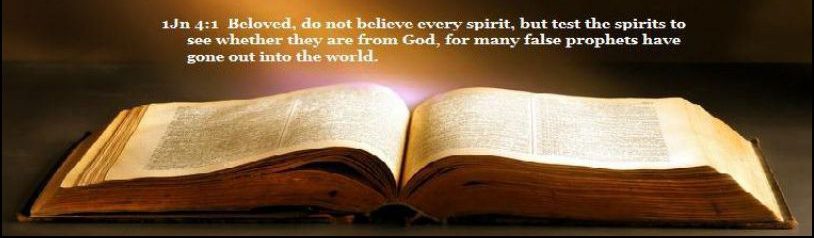




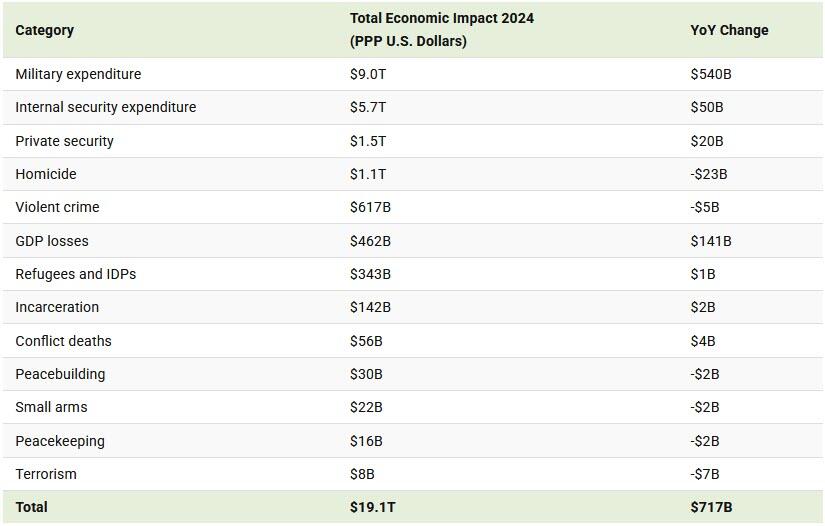

 Truth2Freedom's Blog