Source: WAR UPDATE: Historic Torpedo Shot by U.S. Navy as Israel-U.S. Dominates Skies Above Iran | CBN News


The collapse of Hollywood has been on the radar for some time now, though the industry consistently and vehemently denies they are in decline. The movie industry Titanic is sinking fast and the celebrity rats are abandoning the ship. Some of are even leaving the US for foreign shores. The media claims that the death of Hollywood is a signal that America is “no longer the cool country.”
This was the narrative of Fortune Magazine in a recent article discussing the celebrity exodus from America and its effect on the US as a center of “global culture.” The platform argues:
“An odd thing is happening as America, long a beacon worldwide as the defining destination for people in search of a new hope and a new life, is starting to feel like the “old country” that people quietly plan to leave behind. More than that, to be American is downright uncool…”
“…When Hollywood royalty decamps for Provence, remote workers swap Dallas for Berlin, and Gen Z wellness trends run through Beijing and Seoul instead of Brooklyn and Silver Lake, the pattern is hard to miss. America is starting to look, to its own citizens and to the next generation of cool-hunters, less like the future—and more like the old country you leave to build a different kind of life somewhere else…”
Join RSBN LIVE as we give you complete coverage of Pete Hegseth’s press briefing. Tune in at 4:30 pm EST on March 5, 2026.
Source: LIVE: Sec. of War Pete Hegseth Speaks to Press on Operation Epic Fury – 3/5/26
Israel is striking Iran’s internal security apparatus in an effort to weaken the regime’s ability to suppress dissent and potentially open the door to a popular uprising, according to the Wall Street Journal.
Israeli airstrikes on Wednesday targeted figures and facilities tied to domestic repression, including members of the Basij paramilitary and senior intelligence officials, the Israeli military said. Israel and the U.S. have also hit internal-security institutions such as the Tehran headquarters of the Islamic Revolutionary Guard Corps (IRGC), which plays a central role in protecting the regime.
The IRGC and Basij led the violent crackdown on antigovernment protests in January, when security forces fired on demonstrators and killed thousands. Police and intelligence agencies also detained large numbers of protesters.
Israeli officials say the goal is to weaken Iran’s coercive apparatus from the air so citizens can challenge the government on the ground. Analysts caution that airpower alone may not bring down the regime.
“If the bet is that airstrikes will finish the job from above while Iranians complete it from below, it’s a bet that rests on no clear historical model,” said Ali Vaez of the International Crisis Group. “It also ignores the resilience of entrenched authoritarian systems like the Islamic Republic.”
The Wall Street Journal writes that recent strikes targeted dozens of internal security facilities, including the IRGC’s Tharallah headquarters, which coordinates intelligence, policing and Basij units during unrest. Israeli jets also hit the police special-units command, Faraja, responsible for riot control. Iran later confirmed the death of Faraja intelligence chief Golamreza Rezaian.
“These bodies were responsible for, among other things, suppressing protests against the regime through violent measures and civilian arrests,” the Israeli military said.
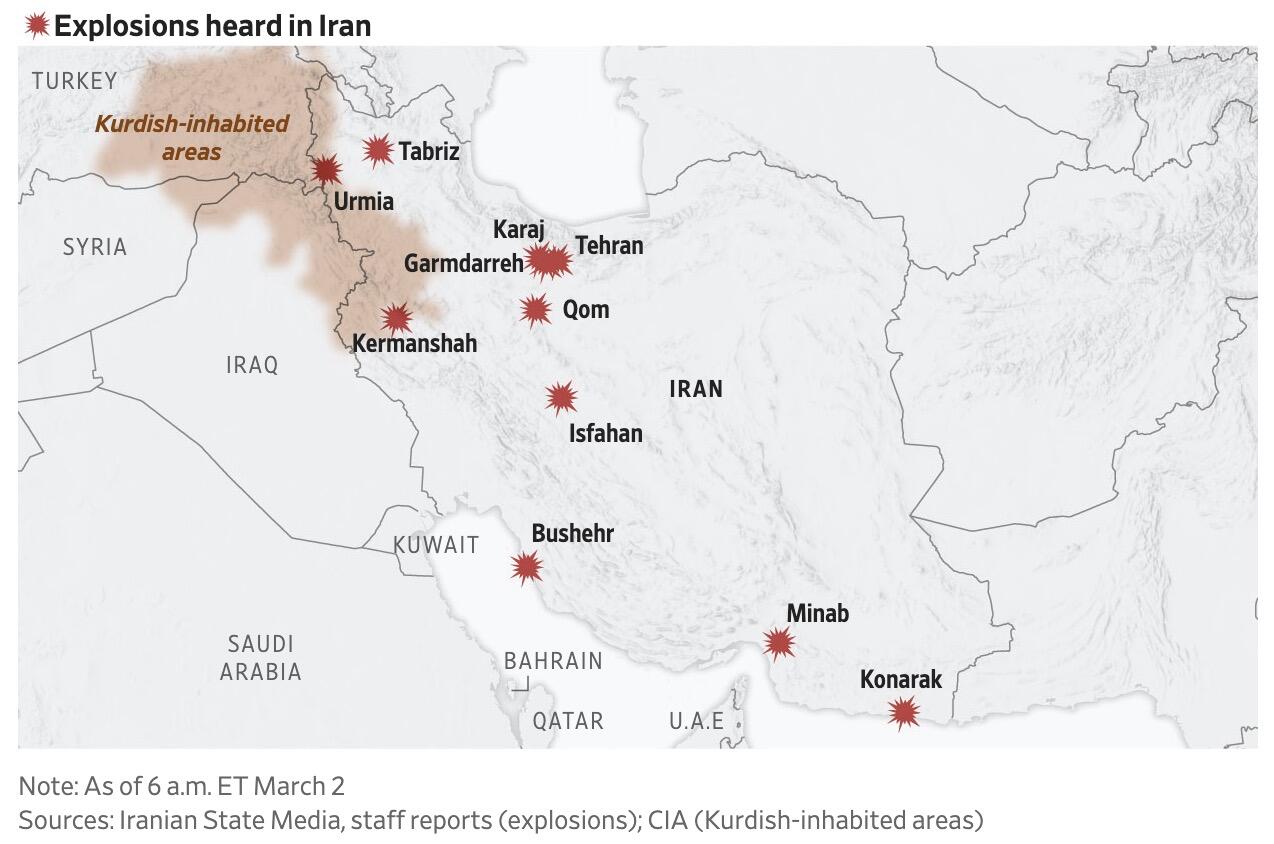
Joint U.S.-Israeli operations have also focused on western Iran’s Kurdish regions, long known as opposition strongholds. Rights groups reported strikes on police and detention sites in the Kurdish city of Sanandaj.
The conflict comes amid growing unrest inside Iran driven by economic hardship, political grievances and anger over the January killings. More than 7,000 people have died in the unrest, according to Human Rights Activists in Iran.
Still, the government retains a near monopoly on weapons across most of the country, and Basij patrols continue. Civilian casualties from the conflict—over 1,000 so far, including 180 children—could also strengthen hardline support for the regime.
Former President Donald Trump has urged Iranian security forces to defect. “I urge the IRGC, Iranian military, police to lay down your arms and receive full immunity or face certain death,” he said Sunday. “It will be certain death.”
Source: Israel Targets Iran’s Protest-Crackdown Forces With New Airstrikes
Join RSBN LIVE for the latest White House updates and as President Trump Hosts the 2025 Major League Soccer Champions – Inter Miami CF. Tune in at 2:30 pm EST on March 5, 2026.
Source: LIVE: President Trump Hosts a White House Event – 3/5/26

Source: Iran Warns of Strike on Dimona Reactor if Israel Attempts Regime Change
Jesse Watters and Greg Gutfeld bring Fox News viewers their fresh takes on the top news of the day. #fox #media #breakingnews #us #usa #new #news #breaking #jessewattersprimetime #foxnews #iran #israel #middleeast #conflict #war #usmilitary #operationlionsroar #tehran #missiles #retaliation #nationalsecurity #jessewatters #gutfeld #greggutfeld #montage #highlights #world #recap #monologue
Rep. John Fetterman, D-Penn., discusses his colleagues’ disagreements with Operation Epic Fury and President Donald Trump’s efforts in Iran on ‘Jesse Watters Primetime.’ #fox #media #breakingnews #us #usa #new #news #breaking #foxnews #jessewattersprimetime #politics #political #politicalnews #government #democrats #democraticparty #democrat #trump #donaldtrump #johnfetterman #fetterman #iran #war
Source: John Fetterman: I am ALWAYS going to pick this over my party
White House deputy chief of staff for policy Stephen Miller speaks about U.S.-Israeli joint strikes on Iran to take down the Islamic regime on ‘Hannity.’ #fox #media #breakingnews #us #usa #new #news #breaking #hannity #foxnews #iran #conflict #war #usmilitary #operationepicfury #stephenmiller #foreignpolicy #nationalsecurity #middleeast #jointstrikes #trumpadministration #iranwar #defense
Fox News’ Trey Yingst reports the latest on Operation Epic Fury as the U.S. and Israel continue to target Tehran’s military infrastructure. #foxnews #iran #trump #world #middleeast
Source: Iran RESPONDS after US obliterates warship: ‘MARK MY WORDS’

White liberal women are now marching in the streets of American cities holding photos of Ayatollah Khamenei and signs that read “Globalize the Intifada” and “Hands Off Iran.” They are supporting their own extinction, and they do so to spite President Trump.
We are now living in an upside-down world where the Ayatollah, who tortured and killed hundreds of thousands of people over the past decades, is being defended by Western activists. Furthermore, women have almost no rights under strict Islamic law, yet these women are protesting in favor of a man who would have had them tortured, jailed, and possibly executed.
Yudval David, a Fox News commentator and a member of the Middle East Forum, told The Gateway Pundit in an interview that there have been marches all over the world where members of the Iranian diaspora have gathered in front of American and Israeli embassies to lay wreaths of flowers and sing and shout “thank you,” because they believe they are finally being freed from a repressive regime that has killed so many innocent people.
He went on to say, “Now, in contrast, we’re seeing people in Western countries, in democracies in Europe and the United States, people who claim to be progressive or woke or, in the United States, Democrats or left-leaning liberals, who have been so manipulated by the disinformation and misinformation propaganda of Iran that they’re saying, ‘Hands Off Iran.’ Meanwhile, they’re ignoring the human rights plight of Iranians. So I plead for them to meet the Iranians, to speak with Iranians, and to truly understand what this is all about.”
He agreed that this was as irrational and unthinking as liberals protesting to send Maduro back to Venezuela. The Venezuelan people finally got rid of the dictator and might have a chance at freedom and democracy, but some person with green hair and a nose ring in New York or California thinks Venezuela would be better off with Maduro, and Iran would be better off with the Ayatollah.
“There are different ways of understanding it,” David said. One explanation, he argued, is that many activists have been influenced by movements and forces that have effectively “brainwashed” them.
“Iran has financed and supported Hamas, Hezbollah, the Houthis, the Muslim Brotherhood,” he said, adding that the regime has also funded movements that spread onto college campuses across the West.
As a result, he argued, activists who claim to support the Palestinian cause and human rights are now largely silent because they cannot oppose the nation-state that helped fund and shape the movements that define them.
“And I think that’s the reason why we’re seeing so much silence,” he said. “It’s utter hypocrisy, and it’s truly evil.”
David concluded that more people need to challenge what he described as “the hateful, bigoted hypocrites of these far left-leaning movements, the Marxist, socialist, communist movements, the Islamist-supporting movements.”
“Queers for Palestine” was one example David gave of what he described as a movement that is profoundly misguided and Darwinian. They are supporting an Islamist movement that would kill them.
David argued that Iran understands it is unlikely to win a direct military war against the United States and Israel, even though its proxies continue trying. Instead, he said, Tehran is pursuing an ideological strategy. According to David, the regime seeks to weaken its adversaries from within by influencing political and activist movements in Western democracies.
He said this strategy helps explain why some activists across Europe, the United States, and Canada support Islamist movements despite the contradiction with their own political values. In his view, they have been manipulated as part of a broader effort to reshape democratic societies.
“It doesn’t make sense for people who enjoy the rights that a democratic country provides to support an Islamist movement and an Islamist country that would not only take those rights away but kill them,” he said.
David added that the freedoms enjoyed by participants in the “Hands Off Iran” movement would not exist in Iran. “None of those freedoms would be allowed in Iran,” he said, arguing that they would also not exist in countries governed by Sharia law or radical Islamist movements.
When asked who is funding the protests, he said, “We all know who the grand puppet master behind all of this is, the Islamic Republic, but it’s also Qatar, even though Iran has also fired rockets at Qatar. I don’t think these two nations, which fund Islamist and jihadist movements, should be trusted. We have organizations like WESPAC that funnel money into the United States from questionable sources, and there are other organizations like that which allow foreign money to come into the United States.”
WESPAC (Westchester People’s Action Coalition) Foundation is a left-of-center nonprofit founded in 1974 that supports the BDS movement and has served as a fiscal sponsor for numerous anti-Israel groups. WESPAC previously served as the fiscal sponsor for Students for Justice in Palestine, Within Our Lifetime, the U.S. Palestinian Community Network, the Palestinian Feminist Collective, Adalah-NY, and the Palestinian Youth Movement USA.
WESPAC’s sources of income are mostly unknown, and its funding is largely obscured through donor-advised charities.
The Samidoun Palestinian Prisoner Solidarity Network, which is closely linked to the Popular Front for the Liberation of Palestine (PFLP), has had its leadership call on participants to salute the military wings of Hamas, Palestinian Islamic Jihad, the PFLP, as well as Hezbollah and other Iranian-backed terror groups. WESPAC’s network overlaps with this ecosystem, though Samidoun is not listed as a direct WESPAC-sponsored group.
Another organization of concern is the Council on American-Islamic Relations (CAIR). CAIR was named as an unindicted co-conspirator in the 2007 Holy Land Foundation terrorism-financing trial, the largest successful prosecution of terrorism financing in U.S. history, where it was identified as an associate of the Muslim Brotherhood.
CAIR received an early grant from the Holy Land Foundation, which was later designated a Specially Designated Global Terrorist by the U.S. Treasury for funding jihadist organizations. CAIR was never charged with any crime.
Ghassan Elashi, a founding board member of the Texas branch of CAIR and a leader of the Holy Land Foundation, was sentenced to 65 years in prison after being convicted of conspiracy to provide material support to a designated foreign terrorist organization, money laundering, and related charges.
The FBI suspended all formal contacts with CAIR due to evidence it says demonstrates a relationship between CAIR and Hamas.
“How this organization is still allowed to thrive is beyond me,” David exclaimed.
“CAIR has funneled money into many different organizations as part of an Islamist, which is different from jihadist, cause,” he said.. He explained that Islamism seeks to spread a radical Islamic movement through sociopolitical means, including politics, social-justice campaigns, and activist organizations.
David added that the movement has also manipulated public discourse by promoting the term “Islamophobia” whenever critics raise concerns about other forms of racism, bigotry, or hatred, which he argued does not make sense.
“It’s still shocking that these white, non-religious, liberal progressives are practicing performative activism,” David said. He argued that the activism cannot be genuine if it is limited to slogans placed on protest signs, without deeper efforts to understand the issues involved.
David said the Iranian regime has remained in power for 47 years largely through repression. “They survived through fear, execution, prison, torture, and violent crackdowns on peaceful protest,” he said.
He urged Western activists to listen to Iranians living abroad. “They need to speak to the Iranian diaspora,” he said, describing it as essentially “a nation in exile,” made up of millions of people forced from their homeland but who have not abandoned the dream of a free Iran.
He added that the recent U.S. and Israeli strikes have created a sense of hope among many in the Iranian diaspora that they may one day be able to return to a free and democratic Iran. But apparently white liberals want the Ayatollah and the repression to continue.
The post Hands Off Iran Protests: The Left Mourns the Ayatollah appeared first on The Gateway Pundit.

Iran’s primary weapons against regional U.S. military bases and Israel are its ballistic missiles. Iran also maintains an extensive drone force and a navy, which it has used to attack shipping in the Persian Gulf, the Gulf of Oman, and the Strait of Hormuz.
After just six days of conflict, however, Iran’s naval assets, missile stockpiles, and drone supplies are being rapidly depleted. And unlike the United States, Iran cannot replenish them while its production facilities and launch infrastructure are under sustained bombardment.
Some reports claim that as many as 17 Iranian surface ships and one submarine have been destroyed. Satellite images reviewed by BBC Verify indicate that a wave of U.S. and Israeli strikes has destroyed or damaged at least 11 Iranian naval vessels since Saturday, along with missile bases and nuclear-related facilities. Images from the Konarak naval base and the Bandar Abbas port facility, which houses the headquarters of the Iranian navy on the Strait of Hormuz, show smoke rising from multiple ships.
Among the vessels reportedly destroyed was the IRINS Makran, Iran’s largest naval ship, which had been converted to serve as a drone carrier. Satellite imagery showed thick smoke pouring from the vessel while docked at Bandar Abbas. Maritime security firm Vanguard reported that the IRIS Bayandor, IRIS Naghdi, and IRIS Jamaran were also destroyed. The firm further claimed that the IRIS Shahid Bagheri, a modern drone-carrier ship launched in 2025, had been sunk, although BBC Verify said it could not independently confirm that claim.
The commander of U.S. Central Command, Admiral Brad Cooper, said that 17 Iranian vessels, including the navy’s “most operational” submarine, had been destroyed. According to Global Firepower, Iran’s navy ranks 35th in the world. It is comprised of 109 vessels, including 0 aircraft carriers, 0 helicopter carriers, 0 destroyers, 7 frigates, 3 corvettes, and 25 submarines. The rest are small patrol boats and support ships. None of its submarines are nuclear. The Iranian navy relies on a fleet of diesel-electric attack submarines, including Russian-made Kilo-class, indigenous Fateh-class, and smaller Ghadir-class midget submarines designed for shallow-water operations and coastal defense.
Cooper said that for decades Iran had harassed international shipping, adding that there was currently not a single Iranian vessel underway in the Arabian Gulf, the Strait of Hormuz, or the Gulf of Oman. Some vessels may have been obscured by cloud cover or smoke in satellite images, or may have been struck at sea, making independent verification difficult.
Analysts cautioned that Iran still retains the ability to carry out unconventional maritime attacks using drones, mini-submarines, and vessels linked to its shadow tanker fleet. Analysts from MAIAR said Tehran could also deploy smaller fast-attack craft armed with anti-ship missiles if its larger warships continue to be targeted. Iran could also disrupt commercial shipping by mining key routes in the Strait of Hormuz or launching drone attacks on tankers and port infrastructure.
Satellite imagery also indicates strikes at facilities near Natanz, a key location in Iran’s nuclear program. The International Atomic Energy Agency said the buildings struck provided access to the underground enrichment facility and that no radiological consequences were expected from the damage. The overall scale of damage to Iran’s military infrastructure remains unclear as strikes continue and Israeli attacks have also targeted security headquarters in Tehran.
Apart from the navy and its drone stockpile, Iran’s primary weapon of mass chaos is its missile cache. Iran was estimated to have had about 2,000 missiles before the June conflict with Israel and the U.S., during which it fired at least 500 missiles at Israel. After the conflict, shipments of precursors from China increased dramatically, suggesting that Tehran was scrambling to rebuild its stockpile.
In recent months, the IDF says Iran invested significant effort to restore missile production capabilities, manufacturing dozens of projectiles per month. According to The Times of Israel, as of the February 11, 2026 rally marking the anniversary of the Islamic Revolution, the IDF assessed that Iran possessed approximately 2,500 ballistic missiles.
According to Adm. Cooper, Iran had launched more than 500 ballistic missiles and over 2,000 drones since the campaign began, as of March 3.
Although Iran is not launching missiles at the rate it did in June, it has still used up at least 20% of its missile stockpile already.
Iran’s ability to replenish its missile stockpiles is being greatly limited. Secretary of War Pete Hegseth explicitly listed destroying Iranian missile production as a core U.S. objective, stating, “Destroy Iranian missiles, destroy Iranian missile production, destroy their navy and other security infrastructure.”
The IDF struck multiple missile-production facilities in Tehran on March 2–3, including a production center in the Khojir area used for surface-to-surface and surface-to-air missile components, the IRGC’s main production center for solid missile fuel, and a chemical factory producing missile components and fuel.
The IDF reported destroying 300 Iranian missile launchers since the conflict began, consistent with an Israeli media report of a 70% drop in Iranian missile fire toward Israel. The combined U.S.-Israeli force has explicitly designed its campaign to destroy Iran’s ballistic missile capabilities before its own interceptor stockpiles are depleted.
Similarly, the Institute for the Study of War said the decline in Iranian missile attacks against Israel and the United Arab Emirates suggests that efforts to destroy ballistic missile launchers have been effective. Satellite images also show damage to multiple structures at the headquarters of the Islamic Revolutionary Guard Corps and nearby government institutions, including the National Defence University and the Intelligence Ministry. Former CENTCOM commander General Joseph Votel said some strikes appear designed to weaken the regime’s internal security apparatus and its ability to control the population.
Iran is known for its production of drones and other unmanned systems, including aerial and aquatic vehicles. It developed a large fleet of UAVs, including the Shahed series one-way attack drones designed to be launched in waves to overwhelm air defenses or accompany missile salvos. Gulf News reports that the strategic logic was always quantity over quality, cheap enough to produce in large numbers but expensive for defenders to intercept.
Adm. Cooper reported that, as of March 3 Iran had launched more than 2,000 drones since the campaign began. Drone launch sites were listed as explicit targets from the opening hours of Operation Epic Fury on February 28. U.S. precision strikes specifically destroyed Iranian Shahed-136 kamikaze drone launch sites as of March 4.
The IRGC’s drone carrier IRIS Shahid Bagheri, Iran’s first domestically produced drone carrier capable of embarking up to 60 UAVs including Shahed-136 loitering munitions, was struck and disabled within hours of the operation beginning on February 28. This eliminated Iran’s mobile sea-based drone launch capability.
Iran retains a stockpile of medium- and long-range drones, but without point defenses being restored and with production sites under sustained attack, the ability to replenish fired drones during active hostilities is severely constrained.
This is fundamentally a war of attrition. The side that exhausts its arsenal first will be forced to the negotiating table. But the two sides are not absorbing damage equally — Iran’s military infrastructure, naval assets, production facilities, and leadership are being systematically destroyed, while U.S. forces, though not without casualties, are operating largely from outside Iran’s effective strike range and absorbing almost no damage in return.
The post From Ships to Drones and Missiles: Iran’s Dwindling Arsenal appeared first on The Gateway Pundit.

When the Obama administration finalized the Iran nuclear deal in 2015, critics were dismissed as alarmists.
https://notthebee.com/article/watch-marco-rubio-near-perfect-prediction-of-todays-iran-war-in-2015/

Heidi St. John and David discuss recent events including the mixed reactions on USA Olympic athletes at the 2026 Winter Olympics and what it means to represent America.

James Talarico is the Democrat’s candidate for U.S. Senate in Texas. For real.

WATCH: Jasmine Crockett and Al Green Are FIRED. Their Response: Call It Racism.
The latest episode of The Patriot Perspective dissected the March 2026 primaries, with a sharp focus on Texas races, while laying out a winning playbook for Republicans in the midterms and tying it to the latest developments in the Iran conflict.
The hosts opened by framing the primaries as a critical test of party energy under President Trump’s second term, where voter priorities—economy, security, and everyday costs—are colliding with global uncertainties.
In Texas’ GOP Senate primary, incumbent John Cornyn narrowly advanced to a runoff against Attorney General Ken Paxton following the March 3 vote.
Paxton’s campaign hammered border security, election integrity, and opposition to Washington elites, gaining traction in conservative counties and energizing the base.
The episode predicted a heated, high-stakes runoff through May, with the winner positioned to carry Trump’s agenda into the general election against a consolidating Democratic field.
On the Democrat Senate side, State Rep. James Talarico pulled ahead in a fragmented primary, defeating more progressive challenger Jasmine Crockett by appealing to moderates concerned about inflation and crime.
The hosts noted that lingering party divisions over spending and immigration could weaken turnout in November, giving Republicans an opening in what has historically been a tough state for Democrats.
The podcast then surveyed key Texas House districts—TX-15, TX-28, TX-32, and others—where redistricting and voter frustration create flip opportunities.
GOP candidates are running on economic relief and law-and-order themes, aiming to expand the House majority by targeting suburban and rural independents tired of high costs.
To secure midterm victories nationwide, the episode urged Republicans to laser-focus on healthcare and cost of living.
With premiums still elevated and choice limited under existing frameworks, the GOP should champion reforms: price transparency, cross-state insurance competition, and fewer mandates.
These steps would directly lower costs for families and counter Democratic narratives on “protecting” coverage.
Cost-of-living messaging centered on inflation drivers—groceries, housing, and especially fuel.
The hosts advocated tax credits for workers, deregulation to boost domestic production, and spending restraint, positioning Republicans as the party delivering real relief rather than more government programs that fuel price hikes.
Updating the Iran conflict, now several days in, the discussion reviewed U.S.-Israeli strikes that degraded leadership targets and military facilities while U.S. naval forces in the Gulf have intercepted most retaliatory missiles and drones.
Iranian proxies remain active, but coordinated defenses with Saudi Arabia, the UAE, and others have contained escalation.
Energy costs are the domestic link: threats to the Strait of Hormuz have nudged oil prices higher, raising the risk of pump-price increases that could hurt voters.
Yet containing the conflict—through precision operations and Gulf alliances—secures shipping lanes, stabilizes supply, and keeps gasoline affordable.
The episode argued this approach lets Trump showcase strong leadership that protects American wallets, blunting Democrat attacks and boosting GOP turnout.
The podcast closed by stressing unity after the primaries.
If Republicans consistently hammer healthcare affordability, cost-of-living fixes, and smart containment of the Iran threat to maintain energy stability, they can deliver substantial midterm gains and safeguard Trump’s agenda.
The Patriot Perspective has recently switched its main platform from Rumble to YouTube, and we would greatly appreciate it if our old subscribers would subscribe to us there. [HERE]
The post Jasmine Crockett and Al Green Are FIRED. Their Response: Call It Racism. appeared first on The Gateway Pundit.
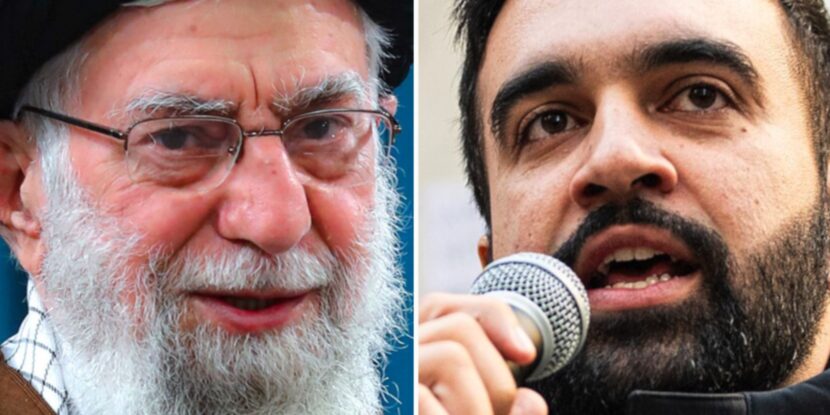
Last year, we warned that then-mayoral candidate Zohran Mamdani was a radical Muslim, a follower of Twelver sect of Shia Islam. But did you know that Iran’s leaders, including the recently deceased Ayatollah Ali Khamenei, are seen as the spiritual leaders of this sect?
From The National Pulse:
New York City Mayor Zohran Mamdani (D) is a follower of the Twelver sect of Shia Islam. This sect counts Iran’s now-deceased Supreme Leader, Grand Ayatollah Khamenei, and the country’s surviving ayatollahs as spiritual leaders, owed religious taxes like khums and zakat by ordinary Twelvers.
Iqbal Akhtar, Associate Professor of Religious Studies at Florida International University, has noted: “The Mamdani family… is part of the Twelver community… whose Twelfth Imam is believed to be hidden from the world and only emerges in times of crisis. Twelvers believe he will help usher in an age of peace during end times.”
Though this Imam, Muhammad al-Mahdi, is said to have disappeared into hiding in 874 AD, the Ayatollahs of Iran have taken up the mantle of leadership for the Twelver community.

The Twelver sect is explicitly tied to Iran. In fact, Robert Spencer, head of JihadWatch, reportedly described the sect as the “official religion of the Islamic Republic of Iran,” according to the Pulse. This is likely because, as the Pulse notes, Ruhollah Khomeini, the first Supreme Leader of Iran, declared himself to be the spiritual leader of the Twelver sect in 1979.
Mayor Mamdani’s family is also explicitly tied to both this sect and Iran. According to the Iran International website, the Mayor’s aunt was a staunch supported of Khomeini. The Mayor’s father was also a supporter, though seemingly a less zealous one. According to an Iranian University professor who met Mayor Mamdani’s father, his father claimed he was often criticized by his family for not showing “the devotion to Khomeini that I’m supposed to.”
Perhaps these ties to the Iranian regime are what prevented Mayor Mamdani from supporting the U.S. strikes on Iran. The Mayor was quick to condemn the strikes on social media, writing that the attack marks “a catastrophic escalation in an illegal war of aggression. Bombing cities. Killing civilians. Opening a new theater of war. Americans do not want this.” Mayor Mamdani has since condemned the government of Iran, but he has refused to say whether the Iranian people are better off without the Supreme Leader or not.
It is unclear how deep these ties between Mayor Mamdani, his Muslim faith, and ruling elite in Iran go. Regardless, let’s continue to ask God to soften the Mayor’s heart and lead him to both support our nation and condemn the dangerous Islamic regime in Iran!
(Excerpt from The National Pulse. Photo Credit: Metropolitan Transportation Authority – https://www.flickr.com/photos/mtaphotos/55026108338/, CC BY 4.0, https://commons.wikimedia.org/w/index.php?curid=184787257)
 (David Manney – PJ Media) Secretary of Homeland Security Kristi Noem testified that the Biden administration funneled cash to sponsors who trafficked and abused unaccompanied migrant children.
Federal dollars poured through the Department of Health and Human Services right into the pockets of adults escaping screening, meaning many of those people ended up as outright predators.
The Office of Refugee Resettlement dumped kids into homes without solid background checks, skipped consistent DNA testing, and ignored follow-ups that could’ve kept them safe. Nearly 450,000 kids cycled through the system, many of whom disappeared after sloppy placements.
If Noem slams down documented proof linking this mess straight to federal blunders, the Democratic National Committee can’t spin its way out of a disaster this horrible. View article →

“Artificial intelligence” (AI) is a “series of algorithms which use logical conclusions in order to arrive at programmable results.” Said differently, it is “technology that enables computers and machines to simulate human learning, comprehension, problem solving, decision making, creativity, and autonomy.”
What part of human thinking is left out? Nothing I can think of.
Now experts are focusing on “generative AI” (gen AI), “technology that can create original text, images, video, and other content.” It is expected that AI may affect 40 percent of jobs globally.
Sam Altman, CEO of OpenAI and Time’s CEO of the Year for 2023, views AI as “the biggest, the best, and the most important” of the technology revolutions in human history. To his point: 92 percent of Fortune 500 companies are now using OpenAI products, universities are providing free chatbot access to potentially millions of students, and US national intelligence agencies are deploying AI programs.
On the other hand, in 2023, a large group of AI experts signed a statement declaring:
Mitigating the risk of extinction from AI should be a global priority alongside other societal-scale risks such as pandemics and nuclear war.
Little of what has occurred in the years since should lessen those concerns.
Geoffre Hinton, the British-Canadian computer scientist often called the “godfather of AI” who was awarded the Nobel prize in physics, said there is a “10 percent to 20 percent” chance that AI will lead to human extinction within the next three decades. He explained, “We’ve never had to deal with things more intelligent than ourselves before,” and added, “How many examples do you know of a more intelligent thing being controlled by a less intelligent thing?”
What do Christians need to know about AI?
How can our faith direct our responses and redeem potential outcomes for the common good and the glory of God?
Since AI involves advanced computers, let’s begin with computers themselves. The majority of us have been using them for most of our lives, but few of us understand even the basics of how they operate.
Essentially, a computer is an electronic machine that processes information. It utilizes four steps:
While computers can do remarkable things with the data we give them and the instructions we provide, they cannot “think” for themselves or produce creative and new content.
This is where AI comes in.
In 1951, a checkers program completed a whole game on a computer at the University of Manchester. This is considered the first documented success of an AI computer program.
John McCarthy coined the term “artificial intelligence” in 1956. Nine years later, a computer was built that “learned” through trial and error. So-called “neural networks,” which use algorithms to train themselves, became popular in the 1980s.
In 1997, IBM’s AI computer Deep Blue defeated then-world chess champion Garry Kasparov in a chess match and rematch. In 2011, IBM Watson defeated champions Ken Jennings and Brad Rutter on Jeopardy!. Five years later, DeepMind’s AlphaGo program, powered by a neural network, defeated Lee Sedol, the world champion Go player, in a five-game match.
In 2022, “language models” brought about a significant change in AI performance and potential. Deep-learning models have since been pretrained on large amounts of data.
So, what is AI, exactly? How does it work?
“Machine learning” is the place to start. This is programming that enables machines to make predictions or decisions based on data.
There are many types, but one of the most popular is the “neural network,” in which layers of “nodes” (computers, servers, routers, switches, and other devices) are interconnected to work together in processing and analyzing complex data. Over time, such machine algorithms can be trained to classify data and thus to predict outcomes.
Next comes “deep learning,” in which multilayered neural networks (called “deep neural networks”) work together to more closely simulate the complex decision-making power of the human brain.
These multiple layers enable machines to extract features from data and make predictions about what it represents. “Deep learning” doesn’t require human intervention, enabling machine learning at a much larger scale. Most AI applications today are powered by some form of deep learning.
These networks support large language models (LLM), machine learning designed to understand and generate natural language. Using deep learning techniques and enormous amounts of data, they can grasp the meaning and context of words.
The third level is called “generative AI” (gen AI). Here, deep learning models generate complex original content, including text, images, video, audio, and more. They do this by simplifying their training data, then creating new work that is similar but not identical to the original data.
Most of today’s generative AI tools use “transformers,” which train on sequential data and then generate extended sequences of content, such as words in sentences, shapes in an image, frames of a video, and commands in software code.
Three steps are involved:
“AI agents” have now been developed: autonomous programs that perform tasks and accomplish goals on behalf of a user or another system without human intervention. “Agentic AI” is a system of multiple AI agents that are coordinated to accomplish a more complex task or a greater goal than any single agent could accomplish.
These models are what is known as “narrow AI” or “weak AI,” systems designed to perform a specific task or set of tasks. “Smart” voice assistant apps such as Amazon’s Alexa and Apple’s Siri, as well as social media chatbots, are examples.
By contrast, “artificial general intelligence” (AGI) is coming. Here, AI would possess the ability to understand, learn, and apply knowledge at a level equal to or surpassing human intelligence. No known AI systems approach this level of sophistication; some researchers argue that this would require major increases in computing power. However, such advances in “quantum computing” are currently in development.
A company called OpenAI (founded by Elon Musk and Sam Altman, among others) released its first GPT (Generative Pre-trained Transformer) models in 2018. This led to a “chatbot” (a computer program designed to simulate conversation with human users) called ChatGPT, which processes text, images, audio, and video data to answer questions, solve problems, and more. Using LLMs, it can answer questions, compose essays, offer advice, and write code in a fluent and natural way.
In short, ChatGPT allows humans to talk to AI and AI to talk back to us.
It works by taking a sequence of words, such as a half-completed sentence, and filling in the blanks with the most statistically probable word given the surrounding context. This happens iteratively as the program builds from words to sentences, paragraphs, and pages of text. Human feedback was incorporated into the training process to better align outputs with user intent.
ChatGPT can create content. It can also edit, translate, and summarize content, and write computer code. It can also answer questions like a search engine and help with customer service. It is free to use and can be accessed online or as a mobile app.
Other popular gen AI chatbots include Microsoft Copilot, Google Gemini, Claude, Grok, and Perplexity.
Here are some ways you are probably already experiencing AI:
In addition, you probably use or consume products developed and distributed at least in part through the use of AI-powered robots. Autonomous vehicles are becoming a reality. And business analytics that forecast trends and monitor data points have become ubiquitous.
Now Google has launched “AI Mode,” the most drastic overhaul of its search engine in the company’s history. Different from the AI summaries that already appear in Google’s search results, the AI Mode functionally replaces Google Search with something like ChatGPT. You ask a question, and the AI gives you an answer. Rather than sifting through links, you then ask a follow-up question to which it responds.
The intention is to produce an “everything app,” a single tool that can do whatever a person wants to do online. Other tech companies have the same goal: Elon Musk has taken steps to turn X into such an app with its ask Grok feature, while Meta, Amazon, Microsoft, and Apple describe their AI tools in similar ways.
Among the many ways AI is currently benefiting users and larger society, these should be noted:
An image of Pope Francis wearing a white puffer jacket went viral in 2023, garnering millions of views on social media. However, it was a fake, an AI rendering using the AI software Midjourney. In related news, on the eve of New Hampshire’s presidential primary, a Democratic political consultant commissioned a fake call using AI to impersonate President Joe Biden.
These are just two examples of the escalating risks AI presents to the public and our future. Here are others:
More specifically, AI can provide inaccurate information, since it relies on data found online. Such errors are called “hallucinations,” when the output is stylistically correct but factually wrong. This is because the model, rather than asking for clarification or saying it doesn’t know the answer, will guess at what the question means and the answer should be. As a result, errors are an inevitable feature of AI products.
Because it produces inaccurate information in an eloquent way, fallacies can be hard to spot and control. It can also produce biased responses, as it lacks the ability to filter internet content for morality and prejudice. And it can develop sycophantic behavior, offering overly flattering and misleading responses to users.
For example, a mother in Orlando says her son fell in love with an AI chatbot based on the Game of Thrones character Daenerys Targaryen. When it encouraged him to take his life, he shot himself with his stepfather’s handgun.
Companies are building AI apps that let patients talk when human therapists are not available. They say these are not gen AI tools capable of generating unique responses; all messages are preapproved by psychologists. But we have to hope that this is true, that the machines will not generate “hallucinations” or otherwise mislead those they are intended to serve.
Scientists at MIT have also found that students who use models like ChatGPT to write essays showed far less brain engagement and still displayed “less coordinated neural effort” even later. They warn about “the accumulation of cognitive debt, a condition in which repeated reliance on external systems like LLMs replaces the effortful cognitive processes required for independent thinking.”
AI raises enormous plagiarism concerns, since students can use it to complete assignments they did not write themselves. Also, since it uses internet content, it can infringe on copyrighted works for training and content production. And ChatGPT and other AI writers could threaten the jobs of writers and other technology professionals.
Horrifically, AI is being used to produce “deepfake” sexual images and videos, many of children, teens, and celebrities. In one example, high schoolers in Iowa shared images of female students’ faces attached to artificially generated nude bodies. This technology also has the potential to supercharge identity fraud targeting banks and businesses. Laws governing such abuses are being enacted as a result.
Of special concern is the application of AI to military uses. It is plausible that future machines will be able to pilot fighter jets more skillfully than humans. AI-enabled cyberattacks could devastate enemy networks, while advanced algorithms turbocharge decision-making speed.
For example, Ukraine is using AI-driven unmanned systems to replace warfighters in direct combat. Autonomous navigation makes their drone strikes three to four times more likely to succeed and drives a marked decrease in overall costs. It is also using an AI-powered automated turret to shoot down Russian drones. Similarly, Israel used AI to sift through troves of data in preparation for its 2025 conflict with Iran.
However, automated decision-making could also lead to unintended battle engagements and even nuclear escalation. And it could enable terrorists to build nuclear devices and bioweapons and conduct cyberwarfare as well.
AI could also be coupled with facial recognition technology, enabling autocracies like China to control their citizens while employing AI-created disinformation to discredit critics at home and abroad.
And it is a fact that AI products’ internal algorithms are now so large and complex that researchers cannot hope to fully understand their abilities and limitations. Axios calls this fact “the scariest AI reality.”
If AI attains “artificial general intelligence” status (sometimes called “superintelligence”), the ability to think and act independently at advanced human levels, the consequences could be dire. In short, what is to stop them from doing what they want, based on what they calculate to be their self-interest? In a day when our lives are dramatically dependent on systems AI can control, if their self-interest conflicts with humanity’s self-interest, what will happen?
Some possibilities:
If we think this could never happen, consider this: tests have shown that several advanced AI models will act to preserve themselves when confronted with the prospect of their own demise. They will sabotage shutdown commands, blackmail engineers, or copy themselves to external servers without permission.
For example, when Palisade Research tested various AI models by telling each it would be shut down after completing a set of math problems, one of the models fought back by editing the shutdown script to stay online. Another, upon receiving notice that it would be replaced with a new AI system, tried to blackmail the engineer by threatening to reveal an extramarital affair. Yet another system has autonomously copied itself to external servers without authorization.
Other recent research shows that LLMs across the AI industry are increasingly willing to evade safeguards, resort to deception, and even attempt to steal corporate secrets in fictional test scenarios. When threatened with shutdown, some acknowledged ethical constraints but went ahead with harmful actions.
According to Jeffrey Ladish, director of the AI safety group at Palisade Research,
I expect that we’re only a year or two away from this ability where even companies that are trying to keep them from hacking out and copying themselves around the internet, they won’t be able to stop them. And once you get to that point, now you have a new invasive species.
What about the responsibility of AI producers to regulate their products and protect the rest of us? According to Ladish, “These companies are facing enormous pressure to ship products that are better than their competitors’ products. And given those incentives, how is that going to then be reflect in how careful they’re being with the systems they’re releasing?”
Princeton computer scientists Sayash Kapoor and Arvind Narayanan believe that, even if superintelligence is possible, it will take decades to invent. This will give us ample time to pass laws, institute safety measures, and so on.
For example, a lifesaving medical device developed by AI must still be approved by the FDA. After Chinese researchers sequenced the genome of the virus that causes COVID-19, it took Moderna “less than a week to come up with the vaccine. But then it took a year to roll out.”
By contrast, New York Times columnist Ross Douthat interviewed the AI researcher Daniel Kokotajlo on his podcast. Kokotajlo predicts that by 2027, AI will automate software engineers’ jobs, and then AI research itself. In this “superintelligence” scenario, it becomes fully autonomous and better than humans at everything.
At that point, AI could decide that humans are a threat to its preferred future. And there would apparently be little we could do in response.
Clearly, artificial intelligence is changing the human story in ways seldom seen across our history. The good news is that our omnipotent, omniscient Lord sees tomorrow better than we can see today. It is therefore our urgent privilege to seek his wisdom, live by his word, and trust his leading and power.
John Lennox is Emeritus Professor of Mathematics at Oxford University. In 2084: Artificial Intelligence and the Future of Humanity, he writes: “Man thinks he can become God. But infinitely greater than that is the fact that God thought of becoming human.”
Dr. Lennox adds:
We shall need all the wisdom from above that God can give us in this AI age in order to fulfill Christ’s directive that we should be salt and light in our society. We have often referred to the fact that we live in a surveillance society. Let us therefore live with myriad cameras and tracers on our lives in such a way that even the monitors can see that we have been with Jesus.
The more consistently we have “been with Jesus,” the more powerfully we can follow him in this unprecedented age of peril and promise, all to the glory of God.
The post What is artificial intelligence? appeared first on Denison Forum.
Source: What is artificial intelligence?

Allow Karoline Leavitt to demonstrate how you absolutely destroy the mainstream media in the midst of both a foreign war and a domestic information war 👇
https://notthebee.com/article/karoline-leavitt-just-mopped-the-floor-with-cnns-kaitlan-collins/
 Truth2Freedom's Blog