There are two ways to be fooled. One is to believe what isn’t true; the other is to refuse to believe what is true. —Soren Kierkegaard. "…truth is true even if nobody believes it, and falsehood is false even if everybody believes it. That is why truth does not yield to opinion, fashion, numbers, office, or sincerity–it is simply true and that is the end of it" – Os Guinness, Time for Truth, pg.39. “He that takes truth for his guide, and duty for his end, may safely trust to God’s providence to lead him aright.” – Blaise Pascal. "There is but one straight course, and that is to seek truth and pursue it steadily" – George Washington letter to Edmund Randolph — 1795. We live in a “post-truth” world. According to the dictionary, “post-truth” means, “relating to or denoting circumstances in which objective facts are less influential in shaping public opinion than appeals to emotion and personal belief.” Simply put, we now live in a culture that seems to value experience and emotion more than truth. Truth will never go away no matter how hard one might wish. Going beyond the MSM idealogical opinion/bias and their low information tabloid reality show news with a distractional superficial focus on entertainment, sensationalism, emotionalism and activist reporting – this blogs goal is to, in some small way, put a plug in the broken dam of truth and save as many as possible from the consequences—temporal and eternal. "The further a society drifts from truth, the more it will hate those who speak it." – George Orwell “There are two ways to be fooled. One is to believe what isn’t true; the other is to refuse to believe what is true.” ― Soren Kierkegaard
Amid findings of massive fraud and theft perpetrated by aliens in the United States, the US State Department has frozen immigration visa processing for immigrants from 75 countries, including Somalia.
The 75 nationalities have been identified as being at “high risk of public benefits usage.”
More from Fox:
Minnesota has become ground zero for some of the largest pandemic-era fraud cases in U.S. history, where Somali aliens have stolen billions of dollars intended to feed children and provide healthcare services.
This comes after the US also ended foreign aid to Somalia because of its thieving culture.
As The Gateway Pundit reported earlier, the United States ended taxpayer-funded food aid to Somalia after local officials torched and looted the stockpiles of food stored in a US-funded World Food Programme (WFP) warehouse.
The Somali animals “illegally seized 76 metric tons of donor-funded food aid for vulnerable Somalis,” the State Department office of the Under Secretary for Foreign Assistance said.
Secretary of State Marco Rubio explained that US taxpayer-funded foreign aid “is not charity” and “should be spent in places and on things that further our foreign policy,” while announcing the Somali aid cut.
WATCH:
“The State Department will pause immigrant visa processing from 75 countries whose migrants take welfare from the American people at unacceptable rates. The freeze will remain active until the U.S. can ensure that new immigrants will not extract wealth from the American people,” The department announced on X last week.
“The pause impacts dozens of countries – including Somalia, Haiti, Iran, and Eritrea – whose immigrants often become public charges on the United States upon arrival. We are working to ensure the generosity of the American people will no longer be abused,” the statement continues. “The Trump Administration will always put America First.”
The State Department will pause immigrant visa processing from 75 countries whose migrants take welfare from the American people at unacceptable rates. The freeze will remain active until the U.S. can ensure that new immigrants will not extract wealth from the American people.
President Trump has made clear that immigrants must be financially self-sufficient and not be a financial burden to Americans. The Department of State is undergoing a full review of all policies, regulations, and guidance to ensure that immigrants from these high-risk countries do not utilize welfare in the United States or become a public charge.
Effective January 21, 2026, the Department of State is pausing all visa issuances to immigrant visa applicants who are nationals of the following countries:
Afghanistan, Albania, Algeria, Antigua and Barbuda, Armenia, Azerbaijan, Bahamas, Bangladesh, Barbados, Belarus, Belize, Bhutan, Bosnia and Herzegovina, Brazil, Burma, Cambodia, Cameroon, Cape Verde, Colombia, Cote d’Ivoire, Cuba, Democratic Republic of the Congo, Dominica, Egypt, Eritrea, Ethiopia, Fiji, The Gambia, Georgia, Ghana, Grenada, Guatemala, Guinea, Haiti, Iran, Iraq, Jamaica, Jordan, Kazakhstan, Kosovo, Kuwait, Kyrgyz Republic, Laos, Lebanon, Liberia, Libya, Moldova, Mongolia, Montenegro, Morocco, Nepal, Nicaragua, Nigeria, North Macedonia, Pakistan, Republic of the Congo, Russia, Rwanda, Saint Kitts and Nevis, Saint Lucia, Saint Vincent and the Grenadines, Senegal, Sierra Leone, Somalia, South Sudan, Sudan, Syria, Tanzania, Thailand, Togo, Tunisia, Uganda, Uruguay, Uzbekistan, and Yemen
While America grapples with its own dark past of slavery, a massive chapter of history gets buried by academics who fixate on Western guilt.
Justin Marozzi’s eye-opening book, Captives and Companions, shines a light on the Islamic world’s slave trade, spanning over a millennium with unmatched scale and savagery. This isn’t ancient news, but it is a wake-up call for historians.
Marozzi estimates that from the 7th century to the 20th, up to 17 million Africans and Europeans were enslaved in Muslim lands, dwarfing the transatlantic trade’s 11-15 million.
Brutal raids targeted black Africans for labor and white Europeans for markets in North Africa and the Middle East. The sheer numbers reveal a system that caused more deaths and misery than often admitted.
In the opulent courts of Abbasid Baghdad, slave concubines like the poet ʿInān rose to fame, dazzling with wit and beauty while navigating deadly risks.
These women, often captured from distant lands, became cultural icons but remained property, their lives hanging on a ruler’s whim. Yet, their stories mix triumph with tragedy, showing resilience amid cruelty.
Raiders from Barbary coasts struck fear across Europe, hitting places like Devon, Cornwall, and even Iceland in 1627, where pirates abducted over 400 people into lifelong bondage.
Witnesses recounted horrors: families torn apart, villages burned, and captives sold far from home. This white slavery terrorized coasts for centuries, a truth sidelined in today’s narratives.
Castration created eunuchs for harems, with Victorian-era Sudan alone seeing 35,000 boys die yearly from botched operations to supply 3,500 survivors.
Female slaves faced routine violation, arriving in Egypt or Arabia rarely as virgins after brutal journeys. Such practices highlight a level of barbarism that demands honest reckoning.
Today, descent-based slavery traps over 200,000 in Mali, where people inherit bondage through ancestry, facing violence for resisting.
UN experts urge criminalization, but cultural norms and weak laws let it persist. Victims like one defiant man in Bamako declare inner freedom despite poverty.
In Morocco, King Hassan II kept dozens of young concubines until his 1999 death, echoing royal traditions.
Saudi Arabia holds 740,000 in modern slavery, fueled by migrant exploitation under kafala systems. These nations cling to a “tradition” of foreign enslavement dating back ages.
Marozzi’s fearless history exposes this ongoing nightmare we pretend ended long ago. He also illuminates a forgotten chapter of world history that many historians have conveniently overlooked, enabling them to attribute all conceivable evils to the Western world.
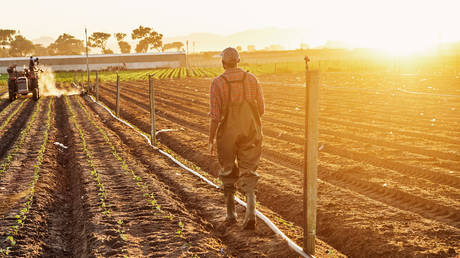
October 30, 2017. Cape Town. People pray during “Stop the farm killings” demonstration at Green Point stadium. Photo by Ruvan Boshoff
President Trump has once again come under fire for admitting White South Africans to the United States under claims of genocide. So far, 59 White South Africans have been granted asylum in the U.S., citing racial persecution and violence.
The same media and politicians who want deported MS-13 gang members returned to the U.S. have decided that there is no genocide in South Africa. While no international court has formally declared it a genocide, and the legal threshold for such a designation is high, the facts on the ground are difficult to ignore: white South Africans are being persecuted. They face the constant threat of violence, along with a legal framework that restricts their career opportunities and threatens to strip them of their land.
South Africa has one of the highest murder rates in the world, and at least half a million people have been murdered in South Africa since the end of apartheid. Some sources claim that as many as a quarter of those victims, particularly in the early years of the current system, were White. However, this claim has been difficult to verify due to the lack of race-disaggregated data in official crime reports.
Attacks on White-owned farms, including theft, rape, assault, and murder, are well documented. Since 1994, there have been approximately 3,398 farm murders, many involving white farmers. In 2024 alone, South Africa recorded nearly 20,000 homicides, including 32 farm-related murders and 256 farm attacks, most of which targeted White farming families. These numbers point to a disproportionate threat faced by White South Africans.
Some South African political figures, such as Julius Malema of the Economic Freedom Fighters (EFF), have made inflammatory statements about land redistribution. Malema has positioned the EFF as a radical alternative, accusing the ruling ANC of failing to address inequality and the transfer of land from White to Black South Africans. He is known for his incendiary rhetoric, including remarks about arming Hamas, singing “Shoot the Boer,” and making statements widely seen as threatening to white South Africans.
Beyond physical violence, white South Africans also face institutionalized discrimination through race-based laws and policies that enforce racial quotas in hiring and promotions, effectively excluding them from many public and private sector opportunities. In addition, land redistribution legislation threatens the possibility of White-owned farms being seized without compensation.
The Broad-Based Black Economic Empowerment (BBBEE) Act rewards companies with higher scores based on Black ownership, management, employment, and procurement from Black-owned businesses. As a result, White-owned businesses often struggle to compete for government contracts or major private sector deals unless they relinquish control or ownership. White entrepreneurs may be excluded from grants, loans, and partnerships because they do not contribute to BBBEE scorecards, limiting economic opportunities, especially for those without political connections or existing wealth.
The Employment Equity Act and its 2025 Amendment require companies to meet racial quotas in hiring and promotions, tied to national and regional demographics. The amendment introduced stricter enforcement and penalties, pressuring employers to favor racial targets over merit. In provinces where Whites make up a small minority, White applicants, regardless of qualifications, can be legally passed over, particularly in civil service and state-owned enterprises.
In South African Police Service v Barnard (2014), the Constitutional Court upheld a decision not to promote a White female officer, Renate Barnard, despite her being the top candidate, because her promotion would have disrupted racial representational goals. This ruling set a precedent that race can legally override merit in public sector advancement, reinforcing systemic barriers for qualified white professionals.
As of recent reports, white South Africans, who make up about 8% of the population, own approximately 72% of privately held farmland. Consequently, the South African government has implemented land reform initiatives, including land restitution and redistribution programs. While expropriation without compensation has been debated, and isolated incidents of land occupation have occurred, a systematic campaign against White farmers has not yet materialized.
However, in 2024, the legal groundwork for such actions was established.
The Expropriation Act of 2024 allows the government to seize private land without compensation under certain “public interest” conditions, such as land reform. Although race-neutral in wording, the political and policy focus overwhelmingly targets land owned by White South Africans due to apartheid-era patterns. As a result, White farmers face legal uncertainty, diminished investment confidence, and the threat of losing their land without recourse.
While some defend these laws as corrective measures for apartheid-era injustices, they function today as legally sanctioned discrimination against a racial minority. Whether or not the violence and systemic marginalization qualify as genocide under international law, the threat is real. These conditions clearly meet the standards for asylum under U.S. and international law.
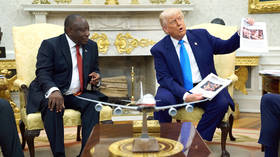
President Donald Trump confronted his South African counterpart, Cyril Ramaphosa, with a video montage alleging discrimination and violence against white farmers during a meeting at the White House on Wednesday.
The meeting, which was ostensibly dedicated to a discussion of trade and bilateral relations, shifted to a discussion about the treatment of the country’s white minority after a journalist asked what would convince Trump that there is “no white genocide in South Africa.”
Ramaphosa interjected, emphasizing the need to listen to the voices of US “friends” to get a full perspective on the issue –prompting Trump to respond, “We have thousands of stories talking about it… I could show you a couple of things.”
“Turn the lights down, and just put this on,” Trump instructed his staff before playing a five-minute-long video montage. The footage included clips of South African opposition figures making inflammatory remarks, as well as images purportedly showing the graves of white farmers.
Trump then presented a stack of printed media articles about South Africa, flipping through the pages and commenting “death, death, death, horrible death.” He claimed the materials evidenced a targeted campaign against white farmers, pointing out that people were fleeing South Africa for their own safety.
In the Oval Office, @POTUS confronted South African President Cyril Ramaphosa's denial of the shocking treatment his country's white farmers are facing with video evidence.
— Rapid Response 47 (@RapidResponse47) May 21, 2025
President Ramaphosa responded by emphasizing that South Africa is a multi-party democracy where individuals can express diverse views, and that the government does not endorse the statements made in the video. He noted that crime in South Africa affects all communities and asserted that it is not racially targeted. Ramaphosa also clarified that the individuals featured in the video were not part of his administration.
“You have hundreds of people, thousands of people trying to come into our country because they feel they’re going to be killed and their land is going to be confiscated. And you do have laws that were passed that give you the right to confiscate land,” Trump claimed.
Tensions between Washington and Pretoria have escalated since Trump returned to office in January. The US administration has accused South Africa of undermining the rights of the white Afrikaner minority through racially-targeted land distribution policies.
Pretoria has defended the measures, stating they are designed to address long-standing racial inequities in land ownership. Trump has pledged to fast-track naturalization for Afrikaners, claiming they are victims of a “genocide.”
Ramaphosa has repeatedly rejected those claims, saying during his latest public appearance, “There’s no genocide in South Africa. That is a fact that’s borne out of a lot of evidence.”
Relations soured further in March when Trump ordered a halt to all US federal funding to South Africa and expelled the country’s ambassador from Washington, accusing him of being “anti-American.” The move came after Pretoria filed a genocide case against Israel at the International Court of Justice (ICJ).
Despite the tense White House exchange, Ramaphosa later described the meeting as having gone “very well,” stressing the importance of dialogue and continued cooperation between the two nations.
In his Oval Office meeting with South African President Cyril Ramaphosa today, President Trump showed a surprise video roundup of political leaders from that country calling for the death of white farmers, a longtime reality that recently resulted in white South African refugees arriving in the U.S.
Trump challenged the foreign leader with a stack of recent news stories about white South Africans being murdered and their farms being seized. Referring to a scene from the video showing white crosses, each representing a murdered South African, Trump said, “It’s a terrible sight.”
The video, entitled “Proof of Persecution in South Africa,” was posted on X by the White House:
President Trump responded to a reporter’s question about the future of the relationship between the U.S. and South Africa:
REPORTER: If this Afrikaner resettlement issue is resolved, what is the potential for the future looking relationship for the United States?@POTUS: “It’s got to be resolved… it will be the end of the country if it’s not resolved.” pic.twitter.com/HTdZxHQw0V
— Rapid Response 47 (@RapidResponse47) May 21, 2025
Later, Trump asked Ramaphosa to explain how such persecution could continue, noting, “They happen to be white, and they happen to be farmers.”
President Trump: “You’re taking people’s land away from them and those people in many cases are being executed. They happen to be White and most of them happen to be Farmers. How do you explain that?” pic.twitter.com/jVv4QfALE4
President Trump asked his counterpart why those inciting violence against white South Africans are not arrested:
Reporter: “Do you denounce that type of language in the video that we saw?”
Ramaphosa: “Oh yes… We are completely opposed to that.”@POTUS: “But why wouldn’t you arrest that man? That man said ‘kill the white farmers’ and then he danced.” pic.twitter.com/tWwNpjsDht
— Rapid Response 47 (@RapidResponse47) May 21, 2025
The Chinese have made enormous mountains of money by exporting cheap goods to the rest of the world, and this has given them a tremendous amount of economic power. Now they are attempting to extend their economic domination by constructing hundreds of very large self-sustaining “special economic zones” in other countries. These “special economic zones” are established in key strategic locations, and they are often exempt from many of the laws and regulations of the host nation.
The most famous “special economic zone” in the world is the Chinese city of Shenzhen.
Back in the 1970s, Shenzhen was just a very small fishing village. Today, it is help up as a shining example of China’s economic miracle…
The most successful SEZ in China was Shenzhen, one of the original pilot zones created by Deng Xiaoping. Shenzhen went from a population of 314,000 to 12.5 million over the span of 40 years. By 1992, within 12 years of its designation as a SEZ, Shenzhen attracted $4.3 billion USD in FDI annually, or 14% of China’s total FDI. Now Shenzhen is known as the Silicon Valley of hardware, because it is home to the world’s largest electronics factories.
China is now home to more than 2,500 SEZs. They range from small business parks to full fledged cities with populations in the millions. The World Bank estimates that China’s SEZs contribute 22% GDP, 45% of its FDI, and 60% of its exports.
After having so much success with special economic zones domestically, the Chinese started implementing this concept elsewhere.
In 2013, the Chinese government announced the creation of the global Belt and Road Initiative (BRI). This plan would revive the silk road by financing the creation of connective infrastructure throughout Eurasia and Africa. The connective infrastructure to be built includes highways, fiber optic cables, railroads, oil pipelines, ports, and airports. This infrastructure would be connected by hubs made up of Chinese SEZs. The Chinese government expects to spend $2 trillion USD by 2030 developing the program.
Today, there are approximately 500 Chinese special economic zones outside of the nation of China, and some of them are the size of “full fledged new cities”…
There are now roughly 500 Chinese funded SEZs outside of China, mostly created as part of the BRI. As hubs of connective infrastructure, SEZs play a critical role in the success of the BRI.
BRI SEZs differ immensely from one another. Most are industrial parks, but some are full fledged new cities. Many are designed from the ground up by Chinese companies, while others are initiated by their home countries and later funded by Chinese interests. Some have budgets in the tens of millions, while others have budgets in the tens of billions.
CBS News recently visited one of these special economic zones in Cambodia.
A convoy of semi-trucks passed by as our CBS News team drove about two hours south of Cambodia’s capital, Phnom Penh. Moments later we were greeted by an enormous arch with signage in two languages — the local Khmer and, beneath it, Chinese.
There could be no mistake about who’s in charge of the “Special Economic Zone” rising from the dirt. We approached a furniture factory, where the Chinese manager invited us in to shoot some video.
Right now, a lot of Chinese companies are moving into that particular special economic zone in an attempt to avoid the tariffs that President Trump has imposed on China.
So the next time you go to Walmart or Target you may see that a lot more products now say that they are made in Cambodia.
Interestingly, CBS News is telling us that construction at that particular special economic zone “goes on for miles”…
We asked the manager about his neighbors in the economic zone and he said most of the companies moving in are Chinese. A driving incentive behind the relocation of those manufacturing operations is avoiding U.S. tariffs on Chinese goods, and there are a lot of companies choosing to make the investment.
The scale of the industrial park growing in the south of Cambodia is hard to fathom. Construction goes on for miles.
Pakistan is another nation that has really embraced Chinese special economic zones.
The provincial administration of Sindh on Saturday announced the establishment of a special economic zone after the signing of a memorandum of understanding supported by Chinese authorities, projecting the initiative to transform Pakistan’s economy by attracting $3 billion in investment and creating over 100,000 jobs.
The announcement is part of the second phase of the China-Pakistan Economic Corridor (CPEC), which aims to enhance industrial development by setting up such economic zones. The first CPEC phase focused on infrastructure and energy projects, while the second phase emphasizes industrial collaboration between the two countries.
An even larger “special economic zone” is planned for Saudi Arabia.
It is being reported that it will be located “at the King Salman International Airport in Riyadh” and will be home to thousands of companies…
The KSA-Sino Logistics Zone will be located at the King Salman International Airport in Riyadh, which is expected to be one of the largest airports in the world when completed by 2030.
The project is expected to attract more than 3,000 wholesalers and retailers and about 200 light industrial manufacturers from China and Asia.
The new development aims to improve logistical connections between China and Saudi Arabia and help establish the kingdom as a base for air cargo movement in the region.
I was quite surprised to learn that the Chinese are moving so rapidly in the Middle East.
But they have been even more active in Africa.
There are 15 Chinese special economic zones in the nation of Kenya, and some of them are absolutely huge. Here is just one example…
The project will be undertaken in three phases and is expected to be one of Africa’s tech hub offering employment and propelling economic growth and development of Uasin Gishu County and the country at large.
In the first phase of AEZ Pearl River project, the Chinese firm will supervise the construction of an industrial park that will cover 700 acres.
It will consist of various industries in agro-processing, energy, machinery, engineering, construction, electronic, ICT, chemical and pharmaceutical sectors.
The second phase will consist of a science and technology hub on an 86-acre piece of land.
Ethiopian Prime Minister Abiy Ahmed on Wednesday launched the construction of Chinese-contracted “Addis Tomorrow Special Economic Zone” at the heart of Addis Ababa, the country’s capital.
The launching ceremony came a year after the Addis Ababa City Administration and China Communications Construction Company (CCCC) inked a deal to build the economic zone, with a planned area of 35 hectares, at an estimated cost of 700 million U.S. dollars.
Speaking at the event, Abiy said the economic zone is part of the government’s commitment to transforming Addis Ababa into one of the most beautiful cities in the world by building smart communities with various facilities, including residential houses, shopping malls, hotels, and recreational centers.
Constructing a vast network of major trade hubs all over the globe could help China become the number one economic superpower in the years ahead.
But is there another motive for what they are doing?
These special economic zones are allowing the Chinese to have a presence in key strategic locations throughout the world.
And once they are there, it will be nearly impossible to remove them.
It appears that the Chinese have been playing chess while we have been playing checkers.
Credit: Official State Department photo by Freddie Everett
Secretary of State Marco Rubio announced he will not attend the upcoming G20 foreign ministers’ meeting in Johannesburg, South Africa, scheduled for February 20-21.
This decision comes in direct response to South Africa’s controversial land expropriation policies and its promotion of diversity, equity, and inclusion (DEI) initiatives.
Rubio took to X to lambast South Africa’s recent actions, stating, “I will NOT attend the G20 summit in Johannesburg. South Africa is doing very bad things. Expropriating private property. Using G20 to promote ‘solidarity, equality, & sustainability.’ In other words: DEI and climate change.”
He continued, “My job is to advance America’s national interests, not waste taxpayer money or coddle anti-Americanism.”
I will NOT attend the G20 summit in Johannesburg.
South Africa is doing very bad things. Expropriating private property. Using G20 to promote “solidarity, equality, & sustainability.” In other words: DEI and climate change.
My job is to advance America’s national interests, not…
Posts on X have echoed Rubio’s sentiments, with many users, including Elon Musk, applauding his decision not to engage in the misuse of international diplomacy for ideological posturing.
The Secretary of State’s comments highlight a growing concern over South Africa’s land seizure bill.
The bill, signed into law recently, allows the South African government to expropriate land for what it deems “public purpose or in the public interest,” often without just compensation.
President Donald Trump announced “a full investigation” and is “cutting off all future funding to South Africa” until the situation is resolved.
“South Africa is confiscating land, and treating certain classes of people VERY BADLY. It is a bad situation that the Radical Left Media doesn’t want to so much as mention. A massive Human Rights VIOLATION, at a minimum, is happening for all to see. The United States won’t stand for it, we will act. Also, I will be cutting off all future funding to South Africa until a full investigation of this situation has been completed”, Trump posted on Truth Social.
South Africa is confiscating land, and treating certain classes of people VERY BADLY. It is a bad situation that the Radical Left Media doesn’t want to so much as mention. A massive Human Rights VIOLATION, at a minimum, is happening for all to see. The United States won’t stand…
— Donald J. Trump Posts From His Truth Social (@TrumpDailyPosts) February 2, 2025






 Truth2Freedom's Blog