There are two ways to be fooled. One is to believe what isn’t true; the other is to refuse to believe what is true. —Soren Kierkegaard. "…truth is true even if nobody believes it, and falsehood is false even if everybody believes it. That is why truth does not yield to opinion, fashion, numbers, office, or sincerity–it is simply true and that is the end of it" – Os Guinness, Time for Truth, pg.39. “He that takes truth for his guide, and duty for his end, may safely trust to God’s providence to lead him aright.” – Blaise Pascal. "There is but one straight course, and that is to seek truth and pursue it steadily" – George Washington letter to Edmund Randolph — 1795. We live in a “post-truth” world. According to the dictionary, “post-truth” means, “relating to or denoting circumstances in which objective facts are less influential in shaping public opinion than appeals to emotion and personal belief.” Simply put, we now live in a culture that seems to value experience and emotion more than truth. Truth will never go away no matter how hard one might wish. Going beyond the MSM idealogical opinion/bias and their low information tabloid reality show news with a distractional superficial focus on entertainment, sensationalism, emotionalism and activist reporting – this blogs goal is to, in some small way, put a plug in the broken dam of truth and save as many as possible from the consequences—temporal and eternal. "The further a society drifts from truth, the more it will hate those who speak it." – George Orwell “There are two ways to be fooled. One is to believe what isn’t true; the other is to refuse to believe what is true.” ― Soren Kierkegaard
So, this is just an advice post for doing apologetics.
Here are three situations I’ve run into while doing apologetics in the last month.
First situation. I was talking with a lady who is an atheist. I had a copy of “God’s Crime Scene” in my hand, and she asked me about it. I told her that it was a book written by the guy who solved the homicide case that I asked her to watch on Dateline. She remembered – it was the two-hour special on the woman who was killed with a garrotte. She pointed at the book and said “what’s in it?” I said, it has 8 pieces of evidence that fit better with a theistic worldview than with an atheistic one, and some of them scientific. Her reply to me was – literally – “which denomination do you want me to join?”
Second situation. I was talking with a friend of mine who teaches in a Catholic school. She was telling that she got the opportunity to talk to her students about God, and found out that some of them were not even theists, and many of them had questions. So she asked them for questions and got a list. The list included many hard cases, like “what about the Bible and slavery” and “why do Christians oppose gay marriage?” and so on.
Third situation. Talking to a grad student about God’s existence. I’m laying out my scientific arguments for her, holding up the peer-reviewed papers for each discovery. I get to the Doug Axe paper on protein folding probabilities, and she holds up her hand. One question: “Am I going to Hell?”
So think about those three situations. In each case, the opponent is trying to reject Christianity by jumping way, way ahead to the very end of the process. When you do Christian apologetics, you do not take the bait and jump to the end of the process dealing with nitty gritty details until you have made your case for the core of the Christian worldview using your strongest evidence. Let me explain.
So, your strongest evidence as a Christian are the scientific arguments, along with the moral argument. Those would include (for starters) the following:
kalam cosmological argument
cosmic fine-tuning
galactic and stellar habitability
origin of life / DNA
molecular machines / irreducible complexity
the moral argument
The problem I am seeing today is that atheists are rejecting discussions about evidence because they think that all we are interested in is getting them to become Christians. Well, yes. I want you to become a Christian. But I know perfectly well what that entails – it entails a change of life priorities. Both of the women I spoke to are living with their boyfriends, and the kids in the Catholic school just want to have fun. None of them wants to believe in a God who will require self-denial, self-control, and self-sacrifice. Nobody wants God to be in that leader position in their lives. Christianity is 100% reversed from today’s me-first, fun-seeking, thrill-seeking, fear-of-missing-out travel spirit of the age.
So, how to answer all these late-game questions? The answer is simple. You don’t answer any late-game questions until the person you are talking with accounts for the widely-accepted data in your list. These are things that have got to be accepted before any discussion about minor issues like one angel vs two angels at the empty tomb can occur. When we discuss all the basic issues where the evidence is the strongest, then we can go on to discuss issues where the evidence is debatable, then finally, in the last bits before the end, we can discuss these other kinds of questions.
How to explain why this process must be followed to the person who asks specific questions about minor issues? Simple. You explain that your goal is not to get them to become a Christian right now. That you want to let them believe anything thing they want. That’s right. They can believe anything they want to believe. As long as what they believe is consistent with the evidence. And what I am going to do is give them the evidence, and then they can believe whatever they want – so long as it’s consistent with the evidence.
So, for example, I’m going to tell them 3 pieces of evidence for a cosmic beginning of the universe: the expanding universe (redshift), the cosmic microwave background radiation, and the light element abundances. That’s mainstream science that shows that the universe came into being out of nothing, a finite time in the past. And I will charge them not to believe in any religion that assumes that the universe has always been here. For example, Mormonism is ruled out, they believe in eternally existing matter. See how that works? Hey, Ms. Atheist. You can believe anything you want. As long as what you believe is consistent with the evidence.
I think this approach of not letting them rush you to the end at the beginning is important for two reasons. First, we can get our foot in the door to talk about things that are interesting to everyone, in a non-stressed environment. Everyone can talk about evidence comfortably. Second, we show that we hold our beliefs because we are simply letting evidence set boundaries for us on what we are allowed to believe. We can’t believe not-Christianity, because not-Christianity is not consistent with the evidence. And you start with the most well-supported evidence, and eliminate worldviews that are falsified by the most well-supported evidence. Atheism actually gets falsified pretty quickly, because of the scientific evidence.
So, that’s my advice. Had a friend of mine named William try this out about a week ago. It went down like this:
William to me:
This guy I know messaged me and bragged for a while about how easy he can dismantle Christianity. He said: “present the gospel to me as you understand it. I’ll simply ask questions to demonstrate it is not worth your belief.”
WK to William:
First of all, he isn’t allowed to just sit there and poke holes in your case, he has to present a positive case for atheism. Second, don’t discuss Christianity with him at all until you first discuss the evidence for theism – start with the good scientific evidence.
And William wrote this to his friend:
The way I’m wired is that I process all competing theories and go with the best one. By doing a comparative analysis of worldviews I find that Christian theology easily explains the most about the world I find myself living in.
I’m pretty sure that a God of some sort exists because of the scientific evidence for the origin of the universe and the fine tuning in physics. From there I find it quite intuitive that if a God went through the trouble of creating and tuning a universe for life that this God likely has some sort of interest in it and has revealed Himself to humanity in some way.
From there I can look at the major world religions and compare them to see which one explains the past and the present the best. Christianity easily comes out on top.
And then a few days later, I got this from William:
I finally got the agnostic to tell me what he thinks about origin and fine tuning. When I started pointing out that his views were unscientific, he blew a gasket, called me dishonest and told me he didn’t want to discuss anything further.
And that’s where you want to be. Cut off all discussions where the challenger tries to jump to the end and get you to debate the very last steps of your case. Present the strongest evidence for your core claims, and get him to account for this evidence within his own worldview. Lead the discussion with public, testable evidence. All warfare depends on picking the terrain, weapons and tactics that allow you to match your strength against your opponent’s weakness.
By now, anyone who has had discussions about scientific evidence for the existence of God knows about the fine-tuning argument. In a nutshell, if the fundamental constants and quantities given in the Big Bang were even slightly other than they are, then the universe itself would not be hospitable for complex, embodied intelligent life.
Here is an article from The New Atlantis written by Australian cosmologist Luke Barnes.
Excerpt:
Today, our deepest understanding of the laws of nature is summarized in a set of equations. Using these equations, we can make very precise calculations of the most elementary physical phenomena, calculations that are confirmed by experimental evidence. But to make these predictions, we have to plug in some numbers that cannot themselves be calculated but are derived from measurements of some of the most basic features of the physical universe. These numbers specify such crucial quantities as the masses of fundamental particles and the strengths of their mutual interactions. After extensive experiments under all manner of conditions, physicists have found that these numbers appear not to change in different times and places, so they are called the fundamental constants of nature.
[…]A universe that has just small tweaks in the fundamental constants might not have any of the chemical bonds that give us molecules, so say farewell to DNA, and also to rocks, water, and planets. Other tweaks could make the formation of stars or even atoms impossible. And with some values for the physical constants, the universe would have flickered out of existence in a fraction of a second. That the constants are all arranged in what is, mathematically speaking, the very improbable combination that makes our grand, complex, life-bearing universe possible is what physicists mean when they talk about the “fine-tuning” of the universe for life.
Let’s look at an example – the strong force. Not only must the strong force be fine-tuned so we have both hydrogen and helium, but the ratio of the strong force must also be fine-tuned with the fine structure constant.
Barnes writes:
The strong nuclear force, for example, is the glue that holds protons and neutrons together in the nuclei of atoms. If, in a hypothetical universe, it is too weak, then nuclei are not stable and the periodic table disappears again. If it is too strong, then the intense heat of the early universe could convert all hydrogen into helium — meaning that there could be no water, and that 99.97 percent of the 24 million carbon compounds we have discovered would be impossible, too. And, as the chart to the right shows, the forces, like the masses, must be in the right balance. If the electromagnetic force, which is responsible for the attraction and repulsion of charged particles, is too strong or too weak compared to the strong nuclear force, anything from stars to chemical compounds would be impossible.
Here’s the chart he’s referencing:
Fine-tuning of the strong nuclear force and the fine structure constant
As you can see from the chart, most of the values that the constants could take would make complex, embodied intelligent life impossible.
We need carbon (carbon-based life) because they form the basis of the components of life chemistry, e.g. proteins, sugars, etc. We need hydrogen for water. We need chemical reactions for obvious reasons. We need the light from the stars to support plant and animal life on the surface of a planet. And so on. In almost every case where you change the values of these constants and quantities and ratios from what they are, you will end up with a universe that does not support life. Not just life as we know it, but life of any conceivable kind under these laws of physics. And we don’t have any alternative laws of physics in this universe.
By the way, just to show you how mainstream these examples of fine-tuning are, I thought I would link to a source that you’re all going to be familiar with: The New Scientist.
The fine-tuning of the force of gravity
So here is an article from the New Scientist about a different constant that also has to be fine-tuned for life: the force of gravity.
Excerpt:
The feebleness of gravity is something we should be grateful for. If it were a tiny bit stronger, none of us would be here to scoff at its puny nature.
The moment of the universe‘s birth created both matter and an expanding space-time in which this matter could exist. While gravity pulled the matter together, the expansion of space drew particles of matter apart – and the further apart they drifted, the weaker their mutual attraction became.
It turns out that the struggle between these two was balanced on a knife-edge. If the expansion of space had overwhelmed the pull of gravity in the newborn universe, stars, galaxies and humans would never have been able to form. If, on the other hand, gravity had been much stronger, stars and galaxies might have formed, but they would have quickly collapsed in on themselves and each other. What’s more, the gravitational distortion of space-time would have folded up the universe in a big crunch. Our cosmic history could have been over by now.
Only the middle ground, where the expansion and the gravitational strength balance to within 1 part in 1015 at 1 second after the big bang, allows life to form.
Notice how the article also mentioned “the universe’s birth”, which is part of mainstream science.
When I’m writing to you about things like the origin of the universe, or the cosmic fine-tuning, I’m not talking to you about things that pastors found in the Bible. These discoveries are known and accepted by mainstream scientists. It’s amazing that people are constructing their worldviews without having to account for the birth of the universe and this cosmic fine-tuning. We all, as rational individuals, have to bound our view of the universe with the findings of science. Right now, those findings support the existence of a Creator and a Designer. So why am I seeing so many atheists who are just plain ignorant about these facts? Maybe we should tell them about this evidence. Maybe we should ask them why they don’t account for scientific evidence when forming their beliefs.
Is Christianity “anti-science”? Has Christianity held back science from progressing? What’s the real truth about the relationship between Christianity and science?
To see more training videos with J. Warner Wallace, visit the YouTube playlist.
Anais Nin, the avant-garde author and diarist, once said, “When we blindly adopt a religion, a political system, a literary dogma, we become automatons. We cease to grow.” I couldn’t agree more. As a detective and evidentialist, the last thing I want a jury to do is adopt a position blindly. Many people seem to think that Christians do this very thing, however, when they adopt the view that Christianity is true. This is largely due to the fact that the term, “faith” is largely misunderstood. For some (even for some Christians), faith is best defined as “believing in something that lacks supporting evidence.” But this is not the definition of faith that is presented on the pages of Christian Scripture. Instead, the Biblical notion of faith is more akin to “trusting in the best inference from the evidence” (more on this in my post on Friday).
Christian faith is not blind. Instead, the Christian faith encourages investigation related to Jesus and to the world around us. Share on X
The Biblical authors repeatedly encouraged their readers to search the evidence to investigate the claims of Christianity (1 Thessalonians 5:19-21 and 1 John 4:1) so they could be convinced of the truth of these claims (Romans 14:5, 2 Timothy 1:8-12 and 2 Timothy 3:14). This encouragement is consistent with the notion that the evidence will lead us to a rational conclusion about the nature of Jesus. In fact, Jesus also encouraged his followers to consider the evidence he provided about his deity (John 14:11 and Acts 1:2-3). Christian faith is not blind. Instead, the Christian faith encourages investigation related to Jesus and to the world around us. Christians ought to understand the distinctions between unreasonable, blind and reasonable faith:
Unreasonable Faith Believing in something IN SPITE of the evidence. We hold an unreasonable faith when we refuse to accept or acknowledge evidence that exists, is easily accessible and clearly refutes what we believe
Blind Faith Believing in something WITHOUT any evidence. We hold a blind faith when we accept something even though there is no evidence to support our beliefs. We don’t search for ANY evidence that either supports or refutes what we are determined to believe
Reasonable Faith Believing in something BECAUSE of the evidence. We hold a reasonable faith when we believe in something because it is the most reasonable conclusion from the evidence that exists. The Bible repeatedly makes evidential claims. It offers eyewitness accounts of historical events that can be verified archeologically, prophetically and even scientifically. We, as Christians are called to hold a REASONABLE FAITH that is grounded in this evidence.
The pages of Scripture support the notion of “reasonable faith”. Perhaps this is why so many Christians are evidentialists and have applied this evidential view of the world to their professional investigations (I’ve assembled a partial list of some of these Christian investigators in a variety of fields). Christianity has not stunted the intellectual growth of these men and women (as Anais Nin seemed to insinuate), but has instead provided the foundation for their exploration. For these investigators, the evidential nature of the Christian Worldview was entirely consistent (and even foundational) to their investigative pursuits in every aspect of God’s creation. Christianity did not cause them to “cease to grow” but, instead, provided the philosophical foundation for their investigations.
Disclosure: This post may contain affiliate links, meaning Beautiful Christian Life LLC may get a commission if you decide to make a purchase through its links, at no cost to you.
My congregation lives within an 80 x 60 x 50 kilometre triangle, an area larger than the Principality of Liechtenstein. So I drive a lot. I don’t enjoy a view of the Swiss Alps, but I do get to listen to podcasts.
One word to describe Surprising Rebirth? Refreshing. Brierley is smart, informed, nuanced, and confident in the truth. He has a beautiful turn of phrase and oozes positivity. Listening to him I get the same kind of feeling as when I read C.S. Lewis’s Surprised by Joy, or J.I. Packer’s Knowing God.
The thesis of the series is in the title.
In the mid-2000s the so-called “Four Horsemen” of the New Atheist movement—Daniel Dennett, Sam Harris, Christopher Hitchens, and their (somewhat) fearless leader Richard Dawkins—scooped up millions of sales with books like The End of Faith (2005), The God Delusion (2006), God is Not Great (2007), and other vaunted takedowns of mainstream religion.
As sarcastic as Voltaire, as certain as Senator McCarthy, as pompous as Sir Humphrey Appleby, and as populistic as Abba, they made a lot of God-suppressors feel more snug in their idolatry.
Dawkins even fronted a bus campaign: “There is Probably No God. Now Stop Worrying and Enjoy Your Life.” Despite the lame hedging of the word “Probably,” it went down well in the burbs of Oxford. Not sure what famine-wracked Somalians would have made of it. Or incarcerated Uighurs.
But the devil has been cursed to only ever kick own goals.
The Four Horsemen’s arguments earned C-minuses all round from real philosophers—theists and atheists alike. Their arguments had all been raised and answered countless times across the past two millennia. Moreover, they failed to offer even a postage stamp of terra firma on which to build a life of meaning and purpose, but instead revelled in a universe that has, “at bottom, no design, no purpose, no evil, no good, nothing but blind, pitiless indifference.” Yet they failed, as Nietzsche and Camus did not fail, to follow through with their nihilist suppositions, persisting that basic human ethics—strangely reminiscent of the ethics of the Second Table—could still be derived from their god-free milieu.
People learned inductively that atheism was rather like an egg left too long in the sun—smooth on the outside, an agglomeration of stinky gas and nothingness within. Moreover, the Horsemen whipped up millions to begin talking again about the target of their attacks—God. Oscar Wilde said it: “There is only one thing in life worse than being talked about, and that is not being talked about.”
Twenty years later it turns out that the New Atheists, rather like Pharaoh’s foremen but without their reasonableness, cause millions to lift up their heads to the possibility of something better—that there might in fact be real substance to the claims of Christian theism.
Justin Brierley tells the story in sixty-to-ninety-minute podcasts, thirty of which have appeared so far. I will engage with a few of the more remarkable of these and make some observations about the oeuvre as a whole.
In “The Rise and Fall of New Atheism” (Ep. 1), Brierley storms the beach with a bracing retelling of the rise of Dawkins et al. They flowed with Matthew Arnold’s “melancholy, long, withdrawing roar” of the Sea of Faith. They had the wind in their sails. Yet how brittle it was. “Elevatorgate: How the Culture Wars Killed New Atheism” (Ep. 2) shows how the movement ripped itself apart over sexism, LGBT and trans rights, and other highly charged public debates. Yes, their impact lingered, but not in the way they hoped.
In “Thank God for Richard Dawkins” (Ep. 3), Brierley interviews a number of public intellectuals who turned to theism, and even to Christian faith, after the undergraduate naïveté of the Horsemen’s books opened their eyes to the better arguments of Christianity. An interview with prominent YouTube atheist Alex O’Connor (Ep. 4) is a case study of this.
“The Jordan Peterson Phenomenon” (Ep. 5) is one of the most exciting episodes, tracing the rise to popularity in 2018 of a gifted but unknown psychology professor at the University of Toronto. Peterson was the doctor’s hammer that tapped all kinds of reflexive tendons. First when he stood against state laws forcing people to use preferred pronouns as an attack on free speech, which Peterson argues is an attack on thought itself. Second for his 2018 Twelve Rules for Life, which has sold over ten million copies and urges people to take responsibility for their lives—young men in particular.
Then Peterson began to lecture on the Bible. Gifted pastor-preachers with half-empty churches were treated to the sight of thousands of predominantly young men paying up to a hundred dollars to pack out large lecture theatres to hear Peterson’s passionate, rambling, and often emotional reflections on Genesis. Reading the text through the prism of Jungian archetypes and symbols, he fails to understand it. Yet millions of people were now hearing from the weeping prophet of Canada all about God and the Bible and a God-given purpose and destiny for life.
In Episode 6, “The Meaning Crisis: Why we’re all religious deep down,” Brierley builds on the idea of the innate sense of meaning and purpose that Peterson was tapping into. He works backwards from the funeral for Elizabeth II, when “a latent spirituality surfaced.” Having been reared on a diet of “you can be whatever we want to be”—what Charles Taylor called “expressive individualism”—and having rejected theocentrism for anthropocentrism, young occidentals were unmoored. And terribly unhappy.
The great bonus of listening to Brierley is that you will discover, through his adroit choice of interlocutors, all manner of wonderful Christian communicators. In Episode 6 you will meet Graham Tomlin, a C of E bishop and author of the superbly titled Why Being Yourself is a Bad Idea (2020). Our anthropocentrism has meant that we are looking in the wrong place for meaning. Social media’s smashing of community has exacerbated this. Refusing to enter “the story of our society,” we have failed in our attempt to invent our own. Sociologist Max Weber described the “disenchantment” of the industrial West. But nature abhors a vacuum and we’ve learnt to worship other entities: ourselves primarily. This is not working well for anyone.
Interviews with Australian historian Sarah Irving-Stonebraker, who converted to Christianity from atheism, and social-psychologist Jonathan Haidt, who has catalogued the catastrophic increase in levels of anxiety, depression, self-harm, and suicide since 2010—when a new generation was being shaped by smartphones and social media—trace the modern mental health crisis to an existential crisis, which itself derives from an identity crisis which is, at its heart, a spiritual crisis. Brierley sums it all up: “If we are made to live in a story that is bigger than us, then I don’t think we can simply play-act a part in something we know is ultimately just a fiction.”
At the moment New Atheism imploded, new voices began to be heard.
“The New Thinkers: A new conversation on God” (Ep. 7) introduces four highly prominent and well-regarded public intellectuals who are all making positive noises about Christianity: Douglas Murray, Tom Holland, Ayaan Hirsi Ali, and Louise Perry. Of the four, the human rights campaigner Ayaan Hirsi Ali is the only one who has come to belief in Christian theism (Ep. 8). She is a friend of Richard Dawkins, who has publicly expressed his disappointment in Ali’s conversion; though even Dawkins has recently called himself “a cultural Christian.” We should ask: “From whence that culture, Prof. Dawkins?” Ex nihilo nihil fit.
In “Paul Kingsnorth & Martin Shaw: A poet and mythologist convert” (Ep. 9), Brierley introduces two recent converts. Shaw is an academic and mythologist who read the Gospels and “found Christ disturbing.” He takes the same kind of line as C.S. Lewis, who was also deeply conversant in pagan mythology, that the echoes of truth heard in the stories of the gods came to be fully realized in the history of Jesus. Shaw finds that the church does best when it is “outnumbered and outgunned,” and that after generations of hostility and marginalization it is beginning to find its feet again in a time of unexpected opportunity.
“History Maker: Why Tom Holland changed his mind about Christ” (Ep. 10) focuses on the extraordinarily popular classicist and historian Tom Holland, author of Rubicon (2003) and Dominion (2019). Holland has done for history what Jamie Oliver did for cooking. I find his books a little sensationalist, but he has done a remarkable service in showing that so many of the ethical principles that we hold dear, and especially that of caring for the weak and downtrodden, can only be traced to the Bible and Christian history. Holland contends that the West is saturated in the Christian worldview and ethics, even if we have distorted our inheritance in strange ways. Even our atheists are Christian atheists: it is the God of the Bible that they suppress. (Brierley follows up on Holland in Episode 17, “Live In London: Tom Holland & Justin Brierley in conversation.”)
“The Sexual Revolution: Why Louise Perry changed her mind” (Ep. 11) is one of the highlights of the series. Perry is a journalist, anti-pornography campaigner, and author of The Case Against the Sexual Revolution (2022). She is a fiercely articulate thinker who had bought into the mores of the sexual revolution until she began working at a rape crisis centre. She is today a non-believer “emotionally and intellectually drawn to Christianity,” who argues that the message that “God chose the weak things of the world to shame the strong” brought about hitherto unheard of emancipation, dignity, and protection to women and children: “To point out the vulnerability of women, children, the poor, the enslaved, and the disabled is to argue in favour of their protection, not their persecution.”
Perry draws on the work of classicist Kyle Harper, who describes a “first sexual revolution” in the fourth to seventh centuries with the irruption of a Christian sexual ethic that steadily de-sanctioned the rights of powerful Roman men to sexually penetrate all and sunder in their households: whether male or female, slaves or children. The evil of rape, which hitherto was only prosecuted against the violation of high-status male-protected women, now included the violation of any person. The first sexual revolution tamed men and was good for maintaining strong families and care for women and children. For it is women who get pregnant and who bear the greatest burden of childcare. They cannot, like men, simply walk away from their progeny to build new lives, careers, and romances in other places.
Fascinatingly, both Harper and Perry analyse our society’s antipathy toward Christian sexual mores as antipathy toward Christianity tout court. Harper writes, “In our secular age, just as in the early years of Christianity, differences in sexual morality are really about the clash between different pictures of the universe and the place of the individual within it,”[1] and Perry, “When pro-life and pro-choice advocates fight about the nitty-gritty of abortion policy, what they are really fighting about is whether our society ought to remain Christian.”[2]
This begins to answer a nagging question: Why do so many secular organizations, who have no inherent interest in homosexual practice, fly the rainbow flag? Is it not because LGBT rights have become the cause célèbre of secularism? That the rainbow flag has become the battle standard of godlessness?
The fact that Jordan Peterson, Tom Holland, Louise Perry, and Douglas Murray do not claim to be Christian believers has arguably given them a greater hearing and influence in contemporary intellectual discourse than they might otherwise have had. I will be fascinated to see where they and our culture land in the coming decade or two.
“The Christian Revolution: Why the cross changed the world” (Ep. 12) goes over very familiar ground for Christians. We have long understood that crucifixion was intended to inflict maximum protracted agony and public humiliation and degradation upon the victim. It was designed to terrorize the subjects of the Roman Empire into meek submission. The pax Romana was established, paradoxically, in large measure upon such placards of intemperate violence. Brierley does a very good job of showing how the Gospel of the Crucified Saviour fundamentally inverted human values. Human success must not be measured by the triumphs of the highborn and powerful over the lowborn and weak, the intellectual over the simple, the beautiful over the plain, the popular over the despised. The Cross teaches us to value the humiliation and subjugation of self for the benefit of the other, to prize the amelioration of the weak rather than their exploitation.
That is why Christians, when they are repentant and trusting and in tune with their Master, have given their time, talents, education, privileges, and wealth to the service of the most vulnerable—widows and orphans, the unborn and abandoned, the sick and enslaved—rather than to self-service.
“Did The Resurrection Really Happen? A classicist discovers the living Christ” (Ep. 16) presents a fresh recapitulation of the arguments for why the resurrection of Jesus is an historical event that truly has been proven beyond reasonable doubt. It focuses on the remarkable conversion story of twenty-first century Oxford scholar James Orr. But Brierley’s interview with John Dickson is one of the highlights of this episode; there are in fact numerous synergies between Brierley’s Surprising Rebirth and Dickson’s own really excellent Undeceptions podcast. It is no surprise that these two public Christian intellectuals have found each other.
In episodes 18 to 20 Brierley moves away from the historical evidence for the truth of Christianity to engage with natural theology, to how the natural sciences support belief in the God of the Bible. The desperately lazy idea that science and faith are opposed, or are at best mutually exclusive, is quickly swept away. Biblical faith—notwithstanding Kierkegaard’s false re-casting of the idea—is never described as believing in the illogical, unproven, or otherwise unbelievable (which is credulity), but as entrusting ourselves to God on the grounds of Spirit-awakened convictions in statements of truth.
Scientia is knowledge. Christians and scientists face in the same direction, wanting to know the truth about things. It is entirely natural that the modern scientific enterprise of discovering truth by rigorous observation and experimentation, the results of which are critically tested and systematized into general principles, arose (most notably) in the seventeenth century among European Christians who hungered for the truth and who believed that a God-created universe was of such a complexity, design, and rational order that truth could be discovered.
“A Goldilocks Universe: The surprising science pointing to God” (Ep. 19) is a very enjoyable exploration of the concept of fine tuning. It is a myth to suppose that scientists are drawing ever closer to fundamental explanations of things, as though the world is like a complicated watch that may be pulled apart into simple components that can be simply explained—end of story. On the contrary, every newly discovered component proves to be in itself a bewilderingly complex entity that must itself be disassembled into its constituent components, and so on, “world without end.” Thus, whereas nineteenth-century biologists saw single cells as quite simple inchoate blobs, molecular biology shows us that every single cell is like a city, teaming with complex machines and processes. Each part of the machine is itself a Tardis of extraordinary order and complexity, within which are untold other Tardis-like components. Furthermore, the matter of the universe exists within scores of physical constructs and forces that must function within extraordinarily miniscule tolerances. Adjust even one of these constructs by an infinitesimal degree and the cosmos as we know it ceases to exist. It looks a little bit like the universe might have been designed.
“The Logos Behind Life: The dissident scientists discovering a mind beyond matter” (Ep. 20) shows that scientists are discovering more and more that living cells exist and replicate according to vast banks of inbuilt information. Information, of course, can derive only from a mind. And although scientists have been able to describe in part how life replicates, they have not even begun to explain how life itself got going in the first place (or indeed why anything exists.) Every new discovery only adds to the complexity and only makes it more difficult to find such explanations. The trajectory of science is toward a mind, a Great Intelligence, lying behind the universe and its elements.
Brierley’s podcast is a brilliant exposé of evidence. But there is never a suggestion that conversion is merely an intellectual affair. His accounts of “surprising conversions” invariably describe people coming to faith within the context of community. Human beings are not just brains on legs. Our thinking develops, for better or for worse, within a communal environment. Many new converts describe how they learned about Christianity within the context of seeing others live out what they were learning, and of experiencing the love of the Christian community. We preach and teach the truth within community: and the richer and more loving that community is the better.
The series reminds us of the importance of other subjective factors too. No amount of evidence will budge an idolater, whose heart is “dead in sin and transgression.” A supernatural intervention is necessary. It is true that the Spirit enlivens the hearts of the spiritually dead by the true and powerful Gospel, by “demolishing strongholds” of lies, by persuading people of the truth with as much reason as we can master, and by loving Christian fellowship. But we must never forget that it is the Spirit who enlivens. A well-equipped smithy with hammer and tongs and bellows is a good thing. But not a single horseshoe will be made without the Blacksmith himself.
Surprising Rebirth is beautifully produced. Each episode is a journey: an important question about the truth of Christianity is posed, then various expert witnesses are heard both for and against. Brierley holds to the “steel man” principle of hearing only the best forms of opposing arguments put by its brightest and best proponents. Then conclusions are drawn, gentle but strong, and always with the sense that “this matter deserves serious consideration.” The production quality echoes the quality of the content: everything is beautifully clear and the whole is adorned with original music inspired by the Baroque, Southern Blues, and, I jest not, the Spaghetti Western.
Justin Brierley has produced a remarkable work and recently finished his first season of thirty episodes. I have been freely and confidently sharing episodes with both Christian and non-Christian friends, knowing that the material is of the highest intellectual and aesthetic quality.
What should we make, finally, of Brierley’s idée fixe, that there seems to be a change in the air, that there is a new wave of serious interest in Christian belief among public intellectuals and opinion-shapers?
We must always take the long view. Movements come and go. The New Atheism has waned, and so will any surprising rebirth of interest. I have been encouraged and even energized by Brierley’s work. He has equipped us with fresh evidence of the Christian faith, with a vigorous recasting of old evidence, and a renewed confidence in the intellectual and logical rigor of Christianity. He has given us a fund of podcasts to share with others on their journey. But we must always remember that Jesus has conquered sin and the curse at its root—“It is finished!”—and that he made a promise: “I will build my church.” Truth is like the great granite monoliths standing sentinel in Greens Pool and other southern beaches of West Australia. Winds, waves, and tides may obscure these mighty monuments for a moment, but they are solid and immoveable and must reappear to sight before too long.
If waves of opposition and enthusiasm come and go, the truth of Christ’s death and resurrection remains untouched. Our greatest need, and our greatest gift to others, is every day to plant our feet upon that Rock, and there to stand.
This article is adapted from “The Surprising Rebirth of Belief in God,” which was originally published at AP, the National Journal of the Presbyterian Church of Australia (PCA).
Sean McDowell, professor of Christian Apologetics at Biola University, on his blog, lists the top ten apologetic books for beginners with short descriptions of each.
I Don’t Have Enough Faith to be an Atheist byNorman Geisler and Frank Turek – One of the best complete introductions to apologetics that covers truth, God’s existence, reliability of the Bible, miracles, and the resurrection.
Can We Trust the Gospels? by Peter J. Williams – A focused, but accessible small book on the trustworthiness of the Gospels.
J. Steve Lee has taught Apologetics for over two and a half decades at Prestonwood Christian Academy. He also has taught World Religions and Philosophy at Mountain View College in Dallas and Collin College in Plano. With a degree in history and education from the University of North Texas, Steve continued his formal studies at Southwestern Baptist Theological Seminary with a M.A. in philosophy of religion and has pursued doctoral studies at the University of Texas at Dallas and is finishing his dissertation at South African Theological Seminary. He has published several articles for the Apologetics Study Bible for Students as well as articles and book reviews in various periodicals including Philosophia Christi, Hope’s Reason: A Journal of Apologetics, and the Areopagus Journal. Having an abiding love for fantasy fiction, Steve has contributed chapters to two books on literary criticism of Harry Potter: Harry Potter for Nerds and Teaching with Harry Potter. He even appeared as a guest on the podcast MuggleNet Academia (“Lesson 23: There and Back Again-Chiasmus, Alchemy, and Ring Composition in Harry Potter”). He is married to his lovely wife, Angela, and has two grown boys, Ethan and Josh.
In this episode of the Cold-Case Christianity Podcast, J. Warner examines the history related to the eyewitness observations of Jesus. How early are the eyewitness accounts and what precisely was being said about Jesus prior to the creation of these written documents?
Here is the audio podcast (the Cold-Case Christianity Weekly Podcast is located on iTunes or our RSS Feed):
In this episode of the Cold-Case Christianity Podcast, J. Warner reviews the evidence for the reliability of the New Testament eyewitness accounts. What are the criteria we use to determine if eyewitnesses are reliable? Do the authors of the New Testament Gospels measure up? J. Warner examines the corroboration of the Gospels and the potential bias of its authors in this episode of Cold-Case Christianity.
Here is the audio podcast (the Cold-Case Christianity Weekly Podcast is located on iTunes or our RSS Feed):
In my opinion, the most able defender of the moral argument is Dr. David Baggett. In this featured post, Dr. Baggett shares 7 reasons why he believes moral apologetics points to Christianity.
He writes:”Various moral arguments for God’s existence are usually deployed for the purpose of arguing for the truth of God’s existence per se, but they strongly hint at a more specific conclusion. Namely, they are plausibly taken to be evidence that Christianity in particular is true. The claim isn’t that by moral apologetics alone one can somehow deduce all the aspects of special revelation contained in Christianity, but rather this: in light of Christianity having been revealed, moral arguments for God’s existence point quite naturally in its direction. The following list is far from exhaustive, but offers a few reasons to think this is so.”
It is always risky to call something a classic. Usually, one requirement is that it has stood the test of time – and usually a long time. But some things that are a bit more recent can also be called classics. The 1981 Francis Schaeffer volume A Christian Manifesto (Crossway Books, revised 1982) is one such example.
All up he wrote 22 books, and Manifesto was his final volume. The book was meant to be a Christian alternative not just to The CommunistManifesto of 1848 but to the 1933 HumanistManifesto and the 1973 Humanist Manifesto II. It was both a work contrasting competing worldviews and a call to action.
I have written various pieces in the past quoting from this book, especially concerning his views on statism, tyranny and civil disobedience. Here I will quote some key passages from the early chapters of the book. The opening paragraphs of Chapter One, “The Abolition of Truth and Morality,” are these:
The basic problem of the Christians in this country in the last eighty years or so, in regard to society and in regard to government, is that they have seen things in bits and pieces instead of totals.
They have very gradually become disturbed over permissiveness, pornography, the public schools, the breakdown of the family, and finally abortion. But they have not seen this as a totality – each thing being a part, a symptom, of a much larger problem. They have failed to see that all of this has come about due to a shift in world view – that is, through a fundamental change in the overall way people think and view the world and life as a whole. This shift has been away from a worldview that was at least vaguely Christian in people’s memory (even if they were not individually Christian) toward something completely different – toward a world view based upon the idea that the final reality is impersonal matter or energy shaped into its present form by impersonal chance. They have not seen that this world view has taken the place of the one that had previously dominated Northern European culture, including the United States, which was at least Christian in memory, even if the individuals were not individually Christian.
These two world views stand as totals in complete antithesis to each other in content and also in their natural results – including sociological and governmental results, and specifically including law.
It is not that these two world views are different only in how they understand the nature of reality and existence. They also inevitably produce totally different results. The operative word here is inevitably. It is not just that they happen to bring forth different results, but it is absolutely inevitable that they will bring forth different results.
Why have the Christians been so slow to understand this? There are various reasons but the central one is a defective view of Christianity…. (pp. 17-18)
He goes on to discuss how Christianity is true for all of life:
True spirituality covers all of reality. There are things the Bible tells us as absolutes which are sinful – which do not conform to the character of God. But aside from these the Lordship of Christ covers all of life and all of life equally. It is not only that true spirituality covers all of life, but it covers all parts of the spectrum of life equally. In this sense there is nothing concerning reality that is not spiritual.
Related to this, it seems to me, is the fact that many Christians do not mean what I mean when I say Christianity is true, or Truth. They are Christians and they believe in, let us say, the truth of creation, the truth of the virgin birth, the truth of Christ’s miracles, Christ’s substitutionary death, and His coming again. But they stop there with these and other individual truths.
When I say Christianity is true I mean it is true to total reality—the total of what is, beginning with the central reality, the objective existence of the personal-infinite God. Christianity is not just a series of truths but Truth — Truth about all of reality. And the holding to that Truth intellectually — and then in some poor way living upon that Truth, the Truth of what is — brings forth not only certain personal results, but also governmental and legal results. (pp. 19-20)
He discusses the Humanist Manifesto and the role of Julian and Aldous Huxley, then says this:
They understood not only that there were two totally different concepts but that they would bring forth two totally different conclusions, both for individuals and for society. What we must understand is that the two world views really do bring forth with inevitable certainty not only personal differences, but also total differences in regard to society, government, and law.
There is no way to mix these two total world views. They are separate entities that cannot be synthesized. Yet we must say that liberal theology, the very essence of it from its beginning, is an attempt to mix the two. (pp. 20-21)
In Chapter Three, “The Destruction of Faith and Freedom,” he looks at the role of law and worldviews. As the secular humanist mindset grew stronger and more powerful, it greatly impacted everything, including law. It resulted in radically differing understandings of things such as pluralism. Schaeffer writes:
Along with the decline of the Judeo-Christian consensus we have come to a new definition and connotation of “pluralism.” Until recently it meant that the Christianity flowing from the Reformation is not now as dominant in the country and in society as it was in the early days of the nation. After about 1848 the great influx of immigrants to the United States meant a sharp increase in viewpoints not shaped by Reformation Christianity. This, of course, is the situation which exists today. Thus as we stand for religious freedom today, we need to realize that this must include a general religious freedom from the control of the state for all religion. It will not mean just freedom for those who are Christians. It is then up to Christians to show that Christianity is the Truth of total reality in the open marketplace of freedom.
This greater mixture in the United States, however, is now used as an excuse for the new meaning and connotation of pluralism. It now is used to mean that all types of situations are spread out before us, and that it really is up to each individual to grab one or the other on the way past, according to the whim of personal preference. What you take is only a matter of personal choice, with one choice as valid as another. Pluralism has come to mean that everything is acceptable. This new concept of pluralism suddenly is everywhere. There is no right or wrong; it is just a matter of your personal preference. On a recent Sixty Minutes program on television, for example, the questions of euthanasia of the old and the growing of marijuana as California’s largest paying crop were presented this way. One choice is as valid as another. It is just a matter of personal preference. This new definition and connotation of pluralism is presented in many forms, not only in personal ethics, but in society’s ethics and in the choices concerning law. (pp. 45-47)
A few words from Chapter Four, “The Humanist Religion” are worth presenting here:
We live in a democracy, or republic, in this country which was born out of the Judeo-Christian base. The freedom that this gives is increasingly rare in the world today. We certainly must use this freedom while we still have it. There was a poll done by a secular group a few years ago which looked across the world to determine where there were freedoms today out of the 150 or so nations. Less than twenty-five were rated as today having significant freedom. We still have it. And it is our calling to do something about it and use it in our democracy while we have it.
Most fundamentally, our culture, society, government, and law are in the condition they are in, not because of a conspiracy, but because the church has forsaken its duty to be the salt of the culture. It is the church’s duty (as well as its privilege) to do now what it should have been doing all the time — to use the freedom we do have to be that salt of the culture. If the slide toward authoritarianism is to be reversed we need a committed Christian church that is dedicated to what John W. Whitehead calls “total revolution in the reformative sense.” (pp. 55-56)
One last quote – from Chapter Five, “Revival, Revolution, and Reform,” offers a call to action, for Christians to have an impact on their surrounding society:
As we turn to the evangelical leadership of this country in the last decades, unhappily, we must come to the conclusion that often it has not been much help. It has shown the mark of a platonic, overly spiritualized Christianity all too often. Spirituality to the evangelical leadership often has not included the Lordship of Christ over the whole spectrum of life. Spirituality has often been shut up to a very narrow area. And also very often, among many evangelicals, including many evangelical leaders, it seems that the final end is to protect their own projects. I am not saying all, by any means, but all too often that has been the case. I am again asking the question, why have we let ourselves go so far down the road? And this is certainly one of the answers.
Now you must remember, this is a rather new phenomenon. The old revivals are spoken about so warmly by the evangelical leadership. Yet they seem to have forgotten what those revivals were. Yes, the old revivals in Great Britain, Scandinavia, and the old revivals in this country did call, and without any question and with tremendous clarity, for personal salvation. But they also called for a resulting social action. Read the history of the old revivals. Every single one of them did this, and there can be no greater example than the great revivals of John Wesley (1703-1791) and George Whitefield (1714-1770)…
The Wesley and Whitefield revivals were tremendous in calling for individual salvation, and thousands upon thousands were saved. Yet even secular historians acknowledge that it was the social results coming out of the Wesley revival that saved England from its own form of the French Revolution. If it had not been for the Wesley revival and its social results, England would almost certainly have had its own “French Revolution.” (pp. 63-65)
Over 40 years ago Schaeffer made his impassioned plea. How much more does the church today need to hear – and act on – such words? There IS a war of worldviews, and it impacts all of life. Christians have a worldview. It is time they discover it and start applying it – to every aspect of life and society.
If you’re watching the culture closely, you’ve probably noticed it’s increasingly difficult (and unpopular) to hold a Christian worldview in America. Fewer and fewer of us identify as Christians in what is quickly becoming a “post-Christian” culture. Some predict it’s only going to get worse, and I tend to agree. That’s why I’m so glad I’m a Christian evidentialist. If you’re a believer, your definition of Biblical “faith” will determine the way you process your own doubt and it will shape your response in difficult times. The God of the Bible admonished Old and New Testament believers when they struggled with doubt in times of crisis, and His and response was consistently grounded in His evidential nature.
The Christian definition of “faith” is not simply “blind,” unsupported belief. Instead, Biblical faith is a reasonable trust in what cannot be seen, given the strength of the evidence that has been seen. When God’s children floundered in their faith, He repeated called them to a reasonable trust in the evidence He had provided them. Let me give you two examples of God’s evidential response to doubt; one from the Old Testament and one from the New:
An Example From the Old Testament: When the Israelites struggled with doubt and fear as they faced hostile cultures and difficult times, God provided them with an approach to help them overcome their uncertainty:
“…you shall not be afraid of them; you shall well remember what the Lord your God did to Pharaoh and to all Egypt: the great trials which your eyes saw and the signs and the wonders and the mighty hand and the outstretched arm by which the Lord your God brought you out.” (Deuteronomy 7:18-19)
God commanded the Israelites to recall the public miracles He worked when He saved them from the Egyptian army. Yahweh told the Jewish nation to remember how He parted the Red Sea, and He used this supernatural act as an evidential point of reference. He didn’t simply tell his people to remember their own subjective, personal experiences with Him, but He instead asked them to recall the miracles He performed publicly. He gave them the evidence they needed to confirm His existence, even when they were starting to doubt this reality. In tough times, the Israelites simply needed to recall the evidence. If their faith was properly grounded and properly evidential, they could withstand even the worst of times. For this reason, they were commanded to respond rationally rather than emotionally.
In tough times, the Israelites simply needed to recall the evidence. If their faith was properly grounded and properly evidential, they could withstand even the worst of times. Share on X
An Example from the New Testament: When John the Baptist struggled with doubt while he was incarcerated (and just prior to his execution), he sent his disciples with a question. Jesus provided the same time-tested approach to help John overcome his doubt:
Summoning two of his disciples, John sent them to the Lord, saying, “Are You the Expected One, or do we look for someone else?” When the men came to Him, they said, “John the Baptist has sent us to You, to ask, ‘Are You the expected One, or do we look for someone else?’” At that very time He cured many people of diseases and afflictions and evil spirits; and He gave sight to many who were blind. And He answered and said to them, “Go and report to John what you have seen and heard: the blind receive sight, the lame walk, the lepers are cleansed, and the deaf hear, the dead are raised up, the poor have the gospel preached to them. Blessed is he who does not take offense at Me.” (Luke 7:19-23)
Jesus called John (and his disciples) to recall the public miracles He worked in response to John’s question. Jesus told John to remember how He healed the blind, deaf, lame and sick, and Jesus used these supernatural acts as an evidential point of reference. He didn’t simply tell John and his disciples to remember their own subjective, personal experiences with Him, but He instead asked them to recall the miracles He performed publicly. He gave them the evidence they needed to confirm His Deity, even when they were starting to doubt this reality. In tough times, John and his disciples simply needed to recall the evidence. If their faith was properly grounded and properly evidential, they could withstand even the worst of times. For this reason, they were commanded to respond rationally rather than emotionally.
In tough times, John the Baptist simply needed to recall the evidence. If their faith was properly grounded and properly evidential, they could withstand even the worst of times. Share on X
Jesus often pointed to the evidence of his miracles to encourage those who had doubts. He once told his observers, “The words that I say to you I do not speak on My own initiative, but the Father abiding in Me does His works. Believe Me that I am in the Father and the Father is in Me; otherwise believe because of the works themselves” (John 14:10-11). Jesus’ followers remembered the evidence (“the works themselves”), and it gave them confidence even when their Christian worldview was unpopular and inconvenient. Jesus presented them with the truth and supported His claims with evidence. What option did they have, then, when things got tough? As Peter said, ““Lord, to whom shall we go? You have the words of eternal life. We have come to believe and to know that you are the Holy One of God” (John 6:68).
Times are probably going to get tougher for us as Christians. Difficulty and doubt may be just around the corner. How will you respond? If you haven’t embraced a properly evidential view of Biblical faith, now is the time. Your definition will shape your response and your ability to stand strong, even in the midst of a crisis. If you actually know why Christianity is true (if you’ve examined the evidence), you’ve got a much better chance of survival. The Israelites and John’s disciples had an evidential point of reference, and by clinging to the evidence they survived their doubt. Before the crisis becomes severe, we need to review and master the evidence supporting the claims of Christianity so we can have a similar evidential point of reference. Don’t wait. Learn the evidence now so you can lean on the evidence later.
Is the Bible full of contradictions? If not, how should we consider the apparent differences between the Gospels? Do these differences invalidate the text as unreliable? If not, why not?
To see more training videos with J. Warner Wallace, visit the YouTube playlist.
MY NOTES ON THE DEBATE: (WC = William Lane Craig, CH = Christopher Hitchens)
WC opening speech:
Introduction:
WC makes two contentions: – there are no good arguments for atheism – there are good arguments for theism
These topics are IRRELEVANT tonight: – social impact of christianity – morality of Old Testament passages – biblical inerrancy – the debate is whether god (a creator and designer of the universe) exists
1. cosmological argument – an actually infinite number of past events is impossible – number of past events must be finite – therefore universe has a beginning – the beginning of the universe is confirmed by science – universe began to exist from nothing – space, time, matter, energy began at the big bang – the creation of the universe requires a cause – the cause is uncaused, timeless, spaceless, powerful – the cause must be beyond space and time, because it created space and time – the cause is not physical, because it created all matter and energy – but there are only two kinds of non-physical cause: abstract objects or minds – abstract objects don’t cause effects – therefore must be mind
2. teleological argument – fine-tuned constants and ratios – constants not determined by laws of nature – also, there are arbitrary quantities – constants and quantities are in narrow range of life-permitting values – an example: if the weak force were different by 1 in 10 to the 100, then no life – there are 3 explanations: physical law or chance or design – not due to law: because constants and quantities are independent of the laws – not due to chance: the odds are too high for chance – therefore, due to design – the atheist response is the world ensemble (multiverse) – but world ensemble has unobservable universes, no evidence that they exist – and world ensemble contradicts scientific observations we have today
3. moral argument – objective moral values are values that exist regardless of what humans think – objective values are not personal preferences – objective values are not evolved standards that cultures have depending on time and place – objective moral values and duties exist – objective moral values and duties require a moral lawgiver
4. argument from resurrection miracle – resurrection implies miracle – miracle implies God – 3 minimal facts pass the historical tests (early attestation, eyewitness testimony, multiple attestation, etc.) – minimal fact 1: empty tomb – minimal fact 2: appearances – minimal fact 3: early belief in the resurrection – jewish theology prohibits a dying messiah – messiah is not supposed to die – jewish theology has a general resurrection of everybody, there is not supposed to be a resurrection of one person – jewish theology certainly does not predict a single resurrection of the messiah after he dies – therefore, the belief in the resurrection is unlikely to have been invented – disciples were willing to die for that belief in the resurrection – naturalistic explanations don’t work for the 3 minimal facts
5. properly basic belief in god – religious experience is properly basic – it’s just like the belief in the external world, grounded in experience – in the absence of defeaters, those experiences are valid
Conclusion: What CH must do: – destroy all 5 of WC’s arguments – erect his own case in its place
CH opening speech:
1. evolution disproves biological design argument – evolution disproves paley’s argument for a watchmaker
2. god wouldn’t have done it that way – god wouldn’t have waited that long before the incarnation – mass extinction and death before Jesus – god wouldn’t have allowed humans to have almost gone extinct a while back in africa – why insist that this wasteful and incompetent history of life is for us, that’s a bad design – the universe is so vast, why would god need so much space, that’s a bad design – there is too much destruction in the universe, like exploding stars – that’s a bad design – the heat death of the universe is a bad design – too many of the other planets don’t support life, that’s a bad design – the sun is going to become a red giant and incinerate us, that’s a bad design
3. hitchens’ burden of proof – there is no good reason that supports the existence of god – all arguments for god can be explained without god – atheists can’t prove there is no god – but they can prove there is no good argument for god
4. craig’s scientific arguments don’t go far enough, they only prove deism, not theism – the scientific arguments don’t prove prayer works – the scientific arguments don’t prove specific moral teachings of christianity
5. if the laws of physics are so great then miracles shouldn’t be allowed – good laws and miracles seem to be in contradiction
6. extraordinary claims need extraordinary evidence – none of craig’s evidence was extraordinary
7. science can change, so craig can’t use the progress of science – it’s too early for craig to use the big bang and fine-tuning – the big bang and fine-tuning evidences are too new – they could be overturned by the progress of science
8. craig wrote in his book that the internal conviction of god’s existence should trump contradicting evidence – but then he isn’t forming his view based on evidence – he refuses to let evidence disprove his view – but then how can atheists be to blame if they don’t believe – so evidence is not really relevant to accepting theism
9. the progress of science has disproved religion – christianity taught that earth was center of the universe – but then cosmology disproved that
Response to the big bang and fine-tuning arguments: – was there pre-existing material? – who designed the designer?
WC first rebuttal:
Reiterates his 2 basic contentions
CH agrees that there is no good argument for atheism – then all you’ve got is agnosticism – because CH did not claim to know there is no God – and he gave no arguments that there is no God
CH’s evolution argument – irrelevant to christianity – Genesis 1 allows for evolution to have occurred – christianity is not committed to young earth creationism – the origin of biological diversity is not central to christianity – st. augustine in 300 AD said days can be long, special potencies unfold over time – also there are scientific reasons to doubt evolution – cites barrow and tipler, and they say: – each of 10 steps in evolution is very improbable – chances are so low, it would be a miracle if evolution occurred
CH’s argument that god is wasteful – efficiency is only important to people with limited time or limited resources – therefore god doesn’t need to be efficient
CH’s argument that god waits too long to send Jesus – population was not that high before jesus – jesus appears just before the exponential explosion of population – conditions were stable – roman empire, peace, literacy, law, etc.
CH’s argument that Craig’s scientific arguments only prove deism, not theism – deism a type of theism, so those scientific arguments work – all that deism denies is miraculous intervention
CH’s argument that Craig has a burden of proof – theism doesn’t need to be proven with certainty – must only prove best explanation of the evidence
CH’s citation of Craig’s book saying that evidence should not overrule experience – there is a difference between knowing and showing christianity is true – knowing is by religious experience which is a properly basic belief – showing is done through evidence, and there the evidence does matter
CH’s rebuttal to the big bang – there was no pre-existent material – space and time and matter came into being at the big bang – the cause must be non-physical and eternal – cause of universe outside of time means = cause of universe did not begin to exist – this is the state of science today
CH’s rebuttal to the fine tuning – CH says scientists are uncertain about the fine-tuning – craig cites martin rees, an atheist, astronomer royal, to substantiate the fine tuning – the fine-tuning is necessary for minimal requirements for life of any kind – the progress of science is not going to dethrone the fine-tuning
CH’s argument about heat death of the universe – duration of design is irrelevant to whether something was designed – cars are designed, yet they break down – design need not be optimal to be designed – ch is saying why create if we all eventually go extinct – but life doesn’t end in the grave on christianity
CH’s rebuttal to the moral argument – CH says no obj moral values – but CH uses them to argue against god and christians – but CH has no foundation for a standard that applies to God and Christians
CH’s rebuttal to the resurrection argument – empty tomb and appearances are virtually certain – these are minimal facts, well evidenced using standard historical criteria – best explanation of these minimal facts is the resurrection
CH’s rebuttal to religious experience – prop basic belief is rational in the absence of defeaters – so long as craig has no psychological deficiency, experience is admissible
CH first rebuttal:
it’s not agnosticism – if there are no good arguments for theism – then there is no reason for belief in god – that is atheism – everything can be explained without god
god wouldn’t have done it that way – homo sapiens is 100K years old – for 98K years, they had no communication from God – lots of people died in childbirth – disease and volcanos are a mystery to them – life expectancy is very low – they die terrible deaths – their teeth are badly designed – their genitalia are badly designed – why solve the problem of sin by allowing a man to be tortured to death – that’s a stupid, cruel, bumbling plan
lots of people haven’t even heard of jesus – many of them die without knowing about him – they cannot be held responsible if they do not know about jesus
the early success of christianity doesn’t prove christianity is true – because then it applies to mormonism and islam, they’re growing fast
objective morality – belief in a supreme dictator doesn’t improve moral behavior – i can do moral actions that you can do – i can repeat moral positions that you can say
religious people are immoral – genital mutilation – suicide bombing
moral behavior doesn’t need god – we need to act moral for social cohesion – it evolved for our survival – that’s why people act morally – it’s degrading to humans, and servile, to require god for morality
free will – i believe in free will – i don’t know why, because i can’t ground free will on atheism – a bossy god seems to reduce free will because then we are accountable to god
WC cross-examination of CH:
WC why call yourself an atheist when you have no reasons?
CH because absence of belief is atheism
WC but agnosticism, atheism, verificationism all don’t hold that belief, which are you?
CH i think god does not exist
WC ok give me an argument for the claim you just made to know god does not exist
CH i have no argument, but i don’t believe in god because it depresses me to think he might be real
WC would you agree that absence of evidence is not evidence of absence?
CH no i don’t agree
WC moral argument: it’s not epistemology it’s the ontology – have you got a foundation for moral values and duties?
CH i do not, it’s just evolution, an evolved standard based on social cohesion
CH cross-examination of WC:
CH you said that the historical reports of jesus doing exorcisms are generally accepted – do you believe in devils?
WC i commit to nothing, what I am saying there historical concensus on the reports that jesus did exorcisms
CH what about the devils going into the pigs, do you believe that?
WC yes i do, but the main point i’m making is that the historical reports show that jesus acted with divine authority
CH do you believe in the virgin birth?
WC yes, but that’s not historically provable using the minimal facts methods, and i did not use the virgin birth in my arguments tonight, because it doesn’t pass the historical tests to be a minimal fact
CH do you believe that all the graves opened and dead people all came out?
WC not sure if the author intended that part as apocalyptic imagery or as literal, i have no opinion on it, have not studied it
CH do exorcisms prove son of god?
WC no, i am only saying that the historical reports show that jesus exercised authority and put himself in the place of god
CH are any religions false? name one that’s false
WC islam
CH so some religions are wicked right?
WC yes
CH if a baby were born in saudi arabia would it be better if it were an atheist or a muslim?
WC i have no opinion on that
CH are any christian denominations wrong?
WC calvinism is wrong about some things, but they are still christians, i could be wrong about some things, i do the best i can studying theology so i’m not wrong
WC second rebuttal
Response to CH arguments:
no reasons for atheism – no reasons to believe that god does not exist – ch withholds belief in god
why wait so long before contacting humans with jesus – population matters, not time – jesus waited until there was about to be a population explosion – there is natural revelation (Romans 1) for those who lived before christ
what about those who never heard – (Acts 17:22-31) god chooses the time and place of each person who is born to optimize their opportunity to know him based on how they will respond to evidence (this is called middle knowledge) – those who haven’t heard will be judged based on general revelation
WC re-assess the state of his five arguments:
cosmological argument – heat death of the universe won’t happen on christianity
moral argument – if no objective moral standard, can’t judge other cultures as wrong – no transcendent objective standard to be able to judge slavery as wrong
name an action argument – e.g. – tithing – the greatest command – love the lord your god your god with everything you’ve got – atheists can’t do that, and that is the biggest commandment to follow
moral obligations – there are no objective moral obligations for anyone on atheism – on atheism, you feel obligated because of genetics and social pressure – on atheism, we’re animals, and animals don’t have moral obligations
resurrection – the belief in resurrection of 1 man, the messiah is totally unexpected on judaism – they would not have made this up, it was unexpected
religious experience – experience is valid in the absence of defeaters
CH second rebuttal:
faith and reason – Tertullian says faith is better when it’s against reason
it’s easy to start a rumor with faith-based people – mother teresa: to be canonized she needs to have done a miracle – so there was a faked miracle report – but everybody believes the fake miracle report! – this proves that religious rumors are easy to start – the resurrection could have started as a similar rumor by people wanting to believe it
name an action – tithing is a religious action, i don’t have to do that
moral argument – i can be as moral as you can without god – i can say that other cultures are wrong, there i just said it – without god, people would still be good, so god isn’t needed
religious people did bad things in history – this church did a bad thing here – that church did a bad thing there – therfore god doesn’t exist
religion is the outcome of man’s struggle with natural phenomenon – that is why there are so many religions
WC concluding speech
no arguments for atheism presented
What CH has said during the debate: – god bad, mother teresa bad, religion bad
atheism is a worldview – it claims to know the truth – therefore it is exclusive of other views
what does theism explain – theism explains a broad range of experiences – origin of universe, CH has dropped the point – fine-tuning, CH has dropped the point – moral, CH says that humans are no different from animals – but an evolved standard is illusory, there are no actual moral values and standards, it’s just a genetic predisposition to act in a certain way – that’s not prescriptive morality – resurrection, CH has dropped the point – experience, craig tells his testimony and urges the audience to give it a shot
CH concluding speech
HITCHENS YIELDS HIS ENTIRE CONCLUDING SPEECH!
A question & answer Period followed end of the formal debate
Further study
Check out my analysis of the 11 arguments Hitchens made in his opening speech in his debate with Frank Turek.
Much has been written and discussed about the Public Religion Research Institute poll, Religious Change in America. According to the poll, “Around one-quarter of Americans (26%) identify as religiously unaffiliated in 2023, a 5 percentage point increase from 21% in 2013. Nearly one in five Americans (18%) left a religious tradition to become religiously unaffiliated, over one-third of whom were previously Catholic (35%) and mainline/non-evangelical Protestant (35%). When statistics like these are released, it’s tempting to panic and respond without properly examining the trends. The devil is always in the details, however, and a careful analysis of the data ought to energize rather than discourage us.
While more and more people say they no longer identify as Christians, the ranks of atheists and agnostics are not growing in equal percentages. So where did all the Christians go? They went to the ranks of those claiming no affiliation with any established Christian denomination or belief system (a category affectionately called, “the nones”). Importantly, those who no longer claim a Christian attachment, have not yet jumped in with the atheists or agnostics. They haven’t even jumped in with other religious groups (such as Jewish, Muslim or other believers). This is an important reality for all of us who seek to make the case for Christianity. We sometimes mistakenly think our culture is becoming more and more atheistic. It isn’t. Instead, it’s simply becoming less and less Christian.
People are not nearly as resistant to the existence of God as the more liberal, atheistic media would like us to believe. In fact, 92.9% of the country rejects atheism and is open to the existence of God in one form or another. We are a country of theists, even though we might be divided on which form of theism (or deism) is true. That’s why the case for Christianity is more important than ever.
Those who believe in the existence of God, yet reject Christianity, can still be reached for Christ. I sometimes think this group of “nones” has rejected their experience in the Church rather than their belief in Jesus. That may simply be a reflection of the sad, non-evidential nature of the Church rather than a reflection of the strong evidential nature of Christianity. Some of those who have left our ranks may never have heard anything about the evidence supporting the Christian worldview in all the years they were attending church with us. My own anecdotal experience, as I speak at churches around the country, supports this uncomfortable hypothesis. Most churches are still uninterested in making the case for Christianity, while more and more Christians want to know why Christianity is true.
Those who believe in the existence of God, yet reject Christianity, can still be reached for Christ. Share on X
Now is the time to make the case for the reliability of the New Testament, the historicity and Deity of Jesus and the reasonable inference of the Resurrection. People are still hovering in the “nones” category, open to the existence of God, but skeptical of their past experience in Christianity. Now is the time to show them a new way forward and a reasonable path to belief. The reasonable, evidential case for Christianity is more important than ever.
In this episode of the Cold-Case Christianity Podcast, J. Warner asks an important question: If you’re a Christian, why is this the case? How we answer this question is critically important given the growing hostile nature of our culture related to classical Christianity. J. Warner reviews some of the answers he’s been given as he travels the country, and offers an evidential response of his own.
Here is the audio podcast (the Cold-Case Christianity Weekly Podcast is located on iTunes or our RSS Feed):
A common challenge to believers is the contention that the gospel accounts we read today are not particularly reliable. Referring to the “telephone game,” the skeptic will claim that since the gospel accounts were penned three to five decades after the life of Christ, the accounts they portray are probably much different than the original accounts, just as the tenth telling of what was said in the “telephone game” is much different than the first. This analogy resonates with many people, who realize how hard it is to memorize in exact order a string of words that are spoken once. By the time the sentence is repeated to that tenth person, it will indeed bear little resemblance to its original form.
But does this analogy aptly describe what occurred with the biblical texts? Are there valid reasons to be concerned that the words of the gospel writers were distorted by retellings and the passage of time?
The first step in assessing this analogy is to consider the unspoken assumptions that are at play. The “telephone game” usually involves a rather meaningless sentence, spoken once, in which word-for-word memorization is the goal. The sentence is not important to the listener and has no particular significance, other than to memorize it word for word. Modern players of this game face a particular challenge – memorization is neither valued nor practiced today. We live in a culture in which electronic information storage systems have virtually eliminated the need to memorize long passages of information.
Another assumption is that having an exact word for word transcript is necessary. Given the existence of technology that can easily make recordings, one may begin to believe that nothing short of this should suffice. Take for instance a criminal trial. As a juror, you may want to view the actual interview in which the killer confessed, because you want to know exactly what he said, and the way he said it. You will insist on viewing the officer’s body worn camera footage before accepting that the events described took place exactly as they were relayed in the testimony. When the non-believer takes this approach to the gospel accounts, he will reject them before he even considers their reliability because they will never meet these assumptions and expectations.
The early Christians lived in a much different world. The writers of the first century did not have electronic means to record statements, nor did their culture put a premium on recording history in the way we do. They did, however, have a rich tradition of passing on stories, of using their minds to memorize long passages, and in some cases even entire books. Accurately passing their traditions, stories and knowledge from generation to generation was often practiced and highly valued. After all, they were not distracted with endless sources of stimulation, as we are today.
When the first followers of Christ began to document Jesus’ message, they were not playing a game in which he quickly said a string of words and asked them to repeat it. He was not providing them with some type of obscure code, which if spoken in just the right order would magically unlock the doors of the kingdom. He did not call a convention at which he spoke on only one occasion to an assembled crowd, with no one taking notes to capture the details of the teaching. No, Jesus traveled from town to town spreading a consistent and repeated message. Much of what he said was shocking to his followers, often contradicting what they were expecting the Messiah to say. His followers no doubt heard him speak on each subject on numerous occasions. They struggled to make sense of his words, and no doubt discussed his sayings among themselves. Jesus’ technique aided the process; he often used parables that were easy to remember and vividly conveyed a point he was trying to make. And when they did not understand the meaning of the parable, he explicitly expanded upon his intended meaning.
Given this context, it is not difficult to understand how those who heard Jesus repeatedly discuss topics they considered critically important to their ultimate salvation would have committed to memory what was said. The important thing for the writer would not be that he got every word in the exact order in which it was said. Indeed, it is likely that Jesus himself varied the words he spoke from speech to speech. The important thing would be that the meaning was accurately captured and passed on.
This process of repeating the revered words of their Lord did not begin out of the blue decades later. No, the process of retelling began immediately after his death. In addition, there were authors such as the apostle Paul who wrote numerous letters that set forth much of what had occurred. Had this process of retelling not been so robust, Christianity would not have grown so rapidly in the succeeding decades. Consider: by AD 64, some thirty years later, Christians had become so large and troublesome a group as to garner the attention of the emperor, who (according to the writer Tacitus) blamed them for the fire which occurred that year in Rome. Consequently, when the gospel writers eventually committed to writing their verbal teachings, they were not attempting to remember the words of a single speech given thirty or forty years earlier, a nearly impossible task. They were instead committing to paper what they had witnessed firsthand and what they had been consistently teaching in the preceding decades.
While the challenge of the “telephone game” has some surface appeal, it is at most a red herring, a distraction which prevents some people from ever giving the historical truth claims of Christianity a fair hearing. The Christian message is far more robust – and meaningful – than a simple children’s game.
And that simple truth is certainly worth remembering.
Recommended Resources:
Why We Know the New Testament Writers Told the Truth by Frank Turek (mp4 Download)
The New Testament: Too Embarrassing to Be False by Frank Turek (DVD, Mp3, and Mp4)
Counter Culture Christian: Is the Bible True? by Frank Turek (Mp3), (Mp4), and (DVD)
The Top Ten Reasons We Know the NT Writers Told the Truth mp3 by Frank Turek
Al Serrato earned his law degree from the University of California at Berkeley in 1985. He began his career as an FBI special agent before becoming a prosecutor in California, where he worked for 33 years. An introduction to CS Lewis’ works sparked his interest in Apologetics, which he has pursued for the past three decades. He got his start writing Apologetics with J. Warner Wallace and Pleaseconvinceme.com.
Can the existence of coded information in the genome be explained by merely space, time, matter, physics, and chemistry? If not, what does this code demonstrate about the existence of God? Is God the best explanation for the information in DNA?
To see more training videos with J. Warner Wallace, visit the YouTube playlist.
Our discussion covers Shaw’s personal journey into apologetics, the importance of New Testament reliability, and the historical criteria that support it. Shaw emphasizes the cumulative approach to understanding the New Testament, the significance of the Gospels as Greco-Roman biographies, and the value of both Christian and non-Christian sources in establishing the reliability of the New Testament. Our conversation also touches on the minimal facts approach to the resurrection and the mission of Core Apologetics to make apologetic resources more accessible to churches and believers.
You can get your copy of Trustworthy: 13 Arguments for the Reliability of the New Testamenthere.
Learn more about Core Apologetics and Ben Shaw here.
Probably the biggest misconception that I encounter when defending the faith is the mistaken notion of what faith is. Today we are going to get to the bottom of what the Bible says faith is, once and for all. This post will be useful to Christians and atheists, alike.
Koukl cites three Biblical examples to support the idea that faith is not blind leap-of-faith wishing, but is based on evidence.
Moses went out into the wilderness and he had that first encounter with the burning bush, and God gave him the directive to go back to Egypt and let his people go. Moses said, Yeah, right. What’s going to happen when they say, why should we believe you, Moses? God said, See that staff? Throw it down. Moses threw it down and it turned into a serpent. God said, See that serpent? Pick it up. And he picked it up and it turned back into a staff. God said, Now you take that and do that before the Jewish people and you do that before Pharaoh. And you do this number with the hail, and the frogs, and turning the Nile River into blood. You put the sun out. You do a bunch of other tricks to get their attention. And then comes this phrase: “So that they might know that there is a God in Israel.”
[I]n Mark 2 you see Jesus preaching in a house, and you know the story where they take the roof off and let the paralytic down through the roof. Jesus said, “Your sins are forgiven.” And people get bugged because how can anyone forgive sins but God alone? Jesus understood what they were thinking and He said this: What’s harder to say, your sins are forgiven, or to rise, take up your pallet and go home? Now, I’ll tell you what would be harder for me to say : Arise, take up your pallet and go home. I can walk into any Bible study and say your sins are forgiven and nobody is going to know if I know what I am talking about or not. But if I lay hands on somebody in a wheelchair and I say, Take up your wheelchair and go home, and they sit there, I look pretty dumb because everyone knows nothing happened. But Jesus adds this. He says, “In order that you may know that the Son of Man has the power and authority to forgive sins, I say to you, arise, take up your pallet and go home.” And he got up and he got out. Notice the phrase “In order that you may know”. Same message, right?
Move over to the Book of Acts. First sermon after Pentecost. Peter was up in front of this massive crowd. He was talking about the resurrection to which he was an eyewitness. He talked about fulfilled prophecy. He talked about the miraculous tongues and the miraculous manifestation of being able to speak in a language you don’t know. Do you think this is physical evidence to those people? I think so. Pretty powerful. Peter tells them, These men are not drunk as it seems, but rather this is a fulfillment of prophecy. David spoke of this. Jesus got out of the grave, and we saw him, and we proclaim this to you. Do you know how he ends his sermon? It’s really great. Acts 2:36. I’ve been a Christian 20 years and I didn’t see this until about a year ago. This is for all of those who think that if you can know it for sure, you can’t exercise faith in it. Here is what Peter said. Acts 2:36, “Therefore let all the house of Israel know for certain that God has made him both Lord and Christ, Messiah, this Jesus whom you crucified.” There it is again. “Know for certain.”
What is faith according to Bible-based theologians?
I am going to reference this article from theologian C. Michael Patton of Parchment and Pen in my explanation.
Patton explains that according to Reformation (conservative, Bible-based) theologians, faith has 3 parts:
notitia – This is the basic informational foundation of our faith. It is best expressed by the word content. Faith, according to the Reformers must have content. You cannot have faith in nothing. There must be some referential propositional truth to which the faith points. The proposition “Christ rose from the grave,” for example, is a necessary information base that Christians must have.
assensus – This is the assent or confidence that we have that the notitia is correct… This involves evidence which leads to the conviction of the truthfulness of the proposition… This involves intellectual assent and persuasion based upon critical thought… assensus… says, “I am persuaded to believe that Christ rose from the grave.”
fiducia – This is the “resting” in the information based upon a conviction of its truthfulness. Fiducia is best expressed by the English word “trust.”… Fiducia is the personal subjective act of the will to take the final step. It is important to note that while fiducia goes beyond or transcends the intellect, it is built upon its foundation.
So, Biblical faith is really trust. Trust(3) can only occur after intellectual assent(2), based on evidence and thought. Intellectual assent(2) can only occur after the propositional information(1) is known.
The church today accepts 1 and 3, but denies 2. I call this “fideism” or “blind faith”. Ironically, activist atheists, (the New Atheists), also believe that faith is blind. The postmodern “emergent church” denies 1 and 2. A person could accept 1 and 2 but deny 3 by not re-prioritizing their life based on what they know to be true.
How do beliefs form, according to Christian philosophers?
I am going to reference a portion of chapter 3 of J.P. Moreland’s “Love Your God With All Your Mind” (i.e. – LYGWYM).
J.P. Moreland explains how beliefs form and how you can change them.
Today, people are inclined to think that the sincerity and fervency of one’s beliefs are more important than the content… Nothing could be further from the truth… As far as reality is concerned, what matters is not whether I like a belief or how sincere I am in believing it but whether or not the belief is true. I am responsible for what I believe and, I might add, for what I refuse to believe because the content of what I do or do not believe makes a tremendous difference to what I become and how I act.
A belief’s strength is the degree to which you are convinced the belief is true. As you gain ,evidence and support for a belief, its strength grows for you… The more certain you are of a belief… the more you rely on it as a basis for action.
But the most important point of the article is that your beliefs are not under the control of your will.
…Scripture holds us responsible for our beliefs since it commands us to embrace certain beliefs and warns us of the consequences of accepting other beliefs. On the other hand, experience teaches us that we cannot choose or change our beliefs by direct effort.
For example, if someone offered you $10,000 to believe right now that a pink elephant was sitting next to you, you could not really choose to believe this… If I want to change my beliefs about something, I can embark on a course of study in which I choose to think regularly about certain things, read certain pieces of evidence and argument, and try to find problems with evidence raised against the belief in question.
…by choosing to undertake a course of study… I can put myself in a position to undergo a change in… my beliefs… And… my character and behavior… will be transformed by these belief changes.
I think definition of faith is important, because atheists seemed to want to substitute their own definition of faith as blind belief for this Biblical definition, but there is no evidence for their view that faith is belief without evidence. I think this might be another case of projection by atheists. Blind faith is how they arrive at their views, so they are trying to push it onto us. But the Bible is clearly opposed to it.
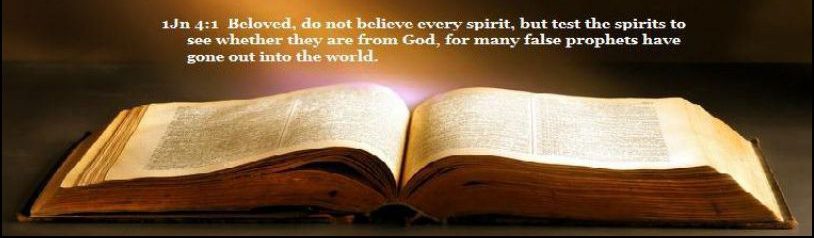


 Truth2Freedom's Blog