
Tag Archives: blog

The Musical Chairs Economy: When You Can’t Find A Job No Matter How Hard You Try, It Can Be Absolutely Soul Crushing | The Economic Collapse

After months of submitting resumes and filling out applications, many unemployed Americans have given in to despair.  Dozens of large companies all over the nation have been conducting mass layoffs, and the competition for any good jobs that do happen to be available has become extremely intense.  But if you have not lost your source of income, things may still seem fairly normal to you and you may be wondering what all of the fuss is about.  That is why I am calling this “the musical chairs economy”.  If you have been able to hold on to a chair each time the music stops playing, that is a good thing.  But you should also realize that there are millions of Americans that have been forced out of the game and are absolutely desperate to get back in.

Earlier today, I came across a social media post from a discouraged job seeker that really tugged at my heart

In recent months I have heard so many stories like this.

Very highly qualified individuals feel like they are banging their heads into a wall because they can’t find work no matter how hard they try.

One unemployed worker named Tim Rogers that has been out of work for five months feels like the job applications that he is constantly submitting are going straight “into the abyss”

I got laid off five months ago. Every morning I drink a pot of coffee while I write cover letters, tweak my résumé, and submit job applications into the abyss, knowing they will likely never be seen by human eyes—only crawled by the cold, lifeless algorithms of an artificial intelligence. I feel like General Zod from Superman, floating off into space trapped inside a two-dimensional phantom zone, screaming in silence about my job qualifications and core competencies.

The job market is a mess. The old system is broken and a functioning replacement has yet to fully emerge. We’re stuck in the between years—a dystopian digital doomscape that has job seekers and hirers picking through a landfill of A.I.-generated garbage and longing for the halcyon days of an analog past.

Some people are firing off hundreds or even thousands of resumes without hearing anything at all.

It can be extremely depressing when you feel like you are trying as hard as you can but you aren’t getting anywhere.

One woman that was laid off by Oracle in November 2023 still hasn’t been able to find work after more than two years

I started at Oracle in January 2020 as a site reliability engineer. In November 2023, I started hearing that my Oracle coworkers were getting pulled into Zoom meetings and told they had been laid off. I hoped I wouldn’t be next, but I was. My entire team was let go.

I didn’t start looking for work right away because I’d received some severance pay, and I’d heard it was difficult to land a tech role during the holiday season. I took some time to reassess what I wanted from my career and began my job search in February 2024.

I was optimistic at first because most of my prior job searches hadn’t taken too long. As the months dragged on, it became clear I had the wrong impression of the tech hiring landscape.

More than two years after being laid off, I’m still unemployed.

It is January 2026 now.

After being unemployed for so long, her value in the marketplace has declined dramatically.

In this environment, it is so helpful to have a personal contact that can help you land a position.

Because in so many cases, the resumes and applications that job seekers fire off to potential employers are not even looked at by human eyes

You did everything they told you to do. You earned the credentials, spent hours on your resume and revised multiple cover letters. You worked side gigs, volunteered, learned new software and perfected your LinkedIn profile. Yet, you can’t get a callback for an interview.

It’s as if your application vanished into the abyss of a company database, and the “thank you for applying” emails are piling up. So-called entry-level jobs now need years of experience, and junior roles expect postgraduate degrees.

You are likely wondering what you’re missing, but it’s not you — it’s the system. Across the United States, Canada and United Kingdom, automation now does the screening before a human ever has a look. Companies say they can’t find talent, yet many have stopped training people.

Unfortunately, it appears that conditions will become even harsher during the months ahead because things are certainly trending in the wrong direction.

In November, the number of job postings in the United States was the lowest in 14 months, and it was also the second lowest in nearly five years

The number of postings in November was the fewest since September 2024. But outside that month, it was the lowest in nearly five years.

Open jobs in November fell sharply in shipping and warehousing, restaurants and hotels, and in state and local government.

As the job market continues to dry up, it is going to have enormous implications for the economy.

Americans just don’t have as much discretionary income as they once did, and as a result large retailers are closing locations all across the country.

And with fewer potential buyers floating around, home prices are starting to fall

Housing market anxiety is spreading — with 26 of the country’s 50 biggest metro areas now seeing home prices lower than they were a year ago.

For the first time in nearly three years, the median US listing price has also slipped below $400,000, a key psychological level that had held firm since the pandemic boom, according to Realtor.com.

It appears that our housing bubble is starting to burst.

Sadly, home prices are declining the fastest in some of the markets that were once the hottest

Worst is Austin, TX, where prices have plunged 7.3 percent over the past year to $462,000, the biggest drop of any major metro.

The pain is spreading well beyond Texas. Prices are down 6.7 percent in San Diego, CA slipping to just under $900,000, while nearby San Jose has seen values fall 5.5 percent to $1.19 million.

Needless to say, what we are currently experiencing is just the beginning.

Many of the economic trends that made big news in 2025 will continue to accelerate in 2026.

So if you are out of work right now, I would grab whatever you can, because competition for jobs is only going to get even fiercer during the months ahead.

Michael’s new book entitled “10 Prophetic Events That Are Coming Next” is available in paperback and for the Kindle on Amazon.com, and you can subscribe to his Substack newsletter at michaeltsnyder.substack.com.

About the Author: Michael Snyder’s new book entitled “10 Prophetic Events That Are Coming Next” is available in paperback and for the Kindle on Amazon.com.  He has also written nine other books that are available on Amazon.com including “Chaos”“End Times”“7 Year Apocalypse”“Lost Prophecies Of The Future Of America”“The Beginning Of The End”, and “Living A Life That Really Matters”.  When you purchase any of Michael’s books you help to support the work that he is doing.  You can also get his articles by email as soon as he publishes them by subscribing to his Substack newsletter.  Michael has published thousands of articles on The Economic Collapse BlogEnd Of The American Dream and The Most Important News, and he always freely and happily allows others to republish those articles on their own websites.  These are such troubled times, and people need hope.  John 3:16 tells us about the hope that God has given us through Jesus Christ: “For God so loved the world, that he gave his only begotten Son, that whosoever believeth in him should not perish, but have everlasting life.”  If you have not already done so, we strongly urge you to invite Jesus Christ to be your Lord and Savior today.

The post The Musical Chairs Economy: When You Can’t Find A Job No Matter How Hard You Try, It Can Be Absolutely Soul Crushing appeared first on The Economic Collapse.

What Is the Origin and Meaning of the Christmas Tree? | Christianity.com

The Christmas tree is a wonderful and historic tradition that we don our homes with every Christmas to fill us with spirit and to lay our gifts underneath. However, it is the birth of our Lord and Savior, Jesus Christ on the very first Christmas that we celebrate.

Christianity.com Contributing Writer

Published Dec 09, 2025

What Is the Origin and Meaning of the Christmas Tree?

It’s said that the symbolic uses of evergreen trees can be traced back to origin in ancient Egypt and Rome and that the German tradition of candle-lit trees was first introduced to America in the 19th century. It is fascinating to learn the history of the Christmas tree, from the first winter solstice to the present-day — with the most famous modern-day Christmas tree in Rockefeller Center in New York City.

Ancient Roots and Symbolism of Christmas Trees

There are several origins of usage of an evergreen tree for symbolic meaning. Before Christianity, people paid special attention to green plants and trees in the winter. While modern people decorate their homes with pine, spruce, and fir trees during the holiday season, people in the ancient world hung evergreen boughs over doors and windows. Evergreen trees were believed to keep witches, ghosts, and evil spirits away in many countries.

The longest day and shortest night of the year fall on December 21 or December 22 in the Northern Hemisphere. People used to believe that the sun was a god, and that winter came every year because he became ill and lost his strength (Ibid.).

In ancient times, the solstice meant that the sun god would finally get well. They thought the evergreen boughs reminded him of all the green plants that would grow again when the sun god was strong, and summer came back.

The ancient Egyptians worshiped a god named Ra, who had the head of a hawk and wore the sun as a blazing disk on his head. When Ra was recovering from his illness, at the solstice, the Egyptians threw palm rushes in their homes, symbolizing life’s triumph over death (Ibid.).

The early Romans celebrated Saturnalia, a festival of the solstice that celebrated the agricultural god Saturn. Farms and orchards were going to be green and fruitful as soon as the solstice hit. The Buddhists celebrated by decorating their temples and homes with evergreen boughs.

As a symbol of eternal life, the ancient Celt priests, known as the Druids from the now present-day United Kingdom, decorated their temples with evergreen boughs. As far as the Vikings were concerned, evergreens were a special gift from Balder, the sun god (Ibid.).

But the real origin of today’s Christian tree traditions can be traced back to Germany.

The German Origin of the Christmas Tree

The tradition of decorating Christmas trees has a rich history that is closely tied to Christian traditions, particularly in Germany during the 16th century. This practice played a significant role in shaping the Christmas tree tradition we know today.

In Germany, devout Christians began the tradition of decorating trees in their homes as part of their Christmas celebrations. The use of evergreen trees held symbolic meaning, representing the eternal life offered through faith in Jesus Christ. These early Christmas trees were adorned with decorations and sometimes even edible items like fruits and nuts.

As time went on, the popularity of Christmas trees grew, but there was a challenge. Wood, typically used for the trees, became increasingly scarce. In response to this scarcity, some people began constructing Christmas pyramids made of wood. These pyramids were decorated with evergreen branches and candles, creating a festive and visually striking display.

One of the legendary stories associated with the addition of candles to Christmas trees involves Martin Luther, the Protestant Reformer. According to the legend, as Luther was walking home one winter night, he was struck by the beauty of the starry sky through the evergreen trees. Inspired by this scene, he decided to recreate it for his family. He erected a tree in their main room and decorated it with lighted candles, symbolizing the stars. This act is said to be one of the earliest instances of candles being used on a Christmas tree, and it contributed to the tradition’s evolution (Ibid.).

How the Christmas Tree Tradition Came to America

Christmas trees were an odd commodity for most Americans in the 19th century. In the 1830s, German settlers in Pennsylvania had the first record of displaying one, though trees had been a tradition in many German homes before then.

There was a community of trees in the Pennsylvania German settlements as early as 1747. Even after the 1840s, Christmas trees were thought of as pagan symbols.

Comparatively, the Christmas tree was adopted late in America, as were many other Christmas customs. Christmas was sacred to New England Puritans. William Bradford, the second governor of the pilgrims, wrote that he did his best to stamp out “pagan mockery” of the observance, he even penalized anyone who did it frivolously (Ibid.).

In 1659, the General Court of Massachusetts issued a law making observing Christmas a penalty offense. People were fined for hanging Christmas decorations.

Oliver Cromwell preached against “the heathen traditions” of Christmas carols, decorated trees, and any expression of joy that desecrated “that sacred event.” However, in the 19th century, German and Irish immigrants undermined the Puritan legacy (Ibid).

Queen Victoria’s Christmas Tree

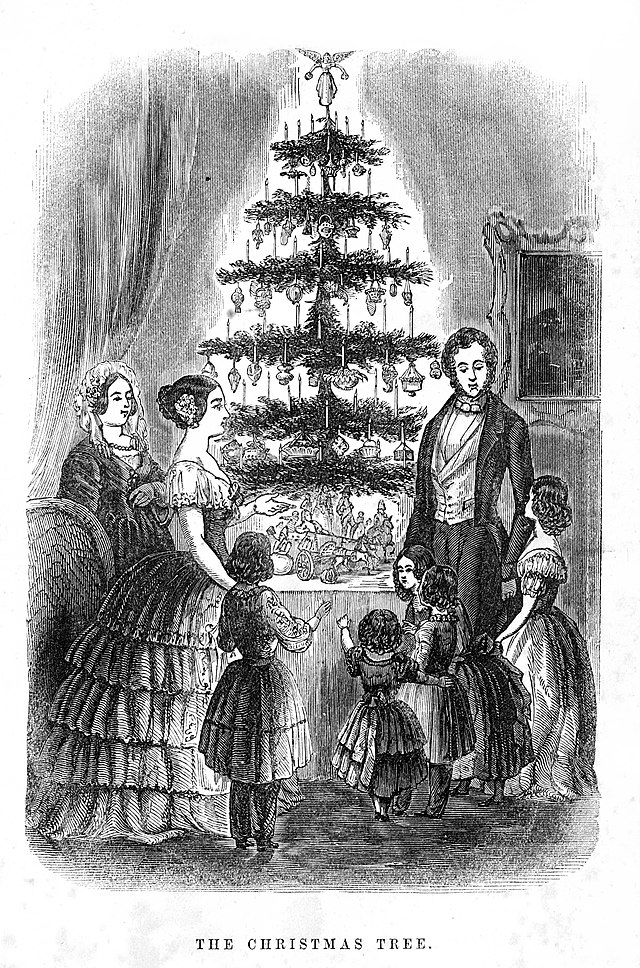
Queen Victoria and her husband Prince Albert, who was from Germany, were pictured with their children around a Christmas tree in 1846 in the Illustrated London News. The Christmas tree was here.

It was Victoria’s first reign, and everything she did was immediately fashionable, not only in Britain but among the fashion-conscious East Coast American society as well.

As early as the 1890s, Christmas ornaments arrived from Germany and Americans were getting into Christmas trees. Europeans like their Christmas trees to be about four feet tall, while Americans like theirs to reach from floor to ceiling.

American Christmas trees were usually decorated with homemade ornaments until the early 20th century, while German-American trees were decorated with apples, nuts, and marzipan cookies. In addition to popcorn, berries, and nuts were mixed in.

It’s thanks to electricity that Christmas trees can glow for days on end. As a result, Christmas trees appeared in town squares across the country, and decorating your own Christmas tree became a tradition.

The Christmas Tree - Godeys Ladys Book, December 1850

*Source: The Christmas Tree – Godey’s Lady’s Book, December 1850, Public Domain

The Rockefeller Center Christmas Tree

Since the Depression, Rockefeller Center has had a Christmas Tree. In 1948, the tallest tree arrived at Rockefeller Center. From Killingworth, Connecticut, it was a huge Norway Spruce. The Rockefeller Center tree is on the west side of Fifth Avenue between 47th and 51st Streets in New York City.

Rockefeller Center planted its first tree in 1931. Construction workers placed a small, unadorned tree in the center of the construction site. A second tree was placed there two years later, this time with lights. Currently, the Rockefeller Center tree has over 25,000 lights.

Christmas Trees Traditions Around the World

Germany

Germans are often credited with popularizing the Christmas tree tradition. They decorate their trees with ornaments, lights, and tinsel. A common ornament is the “Christbaumschmuck,” which includes glass baubles, angels, and stars. Under the tree, there’s often a nativity scene.

Ireland

Irish families decorate their Christmas trees in the weeks leading up to Christmas, with many choosing December 8th, the Feast of the Immaculate Conception, as a significant date. Irish Christmas trees are decorated with ornaments, lights, and tinsel. It’s also common to place a star or angel atop the tree. The tradition of the “Wren Boys” involves young people visiting homes with a decorated holly bush or wren on St. Stephen’s Day (December 26th).

Greece

Greek Christmas trees are adorned with lights and ornaments. In Greece, the main Christmas decoration is a “kalikantzari” or “kallikantzari” – a small wooden vessel with a piece of a cross and holy water, believed to protect homes from mischievous goblins called “kallikantzari” during the Christmas season.

United Kingdom

British Christmas trees are decorated with ornaments, lights, and tinsel. A popular decoration is the Christmas cracker, a festive party favor that is often hung on the tree. In Scotland, it’s traditional to have shortbread and a piece of coal as tree decorations.

Sweden

Swedes typically decorate their Christmas trees on December 13th, St. Lucia’s Day. Swedish Christmas trees are adorned with small straw ornaments, wooden figures, and candles. One unique tradition is the “Julbock” or Christmas goat, which is sometimes included as a decoration.

Italy

Italians typically decorate their Christmas trees on December 8th, the Feast of the Immaculate Conception. In Italy, the “Presepio” or nativity scene is a significant part of Christmas decorations. Christmas trees are also popular and adorned with lights, ornaments, and tinsel.

Mexico

Mexicans celebrate the “Nochebuena” on December 24th and often decorate their Christmas trees during the holiday season. Mexican Christmas trees feature colorful ornaments, lights, and sometimes piñatas. The piñatas are broken on Christmas Eve, showering children with candies and small toys.

Australia

Given that Christmas falls during the Southern Hemisphere’s summer, some Australians decorate “Christmas bush” trees, which have small red flowers that resemble ornaments. Many also incorporate native Australian plants into their Christmas decorations.

Russia

Christmas trees in Russia are often decorated on New Year’s Eve, as it is a more significant holiday than Christmas in the Russian Orthodox tradition. Russian Christmas trees feature an array of ornaments, often including intricate, handcrafted decorations. Ded Moroz (Father Frost) and Snegurochka (the Snow Maiden) are traditional figures who bring gifts to children.

Philippines

Christmas tree decorations typically begin in September, the start of the Filipino Christmas season, and continue until early January. The Philippines is known for its extended Christmas celebrations. Christmas trees are commonly decorated with a combination of Western-style ornaments like lights, tinsel, and baubles, as well as traditional Filipino decorations like parols (star-shaped lanterns) and Belén (nativity scenes). Many homes and businesses participate in “parol” competitions to showcase their creative lantern designs.

Japan

Japan follows many Western traditions around Christmastime. Japanese Christmas trees are often adorned with lights, ornaments, and sometimes small origami decorations. While Christmas is not a traditional Japanese holiday, it has become an occasion for gift-giving and romantic dinners. In recent years, “Christmas cakes” have also become popular, and some families exchange gifts under the tree.

Africa

While some African countries have adopted Western-style Christmas tree customs, others may blend local traditions and symbols into their celebrations. Many people in South Africa and Nigeria include African-themed ornaments or decorations that reflect their cultural heritage. In some regions, palm trees may be used instead of evergreen trees. In Ethiopia, Christmas is celebrated on January 7th (according to the Ethiopian calendar), so Christmas tree traditions align with this date.

The Timeless Tradition of Christmas Trees and Christian Symbolism

So what should you do with the Christian tree tradition? The tradition of Christmas trees is a timeless and cherished practice that holds deep significance for Christians, offering a powerful way to symbolize their faith during the holiday season. At the heart of this tradition lies the evergreen tree, which retains its green foliage even in the depths of winter. This enduring characteristic serves as a poignant reminder of the eternal life offered through faith in Jesus Christ. Just as the evergreen tree remains vibrant and alive in the face of winter’s chill, so does the hope of eternal life persist for believers through Christ’s sacrifice and resurrection.

The lights adorning the Christmas tree further enhance its symbolism. These lights represent Jesus as the “Light of the World,” a reference made by Christ Himself in the Gospel of John. They serve as a reminder that through Jesus, the world receives the light of salvation, dispelling darkness and offering the path to spiritual illumination. The act of decorating the tree with ornaments, often including stars at the tree’s pinnacle, aligns with the Christian message of Jesus as the guiding star leading the way to salvation, as was the case for the Magi who followed the Star of Bethlehem to find the newborn Messiah.

The act of coming together as a family or community to decorate the Christmas tree fosters a sense of unity and joy, mirroring the unity and joy that the birth of Jesus brought to humanity. Christians can use the Christmas tree as a centerpiece for reflection and prayer, focusing on the profound spiritual message it conveys. It serves as a tangible reminder of the central message of Christianity: the gift of eternal life and the hope, light, and joy that Jesus brings to the world. In this way, the Christmas tree becomes not only a beautiful tradition but also a meaningful expression of faith, drawing believers closer to the heart of their Christian beliefs during the holiday season.

The Christmas tree is a wonderful and historic tradition that we don our homes with every Christmas to fill us with spirit and to lay our gifts underneath. However, it is the birth of our Lord and Savior, Jesus Christ on the very first Christmas that we celebrate.

So Joseph also went up from the town of Nazareth in Galilee to Judea, to Bethlehem the town of David, because he belonged to the house and line of David. He went there to register with Mary, who was pledged to be married to him and was expecting a child. While they were there, the time came for the baby to be born, and she gave birth to her firstborn, a son. She wrapped him in cloths and placed him in a manger, because there was no guest room available for them (Luke 2:4-7).

We wish you a very Merry Christmas and a Happy New Year!

For further reading:

Is the Origin of Christmas Truly Rooted in Pagan Traditions?

Is it Important to Know Jesus’ Family Tree at Christmas?

What Is the Origin of Beloved Christmas Traditions?

What Is the Meaning of Christmas?

https://www.christianity.com/wiki/holidays/what-is-the-origin-of-the-christmas-tree.html

It Is “The Toughest Time In Years” To Be Looking For A Job In The U.S. – One 64-Year-Old Man Has Been Waking Up At 3 AM To Search For Work And Can’t Find Anything | The Economic Collapse

Are we defined by what we do?  For so many of us, our identities are tied to our occupations.  For example, when I worked in the legal field many years ago so many of my colleagues took great pride in being able to say “I’m a lawyer” when they were asked about their lives.  Unfortunately, we live in a society where our personal worth is largely determined by what kind of jobs we have or how much money we make.  I wish that our society did not look at people this way, but that is the reality of the world that we live in now.  Unfortunately, large numbers of Americans are now losing the jobs that they value so much, and competition for any good jobs that do happen to be available has become extremely fierce.  In fact, I am going to share a story with you in this article that is so extreme that you may not believe it, but it is actually true.

When someone is unemployed for an extended period of time, it can be absolutely soul crushing.

If you have been there, you know exactly what I am talking about.

You don’t want anyone to ask you what you do, because it can make you feel worthless.

Without a job, your status in society is greatly diminished, and many will look on you with pity.

And with each passing day, the bills just keep on piling up.

A few years ago, it was relatively easy to find work, but now conditions have changed dramatically.  The following comes from a Washington Post article entitled “Why it’s the toughest time to be searching for work in America in years”…

It’s the toughest time in years to be searching for work in America.

New data last week showed a fourth month of tepid job growth and propelled joblessness to its highest level since late 2021, when the economy was still recovering from the effects of the covid-19 pandemic. Now, as companies wrestle with inflation, economic uncertainty and trade policy whiplash, many are shredding payrolls and shifting tasks to artificial intelligence while pulling in higher profits. And some executives are pointedly broadcasting sizable layoffs as wins, a sign they’re making workforces leaner and more efficient.

There are so many people out there that are searching for work right now.

At the same time, postings for available jobs are rapidly drying up

Meanwhile, job postings fell across nearly every sector compared with a year ago, with the steepest declines recorded in child care, community and social service, scientific research, retail, and hospitality, according to the employment website Indeed. Administrative roles such as human resources and accounting also posted double-digit declines.

If you find yourself unemployed at this moment, I feel so badly for you.

The job market is so rough, but you can’t give up, because the market is only going to get even tighter as the weeks roll along.

Earlier today, I came across a story about a 64-year-old unemployed man that is absolutely heartbreaking.

He has a very hard time sleeping because he doesn’t have a job, and so he often gets up around 3 AM to search for work

I often wake up around 3 a.m. with my mind racing — thinking about which roles to apply to or what job search strategy to try next.

Instead of trying to fall back asleep, I usually get up and start working on my job search, which includes sending out applications or post-interview thank you letters. Around 6 a.m., I typically might make breakfast, shower, and then start planning out what I want to accomplish that day. It’s become a sort of routine.

His name is Matthew English and he has decades of experience in accounting.

But even though he has applied for hundreds of jobs, he has been out of work since last October

I’ve been looking for a full-time job since October 2024, after a decadeslong career in accounting.

Submitting hundreds of applications and spending countless hours on my job search have led to several interviews, but I haven’t been able to secure an offer.

I’ve applied for jobs related to my accounting background, but I’ve also expanded my search to any part-time or full-time job I feel I could perform — including entry-level, non-skilled positions. I even applied to be the Chick-fil-A cow mascot at a Birmingham location.

That last sentence really hit me hard.

He is so desperate to find something that he is even willing to put on a cow costume and be a mascot at a Chick-fil-A location.

But he was not hired for that either.

Meanwhile, large employers continue to conduct mass layoffs all over the nation

In the past eight months, Kroger — the nation’s largest supermarket chain — has overseen three rounds of layoffs. The latest, announced last month, included 1,000 corporate staff and mainly affected its technology and digital team, according to LinkedIn posts from former employees.

Nike, which has reported softening sales and an estimated $1 billion a year hit from tariffs, said this week it would lay off nearly 1 percent of its corporate staff while the sporting gear maker undergoes a “realignment.” Estée Lauder, which expects a $100 million tariff bill this fiscal year, cut 7,000 jobs in February, about 11 percent of its staff.

I have been warning for months that this was going to happen.

Now we are here.

According to economist Mark Zandi, quite a few U.S. states are already experiencing recessionary conditions

Leading economist Mark Zandi has warned that a third of the US is already in or at high risk of going into a recession.

Zandi, chief economist at Moody’s Analytics, revealed that states making up nearly a third of America’s GDP – including Virginia, Connecticut and Delaware – are in dangerous territory.

‘States experiencing recessions are spread across the country, but the broader DC area stands out due to government job cuts,’ Zandi wrote on X.

Of course many would argue that it feels like the entire country has already plunged into a recession.

I think that it would be very difficult to refute that.

But what we are experiencing now is not even worth comparing to what is coming.

Individually, we can’t change the circumstances in which we currently find ourselves.

But we can change how we respond to them.

Don’t you dare give up.

Your past does not have to define your future.

No matter what your circumstances may be at this moment, the best chapters of your life can still be ahead of you.

Do not allow yourself to be defined by your employment status of by how much money you have.

We were all put here for a reason, and times of transition can be a perfect opportunity to explore your reason for being here.

Life is about so much more than jobs and money.

Once you discover that, everything changes.

Michael’s new book entitled “10 Prophetic Events That Are Coming Next” is available in paperback and for the Kindle on Amazon.com, and you can subscribe to his Substack newsletter at michaeltsnyder.substack.com.

About the Author: Michael Snyder’s new book entitled “10 Prophetic Events That Are Coming Next” is available in paperback and for the Kindle on Amazon.com.  He has also written nine other books that are available on Amazon.com including “Chaos”“End Times”“7 Year Apocalypse”“Lost Prophecies Of The Future Of America”“The Beginning Of The End”, and “Living A Life That Really Matters”.  When you purchase any of Michael’s books you help to support the work that he is doing.  You can also get his articles by email as soon as he publishes them by subscribing to his Substack newsletter.  Michael has published thousands of articles on The Economic Collapse BlogEnd Of The American Dream and The Most Important News, and he always freely and happily allows others to republish those articles on their own websites.  These are such troubled times, and people need hope.  John 3:16 tells us about the hope that God has given us through Jesus Christ: “For God so loved the world, that he gave his only begotten Son, that whosoever believeth in him should not perish, but have everlasting life.”  If you have not already done so, we strongly urge you to invite Jesus Christ to be your Lord and Savior today.

The post It Is “The Toughest Time In Years” To Be Looking For A Job In The U.S. – One 64-Year-Old Man Has Been Waking Up At 3 AM To Search For Work And Can’t Find Anything appeared first on The Economic Collapse.
Democrat Post Meant to Embarrass Trump BACKFIRES in the Worst Way Possible | The Gateway Pundit

This story originally appeared on vigilantfox.com and was republished with permission.

The @TheDemocrats account on X thought they had a slam dunk, posting “Trump’s America” alongside this chart.

But look closely… because what it actually shows completely destroys what they were trying to prove.

It backfired spectacularly.

Line graph showing the increase in U.S. grocery prices from October 2019 to October 2024, with data points at yearly intervals. Text at the top reads: U.S. Grocery Prices Reached Record Highs In 2025 Prices are higher today than they were on July 2024 all in major categories listed below.

In a now-deleted post, the @TheDemocrats account on X posted the caption “Trump’s America” alongside a chart that read, “U.S. Grocery Prices Reached Record Highs in 2025.”

They really thought they scored a win, believing it showed Trump was responsible.

Image

But X users quickly noticed something hilarious: almost all of those grocery price hikes happened under Biden, not Trump. Oops.

X user Jim Verdi wrote, “Do you dipshits realize what you just posted here?” followed by a stream of laughing and clown emojis.

His post racked up 2.1 million views in no time. The self-own was too good not to share.

It was so bad, people thought it had to be satire. But no—it came straight from the real Democrats.org account with 2.3 million followers. How embarrassing.

“Are Democrats really this dumb?” Gunther Eagleman asked. We now have the answer: yes. Yes, they are.

The self-own didn’t stop there. Then they DELETED the post to stop the bleeding.

Oops—cue the Streisand effect.

@DschlopesIsBack is right. This might be the dumbest post of 2025, and that’s saying something.

Image

This one’s going in the internet hall of shame—forever.

Thanks for reading. I usually cover more serious topics, but this train wreck was too good to pass up. For more stories the mainstream media won’t touch, follow me on X and subscribe on Substack. They hide it. I report it.

X: @VigilantFox

Substack: VigilantFox.com

The post Democrat Post Meant to Embarrass Trump BACKFIRES in the Worst Way Possible appeared first on The Gateway Pundit.

Sen. Kennedy Blasts Brennan and Comey, Says They are as ‘Popular as Male Pattern Baldness’ (Video) | The Gateway Pundit

Senator John Kennedy (R-LA)/ Image: Video screenshot Fox News.

On Thursday, Senator John Kennedy (R-LA) slammed former CIA Director John Brennan and former FBI Director James Comey during a segment with Fox News host Harris Faulkner.

Kennedy said the two men, who were referred to the FBI by CIA Director John Ratcliffe, were “not ethical people” and they are ” as popular as male pattern baldness.”

Brennan and Comey are under criminal investigation by the FBI for potential wrongdoing related to the now-debunked Trump–Russia collusion narrative — including allegedly lying under oath to Congress.

The Gateway Pundit reported that, according to DOJ sources, Ratcliffe formally referred evidence of Brennan’s misconduct to FBI Director Kash Patel for criminal review.

Meanwhile, a separate FBI probe into James Comey is also active, though details remain under wraps.

Sources told Fox News that the feds are exploring a potential “conspiracy” between Brennan and Comey to politicize the 2016 Intelligence Community Assessment (ICA).

Speaking with Faulkner, Kennedy said Brennan and Comey were “especially bad” and contributed to the country’s tense political climate.

“I know Mr. Comey and I know Mr. Brennan. Neither one of them, in my opinion, should attempt more than six of the Ten Commandments. They are not very nice people, they are not ethical people.”

“I know people who have worked with them closely and if you talk to people who have worked with them closely, those people will tell you that they are about as popular as male pattern baldness.”

Kennedy continued, “What’s scary about both of them is that they think that they are competent. They’re not. I would hire the guy who salts the fries at McDonald’s before I would hire either one of them.”

“They think they’re competent, they think they are smarter and more virtuous than the rest of us and they acted on their political beliefs.”

“Brennan, for example, Mr. Brennan, was one of the ones who told the American people that the Hunter Biden laptop wasn’t real, it was Russian disinformation. They’re just not honest people. And if they broke the law, they should be held accountable.”

“They’re just like so many in Washington, Harris, they’re so arrogant. Lyndon Johnson used to have an expression. He’d say, ‘That guy is so arrogant he could strut sitting down.”

“Well, that’s the way Mr. Comey and Mr. Brennan are. Those two have done more to destroy the American people’s confidence in the FBI and National Intelligence than any two people I can think of.”

Watch:

The post Sen. Kennedy Blasts Brennan and Comey, Says They are as ‘Popular as Male Pattern Baldness’ (Video) appeared first on The Gateway Pundit.

Merry Surveillance And A Happy New World | ZeroHedge

Via Off-Guardian,

Welcome to our third Christmas edition of This Week, where we pull out just the most seasonal, tinseliest headlines we can find, take a step back, and laugh at just what a clown world we’re all suddenly living in.

1. Wood Burning Stoves Cause Cancer

Anyone following British news or social media for the last two weeks has probably already seen this story – we mentioned it in our story on the Great Reset:

Terrifying cancer risk of trendy wood burning stoves – as experts warn they are UK’s biggest source of dangerous air pollution

Wood-burning stoves are “more polluting than cars” now, they cause cancer. And birth deformities. And asthma. And make “long covid” worse.

We need rules. And bans. And more rules. And more bans. Yes, OK, we already have regulations on wood burning, but they don’t enforce them enough, and “these people will only stop when they are made to”:

I just can’t believe we’ve lived to see a time where “these people” is being used to venomously describe people who…*checks notes*…burn wood to keep warm.

This is all about clean air, you understand, and not even slightly about the fact wood burning stoves offer energy and fuel independence. That’s just paranoia.

2. …and so do scented candles

Now, maybe you’re thinking, “OK, so maybe my woodburner is illegal now, at least my cinnamon candles make it feel like Christmas”. No such luck, because here comes the Conversation with their mood-killing candle-snuffer:

Scented candles and holiday fragrances may actually harm your home’s air quality

The research is one of those pieces of research which abandons logic in pursuit of some higher truth, and includes this gem of a sentence:

If equal weights of cigarette and incense sticks are burned, the incense sticks produce around four times as much particulate matter as the cigarettes

Wonderful exemplar of the madness of “The Science”, the juxtaposition of technical truth with complete abandonment of reason. Totally disregarding a) that equal weights of incense and cigarettes are not burned, b) the differing nature and composition of their “particulate” or c) the fact people don’t put incense sticks in their mouths.

Anyway, don’t even think about staying warm or smelling nice. You’ll get cancer. And die.

Look out for “improving our air quality” to be a major talking point in 2025. More bans coming.

3. Merry Surveillance and a Happy New World

In the spirit of giving this Holiday Season, the British government has decided to gift us all the long-term comfort of security by promoting their digital ID platform!

From their press release:

Christmas celebrations are set to get a digital upgrade next year, as the UK government plans to roll out a new law allowing pub and bar-goers, as well as shoppers, to use their phones to prove their age when buying alcohol, should they wish to do so. People can continue to use physical forms of ID if they prefer.

See how it’s going to work?

It’s just like the smoking ban, where each year the minimum age to buy cigarettes increases, except in reverse.

If digital ID is the easiest way for young people to prove their age and get drunk, they’ll never need to make it mandatory. Each year the next crop of 18-year-olds will volunteer to be cattle tagged so they can go out drinking with their friends.

Meanwhile, the physical ID that “people can continue to use if they prefer” will be increasingly expensive, subject to longer and longer waiting times to acquire, and probably expire more quickly. Not to mention how bad for the environment the Guardian will tell everyone it is.

4. A Very Climate Christmas

Speaking of the Guardian, did you know “average Briton produces 23 times more CO2 on Christmas Day”?

Of course you didn’t. That’s because the Guardian just paid some people to make it up. Sorry, they “commissioned researchers to write a report” which is totally different.

However it happened, the math exists and is vaguely described. It doesn’t really make any sense if you think about it for five minutes, but we don’t have five minutes. The author quickly rushes us past the numbers and into the opinions.

The Graun has rounded up a few people to talk about how bad Christmas is for the planet. That includes the appropriately named Melanie Nazareth, who warns that people are conditioned into mass consumerism at Christmas time:

“We have been deliberately sold a vision of Christmas that is based on material consumption. We are constantly bombarded by advertising and media that tells us that if we aren’t spending money on things, we are not doing Christmas properly…

Which, to be fair, is a more than reasonable point, if only she didn’t add:

…This is destroying the whole meaning of Christmas as well as destroying the planet.”

I just can’t shake the image of Klaus Schwab, the Ghost of Resets Past, hanging in the air, rattling his chains and wailing “yooouuuu will ooooown nothing and beeee happyyyyy!”

Makes it an uncomfortable read.

BONUS: Scary Turkey Germs

Just when you thought, maybe, you could have a meal or even an entire day without having to be frightened – here comes the Daily Mail to scream:

How your Christmas turkey leaves the kitchen smeared with food poisoning bugs: Grim photos reveal exactly where bacteria spreads – and will make you think twice about scoffing mince pies

The article itself is a joke. They smear blue stuff on someone’s hands, have them use the kitchen, then show the pictures of blue stuff everywhere and say “Imagine this was bacteria! It got everywhere!” like that means something.

*  *  *

All told a pretty hectic Holiday Season for our New Normal World, and we didn’t even mention the Christmas tree being burned in newly liberated Syria or racist dangers of confederate Christmas decorations.

Merry Christmas Everyone.

Source: Merry Surveillance And A Happy New World

20 december (1857) | The first Christmas carol

“Glory to God in the highest, and on earth peace, good will toward men.” Luke 2:14

suggested further reading: Romans 14:5–9

I wish everybody that keeps Christmas this year, would keep it as the angels kept it. There are many persons who, when they talk about keeping Christmas, mean by that the cutting of the bands of their religion for one day in the year, as if Christ were the Lord of misrule, as if the birth of Christ should be celebrated like the orgies of Bacchus. There are some very religious people, that on Christmas would never forget to go to church in the morning; they believe Christmas to be nearly as holy as Sunday, for they reverence the tradition of the elders. Yet their way of spending the rest of the day is very remarkable; for if they see their way straight up stairs to their bed at night, it must be by accident. They would not consider they had kept Christmas in a proper manner, if they did not verge on gluttony and drunkenness. There are many who think Christmas cannot possibly be kept, except there be a great shout of merriment and mirth in the house, and added to that the boisterousness of sin. Now, my brethren, although we, as successors of the Puritans, will not keep the day in any religious sense whatever, attaching nothing more to it than to any other day: believing that every day may be a Christmas for ought we know, and wishing to make every day Christmas, if we can, yet we must try to set an example to others how to behave on that day; and specially since the angels gave glory to God: let us do the same. Once more the angels said, “Peace to men”: let us labour if we can to make peace next Christmas day.

for meditation: The unconverted cannot understand why Christians do not join them in their wild Christmas celebrations (1 Peter 4:3–4); those who celebrate the event without being able to give a sensible reason for doing so, are providing us with wonderful opportunities to give a reason for the hope that is within us (1 Peter 3:15).

sermon no. 1681


1  Spurgeon, C. H., & Crosby, T. P. (1998). 365 Days with Spurgeon (Volume 1) (p. 361). Day One Publications.

World gripped by mental health ‘pandemic’ – FT | RT World News

Burnout, depression, and anxiety increasingly undermine workplace productivity, the news outlet reports, citing a study

World gripped by mental health ‘pandemic’ – FT

A mental health crisis is unfolding in workplaces worldwide, with financial services emerging among the hardest-hit sectors, the Financial Times reported on Monday, citing recent research.

Burnout, depression, and anxiety are the main issues that significantly undermine productivity, economists, business leaders, and health advocates have warned.

A survey by global consultancy firm Deloitte revealed that 17% of finance and insurance workers in the UK experience exhaustion, declining performance, and mental distancing, compared to a 12% average across all sectors.

The report noted that the annual cost of poor mental health per employee in financial services amounts to £5,379, more than double that in any of the 14 other industries examined.

Startling statistics by the World Health Organization (WHO) and the International Labor Organization (ILO) show that around 12 billion work days are lost annually to depression and anxiety, costing the global economy an estimated $1 trillion each year.

Read more

RT
Australia introduces bill to ban children from social media

“The scale of the problem is hugely worrying, particularly among young people,” Kate Pickett, professor of epidemiology at York University, told the FT.

“The increase has been so huge that there is something real going on,” she said, dismissing suggestions that the rise in reported cases is merely due to greater awareness.

Researchers from Deloitte said the wellbeing of young people is particularly alarming, with one in five UK children having a probable mental health disorder in 2023, compared to one in nine in 2017.

Among the factors contributing to the global “mental health pandemic” are the cost-of-living crisis and the pervasive use of social media, according to the researchers.

The decline in mental health was exacerbated by the Covid-19 pandemic, during which global depression cases surged by 25% between 2020 and 2021, according to the WHO.

The organization said that mental health levels have not yet returned to pre-pandemic levels, with some individuals continuing to experience a “massive hangover from the pandemic.”


Source: World gripped by mental health ‘pandemic’ – FT

Christmas—the Interrupter of Winter | Blog – Beautiful Christian Life

Photo by http://www.StillsByHernan.com

Disclosure: This post may contain affiliate links, meaning Beautiful Christian Life LLC may get a commission if you decide to make a purchase through its links, at no cost to you.

The month of December can feel magical. Strings of lights appear in our yards, twinkling in the darkness; trees light up our houses; our favorite Christmas songs play everywhere in the background; Christmas cookies bake in the oven; people host parties and buy gifts; and everyone is filled with a desire to give to others and care for those in need. It can feel like such a season of hope, of things made beautiful, of people coming together in oneness and joy, and of the needy being cared for.

Christmas Letdown

It is lovely and yet, a bit devastating—especially as you get older—to realize just how quickly the season passes and how long it takes to come back round again. You know that for every twinkly light and caroler, there will be a bag of used wrapping paper and a mostly dead tree left the day after Christmas; and you will feel sad and let down, because just like that, it’s gone again, over once more.

Maybe you’ll keep playing Christmas music in an attempt to keep the spirit going; but eventually, the Christmas cookies will be stale, no one will want to watch It’s a Wonderful Life again, and you’ll pack everything all up for next December.

It’s depressing when Christmas feels like the end—the end of the year, the season, the holiday spirit, the Christmas trees, family being together, and those beautiful twinkly lights. I’ve been struggling the last few years with this sense of being let down by Christmas. Everything I’m looking forward to enjoying is heaped up into a few short, extremely busy weeks—maybe into the one day of Christmas itself—and then it’s over and done, and I’m left disappointed.

A Better Perspective about Christmas

As Christmas approaches this year, I’ve been reflecting on the fact that I might be thinking about Christmas from the wrong perspective. As much as it feels like it, Christmas is not the end. It is the beginning! I don’t mean the beginning of the new year or the beginning of our better selves, but the beginning of real hope.

There’s a beautiful passage in The Lion, the Witch, and the Wardrobe by C.S. Lewis that has illustrated this for me. The curse the White Witch places on the country of Narnia is that it would be “always winter and never Christmas.” But after all four children in the story have made their way into this other world, hope awakens. Father Christmas appears!

The significance of this is declared by Father Christmas, himself: “‘I’ve come at last,” said he. “She has kept me out for a long time, but I have got in at last. Aslan is on the move. The Witch’s magic is weakening.’” Christmas signals Aslan’s return and the weakening of the Witch’s dark magic. Christmas stirs hope. The festivities that the animals experience speak to the hope they feel for the end of winter and perhaps an appearance of Aslan.

Christmas—the Interrupter of Winter

There is a very real sense in which Christmas is the interrupter of winter. It enters the bleakness and brings celebration. It brings hope for new beginnings, hope for an appearance of a savior. Just as the Israelites endured a long winter of exile, waiting, longing for the appearance of a Promised One, a joy that at times did not seem possible, we too are waiting, exiled in this winter of a world which is not our true home.

We are waiting for something better, something that at times seems so far off and so distant that we’re not sure it will ever break through. The pain, the loss, the sadness, the suffering of today feels much stronger, much more real. Today, every one of us has something that we’re grieving, someone we’re missing, fears we’re carrying, hurt we’re feeling, and it really seems like there’s no way out. The winter of all of that brokenness does not seem to have an end. But Christmas interrupts the winter and reminds us of what came and of what we are still waiting for.

We remember the arrival or “advent” of Christ thousands of years ago, and it’s beautiful because he came into a hopeless, lost world and gave it a new beginning. The Savior entered our story and gave himself so we could have a new story. As we round the corner of Christmas and all the lights are packed away, it’s tempting to think it’s over. But Christmas is not the end. As we’re celebrating Christ’s birth, we’re walking right into a time of remembering his life and death and resurrection. Christmas begins this period of remembrance and also reminds us that we’re waiting for another advent—the second one.

Christ came to give hope to a broken world, but that hope is not yet fully realized. We are waiting in a time of exile, like the Israelites, for another arrival to interrupt the winter. Christmas is just the beginning. As I put away the Advent calendar and take down the ornaments, that’s what I’ll be reminding myself of this year. Not that it’s all done, but that it’s begun. He has come! The world has been changed by his arrival, and he will come again. It will not always be winter.


This article was originally published on December 20, 2017.

Related Articles:

https://www.beautifulchristianlife.com/blog/christmas-the-interrupter-of-winter

Trump Victory Cemented by TikTok and Podcast Viewers, Not MSNBC Neanderthals

Article Image
 • https://mishtalk.com, By Mish

New Media Is Leaving the Old Guard Behind

Podcasts are exploding, TikTok is a news source, and traditional media is shrinking in reach and influence.

Please consider the Wall Street Journal report Trump’s Win Cemented It: New Media Is Leaving the Old Guard Behind

Two weeks ago, Donald Trump sat down with the podcaster Joe Rogan for three hours, an episode that drew more than 45 million views on YouTube and over 25 million listens across Spotify and other platforms. On election night, Rogan was among several podcast hosts who got shout-outs in Trump’s victory celebration.

It underscored what the 2024 presidential race made clear: A new media landscape has emerged. The traditional gatekeepers of political discourse—TV networks and newspapers—are shrinking in influence as Americans turn to many more outlets for information.

The percentage of people listening to podcasts in a given month has more than tripled in a decade. In the social-media realm, more than half of TikTok’s users say they regularly get news on the platform, according to the Pew Research Center. Elon Musk’s takeover of X has had a major impact, with political content, especially right-leaning posts, blanketing new users’ feeds.

The main three cable channels were down 32% in viewership collectively compared with 2020, to around 21 million, with CNN losing almost half its audience.

Some 47% of people in the U.S. have listened to a podcast in the past month, including nearly 60% of people who are under 35, according to Edison Research. And 54% of podcast listeners say getting news or political analysis is an important benefit of the medium, according to the industry advisory and data tracker Sounds Profitable. [Mish Note: This is the key age group, not 30 and under. I explain why below].

Cable news viewership overall is down from its recent peaks during Covid. Fox News is the leader, averaging 2.7 million prime-time viewers in October; MSNBC is second, with 1.3 million; and CNN, which has had the steepest drop-off in recent years, is averaging 792,000.