Tag Archives: budgeting

92 Percent Of Employed Americans Have Cut Back On Spending As The Standard Of Living In The U.S. Crumbles | The Economic Collapse

The headline of this article is not a misprint.  The reason why “affordability” has become the number one issue for U.S. voters is because most of the population is being absolutely crushed by the rising cost of living.  Just look at how much you are paying for electricity compared to five years ago.  And just look at how much you are paying for food compared to five years ago.  Housing costs have risen to absurd heights, property taxes have become absolutely insane in many areas of the country, and health insurance premiums have more than doubled for millions of Americans.  It isn’t just a coincidence that so many people are bitterly complaining about the cost of living these days.  The truth is that most of the country is experiencing very real pain.

Of course it isn’t an accident that this has happened.  Our politicians have borrowed and spent 28 trillion dollars that we did not have since Barack Obama first entered the White House in January 2009, and I warned that all of this money would create rampant inflation.

On top of that, the Federal Reserve has pumped trillions of dollars that were created out of thin air into the financial system since 2008.  That has helped the stock market hit record highs, but it has been one of the factors that has made the cost of living unbearable for the rest of us.

The very foolish decisions that our leaders have been making have had dramatic consequences.

Our standard of living is crumbling right in front of our eyes, and now a brand new report is telling us that 92 percent of employed Americans have been forced to cut back on spending…

For millions of Americans, staying financially afloat now means difficult trade-offs. As the price of everyday necessities continues to rise faster than wages, new data shows workers are cutting back wherever they can – often at the expense of savings, overall financial security and even essential needs.

That is the picture emerging from Resume Now’s 2026 Cost-of-Living Crunch Report, a national survey of 1,011 employed Americans, which has found that only 17 percent of Americans feel financially secure enough to cover essentials and save money. Nearly two-thirds of respondents cited everyday essentials as their biggest financial burden. What’s more, a remarkable 92 percent said they have cut back on spending, including on items many would previously have considered non-negotiable.

Please notice that only “employed Americans” were asked about the cost of living.

More than 100 million U.S. adults are not working at all.

For those that do not regularly follow my work, yes that is an accurate number.  The vast majority of U.S. adults that are not working are considered to be “not in the labor force” by the federal government.

Another survey that was conducted at the end of December found that 70 percent of Americans consider the cost of living where they live to be “not very affordable” or “not affordable at all”…

American consumers aren’t feeling great about the economy or their own financial situation, with the phrase “affordability crisis” dominating headlines and political campaigns over the last few months.

The majority — 70% — of Americans surveyed in a Marist poll of over 1,400 adults taken in December, say that the cost of living in their area is not very affordable, or not affordable at all, for the average family.

This is the result of decades of incredibly bad economic policy.

The purchasing power of our money has been steadily declining, and now 65 percent of employed Americans are struggling to even afford everyday essentials

Sixty-five percent of the survey respondents said that affording everyday essentials was a top contributor to their financial strain.

Jared Kessler, founder of Forex Broker, said the concentration of stress around essentials is a key indicator that the problem runs deeper than any short-term financial shocks. “It is clear, based on this data, that we are experiencing a real cost-of-living crisis as opposed to an immediate inflationary response to the COVID-19 pandemic,” he told Newsweek.

Read that last sentence again, because it is so true.

We are in the midst of a nightmarish cost of living crisis that never seems to end.

At this stage, 60 percent of employed Americans “could only cover three months or less of expenses if they were to lose their job”…

Sixty percent of respondents said they could only cover three months or less of expenses if they were to lose their job, leaving little room for error in the event of layoffs, illness or other events that could impact their financial standing. For many, even routine expenses are being trimmed.

Most of the country is living right on the edge.

Nobody can deny this.

And consumer sentiment rapidly moved in the wrong direction in 2025

Between January and November last year, consumer sentiment among the lowest and middle terciles of American household income fell 29.8% and 27.6%, respectively, while the country’s highest third of earners suffered a steeper 32.1% decline.

Our politicians in Washington shouldn’t have been borrowing and spending so much money all these years.

But they did.

And we should have never allowed ourselves to go 38.4 trillion dollars in debt.

But we did.

Many of us ranted about the bad decisions that were being made for years.

But most of the population didn’t listen.

Sadly, as I pointed out in a previous article, we have now reached a point where “affordability” has become the number one issue for U.S. voters…

A University of Michigan poll published in December shows that high prices remain a pain point for consumers. About 46% blame high prices for poor personal finances — among the highest shares since the series started in the late 1970s.

Consumers’ views of their current financial situation in December “collapsed” into negative territory for the first time since July 2022, the month after pandemic-era inflation had peaked, according to a poll published Tuesday by the Conference Board.

Overall, 65% of U.S. households say the cost of living has gotten worse or much worse in the past year, according to a recent Politico poll.

Previous generations handed us the keys to the greatest economic machine that the world had never seen.

And we went out and wrecked it.

50 years ago, the U.S. economy was so dominant that it would have taken stupidity on an epic scale to cause it to fail.

But somehow we managed to do it.

Even though our standard of living is in the process of collapsing all around us, most Americans are still working hard and are “effectively trying to muscle through this”

“What we’re seeing is there is still inflation pressure across the system, particularly in the retail environment, and consumers, through our research tell us that they are effectively trying to muscle through this,” Will Auchincloss, Americas retail sector leader at EY-Parthenon, says. “They’re trying to buy what they’ve always bought or want to buy, but in the face of higher prices.”

Most of us want to continue to live the way we did before, but we simply do not have enough money to do it.

So U.S. households are piling up tremendous amounts of debt.

In fact, U.S. household debt recently hit an all-time record high of 18.59 trillion dollars

Americans’ household debt levels – including mortgages, car loans, credit cards and student loans – are now at a new record high, according to data released Wednesday by the Federal Reserve Bank of New York.

Total household debt reached $18.59 trillion from July through September of this year, up by $197 billion from the previous quarter.

Of course the federal government is an even bigger offender.

The U.S. government is now 38.4 trillion dollars in debt, and it is being projected that number will be well above 40 trillion dollars before the end of this year.

For more than a decade I warned about what would happen if we kept going down this road, and now it has happened.

We are literally committing societal suicide.

The next time you feel like screaming while you are paying your bills, you might want to remember who got us into this mess in the first place.

Michael’s new book entitled “10 Prophetic Events That Are Coming Next” is available in paperback and for the Kindle on Amazon.com, and you can subscribe to his Substack newsletter at michaeltsnyder.substack.com.

About the Author: Michael Snyder’s new book entitled “10 Prophetic Events That Are Coming Next” is available in paperback and for the Kindle on Amazon.com.  He has also written nine other books that are available on Amazon.com including “Chaos”“End Times”“7 Year Apocalypse”“Lost Prophecies Of The Future Of America”“The Beginning Of The End”, and “Living A Life That Really Matters”.  When you purchase any of Michael’s books you help to support the work that he is doing.  You can also get his articles by email as soon as he publishes them by subscribing to his Substack newsletter.  Michael has published thousands of articles on The Economic Collapse BlogEnd Of The American Dream and The Most Important News, and he always freely and happily allows others to republish those articles on their own websites.  These are such troubled times, and people need hope.  John 3:16 tells us about the hope that God has given us through Jesus Christ: “For God so loved the world, that he gave his only begotten Son, that whosoever believeth in him should not perish, but have everlasting life.”  If you have not already done so, we strongly urge you to invite Jesus Christ to be your Lord and Savior today.

The post 92 Percent Of Employed Americans Have Cut Back On Spending As The Standard Of Living In The U.S. Crumbles appeared first on The Economic Collapse.

2 Of The Most Prominent Buzzwords For The U.S. Economy In 2025 Were “Affordability” And “Layoffs” | The Economic Collapse

If you are having a really difficult time keeping up with the rapidly rising cost of living, you are certainly not alone.  This year, “affordability” was a buzzword that was constantly on the lips of politicians, economists and talking heads on television.  As you will see below, Americans are being slammed by rising prices from a multitude of directions.  Meanwhile, “layoffs” has been another buzzword that has been widely used in 2025.  Thanks to the rise of AI and our steadily deteriorating economy, we have seen far more mass layoffs this year than we did last year.  Unfortunately, one survey has found that executives are gearing up for an even larger round in 2026.

This is what happens when you flood the system with money and you go into unprecedented amounts of debt.

Eventually a day of reckoning arrives.

Ever since the Great Recession, our leaders have been pursuing highly inflationary policies, and now the American people “are yelling about affordability”

Affordability has been a source of household frustration and a key focus of political discourse in recent months, as prices for everyday goods and services continue to rise.

“People are yelling about affordability,” said Martha Gimbel, executive director and co-founder of the Budget Lab at Yale University. “I think it’s very obviously become a political flash point,” she said.

It wasn’t a foregone conclusion that things would turn out this way.

If we had made different choices, we would have gotten different results.

But we can’t go back and change the past now.  At this point, things are so bad that “affordability” has become the number one concern for U.S. voters…

A University of Michigan poll published in December shows that high prices remain a pain point for consumers. About 46% blame high prices for poor personal finances — among the highest shares since the series started in the late 1970s.

Consumers’ views of their current financial situation in December “collapsed” into negative territory for the first time since July 2022, the month after pandemic-era inflation had peaked, according to a poll published Tuesday by the Conference Board.

Overall, 65% of U.S. households say the cost of living has gotten worse or much worse in the past year, according to a recent Politico poll.

Healthcare costs have risen particularly rapidly.

One 62-year-old man that was recently interviewed by Business Insider openly admitted that he cannot afford to get sick, but he can’t afford to be healthy either…

David Deal’s 2026 outlook is what he describes as a “whack-a-mole of worry.” While he’s 62 and presumably approaching retirement, 65 is “just a number” for him, not a milestone marker for throwing in the towel on his career like his parents’ generation. The thing that really has him wound up, though, is healthcare, which he calls a “DEFCON 1” situation. Deal, a marketing consultant who lives in the Chicago suburbs, and his wife pay for their own insurance, and their premiums are going up by 25% next year. He’s worried one slip on the ice this winter could mean financial disaster. A family member’s recent two-hour trip to the ER cost them thousands of dollars, even with insurance, and the episode has him spooked.

“For me, it’s the double-whammy of skyrocketing premiums and also the skyrocketing costs of actually getting care,” he says. “We are literally at a point where we can’t afford to be sick, and we can’t afford to be healthy.”

He emphasizes that he means a collective “we” — he knows he’s far from alone in his predicament.

Health insurance premiums are set to rise even higher in 2026, and many Americans are cancelling their policies as a result.

When you don’t have health insurance, you just pray that you don’t get sick.

If you do get sick, it can be a financial disaster.

Meanwhile, one recent survey discovered that 75 percent of Americans have “reduced spending in other areas” just so that they can afford to pay for their groceries…

But whatever their preferences, many shoppers still fretted about how to pay for their groceries. More than 2 in 3 respondents (67.6%) said that they’re struggling to pay grocery bills because of inflation and rising food prices, according to a survey by Swiftly, which provides digital and media solutions for brick-and-mortar supermarkets.

More than 3 out of 4 (75.2%) responded that they’ve reduced spending in other areas to afford groceries, and in a follow-up question selected what areas they’ve cut spending in the most to pay grocery bills, with entertainment spending the most likely to be cut, followed by spending on travel, clothing, and going out to eat or drink.

Government bureaucrats keep telling us that food prices are not going up very quickly.

But everyone can see that they are wrong.

And going out to eat has become a luxury that most of the population simply cannot afford on a regular basis.  As a result, restaurants are closing down at a staggering pace

New data shows that 2025 was a record year for restaurant closures in the District.

The Restaurant Association of Metropolitan Washington (RAMW) reports 92 restaurants closed their doors this year, compared to 73 closures in 2024 and 48 in 2022.

Purchasing a new vehicle has also become a luxury that most of the population simply cannot afford any longer.

Since the early days of the pandemic, the average price of a new vehicle has gone from less than $38,000 to more than $50,000

Americans are shelling out record car payments — and now some are signing up for loans stretching nearly a decade to get a new set of wheels.

The average monthly payment for a new car hit about $760 in November, according to industry-research firm J.D. Power, after the typical new-vehicle price surged past the $50,000 mark this fall — up from less than $38,000 in early 2020.

With sticker shock everywhere, buyers are leaning hard on longer financing to keep payments from exploding — even if that means paying far more interest over time.

Some dealers are now stretching out vehicle payments for 100 months so that people can actually afford them.

To me, that is absolutely insane.

But this is the economic system that we live in now.

It is designed to get us into as much debt as possible, and at this stage U.S. households are a whopping 18.6 trillion dollars in debt

The Federal Reserve signaled a higher bar for 2026 interest rate cuts at its December meeting, potentially snatching away a much-needed reprieve for millions of Americans saddled with debt.

Household debt ballooned to a record $18.6 trillion during the third quarter of 2025, and the central bank is expected to lower its benchmark rate just once or twice next year to soften borrowing costs.

Americans have never been more overextended than they are right now.

It was another record year for credit card debt during the holiday season, but vast numbers of our fellow citizens are still paying off credit card debt from Christmas 2024.

Getting deep into debt in this very challenging economic environment is very foolish, because most people do not have jobs that are secure.

In fact, job security is now the number two concern for U.S. voters…

Job security rose to workers’ second-most pressing concern this year, after covering their monthly expenses, according to a new survey by Mercer.

While “covering monthly expenses” had been the leading concern for the past three annual surveys, fears around job loss jumped from seventh place in 2023 to second place in 2025, where it was tied with being able to retire and work-life balance. Mercer did not conduct this survey in 2024.

Throughout this year, I have documented so many of the mass layoffs that have been occurring all over the nation.

For example, Tyson Foods has announced that a beef processing facility in Lexington, Nebraska will be shut down permanently next month, and that means that approximately 3,200 workers will be losing their jobs.

A reporter that visited Lexington discovered that fear of what those layoffs would mean had gripped the entire area

On a frigid day after Mass at St. Ann’s Catholic Church in rural Nebraska, worshipers shuffled into the basement and sat on folding chairs, their faces barely masking the fear gripping their town.

There are only about 11,000 people living in Lexington, and so these layoffs have the potential to turn it into a ghost town

“Suddenly they tell us that there’s no more work. Your world closes in on you,” Alejandra Gutierrez said

She and the others work at Tyson Foods’ beef plant and are among the 3,200 people who will lose their jobs when Lexington’s biggest employer closes the plant next month after more than two decades of operation.

Hundreds of families may be forced to pack up and leave the town of 11,000, heading east to Omaha or Iowa, or south to the meatpacking towns of Kansas or beyond, causing spinoff layoffs in Lexington’s restaurants, barbershops, grocers, convenience stores and taco trucks.

There are so many other examples that I could share with you.

In Michigan, the closure of a facility in Detroit will mean that more than a thousand General Motors employees will be out of work starting on January 5th

According to WARN Act notices filed in November, 1,140 General Motors employees will be let go from the company’s Factory Zero site in Detroit, Michigan on January 5.

In a filing with the Michigan Department of Labor and Economic Opportunity, General Motors said the cuts would be permanent, affect several roles, and stemmed from adjustments related to the slower-than-expected adoption of electric vehicles.

Sadly, this is just the beginning.

According to one recent survey, over one-third of all large companies intend to slash their payrolls during the months ahead

In November, executive search firm Spencer Stuart asked 90 chief marketing officers how aggressively they plan to use AI to shrink payrolls, the Wall Street Journal reported.

More than one in three executives said that they expect to hand out pink slips in the next 12 to 24 months as they deploy more computer agents.

The trend is even worse among bigger companies.

Nearly half the executives at firms worth more than $20 billion said they’re planning significant job cuts.

If this survey is accurate, we could see millions of layoffs over the next couple of years.

Just think about that.

We were warned that this was going to happen.

Now it is playing out right in front of our eyes.

And survey after survey is indicating that the American people are quite gloomy about where economic conditions are heading next…

Americans are ending 2025 significantly more pessimistic about the direction of their financial situations than they were at the start of the year, according to the University of Michigan’s consumer sentiment gauge from early December. Its reading on personal finance expectations is 12% below where it was at the beginning of the year. A November consumer survey from the Federal Reserve Bank of New York similarly found that people are increasingly gloomy about their current and future finances, and their expectations for increased medical care costs are at their highest levels since January 2014.

If you understand what is happening, that will help you to make better decisions.

When conditions get tough, those that are wise tighten things up.

Sadly, most of the population continues to party as if tomorrow will never come, but no matter how hard one may try it is impossible to stop the inexorable march of time.

Michael’s new book entitled “10 Prophetic Events That Are Coming Next” is available in paperback and for the Kindle on Amazon.com, and you can subscribe to his Substack newsletter at michaeltsnyder.substack.com.

About the Author: Michael Snyder’s new book entitled “10 Prophetic Events That Are Coming Next” is available in paperback and for the Kindle on Amazon.com.  He has also written nine other books that are available on Amazon.com including “Chaos”“End Times”“7 Year Apocalypse”“Lost Prophecies Of The Future Of America”“The Beginning Of The End”, and “Living A Life That Really Matters”.  When you purchase any of Michael’s books you help to support the work that he is doing.  You can also get his articles by email as soon as he publishes them by subscribing to his Substack newsletter.  Michael has published thousands of articles on The Economic Collapse BlogEnd Of The American Dream and The Most Important News, and he always freely and happily allows others to republish those articles on their own websites.  These are such troubled times, and people need hope.  John 3:16 tells us about the hope that God has given us through Jesus Christ: “For God so loved the world, that he gave his only begotten Son, that whosoever believeth in him should not perish, but have everlasting life.”  If you have not already done so, we strongly urge you to invite Jesus Christ to be your Lord and Savior today.

The post 2 Of The Most Prominent Buzzwords For The U.S. Economy In 2025 Were “Affordability” And “Layoffs” appeared first on The Economic Collapse.

12 Things That AI Says The Middle Class Won’t Be Able To Afford Soon | The Economic Collapse

The middle class in the United States is being systematically destroyed. I know that this may sound like an obvious statement to many of you, but when I first started writing about this more than a decade ago it wasn’t an obvious statement. For years, the middle class was slowly eroding, but now the decline of the middle class has become an avalanche. Even the mainstream media is talking about America’s “K-shaped economy” these days, and nobody can deny that the poor are steadily getting poorer.

Recently, a reader that has been following my work for many years sent me a very sobering email.

I asked him if I could share some of the content of that email in one of my articles, and he gave me permission.

He is one of the millions of Americans that is barely scraping by from month to month, and I think that his story will really resonate with most of you…

My Pickup Insurance went up $17 this month.

My Real Estate Tax went up $187.

I had to get rid of my Landline Phone because I couldn’t afford it anymore.

I drive a 41 year old Pickup with 221,000 miles. I would love to buy a better used Pickup for $7,000 but just don’t have the cash.

Last month I had $17 in my Checking Account when I got my SS Check. The month before that it was $5.

Michael, you have been writing about the vanishing Middle Class. I don’t think there will be a Middle Class in 1 or 2 more years!!! Like I said in a previous email, I don’t know where else I can cut back. And I live a very, very frugal, less materialistic, simple lifestyle compared to the average American.

If I didn’t inherit a small farm with a livable house, I would be homeless!!!

I know that many of you can identify with this.

For a very long time, the cost of living has been rising faster than paychecks.

Now we have reached a stage where a very large proportion of the population is desperately trying to survive from month to month.

A lot of people out there have cut down to one or two meals a day because reducing food expenses is one of the easiest ways to save money.

In fact, one study has found that 2.6 million people that live in New York City “reported facing food hardships this last year”

According to an alarming study to be released on Tuesday, 2.6 million New Yorkers in the city reported facing food hardships this last year.

“On the worst end, 550,000 New Yorkers actually said that they ran out of food before they had money to buy any more. And to put that in perspective, that’s as if the entire city of Baltimore ran out of food,” Jason Cone with Robin Hood said.

We are not “the land of plenty” anymore.

I realize that this is not welcome news, but it is the truth.

During a recent interview with Fox News, Jade Warshaw laid out some of the facts that show that we are in the midst of a very painful cost of living crisis

We’re in a cost of living crisis, Dana. I think everybody knows it. We speak to more than 18 million Americans every single week on The Ramsey Show and I am hearing firsthand, yes, the price of housing, rent, mortgages, they’re a problem. Obviously, we know that health care has gone up 6%-7%. I spoke to a woman the other day, the price of her health care is going from $400 to $900. Of course, that’s more than 6%-7%. And then of course, we’re finding things like daycare, obviously food, it’s so expensive. The average American, as a result, is going into debt. And we’re seeing more debt on consumers than ever. $103,000 of consumer debt is what Americans are paying, because these big three are still continuing to eat at our wallets: credit cards, student loans, car payments, Dana. It really is a crisis.

So what is our country going to look like as this cost of living crisis continues to intensify?

I asked Google AI to tell me some of the things that the middle class would be unable to afford soon, and this is what I was told…

Homeownership: The traditional cornerstone of middle-class wealth, owning a home, has become an elusive dream for many, especially in urban and high-demand areas. Skyrocketing home prices, high down payments, and increased mortgage rates have made it so that in many markets, fewer than one in five homes are within reach for typical middle-income households.

Higher Education: A college education is increasingly a financial burden, with tuition and expenses soaring. Middle-class families often earn too much to qualify for significant financial aid but not enough to pay out of pocket, leading to massive student debt that can delay other life goals for decades.

Retirement Savings: Due to other financial pressures and the shift from pension plans to 401(k)s, many families struggle to save enough for a comfortable retirement. The inability to put away sufficient funds for the future means many may face the prospect of working longer or a reduced standard of living later in life.

Healthcare: Even with insurance, the costs of premiums, deductibles, and out-of-pocket expenses for medical care and prescriptions can lead to substantial financial strain, making specialized medical treatments unaffordable for some.

Childcare: Quality childcare expenses can rival or exceed college tuition in many areas, forcing many parents (often mothers) to leave the workforce because the cost effectively erases the benefit of a second income.

New Cars: The average price of a new car has surged, partly due to advanced technology features becoming standard. This, combined with higher insurance and maintenance costs, means many families are holding onto older vehicles longer or forgoing car ownership altogether.

Groceries and Everyday Essentials: Persistent inflation means essentials like food, utilities, and gas are significantly more expensive, stretching paychecks and leading many families to worry about affording daily needs.

Comprehensive Insurance Plans: The rising cost of maintaining adequate health, home, and auto insurance coverage is becoming a major concern, potentially leading families to opt for limited coverage and increased financial risk.

Leisure and Vacations: Rising costs of living mean that family vacations and leisure activities, considered essential for a balanced life, are becoming luxuries many cannot afford.

Personal Fitness and Wellness Services: Personalized services like personal trainers or boutique fitness classes are increasingly seen as luxuries for only the upper class.

Organic and Specialty Foods: The higher price tag associated with organic and specialty foods may put these healthier options out of reach for average middle-class budgets.

New Technology and Eco-Friendly Upgrades: Keeping up with the latest tech gadgets or investing in eco-friendly home improvements (like solar panels or energy-efficient appliances) often requires a substantial initial investment that can be prohibitive.

I want to say a little bit more about the first item in that list.

Soaring prices and high mortgage rates are not the only reasons why home ownership has become so expensive.

Insurance rates have been steadily escalating for years, and property taxes have risen to insane levels in many parts of the country

The hidden costs of homeownership are reaching nearly $16,000 per year nationwide, underscoring the ongoing affordability crisis crippling potential buyers.

A new analysis from real estate marketplace Zillow and Thumbtack, an online marketplace for local services, found that insurance, maintenance and property tax can cost the average homeowner $15,979 per year. Maintenance costs account for $10,946 of that, while about $2,003 goes toward homeowners insurance and $3,030 toward property taxes, according to the November analysis.

I have a confession to make.

I really detest property taxes.

In fact, if I could permanently ban property taxes on a nationwide basis, I would do it.

All over America, elderly people are being forced out of homes that have been completely paid for because they can no longer afford the property taxes.

Do we really own our homes if we have to keep shelling out thousands of dollars a year just for the privilege of continuing to live in them?

Home maintenance has also become an increasingly burdensome expense, but many homeowners are trying to cut corners wherever they can in this very challenging economic environment, and that is having a direct impact on Home Depot’s bottom line

The Home Depot is a bellwether for the US economy and housing market. It’s latest quarter isn’t sparking much confidence.

On Tuesday morning, the home improvement chain said it served fewer customers in the past three months than expected.

Its earnings come as Wall Street hits a concerning stretch of losses. In the past week, all three major stock indexes are in the red as investor confidence in AI begins to slide.

I know that things seem bad now, but what is coming in 2026 and beyond will be even worse.

The employment market is really tightening up, and mass layoffs are happening from coast to coast.

According to the Federal Reserve Bank of Cleveland, the number of WARN notices filed during the month of October was one of the highest ever recorded

Impending layoff notices across much of the U.S. surged in October, highlighting signs of stress in the job market.

Data from the Federal Reserve Bank of Cleveland shows that 39,006 Americans last month in 21 states received a Worker Adjustment and Retraining Notification Act, or WARN, notice informing them of an upcoming layoff. U.S. labor law requires employers to provide these written warnings 60 days ahead of plant closings or mass layoffs.

It represents one of the highest numbers of WARN notices since Federal Reserve Bank of Cleveland researchers started tracking the data in January 2006, although the tally remains below the spikes recorded during the 2008 financial crisis and the 2020 pandemic.

Over the last several years, we have witnessed a steady deterioration of the U.S. economy.

But curling up into a fetal position and crying about it isn’t going to help anything.

If you understand what is happening, that will help you to make wise decisions.

And wise decisions lead to wise actions.

The road ahead is going to require all of us to be strong and courageous, because things are starting to move very rapidly now.

Michael’s new book entitled “10 Prophetic Events That Are Coming Next” is available in paperback and for the Kindle on Amazon.com, and you can subscribe to his Substack newsletter at michaeltsnyder.substack.com.

About the Author: Michael Snyder’s new book entitled “10 Prophetic Events That Are Coming Next” is available in paperback and for the Kindle on Amazon.com.  He has also written nine other books that are available on Amazon.com including “Chaos”“End Times”“7 Year Apocalypse”“Lost Prophecies Of The Future Of America”“The Beginning Of The End”, and “Living A Life That Really Matters”.  When you purchase any of Michael’s books you help to support the work that he is doing.  You can also get his articles by email as soon as he publishes them by subscribing to his Substack newsletter.  Michael has published thousands of articles on The Economic Collapse BlogEnd Of The American Dream and The Most Important News, and he always freely and happily allows others to republish those articles on their own websites.  These are such troubled times, and people need hope.  John 3:16 tells us about the hope that God has given us through Jesus Christ: “For God so loved the world, that he gave his only begotten Son, that whosoever believeth in him should not perish, but have everlasting life.”  If you have not already done so, we strongly urge you to invite Jesus Christ to be your Lord and Savior today.

The post 12 Things That AI Says The Middle Class Won’t Be Able To Afford Soon appeared first on The Economic Collapse.

American Household Debt at Record Levels, However Americans Continue to Spend | The Gateway Pundit

Red book titled "Household Income" beside a stack of cash, a calculator, and paperwork for financial planning.
Household Income by Nick Youngson CC BY-SA 3.0 Pix4free.org

Household debt continues to rise as Americans keep spending. Increases in the cost of living have outpaced salary growth, while elevated interest rates have added to the strain.

The elimination of Biden-era benefits and loan forgiveness programs has also weighed heavily on many households that had grown accustomed to government relief and easy credit.

Total U.S. household debt reached a record $18.59 trillion in Q3 2025, an increase of $197 billion from the previous quarter. Household debt is distributed across several categories, with mortgages making up the largest share.

Mortgage balances rose by $137 billion to $13.07 trillion, while credit card balances climbed by $24 billion to $1.23 trillion, an all-time high, nearly 6% higher than a year earlier.

Student loan debt also reached a record $1.65 trillion, while auto loan balances remained steady at $1.66 trillion.

By category, total household debt includes $13.07 trillion in mortgages, $1.66 trillion in auto loans, $1.65 trillion in student loans, $1.23 trillion in credit card debt, $0.55 trillion in other debt, and $0.42 trillion in home equity lines of credit (HELOCs).

While the debt itself is problematic, a more worrying economic indicator is the rise in delinquencies.

About 4.3% of total debt is now more than 30 days past due, the highest level since early 2020 but still well below the 11% recorded during the 2009 financial crisis.

Nearly 10% of all student debt has been reported as 90 days or more delinquent, marking a record high for student loan delinquencies.

Liberal Democrat policies are partially to blame, as the spike stems in part from missed federal student loan payments that were not reported to credit bureaus between Q2 2020 and Q4 2024, which are now appearing in credit reports following the end of the pandemic payment pause.

Currently, 7.7% of aggregate student debt was reported as 90 or more days delinquent, compared to less than 1% in Q4 2024.

Only about 35% of student loan borrowers are currently in active repayment, with delinquency levels significantly elevated and repayment rates far below pre-pandemic levels. When student loan payments were paused, many borrowers took on additional credit and are now facing a financial reckoning as repayments resume, compounded by the broader effects of a higher cost of living.

The cumulative inflation that occurred during the Biden administration exceeded 20%.

Although inflation under the Trump administration has since cooled to around 3%, closer to the Federal Reserve’s 2% target, prices have not declined, and wages have failed to keep pace with the elevated cost of goods and services.

Additionally, interest rates remain elevated, further increasing total debt burdens.

The average credit card interest rate reached 24.35% in August 2025, making it extremely costly for consumers to carry balances.

Mortgage rates, which doubled during the pandemic, are now hovering around 7%, putting further strain on household budgets.

More critically, certain essential costs have far outpaced general inflation. Home prices have risen by more than 40% since 2018, while wages have increased by only 28% over the same period.

The median U.S. asking rent has climbed by roughly 22%, adding pressure to already stretched family finances.

Education costs have also surged, driven by excessive federal grants and loans, as well as the expectation under the Biden administration that student loan debts would eventually be forgiven.

The easy availability of government-backed funding made students less price-sensitive, further fueling tuition hikes. Since 1980, college tuition and fees have increased by an astonishing 1,200%, while the Consumer Price Index for all items has risen only 236%.

Across age groups and income levels, spending and debt patterns in the United States vary sharply. Debt typically peaks between ages 30 and 59, the years when most Americans are working full-time, raising families, and carrying mortgages.

Total and per-capita debt by age group are as follows: ages 18–29, $1.05 trillion ($19,962 per person); 30–39, $3.89 trillion ($84,565); 40–49, $4.76 trillion ($111,148); 50–59, $4.02 trillion ($97,336); 60–69, $2.73 trillion ($67,574); and 70 and older, $1.73 trillion ($43,142).

Older Americans tend to have broader access to credit, with 91% of those aged 60 and above owning at least one credit card, while more than half of adults aged 30 to 59 carry revolving balances.

The data suggest that the U.S. economy is increasingly developing a K-shaped pattern: higher-income households continue spending and borrowing comfortably, while lower-income and younger borrowers are struggling to keep up.

The share of subprime borrowers has risen to levels not seen since 2019, even as the number of super-prime borrowers, those with very strong credit, has also increased.

The average credit card debt per borrower now stands at roughly $6,523, with about 175 million consumers carrying balances.

Federal Reserve Chair Jerome Powell noted that while “consumers at the lower end are struggling,” there is clear evidence that “people are spending” at the higher end.

Younger generations are feeling the brunt of rising costs. Millennials and Gen Z spend a far larger share of their income on housing than older generations.

Millennials devote 21.6% of their income to housing, more than Gen X or baby boomers, leaving less for savings and discretionary spending.

Gen Z renters will spend about $145,000 on rent by age 30, 14% more than the $127,000 spent by millennials at the same age. A majority of Gen Z and millennial renters, around 70%, say they struggle to afford their monthly housing payments.

The post American Household Debt at Record Levels, However Americans Continue to Spend appeared first on The Gateway Pundit.

Can You Guess The Number One Challenge That Americans Believe They Are Facing In 2025? | The Economic Collapse

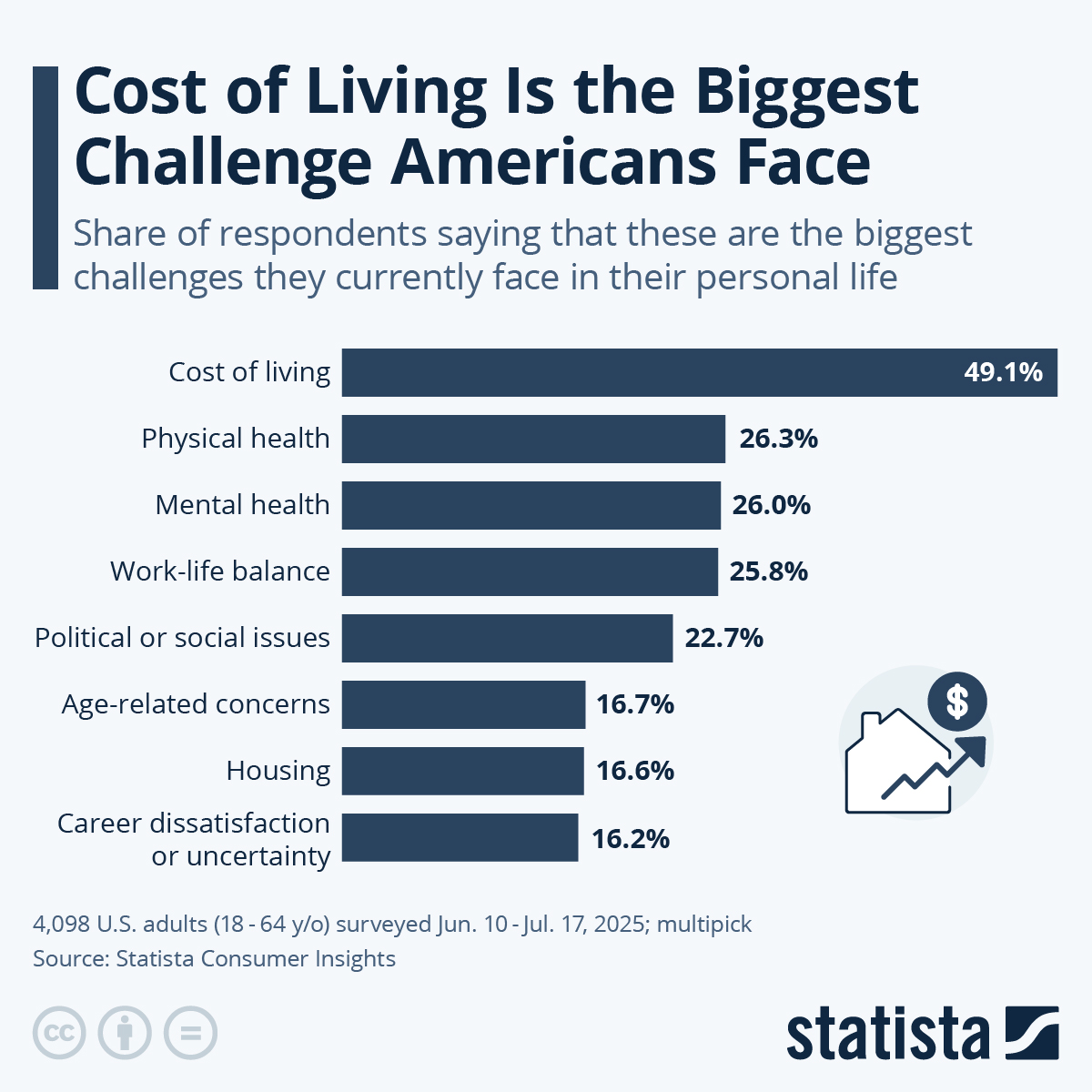
We sure have seen a lot of really crazy things happen so far this year. But in the minds of most Americans, there is one crisis that far outweighs everything else. As I have been documenting for years, our standard of living has been collapsing as the cost of living has risen must faster than our incomes have. As a result, 67 percent of U.S. workers are now living paycheck to paycheck. We are in the midst of the worst cost of living crisis in modern history, and Statista has found that Americans consider it to be the biggest challenge that they are facing by a very large margin 

Infographic: Cost of Living Is the Biggest Challenge Americans Face | Statista

https://www.statista.com/chart/35054/biggest-challenges-faced-by-americans/

Those results are stunning.

The cost of living won this survey in a blowout, but that shouldn’t be a surprise to any of us.

There are countless videos on social media where ordinary Americans are complaining about how oppressive the cost of living has become.  Zac Rios has compiled some of the most poignant videos that have been posted lately, and when you watch them back to back it really is heartbreaking

This is what life is like in America in 2025.

And as economic conditions continue to deteriorate, it is going to get even worse.

Are you ready for that?

Many Americans are going deep into debt in a desperate attempt to stay afloat, and one recent survey found that nearly half of all Americans now worry about debt every single day

Debt weighed heavily on daily life for many participants. Just under half (46.5%) said they worry about debt every day. Half admitted to avoiding their bank statements, a behavior that could worsen financial problems by delaying action.

Shame was another theme. More than half of respondents (54.6%) said they felt embarrassed about their debt, even though nearly everyone surveyed (98%) reported owing money.

When asked about specific concerns, the most common answers included falling behind on payments (53.7%), not having enough for retirement (53.7%), discovering higher balances than expected (53.5%), losing homes or belongings (53.3%), and leaving little to children (51.8%).

It is easy to tell people that they should get out of debt.

But for the two-thirds of the country that is living paycheck to paycheck, there is never an opportunity to get ahead of the game.

And a lot of people that are living on the financial edge are now losing their jobs.

During the second quarter of this year, a whopping 17 trucking and logistics companies went bankrupt

At least 17 trucking and logistics companies filed for bankruptcy in the second quarter of 2025 alone, Equipment Finance News reported.

While dry van truckload contract rates were flat in the first half of 2025 from the same period a year ago, as FreightWaves reported, trucking spot rates, which shippers pay carriers for a one-time shipment, however, finished the first half below year-over-year levels.

Long-haul truckload demand reportedly plummeted by 25% in the first half of 2025, with trucking becoming more of a short-haul delivery method for the final leg of freight movement.

At this moment, we are in a trucking recession.

If the economy was moving in the right direction, that would not be happening.

The retail industry is experiencing a tremendous amount of pain as well.

This may be difficult to believe, but the largest shopping mall in San Francisco is now 93 percent empty

The largest shopping mall in San Francisco is now reportedly 93% vacant and has seen its value plunge by 25% over the past year, as high rents and retail crime continue to batter the Northern California city.

A new appraisal has slashed the value of San Francisco Centre, located at 865 Market Street, to $195 million, which is a 25% decrease since August 2024 and more than $1 billion below its valuation in 2016, the San Francisco Chronicle reported, citing research from Morningstar.

The 1.4 million-square-foot mall has become largely deserted, with 93% of its property now empty, according to the San Francisco Chronicle.

I haven’t written about it for a while, but our rapidly growing commercial real estate crisis is reaching a crescendo.

As large numbers of commercial mortgages go bad, many of our financial institutions suddenly find themselves in very hot water.

Meanwhile, a residential real estate crisis is quickly developing.  In some of the markets that were once the hottest, condo prices have begun to crash

Condo prices in Killeen, TX, a little over an hour north of Austin, have collapsed by 40% since the peak in mid-2022 and have given up the entire 52% spike from mid-2020 to mid-2022, plus some. The spike had been driven by FOMO-madness and the Fed’s Free Money policies. This is one of the fastest-growing cities around; its population has surged by 35% in the past 15 years to 160,000 in 2024.

But Killeen and other cities like this with condo markets in free-fall don’t qualify for our list here because they’re too small.

Several additional cities made it onto this list because the August price drop brought the total price drop from the peak to 12%, including Phoenix, AZ, and Orlando, FL.

In so many ways, it is starting to feel like 2008 all over again.

Of course it isn’t just the U.S. that is experiencing significant economic pain.

Earlier today, I came across an article that was posted on Zero Hedge that warned that “the collapse of the German economy continues unabated”…

The collapse of the German economy continues unabated. The German Engineering Federation (VDMA) now expects a dramatic decline in production this year and lashes out at the federal government.

A rebound in the German economy this autumn has failed to materialize. Just a week ago, the Federal Statistical Office revised the country’s GDP decline for Q2 2025 from –0.1% to –0.3%. Now, the German machinery association follows suit with its forecast for the full year, confirming the ongoing downward trend in production: “We had previously expected a decline of 2 percent, now we anticipate minus 5 percent for 2025,” says VDMA President Bertram Kawlath, who expects production to grow by just 1 percent in 2026. Was 2025 really the trough?

I have been watching Germany for quite some time.

This is not a good sign at all.

I will probably have much more to say about the deteriorating situation in Europe in future articles.

At this stage, the entire global economy has reached a critical tipping point.

It certainly wouldn’t take much to push us into a worldwide economic nightmare, and I am expecting so much chaos in the months ahead.

A lot of people out there seem to think that they have no need to prepare for what is coming.

They are wrong.

Yes, things are bad now, but what is on the horizon is going to be much worse.

So I would encourage you to do what you can to get prepared, because the collapse of our standard of living is only going to escalate.

Michael’s new book entitled “10 Prophetic Events That Are Coming Next” is available in paperback and for the Kindle on Amazon.com, and you can subscribe to his Substack newsletter at michaeltsnyder.substack.com.

About the Author: Michael Snyder’s new book entitled “10 Prophetic Events That Are Coming Next” is available in paperback and for the Kindle on Amazon.com.  He has also written nine other books that are available on Amazon.com including “Chaos”“End Times”“7 Year Apocalypse”“Lost Prophecies Of The Future Of America”“The Beginning Of The End”, and “Living A Life That Really Matters”.  When you purchase any of Michael’s books you help to support the work that he is doing.  You can also get his articles by email as soon as he publishes them by subscribing to his Substack newsletter.  Michael has published thousands of articles on The Economic Collapse BlogEnd Of The American Dream and The Most Important News, and he always freely and happily allows others to republish those articles on their own websites.  These are such troubled times, and people need hope.  John 3:16 tells us about the hope that God has given us through Jesus Christ: “For God so loved the world, that he gave his only begotten Son, that whosoever believeth in him should not perish, but have everlasting life.”  If you have not already done so, we strongly urge you to invite Jesus Christ to be your Lord and Savior today.

The post Can You Guess The Number One Challenge That Americans Believe They Are Facing In 2025? appeared first on The Economic Collapse.

What It Costs A Family Of 4 To Live 1 Month In America: $996 For Groceries, $1,437 For Health Insurance, A $745 Car Payment And A $2,259 Mortgage Payment | The Economic Collapse

You may be quite shocked by the numbers that I am going to reveal in this article. So many people are bitterly complaining about the rising cost of living, and so I decided to do some investigating. What does it really cost for a family of four to live the “American Dream” today? As I was doing my research, what I discovered deeply alarmed me.

Obviously a family of four is going to need to eat, and grocery prices have been going through the roof.

According to the USDA, a realistic food budget for a family of four for one month ranges between $996 and $1,603

The USDA estimates $297–558 for a monthly food budget for one person, $614–963 for a couple, and $996–1,603 for a family of four.

For the purposes of this article, let’s assume that we are being frugal and so we will go with the lowest number in that spectrum.

Health insurance is another major expense that U.S. households face on a monthly basis.

In 2023, an unsubsidized plan for a family of four through the ACA marketplace averaged $1,437 a month

Family plan premium rates will vary based on family size. But, a family of four paid an average of $1,437 a month for an unsubsidized plan.

That figure is two years old, and premiums have continued to rise since that time, but for the purposes of this article we will go with it.

In order to pay the monthly bills, parents must go to work, and in order to go to work they will need at least one vehicle.

According to Experian, the average monthly payment for a new vehicle during the first quarter of 2025 was $745…

In Q1 2025, the average car payment for a new car was $745, and the average payment for a used car was $521. However, monthly payments can vary significantly based on many factors, including the loan amount, loan term, borrower credit history and more.

Most households have more than one vehicle, but for the purposes of this article we will include just one vehicle payment in the monthly budget.

Needless to say, a family of four also needs a place to live, and the median monthly mortgage payment in the United States has now risen to $2,259

The median monthly mortgage payment for U.S. homebuyers is currently $2,259. This assumes a buyer making a 20 percent down payment on a $435,300 home — the median sale price for an existing home in June, according to the National Association of Realtors — at 6.75 percent interest, the current average for a 30-year loan based on Bankrate data.

Okay, now that we have our raw data let’s do some math.

If you add all four of our monthly expenses together, you get a grand total of $5,437 a month.

That is only for food, health insurance, one vehicle payment and a mortgage payment.

Of course there are many other things that a family of four must pay for as well.

Are you starting to understand why it seems like most people are just barely scraping by these days?

Most of us are stressed out about our bills, and the cost of living just keeps going up and up.

Many Americans are trying to cut corners any way that they can.

For example, it is being reported that 44 percent of U.S. adults admit that they have ordered a kiddie meal…

Apparently, grown-ups love a good kiddie meal, too.

That’s one of the takeaways from a new survey conducted by Lightspeed Commerce, a company that provides payment systems to the hospitality industry. The survey found that 44% of U.S. diners say they’ve ordered children’s meals for themselves at restaurants.

I suppose that is one way to save a little bit of money.

We are being told that the number of kiddie meals being ordered by adults is up 28 percent compared to 2019…

According to industry research firm Circana, the number of children’s meals placed by adults was up 28% in 2024 compared with 2019. Another data point, as the Wall Street Journal reports, is that Yelp reviews for kids’ meals were higher in December 2024 than any month since 2019.

“It’s satisfying, cheaper, less calories, and sometimes there’s a little prize or treat,” C.J. Person, a retired teacher in North Carolina, told the Journal.

Are adults technically allowed to order kids’ meals? Probably not. Most restaurants have an age limit policy, but they are rarely enforced.

This isn’t what “prosperity” looks like.

In fact, this is the opposite of “prosperity”.

And now mass layoffs are happening day after day.

Earlier today, I was saddened to learn that John Deere has decided to conduct mass layoffs at three facilities in the Midwest

Legacy tractor maker John Deere has announced layoffs at three Midwestern facilities as the company grapples with declining sales and the effects of tariffs on its bottom line.

“The struggling ag economy continues to impact orders for John Deere equipment,” the company said in a media statement regarding the layoffs. “This is a challenging time for many farmers, growers and producers, and directly impacts our business in the near term.”

Farming is normally fairly recession-proof, and so the fact that demand for John Deere equipment is faltering is not a good sign at all.

The housing market is really struggling right now too.

According to Redfin, the average time that a house is spending on the market has now reached the highest level in 10 years

The typical home that went under contract in July spent 43 days on the market — up from 35 days a year earlier and the longest span for any July since 2015, according to new Redfin data.

It’s another sign that buyers are gaining leverage after years of tight inventory, though the extent of that advantage varies by region.

In Florida, homes are taking much longer to sell, over 90 days in some cities. West Palm Beach (95 days), Fort Lauderdale (92 days) and Miami (86 days) were the slowest major markets in the country last month.

This feels so much like 2008 all over again.

And just like in 2008, the economy of Las Vegas is an early indicator of what is coming for the economy as a whole…

A retail expert has warned Las Vegas is in freefall with consumer spending slumping, with one recent visitor raising concerns over an outrageous tip demand.

The Nevada city, known for its lavish shows and around-the-clock gambling, has recorded a large drop in tourism and spending in recent months.

According to the Nevada Department of Taxation, sales at food and beverage outlets, clothing, shoes and jewelry retailers have all fallen in the last 11 months.

A lot of people out there still don’t seem to get it.

We really are moving into extremely difficult times.

The vast majority of the population is living paycheck to paycheck right now.

And so when a sudden job loss or some sort of an emergency happens, they have nothing to fall back on.

We are far more vulnerable than most people realize, and the months ahead will demonstrate that fact very clearly.

Michael’s new book entitled “10 Prophetic Events That Are Coming Next” is available in paperback and for the Kindle on Amazon.com, and you can subscribe to his Substack newsletter at michaeltsnyder.substack.com.

About the Author: Michael Snyder’s new book entitled “10 Prophetic Events That Are Coming Next” is available in paperback and for the Kindle on Amazon.com.  He has also written nine other books that are available on Amazon.com including “Chaos”“End Times”“7 Year Apocalypse”“Lost Prophecies Of The Future Of America”“The Beginning Of The End”, and “Living A Life That Really Matters”.  When you purchase any of Michael’s books you help to support the work that he is doing.  You can also get his articles by email as soon as he publishes them by subscribing to his Substack newsletter.  Michael has published thousands of articles on The Economic Collapse BlogEnd Of The American Dream and The Most Important News, and he always freely and happily allows others to republish those articles on their own websites.  These are such troubled times, and people need hope.  John 3:16 tells us about the hope that God has given us through Jesus Christ: “For God so loved the world, that he gave his only begotten Son, that whosoever believeth in him should not perish, but have everlasting life.”  If you have not already done so, we strongly urge you to invite Jesus Christ to be your Lord and Savior today.

The post What It Costs A Family Of 4 To Live 1 Month In America: $996 For Groceries, $1,437 For Health Insurance, A $745 Car Payment And A $2,259 Mortgage Payment appeared first on The Economic Collapse.
86 Percent Of Americans Feel Stressed About The Cost Of Groceries, And Many People Are Starting To Really Flip Out Emotionally | The Economic Collapse

Why are social media platforms filled with videos of Americans complaining about grocery prices right now? Needless to say, those videos must be striking a chord, because some of them are receiving millions of views. Government bureaucrats are telling us that the cost of food is only going up a few percentage points per year, but we can all see that is a load of nonsense. A trip to the grocery store has become an enormous expense, and this is especially true if you have kids to feed. As I wrote about earlier this month, one survey found that in 25 percent of U.S. households at least one person is skipping meals so that there will be enough money to pay the bills. Sadly, we are being warned that the cost of groceries will go even higher in the months ahead.

Several years ago, I kept warning my readers over and over again that soon the cost of groceries would become very painful.

Without a doubt, that time has arrived.

According to a recent AP poll, the cost of groceries is a “source of stress” for 86 percent of U.S. adults…

Does your run to the supermarket cause a spike in your blood pressure? You’re in good company.

The overwhelming majority of Americans – 86% – say the cost of groceries is at least a minor source of stress. The number includes 53% who say it’s a major source of anxiety in their lives right now. That’s according to a new Associated Press/NORC poll.

Those are very alarming numbers.

But this is the world that we live in now.

And this is why we are seeing so many videos on social media about grocery prices.

Someone put together a compilation of some of the best videos where people are really flipping out emotionally…

In my entire lifetime, I have never seen it so bad.

At one grocery store in Chicago, one woman admitted that it feels like “you’re spending your soul on groceries”

At a South Loop grocery store, customers experience sticker shock and frustration.

“No matter if it’s organic or if it’s regular, it’s still going to be an arm and a leg for it. It’s like you’re spending your soul on groceries,” said shopper Tria Hutson.

This is one of the reasons why I get so frustrated with the talking heads on television that are telling us that everything is fine.

Just look around you.

People are hurting.

Some companies are trying to hide their price hikes by keeping the prices the same but putting less stuff in each package.

This is known as “shinkflation”, and Jim Quinn recently shared a personal anecdote from his own life

I think a personal anecdote I’ve experienced will show you the devious methods corporations will use to pass these tariffs along. I have been buying a pack of coated paper plates at Wal-Mart for years. The pack contained 70 paper plates. Within the last four months, the pack was reduced to 50 plates, for the same price. They know the average dolt, after years of government schooling, is deficient in math skills, so they would not realize they just experienced a 40% increase in price per plate. This will show up nowhere in the fake BLS numbers. Shrinkflation is just as bad as inflation, but they can hide it and pretend all is well, while maintaining their profits.

I am sure that you are running into the same thing.

Unfortunately, this is just the beginning.

How can I be so confident in saying that?

Let me give you just one example.

Approximately two-thirds of U.S. adults drink coffee, and approximately one-third of all the coffee we drink comes from Brazil.

Thanks to the 50 percent tariff that was just placed on imports from Brazil, coffee is about to become a lot more expensive…

The U.S. relies heavily on Brazil to import coffee for the 165 million people who need their daily caffeine fix, but Trump’s 50 percent tariff threatens the long-term availability and price of the drink.

“When people go to their local coffee shop, whether it’s Starbucks or something else, by and large they will likely be buying some form of Brazilian coffee,” Monica de Bolle, senior fellow at the Peterson Institute for International Economics, told NPR.

“A 50 percent tariff will kill that market.”

I still remember the days when you could get a cup of coffee for 10 cents.

What did your latest cup of coffee cost you?

Of course everything else is becoming more expensive too, and our cost of living crisis never seems to end.

As a result, 62 percent of Gen Z Americans have no emergency savings at all

  • 62% of Gen Z have no emergency savings, nearly double the rate of baby boomers.
  • 51% of Americans would use a credit card for a $500 emergency, with usage jumping to 70% among students.
  • Two-thirds of consumers have six months or less in savings, with Gen X the least prepared.
  • 76% lack a credit card set aside for emergencies, relying instead on everyday-use cards.

Most of the country is living on the edge financially.

The middle class is steadily shrinking, and those that remain in the middle class have much less discretionary income than they once did.

So restaurants all over the nation find themselves torn between rapidly rising costs and customers that now have a lot less money to spend

Ike’s Chili in Tulsa, Oklahoma, has been around for 117 years, surviving a myriad of challenges like the Great Depression, the Covid-19 pandemic and a once-in-a-generation burst of inflation. But 2025 already holds an even more complicated challenge.

“The cost of everything’s just going up, and we’ve got to figure out how to manage it right,” Len Wade, a managing partner at the restaurant, told CNN.

He pointed to surging beef prices as an example, specifically hamburger meat on the wholesale level. In July, those prices were up nearly 21% compared to the same month 10 years ago, federal data shows. And passing the buck to customers might not be the best solution, Wade said.

Tourist destinations from coast to coast are experiencing the same thing.

Las Vegas is getting far less tourist traffic than it once did, and those that do arrive are tipping a lot less

Las Vegas servers say they’re feeling the heat as high prices and declining tourism hammer their tip earnings across the Strip.

Tipping in Sin City is reportedly down by as much as 50% among servers, as some of them blame the economy and policy while others point to high prices, a tipping backlash and poor service.

On Reddit’s r/VegasLocals forum, one cocktail waitress wrote, “I used to average about 80 cents a drink. Now I’m averaging about 10 cents.”

Nobody can deny what is happening.

We really are experiencing a very serious economic crisis.

Sticking our heads in the sand and pretending that everything is okay is not going to fix anything.

Our standard of living really is collapsing, and a lot more pain is ahead as our economic bubbles continue to burst.

We were warned that this storm was coming for a long time, and now it is here.

Michael’s new book entitled “10 Prophetic Events That Are Coming Next” is available in paperback and for the Kindle on Amazon.com, and you can subscribe to his Substack newsletter at michaeltsnyder.substack.com.

About the Author: Michael Snyder’s new book entitled “10 Prophetic Events That Are Coming Next” is available in paperback and for the Kindle on Amazon.com.  He has also written nine other books that are available on Amazon.com including “Chaos”“End Times”“7 Year Apocalypse”“Lost Prophecies Of The Future Of America”“The Beginning Of The End”, and “Living A Life That Really Matters”.  When you purchase any of Michael’s books you help to support the work that he is doing.  You can also get his articles by email as soon as he publishes them by subscribing to his Substack newsletter.  Michael has published thousands of articles on The Economic Collapse BlogEnd Of The American Dream and The Most Important News, and he always freely and happily allows others to republish those articles on their own websites.  These are such troubled times, and people need hope.  John 3:16 tells us about the hope that God has given us through Jesus Christ: “For God so loved the world, that he gave his only begotten Son, that whosoever believeth in him should not perish, but have everlasting life.”  If you have not already done so, we strongly urge you to invite Jesus Christ to be your Lord and Savior today.

The post 86 Percent Of Americans Feel Stressed About The Cost Of Groceries, And Many People Are Starting To Really Flip Out Emotionally appeared first on The Economic Collapse.

The Bubble Is Bursting: Delinquency Rates Have Doubled And Credit Card Defaults Are Soaring | The Economic Collapse

Did you know that U.S. households are carrying $1.18 trillion in credit card debt? Considering the fact that the average rate of interest on credit card balances is now over 20 percent, that is not good news at all. Sadly, most of the country is just barely scraping by from month to month in this very harsh economic environment, and turning to credit cards for some relief can be extremely tempting. A thousand dollar credit card balance can turn into four or five thousand dollars in the blink of an eye, and once you get that deep into the hole it can be very difficult to ever dig yourself out. Of course if you end up losing your job or having a major medical emergency, that can be enough to push you completely over the edge financially. Today, that is happening to an alarming number of Americans.

For some perspective, let’s go back to the end of 2024.  At that time, it was being reported that “credit card loan defaults soared this year”…

Experts are sounding the alarm over a new report indicating credit card loan defaults soared this year, warning the dam is about to break on Americans’ record-high consumer debt.

During the first nine months of 2024, lenders wrote off more than $46 billion in seriously delinquent credit card loans, according to a report from the Financial Times citing data analyzed by BankRegData. That’s an increase of 50% from the first three quarters of 2023, and the highest since 2010.

Unfortunately, this crisis has continued to intensify in recent months.

Delinquency rates have “hit the highest levels in more than a decade”, and this is especially true for younger borrowers…

Delinquency rates have doubled since the record lows of 2021. On one hand, this makes sense: Consumer credit has grown 20% since 2021. Stimulus-fueled excess savings drove down credit card balances during the pandemic, then, as the economy opened up, consumers depleted those savings. This has also reignited delinquencies.

But delinquency rates haven’t just rebounded — they’ve hit the highest levels in more than a decade. Even more concerning, the rate of credit card borrowers who transitioned to serious delinquency (90-plus days) is now at 2008 levels. Borrowers age 18-29 make up the biggest portion of this group.

This is starting to become a big problem for our banks.

In particular, small banks have been getting absolutely hammered by very high delinquency rates.

Let’s hope that we can get this turned around.

Our seemingly endless cost of living crisis is putting a tremendous amount of strain on our society, and even delinquency rates for high income households have been soaring

Upper-income Americans are increasingly falling behind on credit card and auto loan payments, signaling an underlying vulnerability in the US economy as the labor market slows.

Delinquencies on such debts from those making at least $150,000 annually have jumped almost 20% over the last two years, faster than for middle- and lower-income borrowers, according to the credit-scoring firm VantageScore. A recent Federal Reserve Bank of St. Louis study found the share of people making late card payments in the highest-income zip codes has risen twice as much over the last year as in the lowest-income ones.

Are the facts that I just shared with you a sign that the economy is healthy or that the economy is unhealthy?

Needless to say, the answer is self-evident.

Despite what the talking heads on CNBC are telling you, the truth is that most of the nation is really struggling right now.

But no matter how much you are struggling, you should avoid going into credit card debt, because credit card debt is financial poison.

Unfortunately, today the average U.S. household is carrying more than $6,000 in credit card debt…

  • The average U.S. household has $6,120 in credit card debt.
  • Total U.S. household credit card debt is currently at $1.18 trillion, making up 6% of all household debt.
  • Washington, D.C., carries the highest level of credit card debt per capita at $5,360 on average, while Mississippi carries the lowest at $2,940 on average.
  • Americans aged 65 to 74 have more credit card debt than any other age range, coming in at an average of $7,720 in debt.

Can you guess what the average rate of interest on all of that credit card debt is?

I just asked Google AI, and I was told that the “average APR for all credit card accounts in Q2 2025 was 21.16%”.

Wow.

If you are paying more than 20 percent interest on a credit card balance, you are getting absolutely killed financially.

And “buy now, pay later” plans can be even worse.

At this point, those plans have become so lucrative that even Costco is getting in on the game…

Costco is now offering a buy-now, pay-later option for online shoppers through a new multi-year partnership with Affirm.

The installment plans will allow customers to select the payment option at checkout for purchases ranging from $500 to $17,500.

Customers will be checked for eligibility in real time and can choose a monthly payment plan that fits their budget.

I know that it can be so tempting to reach for a short-term solution.

But don’t do it.

You will always regret it later.

But I certainly understand why so many Americans are looking for an easy way out.

I shared this yesterday, but I felt that I should share it again today.  A recent survey discovered that 83 percent of U.S. adults are experiencing “stressflation”

A LifeStance Health survey released today reveals “stressflation” is affecting most Americans, with 83% reporting financial stress driven by inflation, mass layoffs, the rising cost of living and recession fears. Millennials and Gen Z report the most significant mental health impacts.

If you are stressed about your finances, you have lots of company.

Economic conditions are very painful, and more Americans are falling out of the middle class with each passing day.

Unfortunately, even more trouble is potentially on the horizon.

The U.S. and China still have not been able to reach a permanent trade agreement, and if that does not happen by the deadline both nations “are set to once again place historic tariffs on each other’s imports starting August 12″…

Chinese and American trade negotiators concluded their two-day meeting in Stockholm without a resolution to avert tariffs from skyrocketing back to ultra-high levels that formed an effective blockade on trade between the world’s two largest economies. But President Donald Trump’s trade advisers and their Chinese counterparts sounded a hopeful note.

Without an agreement, the United States and China are set to once again place historic tariffs on each other’s imports starting August 12.

We have about two weeks.

Hopefully negotiators will be able to work something out.

But even if an agreement is reached, so many other long-term trends are taking us in the wrong direction very rapidly.

Now is a time to get “lean and mean” financially, because I have a feeling that the economic news is going to get very “interesting” during the second half of this year.

Michael’s new book entitled “10 Prophetic Events That Are Coming Next” is available in paperback and for the Kindle on Amazon.com, and you can subscribe to his Substack newsletter at michaeltsnyder.substack.com.

About the Author: Michael Snyder’s new book entitled “10 Prophetic Events That Are Coming Next” is available in paperback and for the Kindle on Amazon.com.  He has also written nine other books that are available on Amazon.com including “Chaos”“End Times”“7 Year Apocalypse”“Lost Prophecies Of The Future Of America”“The Beginning Of The End”, and “Living A Life That Really Matters”.  When you purchase any of Michael’s books you help to support the work that he is doing.  You can also get his articles by email as soon as he publishes them by subscribing to his Substack newsletter.  Michael has published thousands of articles on The Economic Collapse BlogEnd Of The American Dream and The Most Important News, and he always freely and happily allows others to republish those articles on their own websites.  These are such troubled times, and people need hope.  John 3:16 tells us about the hope that God has given us through Jesus Christ: “For God so loved the world, that he gave his only begotten Son, that whosoever believeth in him should not perish, but have everlasting life.”  If you have not already done so, we strongly urge you to invite Jesus Christ to be your Lord and Savior today.

The post The Bubble Is Bursting: Delinquency Rates Have Doubled And Credit Card Defaults Are Soaring appeared first on The Economic Collapse.

Burrito Now, Pay Later: DoorDash – Klarna Deal Feeds US Debt Addiction | ZeroHedge

We’ve reported on many indications of a faltering US economy being propped up by debt, but our latest entry is particularly emphatic: DoorDash has inked a deal with Klarna that will let cash-strapped consumers pay for restaurant food, groceries and other delivery orders in four equal, interest-free installments, or “at a more convenient time, such as a date that aligns with their paycheck schedules.”

Buy Now, Pay Later (BNPL) arrangements have surged in recent years. However, what began as a reasonable accommodation for large purchases like appliances and furniture has now metastasized to a point where Americans can finance Friday-night-pizza impulse-buys.

Klarna derives more than 60% of its revenue from fees paid by merchants who offer the financing option to their customers, with those fees potentially ranging from 1.5% to 7% of the purchase price. With some merchants, Klarna and other BNPL-facilitators also earn interest on long-term credit plans stretching out to upwards of 36 months.

However, Klarna also has a chance to earn money from consumers who take the interest-free, four-equal-installments plan — in the form of late fees of up to $7 per missed payment, up to 25% of the purchase price. For the financially disorganized or imminently insolvent, the interest-free option could prove to be a siren song that leaves their cash flow dashed against the metaphoric rocks of unexpectedly expensive burritos and Kung Pao chicken.

Even for those who make timely payments, the interest-free option can have a destructive effect over time, by encouraging consumers to commit to spending more money than they would in the absence of the appealing, “interest-free” enticement. Indeed, that’s one of the essential attractions for DoorDash and other merchants who choose to partner with the likes of Klarna:

According to research from RBC Capital Marketsonline BNPL offerings boosted average ticket sales by 30% to 50% and increase the share of customers who ultimately made a purchase. — CNN

“The problem is these things start having a very pervasive and very negative influence on people who can’t afford it,” Anish Nagpal, an University of Melbourne marketing professor who studies behavioral decision-making, told the Washington Post. “They just want something now, and they go into this spiral of debt and always trying to chase up and meet the payment requirement.”

Naturally, Klarna Chief Commercial Officer David Sykes tried putting a different spin on things:

“Our partnership with DoorDash marks an important milestone in Klarna’s expansion into everyday spending categories. By offering smarter, more flexible payment solutions for groceries, takeout, and retail essentials, we’re making convenience even more accessible for millions of Americans.”

We must ask: Is it ever “smarter” to finance a sandwich? 

News of the DealDash BNPL arrangement comes against a backdrop of steadily rising consumer debt and signs that Americans are increasingly unable to keep up with their obligations. The New York Fed’s latest quarterly report found that total household debt increased by $93 billion in 2024’s fourth quarter, pushing the total over $18 trillion. Warning lights are flashing:

After the Doordash-Klarna news broke, social media memesters had an absolute field day:

Source: Burrito Now, Pay Later: DoorDash – Klarna Deal Feeds US Debt Addiction

They Really Do Want Us To Be Weak Physically, Mentally, Emotionally, Financially And Spiritually So That We Will Become Dependent On Them | End Of The American Dream

It takes strength to be free.  That is why they want us to be weak.  When we are weak, we are much more likely to become dependent upon the system to survive, and that makes us much easier to control.  So they give us junk to eat, they put poisons into our air and water, they “dumb us down” from a very early age, they feed us a steady stream of “programming” that makes us depressed and afraid, they get us hooked on legal and illegal drugs, and they constantly try to get us into as much debt as possible. Something that a rapper known as Zuby posted on Twitter sums this up perfectly…

He really nailed it.

We were created to be independent beings, but the elite are constantly attempting to make us as dependent as possible.

Here in the United States, we are supposed to be the most prosperous nation on the entire planet.

And yet most of us are living like servants.

When I was growing up, $80,000 sounded like an enormous mountain of money.  And it actually was a very significant amount of money in those days.  But in 2025 it just doesn’t go that far.  Today, the median household income in the U.S. is approximately $80,000 a year.  Approximately half of all U.S. households make more than that, and approximately half of all U.S. households make less than that.  So if your family earns $80,000 in 2025 that would put you about right in the middle.

So can a typical family of four survive on $80,000 in America today?

The answer might surprise you.

Over the past four years, the cost of living has been rising much faster than our paychecks have.

As a result, our standard of living has been steadily going down.

$80,000 breaks down to about $6,666 a month.  So how far will $6,666 a month stretch for a family of four in today’s economy?….

First of all, our hypothetical family of four needs a place to live.  As I discussed the other day, the household income required to purchase a typical home in the U.S. has more than tripled since January 2012.  At this point, the average mortgage payment in the U.S. is about $2,200.

So after paying the mortgage, we only have $4,466 left.

Next, our family of four has to pay for utilities for their home.  According to Google AI, the average U.S. household spends $600 a month on their utilities bills.

So now we only have $3,866 left.

Our family is also going to need phone and Internet service.  Cell phone bills for a family of four can balloon to ridiculous proportions, but let’s assume that our family of four is extremely budget conscious and has found a package where they can get basic phone service for 50 dollars a month and Internet service for 50 dollars a month.

Now we are down to $3,766.

In our hypothetical household, both parents are also going to need vehicles to get to work.  Let’s assume that both vehicles were purchased used, so the payments will only total about $600 a month.  If the vehicles were purchased new this number could potentially be much higher.

Suddenly we only have $3,166 remaining.

If our family has two vehicles that means that they will also be paying for automobile insurance.  Let’s assume that they both have exemplary driving records and so they are only spending about $100 a month.

Now our total is just $3,066.

Our hypothetical family of four is also going to need health insurance.  According to Anthem Blue Cross Blue Shield, a typical family of four will spend $1,437 a month on health insurance.

Ouch.

Now we only have $1,629 left.

Our hypothetical family is also going to have to eat.  Let’s assume that our family clips coupons and cuts corners any way that it can and only spends about $50 for each member of the family on food and toiletries each week.  That works out to a total of $800 a month for the entire family.

I know that number may seem way too low to many of you, but let’s go with it.

That brings our remaining cash down to just $829.

Needless to say, our hypothetical family will also need to buy gasoline to get to and from work each week.  Let’s assume that they don’t live too far from work and only need to fill up both vehicles about once per week.  That would give them a gasoline bill of about $50 a week or $200 a month.  Of course if either of them has a long commute to work or if a lot of extra driving is required for other reasons this expense could be far, far higher.

After everything that we have gone through so far, we actually have $629 left.

That is a reason to celebrate, right?

Wrong.

We haven’t taken federal, state and local taxes out of the paycheck yet.

Federal, state and local taxes will reduce your paycheck by about one-fourth.

So after taxes, we are now $1,371 in the hole.

Up to this point we have assumed that our family does not have any credit card debt or student loan debt at all.  If they do, those payments will have to be made as well.

In addition, the budget above includes no money for clothing, no money for dining out, no money for additional entertainment, no money for medications, no money for pets, no money for hobbies, no money for life insurance, no money for vacations, no money for vehicle repairs and maintenance, no money for child care, no money for birthday or holiday gifts, and no money for retirement.

On top of everything else, if our family of four has a catastrophic health expense that health insurance will not pay for, then our hypothetical family of four is suddenly facing a complete and utter financial catastrophe.

Are you starting to get the picture?

Most of us are just desperately trying to find a way to scrape by from month to month, and that is the way that the elite like it.

Do you feel like you are a hamster on a wheel that is never really getting anywhere?

Well, the truth is that what you are feeling is very real, because the entire system has been designed to keep us all trapped for as long as possible.

It is time to wake up, get strong, and realize what life is really all about.

You were not designed to be a cog in their machine.

If you don’t take control of your life, someone else will.

I promise you that.

If you don’t want to be a hamster on a wheel, stop listening to their lies and start living the way that you were designed to live.

We were meant to be free, but the elite will happily keep you enslaved if you allow them to do so.

Michael’s new book entitled “Why” is available in paperback and for the Kindle on Amazon.com, and you can subscribe to his Substack newsletter at michaeltsnyder.substack.com.

About the Author: Michael Snyder’s new book entitled “Why” is available in paperback and for the Kindle on Amazon.com. He has also written eight other books that are available on Amazon.com including “Chaos”“End Times”“7 Year Apocalypse”“Lost Prophecies Of The Future Of America”“The Beginning Of The End”, and “Living A Life That Really Matters”.  When you purchase any of Michael’s books you help to support the work that he is doing.  You can also get his articles by email as soon as he publishes them by subscribing to his Substack newsletter.  Michael has published thousands of articles on The Economic Collapse BlogEnd Of The American Dream and The Most Important News, and he always freely and happily allows others to republish those articles on their own websites.  These are such troubled times, and people need hope.  John 3:16 tells us about the hope that God has given us through Jesus Christ: “For God so loved the world, that he gave his only begotten Son, that whosoever believeth in him should not perish, but have everlasting life.”  If you have not already done so, we strongly urge you to invite Jesus Christ to be your Lord and Savior today.

The post They Really Do Want Us To Be Weak Physically, Mentally, Emotionally, Financially And Spiritually So That We Will Become Dependent On Them appeared first on End Of The American Dream.

The Average US Household Budget In One Chart | ZeroHedge

This chart, via Visual Capitalist’s Pallavi Rao, shows what the average U.S. household budget looks like by tracking where all income goes to, including expenditures, savings, and taxes.

The data comes from The Motley Fool, with annual figures for 2023 converted to monthly spending.

ℹ️ Not all spending happens every month (car maintenance for example). The annual cost is averaged over 12 months.

Furthermore, households include families, single people living alone, or two or more people living together sharing the majority of their expenses.

What Do Americans Spend Their Money On?

Taken together, housing (25%), taxes (14%), and savings (10%) account for nearly half of the average American household’s monthly budget.

This works out to about $4,000 every month.

Note: The graphic combines eight categories into miscellaneous spending.

Transport costs (including gas, insurance, and maintenance) take another big chunk ($1,100) out of the average household budget.

After that, food (both groceries and eating out), personal insurance, and healthcare are all the other big ticket items, between $500–800 each.

The biggest “non-necessity” expenditure is entertainment, coming in at roughly $300 a month.

All figures listed are averages and do not account for variances between states with significantly different costs of living.

Additionally this chart breaks down the average pre-tax household income by month. And averages can be skewed by ultra-wealthy outliers in the country with significantly larger expenses.

For context, median household income for that same year stood at $80,610, about $20,000 lower than the average.

Have U.S. households gotten richer over time? Check out How U.S. Household Incomes Have Changed Since 1967 to take a look at inflation-adjusted figures.

Source: The Average US Household Budget In One Chart

Economic Red Alert! Credit Card Defaults Jump To The Highest Level In 14 Years | The Economic Collapse

It is starting to look a lot like the last financial crisis.  Americans are defaulting on their credit cards at a rate that we haven’t seen in more than a decade, and this could have very serious implications for our financial institutions as we move into 2025.  Easy credit has enabled many Americans to enjoy lifestyles that are far beyond what they actually deserve, but outrageously high interest rates, absurd penalties and predatory fees have sucked the financial life out of millions of households.  The temptation of easy credit has proven to be too much for many Americans to resist, and now a day of reckoning has arrived and it isn’t going to be fun.

It was expected that credit card defaults would continue to rise this year.

But a 50 percent jump is ridiculous…

Credit card defaults are at their highest level since 2010 as consumers feel increasingly stretched.

As the Financial Times (FT) reported Sunday (Dec. 29), card lenders wrote off $46 billion in seriously delinquent loans in the first nine months of this year, a 50% jump over 2023. That’s the highest level in 14 years, the report said, citing industry data compiled by BankRegData.

In the last 20 years, there has only been one other year when credit card defaults have reached this level.

This is yet another indication that our economy is rapidly moving in the wrong direction.

Thanks to our seemingly endless cost of living crisis, an increasing number of Americans have been forced to turn to credit card debt just to make ends meet.

At this point, 74.5 percent of all U.S. consumers are carrying at least some credit card debt…

As covered here earlier this month, the share of consumers carrying at least some card debt is pervasive, at 74.5%, per PYMNTS Intelligence research. While that percentage is more or less static across income levels, it leaps to more than 90% for consumers living paycheck to paycheck and having trouble paying their bills.

The research showed that the average outstanding balance among paycheck-to-paycheck cardholders who have issues paying their bills is $7,038, compared to those who live paycheck to paycheck without such difficulties, who had average outstanding balances of $5,766.

This is a nightmare.

Our economy is highly dependent on consumer spending, but now the bottom third of the economic pyramid is “tapped out”

Mark Zandi, the head of Moody’s Analytics, said, “High-income households are fine, but the bottom third of US consumers are tapped out. Their savings rate right now is zero.”

Credit card debt is one of the most destructive forms of debt that you can accumulate.

In fact, it would be difficult for me to overstate just how devastating credit card debt can be to a family.

If you owe $10,000 on a credit card with a 20 percent interest rate and only make a payment of 300 dollars each month, it will take you more than four years to pay it off.

During that time you will pay $4,718 in interest rate charges in addition to the $10,000 in principal that you are required to pay back.

That does not even account for any penalties or late fees.

Are you starting to get the picture?

The truth is that credit cards are one of the greatest inventions for sucking the wealth out of middle class American families ever invented.

Today, Americans have over a billion credit cards, and they owe over a trillion dollars on those cards.

I just asked Google AI, and I was told that “the combined GDP of the 100 poorest countries is estimated to be around $500 billion”.

So that means that what Americans owe on their credit cards is twice as large as the GDP of the 100 poorest nations on the entire planet combined.

What in the world is wrong with us?

The top 10 credit card issuers in the U.S. control approximately 82 percent of the credit card market.

When we go into credit card debt, we are making them even wealthier.

And that is precisely what they want.

Right now, there are no federal laws that limit the interest rates that credit card companies can charge.

If they want to charge you 30 percent, they can do that.

If they want to charge you 40 percent, they can do that.

And of course they love to hit us with all sorts of fees and penalties as well.

According to Google AI, this is how much revenue some of the largest credit card companies earned in 2022…

American Express: $50.7 billion
Bank of America: $92.4 billion
Capital One: $34.2 billion
Chase: $154.8 billion
Citibank: $101 billion
Discover: $15.2 billion

That is a ton of money.

The higher we push our credit card balances, the richer they become.

The bottom line is that we need to change our behavior.

We work so hard to earn the money that we make.

Why hand that money over to greedy bankers?

Last week, I discussed the fact that our central banking system has been designed to funnel as much wealth as possible to the very top of the pyramid.

The same thing is true for credit cards.

If you are paying 20 or 30 percent interest on a credit card balance every month, you are literally committing financial suicide.

The bankers are getting rich from your hard work, and you need to get out of credit card debt as soon as you can.

Sadly, for many American families it is already too late.  It is almost impossible to pay off debt if you don’t have a job and you are about to lose your home.  At this moment, many American families find themselves literally being torn apart by financial stress.

Yesterday, I wrote about how homelessness in the U.S. is at an all-time record high.

Today, I am writing about how credit card defaults have risen to the highest level in 14 years.

If you can’t see where all of this is heading, I don’t know what to say.

We are in far more trouble than most people realize, and the outlook for 2025 is not promising at all.

Michael’s new book entitled “Why” is available in paperback and for the Kindle on Amazon.com, and you can subscribe to his Substack newsletter at michaeltsnyder.substack.com.

About the Author: Michael Snyder’s new book entitled “Why” is available in paperback and for the Kindle on Amazon.com. He has also written eight other books that are available on Amazon.com including “Chaos”“End Times”“7 Year Apocalypse”“Lost Prophecies Of The Future Of America”“The Beginning Of The End”, and “Living A Life That Really Matters”.  When you purchase any of Michael’s books you help to support the work that he is doing.  You can also get his articles by email as soon as he publishes them by subscribing to his Substack newsletter.  Michael has published thousands of articles on The Economic Collapse BlogEnd Of The American Dream and The Most Important News, and he always freely and happily allows others to republish those articles on their own websites.  These are such troubled times, and people need hope.  John 3:16 tells us about the hope that God has given us through Jesus Christ: “For God so loved the world, that he gave his only begotten Son, that whosoever believeth in him should not perish, but have everlasting life.”  If you have not already done so, we strongly urge you to invite Jesus Christ to be your Lord and Savior today.

Get prepared for what is ahead by visiting some of our sponsors…

The Jase Case is more than an emergency medication supply. The right meds the moment you need them: https://shorturl.at/gMpOj

Protect your home and vehicle with EMP Shield: https://shorturl.at/Hh2oz

Ready Hour Emergency Food: https://shorturl.at/RB6ul

My Patriot Supply: https://shorturl.at/GhppY

InstaFire: https://shorturl.at/brRN1

AlexaPure: https://shorturl.at/CH23z

Operation Blackout: https://eflow.americablackout.com/2964TZB/7XDN2/

Exodus Effect: https://trk.exodusrevealed.com/2964TZB/225JFQ/

Final Famine: https://trk.finaleagainstfamine.com/2964TZB/BP658/

Genesis Code: https://trk.discovergenesiscode.com/2964TZB/M2GJW/

Final Blackout: https://trk.borderdatareport.com/2964TZB/2N721M/

Last Blackout: https://trk.last-blackout.com/2964TZB/2J2CRS/

The post Economic Red Alert! Credit Card Defaults Jump To The Highest Level In 14 Years appeared first on The Economic Collapse.

For Millions Of Americans, This Holiday Season Will Be A Season Of Very Deep Suffering | The Economic Collapse

If you live in a warm home and you have plenty of food to eat, you should consider yourself to be extremely blessed, because millions of others are deeply suffering right now.  Most of the country is living paycheck to paycheck, the number of homeless Americans is higher than ever, demand at food banks is back to pandemic levels, and many victims of Hurricane Helene are living in very thin tents and are not getting the help that they need from the government.  Children in the mountains of western North Carolina are literally shivering in the freezing cold all night long because their parents have nowhere else to go

Nearly two months since Helene hit, hundreds of local families are left with nowhere to go.

Now some of these children are living in tents and cars as their parents try desperately to find a new home.

One of those parents is Dana Wunsch.

She showed News 13 the camper where she and her partner, along with her two daughters, are now staying.

We are taxed extremely hard, and one of the things that our tax dollars are supposed to pay for is disaster relief.

But while FEMA personnel in North Carolina are sleeping in heated trailers, many victims of Hurricane Helene are sleeping in extremely flimsy tents that look like they could literally be blown away at any moment.

Could you imagine having your kids sleep in a flimsy tent night after night?

And now snow has arrived in the mountains of western North Carolina…

Some survivors in western North Carolina have had to navigate their recovery efforts around potentially hazardous conditions as snowfall ranging from a light dusting up to about 2 feet has blanketed the area.

In addition to snow, those living in tents have also been facing very high winds

Additionally, Helene survivors in western North Carolina will also have to manage with powerful winds. Wind gusts are expected to reach 30-40 mph in Asheville, while other areas may feel gusts of 50 mph or greater.

Of course Hurricane Helene is just one of the historic natural disasters that have hit our country here in 2024.

Overall, there have been 24 “billion dollar disasters” in the U.S. so far this year

During the first 10 months of this year alone, 24 disasters have occurred in the U.S. with losses exceeding $1 billion, according to the National Centers for Environmental Information.

That’s roughly three times the average annual number since 1980.

Our nation just keeps getting pummeled over and over again.

Is there anyone out there that still believes that this is just a coincidence?

Meanwhile, the homelessness crisis in the U.S. just keeps getting worse, and there are millions more Americans that could soon be joining the ranks of the homeless.

If you can believe it, one recent survey discovered that 22 percent of all U.S. renters say that “all their regular income goes toward rent payments”…

22% of U.S. renters say all their regular income goes toward rent payments, according to a recent Redfin-commissioned survey. 19% of renters report they have worked a job they hated to afford rent.

Just over one in five (22%) U.S. renters say all of their regular income goes directly to paying their rent, according to a recent Redfin-commissioned survey.

Working a second job is also a fairly common way for renters to pay housing costs, with 20% of renters citing that method. Nearly the same share (19%) say they have worked a job they hated to afford rent.

If all of your income is going to paying rent, you are just one step away from being homeless.

Sadly, most of the country is just barely scraping by from month to month at this point.

According to Bank of America, from 2019 to 2024 there was a 10 percent jump in those that are living paycheck to paycheck…

The share of U.S. households living paycheck to paycheck has grown across all income brackets over the past five years, according to a new study from the Bank of America Institute.

A new analysis released by the think tank on Tuesday found that more than a quarter of Americans, 26%, have necessary expenses that chew up more than 95% of their takehome pay, and nearly a third, 30%, of households spend upwards of 90% of their income on critical bills like groceries, housing, utilities, gas, insurance and child care.

The data showed a 10% increase in those living paycheck to paycheck in 2024 compared to 2019.

Economic pain is all around us, and the cost of living just continues to go even higher.

Once upon a time, if you were making $50,000 a year you were doing well.

But now the average American believes that it takes an income of $270,000 a year in order to be “financially successful”…

The average American thinks a salary of just over $270,000 a year qualifies them as “financially successful,” but there are huge disparities between generations, according to a new study.

Needless to say, the vast majority of the population does not make that sort of money.

Instead, the vast majority of us are just trying to survive.

Unfortunately, the outlook for the year ahead is not good because our economic momentum is heading in the wrong direction very rapidly.

In fact, it is being reported that the Conference Board’s index of leading economic indicators has fallen for eight months in a row

Weakness in the housing market and manufacturing, as well as higher jobless claims, pulled the leading indicators for the U.S. economy down for the eighth consecutive month in October.

The Conference Board said its index of leading indicators dropped 0.3 percent last month. The Conference Board pointed out that over the six-month period between April and October 2024, the index declined by 2.2 percent, slightly more than its two percent decline over the previous six-month period, suggesting that drags on the U.S. economy picked up.

If we are seeing such tremendous economic suffering now, what will conditions be like if the U.S. economy continues to deteriorate?

For decades, we have been living a debt-fueled standard of living that is way beyond what we have actually earned.

Now that bubble is starting to burst, and our society is not going to be able to handle it.

We are in far more trouble than most people realize, and an immense amount of pain is ahead of us.

Michael’s new book entitled “Why” is available in paperback and for the Kindle on Amazon.com, and you can subscribe to his Substack newsletter at michaeltsnyder.substack.com.

About the Author: Michael Snyder’s new book entitled “Why” is available in paperback and for the Kindle on Amazon.com. He has also written eight other books that are available on Amazon.com including “Chaos”“End Times”“7 Year Apocalypse”“Lost Prophecies Of The Future Of America”“The Beginning Of The End”, and “Living A Life That Really Matters”.  When you purchase any of Michael’s books you help to support the work that he is doing.  You can also get his articles by email as soon as he publishes them by subscribing to his Substack newsletter.  Michael has published thousands of articles on The Economic Collapse BlogEnd Of The American Dream and The Most Important News, and he always freely and happily allows others to republish those articles on their own websites.  These are such troubled times, and people need hope.  John 3:16 tells us about the hope that God has given us through Jesus Christ: “For God so loved the world, that he gave his only begotten Son, that whosoever believeth in him should not perish, but have everlasting life.”  If you have not already done so, we strongly urge you to invite Jesus Christ to be your Lord and Savior today.

Get prepared for what is ahead by visiting some of our sponsors…

The Jase Case is more than an emergency medication supply. The right meds the moment you need them: https://jasemedical.com/?rstr=22537

Protect your home and vehicle with EMP Shield: https://www.empshield.com/?coupon=snyder50

Ready Hour Emergency Food: https://www.readyhour.com/?_ef_transaction_id=&oid=8&affid=109

My Patriot Supply: https://www.mypatriotsupply.com/?_ef_transaction_id=&oid=1&affid=109

InstaFire: https://www.instafire.com/?_ef_transaction_id=&oid=10&affid=109

AlexaPure: https://www.alexapure.com/?_ef_transaction_id=&oid=9&affid=109

Camping Survival: https://www.campingsurvival.com/?_ef_transaction_id=&oid=7&affid=109

The post For Millions Of Americans, This Holiday Season Will Be A Season Of Very Deep Suffering appeared first on The Economic Collapse.

Kamala Harris Calls Dave Ramsey Show For Advice After Blowing $1 Billion In Three Months | Babylon Bee

Article Image

U.S. — After winding up in debt from blowing through $1.2 billion in just three months, Vice President Kamala Harris called in to the Dave Ramsey Show to ask for some financial guidance.

“One point two… billion dollars,” repeated Ramsey slowly, attempting to wrap his mind around the story. “And you say you did this in just three months? Meaning, you spent half a million dollars every hour, even while sleeping, for three straight months? Oh… my… gracious. Where do I begin?”

Always the professional, Ramsey began by gathering more background information about Harris’s financial situation. “So, you’re saying you also just got fired?” asked Ramsey, incredulous. “No job prospects, except fast food? Okay, well let’s talk about those expenditures, to see if there are any assets you purchased during your spree that you could sell to pay off debt. You paid a rapper to twerk?? No, I don’t believe you can sell twerks back, I don’t think it works like that.”

At publishing time, Ramsey had reiterated to listeners that the envelope system could have easily prevented this tragic billion-dollar spending spree.


BIG NEWS: We made a movie, and you can watch the trailer NOW:

Click here to find out how you can watch the movie when it releases on October 11

https://babylonbee.com/news/kamala-harris-calls-dave-ramsey-show-for-financial-advice-after-blowing-1-billion-in-three-months/

Consumers Are Drowning In Debt As Hordes Of Businesses Fail All Over The U.S. | The Economic Collapse

U.S. consumers have piled up the largest mountain of household debt in the history of the world.  If the federal government was not almost 36 trillion dollars in debt, the fact that U.S. households are nearly 18 trillion dollars in debt would be making a lot more headlines.  Sadly, our entire society is absolutely saturated with debt at this point.  Government debt on all levels is spiraling out of control, corporate debt has ballooned to absurd levels, and consumers have been gorging on debt as if there will never be any consequences.  Unfortunately, a time of reckoning has arrived, and it is going to be incredibly painful.

On Wednesday, we learned that total credit card debt has surged to a brand new record high of 1.17 trillion dollars

Collectively, Americans now owe a record $1.17 trillion on their credit cards, according to a new report on household debt from the Federal Reserve Bank of New York.

Credit card balances rose by $24 billion in the third quarter of 2024 and are 8.1% higher than a year ago.

Needless to say, incomes have not increased by 8.1 percent over the past year.

So our credit card balances are growing faster than our paychecks are, and that is a problem.

Meanwhile, total student loan debt has reached a brand new record high of 1.61 trillion dollars.  If you can believe it, a whopping 30 percent of all student loan borrowers have “gone without food or medicine due to their monthly bills”

  • Thirty percent of federal student loan borrowers say they’ve gone without food or medicine due to their monthly bills, the Consumer Financial Protection Bureau finds.
  • In addition to skipping necessities, 38% of people with federal student loans said they carried credit card debt that they wouldn’t have otherwise, the bureau found.
  • Around 44% of borrowers said their education debt delayed when they could by a home, and 26% said the debt pushed back when they’d start a family.

If you are a young person that is considering going to college, please try to avoid piling up student loan debt.

It can haunt you for decades.

Overall, total household debt in the United States has skyrocketed to a brand new record high of 17.94 trillion dollars

The Federal Reserve Bank of New York’s Center for Microeconomic Data today issued its Quarterly Report on Household Debt and Credit. The report shows total household debt increased by $147 billion (0.8%) in Q3 2024, to $17.94 trillion.

What a nightmare.

How did we ever allow ourselves to pile up nearly 18 trillion dollars in household debt?

That is insane!

Our wild spending fueled solid economic growth for a long time, but now most consumers are just barely scraping by from month to month and businesses all over the country are deeply struggling as a result.

For example, U.S. retailers have announced the closing of 6,481 stores so far in 2024…

U.S. retail closures have reached the highest level since the COVID-19 pandemic, according to recent estimates.

As of Nov. 8, retailers have announced 6,481 store closures, an increase of 336 closures in just the past week, according to the latest data from Coresight Research. The majority of these closures were driven by American Freight, which is shutting all 329 of its locations as part of its parent company’s bankruptcy proceedings.

Meanwhile, the auto industry is having a very tough time adjusting to lower consumer demand.

Last week, we learned that Nissan will be eliminating “9,000 jobs and a fifth of its manufacturing capacity”

Nissan Motor shares slumped 6% in Tokyo trade Friday, a day after the Japanese automaker said it would cut 9,000 jobs and a fifth of its manufacturing capacity as it struggles with sales in China and the United States.

On Thursday, Japan’s third-biggest automaker slashed its forecast for full-year operating profit by 70%. It said restructuring would cut costs by 400 billion yen ($2.61 billion) in the financial year to the end of March.

Ouch.

Stellantis is another automaker that has decided it is time to reduce production and lay off workers…

Stellantis is indefinitely laying off more than 1,000 employees at its Jeep assembly plant in Ohio as the automaker significantly reduces its inventory levels to match demand.

Stellantis, the parent company of Chrysler, Jeep, Dodge and Ram, issued Worker Adjustment and Retraining Notification (WARN) notices to the respective state and local governments as well as the United Auto Workers union.

The 1,100 layoffs at the Toledo South Assembly Plant will be effective as early as Jan. 5.

Sadly, I think that this is just the beginning of very tough times for the auto industry.

The tech industry is facing enormous challenges too.  In fact, chipmaker AMD just announced that it will be reducing the number of workers that it employs globally by about 4 percent

″As a part of aligning our resources with our largest growth opportunities, we are taking a number of targeted steps that will unfortunately result in reducing our global workforce by approximately 4%,” an AMD representative said in a statement. “We are committed to treating impacted employees with respect and helping them through this transition.”

At least AMD is still treading water.

There are countless other firms that are falling apart right in front of our eyes.

Spirit Airlines is one of the latest victims.  Spirit’s share price suddenly crashed when it announced that it will be filing for bankruptcy

Spirit Airlines is preparing to file for bankruptcy protection, it emerged last night – sparking fears among flyers about mass cancelations.

After news broke about the bankruptcy emerged on Tuesday evening, Spirit’s share price plummeted 45 percent in just seconds – erasing hundreds of millions in market value from the carrier. By Wednesday morning, it was down by 70 percent.

The Florida-based low-cost airline is in final negotiations with bondholders on a restructuring plan to secure the support of key creditors, the Wall Street Journal reported this evening. It owes more than $3 billion.

This is what happens when a debt bubble bursts.

At this stage, things are so bad that even CNN is getting ready to conduct some very harsh layoffs

CNN is planning to wield the axe on some of its high-paid staff after dismal election ratings that cap off a disastrous period for the cable news network.

According to an explosive new report from Puck, network executives will unleash sweeping lay-offs in a bid to save the network’s flailing reputation.

It comes after the departure of stalwart Chris Wallace, and amid reports senior stars like Wolf Blitzer and Jake Tapper have both been denied raises.

Of course the carnage is not just limited to large businesses.

The percentage of small businesses that cannot pay their rent has reached the highest level since the peak of the pandemic, and that should deeply alarm all of us…

Close to half of small business owners couldn’t pay their rent in September, marking a new three-year high.

According to business networking platform Alignable’s September Revenue & Rent Report, 48% of small business renters could not make their rent payments. That was up from 41% in July and August. And it was the highest it has been since the Covid recovery era in March 2021, when 49% of small business owners were delinquent.

So what is the bottom line?

For years, we were able to enjoy a ridiculously inflated standard of living by piling up staggering amounts of debt.

But now that debt bubble has started to implode, and a tremendous amount of pain is on the horizon.

Going into massive amounts of debt may be enjoyable for a while, but it always catches up with you in the end.

Those that are telling you that there is an easy way out of this mess are not being honest, and we only have ourselves to blame for what is about to happen.

Michael’s new book entitled “Why” is available in paperback and for the Kindle on Amazon.com, and you can subscribe to his Substack newsletter at michaeltsnyder.substack.com.

About the Author: Michael Snyder’s new book entitled “Why” is available in paperback and for the Kindle on Amazon.com. He has also written eight other books that are available on Amazon.com including “Chaos”“End Times”“7 Year Apocalypse”“Lost Prophecies Of The Future Of America”“The Beginning Of The End”, and “Living A Life That Really Matters”.  When you purchase any of Michael’s books you help to support the work that he is doing.  You can also get his articles by email as soon as he publishes them by subscribing to his Substack newsletter.  Michael has published thousands of articles on The Economic Collapse BlogEnd Of The American Dream and The Most Important News, and he always freely and happily allows others to republish those articles on their own websites.  These are such troubled times, and people need hope.  John 3:16 tells us about the hope that God has given us through Jesus Christ: “For God so loved the world, that he gave his only begotten Son, that whosoever believeth in him should not perish, but have everlasting life.”  If you have not already done so, we strongly urge you to invite Jesus Christ to be your Lord and Savior today.

Get prepared for what is ahead by visiting some of our sponsors…

The Jase Case is more than an emergency medication supply. The right meds the moment you need them: https://jasemedical.com/?rstr=22537

Protect your home and vehicle with EMP Shield: https://www.empshield.com/?coupon=snyder50

Ready Hour Emergency Food: https://www.readyhour.com/?_ef_transaction_id=&oid=8&affid=109

My Patriot Supply: https://www.mypatriotsupply.com/?_ef_transaction_id=&oid=1&affid=109

InstaFire: https://www.instafire.com/?_ef_transaction_id=&oid=10&affid=109

AlexaPure: https://www.alexapure.com/?_ef_transaction_id=&oid=9&affid=109

Camping Survival: https://www.campingsurvival.com/?_ef_transaction_id=&oid=7&affid=109

The post Consumers Are Drowning In Debt As Hordes Of Businesses Fail All Over The U.S. appeared first on The Economic Collapse.