Tag Archives: catholic

LGBTQ Cross Carried Into St. Peter’s Basilica, Pope Leo Urges Bishops to Celebrate Pride Mass | Protestia

For the first time in history, a rainbow pride cross was officially processed into the heart of the Vatican after hundreds of LGBTQ Catholics attended mass in St. Peter’s Basilica, with the blessing of Pope Leo, who personally encouraged the vice president of the Italian Bishops’ Conference, Bishop Francesco Savino, to celebrate with them.


More than 1,400 LGBTQ Catholics and their families have descended on the Vatican over the last week, making a pilgrimage for the 2025 Jubilee, a major Roman Catholic event celebrated every 25 years.

Along with the general revelry, they’ve been attending events specifically geared for the that have been published on the Vatican’s official online calendar, including the prayer vigil at the Jesuit Church of the Gesù and the mass at St. Peters, which appeared under the unnsasuming title “Pilgrimage of the Tenda di Gionata Association (Jonathan’s Tent) and other associations”

These events are sponsored by Jonathan’s Tent, a pro-LGBTQ activist group dedicated to advocating for full acceptance, inclusion, and celebration of LGBTQ Catholics in the life of the Church. The group is named “Jonathan’s Tent” because they believe Jonathan and David had a homosexual relationship

Folks entered the churches carrying the pride cross and wearing rainbow pride gear, including some folks adorned with “F*ck the rules’ shirts.

Others posed for the cameras:

Speaking to those gathered crowd at St. Peters, Bishop Savino said of the Jubilee event and those in attendance:

“It was the year when land was returned to those from whom it had been taken. The Jubilee was the remission of debts and the liberation of slaves and prisoners. The Jubilee was the time to free the oppressed and restore dignity to those who had been denied it. Brothers and sisters, I say this with emotion. It is time to restore dignity to everyone, especially those who have been denied it.”

According to American Catholic Priest ad LGBTQ activist James Martin, who was attending the mass, “Bishop Savino also said that after he told Pope Leo about this Mass, Leo said: Go, celebrate the Mass with them!”

The post LGBTQ Cross Carried Into St. Peter’s Basilica, Pope Leo Urges Bishops to Celebrate Pride Mass appeared first on Protestia.

Letter to the Editor: Leaving the Catholic Church Behind to Follow Jesus | From the Lighthouse

To Lighthouse Trails and readers:

I attended Catholic Church and school through college. There were many things I did not believe, but I never said anything to avoid hurting my parents.

My high school was very sports-minded and blue-collar. Bullies were all over, but the worst of them were young teachers in their 20s, usually coaches, who could get away with it because they could. Yes, these guys cussed in your face, physically threatened AND attacked you, and encouraged other students to do so. Many had graduated from the school then came back after college to teach there and stayed for years. They were pure evil. This was Bishop _________ in Columbus OH. It still hurts me as an older man.

I finally figured out that Catholicism is merely a system of control, and I had to violently rebel against the notion that I would go to Hell for rejecting it. Over the past few years, I’ve seen so many of my old classmates falling away from doctrines Catholics believed in while continuing to attend Mass regularly. Now so many of them are embracing gay marriage, “love is love” at pride parades, gay/predatory priests, abortion on demand, heavy drinking, and acceptance of illegal drugs.

The final blow for me was being a part of a group called Catholic Youth Renewal Team in Seattle back in 1984/85. Very strange things happened in that charismatic organization, which allowed many teachings involving cultish practices.

Bluntly, most Catholics don’t read their Bibles, and Catholicism does not lead to any meaningful changes for the better in their lives. In fact, it is even more dangerous than being of no faith at all because Catholics feel they can simply confess off their sins to a priest and continue the same sins. That is so wrong. As for me, I’m done with it, the whole thing.

Oh yes, Mary is in Heaven enjoying her reward for being the first person to say yes to Christ by allowing herself to be used as a vessel for Jesus’ birth. At Cana, she told the workers “do whatever he tells you.” Praying to her, going through any mediary because you think you can’t go to Jesus directly—how sad! Jesus loves you, and to lost Catholic hearts, I pray you will come to him, the truth, no more distractions of this world. This world is dying. Jesus is LIFE and the only way to salvation!

Andrew


(photo from istockphoto.com;used with permission)

News Weakly – 5/24/2025 | Winging It

Darwin Award
A terrorist exploded a bomb at a Palm Springs, CA, fertility clinic killing one and injuring four. The 25-year-old male suspect was the only fatality. He was a self-identified “antinatalist,” someone who believes that humans should not procreate. He succeeded in removing himself from the gene pool. Antinatalism has been around, but really rose after the global warming “pandemic” where the obvious only answer to climate change is the elimination of the “anthropogenic” part of climate change — humans. Need I say more?

Not What They Wanted to Hear
Pope Leo recently called for “investing in the family, founded upon the stable union between a man and a woman.” Bad news for those hoping for more a more “LGBT-friendly. He spoke out against “gender ideology and claimed “God created man and woman.” And he argued that abortion “is at odds with the Gospel.” The loon. I can’t comment on the pope’s spiritual condition, but I do think he’s not a Pope Francis. He seems to be … more biblical.

The Leadership We Need
Democratic Rep. LaMonica McIver is being charged with assault in a skirmish at an ICE center. When we vote for leaders to fight for us, that’s not quite what we mean.

Wrong Way
COP30 is the United Nations Climate Change Conference coming up in November. It’s being held in Belém, Brazil, a smaller city, so Brazil is cutting down thousands of Amazon rainforest trees to make a road to get there.One obvious topic at this COP30 will be the destruction of the Amazon rainforest. Kind of like California clearing hundreds of acres of desert habitat … to save the planet with solar panels … only worse.

All the Fake News That’s Fit to Print
A Mexican ship crashed into the Brooklyn Bridge (actual story), prompting Trump to declare war on Mexico after their heinous attack. Experts say AI will never replace Congress because it’s not soulless enough. And Democrats have started a strategy of complaining loudly about Trump every day since “lawfare,”slander, and false accusations haven’t worked.

Must be true; I read it on the Internet.

http://birdsoftheair.blogspot.com/2025/05/news-weakly-5242025.html

The Vicar of Christ: What Does This Mean to the RCC? :: By Geri Ungurean

When Jesus said that many would come in His Name, saying, ‘I am Christ,’ and shall deceive many, was He speaking of the popes of the Vatican throughout history?

I have wondered about that passage of Scripture since I was born again in 1983.

Who has come in His Name, claiming to be Jesus? Did you know that the popes of the Catholic Church are considered to be Christ on Earth?

From gotquestions.org

Is the Pope the Vicar of Christ?

The term “vicar” comes from the Latin word vicarius, which means “instead of.” In the Catholic Church, the vicar is the representative of a higher-ranking official, with all of the same authority and power that that official has. Calling the pope the “Vicar of Christ” implies that he has the same power and authority that Christ had over the church. The title is derived from Jesus’ words in John 21:16-17 to Peter, “Feed my lambs… Take care of my sheep.” This, according to Catholic reasoning, defines Peter as the Prince of the Apostles, the first pope, and fulfills the words of Jesus in Matthew 16:18-19 (calling Peter the rock upon which Jesus will build His church).

For a better understanding of whether or not it is biblical to consider that a mere man is the representative of Christ, we turn to the pages of Scripture to find out what it says about Jesus’ role in our lives when He walked the earth and what He continues to do right now. The letter to the Hebrews draws the comparison between Jesus and the high priest Melchizedek (Genesis chapter 14) and contrasts this with the old Levitical priesthood. The question posed is, if perfection could be obtained by following the law, why was another priest to come (Hebrews 7:11)?

The writer says, “For it is clear that our Lord descended from Judah, and in regard to that tribe, Moses said nothing about priests. And what we have said is even more clear if another priest like Melchizedek appears, one who has become a priest not on the basis of a regulation as to his ancestry but on the basis of power of an indestructible life. For it is declared, ‘You are a high priest forever in the order of Melchizedek.’ The former regulation is set aside because it was weak and useless (for the law made nothing perfect), and a better hope is introduced, by which we draw near to God” (Hebrews 7:14-19).

This makes Jesus superior to the priests, and more importantly, the high priests. This is the key text: “Now there have been many of those priests, since death prevented them from continuing in office; but because Jesus lives forever, He has a permanent priesthood. Therefore, He is able to save completely those who come to God through Him, because He always lives to intercede for them” (Hebrews 7:23-25).

This means that Jesus is our high priest forever. Since He is “holy, blameless, pure, set apart from sinners, [and] exalted above the heavens” (Hebrews 7:26), He is unlike other priests in that He “does not need to offer sacrifices day after day, first for His own sins, and then for the sins of the people. He sacrificed for their sins once and for all when He offered Himself” (Hebrews 7:27). Men are appointed by the Law, and men are weak. But the Son was appointed by the New Covenant, and He has been made perfect forever (Hebrews 7:28). The ministry of Jesus is superior to the old, and it is founded on better promises (Hebrews 8:6).

The Bible says of Jesus that there is no other name by which men can be saved (Acts 4:12). There is only one mediator between God and men, and that is Jesus Christ (1 Timothy 2:5). We can now see that there is no biblical foundation for claiming to be a representative of Christ on Earth. No man could do what Christ has done, or what Christ is now doing on behalf of humankind. But the title of vicar also carries with it another implication: the bearer has the same jurisdictional power of the official he represents. In Matthew 16:18, Jesus Christ is the one who says He will build His church; He never delegates this power. By claiming the title of Vicar of Christ, the reigning pope is, in fact, promising to do what Christ promised.

Jesus does indeed predict a “vicar” in the sense of a “replacement” for His physical presence here on Earth. However, this “vicar of Christ” is not a priest, high priest, bishop, or pope. The only biblical “Vicar of Christ” is the Holy Spirit. John 14:26 declares, “But the Counselor, the Holy Spirit, whom the Father will send in my name, will teach you all things and will remind you of everything I have said to you.”

John 14:16-18 proclaims, “And I will ask the Father, and He will give you another Counselor to be with you forever — the Spirit of truth. The world cannot accept Him, because it neither sees Him nor knows Him. But you know Him, for He lives with you and will be in you. I will not leave you as orphans; I will come to you.”

The Holy Spirit is Christ’s “replacement” on the earth. The Holy Spirit is our Counselor, Teacher (John 14:26), and guide into all truth (John 16:13).

In claiming that the pope is the “Vicar of Christ,” the Catholic Church rejects the sufficiency and supremacy of Christ’s priesthood, and grants to the pope roles that Christ Himself declared would belong to the Holy Spirit. It is therefore blasphemy to ascribe to the pope the title of “Vicar of Christ.” Source

Here is a piece I wrote about Pope Francis back in 2018 that I believe will be interesting to the reader:

Quotes From Pope Francis Compared to the Bible: His Newest Quote is Appalling

“Knowing that a man is not justified by the works of the law, but by the faith of Jesus Christ, even we have believed in Jesus Christ, that we might be justified by the faith of Christ, and not by the works of the law: for by the works of the law shall no flesh be justified” (Galatians 2:16).

Scriptures about justification by faith and not by works clearly separate us from the RCC. We, as followers of the Lord Jesus Christ, should not align ourselves with that apostate church — not for any reason, as noble as it might sound.

“Ye adulterers and adulteresses, know ye not that the friendship of the world is enmity with God? whosoever therefore will be a friend of the world is the enemy of God” (James 4:4).

He came onto the world stage in much the same manner as President Obama. The left-wing “Save Mother Earth” radicals are embracing him as their own. Funny, isn’t it? Wasn’t the job description of a pope to lead the so-called faithful upon the earth — spiritually speaking? This speaks VOLUMES about the Vatican and RCC worldwide! I love the Catholic people, and because of this love — I must speak truth to them.

Where is Repentance and trusting the Lord Jesus Christ for Salvation in the pope’s dialogues with the press? Did I miss it? I think not. Is this man saved? Does he know Jesus as Lord and Savior of his own life? If we look for fruit worthy of repentance in his life, it’s just not there.

What are his beliefs?

Well, let’s take a look at what Pope Francis deemed important enough to give to the press. SCRIPTURE will be bolded: – source

FRANCIS: “Each of us has a vision of good and of evil. We have to encourage people to move towards what they think is good…. Everyone has his own idea of good and evil and must choose to follow the good and fight evil as he conceives them. That would be enough to make the world a better place.”

Isaiah 5:20 – “Woe unto them that call evil good, and good evil; that put darkness for light, and light for darkness; that put bitter for sweet, and sweet for bitter!”

FRANCIS: “Since many of you do not belong to the Catholic Church and others are non-believers, from the bottom of my heart I give this silent blessing to each and every one of you, respecting the conscience of each one of you but knowing that each one of you is a child of God.”

John 1:12 – “But as many as received him, to them gave he power to become the sons of God, [even] to them that believe on his name:”

FRANCIS: “From my point of view, God is the light that illuminates the darkness, even if it does not dissolve it, and a spark of divine light is within each of us.”

This is NOT what the Bible says. To say that there is a spark of divine light within each of us SMACKS of New Age teaching!

FRANCIS: “A person once asked me, in a provocative manner, if I approved of homosexuality. I replied with another question: ‘Tell me: when God looks at a gay person, does he endorse the existence of this person with loveor reject and condemn this person?’ We must always consider the person.”

Romans 1:24-27 – “Wherefore God also gave them up to uncleanness through the lusts of their own hearts, to dishonour their own bodies between themselves: Who changed the truth of God into a lie, and worshipped and served the creature more than the Creator, who is blessed for ever. Amen. For this cause God gave them up unto vile affections: for even their women did change the natural use into that which is against nature: And likewise also the men, leaving the natural use of the woman, burned in their lust one toward another; men with men working that which is unseemly, and receiving in themselves that recompence of their error which was meet.”

FRANCIS: “I am always wary of decisions made hastily. I am always wary of the first decision, that is, the first thing that comes to my mind if I have to make a decision. This is usually the wrong thing. I have to wait and assess, looking deep into myself, taking the necessary time.”

Proverbs 3:5-6 —”Trust in the Lord with all thine heart; and lean not unto thine own understanding. In all thy ways acknowledge him, and he shall direct thy paths.”

FRANCIS: “There is a need for financial reform along ethical lines that would produce in its turn an economic reform to benefit everyone. This would nevertheless require a courageous change of attitude on the part of political leaders.”

And now you are giving advice to political leaders and to the leaders of the financial market — this is for the pope to do? I thought that bringing people to a saving knowledge of the Lord Jesus Christ is what the church should be about.

FRANCIS: “The Jesuits have a vow to obey the pope, but if the pope is a Jesuit, maybe he should have a vow to obey the superior general…. I feel like I’m still a Jesuit in terms of my spirituality, what I have in my heart.”

1 Corinthians 11:1 — “Be ye followers of me, even as I also am of Christ.”

FRANCIS: “Proselytism is solemn nonsense; it makes no sense. We need to get to know each other, listen to each other and improve our knowledge of the world around us.”

Matthew 28:19-20 — “Go ye therefore, and teach all nations, baptizing them in the name of the Father, and of the Son, and of the Holy Ghost: Teaching them to observe all things whatsoever I have commanded you: and, lo, I am with you always, even unto the end of the world. Amen.”

FRANCIS: “A church without women would be like the apostolic college without Mary. The Madonna is more important than the apostles, and the church herself is feminine, the spouse of Christ and a mother.”

WHERE in the Bible does it say that the mother of Jesus is more important than the Apostles??

FRANCIS: “The Lord has redeemed all of us with the blood of Christ: all of us, not just Catholics. Everyone! ‘Father, the atheists?’ Even the atheists. Everyone!”

Romans 10:9 — “That if thou shalt confess with thy mouth the Lord Jesus, and shalt believe in thine heart that God hath raised him from the dead, thou shalt be saved.”

FRANCIS: “Right now, we don’t have a very good relation with creation.”

Can you say ‘WICCA’?

FRANCIS: “My authoritarian and quick manner of making decisions led me to have serious problems and to be accused of being ultraconservative. I have never been a right-winger. It was my authoritarian way of making decisions that created problems.”

Oh, Pope Francis — we would NEVER call you a right-winger!

FRANCIS: “God is not afraid of new things. That is why he is continuously surprising us, opening our hearts and guiding us in unexpected ways.”

This came from the pope’s mouth when asked about homosexuality. GOD is not afraid of new things?? He is Creator of the Universe and of each one of us!!! Guiding us in unexpected ways?? HIS WORD NEVER CHANGES!!

FRANCIS: “Safeguard Creation,” he said. “Because if we destroy Creation, Creation will destroy us! Never forget this!”

New Age, New Age, New Age……….

FRANCIS: “But when we exploit Creation we destroy the sign of God’s love for us. In destroying Creation we are saying to God: ‘I don’t like it! This is not good!’ ‘So what do you like?’ ‘I like myself!’ – Here, this is sin! Do you see?”

No, Pope Francis – I do NOT see.

FRANCIS: “Climate change, the loss of biodiversity, and deforestation are already showing their devastating effects in the great cataclysms we witness.”

Now he is a scientist?

FRANCIS: “Beauty of nature and the grandeur of the cosmos” is a Christian value, noting that failure to care for the planet risks apocalyptic consequences.”

Psalm 19:1 “The heavens declare the glory of God; and the firmament sheweth his handywork.”

Recently, this pope declared that the Cross of Christ was God’s failure:

Pope Declares the Cross to be God’s Failure <read article here

Considering that the Vatican just elected a new pope (LEO XIV) and also knowing that this man seems to have aligned himself through the years with Francis on most subjects, I felt it important to bring this article out at this time.

I have many friends who are Catholics, and I love them all. Some of them seem to have a relationship with the Lord Jesus Christ but have chosen to remain in Catholic Churches. I must say that it does give me pause when I hear these people speak of Mary as Co-Redemptrix with Jesus. This is pure blasphemy!

Mary was a Jewish handmaiden who needed the Savior as much as any of us!

We know what God has said about Salvation:

“For it is by grace you have been saved, through faith—and this is not from yourselves, it is the gift of God— not by works, so that no one can boast” (Ephesians 2:8-9).

That passage of Scripture is what brought about the Great Reformation.

The Word of God proved that Catholic doctrine was false!

How Can I Be Saved?

Shalom b’Yeshua

MARANATHA!

Grandmageri422@gmail.com

Articles @grandmageri422.me


The post The Vicar of Christ: What Does This Mean to the RCC? :: By Geri Ungurean appeared first on Rapture Ready.
Source: The Vicar of Christ: What Does This Mean to the RCC? :: By Geri Ungurean

What You Should Know About The New Pope | Babylon Bee

Image for article: What You Should Know About The New Pope

Brought to you by: ProLife Across America

With the election of Pope Leo XIV, millions of people — including some Catholics — were left looking for information about him to provide insight into how he might lead the Church.

The Babylon Bee is here to help with the following list of interesting facts about the new Pope:


  • His previous job was at Whole Foods: A rags-to-riches story for the former deli counter clerk.
  • He may or may not be Catholic: TBD.
  • He hasn’t appeared in a single Home Alone movie: And yet he somehow calls himself an important leader.
  • He doesn’t have a wife or kids: Red flag?
  • He is far less crusade-y than some other popes: Don’t expect any calls to retake the Holy Land.
  • He once beat Ocarina of Time with 3 hearts and no continues: Rumor has it this was what clinched the papacy for him.
  • He describes himself as “spiritual, but not religious”: Whatever that means.
  • He chose his Pope name as a tribute to his favorite Ninja Turtle: Get out of here with your Raphaels and Donatellos.
  • He misses Sunday mass during Bears season: It’s all about priorities.
  • He is not your mediator between man and God: Thankfully, that’s someone else’s job.

After reading the list above, you should have all of the most important information necessary to know who Pope Leo XIV is and what makes him tick. What else have you heard about the new pontiff? Sound off in the comments below.


NOT SATIRE:Did you know a simple Billboard can help save a baby’s life? It’s true. So often, someone experiencing an unplanned pregnancy may not know about alternatives to abortion or that help is available. That’s why PROLIFE Across AMERICA’s Billboards have proven to be lifesaving.

All of our Ads feature our 800# Hotline for Help, which connects callers to pro-life centers nationwide. So often, our Ads may be the only sign of hope and help to those in need. Here’s a recent caller: “I just saw your Billboard … I’m pregnant and I want to keep the baby, but the father of the baby has threatened me if I don’t have an abortion.” We were able to counsel and refer this woman to a local clinic for help.

You can help us change hearts and save babies! PROLIFE Across AMERICA is a nonprofit, non-political and totally educational organization.


The USA undeniably trumps our neighbors to the north.

https://babylonbee.com/news/what-you-should-know-about-the-new-pope/

Popes, Israelite Kings, and National Leaders | CultureWatch

A few quick thoughts on Pope Leo and other rulers:

I did not set out to write a piece on the new Pope and related issues, but as is often the case, a confluence of things conspired against me, so here I am! Let me briefly state them, and then look into matters a bit further. In my morning Bible reading I am back in 1 and 2 Chronicles once again.

As I was walking my dog thereafter, I was thinking about how so many of the kings were such a mixed bag, doing some good things and doing some bad things. I thought that if the rulers of God’s ancient people were such a combination of good and evil, how much more could pagan or secular leaders be the same today. God has very questionable material to work with here!

And then on the social media a friend asked me if I was going to write a piece (or more) on the new Pope, Leo XIV. I said this to her: “With so many other good writers, including Catholic writers, already having done so, I am not sure if I will add to it all.”

I did offer a few quick details: “An American-born Pope, close in sync with Francis it seems – another progressive in various ways. But he seems to be pretty pro-life at least. He could be a worry all up – time will tell.” And then I said what might have been my most helpful comment: “At the very least, we can keep him in our prayers.”

I could just leave things at that, but CultureWatch of course exists to comment on the issues of the day from a biblical perspective. With some 100 different categories, including politics, economics, ethics, theology and philosophy, and with some Christians sometimes looking to me for my thoughts on various matters, I suppose I should weigh in on this just a bit.

But as readers should also be aware, it has long been my policy to try to avoid the incessant sectarian debates. I differ with Catholics of course on key issues, being an evangelical Protestant. And with zillions of other places in existence where Catholics can criticize Protestants, or Protestants can criticize Catholics, I try to steer clear of all that. However…

Pope Leo XIV

So I will say just a few quick things about the new Pope. Cardinal Robert Francis Prevost from the United States is now the 267th Pope – and the first American Pope. The 69-year-old speaks six languages, is a member of the Order of St. Augustine, and has served in Puru doing missions work.

Given that many believers – both Catholic and Protestant – care about the various moral and cultural issues, let me speak to those briefly. As mentioned, he seems to be fairly pro-life, with stated concerns about both abortion and euthanasia.

As to the LGBTQ issues, in the past he has said “The promotion of gender ideology is confusing, because it seeks to create genders that don’t exist.” And in 2012, he said the media in the West is at odds with the gospel because of its “sympathy” for the “homosexual lifestyle” and “alternative families comprised of same-sex partners and their adopted children.”

The question remains as to how much he still holds to these views. His past beliefs may or may not reflect what he will now do as the new Pope. There are of course other issues one can discuss. The conservative Catholic news outlet, LifeSiteNews has released a number of pieces already on Leo.

One article had the title, “5 worrying things you need to know about Leo XIV”. And remember, before you look to string me up, this is a Catholic site! They were certainly quite critical of Francis, and they will likely keep the heat on the new Pope as well. The first point they raised was this:

Vocal critic of Trump immigration policy 

Prevost is a vocal critic of U.S. President Donald Trump’s administration and has consistently used his X account to promote material hostile to Trump’s immigration policies. In one instance from February 3, Prevost reposted an article by NCROnline titled “JD Vance is wrong: Jesus doesn’t ask us to rank our love for others.” The article criticizes the U.S. vice president for correctly arguing that we owe more immediate responsibility to our own family members and country than to those overseas – a position taught by St. Thomas Aquinas and reiterated in the “social encyclicals” of the nineteenth- and twentieth-century popes. He shared a similar article by dissident America Magazine on the same topic days later.

You can read what John-Henry Westen said were his other concerns here: https://www.lifesitenews.com/blogs/5-worrying-things-you-need-to-know-about-leo-xvi/  

That is just one bit of Catholic commentary. By now thousands of other Catholics would have written extensively already about what to expect from the new Pope, and whether he will be good or bad overall. And Protestants have also been discussing him.

For example, the American theologian and ethicist Robert Gagnon posted about him on the social media today. Gagnon has been a leading figure in upholding and affirming the biblical stance on things like homosexuality and transgenderism. He said this in part about Leo:

“He appears to be almost a Francis clone, located theologically and politically close to where Francis was, sadly; though perhaps slightly less favorable to currying LGBTQ support. He is being touted as a ‘centrist,’ which generally means left-tilting.”

He continues:

The National Catholic Reporter states:

“He is closely aligned with Pope Francis’ vision regarding the late pope’s pastoral priorities, especially regarding environmentalism, outreach to the poor and migrants, and a pastoral approach that emphasizes meeting people where they are…. He showed mild support for the Vatican’s 2023 document Fiducia Supplicans.”

The last point is alarming. Fiducia Supplicans requires RCC priests to give “non-ritualized blessings” to “couples of the same sex,” without (allegedly, but absurdly) blessing the homosexual sex that makes two persons of the same sex a “couple.” Support for this policy means that one is either practicing deception (supporting the homosexual sex while pretending not to give support) or is incredibly self-deceived.

He also cites The Associated Press which said, “On social issues, he is viewed as progressive…” Like me, Gagnon wonders just where exactly he will end up on so many of these key issues. Time will tell.

The Israelite Kings

As I mentioned, having been reading the books of Kings and Chronicles has nicely tied in with thoughts on the new Pope, as well as some recent elections, including the American election of Trump and the Australian re-election of Albanese.

When you read about the kings in the Old Testament, you are struck by what an odd collection they were: a few quite good ones, quite a few more bad ones, and a number of them somewhere in between. Some years ago I looked at these kings in a bit more detail, so let me share from that article:

The Divided Kingdom

-Jeroboam ruled in Israel (the northern kingdom); its capital (eventually) was Samaria. All the kings there were bad kings.
-Rehoboam ruled in Judah (the southern kingdom); its capital was Jerusalem. There were some good and some bad kings.

The divided kingdom is covered in 1 Kings 12 through to the end of 2 Kings (which list the northern and southern kings), and in 2 Chronicles 10-36 (which only lists kings of Judah in the south). All up we have 38 kings and 1 queen covered:

-19 kings (18 kings and 1 queen) in the north (Israel), all of whom were bad.
-20 kings in the south (Judah) who were a mixture of good and bad kings.

Of the 39 kings, only one is given an unqualified good rating: a southern king, Josiah. Some of the kings in the south stayed good, some went from good to bad, a few went from bad to good, and some stayed bad. Let me look at some of the kings who went from good to bad:

-Rehoboam – he went with wrong crowd
-Asa – he had faith in man, not God
-Joash – he lost his godly influence
-Amaziah – he became complacent after victory
-Azariah – he became proud and disobedient
-Jotham – he did not show whole-hearted obedience
-Josiah – he picked the wrong fight

One of the tests of a good king was whether he destroyed the high places of the Canaanite gods, and centralized the worship in Jerusalem:

-Of the northern kings, only Hoshea and Shallum made an attempt to do so.
-Of the southern kings, only Hezekiah and Josiah did the best. Six others suppressed idolatry but did not remove the high places. The other 12 did nothing. https://billmuehlenberg.com/2017/04/25/getting-grasp-old-testament-kings-prophets/

Leaders today

As can be seen, the Israelite kings were all over the place – much like leaders today. Just a few days ago I was chatting with a left-leaning Christian. He never has anything good to say about Trump, and he raised his latest beef with him. I reminded him that no one gets it all right, and that in a fallen world any leaders we have will always be a mixture. Some will be better than others, however.

But hardly any leader will get things right all the time, nor always please us with what they say and do. Trump is far from perfect, and I do not like everything he does. But here is the scoop: I pray for him every single day, just as I pray daily for Albanese, Macron, Starmer, Farage and so many others.

And as I mentioned above, we can keep Pope Leo in our prayers. We will see in the days ahead just how he turns out. Plenty of conservative Catholics were deeply concerned about Francis. One very devout Catholic friend of mine even called him a “heretic.”

Time will tell what Leo ends up being like. We may have little or no influence in the affairs of the Vatican and the Papacy, but all believers certainly can pray. So let’s do that to start with.

[1661 words]

The post Popes, Israelite Kings, and National Leaders appeared first on CultureWatch.

Regaining Salvation in Roman Catholicism | CARM

Salvation, in Roman Catholicism, is a process with many steps:  Actual Grace, Faith, Good Works, Baptism, Participation in the Sacraments, Penance, Indulgences, and Keeping the Commandments.  Basically, salvation is attained through baptism and good works.  It is maintained by good works and participation in the sacraments.  If lost, it is regained through the sacrament of Penance which only a Roman Catholic priest can administer.  Add to this purgatorial cleansing after a person dies, and you can see that salvation is an arduous process.

In Catholicism, a person can gain salvation and lose it many times depending on the number of sins committed, their severity, and how much of the sacraments that they participate in–in order to regain grace which enables them to do good works by which they are justified. Furthermore, justifying grace is infused into the Catholic upon baptism and via the sacraments.  This grace can be gradually lost through venial sins or forfeited all together with mortal sins.

In light of all of this, I’ve written three interrelated articles:

Salvation, or the state of being in sanctifying grace (infused grace that makes a person holy and acceptable to God), can be entirely lost if Mortal Sin is committed.  Mortal sins are extremely serious sins such as murder, adultery, homosexuality, etc.  Mortal sin is a transgression of God’s law that is willful, knowledgeable, and on purpose.  Mortal sin results in the complete loss of all grace.  The person’s relationship with God is severed.  Mortal sins damn a person.  If the person dies in a state of mortal sin, he goes to hell and will never escape.

  • “Mortal sin is a radical possibility of human freedom, as is love itself. It results in the loss of charity and the privation of sanctifying grace, that is, of the state of grace. If it is not redeemed by repentance and God’s forgiveness, it causes exclusion from Christ’s kingdom and the eternal death of hell,” (CCC 1861).
  • “To die in mortal sin without repenting and accepting God’s merciful love means remaining separated from him forever by our own free choice. This state of definitive self-exclusion from communion with God and the blessed is called ‘hell,’” (CCC 1033).

Penance

In the article Maintaining Salvation in Roman Catholicism, penance was a means to replenish the lost grace due to venial sins.  But, in regards to mortal sin, the Catholic must also perform penance in order to regain the sanctifying grace that is needed for salvation.

  • “Penance is “necessary for salvation for those who have fallen after Baptism,” (CCC 980)
  • “The whole power of the sacrament of Penance consists in restoring us to God’s grace . . . Reconciliation with God is thus the purpose and effect of this sacrament,” (CCC 1468).
  • “As a means of regaining grace and justice, penance was at all times necessary for those who had defiled their souls with any mortal sin,” (Council of Trent, Session 14, c. i.).
  • “As regards those who, by sin, have fallen from the received grace of Justification, they may be again justified, when, God exciting them, through the sacrament of Penance they shall have attained to the recovery, by the merit of Christ, of the grace lost: for this manner of Justification is of the fallen the reparation: which the holy Fathers have aptly called a second plank after the shipwreck of grace lost,” (Council of Trent, Session 6, Decree on Justification, Chapter 14).

In order for penance to work, the person must be sincerely repentant and willing to perform the necessary actions given by a priest.  In this process, a priest absolves the person’s sins and assigns penance–a series of things he must do.

  • “In the forgiveness of sins, both priests and sacraments are instruments which our Lord Jesus Christ, the only author and liberal giver of salvation, wills to use in order to efface our sins and give us the grace of justification,” (CCC 987).
  • “Penance is a sacrament of the New Law instituted by Christ in which forgiveness of sins committed after baptism is granted through the priest’s absolution to those who with true sorrow confess their sins and promise to satisfy for the same,” (The Catholic Encyclopedia, Penance).
  • “the absolution given by the priest to a penitent who confesses his sins with the proper dispositions remits both the guilt and the eternal punishment (of mortal sin),” (Catholic Encyclopedia, Penance).

Penance can take different forms including reading scripture, restitution to the offended party, saying certain prayers such as the “Our Father” or the “Hail Mary” a specified number of times.

  • “The penance the confessor imposes must take into account the penitent’s personal situation and must seek his spiritual good. It must correspond as far as possible with the gravity and nature of the sins committed. It can consist of prayer, an offering, works of mercy, service of neighbor, voluntary self-denial, sacrifices, and above all the patient acceptance of the cross we must bear. Such penances help configure us to Christ, who alone expiated our sins once for all. They allow us to become co-heirs with the risen Christ, “provided we suffer with him.” “The satisfaction that we make for our sins, however, is not so much ours as though it were not done through Jesus Christ,” (CCC 1460).

What is important to note is that the works of Penance performed by the Roman Catholic help “make satisfaction” for sins.

  • “Absolution takes away sin, but it does not remedy all the disorders sin has caused. Raised up from sin, the sinner must still recover his full spiritual health by doing something more to make amends for the sin: he must “make satisfaction for” or “expiate” his sins. This satisfaction is also called “penance,” (CCC 1459).

The Catholic Catechism says that Penance is a work when it says, “works of penance” (CCC 1430).  Therefore, we can see that Penance is, essentially, taking care of your own sins by undergoing a work that releases you from sins’ debt.  This is works’ righteousness, no matter what the Roman Catholic Church teaches!

Biblical Response

There is nothing we can do in any way to merit the forgiveness of God.  All that we need has been accomplished in the person of Christ who was made under the law (Galatians 4:4) and fulfilled the law perfectly having never sinned (1 Pet. 2:22).  Because of the work of Christ, we receive his righteousness (Phil. 3:9) by faith (Rom. 5:1). What the Roman Catholic Church does is add a huge burden of works by which a Roman Catholic attempts to attain, maintain, and regain salvation. It is a hopeless process because it cannot save.

  • “For we maintain that a man is justified by faith apart from works of the Law.” (Rom. 3:28).
  • “But to the one who does not work, but believes in Him who justifies the ungodly, his faith is reckoned as righteousness,” (Rom. 4:5).
  • “I do not nullify the grace of God; for if righteousness comes through the Law, then Christ died needlessly,” (Gal. 2:21).
  • “You foolish Galatians, who has bewitched you, before whose eyes Jesus Christ was publicly portrayed as crucified? 2 This is the only thing I want to find out from you: did you receive the Spirit by the works of the Law, or by hearing with faith? 3 Are you so foolish? Having begun by the Spirit, are you now being perfected by the flesh?” (Gal. 3:1-3).

The addition of works to salvation invalidates salvation. Essentially, is saying that the work of God in flesh is not sufficient.  This is why we have such verses that condemn salvation based on faith and works . . .

  • “Many will say to Me on that day, ‘Lord, Lord, did we not prophesy in Your name, and in Your name cast out demons, and in Your name perform many miracles?’ 23 “And then I will declare to them, ‘I never knew you; depart from Me, you who practice lawlessness.’” (Matt. 7:22-23).
  • “Two men went up into the temple to pray, one a Pharisee, and the other a tax-gatherer. 11 “The Pharisee stood and was praying thus to himself, ‘God, I thank Thee that I am not like other people: swindlers, unjust, adulterers, or even like this tax-gatherer. 12 ‘I fast twice a week; I pay tithes of all that I get.’ 13 “But the tax-gatherer, standing some distance away, was even unwilling to lift up his eyes to heaven, but was beating his breast, saying, ‘God, be merciful to me, the sinner!’ 14 “I tell you, this man went down to his house justified rather than the other; for everyone who exalts himself shall be humbled, but he who humbles himself shall be exalted.” (Luke 18:10-14).

In essence, the Roman Catholic is supposed to perform works under the Roman Catholic system of law . . . it cannot save.

  • “Behold I, Paul, say to you that if you receive circumcision, Christ will be of no benefit to you. 3 And I testify again to every man who receives circumcision, that he is under obligation to keep the whole Law,” (Gal. 5:2-3).
  • “For as many as are of the works of the Law are under a curse; for it is written, “Cursed is everyone who does not abide by all things written in the book of the law, to perform them,” (Gal. 3:10).
  • “For whoever keeps the whole law and yet stumbles in one point, he has become guilty of all,” (James 2:10).

https://carm.org/roman-catholicism/regaining-salvation-in-roman-catholicism-works/

69-Year Old Robert Prevost, An American, Is Elected New Pope | Protestia

Cardinal Robert Francis Prevost, an American with deep ties to Peru, has been elected as the new Pope of Rome, taking on the name Leo XIV in a victory that has shocked adherents worldwide.

Born on September 14, 1955, in Chicago, Cardinal Prevost is a compelling figure in the Catholic Church, blending American roots with global experience. Earning a Bachelor of Science in Mathematics from Villanova University in 1977, he followed that up with theological training at Catholic Theological Union in Chicago, then learned canon law at the Pontifical University of St. Thomas Aquinas in Rome. Prevost speaks five languages.

He was ordained a priest in 1982 and spent over a decade as a missionary in Peru (1985–1986, 1988–1998), serving as a parish pastor and seminary educator. In 2014, Pope Francis appointed him apostolic administrator of Chiclayo, Peru, and later its bishop, a role he held until 2023.

In 2023, Francis elevated Prevost to Prefect of the Dicastery for Bishops, a pivotal Vatican role overseeing the selection of bishops worldwide, and named him a cardinal. By February 2025, he was promoted to Cardinal-bishop, cementing his influence.

Notably, prominent pro-LGBTQ priest James Martin is delighted with the selection, indicating it’s almost certainly a poor one.

While not an openly out-and-out progressive, Prevost’s theological stance aligns closely with Pope Francis’ vision of a more inclusive, synodal, and squishy Church. He has supported reforms like allowing divorced and remarried Catholics to receive Communion and has advocated for women’s involvement in bishop selection processes, along with adopting several other of his predecessor’s priorities.

While he holds traditional views on issues like women’s ordination, critics have accused him of being opaque on LGBTQ issues and the blessing of same-sex couples.

Notably, he’s been accused of mishandling sexual abuse allegations, with complainants claiming he failed to investigate claims adequately and that his office shuffled around at least one priest who molested young boys for years. The diocese defended Prevost, asserting he complied with canonical procedures, but the lack of transparency was seen as a major strike against him to a church institution that has had to pay out over three billion dollars in the last decade to sex abuse victims.

The post 69-Year Old Robert Prevost, An American, Is Elected New Pope appeared first on Protestia.

Pope Francis: Most Influential & Dangerous False Teacher :: By David Reagan

Doctrines Of Demons: Pope Francis Dies as the Most Influential and Dangerous False Teacher

Jorge Mario Bergoglio was born to Italian parents in Buenos Aires, Argentina, in 1936. He was elevated to the papacy in March of 2013 at the age of 76.

He was a first in several respects. He was the first Jesuit to become pope. He was also the first from Latin America. Further, he was the first to be born and raised outside of Europe, since the Syrian Pope Gregory III in the 8th Century.

Pope Francis

Bergoglio was also the first pope to select the name of Francis. He did so because he so highly respected Saint Francis of Assisi, who devoted his life to the poor. As Bergoglio put it, “Saint Francis brought to Christianity an idea of poverty apart from luxury, pride and vanity…”

The name fit the new pope well because he had developed a reputation for being a humble man who had a heart for social justice and who devoted himself to caring for the poor. Accordingly, after he was elected pope, he refused to live in the luxurious Apostolic Palace. He resided instead in the Vatican guest house. He came to be known as the “No Frills Pope” due to his common touch and his accessibility.

Pope Francis’ focus on the poor and social justice grew out of his involvement in Liberation Theology, which swept the Catholic Church in Latin America during the 1960s. It proved to be a more radical form of what was called “The Social Gospel,” which captivated many of the mainline Protestant denominations in the United States during the 1920s. In both cases, concern for social justice ended up triumphing over evangelism.

Vocal Blunders

It did not take long for Pope Francis to develop a reputation for “shooting from the hip.” This tendency on his part kept the Vatican busy because every time he would make an off-the-wall statement, the Vatican would have to call a press conference to explain that he did not mean what he said!

Many of his bizarre statements were just downright silly, as when, in May 2014, he proclaimed that he would be willing to baptize aliens from Mars. Or, when in July 2016, he said, “I do not believe it is right to identify Islam with violence.”

It was his theological declarations that caused the most concern — among both Catholics and Protestants. Many of these were so weird that Mike Gendron, a former Catholic and now a missionary to Catholics, was prompted to write a scathing essay titled, “Is the Pope Still Catholic?” Mike concluded that essay with this observation: “Pope Francis has become the most influential and dangerous false teacher in the world.” Was that overkill? I don’t think so.

Let’s consider some of the pope’s statements over the past 12 years:

>In May of 2013, Pope Francis said that atheists could go to Heaven “if they lead good and honorable lives.”

>In July of 2013, when asked if homosexuals could serve as priests, he replied: “If someone is gay and he searches for the Lord and has good will, who am I to judge?”

>In October of 2013, he declared that proselytism is “solemn nonsense.”

>In June 2015, he proclaimed pollution to be a sin and called for an international agreement to combat global warming.

>In September 2015, he slammed Capitalism, calling it an “economy of exclusion and inequality.” He also said that Capitalism is the “dung of the devil.”

>In November of 2015, he proclaimed that “Christians and Muslims are brothers and sisters.”

>In June 2016, Pope Francis issued his first video. In it, he expressed his belief that all the major religions are different paths to the same God. Following this shocking revelation, the video featured persons from different world religions expressing confidence in their various gods. The video then closed with the pope expressing his belief that regardless of religious profession, “we are all children of God.”

>In October 2020, the pope issued an encyclical in which he called on people to ditch Capitalism, support open borders, and reject the traditional Christian doctrine of “Just War.”

>In May of 2023, he emphasized “doing good” as the principle that unites all humanity. He added, “The Lord has redeemed all of us, all of us, with the blood of Christ — not just Catholics. Everyone! Even the atheists. Everyone! … We must meet one another doing good.”

>In December 2023, he authorized priests to bless same-sex couples.

>In September 2024, he declared that those who “kick out migrants” are against life as much as “the ones that kill babies.”

Still Relying on Good Works

These many statements indicate clearly that Pope Francis is still captivated by the traditional Catholic doctrine of salvation by good works. But he goes even further by applying the principle to all religions! This gross violation of biblical teaching reminds me of a statement I once heard Skip Heitzig make. He is the pastor of Calvary Chapel in Albuquerque, New Mexico. Pastor Heitzig said, “Heaven is not for good people. Heaven is for saved people.”

The apostasy of Pope Francis was reinforced recently when he boldly proclaimed that there are many different roads to God. He made this declaration while speaking in Singapore in September of 2024. Specifically, he said, “There’s only one God, and each of us has a language to arrive at God. Some are Sikh, Muslim, Hindu, Christian, and they are different paths [to God].” Actually, this was nothing new for him. It was simply a more precise definition of what he had proclaimed in his infamous video of June 2016.

A Long Apostate Trend

When you combine his belief in people earning salvation through good works with his conviction that all religions lead to the same God (including Atheism), it appears that he is actually a Universalist — that is, a person who believes in the ultimate salvation of all people.

Actually, the pope’s endorsement of “many roads to God” is not all that much a radical departure from actions by the popes who preceded him. Francis simply made clear what his predecessors had implied for the previous 50 years.

The apostate shift began in October of 1958 when Pope John XXIII took over the papacy. Shortly after his election, he called for the convening of a Vatican Council. His purpose was to revitalize the Catholic Church by adapting its doctrines and liturgical practices to modern times. After three years of preparations, the Council convened in October of 1962. The first session continued until the death of Pope John in June of 1963. The second session resumed immediately after the election of Pope Paul VI in the same month and continued until December of 1965.

In one of the Council’s most important declarations, Lumen Gentium, the following proclamation was made: “…the plan of salvation also includes those who acknowledge the Creator. In the first place amongst these there are the Muslims, who, professing to hold the faith of Abraham, along with us adore the one and merciful God, who on the last day will judge mankind.

This statement represented a profound departure from the Scriptures. It granted salvation to members of a religion that denies the divinity of Jesus and also denies that He died on the Cross for the salvation of Mankind. Further, it equates the false god of Allah with the true biblical God of the Bible named Yahweh.

This blasphemous document continued to extend the possibility of salvation to other non-Christians as well: “Those also can attain to salvation who through no fault of their own do not know the Gospel of Christ or His Church, yet sincerely seek God and, moved by grace, strive by their deeds to do His will as it is known to them through the dictates of conscience.

Again, these statements seemed to offer salvation to anyone living a life of good works. Both concepts were actually added to the revised Catholic Catechism of 1992.

Section 847 extended salvation to those who were unaffiliated with any religion, based upon “their actions.”

Pope Paul VI died in August of 1978 and was succeeded by Pope John Paul, who died 33 days later of a heart attack. He, in turn, was succeeded by John Paul II, who shifted the Catholic Church into high gear regarding ecumenism with other religions.

Pope John Paul II

John Paul II, who was only 58 years old when he became pope, was to have a profound influence on the Catholic Church, not only because he was a progressive but also because he reigned longer than any pope in modern history — a total of 27 years (1978-2005). During that time, he took his message personally to 129 countries!

In his early years, Pope John Paul II expressed his admiration of Islam on several occasions, stressing that “both of us [Muslims and Christians] believe in one God, the only God.”

He muddied the waters further when he addressed 30,000 pilgrims in St. Peter’s Square in December 2000. He told the multitude that “all who live a just life will be saved, even if they do not believe in Jesus Christ and the Roman Catholic Church.” The pope added, “The gospel teaches that those who live in accordance with the Beatitudes … will enter God’s kingdom.” He concluded by observing that all that is needed for salvation is “a sincere heart.”

Of course, no Scripture references were given to substantiate these completely unscriptural opinions.

The Assisi Conferences

John Paul’s radical commitment to ecumenism shifted into high gear in 1986 when he suddenly issued a call for all the religious leaders of the world to join him in Assisi, Italy, in October to pray for world peace. He emphasized that the participants would be free to pray to their own gods — as if other gods exist besides Yahweh!

A total of 160 religious leaders from all over the world accepted the pope’s invitation. There were Catholic, Protestant and Orthodox Christians, as well as representatives of Hinduism, Judaism, Islam and Buddhism. The Dalai Lama, whose followers considered him to be a god, showed up, as did an African animist witch doctor. The person who stole the show was a Crow Indian from Montana named Pretty-on-Top. He was dressed in his full native attire and chanted prayers to his sky god as he danced.

John Paul repeated the bizarre event in January of 2002 — again, in Assisi. That time, over 200 religious leaders were present.

In June of 2011, Pope Benedict XVI decided to renew the “spirit of Assisi” by calling for a celebration of the 25th anniversary of the first gathering. It was held in Assisi in October, and for the first time, agnostics were invited to attend. Explaining this unusual invitation, Pope Benedict said, “Even though they have not received the gift of faith, they are nevertheless on the lookout for truth, searching for God.”

Pope Francis gave the “spirit of Assisi” his endorsement in September of 2016 when he convened a 30th anniversary celebration.

The Climax of Catholic Apostasy

These outreaches to world religions, regardless of the gods they worship, have now come to a climax with Pope Francis’ proclamation that all religions are roads to the same God.

This proclamation makes a mockery of the sacrifice of Jesus. It also makes Jesus a liar when He proclaimed, “I am the way, and the truth, and the life; no one comes to the Father but though Me” (John 14:6). Further, it is directly contrary to the Apostle Peter’s declaration that “There is salvation in no one else [except Jesus]; for there is no other name under heaven that has been given among men, by which we must be saved” (Acts 4:12). It also renders all mission work irrelevant since it maintains that a person can be saved through any religion, whether it be by Buddha or the sky god of the Crow Indians.

In short, Pope Francis is guilty of blaspheming the blood of Jesus!

The movement of the Catholic Church in the direction it is now going is a fulfillment of Bible prophecy. The Bible teaches that the Church of the end times will be wallowing in apostasy, proclaiming “doctrines of demons” (1 Timothy 4:11). And the book of Revelation teaches that the Antichrist’s rise to power will be aided by the leader of a false world religion, pictured in Revelation as a harlot (Revelation 17:1).

I have always believed the leader of the one world church will be the pope, and I am now more convinced than ever before. Revelation reveals that this religious leader will grow in power and influence until the Antichrist decides to rid himself of him. In Revelation 18:16, we are told the Antichrist will destroy this church and replace it with a new one-world religion headed up by his False Prophet.

As is the case with the end-time signs of society, weather, technology, world politics, and Israel, the spiritual signs are coalescing before our very eyes, indicating that we are the terminal generation who will experience the Lord’s return. Maranatha!

***

Dr. David Reagan founded Lamb And Lion Ministries in 1980, which he led for 41 years; he is a well-known author, writer, and speaker, with his latest work featured on DocReagan.com. He is also a contributor to Harbinger’s Daily.


The post Pope Francis: Most Influential & Dangerous False Teacher :: By David Reagan appeared first on Rapture Ready.

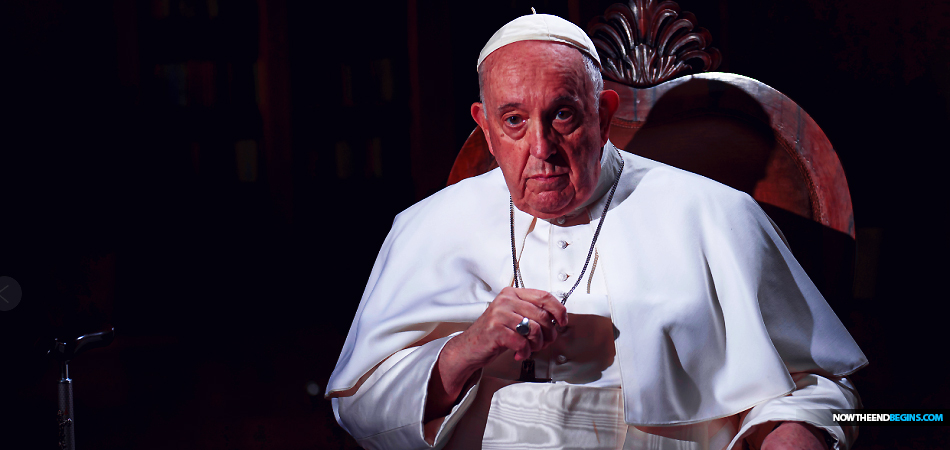
Source: Pope Francis: Most Influential & Dangerous False Teacher :: By David Reagan

Quick Thought on The Pope and Roman Catholicism

I am concerned how many “Christians” are compromising on/with the Catholic Church along with the Pope. Pope Francis has died, and the world is asking: Will the Pope go to Heaven? Some say yes, some say no. But the real answer depends on one crucial question: Has he been born again? Many grow up Catholic but never heard Jesus’ command: “You must be born again.” Others are trusting in the Catholic traditions, church teachings, sacraments, confession, the Eucharist, or their own good works and goodness.

In the long war for truth, the most formidable, implacable, and deceptive enemy has been “Roman Catholicism”, is an apostate, corrupt, heretic, “false Christianity”, is a front for the reign of Satan.

In one of his many controversial speeches Pope Francis said, “All religions are paths to God. I will use an analogy: they are like different languages that express the divine…There is only one God, and religions are like languages, paths to reach God. Some are Sikh, some Muslim, some Hindu, some Christian.”

The Assisi Conferences

John Paul’s radical commitment to ecumenism shifted into high gear in 1986 when he suddenly issued a call for all the religious leaders of the world to join him in Assisi, Italy, in October to pray for world peace. He emphasized that the participants would be free to pray to their own gods — as if other gods exist besides Yahweh!

A total of 160 religious leaders from all over the world accepted the Pope’s invitation. There were Catholic, Protestant and Orthodox Christians, as well as representatives of Hinduism, Judaism, Islam and Buddhism. The Dalai Lama, whose followers considered him to be a god, showed up, as did an African animist witch doctor. The person who stole the show was a Crow Indian from Montana named Pretty-on-Top. He was dressed in his full native attire and chanted prayers to his sky-god as he danced.

John Paul repeated the bizarre event in January of 2002 — again, in Assisi. At that time, over 200 religious leaders were present.

In June of 2011, Pope Benedict XVI decided to renew the “spirit of Assisi” by calling for a celebration of the 25th anniversary of the first gathering. It was held in Assisi in October, and for the first time, agnostics were invited to attend. Explaining this unusual invitation, Pope Benedict said, “Even though they have not received the gift of faith, they are nevertheless on the lookout for truth, searching for God.”

Pope Francis gave the “spirit of Assisi” his endorsement in September of 2016 when he convened a 30th anniversary celebration.

The Climax of Catholic Apostasy

These outreaches to world religions, regardless of the gods they worship, have now come to a climax with Pope Francis’ proclamation that all religions are roads to the same God.

This proclamation makes a mockery of the sacrifice of Jesus. It also makes Jesus a liar when He proclaimed, “I am the way, and the truth, and the life; no one comes to the Father but though Me” (John 14:6). Further, it is directly contrary to the Apostle Peter’s declaration that “There is salvation in no one else [except Jesus]; for there is no other name under heaven that has been given among men, by which we must be saved” (Acts 4:12). It also renders all mission work irrelevant since it maintains that a person can be saved through any religion, whether it be by Buddha or the sky-god of the Crow Indians.

In short, Pope Francis is guilty of blaspheming the blood of Jesus!

Pope Francis, though regarded by people as a kind and humble man, was a man who did not understand the Gospel. He taught a different gospel and led people towards a false gospel while attempting to steer people away from the gospel the apostles taught.

Obviously, it is possible that in his last moments, Pope Francis repented and stopped believing the heresies he so desperately wanted others to believe even up to days before his death. That said, one must be able to kindly and gently declare without hesitation that salvation is by Grace Alone and through faith alone and that anyone who believes differently is in hell, and that hell will be hotter for those who taught and desired for others to believe anything different. (2 Peter 2:17)

Works don’t matter. The titles don’t matter. Power doesn’t matter. Being born again is all that matters.

The World Observes the Passing of a Pope | VCY

Date: April 23, 2025
Host: Jim Schneider
​Guest: Mike Gendron
MP3 | Order

https://embed.sermonaudio.com/player/a/42325219392213/

This past Monday, worldwide media brought us the news that Pope Francis had died at the age of 88.  Network coverage was dominated by this news, with lengthy pieces, hour-long specials and even live streaming showing thousands filing past the body of the Pope.  Yet to come is the funeral this Saturday, in St. Peter’s Square, outside the basilica where leaders and heads of state from about 170 governments from all over the world will be in attendance.    

With more on this topic, Crosstalk welcomed Mike Gendron.  Mike is the founder and director of Proclaiming the Gospel Ministry.  Mike was a devout Roman Catholic for over 3 decades and was taught to rely upon the authority of the church above all else.  Mike searched the Scriptures and was amazed to find that what he read contradicted the teaching and tradition of the church he had been a part of for so long.  He trusted Jesus as his Savior and now the Bible has become his sole authority in all matters of faith.  Mike is the author of the books, Preparing for Eternity and Contending for the Gospel and has produced numerous videos with warnings concerning false teachings vs. the truth of the Scriptures.

Pope Francis had a history of false teachings.  For example, in May of 2013 he said that atheists would go to heaven if they lead good and honorable lives.  In July of that same year, in the context of whether homosexuals could serve in the priesthood, he said that if someone is gay and searches for the Lord and has goodwill, who was he to judge?  In November of 2015 he proclaimed that Christians and Muslims are brothers and sisters. In June of 2016 he said that all religions are different paths to the same god so he believed that all people are children of God.  Then in a 2018 tweet he communicated that there is no hell and those who don’t repent and cannot be forgiven simply disappear.  In May of 2023 he emphasized that doing good is the principle that unites all of humanity.  Ironically, these teachings from Pope Francis contradict those of the apostle Peter, the man who Catholics teach was the first Pope.

There’s much more to take in, and you can hear it all, when you review this edition of Crosstalk.

More Information

proclaimingthegospel.org

817-379-5300

Pope Francis, My Worst Protestant Nightmare | The Log College

CARL R. TRUEMAN; FIRST THINGS;  APRIL 22, 2025

The era of Francis is over, and it is time to start the postmortems on his tenure. Throughout his time as pope, Roman Catholic critics of Francis typically prefaced their remarks with an acknowledgment of his strengths: his care for the poor, his stand on abortion, his clarity on transgenderism. He was certainly solid on these matters, as one would expect any Christian with a basic catechetical knowledge of the faith to be. Yes, one might say, the pope was Catholic. But in other areas, he was more problematic.

Intellectually, he was always going to be lackluster compared to his two predecessors. It’s hard to measure up to the author of Love and Responsibilityand a man who could discuss the problems of European culture with Jürgen Habermas. But this should have prompted Francis to place the intellectual project of Catholicism into the hands of serious thinkers. Instead, he appointed Victor Manuel Fernández to head the Dicastery for the Doctrine of the Faith. The position once held by Joseph Ratzinger, scholar of patristics and author of The Spirit of the Liturgy, is now held by the author of Heal Me with Your Mouth and Mystical Passion, which includes lurid ramblings about the theological significance of orgasms. It is as if Aquinas had been succeeded by Johann Tetzel.

Francis’s equivocal actions, or lack thereof, in the matter of Marko Rupnik were disturbing. Rupnik, the producer of what can best be described as creepy religious kitsch, stands accused of the most lurid sexual crimes. Expelled from the Jesuits in 2023, he was still officially listed as advisor to the Dicastery for Divine Worship and the Discipline of the Sacraments in 2024. Intentional or accidental? Neither speaks of a leadership concerned overmuch with the victims.

Francis made little secret of his disdain for conservative U.S. Catholic bishops, promoting instead the cause of those who most faithfully represent the spirit of the age. Archbishop Charles Chaput’s work for the people of Philadelphia, his writings for the wider Christian world, and his role in hosting the World Meeting of Families in 2015 should easily have merited a cardinal’s hat. It never came, and Francis accepted without hesitation his pro forma letter of resignation on his seventy-fifth birthday.  

Archbishop Cordileone tried for years to gently persuade Nancy Pelosi not to support abortion, but to no avail. Finally, in 2022, he told her she would be barred from receiving Communion in the archdiocese of San Francisco. The archbishop was simply fulfilling his pastoral duty to care for his flock—and in this case, to care for the soul of someone who advocates for the destruction of innocent lives. Francis was happy to help in this situation. Sadly, though, his aid went to Pelosi, not the archbishop. He gave her the Sacrament himself while she was visiting the Vatican. No doubt this reassured her that her evil was of no consequence to her or the unborn victims of her political ambitions. In the aftermath, I saw Archbishop Cordileone being interviewed at a conference. He refused to criticize the pope’s clear subversion of his authority. That is the mark of a Christian gentleman who understands how his Church’s authority structure works and who cares for the souls under his care. 

Francis’s love of creating chaos for his fellow priests was obvious. His recent comment that “all religions are paths to God,” and the confusion surrounding the translation of the text, is but one example. Then there were the constant sound bites that caused such trouble. At first these seemed to be the inevitable concomitants of an elderly pope governing in an era of social media that he could not possibly understand. And yet over time the persistence of the gaffes made them look more intentional and less pardonable. 

Then there was the matter of blessings for same-sex couples—or, to be more precise, for those individuals in same-sex relationships. The fine distinction sowed more chaos and empowered those looking to shift the Catholic Church’s teaching in a progressive direction. It was perhaps appropriate that the first Jesuit pope reminded us of where the term “Jesuitical” originated.

Then there was the big sellout to the Chinese Communist party. What a confusion of Church and state it is to allow the secular magistrate a role in choosing a bishop. But when that secular magistrate is a party with blood—Christian and otherwise—on its unrepentant hands, the problem is not merely a confusion of powers; it is an insult to everyone who has sacrificed, often in extreme ways, to oppose such criminals.

While China enjoyed a special deal, Francis’s constant carping at America and Americans grew tiresome. His recent letter to the U.S. bishops, in which he criticized the Trump administration’s policy on illegal immigration, was emblematic of his attitude of sanctimonious hypocrisy. Just a few months before, Vatican City had implemented its own draconian laws relative to unwelcome foreign intruders. 

As a confessional Protestant, there is perhaps one decision Francis made that I should approve: restricting the Latin Mass. The need for vernacular liturgy was a standard part of Reformation Protestant policy. But even here there was a problem. The Protestant Reformers’ liturgical changes were driven by a specific theology of the word and its connection to salvation and sacraments. Catholicism’s theology of the sacraments is different and does not require liturgy in the vernacular. The pope’s move therefore lacked any obvious doctrinal motivation. One can only speculate as to his motives, but it appeared to be a liberal assault on traditional Catholicism. Francis was thus my own worst Protestant nightmare: an authoritarian Roman pope driving a liberal Protestant agenda, a leader who embodied the worst of all possible Christian worlds.

Time will tell whether the next pope will follow in Francis’s footstep and permit the continuation of liberal Protestant policies. It’s up to the men who will be gathering in the Sistine Chapel in the coming weeks. As a Catholic friend once said to me about the last papal election, the Holy Spirit never errs. But, he added, the same cannot be said for the College of Cardinals.

Pope Francis Dead at 88 | Protestia

Jorge Mario Bergoglio, otherwise known as Pope Francis, passed away early Monday morning. He was 88 years old.

Vatican Cardinal Farrell announced the death of Pope Francis on Monday with these words:

“Dearest brothers and sisters, with deep sorrow I must announce the death of our Holy Father Francis.

At 7:35 this morning, the Bishop of Rome, Francis, returned to the house of the Father. His entire life was dedicated to the service of the Lord and His Church. He taught us to live the values ​​of the Gospel with fidelity, courage and universal love, especially in favor of the poorest and most marginalized.

“With immense gratitude for his example as a true disciple of the Lord Jesus, we commend the soul of Pope Francis to the infinite merciful love of the One and Triune God.”

The first pope from the Jesuit society, Francis made a name for himself after spending a decade slowly but surely pulling the Roman Catholic Church into a more progressive direction. He routinely advocated against close borders and capitalism and for cultural Marxism, radical environmentalism, and a lessening of the church’s strong stance against homosexuality and abortion.

While there is no such thing as a ‘good’ pope, Francis was particularly noxious and vexatious. He affirmed the faith of Joe Biden by saying he would never refuse him communion because the President’s love for abortion is between him and God, endorsing civil unions for gay couples, appointing multiple pro-choice people to his pro-life organization, saying that he’s open to priests blessing homosexual relationships, so long as there is no suggestion that they’re blessing gay marriages, and continuing to promote and endorse notorious LGBTQ-affirming priest James Martin.

With his passing, the College of Cardinals will call for a papal conclave to be convened, which will elect the next pope by secret ballot. While there are 252 cardinals, only those under the age of 80 can vote, which pegs the number of participants at 138 electors. Once a candidate receives 2/3rds of the votes, a new pope will be crowned in a process that typically takes two weeks.

This is a developing story.

The post Pope Francis Dead at 88 appeared first on Protestia.

Now That Pope Francis Is Dead What Will Become Of His Alliance With Islam And His Work To Bring The LGBTQ Into The Roman Catholic Church? | Now The End Begins

Pope Francis made his last public appearance on Easter Sunday a day before his death to bless thousands of people in St. Peter’s Square, drawing wild cheers and applause.

Pope Francis bore two titles as he served his 12 years in the Roman Catholic Church, those of Pontifex Maximus and the Holy Father. The first title was that that was given to the Roman emperor Julius Caesar in 63 AD, and the second is actually one of the names for God the Father in John 17. Pope Francis was worshipped by 1.4 billion Catholics, lived as a god but died as a man. The question that everyone wants to answer today is, what will become of the Roman Catholic Church he created? That’s the memo.

“I have said, Ye are gods; and all of you are children of the most High. But ye shall die like men, and fall like one of the princes.” Psalm 82:6,7 (KJB)

Over the years, NTEB has brought you a plethora of articles and stories on the main work of Pope Francis, and in the many articles we have done on him, two things are more prominent than all the rest. The first being his alliance with Chrislam, his connection to Mohammed bin Zayed and the work done with the Abraham Accords, and the second being the changes made to attempt to bring in the LGBTQ into the Roman church. It’s quite an end times legacy he leaves behind, and we are about to see just what will become of it. I think it’s time for a much younger leader to come on the scene, don’t you?

Pope Francis, first Latin American pontiff dead at 88

FROM THE ASSOCIATED PRESS: Pope Francis performed the blessing from the same loggia where he was introduced to the world on March 13, 2013 as the 266th pope. From his first greeting that night — a remarkably normal “Buonasera” (“Good evening”) — to his embrace of refugees and the downtrodden, Francis signaled a very different tone for the papacy, stressing humility over hubris for a Catholic Church beset by scandal and accusations of indifference.

After that rainy night, the Argentine-born Jorge Mario Bergoglio brought a breath of fresh air into a 2,000-year-old institution that had seen its influence wane during the troubled tenure of Pope Benedict XVI, whose surprise resignation led to Francis’ election.

But Francis soon invited troubles of his own, and conservatives grew increasingly upset with his progressive bent, outreach to LGBTQ+ Catholics and crackdown on traditionalists. His greatest test came in 2018 when he botched a notorious case of clergy sexual abuse in Chile, and the scandal that festered under his predecessors erupted anew on his watch. And then Francis, the crowd-loving, globe-trotting pope of the peripheries, navigated the unprecedented reality of leading a universal religion through the coronavirus pandemic from a locked-down Vatican City.

Francis was elected on a mandate to reform the Vatican bureaucracy and finances but went further in shaking up the church without changing its core doctrine. “Who am I to judge?” he replied when asked about a purportedly gay priest.

The comment sent a message of welcome to the LGBTQ+ community and those who felt shunned by a church that had stressed sexual propriety over unconditional love. “Being homosexual is not a crime,” he told The Associated Press in 2023, urging an end to civil laws that criminalize it. READ MORE

Breaking News: Pope Francis dead at 88, Vatican reports

The post Now That Pope Francis Is Dead What Will Become Of His Alliance With Islam And His Work To Bring The LGBTQ Into The Roman Catholic Church? appeared first on Now The End Begins.

https://www.nowtheendbegins.com/pope-francis-is-dead-after-easter-sunday/

The Catholic Eucharist: Unbiblical and Idolatry | The Watchman’s Bagpipes

This article was originally published on 6/20/10 but I thought it needed to be revisited after 15 years.

========

Roman Catholicism teaches that Jesus instituted the Mass at the Last Supper. According to Rome, Jesus actually turned the bread and wine into his physical body and blood. Since that time, whenever the priest says the same words Jesus said at the Last Supper, the bread and wine of the Mass miraculously turns into the actual body and blood of Christ. While the outer appearance of the bread and wine remain the same, supposedly the inner essence – the substance – changes to Christ’s body and blood and remains that way as long as the bread and wine remain “incorrupted.” According to Catholicism, the Eucharist – popularly called Mass – is a means of God’s sanctifying grace which enables the faithful to keep the commandments and do good works. It also helps the faithful to attain salvation. Let’s look at some teachings on the subject from the Catechism:

Para 1365: “Because it is the memorial of Christ’s Passover, the Eucharist is also a sacrifice. The sacrificial character of the Eucharist is manifested in the very words of institution: ‘This is my body which is given for you’ and ‘This cup which is poured out for you is the New Covenant in my blood.’ In the Eucharist Christ gives us the very body which he gave up for us on the cross, the very blood which he ‘poured out for many for the forgiveness of sins.’”

Para 1368: The Eucharist is also the sacrifice of the Church. The Church which is the Body of Christ participates in the offering of her Head. With him, she herself is offered whole and entire. She unites herself to his intercession with the Father for all men. In the Eucharist the sacrifice of Christ becomes also the sacrifice of the members of his Body. The lives of the faithful, their praise, sufferings, prayer, and work, are united with those of Christ and with his total offering, and so acquire a new value. Christ’s sacrifice present on the altar makes it possible for all generations of Christians to be united with his offering.

Para 1376: “The Council of Trent summarizes the Catholic faith by declaring: ‘Because Christ our Redeemer said that it was truly his body that he was offering under the species of bread, it has always been the conviction of the Church of God, and this holy Council now declares again, that by the consecration of the bread and wine there takes place a change of the whole substance of the bread into the substance of the body of Christ our Lord and of the whole substance of the wine into the substance of his blood. This change the holy Catholic Church has fittingly and properly called transubstantiation.’”

Para 1377: “The Eucharistic presence of Christ begins at the moment of the consecration and endures as long as the Eucharistic species subsist. Christ is present whole and entire in each of the species and whole and entire in each of their parts, in such a way that the breaking of the bread does not divide Christ.”

Para 1378: “Worship of the Eucharist. In the liturgy of the Mass we express our faith in the real presence of Christ under the species of bread and wine by, among other ways, genuflecting or bowing deeply as a sign of adoration of the Lord. ‘The Catholic Church has always offered and still offers to the sacrament of the Eucharist the cult of adoration, not only during Mass, but also outside of it, reserving the consecrated hosts with the utmost care, exposing them to the solemn veneration of the faithful, and carrying them in procession.’”

Para 2181: “The Sunday Eucharist is the foundation and confirmation of all Christian practice. For this reason the faithful are obliged to participate in the Eucharist on days of obligation, unless excused for a serious reason (for example, illness, the care of infants) or dispensed by their own pastor. Those who deliberately fail in this obligation commit a grave sin.”

In addition to teaching that the bread and wine actually become the body and blood of Christ, Rome teaches that the Eucharist is to be worshiped as Christ. The Code of Canon Law states that the faithful are to “hold the Eucharist in highest honor…worshiping it with supreme adoration.” According to Vatican II, this is to be with “the same worship of latria or adoration that we offer to God.” (both citations from James G. McCarthy, The Gospel According to Rome, P.131). Yet worshiping objects such as wine and bread is nothing less than idolatry, which Scripture specifically prohibits.

Let’s use a little common sense and reasoning here. If the Last Supper was in actuality a Mass, then how could Jesus be sitting there with the elements at the same time saying the elements were his body and blood? Do you think the disciples understood Jesus to be speaking literally, since the Law prohibited the eating of blood? And if the human body of Christ is located in heaven at the Father’s right hand, how can it be at the same time in millions of places in Masses all over the world? Isn’t it more likely that Jesus was using the bread and wine figuratively so as to provide Christians with symbols to celebrate with as a memorial?

Rome also claims that in the Eucharist Christ is sacrificed to God, and that the Last Supper was in itself a Mass. If the Last Supper was indeed a sacrifice of Christ, then we have an illogical situation of Christ sacrificing himself before he was sacrificed on the cross. Additionally, if each Mass is a sacrifice of Christ, then we have a direct contradiction of the Bible which says that Christ was sacrificed once for all time, and that this eliminated the need for continual sacrifices.

Hebrews 7:26-27: For such a High Priest was fitting for us, who is holy, harmless, undefiled, separate from sinners, and has become higher than the heavens; who does not need daily, as those high priests, to offer up sacrifices, first for His own sins and then for the people’s, for this He did once for all when He offered up Himself.

Hebrews 9:24-28: For Christ has not entered the holy places made with hands, which are copies of the true, but into heaven itself, now to appear in the presence of God for us; not that He should offer Himself often, as the high priest enters the Most Holy Place every year with blood of another— He then would have had to suffer often since the foundation of the world; but now, once at the end of the ages, He has appeared to put away sin by the sacrifice of Himself. And as it is appointed for men to die once, but after this the judgment, so Christ was offered once to bear the sins of many.

Hebrews 10:14: For by one offering He has perfected forever those who are being sanctified.

1 Peter 3:18a: For Christ also suffered once for sins, the just for the unjust, that He might bring us to God

Lastly, notice also that deliberately failing to participate in the Sunday Eucharist is a mortal sin, which would mean the person was in a state outside of grace and in danger of going to Hell. This would also mean that the Mass is necessary for salvation, thereby adding to the plain teaching of Scripture that we are saved by faith apart from works. (Acts 16:30-31).

The Roman church has many reasons why they claim this is all true, and twist the Scriptures to justify much of it. However, once the reasons are examined in light of Scripture in context, one is able see that the whole basis of this teaching is because the Church says so – because they are the Magisterium, and they have the authority to speak for God, while the Pope is Christ’s representative on earth. Of course, by examining the history of the papacy and of the Catholic Church, one sees immediately the fraudulent nature of these claims.

http://watchmansbagpipes.blogspot.com/2025/04/the-catholic-eucharist-unbiblical-and.html

Unbiblical Catholic Sin, Purgatory and Indulgences | The Watchman’s Bagpipes

This article was originally published on 6/18/10 but I thought it needed to be revisited after 15 years.

============

Roman Catholicism teaches that there are two types of sin, mortal and venial. As described in the Catechism: “Mortal sin destroys charity in the heart of man by a grave violation of God’s law; it turns man away from God, who is his ultimate end and his beatitude, by preferring an inferior good to him. Venial sin allows charity to subsist, even though it offends and wounds it.” (Para. 1855)

James McCarthy sums up the teaching thus (bracketed numbers are paragraphs in the Catechism): “Roman Catholic theologians compare the manner in which mortal and venial sins affect the soul to the way in which illnesses affect the body. Most ailments are minor. The body’s immune system fights them off and eventually restores health. A venial sin is like a minor sickness of the soul. It hinders spirituality and lowers resistance to temptation, but the vitality of the soul survives [1863]. Mortal sin is a deathblow. It kills the soul as surely as a fatal disease kills the body. When a Catholic who has received sanctifying grace through baptism commit’s a mortal sin, he loses that grace [1861]. Though by baptism he had been justified, because of mortal sin he forfeits the grace of justification, or, it might be said, is dejustified. He becomes a child of wrath and destined for hell [1033, 1861, 1874]. And just as a dead body has no capacity to restore itself, the Church teaches that a soul struck dead by mortal sin cannot revive itself. The sinner must turn to the Church and to the sacrament of penance [1446, 1856].” (The Gospel According to Rome, pp.75,76)

Biblically-speaking, all sin is mortal in that all sin not forgiven through faith in Christ condemns one to eternal separation from God. While under Catholic teaching one is required to confess mortal sins to a priest, who will prescribe a work of penance for forgiveness and release from eternity in Hell, Scripture says we confess our sins directly to God for forgiveness (1 John 1:8-9; Heb. 4:16, 1 John 2: 1,2) and our salvation has never been in danger.

Purgatory: Invented by Pope Gregory the Great in 593, this didn’t become dogma until 1439 because of so much reluctance to accept such an unbiblical idea. Catholicism teaches that Christ’s death made it possible to be forgiven of sin, but the sinner must still undergo some pain and torment in order to be purged and made acceptable to enter heaven. This “purging” is of unknown intensity and duration. “While Catholicism says it is theoretically possible to be cleansed through the sufferings of this life and one’s death, no one, not even the pope himself, can know whether that has occurred. Consequently, almost all Catholics expect to spend some unknown length of time in purgatory.” (Dave Hunt, A Woman Rides the Beast, p.475)

The Second Ecumenical Council of the Vatican, which was held from 1962 to 1965, stated this about purgatory: “The doctrine of purgatory clearly demonstrates that even when the guilt of sin has been taken away, punishment for it or the consequences of it may remain to be expiated or cleansed. … [I]n purgatory the souls of those who died in the charity of God and truly repentant but who had not made satisfaction with adequate penance for their sins and omissions are cleansed after death with punishments designed to purge away their debt.”

Paragraphs 1030-1032 of the Catechism say, “All who die in God’s grace and friendship, but still imperfectly purified, are indeed assured of their eternal salvation; but after death they undergo purification, so as to achieve the holiness necessary to enter the joy of heaven. The Church gives the name Purgatory to this final purification of the elect, which is entirely different from the punishment of the damned. The Church formulated her doctrine of faith on Purgatory especially at the Councils of Florence and Trent. The tradition of the Church, by reference to certain texts of Scripture, speaks of a cleansing fire: ‘As for certain lesser faults, we must believe that, before the Final Judgment, there is a purifying fire. He who is truth says that whoever utters blasphemy against the Holy Spirit will be pardoned neither in this age nor in the age to come. From this sentence we understand that certain offenses can be forgiven in this age, but certain others in the age to come.’ This teaching is also based on the practice of prayer for the dead, already mentioned in Sacred Scripture: ‘Therefore [Judas Maccabeus] made atonement for the dead, that they might be delivered from their sin.’… The Church also commends almsgiving, indulgences, and works of penance undertaken on behalf of the dead.”

Catholics are taught that the living can help those in purgatory by saying prayers, giving alms and doing good works, which merits are then offered on the behalf of those in purgatory. Requesting a Mass on the behalf of the dead is supposedly the most effective means (usually money is provided to the priest for this service).

What does the Bible say?

[Christ] being the brightness of His glory and the express image of His person, and upholding all things by the word of His power, when He had by Himself purged our sins, sat down on the right hand of the Majesty on high. (Hebrews 1:3, NKJV)

But he that lacketh these things is blind, and cannot see afar off, and hath forgotten that he was purged from his old sins. (2 Peter 1:9, KJV)

Since Christ died to purge our sins, there is no need for a purgatory. Additionally, Scripture says that when we die, we go to be immediately with the Lord and not in a place of purging (Luke 23:43; Philippians 1:23-24; 2 Corinthians 5:8).

Indulgences: “Another way in which the living can help the dead is by acquiring special credits, called indulgences, that cancel out temporal punishment [1032 1471]” (McCarthy, p.94)

“The doctrine of indulgences arises from Catholicism’s strange and unbiblical insistence that Christ’s sufferings for our sins upon the cross at the hands of man and God could only obtain forgiveness of guilt but still left the ‘forgiven but repentant sinner’ under the obligation of suffering for his own sins either in this life or most likely in the ‘purifying flames of purgatory.’ An indulgence presumes, through the power given to the Church, to reduce the time or intensity of the suffering in purgatory by some unknown length or amount.” (Hunt, p. 522)

Catechism, Para 1471: …“‘An indulgence is a remission before God of the temporal punishment due to sins whose guilt has already been forgiven, which the faithful Christian who is duly disposed gains under certain prescribed conditions through the action of the Church which, as the minister of redemption, dispenses and applies with authority the treasury of the satisfactions of Christ and the saints.’” ‘An indulgence is partial or plenary according as it removes either part or all of the temporal punishment due to sin.’ The faithful can gain indulgences for themselves or apply them to the dead.”

Catechism, Para 1478-1479: “An indulgence is obtained through the Church who, by virtue of the power of binding and loosing granted her by Christ Jesus, intervenes in favor of individual Christians and opens for them the treasury of the merits of Christ and the saints to obtain from the Father of mercies the remission of the temporal punishments due for their sins. Thus the Church does not want simply to come to the aid of these Christians, but also to spur them to works of devotion, penance, and charity. Since the faithful departed now being purified are also members of the same communion of saints, one way we can help them is to obtain indulgences for them, so that the temporal punishments due for their sins may be remitted.”

As you can see, this doctrine says that Christ’s atonement was insufficient for the total forgiveness of sin, and that we must therefore do additional works.

Scripture tells us our sins are forgiven in Christ and that He paid the penalty for that sin. Since Christ was purged for our sin, there is no need of purgatory, and if there is no need for purgatory, then there is even less need for indulgences to pay for lessened time in purgatory.

Rome controls its members by legalistic rules which make them fear the loss of salvation and continued punishment for sin. Additionally, Rome has enriched itself over centuries by taking money from members who think they are paying to have less time served in an imaginary purgatory. These are not actions of a church of Christ, rather they are the actions of a religious organization of man.

http://watchmansbagpipes.blogspot.com/2025/04/unbiblical-catholic-sin-purgatory-and.html

Ungodly Beliefs and Behaviors Catholic Leaders Promote | The Watchman’s Bagpipes

I’m going to be doing a series on the Roman Catholic Church, essentially pulling from 15-year-old posts because more people need to learn about the RCC.

The RCC claims to be the one true, original church with a leader—their Pope—who pretty much speaks for God. So to start with, I want to give examples of the teachings of RCC leadership, including the Pope, to show how they thumb their collective noses at God.  Now this post just has a small sample of what I’ve collected over the years, and this collection only goes back to 2021. So let’s look at what I’ve discovered.

Dissident priest Fr. James Martin wants you to celebrate LGBT ‘pride month’.  Isn’t pride a sin? And isn’t what they are proud of a abomination to God?

A Catholic teacher was nominated for atheist ‘person of the year’ award for classroom LGBT activism.  Again acting FOR what God calls an abomination.

The new president of John Paul II Institute wants ‘pastoral care’ of homosexuals, including ‘integration’ and reception of the sacraments.  More promotion/celebration of what God calls an abomination.

Remember, the Pope speaks for God! Really?!?!? Pope Calls for ‘Ecological Spirituality’ to care for ‘Mother Earth’. The earth is not our mother!! Just what is “ecological spirituality”?

Florida diocese forces schoolkids to wear masks while hosting ball for wealthy maskless donors. Abuse students and kneel to wealth.

Austrian bishop hangs banner of nude trans activist over main altar for Lent. Sounds more like something Satan would do.

Catholic school district in Ontario to fly rainbow flag during LGBT ‘pride month’. Again celebrating what God call an abomination.

Pope Francis denies Christ. Despicable.

Pope Francis is preaching un-Christian clap-trap: he is essentially saying that we are all racists.

Catholic Health Ministry Sponsors Texas Drag Queen Event Which Children Attended. This is abusing children by teaching them sinful and disgusting behavior.

Catholic High School Bursts Into Applause as Drag Queen Takes Stage During Chapel Worship Service. Chapel worship service with a drag queen?!?!

How about a Catholic school that suspended a student for saying men and women are different?!!? Punishing a student for telling the truth?!?

We have a Catholic university denying a formation of a group on campus because the group believes in only two genders — male and female. Denying a group because the believe the truth?

There is a priest in Ireland who allows a Muslim call to prayer during Mass. Islam is the enemy of the Christian faith! Islam massacres Jews and Christians around the world and yet a priest celebrates this blasphemy?!?!?

An archdiocese has a “Pride Mass.” Thumbing their nose at God.

Catholic All-Girls College Will Admit Men Who Identify as Trans Women. So Catholics are denying biology? Isn’t this an affront to God?

Catholic Church Updates Dogma to Include Co-habiting Homosexual Couples as “Conforming to the Faith” So what God calls an abomination conforms to the faith?!?!

There is absolutely no evidence of any “climate” emergency and yet Pope Francis said those who refute the idea are stupid! Remember, he claims to speak for God. (The climate change agenda is for more government control.) And he gets worse than that.

Pope Francis says “All religions are paths to reach God…some are Sikh, Muslim, HIndu, Christians; they are different ways to God.”  This is abject heresy. NOWHERE in Scripture will find any but one path to God and that is through Jesus Christ. Acts 4:12 says only ONE WAY to God.

Pope Francis proclaims Special Jubilee for LGBTQ+ Community. Special Jubilee for what God calls an abomination?!?

Cardinal Dolan Hails ‘Our Islamic Brothers and Sisters,’ Calls Ash Wednesday ‘Our Ramadan’ This is just plain heresy. Islam is the enemy of Christianity!!

Notice how these Catholic leaders, including the Pope, are especially celebrating homosexuality, drag queens and “transgenderism”—a complete affront to God!!! The Pope has also bought into the whole lying Communist agenda regarding ecology and climate. 

The Pope is supporting evil and yet claims to speak for God.

http://watchmansbagpipes.blogspot.com/2025/03/ungodly-beliefs-and-behaviors-catholic.html

Roman Catholic Cardinal Timothy Dolan Delivers Shocking ‘Ramadan Message’ Calling On All Catholics To Pray For Their ‘Muslim Brothers And Sisters’ | Now The End Begins

Cardinal Dolan delivers a ‘Ramadan message’ shaming all Catholics into praying for ‘our Muslim brothers and sisters’ continuing the work Pope Francis has done with his Islam Alliance

As Pope Francis lays in his hospital bed, and quite possibly his death bed as his condition continues to worsen, Cardinal Timothy Dolan took to his Podcast to deliver a stunning message on the Muslim holiday of Ramadan that starts today. In that message, Dolan refers them as “our Muslim brothers and sisters”, sparking quite the controversy online. Calling Muslims as “brothers and sisters” implies there is a bond connecting the two religions that are very far apart. Yes, not as far as you might think when you consider the alliance forged by Pope Francis over the past 12 years between Islam and the Roman Catholic Church. Has Ash Wednesday become the ‘Catholic Ramadan’, as Cardinal Dolan suggests? It sure has and a whole lot more than that, and that’s the memo.

“Can two walk together, except they be agreed?” Amos 3:3 (KJB)

Cardinal Dolan said he was giving this message to “shame Catholics” into becoming more like Muslims, and concluded his fiery missive by saying “let’s unite with our Muslim brothers and sisters in prayer and fasting.” Dolan even went so far to call the Roman observance of Ash Wednesday as the ‘Catholic Ramadan’. Wow, there’s a lot to unpack there. So let’s do a quick review of the foundation for all this laid by Pope Francis. Please take a moment to click on these links to refresh your memory about the alliance Pope Francis created between Islam and the Roman Catholic Church.

Pope Francis and the Chrislam Alliance:

So you see, the “shocking message” delivered by Cardinal Dolan is absolutely on target with the official stance the Roman Catholic pope has taken on Mohammed’s religion of Allah. Even if Pope Francis does not survive his current health crisis, the work he has put in place with Islam and the Muslims will live on into the arrival of Antichrist in the time of Jacob’s trouble.

https://twitter.com/NowTheEndBegins/status/1895901794146136117

https://www.nowtheendbegins.com/roman-catholic-cardinal-timothy-dolan-delivers-shocking-ramadan-message-calling-on-all-catholics-to-pray-for-their-muslim-brothers-and-sisters/

Is Mary the Mother of the Church and Our Mediatrix? | Midwest Christian Outreach, Inc

This is the third of a number of reasons why I could never be a Catholic (click here for articles 1 and 2). Mariology issues cannot be adequately covered in one article. I plan to address this further in the future. Part 3 of this series will focus on the problems with the Catholic Church’s argument that the Virgin Mary is the Mother of the Church and our mediatrix.

Introduction: Why are Protestants Getting Interested in Mary?

As an introduction to the discussion, it’s important to understand why this series on Mary is particularly important today. In his book Queen of All: The Marian apparitions’ plan to unite all religions under the Roman Catholic Church, Jim Tetlow of Understand the Times International shares the following information on the growing interest in Mariology within the Protestant church:

In 2005, Time Magazine featured an image of Mary as The Mother of God on the cover with the title “Hail, Mary – Catholics have long revered her, but now Protestants are finding their own reasons to celebrate the mother of Jesus.” The article explains the stunning trend of the growing Marian devotion among Protestant churches:

In a shift whose ideological breadth is unusual in the fragmented Protestant world, a long-standing wall around Mary appears to be eroding…Mary is also gaining popularity at Protestant divinity schools, where her icons adorn future pastors’ walls.1

Albert Mohler, Jr. – president of The Southern Baptist Theological Seminary – commented on the Time Magazine article “Hail, Mary”:

The Time cover story is part of a larger phenomenon, with many mainline Protestants turning to a reconsideration of Mary and incorporating the veneration of Mary into personal devotions and corporate worship. Some are going so far as to acknowledge Mary as an intercessor, addressing prayers to her as well as to other saints. Surprisingly enough, some Protestants now argue that believers should pray to Mary and should request her intercession.2

Is Mary the Mother of the Church?

What does the Roman Catholic Church mean when it says that Mary is the mother of the Church, and why is this an important subject to discuss? According to Catholic Answers, Mary is the “New Eve” and thus the mother of the church.

Scripture reveals that through our salvation, God was initiating a “new creation” (2 Cor. 5:17), with Jesus as the New Adam (see 1 Cor. 15:47). The early Church Fathers, who received the teaching of the apostles, recognized Mary as the New Eve. The name Eve means “mother of all living” (Gen. 3:20). As Eve was mother of the living in the natural order, so Mary is the Mother of the living in the order of grace. Everyone who receives spiritual life receives it through her (LG 61).

Vatican II confirmed:

[Mary] was the new Eve, who put her absolute trust not in the ancient serpent but in God’s messenger. The Son whom she brought forth is he whom God placed as the first-born of many brethren (cf. Rom. 8:29), namely, the faithful. In their birth and development she cooperates with a maternal love. (LG 63)

The teaching of Mary’s maternity of the faithful is strengthened in a passage in Revelation 12. After speaking of the woman who will give birth to “a male child, one who is to rule all the nationss,”[sic] Scripture goes on to tell us that this mother has other children. “The rest of her offspring [are] those who keep the commandments of God and bear testimony to Jesus” (Rev. 12:17). Mary is the Mother of everyone who belongs to Jesus. A mother “mediates” life to her children; Mary mediates spiritual life—grace—to every Christian.3

According to Fr. Dwight Longdecker:

Every Christian believes that he or she is called to pray for the world, to intercede and to mediate for others, to have a “ministry of reconciliation” (2 Cor. 5:18-19). . . . all Christians agree about the need to mediate in prayer for others. . . . Mary is the first evangelist. She carried the Word of God in her body, kept it there, and bore it to the world. This was her practical role in the Incarnation, but it was also her theological role. In doing this she shows us our lesser calling to be mediators of the New Covenant and ministers of reconciliation. 4

Mary Beth Kremski and Fr. Longdecker fairly articulated the position and teaching of the Roman Catholic Church, but if we check their biblical citations in context, we note that they used eisegesis rather than exegesis. The Apostle Paul’s discussion in 2 Corinthians 5:1-10 is about being freed from our mortal body to be with Christ in our immortal resurrection body. Verses 5:11-15 are about living for Christ and those for whom He died and was resurrected, “and he died for all” (2 Corinthians 5:15). When Paul mentions the “new creation” it is those who have believed and are already “in Christ.”:

Therefore, if anyone is in Christ, he is a new creation. The old has passed away; behold, the new has come. (2 Corinthians 5:17)

Christ performed the mediatorial work in His death, burial, and resurrection. In light of this, we are sent as His ambassadors with the message of reconciliation. (2 Corinthians 5:18-21) We might notice that Mary is nowhere mentioned or even implied in this passage. Similarly, in 1 Corinthians 15:47 Paul contrasts the first Adam, who could only receive life, and the second Adam, Christ, Who is the life-giver. Again, Mary is not implied or mentioned in this passage. It might also be noted Mary gave birth to the human life God brought into being in her womb. Like the first Adam, Mary can only receive life, but contrary to Rome’s claims, she is unable to mediate between God and man, much less mediate spiritual life “to every Christian.”

According to research done by Dr. Lawrence Feingold STD, Associate Professor of Theology and Philosophy at Kenrick-Glennon Seminary, Justin Martyr, Irenaeus, and Tertullian, all alluded to the idea of Mary being the “New Eve.”5 While the temptation to leap from these Fathers alluding to Mary being the “New Eve” that is not the same as demonstrating they taught this was true. The Ante-Nicene Fathers, like theologians down through history, were trying to figure out how this all works together, something we might call the mechanics of the faith. However, it is a monumental leap to claim that because they “alluded to the idea” that means Mary is the mother of the Church.

The Catholic Answers argument from Revelation 12 is again a bit of eisegesis aided by an amillennial eschatology.

As far as the millennium goes, we tend to agree with Augustine and, derivatively, with the amillennialists. The Catholic position has thus historically been “amillennial” (as has been the majority Christian position in general), though Catholics do not typically use this term. The Church has rejected the premillennial position, sometimes called “millenarianism” (see the Catechism of the Catholic Church 676).6

Amillennialism contributes to supersessionism, more commonly known as  Replacement Theology and the furtherance of the idea that God no longer has a plan for the Jews. When the Catholic Church replaces Israel, it opens the door for Catholics to interpret the woman of Revelation 12 as Mary, (the New Eve) because the church is the new Israel in their view. From a pre-millennial, dispensational eschatology however, “the woman” is seen as Israel. And “the rest of her offspring” (v7) could refer to Gentiles who come to faith in Jesus during the Great Tribulation.).7

The similarity between the description in Revelation 12 and Joseph’s dream in Genesis 37:9-11 where his father, Jacob (Israel), his mother, and their children would bow down to him is interesting. The book of Revelation is a sort of Reader’s Digest version of the Old Testament descriptions of the end times where Israel figures prominently. In Revelation 12, the twelve stars refer to the twelve tribes of Israel.

There is additional evidence for this interpretation. While Revelation 12:2-5 speaks of the woman being with child and giving birth, it should be noted that the Nation of Israel is described as God’s wife in Jeremiah 3:14 and betrothed to Him forever in Hosea 2:19. It is true that Mary, of the lineage of Abraham, Issacc and Jacob (Israel) gave birth to Jesus, that established the lineage of Jesus, as the son of David from the tribe of Judah, came from Israel. In a sense, Israel gave birth—or brought forth—Christ Jesus.

Mary as Mediatrix

I rarely hear Catholics talk about the work of Jesus Christ; instead, their focus seems to be mainly on Mary. But why? Isn’t this placing too much emphasis on Mary and not enough on Jesus? Catholics tend to disagree. Many I have spoken with claim that to focus on Mary is to focus on the one that is your path to Jesus.

Catholics view Mary as the “Ark of the New Covenant” or the channel through which Christ and His saving work came into the world. She not only gave birth to our Lord, but gave birth to the church, who will bring the message of salvation to the world. According to the Swiss theologian Karl Barth, Mary is the archetype of the Catholic faith.

Marian dogma is neither more nor less than the critical, central normative dogma of the Roman Catholic Church, the dogma from the standpoint of which all their important positions are to be regarded and by which they stand or fall. The “mother of god” of Roman Catholic Marian dogma is quite simply the principle, type and the essence of the human creature cooperating servantlike (ministerialiter) in its own redemption on the basis of prevenient grace, and to that extent the principle, type and the essence of the Church.8

According to Casey Chalk of TheCatholicThing.org:

Barth is correct in describing Catholic teaching as upholding Mary as the “type and the essence of the human creature” cooperating in his own redemption. Catholics aim to imitate Mary in being entirely submissive to the divine will.9

Therefore, to get to Jesus, the Catholic must go through Mary. They must be willing to live the type of life she lived and be willing to work with God toward their own salvation. Therefore, Mary is considered the mediatrix between us and Jesus, while Jesus is still the mediator between us and God the Father.

With equal truth may it be also affirmed that, by the will of God, Mary is the intermediary through whom is distributed unto us this immense treasure of mercies gathered by God, for mercy and truth were created by Jesus Christ.(6) Thus as no man goeth to the Father but by the Son, so no man goeth to Christ but by His Mother.10

However, according to Norman Geisler and Ralph E. MacKenzie:

  • The doctrine of Mary as mediatrix is not considered an infallible dogma by the church and has little support from the writings of the early church.11
  • It wasn’t even doctrine until the 1854 bull “Ineffabilis” of Pope Pius IX.12
  • And the scriptural evidence for calling Mary a mediator or co-redemptrix is totally lacking.13

Conclusion

The doctrine of Mary as the Mother of the Church and our mediatrix is not well supported by scripture or by the writings of early church fathers. The only way the Catholic Church is able to support these ideas is by reading scripture through an allegorized interpretation of the End Times. This is dangerous not only because it can lead to writing the Jews out of Scripture but also because it leads to the Catholic Church believing that Mary, a mere human, should be venerated as the archetype of the church instead of Christ and making Mary the Way to the Truth and Life. (See John 14:6) How many will miss salvation by following a false path?

My next article on Mariology will discuss how this veneration of Mary is leading to deception within the Catholic Marian movements and societies

Stephanie Potts and her husband, Jim live in Dayton, Ohio, and have been married for 23 years. She worked with the federal government for 15 years as an intelligence analyst and then entered full-time Christian service in 2015. She first joined Haven Ministries in Denver, Colorado, in 2015 and then transferred to Midwest Christian Outreach, Inc in 2021. She received her Bachelor’s degree from Florida State University in Political Science and International Relations and received her Master’s degree in Geographic Information Systems from Penn State University. She is currently working towards her master’s degree in Christian Apologetics through Southern Evangelical Seminary. She specializes in evangelizing to people involved in the New Age, to Muslims, and Native Americans. Stephanie’s personal website: rainbowapologetics.com

Source: https://midwestoutreach.org/2025/02/20/is-mary-the-mother-of-the-church-and-our-mediatrix/

How To Obtain a Plenary Indulgence in 2025 | The Log College

JAN 15; Tim Challies; INFORMING THE REFORMING

How To Obtain a Plenary Indulgence in 2025

I think we can sometimes fool ourselves into believing that the Reformation caused the Roman Catholic Church to abandon some, most, or all of the doctrine that was so concerning to the Reformers. We can sometimes believe that the Catholicism of today is materially different from that of the 16th century or that it has drawn much closer to Protestantism. But now and again we receive reminders that this is simply not so. A Year of Jubilee is a good opportunity to see this with clarity.

A Year of Jubilee

A Year of Jubilee must be declared by a pope and tends to take place every 25 years or so. It marks a time of special spiritual reflection and renewal for the faithful. A couple of years ago, Pope Francis declared that 2025 would be a year of Jubilee with the theme of “Pilgrims of Hope.” It began on December 24, 2024, with the ceremonial opening of the Holy Doors of St. Peter’s Basilica and will conclude when they are closed on January 6, 2026.

Indulgences

The dominant feature of a Year of Jubilee is the issuing of indulgences. According to the Catechism of the Catholic Church, an indulgence is “a remission before God of the temporal punishment due to sins whose guilt has already been forgiven, which the faithful Christian who is duly disposed gains under certain prescribed conditions…” In other words, an indulgence is a means of reducing the punishment a believer needs to endure in purgatory for sins that have been forgiven but not completely remitted. Indulgences draw upon the Treasury of Merit—a pool of surplus righteousness accumulated by Jesus and the saints that is now made available by the Church. When you perform certain deeds worthy of an indulgence, some of this righteousness is effectively added to your account to either reduce (partial indulgence) or entirely remove (plenary indulgence) the punishment owed to you for your sin. 

During this Jubilee, indulgences can be gained in several ways:

  • Making a pilgrimage to Rome and, while there, carrying out certain acts within particular buildings (e.g. visiting St. Peter’s; praying within the Roman Catacombs).
  • Performing works of mercy (e.g. visiting prisoners; spending time with the elderly).
  • Undertaking certain acts of penance (e.g. fasting from social media for at least a day per week; offering support to the needy).
  • Making a pious pilgrimage to a local cathedral or shrine identified by the appropriate bishop.
  • Engaging in acts of spiritual formation based on the documents of Vatican II.

Those who do these things in the right spirit will receive a plenary indulgence they can apply to themselves or to someone who has died and is in purgatory. This indulgence will be effective for any sins they have committed and confessed and will entirely remove the punishment of those sins in purgatory, thus making their souls entirely pure.

Many Differences

One of the reasons a Year of Jubilee is especially noteworthy is that it highlights so many of the differences between Catholicism and Protestantism. A Year of Jubilee shows that according to the Roman Catholic Church:

  • Christ’s suffering was sufficient to remove the guilt of sin but not its punishment;
  • The Church has the power to forgive sins through confession, yet in such a way that their punishment is not removed;
  • The Church has the authority to issue indulgences;
  • The Church has access to a Treasury of Merit that it can dispense as it sees fit;
  • Baptism is an act of regeneration in which original sin is forgiven and the soul is objectively purified;
  • An indulgence can return the soul to the state of being objectively purified as if the one receiving it had just been baptized;
  • Christians (unless they are saints) do not go to heaven when they die, but first to purgatory to be punished for sin until they have attained sufficient holiness;
  • Christians can effect not only their own future punishment in purgatory but also the present or future punishment of others.

Putting this all together: According to Roman Catholic doctrine, when you are baptized, you are regenerated—cleansed of original sin, made entirely holy, and initiated into the Church. However, every time you subsequently sin, you accumulate a necessary degree of guilt and punishment before God. When you confess that sin to a priest in the sacrament of confession, he forgives you on behalf of God so that the guilt of the sin is removed. Yet the consequence of that sin is not removed. Thus if you live as a faithful Catholic who attends the mass and participates in confession, you can die with your sins forgiven but with sin’s consequences still on your account. For the consequences of your sins to be removed, you must go to purgatory—a place of purging where you are purified (made holy) through punishment. It is only when you have been entirely purified—a process that may take years or centuries—that you can enter heaven.

An indulgence such as those made available during a Year of Jubilee either reduces or entirely removes this punishment so that God once again views you as entirely holy. Your sin is forgiven in confession and your punishment is removed in the indulgence. These indulgences can be applied to yourself or other people so that you can either reduce your own punishment in purgatory or that of a loved one.

Conclusion

There are always movements within Christendom that mean to pursue unity by minimizing the differences between Protestantism and Catholicism. Yet a Year of Jubilee provides many clear demonstrations of the way the Roman Catholic Church has corrupted, perverted, and denied the gospel of salvation by grace alone through faith alone in Christ alone. Time would fail me to go through each one and offer a Protestant (which is to say a biblical) response, but thankfully we have access to many resources that ably do so.

What’s especially important is that we do not regard these differences as an assortment of minor disagreements flowing from the same truth, but as a collection of doctrines and practices that flow from the worst kind of error and teach a different gospel, a gospel that denies the sufficiency of Christ’s sacrifice, a gospel that adds works to faith, a gospel that can never save and only damn.

If you’d like to better understand the differences between Catholicism and Protestantism, your best resource is Leonardo De Chirico’s Same Words, Different Worlds. His book highlights how Catholicism and Protestantism often use the same theological words and terminology but with completely different meanings attached to them. He will also soon be releasing a short book titled Jubilee: Much More and Much Better Than a Holy Year. You can see Catholic News Agency for a summary of the terms of the Year of Jubilee or read the full decree from the Vatican.