Tag Archives: debt

American Household Debt at Record Levels, However Americans Continue to Spend | The Gateway Pundit

Red book titled "Household Income" beside a stack of cash, a calculator, and paperwork for financial planning.
Household Income by Nick Youngson CC BY-SA 3.0 Pix4free.org

Household debt continues to rise as Americans keep spending. Increases in the cost of living have outpaced salary growth, while elevated interest rates have added to the strain.

The elimination of Biden-era benefits and loan forgiveness programs has also weighed heavily on many households that had grown accustomed to government relief and easy credit.

Total U.S. household debt reached a record $18.59 trillion in Q3 2025, an increase of $197 billion from the previous quarter. Household debt is distributed across several categories, with mortgages making up the largest share.

Mortgage balances rose by $137 billion to $13.07 trillion, while credit card balances climbed by $24 billion to $1.23 trillion, an all-time high, nearly 6% higher than a year earlier.

Student loan debt also reached a record $1.65 trillion, while auto loan balances remained steady at $1.66 trillion.

By category, total household debt includes $13.07 trillion in mortgages, $1.66 trillion in auto loans, $1.65 trillion in student loans, $1.23 trillion in credit card debt, $0.55 trillion in other debt, and $0.42 trillion in home equity lines of credit (HELOCs).

While the debt itself is problematic, a more worrying economic indicator is the rise in delinquencies.

About 4.3% of total debt is now more than 30 days past due, the highest level since early 2020 but still well below the 11% recorded during the 2009 financial crisis.

Nearly 10% of all student debt has been reported as 90 days or more delinquent, marking a record high for student loan delinquencies.

Liberal Democrat policies are partially to blame, as the spike stems in part from missed federal student loan payments that were not reported to credit bureaus between Q2 2020 and Q4 2024, which are now appearing in credit reports following the end of the pandemic payment pause.

Currently, 7.7% of aggregate student debt was reported as 90 or more days delinquent, compared to less than 1% in Q4 2024.

Only about 35% of student loan borrowers are currently in active repayment, with delinquency levels significantly elevated and repayment rates far below pre-pandemic levels. When student loan payments were paused, many borrowers took on additional credit and are now facing a financial reckoning as repayments resume, compounded by the broader effects of a higher cost of living.

The cumulative inflation that occurred during the Biden administration exceeded 20%.

Although inflation under the Trump administration has since cooled to around 3%, closer to the Federal Reserve’s 2% target, prices have not declined, and wages have failed to keep pace with the elevated cost of goods and services.

Additionally, interest rates remain elevated, further increasing total debt burdens.

The average credit card interest rate reached 24.35% in August 2025, making it extremely costly for consumers to carry balances.

Mortgage rates, which doubled during the pandemic, are now hovering around 7%, putting further strain on household budgets.

More critically, certain essential costs have far outpaced general inflation. Home prices have risen by more than 40% since 2018, while wages have increased by only 28% over the same period.

The median U.S. asking rent has climbed by roughly 22%, adding pressure to already stretched family finances.

Education costs have also surged, driven by excessive federal grants and loans, as well as the expectation under the Biden administration that student loan debts would eventually be forgiven.

The easy availability of government-backed funding made students less price-sensitive, further fueling tuition hikes. Since 1980, college tuition and fees have increased by an astonishing 1,200%, while the Consumer Price Index for all items has risen only 236%.

Across age groups and income levels, spending and debt patterns in the United States vary sharply. Debt typically peaks between ages 30 and 59, the years when most Americans are working full-time, raising families, and carrying mortgages.

Total and per-capita debt by age group are as follows: ages 18–29, $1.05 trillion ($19,962 per person); 30–39, $3.89 trillion ($84,565); 40–49, $4.76 trillion ($111,148); 50–59, $4.02 trillion ($97,336); 60–69, $2.73 trillion ($67,574); and 70 and older, $1.73 trillion ($43,142).

Older Americans tend to have broader access to credit, with 91% of those aged 60 and above owning at least one credit card, while more than half of adults aged 30 to 59 carry revolving balances.

The data suggest that the U.S. economy is increasingly developing a K-shaped pattern: higher-income households continue spending and borrowing comfortably, while lower-income and younger borrowers are struggling to keep up.

The share of subprime borrowers has risen to levels not seen since 2019, even as the number of super-prime borrowers, those with very strong credit, has also increased.

The average credit card debt per borrower now stands at roughly $6,523, with about 175 million consumers carrying balances.

Federal Reserve Chair Jerome Powell noted that while “consumers at the lower end are struggling,” there is clear evidence that “people are spending” at the higher end.

Younger generations are feeling the brunt of rising costs. Millennials and Gen Z spend a far larger share of their income on housing than older generations.

Millennials devote 21.6% of their income to housing, more than Gen X or baby boomers, leaving less for savings and discretionary spending.

Gen Z renters will spend about $145,000 on rent by age 30, 14% more than the $127,000 spent by millennials at the same age. A majority of Gen Z and millennial renters, around 70%, say they struggle to afford their monthly housing payments.

The post American Household Debt at Record Levels, However Americans Continue to Spend appeared first on The Gateway Pundit.

The Bubble Is Bursting: Delinquency Rates Have Doubled And Credit Card Defaults Are Soaring | The Economic Collapse

Did you know that U.S. households are carrying $1.18 trillion in credit card debt? Considering the fact that the average rate of interest on credit card balances is now over 20 percent, that is not good news at all. Sadly, most of the country is just barely scraping by from month to month in this very harsh economic environment, and turning to credit cards for some relief can be extremely tempting. A thousand dollar credit card balance can turn into four or five thousand dollars in the blink of an eye, and once you get that deep into the hole it can be very difficult to ever dig yourself out. Of course if you end up losing your job or having a major medical emergency, that can be enough to push you completely over the edge financially. Today, that is happening to an alarming number of Americans.

For some perspective, let’s go back to the end of 2024.  At that time, it was being reported that “credit card loan defaults soared this year”…

Experts are sounding the alarm over a new report indicating credit card loan defaults soared this year, warning the dam is about to break on Americans’ record-high consumer debt.

During the first nine months of 2024, lenders wrote off more than $46 billion in seriously delinquent credit card loans, according to a report from the Financial Times citing data analyzed by BankRegData. That’s an increase of 50% from the first three quarters of 2023, and the highest since 2010.

Unfortunately, this crisis has continued to intensify in recent months.

Delinquency rates have “hit the highest levels in more than a decade”, and this is especially true for younger borrowers…

Delinquency rates have doubled since the record lows of 2021. On one hand, this makes sense: Consumer credit has grown 20% since 2021. Stimulus-fueled excess savings drove down credit card balances during the pandemic, then, as the economy opened up, consumers depleted those savings. This has also reignited delinquencies.

But delinquency rates haven’t just rebounded — they’ve hit the highest levels in more than a decade. Even more concerning, the rate of credit card borrowers who transitioned to serious delinquency (90-plus days) is now at 2008 levels. Borrowers age 18-29 make up the biggest portion of this group.

This is starting to become a big problem for our banks.

In particular, small banks have been getting absolutely hammered by very high delinquency rates.

Let’s hope that we can get this turned around.

Our seemingly endless cost of living crisis is putting a tremendous amount of strain on our society, and even delinquency rates for high income households have been soaring

Upper-income Americans are increasingly falling behind on credit card and auto loan payments, signaling an underlying vulnerability in the US economy as the labor market slows.

Delinquencies on such debts from those making at least $150,000 annually have jumped almost 20% over the last two years, faster than for middle- and lower-income borrowers, according to the credit-scoring firm VantageScore. A recent Federal Reserve Bank of St. Louis study found the share of people making late card payments in the highest-income zip codes has risen twice as much over the last year as in the lowest-income ones.

Are the facts that I just shared with you a sign that the economy is healthy or that the economy is unhealthy?

Needless to say, the answer is self-evident.

Despite what the talking heads on CNBC are telling you, the truth is that most of the nation is really struggling right now.

But no matter how much you are struggling, you should avoid going into credit card debt, because credit card debt is financial poison.

Unfortunately, today the average U.S. household is carrying more than $6,000 in credit card debt…

  • The average U.S. household has $6,120 in credit card debt.
  • Total U.S. household credit card debt is currently at $1.18 trillion, making up 6% of all household debt.
  • Washington, D.C., carries the highest level of credit card debt per capita at $5,360 on average, while Mississippi carries the lowest at $2,940 on average.
  • Americans aged 65 to 74 have more credit card debt than any other age range, coming in at an average of $7,720 in debt.

Can you guess what the average rate of interest on all of that credit card debt is?

I just asked Google AI, and I was told that the “average APR for all credit card accounts in Q2 2025 was 21.16%”.

Wow.

If you are paying more than 20 percent interest on a credit card balance, you are getting absolutely killed financially.

And “buy now, pay later” plans can be even worse.

At this point, those plans have become so lucrative that even Costco is getting in on the game…

Costco is now offering a buy-now, pay-later option for online shoppers through a new multi-year partnership with Affirm.

The installment plans will allow customers to select the payment option at checkout for purchases ranging from $500 to $17,500.

Customers will be checked for eligibility in real time and can choose a monthly payment plan that fits their budget.

I know that it can be so tempting to reach for a short-term solution.

But don’t do it.

You will always regret it later.

But I certainly understand why so many Americans are looking for an easy way out.

I shared this yesterday, but I felt that I should share it again today.  A recent survey discovered that 83 percent of U.S. adults are experiencing “stressflation”

A LifeStance Health survey released today reveals “stressflation” is affecting most Americans, with 83% reporting financial stress driven by inflation, mass layoffs, the rising cost of living and recession fears. Millennials and Gen Z report the most significant mental health impacts.

If you are stressed about your finances, you have lots of company.

Economic conditions are very painful, and more Americans are falling out of the middle class with each passing day.

Unfortunately, even more trouble is potentially on the horizon.

The U.S. and China still have not been able to reach a permanent trade agreement, and if that does not happen by the deadline both nations “are set to once again place historic tariffs on each other’s imports starting August 12″…

Chinese and American trade negotiators concluded their two-day meeting in Stockholm without a resolution to avert tariffs from skyrocketing back to ultra-high levels that formed an effective blockade on trade between the world’s two largest economies. But President Donald Trump’s trade advisers and their Chinese counterparts sounded a hopeful note.

Without an agreement, the United States and China are set to once again place historic tariffs on each other’s imports starting August 12.

We have about two weeks.

Hopefully negotiators will be able to work something out.

But even if an agreement is reached, so many other long-term trends are taking us in the wrong direction very rapidly.

Now is a time to get “lean and mean” financially, because I have a feeling that the economic news is going to get very “interesting” during the second half of this year.

Michael’s new book entitled “10 Prophetic Events That Are Coming Next” is available in paperback and for the Kindle on Amazon.com, and you can subscribe to his Substack newsletter at michaeltsnyder.substack.com.

About the Author: Michael Snyder’s new book entitled “10 Prophetic Events That Are Coming Next” is available in paperback and for the Kindle on Amazon.com.  He has also written nine other books that are available on Amazon.com including “Chaos”“End Times”“7 Year Apocalypse”“Lost Prophecies Of The Future Of America”“The Beginning Of The End”, and “Living A Life That Really Matters”.  When you purchase any of Michael’s books you help to support the work that he is doing.  You can also get his articles by email as soon as he publishes them by subscribing to his Substack newsletter.  Michael has published thousands of articles on The Economic Collapse BlogEnd Of The American Dream and The Most Important News, and he always freely and happily allows others to republish those articles on their own websites.  These are such troubled times, and people need hope.  John 3:16 tells us about the hope that God has given us through Jesus Christ: “For God so loved the world, that he gave his only begotten Son, that whosoever believeth in him should not perish, but have everlasting life.”  If you have not already done so, we strongly urge you to invite Jesus Christ to be your Lord and Savior today.

The post The Bubble Is Bursting: Delinquency Rates Have Doubled And Credit Card Defaults Are Soaring appeared first on The Economic Collapse.

30 Trillion Dollars In 30 Years – The Greatest Party In The History Of The World Has Destroyed America’s Future | The Economic Collapse

When you spend 30 trillion dollars that you do not have, it is easy to create an illusion of prosperity. In 1995, the nation was obsessed with the O.J. Simpson trial, “Toy Story” was the biggest movie of the year, the Sony Playstation made its debut in the United States, and Bill Clinton was in the White House. At that time, the U.S. national debt was right on the verge of crossing the 5 trillion dollar mark. Today, the U.S. national debt is sitting at 36.2 trillion dollars. That means that we have added more than 30 trillion dollars to the national debt in just 30 years.

So what did we get for 30 trillion dollars?

We got the greatest party in the history of the world.

Over the past three decades, we have been enjoying an obscenely inflated standard of living that we did not deserve.

When the government spends money, it provides a short-term boost to the economy.  Those that get their hands on the money that the government spends end up using it to go shopping, repair their vehicles, eat at restaurants, etc.

If we could go back and pull 30 trillion dollars of extra government spending over the last 30 years out of the economy, we would be in a rip-roaring depression right now.

So for those of you that wish to avoid economic pain at all costs, you should thank our Congress critters for spending money like drunken sailors all these years.

But in the process, our leaders have destroyed America’s future.

We are broke, and we are absolutely drowning in debt.

The only way that we can meet our obligations is to go into ever larger amounts of debt.

Unfortunately, that cycle can only go on for so long before we reach a point where nobody wants to lend us money anymore.

If you have been paying attention to the bond market, you already know that there have been all sorts of red flags in 2025.

The clock is ticking.  But instead of getting our spending under control, Congress seems determined to ramp our spending up to a much higher level

The package of tax-and-spending measures sent to the Senate, now officially called the One Big Beautiful Bill Act, could act like budgetary wolf bait. It would add around $3 trillion to debt levels over the next decade compared with existing estimates and $5 trillion if certain temporary features were made permanent, according to the nonpartisan Committee for a Responsible Federal Budget.

For perspective, federal interest this fiscal year already will be more than the defense budget and more than Medicaid, disability insurance and food stamps combined.

If you are one of those that want to keep the party going for as long as possible, you probably support this bill.

But for those of us that want our children and grandchildren to actually have a future, we are absolutely horrified by what we are witnessing.

In fact, Elon Musk just called this bill a “disgusting abomination”…

Elon Musk is right.

Rand Paul has also spoken out against this bill, and he is right too.

What we have been doing to future generations of Americans over the past 30 years is beyond criminal.

It must stop.

If it doesn’t stop, it is just a matter of time before the entire system collapses.

We have been able to defy the laws of economics for many years, but now economic reality is catching up with us in a major way.

And even though we continue to spend giant mountains of money that we do not have, the illusion of prosperity that we have created is rapidly starting to crumble anyway.

This week, we learned that Disney is conducting “major layoffs”

Major layoffs are underway Monday the Walt Disney Company, with several hundred employees impacted globally, Deadline has learned. The bulk of them are across divisions of Disney Entertainment, including marketing for both film and television as well as television publicity, casting and development. Also affected are Disney’s corporate financial operations.

Microsoft is even bigger than Disney, and they are conducting mass layoffs as well

Microsoft Corp. cut hundreds more jobs just weeks after its largest layoff in years, underscoring the tech industry’s efforts to trim costs even as it plows billions of dollars into artificial intelligence.

More than 300 employees were told their positions had been eliminated on Monday, according to a Washington state notice reviewed by Bloomberg.

These latest layoffs by Microsoft are on top of the 6,000 job cuts that were revealed last month

A Microsoft spokesperson said the latest headcount reduction is in addition to the 6,000 job cuts announced last month. “We continue to implement organizational changes necessary to best position the company for success in a dynamic marketplace,” the spokesperson said.

If you have a job that you value, hold on to it as tightly as you can, because a lot more people are going to be losing their jobs in the months ahead.

And that is really bad news, because we already have a major employment crisis in this country.

As I discussed the other day, nearly 1 out of every 4 Americans is “functionally unemployed” at this point.

Things are really tough out there right now.

In fact, things are so tough that Americans are eating meals at home at the highest level we have seen since the early days of the pandemic

More Americans are cooking at home as growing economic concerns are forcing households to cut back, according to Campbell’s CEO Mick Beekhuizen.

Beekhuizen told analysts during the company’s third-quarter earnings call on Monday that consumer sentiment continued to soften throughout the quarter, with shoppers becoming even more deliberate about how they were spending money on food.

“A key outcome is a growing preference for home-cooked meals, leading to the highest levels of meals prepared at home since early 2020,” Beekhuizen said.

One way or another, we are going to have to take our medicine.

Either our leaders will have to get our financial house in order, or the bond market will force us to change.

But no matter how it plays out, nobody can deny that the party is ending.

It was fun while it lasted, but everybody knew that the wild spending would eventually have to come to an end.

Needless to say, the adjustment to our standard of living that we will soon experience will be exceedingly painful, and our society is not prepared for that at all.

Michael’s new book entitled “10 Prophetic Events That Are Coming Next” is available in paperback and for the Kindle on Amazon.com, and you can subscribe to his Substack newsletter at michaeltsnyder.substack.com.

About the Author: Michael Snyder’s new book entitled “10 Prophetic Events That Are Coming Next” is available in paperback and for the Kindle on Amazon.com.  He has also written nine other books that are available on Amazon.com including “Chaos”“End Times”“7 Year Apocalypse”“Lost Prophecies Of The Future Of America”“The Beginning Of The End”, and “Living A Life That Really Matters”.  When you purchase any of Michael’s books you help to support the work that he is doing.  You can also get his articles by email as soon as he publishes them by subscribing to his Substack newsletter.  Michael has published thousands of articles on The Economic Collapse BlogEnd Of The American Dream and The Most Important News, and he always freely and happily allows others to republish those articles on their own websites.  These are such troubled times, and people need hope.  John 3:16 tells us about the hope that God has given us through Jesus Christ: “For God so loved the world, that he gave his only begotten Son, that whosoever believeth in him should not perish, but have everlasting life.”  If you have not already done so, we strongly urge you to invite Jesus Christ to be your Lord and Savior today.

The post 30 Trillion Dollars In 30 Years – The Greatest Party In The History Of The World Has Destroyed America’s Future appeared first on The Economic Collapse.

The ‘Big, Beautiful Bill’ Will “Massively” Increase Near-Term Deficits, Add $5 Trillilon In Debt | ZeroHedge

Late last week, the Joint Committee on Taxation (JCT) released its preliminary score of the House Ways and Means Committee mark-up of the large budget reconciliation bill working its way through Congress, also known as Trump’s “Big, Beautiful Bill” (BBB). And while the BBB is inching to passing through Congress – despite holdouts still remaining especially over the size of the SALT deduction – here is a snapshot of what is in the Bill, and how it will affect the US in the coming decade.

We start with a look at the fiscal policy focus of the BBB: Republicans’ slim majority and their use of the budget reconciliation process are key influences on the composition of the fiscal policy-related legislation. That said, extending the expiring provisions of the TCJA should have sufficient support within the party for enactment. Additional tax cuts, such as a domestic manufacturing credit and not taxing tips, will be facilitated by the political viability of sufficient “pay-fors”. This will likely include watered-down versions of proposed IRA tax credit phase-outs and cuts to social spending programs.

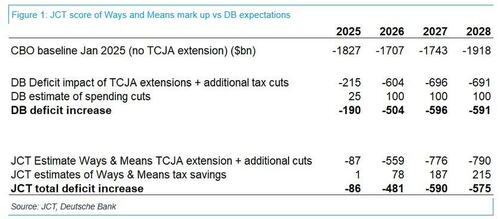
So how does one quantify the impact of the BBB: as a reminder, the Ways and Means Committee is responsible for writing the main tax code portion of the bill. Relative to the CBO’s January 2025 baseline, the JCT estimated the mark up to increase deficits by $3.8trn over the next 10 years, with most of the deficit increase ($2.2trn) occurring over the next five years. Indeed, breaking the bill down even further, of the $1.9trn of total savings identified in the mark up, the majority ($1.2trn) is realized over the back half of the 10-year budget window.

It is also notable that $915bn of savings stem from capping individual deductions for state and local taxes – a figure that will come down in the final legislation given the pushback from many Republicans in high tax states. As a reminder, under current law, upon expiry of the Tax Cuts and Jobs Act, the cap on state on local deductions would go away leading to lower tax revenues (all else equal).

In addition, ~$560bn of savings are generated through terminations or earlier phasing out of clean energy-related tax credits and another $116bn from “remedies against unfair foreign taxes” – both measures highly dependent on projections with very wide error bands and/or yet to be defined enforcement mechanisms.

As DB’s Brett Ryan – who previously had made his own deficit claculations as a result of the “Big, Beautiful Bill”- writes, while the specific components of the additional tax cuts on top of the TCJA extension differed from what he had previously outlined, the JCT score of the Ways and Means mark-up was largely in line with the top-line deficit assumptions provided by Deutsche Bank. However, one key difference was 2025, where Ryan had assumed more of the additional tax cuts on top of the TCJA extension would be made retroactive to 2025. The first table below shows DB’s prior estimates for deficit increases from tax and spending measures – excluding tariff revenue assumptions – compared to the latest JCT score of the Ways and Means mark up.

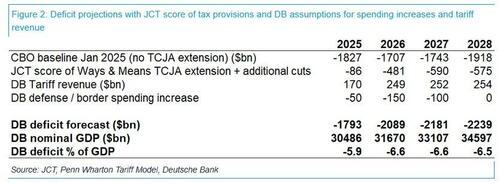
To be sure, the JCT scoring of the Ways and Means Committee mark-up does not capture key elements of the fiscal outlook – namely, estimates of tariff revenues and potential spending increases. Recall that the Ways and Means Committee is responsible for the tax writing portion of the bill and JCT only scores revenue-related measures. Indeed, CBO scoring will likely provide a more complete picture on tariff revenue and spending as the legislative process moves forward. DB anticipates $300bn of increased spending on border and defense to be front loaded over the next couple of years as well as tariff revenues of around ~250bn per year.

Risks are two-sided at this point. On the one hand, tariff revenues could be higher than currently penciled in, which assumes a ~15% tariff rate and only 2% import growth on average going forward. Conversely, the JCT score of the Ways and Means mark-up can be best thought of as a floor in terms of deficit increases over the 10-year budget window. The final legislative product is likely to show even less savings once the House and Senate “reconcile” their differences. 

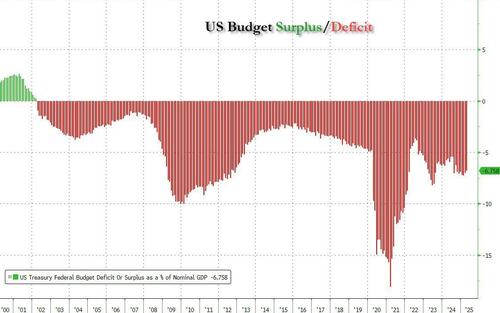
In short, as DB concludes, “there appears to be no serious effort at reining in historically-elevated deficits which remain on track to exceed over 6% of GDP in the coming years.”

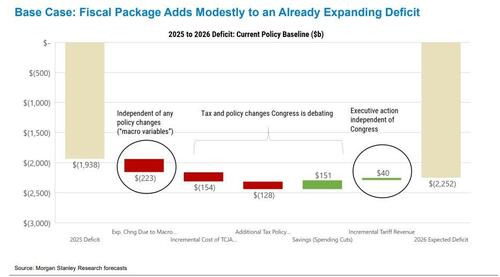
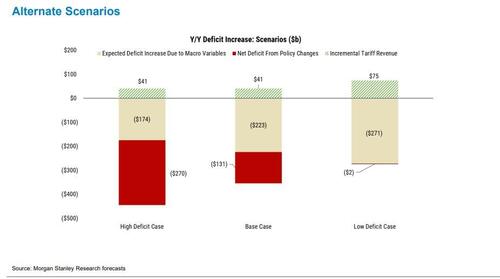
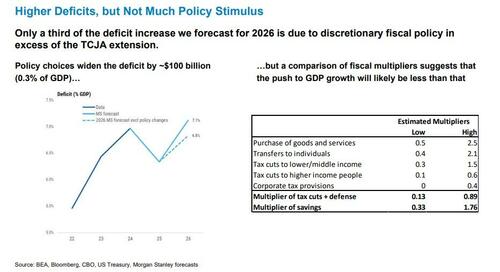
Extending on this, Morgan Stanley writes that the bank’s base case is that a politically viable fiscal package will be composed of tax cut extensions with incremental tax cuts mostly offset by “pay-fors”. As such, the key driver of projected deficit expansion in 2026 is slowing economic growth and cost growth embedded in current policy, and this fiscal package would add modestly to that baseline. Accounting for potential tariff revenue as a mitigant, the bank expects a 2026 deficit of 7.1% of GDP (vs. 6.7% in 2025), an increase of ~$310 billion year on year…

… however, the bank also lays out a low and high deficit case, where the former leads to a $400BN increase in the deficit, while the latter “only” $200BN.

Taking a look at the bigger picture, keep in mind that the bulk of the BBB is just extending on the tax cuts from Trump 1.0, which is why if the bill does not pass, it would be equivalent to a huge tax hike, one which would lead to a lower budget deficit, but lead to an immediate recession as it would translate into a massive fiscal headwind. As such, while the BBB does lead to higher deficits, if largely due to secondary drivers such as the record $1.2 trillion in gross interest expense and economic slowdown, the Big Beautiful Bill will not result in much policy stimulus in 2026. Meanwhile, as Morgan Stanley notes, even assuming continuation of current policy, deficits should increase as the economy slows. And speaking of growth slowing down, MS expects this to happen due to a rise in uncertainty, trade policy, and restrictive immigration, but really it is a modest normalization of the runaway spending of the last two years of the Biden admin. In any case, softer economic growth means lower revenues and a higher deficit. In fact, only a third of the deficit increase for 2026 is due to discretionary fiscal policy in excess of TCJA extension.

Finally, we look at the latest in-depth analysis from the Committee for a Responsible Federal Budget, which estimates the BBB would add $3.3 trillion to the debt including interest or $5.2 trillion if its temporary provisions are made permanent. In part because new borrowing is front-loaded and offsets are back-loaded, the bill would add massively to near-term deficits.

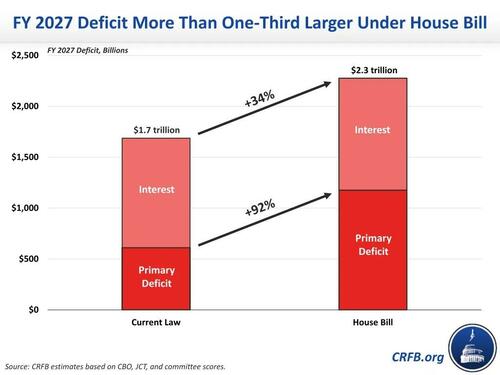
Unlike Morgan Stanley, the CRFB estimates the House bill would boost the FY 2027 deficit – the deficit in the first year the policies would be fully in effect – substantially more, by nearly $600 billion, or 1.8% of GDP. That’s the net effect of roughly $770 billion of new borrowing and only $180 billion of offsets.

The deficits boost represents a one-third increase in total projected deficits from $1.7 to $2.3 trillion – and a near doubling of the primary (non-interest) deficit.

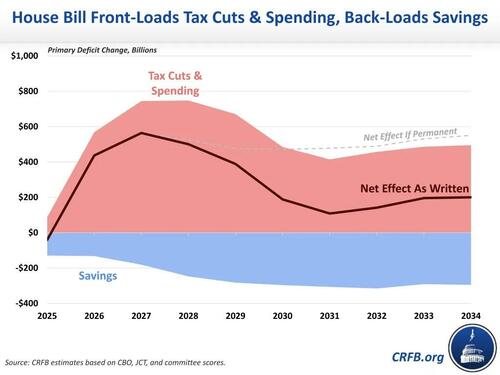
What is (perhaps not so) unique about the bill is that spending and tax cuts are front-loaded, while offsets are back-loaded, which means about 55% of the gross deficit increases – $2.8 trillion – would take place in the first half of the budget window. Meanwhile only 40% of the offsets – $970 billion – would accumulate over that period. As a result, 70% of the non-interest borrowing would occur in the first five years.

The tax cut and spending increase provisions are front-loaded due to the use of “arbitrary expirations” designed to limit reported costs. A number of provisions – including the enhanced Child Tax Credit and standard deduction, no tax on tips and overtime, 100 percent bonus depreciation for equipment, and new ‘MAGA accounts’ – are scheduled to expire in 2028 or 2029. The bill also relies on one-time appropriations for defense and immigration, which must be obligated by 2029. And finally, the bill includes a large number of retroactive provisions that provide a one-time windfall for activities already undertaken.

Meanwhile, many of the offsets don’t begin or ramp up until late in the budget window. Medicaid work requirements, for example, save $300 billion through 2034 but do not take effect until 2028. In addition, while some of the Inflation Reduction Act (IRA) energy credits are repealed at the end of 2025, the most expensive ones only begin phasing out in a few years with some restrictions taking effect sooner. And the Supplemental Nutrition Assistance Program (SNAP) state matching fund requirements do not start until 2028. 

As a result of this mismatch and the sheer size of the bill’s deficit increases, the House bill would add to the deficit in every single year – with the possible exception of 2025 – even after the temporary provisions expire. But the largest deficit increases will take place very early in the budget window. 

The impact of tariffs aside, this additional acceleration in near-term borrowing could stoke inflation and push up interest rates well above current levels. And it may continue in the future if Congress extends expiring provisions and perhaps cancel some of the offsets.

But what is most amazing, is that even this massive increase in the US deficit in the coming years is still a remarkable slowdown to the debt and deficit avalanche observed during the Biden administration, where like the president himself the economy was kept on life support thanks to a cocktail of debt, debt and more debt, as we first explained in the summer of 2023.

This is how Bank of America’s Michael Hartnett explained the “policy math” as one where monetary and fiscal policy stimulus in 2024 was best in USA, but in 2025 it’s better in the Rest-of-World:

  • US Fed funds rate: 2024 = down 100bps, 2025 = unchanged.
  • US government spending: past 12 months spending up huge $750bn (to $7.1tn), next 12 months spend down $50bn according to FY26 budget proposal.
  • US tariffs: past 12 months import duties raised $85bn, next 12 months = $400-600bn (assuming 10-15% tariff rate), tariff taxation that falls on either foreign exporters, domestic importers, or domestic consumers.
  • US tax cuts: next 12 months potentially start delivering $90bn per year in new tax cuts (rather than tax cut extensions); per CRFB current cost of “big, beautiful bill” next 10 years sees $0.2tn TCJA expansion of tax cuts + $0.7tn new tax cuts.
  • US policy stimulus crudely flipping from meaty 100bps cuts & $750bn fiscal stimulus to >$250bn fiscal contraction (spending cuts & tariff hikes before tax cuts) & zero rate cuts…big reason why US economy slows in 2025
  • Meanwhile, China is in big fiscal stimulus mood, and NATO military expenditures: defense spending in Europe set to rise $100bn per annum; per US proposal all other 31 NATO countries to raise military spend to 5% of GDP by 2032= $700bn extra defense spending by NATO ex. US (currently US accounts for $0.9tn or 69% of the NATO military budget covering 32 members

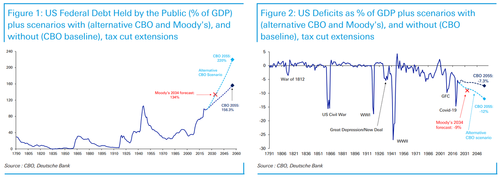
The final straw, of course, was last Friday’s Moody’s downgrade of the US Aaa rating – the final one – which took place on purpose just as the debate over the BBB hit a fever pitch. And speaking of Moody’s, earlier today we explained that the rating agency assumes the 2017 tax cuts are extended (unlike the last CBO semi-annual estimates), pushing debt and deficits much higher. The key Moody’s projections are:

  • Interest + mandatory spending will hit 78% of total federal outlays by 2035 (from 73% in 2024)
  • Deficits will rise from 6.4% to 9% of GDP by 2035
  • Debt/GDP will hit 134% by 2035 (vs. 98% today)

And, as we also discussed earlier today in what America’s Debt Doomsday looks like, both U.S. debt and deficits are about to truly take off. As shown in the chart below, while the baseline CBO projections don’t include the tax cut extension, one of their alternative scenarios of including it pushes debt/GDP above 200% of GDP over the decades ahead. The chart hardly needs any further commentary.

For anyone “shocked” by this development, don’t be: back in February we warned readers, while praising the efforts of Elon Musk and DOGE, that while superficially cutting and streamlining government spending here and there will help, it will do nothing at all in the grand scheme of things to truly slash unsustainable government spending, which is dictated by Congress…

… and when it comes to the debt trajectory set there, nothing will ever stop this train, or as we put it in February:

What Musk is doing in trying to streamline the govt is admirable but ultimately it will be Congress that decides the endgame.

And there things are as status quo as always.

Three months later, a rather dejected Elon Musk observed the same thing when he said that the $2 trillion DOGE savings goal relies on the government, and that the “Doge team has done incredible work, but the magnitude of the savings is proportionate to the support we get from Congress and from the executive branch of the government in general.”

And saving money is, unfortunately, the very last thing on the uniparty’s mind.

Source: The ‘Big, Beautiful Bill’ Will “Massively” Increase Near-Term Deficits, Add $5 Trillilon In Debt

US could face default by August – Treasury chief | RT

Scott Bessent has urged Congress to raise or suspend the debt ceiling to avoid running out of money to cover federal expenses 

US could face default by August – Treasury chief

The US could default on its obligations by the end of summer, Treasury Secretary Scott Bessent has warned. In a letter to Congress on Friday, he urged lawmakers to act by either raising or suspending the debt ceiling – a cap on how much the government can borrow – to avoid running out of money to cover federal expenses.

The country hit its current statutory debt limit of $36.1 trillion in January. Once the ceiling is reached, the government can no longer borrow to meet its obligations in full and on time. By now, total US debt has risen to $36.2 trillion, according to official data. However, the Treasury has relied on ‘extraordinary measures’ – primarily accounting tactics like pausing payments into civil service retirement funds – to continue to meet its obligations and delay default.

Republicans have reportedly been working on a legislative package that would raise the limit by up to $5 trillion, largely by extending and expanding President Donald Trump’s 2017 tax cuts. However, recent reports suggest that negotiations are progressing slowly and could take months.

Bessent said there is a “reasonable probability” that the Treasury’s emergency measures will run out by August, when Congress is scheduled to recess. He called on lawmakers to finalize the package by mid-July, warning that missing the deadline could leave the government without options to stave off default.

Read more

FILE PHOTO: US President Donald Trump.
Trump seeks tax hike on the rich – media

“I respectfully urge Congress to increase or suspend the debt limit by mid-July, before its scheduled break, to protect the full faith and credit of the United States,” Bessent wrote in a letter addressed to House Speaker Mike Johnson.

“A failure to suspend or increase the debt limit would wreak havoc on our financial system and diminish America’s security and global leadership position,” he added.

Bessent went on to warn that “waiting until the last minute to suspend or increase the debt limit” could have “serious adverse consequences” for financial markets, businesses, and the federal government, harm business and consumer confidence, and raise borrowing costs for US taxpayers.

The Congressional Budget Office has projected that the emergency measures would be exhausted in August or September.

The debt ceiling was raised three times under former President Joe Biden. Trump has argued that the cap should be abolished entirely, calling it pointless if it’s routinely lifted.

READ MORE: Moody’s issues warning on US finances

Bessent has pledged that a default will be avoided. Speaking at a House Appropriations Committee hearing last week, he said, “The US government will never default,” assuring lawmakers that the Treasury “will make sure that the debt ceiling is raised.”

Source: US could face default by August – Treasury chief

12 Signs That U.S. Consumers Are Experiencing Far More Financial Stress Than Most People Realize | The Economic Collapse

Consumer sentiment is plummeting, delinquency rates are rising, and nearly three-quarters of all U.S. consumers admit that they are “financially stressed”.  If U.S. consumers are experiencing this much pain now, what will things look like six months from today if there are empty shelves and widespread shortages?  We witnessed a brief period of severe financial stress during the early days of the last pandemic, but we would have to go all the way back to the Great Recession to find a time that is truly comparable to what we are enduring now.  U.S consumers have been getting hammered for years, and now it appears that our problems are about to go to an entirely new level.  The following are 12 signs that U.S. consumers are experiencing far more financial stress than most people realize…

#1 According to the University of Michigan, consumer sentiment in the United States has fallen to the second-lowest reading ever recorded

Americans are rarely this pessimistic about the economy.

Consumer sentiment plunged 11% this month to a preliminary reading of 50.8, the University of Michigan said in its latest survey released Friday, the second-lowest reading on records going back to 1952.

#2 According to a new CNBC/SurveyMonkey poll, a whopping 73 percent of U.S. consumers admit that they are “financially stressed”…

Americans are growing increasingly uneasy about the state of the U.S. economy and their own personal financial situation in the face of stubborn inflation and tariff wars.

To that point, 73% of respondents said they are “financially stressed,” with 66% of that group pointing to the tariff wars as a main source, according to a new CNBC/SurveyMonkey online poll.

The survey of 4,200 U.S. adults was conducted April 3 to 7.

#3 Approximately two-thirds of U.S. adults feel like they are “behind on their savings goals”, and half of U.S. adults believe that they will never reach their savings goals at all…

67% of Americans feel behind on their savings goals, with nearly half (47%) believing they’ll never reach their targets

#4 More than 60 percent of U.S. adults that currently have savings accounts have taken money out of them since the start of this year

63% of people with savings accounts have withdrawn money since the beginning of 2025, primarily for unexpected expenses (48%) and everyday necessities (36%)

#5 The percentage of U.S. credit card accounts that are at least 90 days past due has reached the highest level in 12 years

The percentage of credit card accounts that were at least 90 days past due hit a 12-year high in the fourth quarter of 2024.

According to data from the Federal Reserve Bank of Philadelphia, 0.90% of accounts were delinquent, the most since the Fed bank began its report.

#6 5 million student loan borrowers in the United States have not made a single payment in the last year, and 4 million other student loan borrowers will soon reach that status…

Of the more than 42.7 million student loan borrowers in the U.S., who owe a collective $1.6 trillion, the department says that more than 5 million have not made a payment in the past year. That number is expected to grow as an additional 4 million borrowers are approaching default status.

#7 For the first time in about 5 years, the Department of Eduction “will resume collections of its defaulted federal student loan portfolio”.  This is going to put additional financial stress on millions of U.S. households

The U.S. Department of Education today announced its Office of Federal Student Aid (FSA) will resume collections of its defaulted federal student loan portfolio on Monday, May 5th. The Department has not collected on defaulted loans since March 2020. Resuming collections protects taxpayers from shouldering the cost of federal student loans that borrowers willingly undertook to finance their postsecondary education. This initiative will be paired with a comprehensive communications and outreach campaign to ensure borrowers understand how to return to repayment or get out of default.

#8 The average credit score in the United States just dropped at the fastest pace since the Great Recession

America’s credit score just took its biggest hit since the 2008 crash.

The average FICO score in the US has dropped to 715 from 717 — the largest one-year drop since the Great Recession, according to new data from the credit-rating giant FICO.

#9 U.S. consumers are eating out less, and as a result restaurant chains all over the country are in financial distress

Once rapidly growing commercial marvels, casual dining chains — sit-down restaurants where middle-class families can walk in without a reservation, order from another human and share a meal — have been in decline for most of the 21st century. Last year, TGI Fridays and Red Lobster both filed for bankruptcy. Outback and Applebee’s have closed dozens of locations. Pizza Hut locations with actual dining rooms are vanishingly rare, with hundreds closing since 2019.

According to a February survey by the market research firm Datassential, 24 percent of Americans say they are having dinner at casual restaurants less often, and 29 percent are dining out less with groups of friends and family.

#10 U.S. consumers are visiting shopping malls a lot less than they once did, and as a result many mall retailers are going belly up

Merry Go Round, Bon-Ton, Lord & Taylor, The Limited, Loehmann’s, Bonwit Teller, Chess King, and Anchor Blue are just a few once-successful clothing retailers that no longer exist.

Now, a once-trendy fashion/clothing retailer finds itself having to make massive cuts and shut down 100s of stores in a fight to avoid bankruptcy.

#11 U.S. consumers are not spending as much money at hair salons, and Bloomberg is telling us that this is an indicator that a recession is coming

Stylists from Manhattan to rural New Hampshire are seeing regular clients start to skip cuts and blowouts. In from the Maine town of Brewer, hairstylist Alyssa Dow said customers are choosing cheaper, “more low-maintenance” looks—and tipping less. In affluent Longmeadow, Massachusetts, where “people don’t like to walk around with roots” showing, clients who previously got color every two or three weeks are stretching it to four or five, citing the “political situation” and implying they’ve lost money in the stock market, said Michelle LaValley. “They’re cutting back in other areas as well, so it’s not just us,” said the salon owner, who has 28 years in the business. The wider pullback in spending seems to go beyond the general grumpiness that accompanied the so-called vibecession that started years ago when inflation rose, interest rates spiked and yet the US kept growing.

#12 According to the Fed, U.S. consumers are becoming more concerned about inflation and unemployment…

The central bank’s monthly Survey of Consumer Expectations showed that respondents saw inflation a year from now at 3.6%, an increase of half a percentage point from February and the highest reading since October 2023.

Along with concerns over a higher cost of living came a surge in worries over the labor market: The probability that the unemployment rate would be higher a year from now surged to 44%, a move up of 4.6 percentage points and the highest level going back to the early Covid pandemic days of April 2020.

Right now, economists all over the country are arguing about whether a recession is ahead of us or not.

But to millions of hard working Americans, it feels like a recession has already begun.

If you are currently experiencing financial stress, I want you to know that you aren’t alone.

Countless others are in the exact same boat, and the outlook for the months ahead is not promising at all.

Michael’s new book entitled “10 Prophetic Events That Are Coming Next” is available in paperback and for the Kindle on Amazon.com, and you can subscribe to his Substack newsletter at michaeltsnyder.substack.com.

About the Author: Michael Snyder’s new book entitled “10 Prophetic Events That Are Coming Next” is available in paperback and for the Kindle on Amazon.com.  He has also written nine other books that are available on Amazon.com including “Chaos”“End Times”“7 Year Apocalypse”“Lost Prophecies Of The Future Of America”“The Beginning Of The End”, and “Living A Life That Really Matters”.  When you purchase any of Michael’s books you help to support the work that he is doing.  You can also get his articles by email as soon as he publishes them by subscribing to his Substack newsletter.  Michael has published thousands of articles on The Economic Collapse BlogEnd Of The American Dream and The Most Important News, and he always freely and happily allows others to republish those articles on their own websites.  These are such troubled times, and people need hope.  John 3:16 tells us about the hope that God has given us through Jesus Christ: “For God so loved the world, that he gave his only begotten Son, that whosoever believeth in him should not perish, but have everlasting life.”  If you have not already done so, we strongly urge you to invite Jesus Christ to be your Lord and Savior today.

The post 12 Signs That U.S. Consumers Are Experiencing Far More Financial Stress Than Most People Realize appeared first on The Economic Collapse.

17 Signs That America’s Long Economic Slide Threatens To Become An Economic Avalanche | The Economic Collapse

Are you better off than you were four years ago?  If you are, you should consider yourself to be extremely fortunate, because the vast majority of the population is not.  The U.S. economy has been sliding the wrong direction for a very long time, and now our economic momentum in the wrong direction is accelerating.  Retail sales are slowing down, the housing market is in a depressed state, mass layoffs are happening all over the nation, stores are closing at a staggering pace, the cost of living has become extremely painful, and debt levels have soared to unprecedented heights.  Four years of deteriorating economic conditions have brought us to a breaking point, and now we are witnessing quite a bit of shaking in the financial markets.  Even though many in the mainstream media are still trying to deny it, the truth is that we are in an enormous amount of trouble.  The following are 17 signs that America’s long economic slide threatens to become an economic avalanche…

#1 The Conference Board’s index of consumer confidence just experienced the largest drop that we have seen since August 2021

Consumers grew more pessimistic about the economic outlook in February as worries brewed about a slowing economy and rising inflation, the Conference Board reported Tuesday.

The board’s Consumer Confidence Index slipped to 98.3 for the month, down 7 points and below the Dow Jones forecast for 102.3. This was the lowest reading since June 2024 and the largest monthly drop since August 2021.

#2 The University of Michigan’s consumer sentiment index just fell to the lowest level that we have seen since November 2023

The University of Michigan Surveys of Consumers on Friday released its consumer sentiment index which dropped from 71.7 in January to 64.7 in February. That’s the lowest reading since November 2023 and was weaker than the preliminary reading of 67.8, which was the consensus expectation among economists polled by Reuters.

#3 Retail sales in the United States just fell “by the most in nearly two years”

U.S. retail sales dropped by the most in nearly two years in January, likely weighed down by frigid temperatures, wildfires and motor vehicle shortages, suggesting a sharp slowdown in economic growth early in the first quarter.

#4 Walmart is warning us that it will experience a year-over-year drop in quarterly profit for the first time in 3 years

Shares of Walmart Inc. were hit hard Thursday after the retail behemoth provided a disappointing earnings outlook, including a warning for the first year-over-year decline in quarterly profit in three years.

#5 Last month, sales of previously-owned homes dropped 4.9 percent

The U.S. housing market continues to weaken, as potential buyers face stubbornly high mortgage rates, elevated prices and limited supply of listings.

Sales of previously owned homes fell 4.9% in January from the prior month to 4.08 million units on a seasonally adjusted, annualized basis, according to the National Association of Realtors. Analysts were expecting a 2.6% decline.

#6 The cost of living is absolutely crushing most Americans.  At this stage, almost 70 percent of all single adults “struggle to afford their regular rent or mortgage payments”

Nearly 70% of single, divorced or separated people struggle to afford their regular rent or mortgage payments, compared to just over half (52%) of married people, according to a recent Redfin-commissioned survey. More than three-quarters (76%) of respondents who live with their partner but aren’t married struggle with housing payments, making them the group most likely to struggle.

#7 Starbucks is telling us that they will be laying off more than 1,000 corporate employees

Starbucks has announced plans to lay off 1,100 corporate employees as it looks to restructure its operations.

CEO Brian Niccol sent out a letter on Monday revealing employees who have been laid off will be notified on Tuesday.

Niccol stated, “Our intent is to operate more efficiently, increase accountability, reduce complexity, and drive better integration.”

#8 Southwest Airlines is giving the axe to more than 1,700 corporate employees

Southwest Airlines said Monday that it is cutting about 15% of corporate jobs, or about 1,750 people, a move its CEO called “unprecedented” as the company scrambles to cut costs.

The company said it expects savings from the cuts of $210 million this year and about $300 million in 2026. The layoffs will be mostly done by the end of the second quarter and include some senior leadership roles, CEO Bob Jordan said in a staff note, which was seen by CNBC.

#9 Blue Origin has decided to fire nearly 14,000 workers

Blue Origin announced layoffs late last week. Almost 14,000 people work at the space company founded by Jeff Bezos, according to Reuters.

#10 Chevron has announced that it will be reducing the size of their workforce by about 15 to 20 percent

Chevron Corp. Vice Chair Mark Nelson said it will lay off 15-20% of its workers in a bid to “simplify our organizational structure, [execute] faster and more efficiently, and position the company for stronger long-term competitiveness.”

#11 Estée Lauder is telling thousands of employees that it is time to hit the bricks

Estee Lauder’s job cuts will impact a net of 5,800 to 7,000 roles.

They came as part of an updated “profit recovery and growth plan” and restructuring program that the cosmetics company detailed Feb. 4 along with other measures meant to “further transform the Company’s operating model to fund a return to sales growth and restore a solid double-digit adjusted operating margin over the next few years.”

#12 So many federal workers are being fired that initial claims for unemployment benefits in Washington D.C. went up by 36 percent in just one week…

Since Trump has taken office, nearly 4,000 workers in the city have filed for unemployment insurance as part of a surge that began at the start of the new year, according to Labor Department figures not adjusted for seasonal factors.

In all, just shy of 7,000 claims have been filed in the six weeks of the new year, or about 55% more than in the prior six-week period. Filings rose to 1,780 for the week ending Feb. 8, a 36% increase from the prior week and more than four times around the same period in 2024.

#13 Forever 21 has announced that it will be closing another 200 stores

A clothing chain that was once a fixture in every mall across America is to close 200 more stores as it prepares for second bankruptcy in five years.

Amid mounting debt, Forever 21’s US operator could file for Chapter 11 protection as soon as next month, Bloomberg News reported on Wednesday.

#14 Joann Inc. has decided to close all of their stores in the United States

Joann Inc., which has supplied crafty Americans with art supplies and fabrics for decades, recently announced that it plans to close all of its U.S. stores, just a month after filing Chapter 11 bankruptcy protection.

In a statement obtained by Reuters on Sunday, the 82-year-old company announced its plans to sell all assets to a buyer group. Joann executives originally hoped that a buyer would continue its business, but the highest bidder is slated to start going-out-of-business sales at all locations.

#15 Overall, Coresight Research is projecting that an all-time record 15,000 stores will be permanently closed in the United States in 2025.

#16 Household debt in the United States has now crossed the 18 trillion dollar mark

Americans’ household debt — including credit cards, mortgages, auto loans and student loans — is at a new all-time high of $18.04 trillion, according to a report released Thursday by the Federal Reserve Bank of New York.

#17 More than 26 trillion dollars has been added to the U.S. national debt since the start of 2009, and now we are shelling out more than a trillion dollars a year just in interest payments…

And the punchline is that no matter what Musk does, the USS Titanic is now more or less on autopilot because while a few billions in discretionary spending can be cut, interest on the debt can not be – without a default (it can however be inflated away… and it will be) – and in January, gross interest on the Federal debt hit a record $1.167 trillion in the past twelve months thanks to another $83.6 billion in interest spending.

The meltdown that so many of us warned about is happening right in front of our eyes.

We piled up trillions of dollars in new debt in recent years, and that bought us some time.

But now a day of reckoning has arrived.

For those that haven’t figured it out yet, an extreme amount of pain is ahead of us.

You can cheat the laws of economics for a while, but economic reality always catches up with you eventually.

Michael’s blockbuster entitled “Why” is available in paperback and for the Kindle on Amazon.com, and you can subscribe to his Substack newsletter at michaeltsnyder.substack.com.

About the Author: Michael Snyder’s new book entitled “Why” is available in paperback and for the Kindle on Amazon.com. He has also written eight other books that are available on Amazon.com including “Chaos”“End Times”“7 Year Apocalypse”“Lost Prophecies Of The Future Of America”“The Beginning Of The End”, and “Living A Life That Really Matters”.  When you purchase any of Michael’s books you help to support the work that he is doing.  You can also get his articles by email as soon as he publishes them by subscribing to his Substack newsletter.  Michael has published thousands of articles on The Economic Collapse BlogEnd Of The American Dream and The Most Important News, and he always freely and happily allows others to republish those articles on their own websites.  These are such troubled times, and people need hope.  John 3:16 tells us about the hope that God has given us through Jesus Christ: “For God so loved the world, that he gave his only begotten Son, that whosoever believeth in him should not perish, but have everlasting life.”  If you have not already done so, we strongly urge you to invite Jesus Christ to be your Lord and Savior today.

The post 17 Signs That America’s Long Economic Slide Threatens To Become An Economic Avalanche appeared first on The Economic Collapse.

Our 101 Trillion Dollar Problem: This Is The Number One Tool The Elite Use To Enslave Us | The Economic Collapse

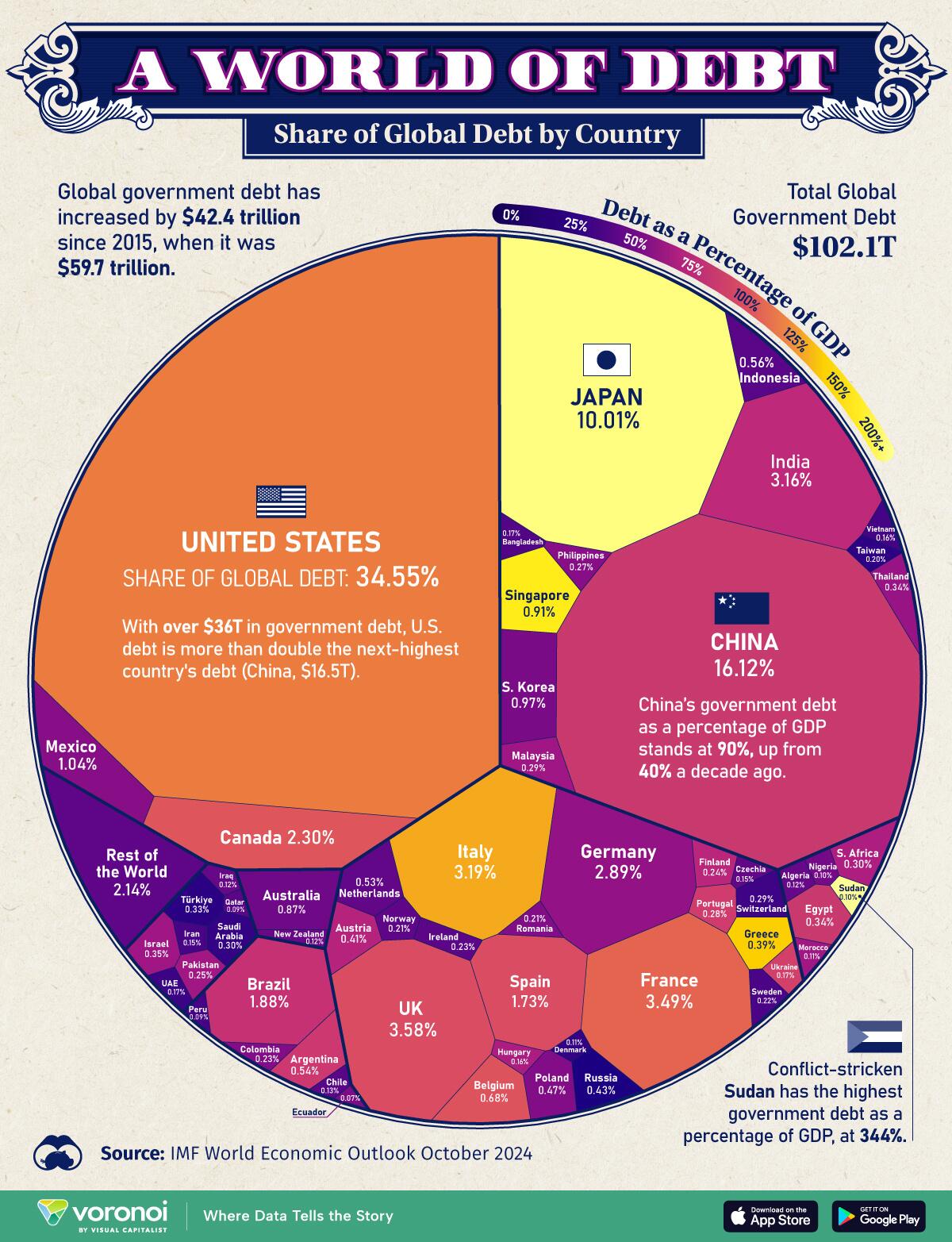
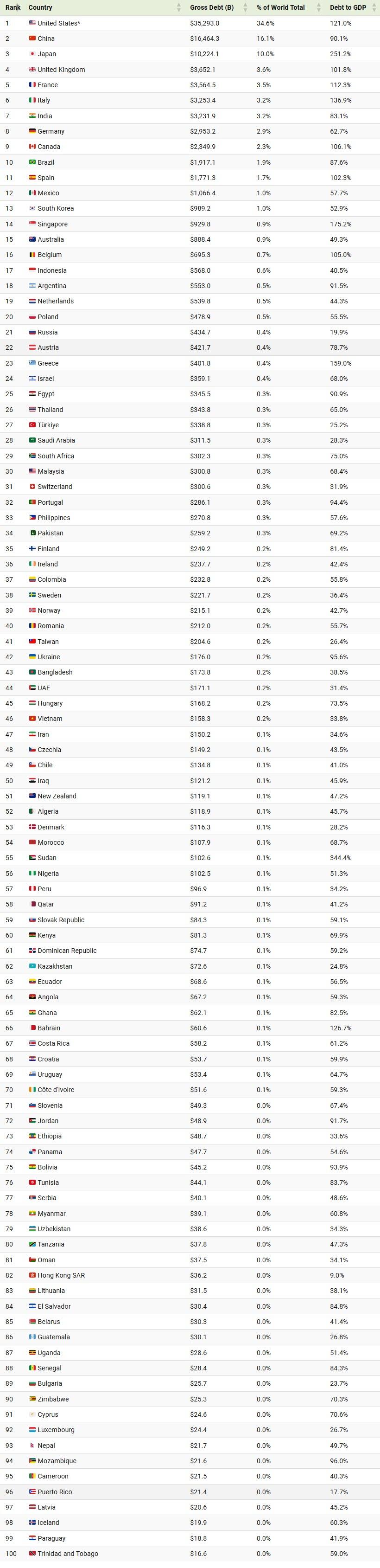
Right now, a tremendous awakening is happening as people all over the world become educated about the tools that the elite use to enslave us to their system.  The number one tool that they use to enslave us is debt.  The financial powers of the world use it to enslave individuals, corporations and governments.  For thousands of years humanity has been taught the proverb that “the borrower is the servant of the lender”, and yet today billions of people around the globe have willingly made themselves servants of the money powers.  You see, when you borrow money from a financial institution, you not only have to pay that money back, but you also have to pay a significant amount of interest.  In fact, often the interest ends up being much more than the principal of the loan.  Thus the borrower ends up devoting a great deal of his or her labor to earning money for the lender.  Yes, there are times when it is necessary to borrow money.  But what we have been doing over the last 30 years goes far beyond “necessary” borrowing.  The fact that the U.S. government is now 36 trillion dollars in debt gets a lot of attention, but the truth is that state and local governments, corporations, and U.S. households have piled up enormous mountains of debt as well.

I want to show you a chart from the Federal Reserve that is hard to believe.

In the mid-90s, the total amount of debt in the system was about 20 trillion dollars, but now we have reached the 101 trillion dollar mark…

The word “insanity” does not even begin to describe what we have been doing to ourselves.

It takes a lot of really hard work to add 80 trillion dollars of debt in just 30 years.

Every time we pile up more debt, there is a winner and there is a loser.

Debt strips you of your freedom and slowly drains you of your wealth.  It puts the fruits of your labor into the pockets of others.

That is true for individuals, and it is true for a nation as a whole.

Getting others enslaved by debt is how the most powerful financial institutions in the world became so dominant.  It is one of the most profitable ways of making money ever invented.

What many people don’t realize is just how much interest they end up paying on some of their debts.

For example, if you go to mortgagecalculator.org, you can calculate the amount of interest that you will pay over the life of your home mortgage.  According to that calculator, someone with a $400,000 mortgage at an interest rate of 6.98% over 30 years will end up paying $556,102.18 in interest before the mortgage is finally paid off.

When those 30 years are over, you will have bought a house for yourself and you will also have bought a house for the bankers.

So what should we do?

We need to stop feeding the monster.

They are getting insanely wealthy by financially enslaving all the rest of us.

Unfortunately, many Americans find themselves deep in debt because the cost of living has been rising faster than our paychecks have.

One of the great joys that men in free societies have long enjoyed is the ability to earn an honest wage for an honest day of work.  In particular, the amazing capitalist engine that powered the U.S. economy for decade after decade greatly rewarded the incredible hard work and industriousness of the American people.  America was known as the land of opportunity, and we built the largest middle class in the history of the world by working incredibly hard.

Unfortunately, things have changed.

Thanks to globalization and extremely rapid advances in technology, the labor of U.S. workers is rapidly losing value.  Automation, robotics and AI have made many jobs obsolete.  In addition, American workers now must compete against workers from all over the world.  Global corporations often find themselves having to choose whether to build a factory in the United States or in the third world.  But in the third world workers often earn less than 10 percent of what American workers earn, corporations are often not required to provide any benefits to those workers, and there are often very few oppressive government regulations to contend with.

How can American workers compete against that?

The truth is that labor is now a global commodity.  It is exceedingly difficult for a worker in the United States to effectively compete with a desperate, half-starving worker in the third world that will work like mad for two dollars an hour.

But this is what we get for letting our politicians push “free trade” down our throats.

Most American workers had no idea that free trade would mean that they would suddenly be competing for jobs against workers in the Philippines and Malaysia.

But this is the cold, hard reality of globalism.

Of course the top executives at the big global corporations are certainly enjoying this new environment, because their salaries have soared.

In 1950, the ratio of the average executive’s paycheck to the average worker’s paycheck was about 30 to 1.

Now it is 268 to 1.

The rich are getting richer and the poor are getting poorer.

That is what globalism is all about.

The elite make out like bandits as they exploit third world labor pools, while the American middle class finds itself slowly being crushed out of existence.

Our system has been designed to funnel nearly all of the rewards to the very top.  Meanwhile, the vast majority of Americans are left wondering why things just don’t ever seem to work out for them.

If you talk to many Americans, they just can’t seem to figure out why they can’t make things work out even though they are working as hard as they can.  Millions of Americans have found themselves taking on second or even third jobs in a desperate attempt to provide for their families.

Sadly, things just keep getting worse with each passing year.

As I have discussed in previous articles, demand at food banks is at an all-time high, homelessness in the U.S. is at an all-time high, and homelessness in the U.S. is growing at the fastest pace ever recorded.

But there are elitists out there that are still attempting to claim that the U.S. economy is in great shape.

Of course most of us aren’t buying the propaganda anymore, and that is one of the primary reasons why the election turned out the way that it did.

We need to return to an economy where good workers are valued and where hard work is rewarded.

We need to return to an economy where having a large middle class is an important national goal.

We need to return to an economy where we build American businesses, where we hire American workers, and where we buy American products.

But unless the American people wake up, American workers are going to continue to be devalued.

And if you think that things are bad now, just wait until AI starts taking millions of our jobs.

Are we just going to sit back and let American living standards decline to third world standards, or are we going to do something about it?

Perhaps the greatest victims of the economic nightmare that is unfolding right in front of our eyes are our children.

The overall economic numbers are really bad, but when you examine the impact that this economy is having on children things get really horrifying.  Today, 16 percent of U.S. children live in poverty and 14 million U.S. children are on food stamps.

It has been estimated that approximately 50 percent of all U.S. children will be on food stamps at some point before they reach the age of 18.

We were once the most prosperous nation on the entire planet.

How could we let this happen?

Meanwhile, the rich have gotten even richer.

In 2009, there were 8 million millionaires in the United States.

Now there are 22 million.

If everyone was becoming wealthier, that would be great.  Unfortunately, the poor have been left with an increasingly smaller slice of the pie to divide among themselves.

At this point, the bottom 50 percent of Americans control just 2.5 percent of the wealth.

I have been ranting about all of this for over a decade, and yet conditions have just continued to deteriorate year after year.

We can’t have an economy that works for the top 10 percent but that sucks the life out of the bottom 90 percent.

Our debt-based financial system needs to be fundamentally reformed, and it is time for us to demand action.

Michael’s new book entitled “Why” is available in paperback and for the Kindle on Amazon.com, and you can subscribe to his Substack newsletter at michaeltsnyder.substack.com.

About the Author: Michael Snyder’s new book entitled “Why” is available in paperback and for the Kindle on Amazon.com. He has also written eight other books that are available on Amazon.com including “Chaos”“End Times”“7 Year Apocalypse”“Lost Prophecies Of The Future Of America”“The Beginning Of The End”, and “Living A Life That Really Matters”.  When you purchase any of Michael’s books you help to support the work that he is doing.  You can also get his articles by email as soon as he publishes them by subscribing to his Substack newsletter.  Michael has published thousands of articles on The Economic Collapse BlogEnd Of The American Dream and The Most Important News, and he always freely and happily allows others to republish those articles on their own websites.  These are such troubled times, and people need hope.  John 3:16 tells us about the hope that God has given us through Jesus Christ: “For God so loved the world, that he gave his only begotten Son, that whosoever believeth in him should not perish, but have everlasting life.”  If you have not already done so, we strongly urge you to invite Jesus Christ to be your Lord and Savior today.

The post Our 101 Trillion Dollar Problem: This Is The Number One Tool The Elite Use To Enslave Us appeared first on The Economic Collapse.

Economic Red Alert! Credit Card Defaults Jump To The Highest Level In 14 Years | The Economic Collapse

It is starting to look a lot like the last financial crisis.  Americans are defaulting on their credit cards at a rate that we haven’t seen in more than a decade, and this could have very serious implications for our financial institutions as we move into 2025.  Easy credit has enabled many Americans to enjoy lifestyles that are far beyond what they actually deserve, but outrageously high interest rates, absurd penalties and predatory fees have sucked the financial life out of millions of households.  The temptation of easy credit has proven to be too much for many Americans to resist, and now a day of reckoning has arrived and it isn’t going to be fun.

It was expected that credit card defaults would continue to rise this year.

But a 50 percent jump is ridiculous…

Credit card defaults are at their highest level since 2010 as consumers feel increasingly stretched.

As the Financial Times (FT) reported Sunday (Dec. 29), card lenders wrote off $46 billion in seriously delinquent loans in the first nine months of this year, a 50% jump over 2023. That’s the highest level in 14 years, the report said, citing industry data compiled by BankRegData.

In the last 20 years, there has only been one other year when credit card defaults have reached this level.

This is yet another indication that our economy is rapidly moving in the wrong direction.

Thanks to our seemingly endless cost of living crisis, an increasing number of Americans have been forced to turn to credit card debt just to make ends meet.

At this point, 74.5 percent of all U.S. consumers are carrying at least some credit card debt…

As covered here earlier this month, the share of consumers carrying at least some card debt is pervasive, at 74.5%, per PYMNTS Intelligence research. While that percentage is more or less static across income levels, it leaps to more than 90% for consumers living paycheck to paycheck and having trouble paying their bills.

The research showed that the average outstanding balance among paycheck-to-paycheck cardholders who have issues paying their bills is $7,038, compared to those who live paycheck to paycheck without such difficulties, who had average outstanding balances of $5,766.

This is a nightmare.

Our economy is highly dependent on consumer spending, but now the bottom third of the economic pyramid is “tapped out”

Mark Zandi, the head of Moody’s Analytics, said, “High-income households are fine, but the bottom third of US consumers are tapped out. Their savings rate right now is zero.”

Credit card debt is one of the most destructive forms of debt that you can accumulate.

In fact, it would be difficult for me to overstate just how devastating credit card debt can be to a family.

If you owe $10,000 on a credit card with a 20 percent interest rate and only make a payment of 300 dollars each month, it will take you more than four years to pay it off.

During that time you will pay $4,718 in interest rate charges in addition to the $10,000 in principal that you are required to pay back.

That does not even account for any penalties or late fees.

Are you starting to get the picture?

The truth is that credit cards are one of the greatest inventions for sucking the wealth out of middle class American families ever invented.

Today, Americans have over a billion credit cards, and they owe over a trillion dollars on those cards.

I just asked Google AI, and I was told that “the combined GDP of the 100 poorest countries is estimated to be around $500 billion”.

So that means that what Americans owe on their credit cards is twice as large as the GDP of the 100 poorest nations on the entire planet combined.

What in the world is wrong with us?

The top 10 credit card issuers in the U.S. control approximately 82 percent of the credit card market.

When we go into credit card debt, we are making them even wealthier.

And that is precisely what they want.

Right now, there are no federal laws that limit the interest rates that credit card companies can charge.

If they want to charge you 30 percent, they can do that.

If they want to charge you 40 percent, they can do that.

And of course they love to hit us with all sorts of fees and penalties as well.

According to Google AI, this is how much revenue some of the largest credit card companies earned in 2022…

American Express: $50.7 billion
Bank of America: $92.4 billion
Capital One: $34.2 billion
Chase: $154.8 billion
Citibank: $101 billion
Discover: $15.2 billion

That is a ton of money.

The higher we push our credit card balances, the richer they become.

The bottom line is that we need to change our behavior.

We work so hard to earn the money that we make.

Why hand that money over to greedy bankers?

Last week, I discussed the fact that our central banking system has been designed to funnel as much wealth as possible to the very top of the pyramid.

The same thing is true for credit cards.

If you are paying 20 or 30 percent interest on a credit card balance every month, you are literally committing financial suicide.

The bankers are getting rich from your hard work, and you need to get out of credit card debt as soon as you can.

Sadly, for many American families it is already too late.  It is almost impossible to pay off debt if you don’t have a job and you are about to lose your home.  At this moment, many American families find themselves literally being torn apart by financial stress.

Yesterday, I wrote about how homelessness in the U.S. is at an all-time record high.

Today, I am writing about how credit card defaults have risen to the highest level in 14 years.

If you can’t see where all of this is heading, I don’t know what to say.

We are in far more trouble than most people realize, and the outlook for 2025 is not promising at all.

Michael’s new book entitled “Why” is available in paperback and for the Kindle on Amazon.com, and you can subscribe to his Substack newsletter at michaeltsnyder.substack.com.

About the Author: Michael Snyder’s new book entitled “Why” is available in paperback and for the Kindle on Amazon.com. He has also written eight other books that are available on Amazon.com including “Chaos”“End Times”“7 Year Apocalypse”“Lost Prophecies Of The Future Of America”“The Beginning Of The End”, and “Living A Life That Really Matters”.  When you purchase any of Michael’s books you help to support the work that he is doing.  You can also get his articles by email as soon as he publishes them by subscribing to his Substack newsletter.  Michael has published thousands of articles on The Economic Collapse BlogEnd Of The American Dream and The Most Important News, and he always freely and happily allows others to republish those articles on their own websites.  These are such troubled times, and people need hope.  John 3:16 tells us about the hope that God has given us through Jesus Christ: “For God so loved the world, that he gave his only begotten Son, that whosoever believeth in him should not perish, but have everlasting life.”  If you have not already done so, we strongly urge you to invite Jesus Christ to be your Lord and Savior today.

Get prepared for what is ahead by visiting some of our sponsors…

The Jase Case is more than an emergency medication supply. The right meds the moment you need them: https://shorturl.at/gMpOj

Protect your home and vehicle with EMP Shield: https://shorturl.at/Hh2oz

Ready Hour Emergency Food: https://shorturl.at/RB6ul

My Patriot Supply: https://shorturl.at/GhppY

InstaFire: https://shorturl.at/brRN1

AlexaPure: https://shorturl.at/CH23z

Operation Blackout: https://eflow.americablackout.com/2964TZB/7XDN2/

Exodus Effect: https://trk.exodusrevealed.com/2964TZB/225JFQ/

Final Famine: https://trk.finaleagainstfamine.com/2964TZB/BP658/

Genesis Code: https://trk.discovergenesiscode.com/2964TZB/M2GJW/

Final Blackout: https://trk.borderdatareport.com/2964TZB/2N721M/

Last Blackout: https://trk.last-blackout.com/2964TZB/2J2CRS/

The post Economic Red Alert! Credit Card Defaults Jump To The Highest Level In 14 Years appeared first on The Economic Collapse.

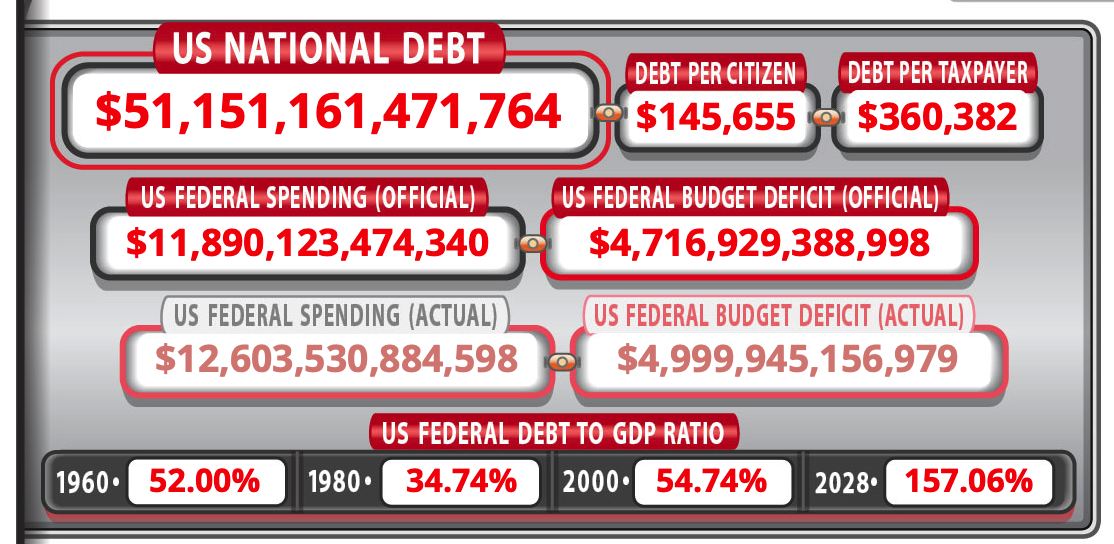
Unless Something Changes, 4 Years From Now We Will Be 51 Trillion Dollars In Debt | End Of The American Dream

The U.S. government is currently constructing the most colossal monument in the history of the world.  It is a monument of debt, and we will forever be remembered as the nation that piled up far more debt than anyone else ever did.  For decades, this generation has been recklessly spending the money of future generations of Americans.  Most people seem to think that we are totally getting away with this swindle, but the truth is that the party is almost over.  Our national debt has already surpassed the 36 trillion dollar mark, and according to usdebtclock.org at our current rate of spending our national debt will surpass the 51 trillion dollar mark four years from now.

We are a spoiled, bloated, greedy nation that has run up a debt so big that words simply do not do it justice.

We have got to stop spending so much money, but we just can’t help ourselves.

In January, Donald Trump will be faced with some very difficult decisions regarding our debt as soon as he is inaugurated

It’s going to be an urgent issue for Trump as soon as he takes office. The federal government will resume the cap on its borrowing authority on Jan. 1, as the U.S. sits on a national debt of more than $36 trillion, though the Treasury Department can buy time for a number of months with so-called extraordinary measures. The fiscal time bomb illustrates the struggle Trump and Republican leaders face heading into 2025, as they consider whether to court Democrats who will want concessions or their own conservatives who are known for rigidly sticking to their demands to cut funding.

If Trump decides that it is time to cut spending, that will make our short-term economic problems even worse.

But if he decides to keep spending money at current levels that would be suicidal.

Most Americans have no idea how difficult it is to spend a trillion dollars.

If you spend one dollar every single second, you could spend a million dollars in just twelve days.

If you spend one dollar every single second, you could spend a billion dollars in 32 years.

But at that same rate, it would  take you more than 31,000 years to spend a trillion dollars.

Let me give you another illustration.

If you were alive 2000 years ago and you started spending one million dollars every single day when Christ was born, you still would not have spent one trillion dollars by now.

That is how large one trillion dollars is.

But the United States is not one trillion dollars in debt.

The United States is 36 trillion dollars in debt.

And as I discussed the other day, we will never pay that debt off.

A trillion $10 bills, if they were taped end to end, would wrap around the globe more than 380 times.  That amount of money would still not be enough to pay off one-third of the U.S. national debt.

But if you are determined to do something, the government wants you to know that you can help.

If you can believe it, the government is actually taking online donations that will be used to help pay off the national debt.

Or at least that is what they are claiming.

If you were able to donate one dollar every single second to help pay off the national debt, it would take you hundreds of thousands of years to come up with enough money to pay it off.

Are you starting to get the picture?

We are in so much trouble.

We could have lived within our means and left America in tremendous shape for the generations that follow us.

But that is not what we did.

Instead, we have saddled our children and grandchildren with the greatest mountain of debt in the history of the world.

What we have done to future generations of Americans is beyond criminal.  One day, if they get the chance, they will look back and curse this generation for what we have done to them.  We spent tens of trillions of dollars that belonged to them, and we have stuck them with the bill for our wild excesses.  We have taken the greatest economic machine that humanity has ever seen and we have driven it straight off a cliff.

And yet we are so proud of ourselves.

We think that we are so special and that we have all the answers.

Of course the truth is that we should be deeply ashamed of ourselves.  Over and over again we kept sending the same clowns back to Washington D.C. and they just kept on spending our money like they were playing a really twisted game of Monopoly.

So now we are going to pay the price.

All of us.

Apparently the Chinese wanted to see how much of a joke the U.S. Treasury has become, because they hacked into it a few weeks ago

A state-sponsored actor in China hacked the U.S. Treasury Department, gaining access to the workstations of government employees and unclassified documents, the Biden administration said on Monday.

The announcement comes after revelations in recent months that China had penetrated deep into U.S. telecommunications systems, gaining access to the phone conversations and text messages of U.S. officials and others.

According to Reuters, this was a “major incident”…

The hackers compromised a third-party cybersecurity service provider and were able to access unclassified documents, the letter said, calling it a “major incident.”

According to the letter, hackers “gained access to a key used by the vendor to secure a cloud-based service used to remotely provide technical support for Treasury Departmental Offices (DO) end users. With access to the stolen key, the threat actor was able override the service’s security, remotely access certain Treasury DO user workstations, and access certain unclassified documents maintained by those users.”

Of course you don’t have to be a hacker to find out the big secret that the U.S. Treasury is trying to hide.

The big secret is that we are broke.

We are drowning in an ocean of red ink, and we can barely pay our bills.

Something has got to change, because if we stay on the path that we are currently on we will be 51 trillion dollars in debt four years from today.

Michael’s new book entitled “Why” is available in paperback and for the Kindle on Amazon.com, and you can subscribe to his Substack newsletter at michaeltsnyder.substack.com.

About the Author: Michael Snyder’s new book entitled “Why” is available in paperback and for the Kindle on Amazon.com. He has also written eight other books that are available on Amazon.com including “Chaos”“End Times”“7 Year Apocalypse”“Lost Prophecies Of The Future Of America”“The Beginning Of The End”, and “Living A Life That Really Matters”.  When you purchase any of Michael’s books you help to support the work that he is doing.  You can also get his articles by email as soon as he publishes them by subscribing to his Substack newsletter.  Michael has published thousands of articles on The Economic Collapse BlogEnd Of The American Dream and The Most Important News, and he always freely and happily allows others to republish those articles on their own websites.  These are such troubled times, and people need hope.  John 3:16 tells us about the hope that God has given us through Jesus Christ: “For God so loved the world, that he gave his only begotten Son, that whosoever believeth in him should not perish, but have everlasting life.”  If you have not already done so, we strongly urge you to invite Jesus Christ to be your Lord and Savior today.

Get prepared for what is ahead by visiting some of our sponsors…

The Jase Case is more than an emergency medication supply. The right meds the moment you need them: https://shorturl.at/gMpOj

Protect your home and vehicle with EMP Shield: https://shorturl.at/Hh2oz

Ready Hour Emergency Food: https://shorturl.at/RB6ul

My Patriot Supply: https://shorturl.at/GhppY

InstaFire: https://shorturl.at/brRN1

AlexaPure: https://shorturl.at/CH23z

Operation Blackout: https://eflow.americablackout.com/2964TZB/7XDN2/

Exodus Effect: https://trk.exodusrevealed.com/2964TZB/225JFQ/

Final Famine: https://trk.finaleagainstfamine.com/2964TZB/BP658/

Genesis Code: https://trk.discovergenesiscode.com/2964TZB/M2GJW/

Final Blackout: https://trk.borderdatareport.com/2964TZB/2N721M/

Last Blackout: https://trk.last-blackout.com/2964TZB/2J2CRS/

The post Unless Something Changes, 4 Years From Now We Will Be 51 Trillion Dollars In Debt appeared first on End Of The American Dream.

Rand Paul Releases Annual Festivus Report on $1 Trillion in Government Waste: Millions Spent on Ice-Skating Drag Queens, Ukrainian Influencers, Lonely Coked Up Rats…and More! | The Gateway Pundit

Senator Rand Paul (R-KY) released his annual Festivus report on the more than $1 trillion in government waste, including millions spent on ice-skating drag queens, a Sesame Street show in Iraq, Ukrainian influencers and more.

“This year, I am highlighting a whopping $1,008,313,329,626.12. That’s over $1 trillion in government waste, including things like ice-skating drag queens, a $12 Million Las Vegas pickleball complex, $4,840,082 on Ukrainian influencers, and more! No matter how much money the government has wasted, politicians keep demanding even more,” Rand Paul said.

“As always, taking the path to fiscal responsibility is often a lonely journey, but I’ve been fighting government waste like DOGE before DOGE was cool. And I will continue my fight against government waste this holiday season.

Here’s the full list of projects:

  • Ghost Towns on the Government’s Dime: The federal government spent $10 billion on maintaining, leasing, and furnishing almost entirely empty buildings
  • A Pandemic Plunder: A Florida man stole $8 million in COVID-19 Relief funds to buy an island and more
  • Your Tax Dollars at Play: The Department of the Interior (DOI) spent $12 Million on a Las Vegas Pickleball Complex
  • Taxpayers Fund a Disinformation Index: The Department of State (DOS) wasted $330,000 to fund censorship of nonliberal and conservative media
  • Snack Attack: The Department of Health and Human Services (HHS) awarded a $2 million grant to study kids looking at Facebook ads about food
  • Taxpayers Dollars Down the Drain in Nevis: The Department of State (DOS) spent $108,272 on a non-functioning hotel
  • Direct File Fail: Congress spent $15 million to turn the Internal Revenue Service (IRS) into an unconstitutional force to prepare, file, and audit your hard-earned money
  • Oh Rats! HHS Spends Nearly Half a Million on a Depressing Study of Lonely, Starved Rats: The Department of Health and Human Services (HHS) spent $419,470 to determine if lonely rats seek cocaine more than happy rats
  • Hold on to Your Steering Wheels: The Department of Energy (DOE) spent $15.5 billion to push Americans toward electric vehicles they don’t want
  • The Influencer Effect Hits Foreign Policy: The Department of State (DOS) squandered $4,840,082 on influencers
  • Cirque du Taxpayer: The National Endowment for the Arts (NEA) spent $365,000 to promote circuses in city parks
  • Girls Just Wanna Have Funds: The Department of State (DOS) spent $3 Million for ‘Girl-Centered Climate Action’ in Brazil
  • A State Department Production Featuring Your Hard-Earned Money: The Department of State (DOS) paid the Royal
  • Film Commission $873,584 for movies in Jordan
  • Goalposts and Grandstanding: The Department of State (DOS) spent $345,434 on football engagement to counter terrorism
  • When Bailouts Go Bust: The United States Department of the Treasury (USDT) granted a failed trucking company a $700 million pandemic-era loan
  • Flocking Together! DEI Takes Flight: The National Science Foundation (NSF) spent $288,563 to ensure bird watching groups have safe spaces aka “Affinity Groups”
  • Interest-ingly Wasteful: Americans are paying $892 billion in fiscal year 2024 on the interest on Uncle Sam’s Credit Card
  • Hashtag to Handouts in Ethiopia: The Department of State (DOS) spent $500,000 to expand the U.S. Embassy in Ethiopia’s #USInvestsInEthiopians social media campaign to a larger national public relations campaign
  • Bibbidi-Bobbidi-Boo, There Goes Your Tax Dollars Too! The federal government spent $7,026,689 on various magical projects
  • Because Who Needs a Secure U.S. Border, Anyway? The Department of State (DOS) spent $2.1 million for Paraguayan Border Security
  • The High Price of High Line Art: Since 2015 the National Endowment for the Arts (NEA) has awarded $385,000 for art
    displays on the High Line
  • Money to Manure: The Department of Agriculture (USDA) is spending $20 million on the Fertilize Right Initiative to advance
    fertilizer use in Pakistan, Vietnam, Colombia, and Brazil
  • Fauci Funded Feline COVID Experiments: The National Institute of Allergy and Infectious Diseases (NIAID) and U.S. Department of Agriculture (USDA) spent $2.24 million on COVID experiments
    Going Viral for World Peace: The Department of State (DOS) is spending $123,066 to teach Kyrgyzstan youth how to go viral
    Spinning Kittens for Science and Motion Sickness: The National Institutes of Health (NIH) spent $1,513,299 on a study
    of waste and cruelty
  • Cat-Stipated?: The Department of Defense (DOD) spent $10,851,439 on Orwellian cat experiments
  • More Ducking Waste in Mexico: The Department of the Interior (DOI) spent $720,479 on wetland conservation projects for
    ducks in Mexico
  • Big Bird Goes to Baghdad: The Agency for International Development (USAID) is spending $20 million on “Ahlan Simsim”
    a new Sesame Street show in Iraq
  • News We Wish Was Fake: The Department of State (DOS) sent $253,653 to Bosnia to fight “misinformation”
  • Abandon Ship: The Navy Sinks Billions on LCS Vessels: The U.S. Navy is set to waste almost $90 billion on ineffective Navy vessels
  • Dragging Tax Dollars onto Thin Ice: The National Endowment for the Arts (NEA) awarded the Bearded Ladies Cabaret a $10,000 grant to support a cabaret show on ice skates focused on climate change
  • Taxpayers Get Spun: The Department of State (DOS) allocated $32,596.12 for breakdancing

The post Rand Paul Releases Annual Festivus Report on $1 Trillion in Government Waste: Millions Spent on Ice-Skating Drag Queens, Ukrainian Influencers, Lonely Coked Up Rats…and More! appeared first on The Gateway Pundit.

Visualizing $102 Trillion Of Global Debt In 2024 | ZeroHedge

In 2024, global public debt is forecast to reach $102 trillion, with the U.S. and China largely contributing to rising levels of debt.

This marks a $5 trillion increase since 2023 alone. Looking ahead, debt levels are projected to increase faster than previously expected as government policies fail to address debt risks amid aging populations and increasing healthcare costs. Going further, rising geopolitical tensions could lead to higher spending on defense, adding strain to government budgets.

This graphic, via Visual Capitalist’s Dorothy Neufeld, shows government debt by country in 2024, based on data from the IMF’s October 2024 World Economic Outlook.

Ranked: Government Debt by Country

As the world’s largest economy, the U.S. debt pile continues to balloon, accounting for 34.6% of the world’s total government debt.

Overall, net interest payments on the national debt soared to $892 billion in the 2024 fiscal year. By 2034, these costs are forecast to reach $1.7 trillion, with total net interest costs amounting to $12.9 trillion over the next decade. A rising mountain of debt and higher interest rates are among the primary factors driving up net interest costs.

Below, we show the gross government debt of 186 countries worldwide in 2024:

*The above table uses IMF data from October 2024, however, the most current up-to-date number for U.S. government debt is $36.1 trillion based on data from the U.S. Treasury for December 12, 2024.

China, ranking second globally, holds 16.1% of the world’s government debt.

Over the next five years, China’s debt to GDP ratio is projected to hit 111.1% of GDP, up from 90.1% in 2024. Going further, Chinese officials recently stated they are prepared to deploy stimulus measures to support the economy if Trump imposes sweeping tariffs on goods imported from China. As a result, China’s debt to GDP could rise even faster than current projections.

India, ranked seventh globally, has amassed $3.2 trillion in debt, an increase of 74% since 2019. However, thanks to its strong economic growth and fiscal policies that are increasing government revenues, debt as a percentage of GDP is projected to fall gradually from 83.1% in 2024 to 80.5% by 2028.

In Europe, the UK has amassed the most debt, about $3.65 trillion, equal to 101.8% of GDP. This is far higher than the regional average, standing at 77.4% of GDP in 2024. Europe has a lower debt to GDP than North America and the Asia-Pacific, but European budgets likely face increasing pressures looking ahead, due to sluggish economic growth, trade wars, and aging populations.

A Regional Outlook for Global Debt

Below, we show how government debt by region is projected to change over the next five years:

As we can see, average debt by country in North America is set to swell to 125% of GDP, the highest across global regions.

With governments increasingly using stimulus measures to boost the economy, it poses a greater threat to fiscal sustainability. In order to stabilize debts, the IMF stated that major spending cuts and tax hikes are needed over the next five to seven years.

Like North America, debt to GDP ratios are set to increase across Asia, Europe, and the Middle East.

Overall, world government debt is projected to exceed 100% of global output by 2029, driven by several large countries including the U.S., China, Brazil, and France, among others.

To learn more about this topic from a forward-looking perspective, check out this graphic on G7 government debt projections over the next five years.

Source: Visualizing $102 Trillion Of Global Debt In 2024

Government Spending Shock: US Budget Deficit Soars In Worst Start To Year On Record | ZeroHedge

We thought last month’s US budget deficit was bad. Boy, were we wrong.

It is only fitting that the twilight days of the Biden admin would exhibit more of the same fakeness that defined not only all of the past four years, but certainly the fakeness of that Kamala Harris presidential campaign which had a billion dollars a month ago and ended up in failure, broke… and millions in debt. We are talking, of course, about the relentless debt-funded spree that somehow became synonymous with economic success in the US.

According to the latest Treasury data released today, in November – the second month of fiscal 2025 – the US spent a massive $584.2 billion, a 14% increase from the prior year, and a record for the month of November. For those who remember out outrage from a month ago, will also remember that the latest deficit number follows what was also a record government outlay for the month of October.

On a trailing 6 month moving average basis, to smooth out outliers months, the spending hit $586 billion, effectively at an all time high with just the record spending spree during covid pushing government spending higher.

The surge in spending was driven primarily by higher spending on health, defense and Social Security, but mostly a huge $50BN spike on Medicare outlays!

The long-term chart of government spending shows what we all know: DOGE or not DOGE, there is no stopping this train.

The surge in spending was far greater than the much more modest increase in tax revenues: in November, the US government collected $301.8 billion in taxes, up 9.8% from the $274.8 billion last November. As shown in the next chart, while spending continued to grow exponentially, tax receipts have flatlined, and the 6 month average in October was just $380 billion, the same as three years ago!

To be sure, there were some calendar effects in play. Recall that last month we said that October 2023’s tax receipts were unusually higher due to deferred tax receipts that were received that month from companies and individuals affected by disasters including wildfires in California. Taking that into account, the October budget deficit would have been 22% higher (and would offset the freak September surplus which we are convinced was staged to make the last month of fiscal 2024 look abnormally good for the Biden admin). And since some of this calendar effect also nets in November, to avoid the calendar shifts across months we combined the first two months of fiscal 2025.  What we got was this shocker of a chart: 

It shows that in October and November, the US deficit exploded to a staggering $624.2 billion, and even though this included several calendar adjustments – which explains the freak September surplus which as we said was due to calendar effects – the November deficit of $367 billion was $14 billion more than consensus estimates of $353 billion. Worse, combining October and November we find that not only was the combined number of $624 billion some 64% higher than the corresponding period one year ago, but it was also the highest deficit on record for the first two-months of the year (and that includes the spending insanity during the covid crisis).

Putting the deficit in context, the budget deficit in October and November – the first two months of fiscal 2025 – are now officially the worst start a year for the US Treasury on record.

Taking a closer look at what has been the most terrifying trend in the US income statement for some time now, the Treasury’s debt-servicing costs rose once again in November. Gross interest costs totaled $87 billion, up $7 billion from $80 billion in the same month a year before.

And if the November print seems low by recent standards, just wait one month: the December gross interest payment will be an absolute shocker as that’s when the bulk of interest payments take place. For December, expect a number north of $150 billion in interest alone!

And while we wait, this is what a chart of LTM spending across the main categories looks like. Yes, gross interest spending is not only the second largest outlay for the US government, just shy of $1.2 trillion, it’s also the highest it has ever been, and will continue rising, especially if/when the Fed ends its easing cycle prematurely due to rising prices sparking the next meltup…. in US interest payment.

The good news is that for now (certainly until the December explosion), the surge in US interest payments has been delayed. That’s because the weighted average interest rate for total outstanding debt at the end of November was 3.36%, at roughly 15-year highs, but down slightly from the month before, the third monthly decline.

However, don’t expect this decline in interest spending to persist because even though the Fed has cut rates twice since September, this has been more than offset by the surge in debt which at last check was now $36.2 trillion, up half a trillion from a month ago, and unless Elon’s Department for Government Efficiency (DOGE) manages to somehow slash trillions in both spending and interest, this is what US debt will look like for the next few years, guaranteeing that interest on said debt will very soon become the single largest spending category for the US government.

For those who were still unsure if buying votes has a cost associated with it, now you know.

The mindblowing figures illustrate the monumental challenge for Trump and all those promising to rein in US debt, which has exploded to 120% of GDP after four years of Biden’s “drunken-sailor” spending ways. The last hope for the US is that Trump has tapped Elon Musk and Vivek Ramaswamy to look at ways to cut spending. Alas, these figures show that the bulk of the outlays are in areas that are bound to be a politically explosive to address, in other words any cuts even remotely close to the $2 trillion suggested by Vivek would lead to a full-blown deep state revolt… and government cataclysm.

It’s also why attempts to reroute the US from its inevitable collision with the iceberg of fiscal devastation will likewise end in ruin.

Source: Government Spending Shock: US Budget Deficit Soars In Worst Start To Year On Record

Consumers Are Drowning In Debt As Hordes Of Businesses Fail All Over The U.S. | The Economic Collapse

U.S. consumers have piled up the largest mountain of household debt in the history of the world.  If the federal government was not almost 36 trillion dollars in debt, the fact that U.S. households are nearly 18 trillion dollars in debt would be making a lot more headlines.  Sadly, our entire society is absolutely saturated with debt at this point.  Government debt on all levels is spiraling out of control, corporate debt has ballooned to absurd levels, and consumers have been gorging on debt as if there will never be any consequences.  Unfortunately, a time of reckoning has arrived, and it is going to be incredibly painful.

On Wednesday, we learned that total credit card debt has surged to a brand new record high of 1.17 trillion dollars

Collectively, Americans now owe a record $1.17 trillion on their credit cards, according to a new report on household debt from the Federal Reserve Bank of New York.

Credit card balances rose by $24 billion in the third quarter of 2024 and are 8.1% higher than a year ago.

Needless to say, incomes have not increased by 8.1 percent over the past year.

So our credit card balances are growing faster than our paychecks are, and that is a problem.

Meanwhile, total student loan debt has reached a brand new record high of 1.61 trillion dollars.  If you can believe it, a whopping 30 percent of all student loan borrowers have “gone without food or medicine due to their monthly bills”

  • Thirty percent of federal student loan borrowers say they’ve gone without food or medicine due to their monthly bills, the Consumer Financial Protection Bureau finds.
  • In addition to skipping necessities, 38% of people with federal student loans said they carried credit card debt that they wouldn’t have otherwise, the bureau found.
  • Around 44% of borrowers said their education debt delayed when they could by a home, and 26% said the debt pushed back when they’d start a family.

If you are a young person that is considering going to college, please try to avoid piling up student loan debt.

It can haunt you for decades.

Overall, total household debt in the United States has skyrocketed to a brand new record high of 17.94 trillion dollars

The Federal Reserve Bank of New York’s Center for Microeconomic Data today issued its Quarterly Report on Household Debt and Credit. The report shows total household debt increased by $147 billion (0.8%) in Q3 2024, to $17.94 trillion.

What a nightmare.

How did we ever allow ourselves to pile up nearly 18 trillion dollars in household debt?

That is insane!

Our wild spending fueled solid economic growth for a long time, but now most consumers are just barely scraping by from month to month and businesses all over the country are deeply struggling as a result.

For example, U.S. retailers have announced the closing of 6,481 stores so far in 2024…

U.S. retail closures have reached the highest level since the COVID-19 pandemic, according to recent estimates.

As of Nov. 8, retailers have announced 6,481 store closures, an increase of 336 closures in just the past week, according to the latest data from Coresight Research. The majority of these closures were driven by American Freight, which is shutting all 329 of its locations as part of its parent company’s bankruptcy proceedings.

Meanwhile, the auto industry is having a very tough time adjusting to lower consumer demand.

Last week, we learned that Nissan will be eliminating “9,000 jobs and a fifth of its manufacturing capacity”

Nissan Motor shares slumped 6% in Tokyo trade Friday, a day after the Japanese automaker said it would cut 9,000 jobs and a fifth of its manufacturing capacity as it struggles with sales in China and the United States.

On Thursday, Japan’s third-biggest automaker slashed its forecast for full-year operating profit by 70%. It said restructuring would cut costs by 400 billion yen ($2.61 billion) in the financial year to the end of March.

Ouch.

Stellantis is another automaker that has decided it is time to reduce production and lay off workers…

Stellantis is indefinitely laying off more than 1,000 employees at its Jeep assembly plant in Ohio as the automaker significantly reduces its inventory levels to match demand.

Stellantis, the parent company of Chrysler, Jeep, Dodge and Ram, issued Worker Adjustment and Retraining Notification (WARN) notices to the respective state and local governments as well as the United Auto Workers union.

The 1,100 layoffs at the Toledo South Assembly Plant will be effective as early as Jan. 5.

Sadly, I think that this is just the beginning of very tough times for the auto industry.

The tech industry is facing enormous challenges too.  In fact, chipmaker AMD just announced that it will be reducing the number of workers that it employs globally by about 4 percent

″As a part of aligning our resources with our largest growth opportunities, we are taking a number of targeted steps that will unfortunately result in reducing our global workforce by approximately 4%,” an AMD representative said in a statement. “We are committed to treating impacted employees with respect and helping them through this transition.”

At least AMD is still treading water.

There are countless other firms that are falling apart right in front of our eyes.

Spirit Airlines is one of the latest victims.  Spirit’s share price suddenly crashed when it announced that it will be filing for bankruptcy

Spirit Airlines is preparing to file for bankruptcy protection, it emerged last night – sparking fears among flyers about mass cancelations.

After news broke about the bankruptcy emerged on Tuesday evening, Spirit’s share price plummeted 45 percent in just seconds – erasing hundreds of millions in market value from the carrier. By Wednesday morning, it was down by 70 percent.

The Florida-based low-cost airline is in final negotiations with bondholders on a restructuring plan to secure the support of key creditors, the Wall Street Journal reported this evening. It owes more than $3 billion.

This is what happens when a debt bubble bursts.

At this stage, things are so bad that even CNN is getting ready to conduct some very harsh layoffs

CNN is planning to wield the axe on some of its high-paid staff after dismal election ratings that cap off a disastrous period for the cable news network.

According to an explosive new report from Puck, network executives will unleash sweeping lay-offs in a bid to save the network’s flailing reputation.

It comes after the departure of stalwart Chris Wallace, and amid reports senior stars like Wolf Blitzer and Jake Tapper have both been denied raises.

Of course the carnage is not just limited to large businesses.

The percentage of small businesses that cannot pay their rent has reached the highest level since the peak of the pandemic, and that should deeply alarm all of us…

Close to half of small business owners couldn’t pay their rent in September, marking a new three-year high.

According to business networking platform Alignable’s September Revenue & Rent Report, 48% of small business renters could not make their rent payments. That was up from 41% in July and August. And it was the highest it has been since the Covid recovery era in March 2021, when 49% of small business owners were delinquent.

So what is the bottom line?

For years, we were able to enjoy a ridiculously inflated standard of living by piling up staggering amounts of debt.

But now that debt bubble has started to implode, and a tremendous amount of pain is on the horizon.

Going into massive amounts of debt may be enjoyable for a while, but it always catches up with you in the end.

Those that are telling you that there is an easy way out of this mess are not being honest, and we only have ourselves to blame for what is about to happen.

Michael’s new book entitled “Why” is available in paperback and for the Kindle on Amazon.com, and you can subscribe to his Substack newsletter at michaeltsnyder.substack.com.

About the Author: Michael Snyder’s new book entitled “Why” is available in paperback and for the Kindle on Amazon.com. He has also written eight other books that are available on Amazon.com including “Chaos”“End Times”“7 Year Apocalypse”“Lost Prophecies Of The Future Of America”“The Beginning Of The End”, and “Living A Life That Really Matters”.  When you purchase any of Michael’s books you help to support the work that he is doing.  You can also get his articles by email as soon as he publishes them by subscribing to his Substack newsletter.  Michael has published thousands of articles on The Economic Collapse BlogEnd Of The American Dream and The Most Important News, and he always freely and happily allows others to republish those articles on their own websites.  These are such troubled times, and people need hope.  John 3:16 tells us about the hope that God has given us through Jesus Christ: “For God so loved the world, that he gave his only begotten Son, that whosoever believeth in him should not perish, but have everlasting life.”  If you have not already done so, we strongly urge you to invite Jesus Christ to be your Lord and Savior today.

Get prepared for what is ahead by visiting some of our sponsors…

The Jase Case is more than an emergency medication supply. The right meds the moment you need them: https://jasemedical.com/?rstr=22537

Protect your home and vehicle with EMP Shield: https://www.empshield.com/?coupon=snyder50

Ready Hour Emergency Food: https://www.readyhour.com/?_ef_transaction_id=&oid=8&affid=109

My Patriot Supply: https://www.mypatriotsupply.com/?_ef_transaction_id=&oid=1&affid=109

InstaFire: https://www.instafire.com/?_ef_transaction_id=&oid=10&affid=109

AlexaPure: https://www.alexapure.com/?_ef_transaction_id=&oid=9&affid=109

Camping Survival: https://www.campingsurvival.com/?_ef_transaction_id=&oid=7&affid=109

The post Consumers Are Drowning In Debt As Hordes Of Businesses Fail All Over The U.S. appeared first on The Economic Collapse.