
Tag Archives: dna

DNA: Darwin Or A Divine Programmer? | The Log College

ByStuart Atkins; CHRISTIAN PROOFS; November 18, 2025

DNA and CUDA code

Estimated reading time: 5 minutes

Key Takeaways

  • DNA serves as a digital, information-rich code that suggests intelligent design rather than random chance.
  • The complexity of the human genome surpasses human-made software, featuring 3.2 billion ‘letters’ that form biological instructions.
  • Dr. Stephen Meyer argues that DNA contains specified digital information, which only intelligence can produce.
  • Life and DNA exhibit a circular dependency, as life requires DNA to exist and vice versa.
  • The structure of DNA aligns with the idea that rational intelligence created it, supporting a biblical worldview.
  • As DNA evidence is reversed engineered, evolutionary theories on human origins are collapsing.

I don’t have enough faith to be an atheist. Read on to see why…

In the last century, science has uncovered something astonishing at the heart of every living cell: a digital, information-rich code known as DNA, or Deoxyribonucleic acid. This discovery has revolutionized biology—and it has profound implications for the biggest question of all: Does life point to a Creator?

The DNA code is by far the strongest intelligent design argument for the existence of God. The latest scientific and medical DNA evidence puts the atheist on notice. If God does not exist, the burden of proof now falls on atheism or agnosticism, not theism. Apart from the “faith” or “religion” or “myth” or “wishful thinking” or “opiate of the people” arguments, the facts of DNA ushers both scientist and atheist into God’s sanctuary of intelligent creation. They can no longer escape to a naturalistic, materialist lab. Is it a Designer DNA universe with no exit?

The human genome is not random chemistry. It is a sophisticated, encoded language—far more advanced than anything humans have ever written. When examined objectively, the information within DNA strongly suggests design rather than chance. The tired evolutionary formula of time plus chance plus matter cannot explain the mind behind the DNA matter. This following explores why.


1. DNA Is a Digital, Symbol-Based Language

Every human cell contains about 3.2 billion “letters”—sequences of A, T, C, and G that form biological instructions. These are arranged in meaningful, ordered sequences that function exactly like a written code or software program.

DNA is:

  • Digital (only four symbols)
  • Ordered, not chaotic
  • Meaningfully arranged
  • Used to direct complex functions

Bill Gates once remarked:

“DNA is like a computer program, but far more advanced than any software we’ve ever created.”

This is not an analogy—it is a description. DNA stores, processes, and transmits information, exactly like computer code.


2. The Human Genome Surpasses Human Software

Highlights of the human genome:

  • One cell would fill 3,000 books of 1,000 pages each
  • The human body contains ~37 trillion such copies
  • 3.2 billion base pairs arranged in a precise, sequential language
  • DNA uses a four-letter digital alphabet (A, T, C, G)
  • Molecular machines inside the cell read, copy, correct, and operate on this code
  • Leading scientists—even non-theists—have noticed its computer-like nature: Richard Dawkins: “The machine-code of the genes is uncannily computer-like.”
  • DNA compresses data with efficiency that computer scientists still cannot replicate
  • Every instruction to build and sustain life—from bone density to brain development—is encoded inside this language-like system.

The question is simple: Where does information come from?

In every instance we observe, information comes from a mind. Codes don’t write themselves.
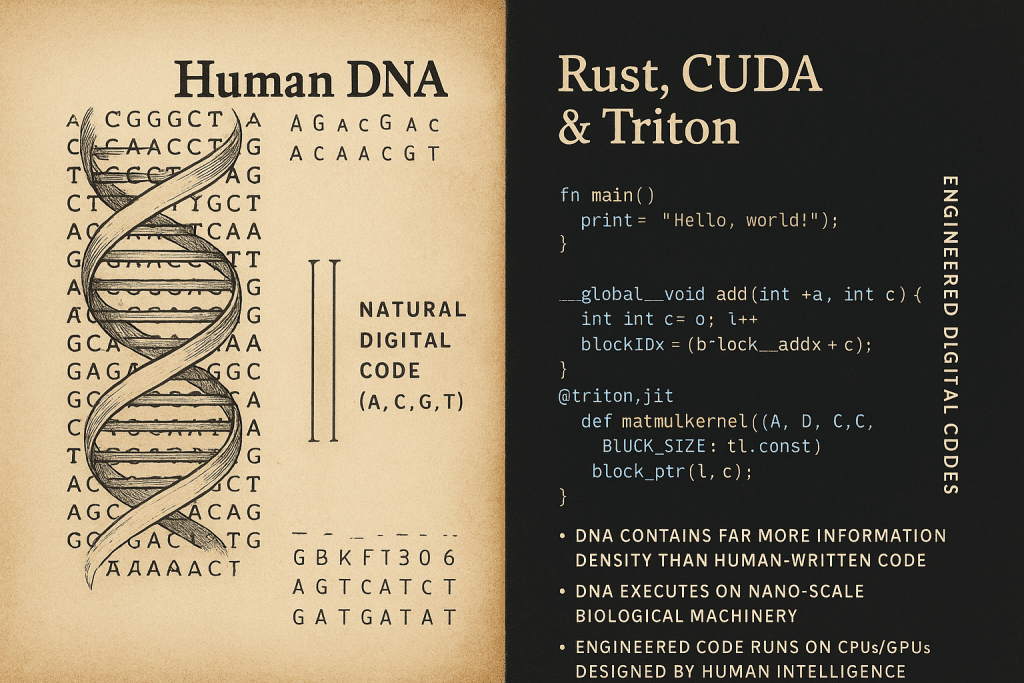
Human DNA and Rust, CUDA, and Triton code.

3. Stephen Meyer and the Case From Information

Dr. Stephen C. Meyer—Cambridge-trained philosopher of science—argues in Return of the God Hypothesis that DNA is the single most powerful biological evidence for intelligent design.

His argument is straightforward:

  1. DNA contains specified, digital information.
  2. The only known cause of such information is intelligence.
  3. Natural selection cannot begin until a self-replicating system exists.
  4. Therefore, the origin of life requires a mind—not material processes.

Chance, chemistry, and natural selection cannot generate meaningful digital code from nothing.


4. The Origin of Life Problem

Here’s the dilemma naturalism cannot escape:

  • Life needs DNA to exist.
  • DNA needs life to copy itself.
  • Therefore, neither can form without the other already present.

This circular dependency is why Francis Crick (co-discoverer of DNA) wrote:

“The origin of life appears to be almost a miracle.”

The more we learn, the more this statement makes sense.


5. DNA and the Biblical Worldview

The Gospel of John begins with a profound statement:

“In the beginning was the Word (logos)…All things came into being through Him, and apart from Him nothing came into being that has come into being.” — John 1:1–3

“Logos” means mind, intelligence, rationality. DNA is precisely the kind of system a rational mind would create.

DNA is not random. It is structured, meaningful, digital information—the kind that always comes from intelligence. The discovery of DNA gives modern science a powerful reason to affirm what Scripture has said all along: Life comes from a Mind — not from matter alone.

Final Thoughts

The naturalistic evolutionist is now caught between a coding rock and a hard decision: If evolution cannot solve the DNA question what is the materialist to do? Darwinism is in trouble and modern science is making that case clear. “Intelligent intervention” is the term that modern science is now using to explain the story DNA is telling them. See Joe Rogan’s podcast interview with Gregg Braden.

Is an infinite God lurking behind stage? It’s certainly probable. Based on the ramifications of DNA design, the decision to believe in a random universe takes more faith then rational faith in God.

Does this take us to the infinite, personal God of the bible? I believe it does. If an infinite, personal God exists why would He not want to communicate with the creatures he made in His own image. That image is defined by a specific, intentional mind. As 1 Corinthians 2:16 says: “For who has known the mind of the Lord, that he will instruct Him? But we have the mind of Christ.”

“I will give thanks to You, for I am fearfully and wonderfully made; Wonderful are Your works, And my soul knows it very well.” Psalm 139:14

I welcome your questions, thoughts, and comments.

Stuart Atkins

FacebookMastodonEmailShare

9 Sickening Abominations That Are Being Created By Our Top Scientists | End Of The American Dream

Just because something is possible doesn’t mean that our scientists should actually be doing it. We live at a time when technology is advancing at an exponential rate, but there are very few guardrails. As a result, researchers are pretty much doing whatever they feel like doing.  In secret laboratories all over the planet, atrocities are being committed and monstrosities are being created. Unfortunately, since the mainstream media talks very little about what is going on behind closed doors, the vast majority of the population has no idea what is happening.  Hopefully articles such as this one will help to shed some light in the darkness. The following are 9 sickening abominations that are being created by our top scientists…

#1 Researchers in China have successfully created mice that have two fathers and no mothers, and those mice were able to produce offspring of their own

In a world first, scientists have created mice with two fathers, capable of having offspring of their own. It’s a huge step forward for our understanding of mammalian reproduction, and could, in theory, have implications for us humans – though this is still a long way off becoming reality.

Led by Yanchang Wei of Shanghai Jiao Tong University in China, the team injected two sperm cells into an empty egg, before using epigenome engineering to reprogram the sperm DNA, allowing an embryo to develop. Over 250 embryos were implanted in female mice, but only two – both male – survived to adulthood. It may be a low success rate, but both mice were fertile and fathered further offspring, something that has never been achieved before.

Previously, researchers have created mice with two mothers; however, attempts to do the same for mice with two fathers have been less successful. The embryos develop until a point, but eventually stop growing, hindered by a process known as genomic imprinting. This happens when certain maternal or paternal genes are shut down during development, and it is a fundamental barrier to unisexual reproduction in mammals.

#2 A company known as “Colossal Biosciences” was able to use genetic engineering to bring dire wolves back from extinction, and now they want to do the same thing for the wooly mammoth, the dodo and the Tasmanian Tiger.  Anyone that has watched a Jurassic Park movie knows how this story is likely to end…

Relying on deft genetic engineering and ancient, preserved DNA, Colossal scientists deciphered the dire wolf genome, rewrote the genetic code of the common gray wolf to match it, and, using domestic dogs as surrogate mothers, brought Romulus, Remus, and their sister, 2-month-old Khaleesi, into the world during three separate births last fall and this winter—effectively for the first time de-extincting a line of beasts whose live gene pool long ago vanished. TIME met the males (Khaleesi was not present due to her young age) at a fenced field in a U.S. wildlife facility on March 24, on the condition that their location remain a secret to protect the animals from prying eyes.

The dire wolf isn’t the only animal that Colossal, which was founded in 2021 and currently employs 130 scientists, wants to bring back. Also on their de-extinction wish list is the woolly mammoth, the dodo, and the thylacine, or Tasmanian tiger. Already, in March, the company surprised the science community with the news that it had copied mammoth DNA to create a woolly mouse, a chimeric critter with the long, golden coat and the accelerated fat metabolism of the mammoth.

#3 It is being reported that a group of very prominent scientists intends to “play God” by building synthetic human DNA from scratch

A radical new endeavor, the Synthetic Human Genome Project, is attempting to build synthetic human DNA from scratch, but who is asking how this science will impact society?

Leading an effort to analyze these new genomic developments from a social science perspective is Professor Joy Zhang of the University of Kent. With major technologies poised to radically transform society, staying ahead of these changes has become a significant concern for technologists and policymakers alike.

#4 How would you feel if you were literally frozen for 3 decades before you were born?  Recently, a couple in Ohio set a brand new record by giving birth to a child that was born from an embryo that had been frozen for over 30 years

A baby boy has been born to an Ohio couple from an embryo that was frozen for more than 30 years, reportedly setting a new world record.

Lindsey, 35, and Tim Pierce, 34, welcomed their son, Thaddeus Daniel Pierce, on Saturday. Ms Pierce told MIT Technology Review her family thought “it’s like something from a sci-fi movie”.

It is believed to be longest that an embryo has been frozen before resulting in a successful live birth. The previous record-holder was a pair of twins who were born in 2022 from embryos frozen in 1992.

#5 A team of researchers that is led by a scientist at Stanford University has developed a brain-computer interface that can literally read minds.  This new brain-computer interface reportedly has an accuracy rate of 74 percent

Scientists have now identified brain activity patterns linked to inner speech and decoded them into text with a 74% accuracy rate.

Published in the journal Cell, the work could enable brain-computer interface (BCI) systems to help people who cannot speak out loud communicate by silently thinking a password to activate the system.

“This is the first time we’ve managed to understand what brain activity looks like when you just think about speaking,” explains lead author Erin Kunz of Stanford University.

#6 A company that is being backed by Bill Gates would like us to start eating “butter” that is made out of carbon

“Innovative food tech company Savor has launched the world’s first butter made out of carbon,” explains a recent puff-piece from The Carbon Herald.

“The company, backed by Bill Gates’ Breakthrough Energy Ventures, was able to achieve this technological advancement by molecularly constructing fat out of carbon dioxide (CO₂), green hydrogen (GH₂), and methane (CH₄).

“This revolutionary product aims to answer the growing need for sustainable food chain solutions that offer a reliable alternative to agriculture-dependent oils.”

#7 How can anyone possibly think that this is a good idea?  Scientists in Brazil have created “chimeric H5N1 viruses that did not previously exist in nature”…

A newly published peer-reviewed study states that researchers at Brazil’s Butantan Institute have engineered entirely new influenza viruses in the lab using reverse genetics, constructing chimeric H5N1 viruses that did not previously exist in nature.

When chicken embryos were exposed to these new viruses, they rapidly developed “hemorrhagic lesions”

The study also reports that chicken embryos inoculated with these lab-created viruses developed hemorrhagic lesions, an abnormal result not seen with seasonal influenza viruses.

“The recovered embryos displayed hemorrhagic lesions… These features were not observed with seasonal influenza strains. The reasons… are unknown.” (p. 8)

If a strain of the bird flu that causes humans to develop “hemorrhagic lesions” ever gets loose, we will know exactly who to blame.

#8 Researchers at Johns Hopkins University are creating human “mini-brains” in order to study neurological diseases.  I do not even have the words to describe how sick this is…

To understand how neurological diseases and conditions develop, scientists have created simplified versions of the brain called brain organoids.

These are three-dimensional tissue cultures that grow from stem cells and replicate the structure and function of the brain.

More recently, they have developed brain assembloids, which are fusions of multiple brain organoids. They combine organoids representing different parts of the brain, such as the cortex, midbrain, and hindbrain.

#9 Apparently they did not learn their lesson the first time, because now researchers at China’s Wuhan Institute of Virology are playing around with the monkeypox virus

A new peer-reviewed study reveals that scientists at China’s Wuhan Institute of Virology (WIV) and Wuhan University have cloned and engineered a monkeypox virus protein, known as OPG147, which suppresses the human immune system’s early-warning signal without triggering obvious alarms.

The researchers are particularly interested in a protein that can disrupt the human immune system’s “ability to signal the presence of viral material”

The new research, published in PLOS Pathogens on June 11, 2025, shows that OPG147—originally found in the purported wild-type monkeypox virus—has a covert capacity to interact with a key human immune sensor called MITA/STING, disrupting its ability to signal the presence of viral material.

What I have shared in this article is just what we know about.

How much more is going on behind closed doors that we don’t know about?

When our scientists try to “play God”, there will inevitably be unexpected consequences.

Of course when the next great pandemic breaks out, there will be a tremendous effort to shield the scientific community from blame.

But the truth is that so many of the things that they are doing right now are completely and utterly insane.

They are literally gambling with billions of lives, and they need to stop before it is too late.

Michael’s new book entitled “10 Prophetic Events That Are Coming Next” is available in paperback and for the Kindle on Amazon.com, and you can subscribe to his Substack newsletter at michaeltsnyder.substack.com.

About the Author: Michael Snyder’s new book entitled “10 Prophetic Events That Are Coming Next” is available in paperback and for the Kindle on Amazon.com. He has also written nine other books that are available on Amazon.com including “Chaos”“End Times”“7 Year Apocalypse”“Lost Prophecies Of The Future Of America”“The Beginning Of The End”, and “Living A Life That Really Matters”.  When you purchase any of Michael’s books you help to support the work that he is doing.  You can also get his articles by email as soon as he publishes them by subscribing to his Substack newsletter.  Michael has published thousands of articles on The Economic Collapse BlogEnd Of The American Dream and The Most Important News, and he always freely and happily allows others to republish those articles on their own websites.  These are such troubled times, and people need hope.  John 3:16 tells us about the hope that God has given us through Jesus Christ: “For God so loved the world, that he gave his only begotten Son, that whosoever believeth in him should not perish, but have everlasting life.”  If you have not already done so, we strongly urge you to invite Jesus Christ to be your Lord and Savior today.

The post 9 Sickening Abominations That Are Being Created By Our Top Scientists appeared first on End Of The American Dream.

Life’s fragile towers: why proteins and RNA need a Designer’s hand | WINTERY KNIGHT

Non-theists are committed to the idea that the building blocks of life emerged spontaneously from chemicals on the early Earth. Well, Dr. James Tour and a couple of colleagues have written a new article that argues that proteins and RNA both break down faster than they can be formed in a realistic early Earth environment. To get them formed, you would need an intelligent designer.

Before we get to the paper, I should say what a protein is. A protein is a chain of amino acids. If you imagine a chain of kid’s blocks that can chain together, then the amino acids are the blocks, and the chain of blocks is the protein. Once the chain of amino acids is long enough, it can fold up into a shape to do things in the body. BUT the chain only folds into a useful shape if the sequence of blocks is in the right order. It’s similar to how Scrabble letters can form words and sentences. If the amino acids make meaningful words and sentences, then they will fold up, and be useful. Otherwise, they are junk.

RNA is like a messenger that reads recipes out of a book of recipes (DNA) and carries them to the kitchen (cells) where the recipes can be followed to make dishes. The recipe tells the kitchen how to put the blocks (amino acids) together to make a protein chain (a meal). Without RNA, the body wouldn’t know how to build the right proteins to perform biological functions. Again, the RNA itself is another chain, but this time it’s a chain of nucleotides. Nucleotides are also like letters, but more complex than amino acids.

So, the paper is asking the question: could these chains of components arise in the early Earth, without an intelligent designer to arrange them?

The paper was published in the journal BioCosmos, and it’s posted on Sciendo. You can read the full text and even download the PDF.

Anyway, Evolution News reported on the article, and here is what they said:

Rice University chemist James Tour, along with co-authors M. C. Parker and C. Jeynes, recently published an article in BioCosmos titled “Thermodynamic Limitations on the Natural Emergence of Long Chain Molecules: Implications for Origin of Life.” The study demonstrates that proteins and RNA degrade at rates that render their spontaneous formation under natural, undirected conditions highly implausible. To date, no origin-of-life researcher has provided a substantive response to the thermodynamic challenges outlined in the paper.

The early Earth environment is a much more messy place than a university lab, and as a result, chains tend to break down. It would be like trying to chain together blocks while running or swimming.

The authors calculate the decay time of proteins and RNA, to see how quickly they break down. And it turns out that the longer the chain is, the faster it breaks down.

Here’s how Evolution News explains it:

More specifically, the half-life of a dipeptide — two amino acids linked by a peptide bond, as found in proteins — is approximately 7 years. Therefore, a polypeptide chain of 200 amino acids, which is typical for many functional proteins, has a half-life of only 13 days. The situation is even more severe for RNA. A chain of two nucleotides has a half-life of about 100 days, meaning that an RNA strand of 200 nucleotides would degrade in roughly 12 hours. Both classes of molecules decay far more rapidly than they could plausibly form under natural conditions, making their spontaneous emergence highly unlikely in any undirected origin-of-life scenario.

The key point again is that the longer the chain gets, the faster it breaks down. But how fast is the building up rate?

In comparison to a protein’s half-life, the rate of polypeptide chain elongation under prebiotic conditions is very long. Yang et al. (2025) identify numerous barriers to sustained polypeptide growth, including the formation of non-peptide linkages and cyclic structures, stringent environmental requirements, and unfavorable thermodynamics. Their analysis establishes that the rate of growth must be far smaller than one added amino acid per chain per day.

Even assuming one addition each day, synthesizing a protein of 200 amino acids would require over six months. However, the growing chain would almost certainly degrade in a much shorter time span. The challenge is even greater for RNA, which has a significantly shorter half-life and encounters additional chemical and structural hurdles during formation.

So the building up rate for proteins and RNA is much slower than the breaking down rate.

I’m not a biochemist, I’m a software engineer. So my job is to try to come up with a good analogy for you so that you remember this well enough to use it in a conversation, later. After all, we must help the evolutionists to come to their senses!

Imagine building a tall tower of toy blocks on a windy beach. You carefully stack each block (amino acids or nucleotides) to make a protein or RNA chain, but it’s slow work—maybe one block a day. Meanwhile, big waves (the harsh early Earth environment) keep crashing in, knocking your tower down faster than you can build it. For a 200-block tower (a functional protein), it’d take months to stack, but waves destroy it in days (protein half-life: 13 days). For RNA, it’s even worse—your tower collapses in hours (half-life: 12 hours)! Without a skilled builder (an intelligent designer) shielding and guiding the process, the tower will never get built.

Well, I think this is a very interesting piece of work these gentlemen have put together, so we shall see how good of a job the other side does at finding an answer. If you have ever seen Dr. Tour debate, he likes to draw a formula on the chalkboard, and then hand the chalk to his opponent and ask them to solve it. Will they be able to solve this problem? If not, then they should quit being so bold about their naturalistic view of life!

Controversy Erupts As Scientists Start Work To Create Artificial Human DNA

Article Image
 • https://www.ndtv.com, by: Abhinav Singh

Scientists have begun work on a controversial project that aims to create human DNA from scratch. World’s largest medical charity, the Wellcome Trust, has donated Rs 117 crore (10 million pounds) to start the project, which involves scientists from universities including Oxford, Cambridge and Imperial College.

Regarded as the building blocks of human life, DNA is made up of repeating units called nucleotides, which contain all the genetic information that physically makes us who we are. Scientists involved in the Synthetic Human Genome Project are now attempting to create a fully synthetic human chromosome, making up about two per cent of human DNA, as proof of concept. The ultimate aim is to maybe one day, create all of it from scratch.

“The sky is the limit. We are looking at therapies that will improve people’s lives as they age, that will lead to healthier ageing with less disease as they get older,” Dr Julian Sale, of the MRC Laboratory of Molecular Biology in Cambridge, who is part of the project, told the BBC.

“We are looking to use this approach to generate disease-resistant cells we can use to repopulate damaged organs, for example, in the liver and the heart, even the immune system,” he said.

As per Professor Matthew Hurles, director of the Wellcome Sanger Insititute, studying how genes and DNA regulate our bodies could help us pinpoint when they go wrong and ultimately develop better treatments.

“Building DNA from scratch allows us to test out how DNA really works and test out new theories, because currently we can only really do that by tweaking DNA in DNA that already exists in living systems,” said Mr Hurles.

However, not everyone is seemingly convinced by the idea of humans playing gods. Professor Bill Earnshaw, a genetic scientist at Edinburgh University who designed a method for creating artificial chromosomes, said the technology could be commercialised quickly by healthcare companies.

Astrophysicist explains the problems with naturalistic origin of life | WINTERY KNIGHT

There’s an interesting article posted at Universe Today by Dr. Paul M. Sutter. Although he does accept unguided evolution after the origin of life, he doesn’t think that naturalism can account for the origin of life. On this blog, I’ve talked about three problem’s with life’s origin: 1) getting the right building blocks, 2) getting the right information, and 3) irreducible complexity. Let’s take a look.

Here is a link to the article from Universe Today.

Here is a quick bio of the author:

Paul M. Sutter is a theoretical cosmologist, award-winning science communicator, NASA advisor, U.S. Cultural Ambassador, and a globally recognized leader in the intersection of art and science. Paul is a research professor at the Institute for Advanced Computational Science at Stony Brook University and a visiting professor at Barnard College, Columbia University.

[…]Paul earned his PhD in physics in 2011 as a Department of Energy Computational Science Graduate Fellow at the University of Illinois. He then spent three years as a research fellow at the Paris Institute for Astrophysics followed by two years at the Trieste Observatory in Italy. Prior to his current appointment, he held a joint position as the chief scientist at the Center of Science and Industry in Columbus, Ohio and as a cosmological researcher at the Ohio State University.

Now let’s turn to his article.

It’s always good to remind people what is required for the simplest kind of life, and he does that:

To succeed at evolution and separate itself from mere chemical reactions, life must do three things. First, it must somehow store information, such as the encoding for various processes, traits, and characteristics. This way the successful traits can pass from one generation to another.

Second, life must self-replicate. It must be able to make reasonably accurate copies of its own molecular structure, so that the information contained within itself has the chance to become a new generation, changed and altered based on its survivability.

Lastly, life must catalyze reactions. It must affect its own environment, whether for movement, or to acquire or store energy, or grow new structures, or all the many wonderful activities that life does on a daily basis.

I remember listening to lectures about the origin of life by Dean Kenyon, Charles Thaxton, and Walter Bradley in my younger years. If I remember correctly, the minimal functions of a living system are capture energy, store information, and replicate. Sutter does a nice job of describing an even longer list.

So what’s the problem with appealing to chance and necessity to create all that? Well, in order to do all that, we need to have three components in place: DNA, RNA and molecular machines.

He writes:

Put exceedingly simply (for I would hate for you to mistake me for a biologist), life accomplishes these tasks with a triad of molecular tools.

One is the DNA, which through its genetic code stores information using combinations of just four molecules: adenine, guanine, cytosine, and thymine. The raw ability of DNA to store massive amounts of information is nothing short of a miracle; our own digital system of 1’s and 0’s (invented because it’s much simpler to tell if a circuit is on or off than some stage in-between) is the closest comparison we can make to DNA’s information density. Natural languages don’t even earn a place on the chart.

The second component is RNA, which is intriguingly similar to DNA but with two subtle, but significant, differences: RNA swaps out thymine for uracil in its codebase, and contains the sugar ribose, which is one oxygen atom short of the deoxyribose of DNA. RNA also stores information but, again speaking only in generalities, has the main job of reading the chemical instructions stored in the DNA and using that to manufacture the last member of the triad, proteins.

“Proteins” is a generic catch-all term for the almost uncountable varieties of molecular machines that do stuff: they snip apart molecules, bind them back together, manufacture new ones, hold structures together, become structures themselves, move important molecules from one place to another, transform energy from one form to another, and so on.

Proteins have one additional function: they perform the job of unraveling DNA and making copies of it. Thus the triad completes all the functions of life: DNA stores information, RNA uses that information to manufacture proteins, and the proteins interact with the environment and perform the self-replication of DNA.

What’s the problem? The problem is that this all has to come together at the start, in order to have life. You can’t build up gradually, from one component, to two components, to three components. All three are needed at the start. This is what Michael Behe calls irreducible complexity, but others have described it as minimal complexity.

Sutter says:

The interconnected nature of DNA, RNA, and proteins means that it could not have sprung up ab initio from the primordial ooze, because if only one component is missing then the whole system falls apart – a three-legged table with one missing cannot stand.

And just to be clear, he would have to provide some evidence of “primordial ooze”. As I’ve blogged about before, life appears almost instantaneously after the cooling of the Earth. He might like to appeal to “billions of years” to get that first replicator, but he doesn’t have billions of years. Molecular oxygen, which is poisonous to origin of life chemistry, was present right after the Earth cooled. And that’s not my opinion – that’s right out of the prestigious peer-reviewed journal Nature.

Evolution News notes:

A recent Nature publication reports a new technique for measuring the oxygen levels in Earth’s atmosphere some 4.4 billion years ago. The authors found that by studying cerium oxidation states in zircon, a compound formed from volcanic magma, they could ascertain the oxidation levels in the early earth. Their findings suggest that the early Earth’s oxygen levels were very close to current levels.

[…]Their findings not only showed that oxygen was present in the early Earth atmosphere, something that has been shown in other studies, but that oxygen was present as early as 4.4 billion years ago. This takes the window of time available for life to have begun, by an origin-of-life scenario like the RNA-first world, and reduces it to an incredibly short amount of time. Several factors need to coincide in order for nucleotides or amino acids to form from purely naturalistic circumstances (chance and chemistry). The specific conditions required already made purely naturalist origin-of-life scenarios highly unlikely. Drastically reducing the amount of time available, adding that to the other conditions needing to be fulfilled, makes the RNA world hypothesis or a Miller-Urey-like synthesis of amino acids simply impossible.

I understand that naturalists want to believe that nature is self-contained, and can do it’s own creating. That belief is practically required in order to have careers in academia. Scientists have to at least claim that “naturalism can do it” or they would draw the unwanted attention of the Darwin mob – the people who got people like William Dembski, Guillermo Gonzalez, Richard Sternberg, etc. fired. However, the scientific evidence doesn’t support naturalism. I wish more people would form their views based on scientific evidence, rather than on the religion of naturalism.

Why the Information in Our DNA Points to the Existence of God | Cold Case Christianity

The more we learn about the origin of life in our universe, the more reasonable the case for God’s existence. The building blocks of life (proteins, ribosomes, enzymes etc.) are formed at the direction of specific nucleotide sequencing in DNA, the largest molecule known. In humans, DNA contains as many as 10 billion atoms. The adenine, guanine, cytosine, and thymine bases in DNA are linked in a particular order to form the genetic code containing the master plan for every organism. The information in DNA guides and instructs the formation of proteins; without it, protein formation would be a haphazard, hit-or-miss proposal. The nucleic sequence in DNA is informational.

Physicist Paul Davies expresses it well: “Once this essential point is grasped, the real problem of biogenesis is clear. Since the heady successes of molecular biology, most investigators have sought the secret of life in the physics and chemistry of molecules. But they will look in vain for conventional physics and chemistry to explain life, for that is a classic case of confusing the medium with the message. The secret of life lies, not in its chemical basis, but in the logical and informational rules it exploits.”

GCS Chapter 03 Illustration 04

Illustration from God’s Crime Scene

Information in RNA and DNA presents a problem for researchers, especially those who propose RNA as the first molecule to appear through some combination of chance and chemical necessity (known as the “RNA World Hypothesis”). Even if RNA is a precursor to DNA, the first RNA molecules would have to be rich in information to replicate. Information must exist first, before any other transformational process can take place. Without the prior genetic information in DNA and RNA, nothing of significance happens within cells.

Nucleotide sequences are more than statistical gibberish. They are semantically, pragmatically, and apobetically significant sources of information (for more information on these categories of information, see my book, God’s Crime Scene). The genetic sequence has meaning and directs action for a specific purpose.

Our personal experience tells us information comes only from intelligent sources. In fact, in the entire history of the universe (and the history of science) a single instance of information arising from anything other than intelligence has never been identified. This presents a problem for those who attempt to stay “in the room” of the universe to account for genetic information. If we limit ourselves to the materials available to us in the universe, information must be explained from matter, chance, the laws of chemistry or physics, and nothing more. Nobel winning biophysical chemist, Manfred Eigen recognized this challenge when he once said, “Our task is to find an algorithm, a natural law that leads to the origin of information.” Efforts to account for information in this way have repeatedly failed. In fact, the information in DNA proves to be the decisive stumbling block for every naturalistic theory offered for the origin of life.

Every geographic location proposed—whether in the atmosphere, in the water, on the ground, under the Earth’s crust, or from outer space—requires an explanation for the existence of information in the genetic code.

Every timeframe offered for life’s origin, be it earlier or later in the history of our planet, requires an explanation for this information.

Every description of why life emerges—whether by chance or some form of physical necessity—requires an explanation for information.

And finally, every mechanism proposed for the origin of life—be it through “protein first” models, “RNA first” models, or any other model—requires an explanation for the existence of genetic information. Cambridge education Philosopher of Science, Stephen C. Meyer, says “Proposals that merely transfer the information problem elsewhere necessarily fail because they assume the existence of the very entity—specified information—they are trying to explain. And new laws will never explain the origin of information, because the processes that laws describe necessarily lack the complexity that informative sequences require. To say otherwise betrays confusion about the nature of scientific laws, the nature of information, or both.”

The chance arrangement of information in DNA is prohibitively improbable, and there are no chemical or physical laws at work to dictate its existence. We are left, then, with a paradox: the laws and forces of nature cannot produce information, but information is required for life to begin. As Paul Davies laments, “we are still left with the mystery of where biological information comes from . . . If the normal laws of physics can’t inject information, and if we are ruling out miracles, then how can life be predetermined and inevitable rather than a freak accident? How is it possible to generate random complexity and specificity together in a lawlike manner? We always come back to that basic paradox.”

Given the utter inability of chance or natural law, and our observations related to the origin of information, intelligence is the best explanation. But this requires us to look for an intelligent source transcending the limits of the physical universe. Scientists trying to account for information by staying “inside the room” seem to be rejecting the obvious. In order to create information, the author of this information must have the ability to select between possible alternatives. This ability to choose selectively requires intelligence, will, and purpose. Unguided physical processes simply cannot accomplish the task. German engineer and IT specialist, Werner Gitt summarizes it this way: “A necessary requirement for generating meaningful information is the ability to select from alternatives and this requires an intelligent, volitional entity . . . Unguided, random processes cannot do this—not in any amount of time—because this selection process demands continuous guidance by intelligent beings that have a purpose.”


Given the utter inability of chance or natural law, and our observations related to the origin of information, intelligence is the best explanation.
Share on X


The selection process required in the creation of information requires an intelligent, volitional free agent. That’s why the information in DNA most reasonably points to the existence of God. For a much more thorough description of this evidence, please refer to God’s Crime Scene, Chapter Three – The Origin of Life: Does the Text Require an Author?

For more information about the scientific and philosophical evidence pointing to a Divine Creator, please read God’s Crime Scene: A Cold-Case Detective Examines the Evidence for a Divinely Created Universe. This book employs a simple crime scene strategy to investigate eight pieces of evidence in the universe to determine the most reasonable explanation. The book is accompanied by an eight-session God’s Crime Scene DVD Set (and Participant’s Guide) to help individuals or small groups examine the evidence and make the case.

The post Why the Information in Our DNA Points to the Existence of God first appeared on Cold Case Christianity.

No Accident: Scientists Can’t Help But Acknowledge The Intelligent Design Of DNA | Harbingers Daily »

Ray Comfort

Consider for a moment whether you could ever believe a book happened by accident. Here’s the argument: There was nothing. Then paper appeared, and ink fell from nowhere onto the sheets and shaped itself into perfectly formed letters. Initially, the letters said something like this: “fgsn&k cn1clxc dumh cckvkduh vstupidm ncnx.” As you can see, random letters rarely produce words that make sense. But in time, mindless chance formed them into the order of meaningful words separated by spaces.

The sentences then grouped themselves to relate to each other, giving them coherence. Punctuation marks, paragraphs, margins, etc., also came into being in the correct placements. Page numbers fell in sequence at the right places, and headers, footers, and footnotes appeared from nowhere on the pages, matching the portions of text to which they related. The paper trimmed itself and bound itself into a book. The ink for the cover fell from different directions, being careful not to incorrectly mingle with the other colors, forming itself into the graphics and title. There are multiple copies of this publication, so it then developed the ability to replicate itself thousands of times over.

With this thought in mind, notice that in the following description, DNA is likened to a book:

If you think of your genome (all of your chromosomes) as the book that makes you, then the genes are the words that make up the story…The letters that make up the words are called DNA bases, and there are only four of them: adenine (A), guanine (G), cytosine (C), and thymine (T). It’s hard to believe that an alphabet with only four letters can make something as wonderful and complex as a person!

To liken DNA to a book is a gross understatement. The amount of information in the 3 billion base pairs in the DNA in every human cell is equivalent to that in 1,000 books of encyclopedia size. It would take a person typing 60 words per minute, eight hours a day, around 50 years to type the human genome. And if all the DNA in your body’s 100 trillion cells was put end to end, it would reach to the sun (90 million miles away) and back over 600 times.

Aside from the immense volume of information that your DNA contains, consider whether all the intricate, interrelated parts of this “book” could have come together by sheer chance. Physical chemist Charles Thaxton writes:

The DNA code is quite simple in its basic structure (although enormously complex in its functioning). By now most people are familiar with the double helix structure of the DNA molecule. It is like a long ladder, twisted into a spiral. Sugar and phosphate molecules form the sides of the ladder. Four bases make up its “rungs.” These are adenine, thymine, guanine, and cytosine. These bases act as the “letters” of a genetic alphabet. They combine in various sequences to form words, sentences, and paragraphs. These base sequences are all the instructions needed to guide the functioning of the cell.

The DNA code is a genetic “language” that communicates information to the cell . . . The DNA molecule is exquisitely complex, and extremely precise: the “letters” must be in a very exact sequence. If they are out of order, it is like a typing error in a message. The instructions that it gives the cell are garbled. This is what a mutation is. The discovery of the DNA code gives the argument from design a new twist. Since life is at its core a chemical code, the origin of life is the origin of a code. A  code is a very special kind of order. It represents “specified complexity.”

Could DNA’s amazing structure have come together by accident? Or does it point to an intelligent Designer? Even the director of the U.S. National Human Genome Research Institute concluded there is a God based on his study of DNA. Francis Collins, the scientist who led the team that cracked the human genome, believes there is a rational basis for a Creator and that scientific discoveries bring man “closer to God”: “When you have for the first time in front of you this 3.1-billion-letter instruction book that conveys all kinds of information and all kinds of mystery about humankind, you can’t survey that going through page after page without a sense of awe. I can’t help but look at those pages and have a vague sense that this is giving me a glimpse of God’s mind.”


Ray Comfort is the Founder and CEO of Living Waters, a bestselling author, and cohost of the award-winning television program Way of the Master, which airs in 190 countries. Comfort also wrote the commentary for the “The Evidence Study Bible

Source: No Accident: Scientists Can’t Help But Acknowledge The Intelligent Design Of DNA

Does Design ‘Imperfection’ Prove God Is Not the Designer of Life? | Harbingers Daily »

J. Warner Wallace

Skeptics have argued against the involvement of an external designer on the basis of perceived imperfections within biological structures. If there is an all-powerful intelligent designer, this designer would be working from scratch and should be capable of creating optimally designed micro-machines and biological structures. Evolution, on the other hand, modifies and builds from existing structures, and this process won’t necessarily produce design perfection.

Scientists and philosophers who identify imperfections (and liabilities) in biological organisms point to these deficiencies as evidence against the involvement of an external intelligent agent. Some skeptics have also offered DNA as an example of design imperfection, given the presence of non-functional genes (“junk DNA”) within a variety of genomes.

According to these critics, if a powerful, intelligent creator designed the DNA with these non-functional “pseudogenes”, the designer was apparently error-prone, wasting millions of DNA bases. Imprecise evolutionary processes resulting from random gene mutations are offered as a better explanation for the non-functional genes we find in DNA. But examples of apparent biological imperfections fail to negate the reasonable existence of a designer for the following reasons:

The Appearance of “Imperfection” Often Results from Entropy or Adaptation

Those who advocate for the existence and interaction of an external intelligent designer aren’t denying the impact of entropy or adaptation over time. Rather than an “either/or” explanation resulting from the creative interaction of an intelligent designer or unguided natural processes, the explanation for “imperfection” we observe in biological systems is most reasonably inferred as the result of intelligent design and processes of modification over time. One example of design “imperfection,” the sesamoid bone “thumb” observed on pandas, is typically offered as an example of poor or inadequate design.

The panda’s “thumb” seems to be an imperfect appendage. Unlike the opposing thumbs of primates, the panda’s “thumb” is unable to grasp as efficiently as would be the case if it were shaped just slightly differently. As a result, the panda’s thumb has been offered by many naturalists as an example of the kind of imperfect shape we might expect from the evolutionary process, and as an evidence against intelligent design.

But this unusual protrusion found in pandas isn’t necessarily the product of an intentional, original design. Mutation and selection operate on all biological organisms, whether they are initially designed or not. The panda’s “thumb” may simply be an adaptation of an original design. Those advocating for an external designer recognize the real and pervasive power entropy has to pervert design in nature. The Second Law of Thermodynamics is an inescapable reality, resulting in degradation from order to disorder. When we see an apparent example of imperfection, entropy may be the better explanation.

The Appearance of “Imperfection” Often Results from Our Limited Understanding

There are times when our limited understanding of biological systems leads us to perceive some degree of imperfection even when this is not the case. This appears to be the situation involving what used to be considered “junk DNA”. The more we learn about apparent “non-functioning” genes and seemingly useless genomic regions, the more we recognize them as important contributors to an elaborate informational system. In the past several years, scientists have discovered a large number of non-protein coding DNA regions under strong “selective constraint.”

Evolutionary scientists recognize these genetics regions have been maintained in the genome for a very long time, even from an evolutionary perspective. The retention of these regions of the DNA molecule indicates their importance to the organism, even if scientists are presently unable to understand why they are important. Typically, those regions of the genome demonstrating “selective constraint” are fundamental to an organism’s ability to survive. These previously under-valued regions of the genome apparently have an important, yet unrecognized, role to play. Scientists have now concluded these “junk sequences” are not junk at all, but “have been under purifying selection and have a significant function that contributes to host viability.” What might at first appear to be an unnecessary, imperfect, extraneous mutation, isn’t necessarily the case. It may simply be a matter of our limited understanding.

The Appearance of “Imperfection” Often Results from Our Narrow Perspective

Prior to serving as a detective, I was classically trained as a designer and architect. Working in an architectural firm in Santa Monica, California, I was typically assigned very limited responsibilities within much larger design projects. While the lead architect was responsible for the overall design of the building, I was sometimes given the limited responsibility of designing an entry portico or the arches in a large courtyard. I would design a prototype, only to have the firm’s principal modify the design later. I often found his modifications were necessary because I’d overlooked some important relationship between design elements. He understood the functional connectivity between these design elements better than I did, and I often had to compromise some aspect of my effort to achieve the larger goal.

This is nearly always the case when engaged in the design process. Every design effort has an impact on some other feature of the overall project, and compromise is essential, even when trying to remove an annoying, apparently “imperfect” feature in the design.

As engineer and historian Henry Petroski writes, “When a new design removes one of these annoyances, it more likely than not fails to address some others or adds a new one of its own. This is what makes engineering and inventing so challenging. All design involves conflicting objectives and hence compromise, and the best designs will always be those that come up with the best compromise.”

For this reason, we simply cannot assume a design is somehow “imperfect” unless we know precisely the goals (or motives) of the designer and the challenges incumbent in the project. As detectives investigating the designs we observe in cellular systems, our limited perspective and understanding sometimes inhibits our ability to fairly judge the design features we observe.

The appearance of design “imperfection” fails to disprove the existence of a designer, both in designed objects created by humans and in designed objects created by God. In fact, the cumulative evidence for a Creator and Intelligent Designer is overwhelming.


J. Warner Wallace is a Christian apologist and former Los Angeles cold-case homicide detective who has been featured numerous times on NBC’s “Dateline” program for his crime scene expertise.

Source: Does Design ‘Imperfection’ Prove God Is Not the Designer of Life?

Origin of Life Conundrums Require A Divine Designer | Cold Case Christianity

As a homicide detective, I understand the power of alibis. When a potential suspect can prove he or she wasn’t available to commit a crime because they were occupied elsewhere, they are eliminated as a candidate for the murder. Alibis create conundrums: conditions difficult to explain based on the impossibility of simultaneous appearances. In a similar way, the relationships between DNA, proteins, enzymes, and the cell’s membrane present a biological conundrum. Those who believe life can originate in our universe without supernatural interaction (and guidance) must overcome this conundrum if they hope to account for the presence of life “inside the room” of the natural universe by staying “inside the room” for an explanation. In my new book, God’s Crime Scene: A Cold-Case Detective Examines the Evidence For A Divinely Created Universe, I describe the depth of the dilemma by illustrating the process of protein formation within the cell.

Specially formed functional proteins “unzip” a specific portion of the DNA by separating the helix at the middle of its rungs. Additional specialized proteins then act as molecular machines, helping to assemble nucleotide bases along one of the unzipped DNA segments.

This new assemblage of nucleotides is called a messenger RNA (mRNA). Once formed, the shorter mRNA molecule detaches from the DNA and is carried off into the cell by additional protein “helpers.” The mRNA is carrying instructions needed to build a protein. It is helped by another RNA molecule known as transfer RNA (tRNA). The mRNA and tRNA meet in a molecular machine called a ribosome. This important mini-factory is constructed from proteins and RNA complexes. Here, the tRNA transfers the message carried in the mRNA so amino acids can form each protein:

GCS Chapter 03 Illustration 07

Illustrations from God’s Crime Scene

Once the sequence of amino acids has been established, something amazing happens. Rather than remain in a long chain, the amino acids begin to roll up and fold onto one another, forming the specific finished shape of the protein required to accomplish its job. This may take a few seconds and scientists are still mystified as to how amino acids accomplish this task.

None of this can happen without the aid of enzymes and the protection of the cell membrane. Enzymes are large molecules constructed primarily with proteins. These important molecules activate and accelerate the reactions related to everything from food digestion to DNA formation. Nearly every chemical response in the cell requires an enzyme to help it happen fast enough for life to result. Finally, all of this activity must be protected. That’s where the cell membrane becomes critical. The membrane separates the interior of the cell from hostile exterior forces. It is constructed with fatty molecules (lipids) and proteins (along with carbohydrates). Some cells also have an additional cell wall surrounding the membrane. Cell walls are tough but flexible, and offer an additional layer of filtering and protection.

Now that we’ve reviewed the inner activities of the cell, you’ve probably already recognized the “chicken and egg” problem. Enzymes are necessary for the timely formation of proteins, but these enzymes are built, in part, with proteins. Worse yet, this “chicken and egg” problem is also present in the larger relationships between the DNA, RNA, proteins, ribosomes and cell membrane.

GCS Chapter 03 Illustration 08

Paul Davies describes the conundrum: “Take DNA… It has a grand agenda, but to implement this, DNA must enlist the help of proteins… proteins are made by complicated machines called ribosomes, according to coded instruction received from DNA via mRNA. The problem is, how could proteins get made without the DNA code for them, the mRNA to transcribe the instructions, and the ribosomes to assemble them? But if the proteins are not already there, how can DNA, ribosomes and all the rest of the paraphernalia get made in the first place? It’s Catch-22.”

All these important machines, transportation vehicles and tools must arrive at the cellular factory simultaneously and function in unison if life is to be possible. The cell membrane and enzymes cannot be constructed without proteins, but the protein formation must be accelerated by enzymes and protected by the membrane. Proteins can’t be formed without DNA information and RNA activity, but machines formed from proteins (like ribosomes), are a critically necessary part of this process.

In this brief blog post (excerpted from God’s Crime Scene), I’ve only described two of the many “chicken and egg” problems naturalists must consider and explain as they account for the origin of life in the universe. Biological systems are replete with irreducibly complex conundrums such as these, and the best explanation for this kind of complexity is intelligent interaction. A supernatural designer can overcome the “chicken and egg” conundrums we’ve described, and a Divine Designer of this nature remains the best inference from the evidence. For a much more thorough description of this evidence, please refer to God’s Crime Scene, Chapter Three – The Origin of Life: Does the Text Require an Author?

For more information about the scientific and philosophical evidence pointing to a Divine Creator, please read God’s Crime Scene: A Cold-Case Detective Examines the Evidence for a Divinely Created Universe. This book employs a simple crime scene strategy to investigate eight pieces of evidence in the universe to determine the most reasonable explanation. The book is accompanied by an eight-session God’s Crime Scene DVD Set (and Participant’s Guide) to help individuals or small groups examine the evidence and make the case.

The post Origin of Life Conundrums Require A Divine Designer first appeared on Cold Case Christianity.

Casey Luskin and Fuz Rana: Nobel Prize supports intelligent design | WINTERY KNIGHT

Exciting news! Not only has the winner of the Nobel Prize in Physiology or Medicine been announced, but the winning discovery supports intelligent design. Do you remember a while back when we had Dr. Casey Luskin and Dr. Fazale Rana on the Knight and Rose Show to discuss junk DNA and the origin of life? Well, they discussed it with Lenny Esposito on a new Come Reason podcast episode.

Here’s the description from Evolution News, written by Casey Luskin:

What’s the biggest science story of the year? My vote goes to the 2024 Nobel Prize in Physiology or Medicine, awarded for the discovery of function for a type of “junk DNA” that produces microRNA (miRNA), a crucial molecule involved in gene regulation. That so-called genetic junk would turn out to be functional was a prediction of intelligent design going back to the 1990s. On that, ID has been vindicated over and over again, now by the Nobel Committee. Our colleagues Richard Sternberg and Bill Dembski were early predictors, as critics of what Jonathan Wells called in a 2011 book, The Myth of Junk DNA.

[…]Not only was this 2024 Nobel Prize awarded for the discovery that a type of junk DNA is actually extremely important (it produces microRNAs that regulate gene expression), but we see that the evolutionary “junk DNA” paradigm probably hindered acceptance of this groundbreaking discovery.

Here’s the video of the podcast:

Here are the topics:

  • Introduction
  • The Mystery of Protein Creation in the Cell
  • Replication, Transcription, and Translation
  • The Central Dogma and its Oversimplification
  • Junk DNA Isn’t Junk After All
  • The Human Genome Project and The Revolution In Understanding DNA
  • Ambrose and Ruvkin’s Discovery – Micro RNA
  • Micro RNA and protein regulation
  • The Complex Interactions That Shows Design in the Cell
  • Pseudo Genes and Their Importance For the Cell
  • ID-Based Biology Finds Answers That Evolutionary Biology Misses
  • Does the Discovery of Micro RNAs show it Isn’t Mutations That Provide New information In DNA?
  • The Evolutionary Paradigm Is Getting Harder to Explain
  • We See In the Cell Just What Designers Do
  • Predictions From an ID Paradigm
  • What The Nobel Means to ID as “Real Science”
  • Are There Any implications for the RNA World Hypothesis?

If you missed our previous episodes of the Knight and Rose Show with Dr. Casey Luskin and Dr. Fuz Rana, here are the links:

The simplest argument against Darwinian evolution is Junk DNA | WINTERY KNIGHT

The Discovery Institute has a new video out in their series on intelligent design, about so-called “junk DNA”. Basically, there are two sides to the origins issue: the design-deniers and the design-recognizers. (And theistic evolutionists belong in the former group). These two groups make different predictions about the information in the human genome. And we can check their predictions.

First, here’s the new video:

Here is description from Evolution News:

The myth of junk DNA is much more than just an evolutionary idea that turned out to be mistaken. As the new episode of Long Story Short makes amusingly clear, it also reflects a “battle of predictions” with intelligent design. Going back to the 1970s, evolutionists predicted that, in line with their premise of a randomly generated genome, DNA would turn out to be full of Darwinian debris, playing no functional role but merely parasitic (atheist Richard Dawkins’s term) on the small portion of functional DNA.

Proponents of intelligent design said the opposite. William Dembski (1998) and Richard Sternberg (2002) predicted widespread function for the so-called “junk.” After all, as a product of care and intention, the genome ought to be comparable in a way with products of human genius, with every detail there for a reason.

On that, ID has since been massively vindicated. Scientific theories are tested by the predictions they make. If those fail, it’s a bad sign for the theory. Mainstream science journals like Science are admitting the truth about the erstwhile “junk” — even as a few diehard Darwinists like Laurence Moran at the University of Toronto deny it.

And these predictions by the design side are not new. My young Earth creationist friend even sent me this today (today is Wednesday, I always write these posts the night before and schedule them for the next morning):

While a Creation/Fall model could account for the accumulation of some random, mutationally defective “extra copies,” evolutionists felt they had a strong point that 97% “junk” DNA pointed more to evolution than intelligent design. Creationists have long suspected that this “junk DNA” will turn out to have a function. In fact, junk DNA research is now a hot topic; not only are more and more functions being detected, but it is suspected that junk DNA is full of yet-to-be-discovered “intellectual riches.

That prediction is from 1994. My friend has a whole article about Junk DNA here, with all the predictions from each side.

He says “Carl Wieland founded CMI”. CMI is Creation Ministries International, which is supposed to be the best YEC web site.

Anyway, if you missed the other videos in the series, there is a playlist, but all the videos are out of order! If you want a quick and snarky introduction to intelligent design, this is it.

The DNA Replisome: A Paradigm of Design | Cross Examined

The DNA replisome is one of the most remarkable molecular machines, involving a complex of different proteins, each of which is very specifically crafted to fulfill its role in the process of replicating the genome in preparation for cell division. The rate of DNA replication has been measured at a whopping 749 nucleotides per second[1] and the error rate for accurate polymerases is believed to be in the range of 10-7 and 10-7, based on studies of E. coli and bacteriophage DNA replication.[2]

One of the best animations of this incredible process is this one by Australian animator Drew Berry. It is difficult to look at an animation such as this (which is drastically over-simplified) and not come away with the strong intuition that such an intricately choreographed machine is the product of masterful engineering. Stable and functional protein structures are astronomically rare in combinatorial sequence space, and DNA replication requires many of them. But not just any old stably folding proteins will do. These proteins have to be crafted very particularly in order to perform their respective jobs. Indeed, when one focuses on specific proteins, it takes the design intuition to new heights. For example, see these beautiful animations of topoisomerasehelicase, and DNA polymerase. One paper summarizes the engineering prowess of DNA replication thus [3]:

Synthesis of all genomic DNA involves the highly coordinated action of multiple polypeptides. These proteins assemble two new DNA chains at a remarkable pace, approaching 1000 nucleotides (nt) per second in E. coli. If the DNA duplex were 1 m in diameter, then the following statements would roughly describe E. coli replication. The fork would move at approximately 600km/hr (375 mph), and the replication machinery would be about the size of a FedEx delivery truck. Replicating the E. coli genome would be a 40 min, 400 km (250 mile) trip for two such machines, which would, on average make an error only once every 170 km (106 miles). The mechanical prowess of this complex is even more impressive given that it synthesizes two chains simultaneously as it moves. Although one strand is synthesized in the same direction as the fork is moving, the other chain (the lagging strand) is synthesized in a piecemeal fashion (as Okazaki fragments) and in the opposite direction of overall fork movement. As a result, about once a second one delivery person (i.e. polymerase active site) associated with the truck must take a detour, coming off and then rejoining its template DNA strand, to synthesize the 0.2km (0.13 mile) fragments.[3]

Irreducible Complexity on Steroids

DNA replication is an example of what we might call “irreducible complexity on steroids.” Genome duplication is a prerequisite of differential survival, which is necessary for the process of natural selection to even work. Thus, one can hardly appeal to natural selection to account for the origins of DNA replication without assuming the existence of the very thing one is attempting to explain. It is difficult to envision a viable replication system that is simpler than the DNA replisome shown in the animation above. Though the RNA world scenario (which maintains that RNA-based life predates life based on DNA and proteins) is a popular hypothesis, problems abound for this scenario, as has been discussed many times in various other publications (e.g., Meyer, Signature in the Cell, Ch. 14). For example, one of the foremost challenges is the inherent instability of RNA (being single-stranded, and possessing an additional 2’ OH group, rendering it prone to hydrolysis). RNA polymers are therefore extremely unlikely to have survived in the early earth environment for long enough to be of much value. Second, when RNA forms complementary base pairs to fold back on itself, part of the molecule no longer presents an exposed strand that can serve as a template for copying. Thus, there is a physical limitation on the capability of RNA to self-replicate.

A further reason why the DNA replication machinery exhibits irreducible complexity on steroids is that, by being so primitive, it is far more difficult to envision any kind of co-optation scenario than it would be for a system that arose much later, such as bacterial flagella. With the flagellum, one can at least point to alternative functions that might be performed by a number of the flagellar components (such as the Type-III Secretion System). However, with DNA replication, it is unclear what other systems any of the components might be co-opted from – since any other system would need to have arisen after the origins of DNA replication.

An even more striking enigma is that, across the three domains of life, the key enzymes (in particular, the replicative polymerases) are not homologous, which has led to the suggestion that DNA replication may have arisen more than once independently.[4] This observation sits more comfortably on a design paradigm than on one committed to naturalism.

Which Components Are Essential for DNA Replication?

What protein components that are involved in DNA replication are indispensable for function? First, there is the DNA polymerase that actually performs the copying of each strand. Without it, no replication would take place at all. But, the DNA polymerase is unable to begin replication without the presence of a free 3’ OH (hydroxyl) group. Thus, another enzyme — a form of RNA polymerase called a primase — creates a short RNA fragment (called a primer) from which the DNA polymerase can extend (unlike DNA polymerase, the primase does not require the presence of a free 3’ OH group). Thus, in the absence of the primase enzyme, no RNA primers would be laid down on either the leading or lagging strand, and DNA replication would be unable to commence. Furthermore, the DNA polymerase itself has to be attached to the DNA by a ring-shaped protein known as a sliding clamp (which prevents it from falling off the DNA template strand). But, the sliding clamp cannot directly attach to the DNA on its own. Instead, a protein complex called the clamp loader mediates the loading of the sliding clamp onto the DNA at the replication fork, utilizing the energy from ATP hydrolysis to open the sliding clamp ring and load it onto the DNA. In the absence of the sliding clamp or clamp loader, the DNA polymerase would frequently fall off the DNA template, rendering it extremely inefficient.

Of course, the replication process cannot begin unless the DNA double helix is unzipped, and this is accomplished by the enzyme helicase, which breaks the hydrogen bonds along the DNA molecule, thereby opening up and exposing the two strands for replication by the polymerase. In its absence, the DNA polymerase will stall, unable to separate the strands that lie ahead.

Even with the helicase enzyme separating the two strands, the strands are likely to reanneal during the copying process. Enter the single-stranded binding proteins which bind to the exposed DNA strands, preventing them from re-annealing during copying. Without them, the DNA strands would bind together again before they were able to be copied.

The topoisomerase enzymes are necessary for removing supercoils that are induced by the torsional stress. They do so by cutting one strand, passing the other strand through the gap, and then resealing the break. In the absence of the topoisomerase enzymes, the DNA would eventually break, thereby hindering the DNA replication process.

Because of the anti-parallel nature of DNA (and the fact that the DNA polymerase can only replicate in a 5’ to 3’ direction), one strand, the lagging strand, has to be replicated backwards (in order for the replication fork to move in a single direction). This is done discontinuously in small sections. RNA primers are laid down by primase, and from those are synthesized short fragments of DNA known as Okazaki fragments. The RNA primers are then removed and replaced with DNA, and the Okazaki fragments are stitched together by the enzyme ligase. We have already discussed the necessity of the primase enzyme for synthesizing RNA primers. It may be added that, in the absence of the RNA excision enzymes (which remove the RNA primers), the RNA fragments would remain covalently attached to the newly replicated fragments of DNA. Moreover, in the absence of ligase (which links the Okazaki fragments together), the newly replicated strands would remain as fragments.

If the removal of any of the aforementioned components would render the DNA replication machinery non-functional, how could such a system come about through an undirected Darwinian step-wise pathway, preserving selective utility at every step along the way? Whatever process produced the DNA replisome had to know where the target was. Such a cause would have to be teleological in nature.

A Paradigm of Design

The DNA replication machinery represents one of the most extraordinary examples of nanotechnology found in the cell. In any other realm of experience, such a complex and delicate arrangement of parts would be immediately recognized as reflecting conscious intent — that is, as being the product of a mind. Why should such an inference be disallowed when examining biological systems? For more detail on this fascinating molecular machine, see my interview on it from last summer on ID the Future. I also published an earlier series (more than a decade ago) exploring the various protein components in more detail. You can find these here:

If you enjoyed the animation by Drew Berry linked at the beginning of this article, here is a more detailed animation, produced by Oxford University Press. Here is a second animation which reveals how the DNA polymerases are coupled so that they can move in the same direction.

References: 

[1] McCarthy D, Minner C, Bernstein H, Bernstein C. DNA elongation rates and growing point distributions of wild-type phage T4 and a DNA-delay amber mutant. J Mol Biol. 1976 Oct 5;106(4):963-81.

[2] Schaaper RM. Base selection, proofreading, and mismatch repair during DNA replication in Escherichia coli. J Biol Chem.1993 Nov 15;268(32):23762-5.

[3] Baker TA, Bell SP. Polymerases and the replisome: machines within machines. Cell. 1998 Feb 6;92(3):295-305.

[4] Leipe DD, Aravind L, Koonin EV. Did DNA replication evolve twice independently? Nucleic Acids Res. 1999 Sep 1;27(17):3389-401; and Brown JR, Doolittle WF. Archaea and the prokaryote-to-eukaryote transition. Microbiol Mol Biol Rev. 1997 Dec;61(4):456-502.

Recommended Resources:

Why Science Needs God by Dr. Frank Turek (DVD and Mp4)

Science Doesn’t Say Anything, Scientists Do by Dr. Frank Turek (DVD, Mp3, and Mp4)

Oh, Why Didn’t I Say That? Does Science Disprove God? by Dr. Frank Turek (DVD and Mp4)

I Don’t Have Enough Faith to Be an Atheist (Paperback), and (Sermon) by Norman Geisler and Frank Turek


Dr. Jonathan McLatchie is a Christian writer, international speaker, and debater. He holds a Bachelor’s degree (with Honors) in forensic biology, a Masters’s (M.Res) degree in evolutionary biology, a second Master’s degree in medical and molecular bioscience, and a Ph.D. in evolutionary biology. Currently, he is an assistant professor of biology at Sattler College in Boston, Massachusetts. Dr. McLatchie is a contributor to various apologetics websites and is the founder of the Apologetics Academy (Apologetics-Academy.org), a ministry that seeks to equip and train Christians to persuasively defend the faith through regular online webinars, as well as assist Christians who are wrestling with doubts. Dr. McLatchie has participated in more than thirty moderated debates around the world with representatives of atheism, Islam, and other alternative worldview perspectives. He has spoken internationally in Europe, North America, and South Africa promoting an intelligent, reflective, and evidence-based Christian faith.

This article was originally published on March 21st, 2024, at Evolution News & Science Today.

And republished at: https://bit.ly/4f6pp5q

The post The DNA Replisome: A Paradigm of Design appeared first on Cross Examined.

https://crossexamined.org/the-dna-replisome-a-paradigm-of-design/

Why DNA is Best Explained by the Existence of God (Video) | Cold Case Christianity

Does DNA contain coded information? If so, what does this code tell us about the nature of its source? Can anything other than a mind account for information? What kind of mind would explain the information we find in DNA?

To see more training videos with J. Warner Wallace, visit the YouTube playlist.

For more information about the scientific and philosophical evidence pointing to a Divine Creator, please read God’s Crime Scene: A Cold-Case Detective Examines the Evidence for a Divinely Created Universe. This book employs a simple crime scene strategy to investigate eight pieces of evidence in the universe to determine the most reasonable explanation. The book is accompanied by an eight-session God’s Crime Scene DVD Set (and Participant’s Guide) to help individuals or small groups examine the evidence and make the case.

The post Why DNA is Best Explained by the Existence of God (Video) first appeared on Cold Case Christianity.