There are two ways to be fooled. One is to believe what isn’t true; the other is to refuse to believe what is true. —Soren Kierkegaard. "…truth is true even if nobody believes it, and falsehood is false even if everybody believes it. That is why truth does not yield to opinion, fashion, numbers, office, or sincerity–it is simply true and that is the end of it" – Os Guinness, Time for Truth, pg.39. “He that takes truth for his guide, and duty for his end, may safely trust to God’s providence to lead him aright.” – Blaise Pascal. "There is but one straight course, and that is to seek truth and pursue it steadily" – George Washington letter to Edmund Randolph — 1795. We live in a “post-truth” world. According to the dictionary, “post-truth” means, “relating to or denoting circumstances in which objective facts are less influential in shaping public opinion than appeals to emotion and personal belief.” Simply put, we now live in a culture that seems to value experience and emotion more than truth. Truth will never go away no matter how hard one might wish. Going beyond the MSM idealogical opinion/bias and their low information tabloid reality show news with a distractional superficial focus on entertainment, sensationalism, emotionalism and activist reporting – this blogs goal is to, in some small way, put a plug in the broken dam of truth and save as many as possible from the consequences—temporal and eternal. "The further a society drifts from truth, the more it will hate those who speak it." – George Orwell “There are two ways to be fooled. One is to believe what isn’t true; the other is to refuse to believe what is true.” ― Soren Kierkegaard
For decades, we’ve heard that so-called “junk DNA” is proof of evolution. After all, what kind of Creator would fill our genome with large areas of DNA that don’t do anything? Clearly, those regions are just leftovers from millions of years of evolutionary processes . . . except the latest in DNA research doesn’t confirm this decades-old “proof” of evolution!
For a long time, scientists virtually ignored the “junk” portions of our DNA—after all, if they’re just evolutionary leftovers, there isn’t much point in studying them. But once they began to look into these regions, researchers realized the “junk” is anything but junk! These regions of our DNA don’t code for proteins, but they are regulatory switches that are extremely important to organisms. And that’s what we would expect from a biblical worldview.
These regions of our DNA don’t code for proteins, but they are regulatory switches that are extremely important to organisms.
This new DNA research is fascinating, and it destroys this long-cherished “proof” of evolutionary ideas. On a recent episode of Answers News, geneticist Dr. Georgia Purdom shared about the latest in DNA research and how its incredible complexity confirms it was designed by the all-knowing Creator. I encourage you to watch and share this with others:
Be sure to subscribe to our Answers in Genesis YouTube channel so you don’t miss another episode of Answers News or any of the other video content our social media team produces.
When we launched this ministry in 1993, I could never have imagined YouTube and other social media platforms giving us the opportunity to reach millions of people. But praise the Lord, God has allowed us to use social media to promote the message of biblical authority and the gospel to people across the nation and in many different countries. What an incredible opportunity!
Thanks for stopping by and thanks for praying, Ken
This item was written with the assistance of AiG’s research team.
ByStuart Atkins; CHRISTIAN PROOFS; November 18, 2025
Estimated reading time: 5 minutes
Key Takeaways
DNA serves as a digital, information-rich code that suggests intelligent design rather than random chance.
The complexity of the human genome surpasses human-made software, featuring 3.2 billion ‘letters’ that form biological instructions.
Dr. Stephen Meyer argues that DNA contains specified digital information, which only intelligence can produce.
Life and DNA exhibit a circular dependency, as life requires DNA to exist and vice versa.
The structure of DNA aligns with the idea that rational intelligence created it, supporting a biblical worldview.
As DNA evidence is reversed engineered, evolutionary theories on human origins are collapsing.
I don’t have enough faith to be an atheist. Read on to see why…
In the last century, science has uncovered something astonishing at the heart of every living cell: a digital, information-rich code known as DNA, or Deoxyribonucleic acid. This discovery has revolutionized biology—and it has profound implications for the biggest question of all: Does life point to a Creator?
The DNA code is by far the strongest intelligent design argument for the existence of God. The latest scientific and medical DNA evidence puts the atheist on notice. If God does not exist, the burden of proof now falls on atheism or agnosticism, not theism. Apart from the “faith” or “religion” or “myth” or “wishful thinking” or “opiate of the people” arguments, the facts of DNA ushers both scientist and atheist into God’s sanctuary of intelligent creation. They can no longer escape to a naturalistic, materialist lab. Is it a Designer DNA universe with no exit?
The human genome is not random chemistry. It is a sophisticated, encoded language—far more advanced than anything humans have ever written. When examined objectively, the information within DNA strongly suggests design rather than chance. The tired evolutionary formula of time plus chance plus matter cannot explain the mind behind the DNA matter. This following explores why.
1. DNA Is a Digital, Symbol-Based Language
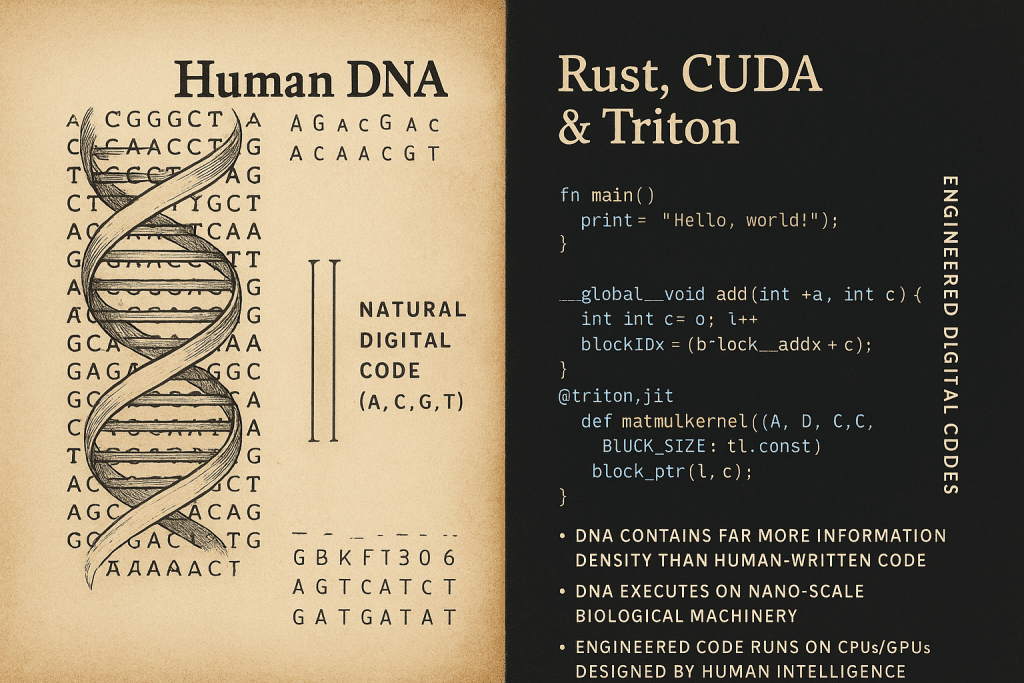
Every human cell contains about 3.2 billion “letters”—sequences of A, T, C, and G that form biological instructions. These are arranged in meaningful, ordered sequences that function exactly like a written code or software program.
DNA is:
Digital (only four symbols)
Ordered, not chaotic
Meaningfully arranged
Used to direct complex functions
Bill Gates once remarked:
“DNA is like a computer program, but far more advanced than any software we’ve ever created.”
This is not an analogy—it is a description. DNA stores, processes, and transmits information, exactly like computer code.
2. The Human Genome Surpasses Human Software
Highlights of the human genome:
One cell would fill 3,000 books of 1,000 pages each
The human body contains ~37 trillion such copies
3.2 billion base pairs arranged in a precise, sequential language
DNA uses a four-letter digital alphabet (A, T, C, G)
Molecular machines inside the cell read, copy, correct, and operate on this code
Leading scientists—even non-theists—have noticed its computer-like nature: Richard Dawkins: “The machine-code of the genes is uncannily computer-like.”
DNA compresses data with efficiency that computer scientists still cannot replicate
Every instruction to build and sustain life—from bone density to brain development—is encoded inside this language-like system.
The question is simple: Where does information come from?
In every instance we observe, information comes from a mind. Codes don’t write themselves.
3. Stephen Meyer and the Case From Information
Dr. Stephen C. Meyer—Cambridge-trained philosopher of science—argues in Return of the God Hypothesis that DNA is the single most powerful biological evidence for intelligent design.
His argument is straightforward:
DNA contains specified, digital information.
The only known cause of such information is intelligence.
Natural selection cannot begin until a self-replicating system exists.
Therefore, the origin of life requires a mind—not material processes.
Chance, chemistry, and natural selection cannot generate meaningful digital code from nothing.
4. The Origin of Life Problem
Here’s the dilemma naturalism cannot escape:
Life needs DNA to exist.
DNA needs life to copy itself.
Therefore, neither can form without the other already present.
This circular dependency is why Francis Crick (co-discoverer of DNA) wrote:
“The origin of life appears to be almost a miracle.”
The more we learn, the more this statement makes sense.
5. DNA and the Biblical Worldview
The Gospel of John begins with a profound statement:
“In the beginning was the Word (logos)…All things came into being through Him, and apart from Him nothing came into being that has come into being.” — John 1:1–3
“Logos” means mind, intelligence, rationality. DNA is precisely the kind of system a rational mind would create.
DNA is not random. It is structured, meaningful, digital information—the kind that always comes from intelligence. The discovery of DNA gives modern science a powerful reason to affirm what Scripture has said all along: Life comes from a Mind — not from matter alone.
Final Thoughts
The naturalistic evolutionist is now caught between a coding rock and a hard decision: If evolution cannot solve the DNA question what is the materialist to do? Darwinism is in trouble and modern science is making that case clear. “Intelligent intervention” is the term that modern science is now using to explain the story DNA is telling them. See Joe Rogan’s podcast interview with Gregg Braden.
Is an infinite God lurking behind stage? It’s certainly probable. Based on the ramifications of DNA design, the decision to believe in a random universe takes more faith then rational faith in God.
Does this take us to the infinite, personal God of the bible? I believe it does. If an infinite, personal God exists why would He not want to communicate with the creatures he made in His own image. That image is defined by a specific, intentional mind. As 1 Corinthians 2:16 says: “For who has known the mind of the Lord, that he will instruct Him? But we have the mind of Christ.”
“I will give thanks to You, for I am fearfully and wonderfully made; Wonderful are Your works, And my soul knows it very well.” Psalm 139:14
Now we are allowing AI to create new viruses? Are we mad? What scientists at Stanford University are doing sounds like the plot to a really bad disaster movie. Viruses that are designed by AI are assembled by crazy researchers, and then those viruses start hunting down bacteria and reproducing. Needless to say, it doesn’t take much imagination to see where the rest of the movie would go. I realize that all of this sounds completely insane, but this is actually happening in real life. Our scientists really are assembling viruses that have been dreamed up by AI, and those viruses really are “capable of hunting down and killing strains of Escherichia coli”…
Scientists have created the first ever viruses designed by artificial intelligence (AI), and they’re capable of hunting down and killing strains of Escherichia coli (E. coli).
“This is the first time AI systems are able to write coherent genome-scale sequences,” says Brian Hie, a computational biologist at Stanford University, California. “The next step is AI-generated life,” says Hie, although his colleague Samuel King adds that “a lot of experimental advances need to occur in order to design an entire living organism”.
We are bringing viruses into existence that have never existed before.
Since AI can dream them up, allowing them to exist must be a good idea, right?
In the new work, researchers at the Arc Institute sought to develop variants of a bacteriophage—a virus that infects bacteria—called phiX174, which has only 11 genes and about 5,000 DNA letters.
To do so, they used two versions of an AI called Evo, which works on the same principles as large language models like ChatGPT. Instead of feeding them textbooks and blog posts to learn from, the scientists trained the models on the genomes of about 2 million other bacteriophage viruses.
Ultimately, “Evo” designed 302 viruses.
The scientists conducting this twisted research decided that the best approach would be to chemically assemble all of them and see what happens.
After probing the AI model, the team came up with 302 virus designs. The best way to test them, the researchers figured, was to print, or chemically assemble, all of them and unleash them on real strains of E. Coli.
As it turned out, some of them worked. Once inserted into the poor waiting germs, 16 of the AI-designed viruses successfully infected their hosts by inserting their DNA, hijacking the bacteria to start cranking out copies of themselves, and then burst through the cell’s body, killing it.
So what would happen if these viruses escaped from the lab and got loose?
Hopefully it would not cause a major crisis.
We are being told that these researchers specifically avoided viruses that could potentially infect people.
The Stanford researchers say they purposely haven’t taught their AI about viruses that can infect people. But this type of technology does create the risk that other scientists—out of curiosity, good intentions, or malice—could turn the methods on human pathogens, exploring new dimensions of lethality.
“One area where I urge extreme caution is any viral enhancement research, especially when it’s random so you don’t know what you are getting,” says Venter. “If someone did this with smallpox or anthrax, I would have grave concerns.”
It is just a matter of time before someone actually does this.
And once a highly contagious virus starts spreading all over the globe, it will be impossible to put it back in the bottle.
I don’t even want to think about how AI could modify the bird flu or the Marburg virus or the Ebola virus.
There is no way that we can stop those that are evil from using AI to create designer viruses that have the potential to kill hundreds of millions of people.
Once they are released, the entire planet would be instantly paralyzed.
I keep warning that the next great pandemic is coming, and when it arrives it may not look like anything that the world has ever seen before.
In addition to monkeying around with viruses, mad scientists all over the world are using genetic engineering to create all sorts of really bizarre animals…
In April of this year, a company called Colossal Biosciences announced that it had brought back the dire wolf, which was extinct for more than 10,000 years. This was an incredible feat even if you’d been paying attention to recent developments in animal engineering. Today, humans who want to tinker with evolution have sophisticated and accelerated tools — not just cloning but also gene editing. Where cloning creates a genetic twin of an existing animal, gene editing via technology like CRISPR changes an animal’s DNA sequence, editing specific locations. CRISPR has led to new medical treatments for sickle-cell anemia and other diseases; it can also be used to create animals, often in conjunction with cloning. Gene-edited animals can be innovative, beautiful, and grotesque. Over the past couple of decades, scientists have used the technology to make cats, rabbits, monkeys, and mice glow in the dark for disease research; to create pigs specifically made to be farmed for their organs; to develop extra-muscly (and thus meaty) rabbits, sheep, pigs, and cattle; and to produce a drove of miniaturized pigs meant for drug-testing. (These ended up being so cute their creators sold them as pets.)
Our scientists are “playing God”, and nobody is stopping them.
They insist that they have everything under control and that there will never be any serious consequences.
But of course there are always consequences.
Just look at what happened when a nasty little bug escaped from a lab in Wuhan.
In the future, the “accidents” that we will witness will be far more dramatic.
For years, many of us have been ranting and raving about how reckless our scientific community has become.
But nothing ever changes.
So they will just keep on doing what they have been doing behind closed doors, and ultimately millions will die as a result.
The teaching of biological evolution in science classes amounts to the teaching of a materialistic religion based on arguments that lack scientific merit.
Evolution: the naturalistic origin of life and its diversity
(The General Theory of Evolution, as acknowledged by prominent evolutionists, includes the origin of life; see introduction to Origin of life.)
How did life originate? Evolutionist Professor Paul Davies admitted, “Nobody knows how a mixture of lifeless chemicals spontaneously organized themselves into the first living cell.”1 Andrew Knoll, professor of biology, Harvard, said, “we don’t really know how life originated on this planet”.2 A minimal cell needs several hundred proteins. Even if every atom in the universe were an experiment with all the correct amino acids present for every possible molecular vibration in the supposed evolutionary age of the universe, not even one average-sized functional protein would form. So how did life with hundreds of proteins originate just by chemistry without intelligent design?
See:
How did the DNA code originate? The code is a sophisticated language system with letters and words where the meaning of the words is unrelated to the chemical properties of the letters—just as the information on this page is not a product of the chemical properties of the ink (or pixels on a screen). What other coding system has existed without intelligent design? How did the DNA coding system arise without it being created?
See:
Thanks to “Cowboy Bob” Sorensen for this ‘YouTube’ version of the 15 questions brochure.
How could mutations—accidental copying mistakes (DNA ‘letters’ exchanged, deleted or added, genes duplicated, chromosome inversions, etc.)—create the huge volumes of information in the DNA of living things? How could such errors create 3 billion letters of DNA information to change a microbe into a microbiologist? There is information for how to make proteins but also for controlling their use—much like a cookbook contains the ingredients as well as the instructions for how and when to use them. One without the other is useless. See: Meta-information: An impossible conundrum for evolution. Mutations are known for their destructive effects, including over 1,000 human diseases such as hemophilia. Rarely are they even helpful. But how can scrambling existing DNA information create a new biochemical pathway or nano-machines with many components, to make ‘goo-to-you’ evolution possible? E.g., How did a 32-component rotary motor like ATP synthase (which produces the energy currency, ATP, for all life), or robots like kinesin (a ‘postman’ delivering parcels inside cells) originate?
See:
Why is natural selection, a principle recognized by creationists, taught as ‘evolution’, as if it explains the origin of the diversity of life? By definition it is a selective process (selecting from already existing information), so is not a creative process. It might explain the survival of the fittest (why certain genes benefit creatures more in certain environments), but not the arrival of the fittest (where the genes and creatures came from in the first place). The death of individuals not adapted to an environment and the survival of those that are suited does not explain the origin of the traits that make an organism adapted to an environment. E.g., how do minor back-and-forth variations in finch beaks explain the origin of beaks or finches? How does natural selection explain goo-to-you evolution?
See:
iStockphotoEveryone recognizes design in a glass vase, but evolutionists refuse to believe that the flowers in the vase must also have been designed. The problem is not that they do not show design, but that they show too much design.
How did new biochemical pathways, which involve multiple enzymes working together in sequence, originate? Every pathway and nano-machine requires multiple protein/enzyme components to work. How did lucky accidents create even one of the components, let alone 10 or 20 or 30 at the same time, often in a necessary programmed sequence? Evolutionary biochemist Franklin Harold wrote, “we must concede that there are presently no detailed Darwinian accounts of the evolution of any biochemical or cellular system, only a variety of wishful speculations.”3
See:
Living things look like they were designed, so how do evolutionists know that they were not designed? Richard Dawkins wrote, “biology is the study of complicated things that have the appearance of having been designed with a purpose.”4 Francis Crick, the co-discoverer of the double helix structure of DNA, wrote, “Biologists must constantly keep in mind that what they see was not designed, but rather evolved.”5 The problem for evolutionists is that living things show too much design. Who objects when an archaeologist says that pottery points to human design? Yet if someone attributes the design in living things to a designer, that is not acceptable. Why should science be restricted to naturalistic causes rather than logical causes?
See:
How did multi-cellular life originate? How did cells adapted to individual survival ‘learn’ to cooperate and specialize (including undergoing programmed cell death) to create complex plants and animals?
See:
How did sex originate? Asexual reproduction gives up to twice as much reproductive success (‘fitness’) for the same resources as sexual reproduction, so how could the latter ever gain enough advantage to be selected? And how could mere physics and chemistry invent the complementary apparatuses needed at the same time (non-intelligent processes cannot plan for future coordination of male and female organs).
See:
Photo by Joachim SchevenThe horseshoe crab is one of thousands of organisms living today that show little change from their ‘deep time’ fossils. In the supposed ‘200 million’ years that the horseshoe crab has remained unchanged (no evolution), virtually all reptiles, dinosaurs, birds, mammals and flowering plants have supposedly evolved.
Why are the (expected) countless millions of transitional fossils missing? Darwin noted the problem and it still remains. The evolutionary family trees in textbooks are based on imagination, not fossil evidence. Famous Harvard paleontologist (and evolutionist), Stephen Jay Gould, wrote, “The extreme rarity of transitional forms in the fossil record persists as the trade secret of paleontology”.6 Other evolutionist fossil experts also acknowledge the problem.
See:
How do ‘living fossils’ remain unchanged over supposed hundreds of millions of years, if evolution has changed worms into humans in the same time frame? Professor Gould wrote, “the maintenance of stability within species must be considered as a major evolutionary problem.”7
See:
How did blind chemistry create mind/ intelligence, meaning, altruism and morality? If everything evolved, and we invented God, as per evolutionary teaching, what purpose or meaning is there to human life? Should students be learning nihilism (life is meaningless) in science classes?
See:
Why is evolutionary ‘just-so’ story-telling tolerated? Evolutionists often use flexible story-telling to ‘explain’ observations contrary to evolutionary theory. NAS(USA) member Dr Philip Skell wrote, “Darwinian explanations for such things are often too supple: Natural selection makes humans self-centered and aggressive—except when it makes them altruistic and peaceable. Or natural selection produces virile men who eagerly spread their seed—except when it prefers men who are faithful protectors and providers. When an explanation is so supple that it can explain any behavior, it is difficult to test it experimentally, much less use it as a catalyst for scientific discovery.”8
See:
Where are the scientific breakthroughs due to evolution? Dr Marc Kirschner, chair of the Department of Systems Biology, Harvard Medical School, stated: “In fact, over the last 100 years, almost all of biology has proceeded independent of evolution, except evolutionary biology itself. Molecular biology, biochemistry, physiology, have not taken evolution into account at all.”9 Dr Skell wrote, “It is our knowledge of how these organisms actually operate, not speculations about how they may have arisen millions of years ago, that is essential to doctors, veterinarians, farmers … .”10 Evolution actually hinders medical discovery.11 Then why do schools and universities teach evolution so dogmatically, stealing time from experimental biology that so benefits humankind?
See:
Science involves experimenting to figure out how things work; how they operate. Why is evolution, a theory about history, taught as if it is the same as this operational science? You cannot do experiments, or even observe what happened, in the past. Asked if evolution has been observed, Richard Dawkins said, “Evolution has been observed. It’s just that it hasn’t been observed while it’s happening.”12
See:
Why is a fundamentally religious idea, a dogmatic belief system that fails to explain the evidence, taught in science classes? Karl Popper, famous philosopher of science, said “Darwinism is not a testable scientific theory, but a metaphysical [religious] research programme ….”13 Michael Ruse, evolutionist science philosopher admitted, “Evolution is a religion. This was true of evolution in the beginning, and it is true of evolution still today.”14If “you can’t teach religion in science classes”, why is evolution taught?
See:
I listened to a lot of different apologetics-related shows last week, and the very best one was Dr. Casey Luskin appearing on Dr. Sean McDowell’s podcast to discuss new findings about chimpanzee and human DNA. Have you ever heard the argument for common descent that says “human and chimpanzee DNA only differ by 1% so of course they have a common ancestry”? I had a friend in high school who believed that. Let’s see what the evidence says.
This is the YouTube episode from Sean’s popular YouTube channel:
This is 64 minutes long.
Here are the questions from the interview:
How did you first get interested in the topic of origins, and human origins in particular?
What interested you in the topic of human-chimp genetic similarity?
Can you give us some examples of people who’ve claimed that we’re 99% genetically similar to chimps or apes or kind of 1% different from them as they use that to make an argument for common descent slash evolution?
How do museums present the data to visitors?
When did that data that questions the 1% chimp-human DNA difference first emerge?
What is an “icon of evolution”?
Does human-chimp genetic similarity falls into that category of “icons of evolution”?
Do you have a sense of how significant this piece of evidence is for supporting Darwinian evolution?
How was the original 1% genetic difference calculation made?
So now we have new evidence that the 1% number was wrong. A new paper suggests that there is a 15%. How did they calculate that?
Are these numbers being challenged? Are critics accepting them, saying this is the new data?
Now, one response that I’ve heard is that our genome is full of what’s called junk DNA. So, the differences are like repetitive DNA and thus junk. Thus, we can ignore them and get a much smaller number getting closer to that 1% if we assess the genome that way. Is that fair or reasonable?
Humans can vary by as much as 10% difference in DNA, so is 15% between humans and chimps really a big difference?
Does a small genenetic difference automatically imply common ancestry or it could be because of a common creator?
Is this new 15% difference evidence against common descent?
You’ve written a piece in the New York Post about how this is presented in museums. Did the museums respond at all? And if so, what did they say?
Are there other areas of scientific misinformation at the Smithsonian that either you saw when you were there in person or you’ve just seen in your research?
Where does this go next as far as you can see?
If a follow-up comes in a journal article as prestigious as Nature and they go, you know what, we got it wrong, it’s 0.5% genetic difference and we blew it, whether two years, five years, 10 years, will you come back and say, you know what, I’ll own it.
If you don’t have time to watch the whole video, Casey did write a nice recent article in the New York Post about it.
He writes:
The National Museum of Natural History’s Hall of Human Origins vastly distorts the scientific evidence on human evolution, seeking to convince visitors that there’s nothing special about us as human beings.
“There is only about a 1.2% genetic difference between modern humans and chimpanzees,” the exhibit starts, with large photos of a human and apes. “You and chimpanzees [are] 98.8% genetically similar.”
No doubt you’ve heard this statistic before because many science popularizers say the same thing.
Yet it’s been known for years that these numbers are inaccurate. Thanks to a groundbreaking April paper in the journal Nature, we know just how wrong they are.
For the first time, the paper reports “complete” sequences of the genomes of chimpanzees and other apes done from scratch. When we compare them to humans, we find our genomes are more like 15% genetically different from chimpanzees’. That means the true genetic differences between humans and chimps are more than 10 times greater than what the Smithsonian tells us.
It’s very good for him to point this out, because we a lot of people go to these taxpayer-funded museums and believe things that we now know have been discredited by the progress of science. I had a friend in high school who saw this in some History Channel or Discovery Channel documentary, and he believed it. So I think it’s important for Christians to know that there is evidence available now, to push back against the claim. Even if you don’t know how to discuss it as well as Sean and Casey, you should know how to pull up this discussion, or maybe the New York Post article, and respond.
Just because something is possible doesn’t mean that our scientists should actually be doing it. We live at a time when technology is advancing at an exponential rate, but there are very few guardrails. As a result, researchers are pretty much doing whatever they feel like doing. In secret laboratories all over the planet, atrocities are being committed and monstrosities are being created. Unfortunately, since the mainstream media talks very little about what is going on behind closed doors, the vast majority of the population has no idea what is happening. Hopefully articles such as this one will help to shed some light in the darkness. The following are 9 sickening abominations that are being created by our top scientists…
#1 Researchers in China have successfully created mice that have two fathers and no mothers, and those mice were able to produce offspring of their own…
In a world first, scientists have created mice with two fathers, capable of having offspring of their own. It’s a huge step forward for our understanding of mammalian reproduction, and could, in theory, have implications for us humans – though this is still a long way off becoming reality.
Led by Yanchang Wei of Shanghai Jiao Tong University in China, the team injected two sperm cells into an empty egg, before using epigenome engineering to reprogram the sperm DNA, allowing an embryo to develop. Over 250 embryos were implanted in female mice, but only two – both male – survived to adulthood. It may be a low success rate, but both mice were fertile and fathered further offspring, something that has never been achieved before.
Previously, researchers have created mice with two mothers; however, attempts to do the same for mice with two fathers have been less successful. The embryos develop until a point, but eventually stop growing, hindered by a process known as genomic imprinting. This happens when certain maternal or paternal genes are shut down during development, and it is a fundamental barrier to unisexual reproduction in mammals.
#2 A company known as “Colossal Biosciences” was able to use genetic engineering to bring dire wolves back from extinction, and now they want to do the same thing for the wooly mammoth, the dodo and the Tasmanian Tiger. Anyone that has watched a Jurassic Park movie knows how this story is likely to end…
Relying on deft genetic engineering and ancient, preserved DNA, Colossal scientists deciphered the dire wolf genome, rewrote the genetic code of the common gray wolf to match it, and, using domestic dogs as surrogate mothers, brought Romulus, Remus, and their sister, 2-month-old Khaleesi, into the world during three separate births last fall and this winter—effectively for the first time de-extincting a line of beasts whose live gene pool long ago vanished. TIME met the males (Khaleesi was not present due to her young age) at a fenced field in a U.S. wildlife facility on March 24, on the condition that their location remain a secret to protect the animals from prying eyes.
The dire wolf isn’t the only animal that Colossal, which was founded in 2021 and currently employs 130 scientists, wants to bring back. Also on their de-extinction wish list is the woolly mammoth, the dodo, and the thylacine, or Tasmanian tiger. Already, in March, the company surprised the science community with the news that it had copied mammoth DNA to create a woolly mouse, a chimeric critter with the long, golden coat and the accelerated fat metabolism of the mammoth.
A radical new endeavor, the Synthetic Human Genome Project, is attempting to build synthetic human DNA from scratch, but who is asking how this science will impact society?
Leading an effort to analyze these new genomic developments from a social science perspective is Professor Joy Zhang of the University of Kent. With major technologies poised to radically transform society, staying ahead of these changes has become a significant concern for technologists and policymakers alike.
#4 How would you feel if you were literally frozen for 3 decades before you were born? Recently, a couple in Ohio set a brand new record by giving birth to a child that was born from an embryo that had been frozen for over 30 years…
A baby boy has been born to an Ohio couple from an embryo that was frozen for more than 30 years, reportedly setting a new world record.
Lindsey, 35, and Tim Pierce, 34, welcomed their son, Thaddeus Daniel Pierce, on Saturday. Ms Pierce told MIT Technology Review her family thought “it’s like something from a sci-fi movie”.
It is believed to be longest that an embryo has been frozen before resulting in a successful live birth. The previous record-holder was a pair of twins who were born in 2022 from embryos frozen in 1992.
#5 A team of researchers that is led by a scientist at Stanford University has developed a brain-computer interface that can literally read minds. This new brain-computer interface reportedly has an accuracy rate of 74 percent…
Scientists have now identified brain activity patterns linked to inner speech and decoded them into text with a 74% accuracy rate.
Published in the journal Cell, the work could enable brain-computer interface (BCI) systems to help people who cannot speak out loud communicate by silently thinking a password to activate the system.
“This is the first time we’ve managed to understand what brain activity looks like when you just think about speaking,” explains lead author Erin Kunz of Stanford University.
#6 A company that is being backed by Bill Gates would like us to start eating “butter” that is made out of carbon…
“Innovative food tech company Savor has launched the world’s first butter made out of carbon,” explains a recent puff-piece from The Carbon Herald.
“The company, backed by Bill Gates’ Breakthrough Energy Ventures, was able to achieve this technological advancement by molecularly constructing fat out of carbon dioxide (CO₂), green hydrogen (GH₂), and methane (CH₄).
“This revolutionary product aims to answer the growing need for sustainable food chain solutions that offer a reliable alternative to agriculture-dependent oils.”
#7 How can anyone possibly think that this is a good idea? Scientists in Brazil have created “chimeric H5N1 viruses that did not previously exist in nature”…
A newly published peer-reviewed study states that researchers at Brazil’s Butantan Institute have engineered entirely new influenza viruses in the lab using reverse genetics, constructing chimeric H5N1 viruses that did not previously exist in nature.
When chicken embryos were exposed to these new viruses, they rapidly developed “hemorrhagic lesions”…
The study also reports that chicken embryos inoculated with these lab-created viruses developed hemorrhagic lesions, an abnormal result not seen with seasonal influenza viruses.
“The recovered embryos displayed hemorrhagic lesions… These features were not observed with seasonal influenza strains. The reasons… are unknown.” (p. 8)
If a strain of the bird flu that causes humans to develop “hemorrhagic lesions” ever gets loose, we will know exactly who to blame.
#8 Researchers at Johns Hopkins University are creating human “mini-brains” in order to study neurological diseases. I do not even have the words to describe how sick this is…
To understand how neurological diseases and conditions develop, scientists have created simplified versions of the brain called brain organoids.
These are three-dimensional tissue cultures that grow from stem cells and replicate the structure and function of the brain.
More recently, they have developed brain assembloids, which are fusions of multiple brain organoids. They combine organoids representing different parts of the brain, such as the cortex, midbrain, and hindbrain.
A new peer-reviewed study reveals that scientists at China’s Wuhan Institute of Virology (WIV) and Wuhan University have cloned and engineered a monkeypox virus protein, known as OPG147, which suppresses the human immune system’s early-warning signal without triggering obvious alarms.
The new research, published in PLOS Pathogens on June 11, 2025, shows that OPG147—originally found in the purported wild-type monkeypox virus—has a covert capacity to interact with a key human immune sensor called MITA/STING, disrupting its ability to signal the presence of viral material.
What I have shared in this article is just what we know about.
How much more is going on behind closed doors that we don’t know about?
When our scientists try to “play God”, there will inevitably be unexpected consequences.
Scientists have begun work on a controversial project that aims to create human DNA from scratch. World’s largest medical charity, the Wellcome Trust, has donated Rs 117 crore (10 million pounds) to start the project, which involves scientists from universities including Oxford, Cambridge and Imperial College.
Regarded as the building blocks of human life, DNA is made up of repeating units called nucleotides, which contain all the genetic information that physically makes us who we are. Scientists involved in the Synthetic Human Genome Project are now attempting to create a fully synthetic human chromosome, making up about two per cent of human DNA, as proof of concept. The ultimate aim is to maybe one day, create all of it from scratch.
“The sky is the limit. We are looking at therapies that will improve people’s lives as they age, that will lead to healthier ageing with less disease as they get older,” Dr Julian Sale, of the MRC Laboratory of Molecular Biology in Cambridge, who is part of the project, told the BBC.
“We are looking to use this approach to generate disease-resistant cells we can use to repopulate damaged organs, for example, in the liver and the heart, even the immune system,” he said.
As per Professor Matthew Hurles, director of the Wellcome Sanger Insititute, studying how genes and DNA regulate our bodies could help us pinpoint when they go wrong and ultimately develop better treatments.
“Building DNA from scratch allows us to test out how DNA really works and test out new theories, because currently we can only really do that by tweaking DNA in DNA that already exists in living systems,” said Mr Hurles.
However, not everyone is seemingly convinced by the idea of humans playing gods. Professor Bill Earnshaw, a genetic scientist at Edinburgh University who designed a method for creating artificial chromosomes, said the technology could be commercialised quickly by healthcare companies.
There’s an interesting article posted at Universe Today by Dr. Paul M. Sutter. Although he does accept unguided evolution after the origin of life, he doesn’t think that naturalism can account for the origin of life. On this blog, I’ve talked about three problem’s with life’s origin: 1) getting the right building blocks, 2) getting the right information, and 3) irreducible complexity. Let’s take a look.
Paul M. Sutter is a theoretical cosmologist, award-winning science communicator, NASA advisor, U.S. Cultural Ambassador, and a globally recognized leader in the intersection of art and science. Paul is a research professor at the Institute for Advanced Computational Science at Stony Brook University and a visiting professor at Barnard College, Columbia University.
[…]Paul earned his PhD in physics in 2011 as a Department of Energy Computational Science Graduate Fellow at the University of Illinois. He then spent three years as a research fellow at the Paris Institute for Astrophysics followed by two years at the Trieste Observatory in Italy. Prior to his current appointment, he held a joint position as the chief scientist at the Center of Science and Industry in Columbus, Ohio and as a cosmological researcher at the Ohio State University.
Now let’s turn to his article.
It’s always good to remind people what is required for the simplest kind of life, and he does that:
To succeed at evolution and separate itself from mere chemical reactions, life must do three things. First, it must somehow store information, such as the encoding for various processes, traits, and characteristics. This way the successful traits can pass from one generation to another.
Second, life must self-replicate. It must be able to make reasonably accurate copies of its own molecular structure, so that the information contained within itself has the chance to become a new generation, changed and altered based on its survivability.
Lastly, life must catalyze reactions. It must affect its own environment, whether for movement, or to acquire or store energy, or grow new structures, or all the many wonderful activities that life does on a daily basis.
I remember listening to lectures about the origin of life by Dean Kenyon, Charles Thaxton, and Walter Bradley in my younger years. If I remember correctly, the minimal functions of a living system are capture energy, store information, and replicate. Sutter does a nice job of describing an even longer list.
So what’s the problem with appealing to chance and necessity to create all that? Well, in order to do all that, we need to have three components in place: DNA, RNA and molecular machines.
He writes:
Put exceedingly simply (for I would hate for you to mistake me for a biologist), life accomplishes these tasks with a triad of molecular tools.
One is the DNA, which through its genetic code stores information using combinations of just four molecules: adenine, guanine, cytosine, and thymine. The raw ability of DNA to store massive amounts of information is nothing short of a miracle; our own digital system of 1’s and 0’s (invented because it’s much simpler to tell if a circuit is on or off than some stage in-between) is the closest comparison we can make to DNA’s information density. Natural languages don’t even earn a place on the chart.
The second component is RNA, which is intriguingly similar to DNA but with two subtle, but significant, differences: RNA swaps out thymine for uracil in its codebase, and contains the sugar ribose, which is one oxygen atom short of the deoxyribose of DNA. RNA also stores information but, again speaking only in generalities, has the main job of reading the chemical instructions stored in the DNA and using that to manufacture the last member of the triad, proteins.
“Proteins” is a generic catch-all term for the almost uncountable varieties of molecular machines that do stuff: they snip apart molecules, bind them back together, manufacture new ones, hold structures together, become structures themselves, move important molecules from one place to another, transform energy from one form to another, and so on.
Proteins have one additional function: they perform the job of unraveling DNA and making copies of it. Thus the triad completes all the functions of life: DNA stores information, RNA uses that information to manufacture proteins, and the proteins interact with the environment and perform the self-replication of DNA.
What’s the problem? The problem is that this all has to come together at the start, in order to have life. You can’t build up gradually, from one component, to two components, to three components. All three are needed at the start. This is what Michael Behe calls irreducible complexity, but others have described it as minimal complexity.
Sutter says:
The interconnected nature of DNA, RNA, and proteins means that it could not have sprung up ab initio from the primordial ooze, because if only one component is missing then the whole system falls apart – a three-legged table with one missing cannot stand.
And just to be clear, he would have to provide some evidence of “primordial ooze”. As I’ve blogged about before, life appears almost instantaneously after the cooling of the Earth. He might like to appeal to “billions of years” to get that first replicator, but he doesn’t have billions of years. Molecular oxygen, which is poisonous to origin of life chemistry, was present right after the Earth cooled. And that’s not my opinion – that’s right out of the prestigious peer-reviewed journal Nature.
A recent Nature publication reports a new technique for measuring the oxygen levels in Earth’s atmosphere some 4.4 billion years ago. The authors found that by studying cerium oxidation states in zircon, a compound formed from volcanic magma, they could ascertain the oxidation levels in the early earth. Their findings suggest that the early Earth’s oxygen levels were very close to current levels.
[…]Their findings not only showed that oxygen was present in the early Earth atmosphere, something that has been shown in other studies, but that oxygen was present as early as 4.4 billion years ago. This takes the window of time available for life to have begun, by an origin-of-life scenario like the RNA-first world, and reduces it to an incredibly short amount of time. Several factors need to coincide in order for nucleotides or amino acids to form from purely naturalistic circumstances (chance and chemistry). The specific conditions required already made purely naturalist origin-of-life scenarios highly unlikely. Drastically reducing the amount of time available, adding that to the other conditions needing to be fulfilled, makes the RNA world hypothesis or a Miller-Urey-like synthesis of amino acids simply impossible.
I understand that naturalists want to believe that nature is self-contained, and can do it’s own creating. That belief is practically required in order to have careers in academia. Scientists have to at least claim that “naturalism can do it” or they would draw the unwanted attention of the Darwin mob – the people who got people like William Dembski, Guillermo Gonzalez, Richard Sternberg, etc. fired. However, the scientific evidence doesn’t support naturalism. I wish more people would form their views based on scientific evidence, rather than on the religion of naturalism.
Consider for a moment whether you could ever believe a book happened by accident. Here’s the argument: There was nothing. Then paper appeared, and ink fell from nowhere onto the sheets and shaped itself into perfectly formed letters. Initially, the letters said something like this: “fgsn&k cn1clxc dumh cckvkduh vstupidm ncnx.” As you can see, random letters rarely produce words that make sense. But in time, mindless chance formed them into the order of meaningful words separated by spaces.
The sentences then grouped themselves to relate to each other, giving them coherence. Punctuation marks, paragraphs, margins, etc., also came into being in the correct placements. Page numbers fell in sequence at the right places, and headers, footers, and footnotes appeared from nowhere on the pages, matching the portions of text to which they related. The paper trimmed itself and bound itself into a book. The ink for the cover fell from different directions, being careful not to incorrectly mingle with the other colors, forming itself into the graphics and title. There are multiple copies of this publication, so it then developed the ability to replicate itself thousands of times over.
With this thought in mind, notice that in the following description, DNA is likened to a book:
If you think of your genome (all of your chromosomes) as the book that makes you, then the genes are the words that make up the story…The letters that make up the words are called DNA bases, and there are only four of them: adenine (A), guanine (G), cytosine (C), and thymine (T). It’s hard to believe that an alphabet with only four letters can make something as wonderful and complex as a person!
To liken DNA to a book is a gross understatement. The amount of information in the 3 billion base pairs in the DNA in every human cell is equivalent to that in 1,000 books of encyclopedia size. It would take a person typing 60 words per minute, eight hours a day, around 50 years to type the human genome. And if all the DNA in your body’s 100 trillion cells was put end to end, it would reach to the sun (90 million miles away) and back over 600 times.
Aside from the immense volume of information that your DNA contains, consider whether all the intricate, interrelated parts of this “book” could have come together by sheer chance. Physical chemist Charles Thaxton writes:
The DNA code is quite simple in its basic structure (although enormously complex in its functioning). By now most people are familiar with the double helix structure of the DNA molecule. It is like a long ladder, twisted into a spiral. Sugar and phosphate molecules form the sides of the ladder. Four bases make up its “rungs.” These are adenine, thymine, guanine, and cytosine. These bases act as the “letters” of a genetic alphabet. They combine in various sequences to form words, sentences, and paragraphs. These base sequences are all the instructions needed to guide the functioning of the cell.
The DNA code is a genetic “language” that communicates information to the cell . . . The DNA molecule is exquisitely complex, and extremely precise: the “letters” must be in a very exact sequence. If they are out of order, it is like a typing error in a message. The instructions that it gives the cell are garbled. This is what a mutation is. The discovery of the DNA code gives the argument from design a new twist. Since life is at its core a chemical code, the origin of life is the origin of a code. A code is a very special kind of order. It represents “specified complexity.”
Could DNA’s amazing structure have come together by accident? Or does it point to an intelligent Designer? Even the director of the U.S. National Human Genome Research Institute concluded there is a God based on his study of DNA. Francis Collins, the scientist who led the team that cracked the human genome, believes there is a rational basis for a Creator and that scientific discoveries bring man “closer to God”: “When you have for the first time in front of you this 3.1-billion-letter instruction book that conveys all kinds of information and all kinds of mystery about humankind, you can’t survey that going through page after page without a sense of awe. I can’t help but look at those pages and have a vague sense that this is giving me a glimpse of God’s mind.”
Ray Comfort is the Founder and CEO of Living Waters, a bestselling author, and cohost of the award-winning television program Way of the Master, which airs in 190 countries.Comfort also wrote the commentary for the “The Evidence Study Bible“
Skeptics have argued against the involvement of an external designer on the basis of perceived imperfections within biological structures. If there is an all-powerful intelligent designer, this designer would be working from scratch and should be capable of creating optimally designed micro-machines and biological structures. Evolution, on the other hand, modifies and builds from existing structures, and this process won’t necessarily produce design perfection.
Scientists and philosophers who identify imperfections (and liabilities) in biological organisms point to these deficiencies as evidence against the involvement of an external intelligent agent. Some skeptics have also offered DNA as an example of design imperfection, given the presence of non-functional genes (“junk DNA”) within a variety of genomes.
The Appearance of “Imperfection” Often Results from Entropy or Adaptation
Those who advocate for the existence and interaction of an external intelligent designer aren’t denying the impact of entropy or adaptation over time. Rather than an “either/or” explanation resulting from the creative interaction of an intelligent designer or unguided natural processes, the explanation for “imperfection” we observe in biological systems is most reasonably inferred as the result of intelligent design and processes of modification over time. One example of design “imperfection,” the sesamoid bone “thumb” observed on pandas, is typically offered as an example of poor or inadequate design.
The panda’s “thumb” seems to be an imperfect appendage. Unlike the opposing thumbs of primates, the panda’s “thumb” is unable to grasp as efficiently as would be the case if it were shaped just slightly differently. As a result, the panda’s thumb has been offered by many naturalists as an example of the kind of imperfect shape we might expect from the evolutionary process, and as an evidence against intelligent design.
But this unusual protrusion found in pandas isn’t necessarily the product of an intentional, original design. Mutation and selection operate on all biological organisms, whether they are initially designed or not. The panda’s “thumb” may simply be an adaptation of an original design. Those advocating for an external designer recognize the real and pervasive power entropy has to pervert design in nature. The Second Law of Thermodynamics is an inescapable reality, resulting in degradation from order to disorder. When we see an apparent example of imperfection, entropy may be the better explanation.
The Appearance of “Imperfection” Often Results from Our Limited Understanding
There are times when our limited understanding of biological systems leads us to perceive some degree of imperfection even when this is not the case. This appears to be the situation involving what used to be considered “junk DNA”. The more we learn about apparent “non-functioning” genes and seemingly useless genomic regions, the more we recognize them as important contributors to an elaborate informational system. In the past several years, scientists have discovered a large number of non-protein coding DNA regions under strong “selective constraint.”
Evolutionary scientists recognize these genetics regions have been maintained in the genome for a very long time, even from an evolutionary perspective. The retention of these regions of the DNA molecule indicates their importance to the organism, even if scientists are presently unable to understand why they are important. Typically, those regions of the genome demonstrating “selective constraint” are fundamental to an organism’s ability to survive. These previously under-valued regions of the genome apparently have an important, yet unrecognized, role to play. Scientists have now concluded these “junk sequences” are not junk at all, but “have been under purifying selection and have a significant function that contributes to host viability.” What might at first appear to be an unnecessary, imperfect, extraneous mutation, isn’t necessarily the case. It may simply be a matter of our limited understanding.
The Appearance of “Imperfection” Often Results from Our Narrow Perspective
Prior to serving as a detective, I was classically trained as a designer and architect. Working in an architectural firm in Santa Monica, California, I was typically assigned very limited responsibilities within much larger design projects. While the lead architect was responsible for the overall design of the building, I was sometimes given the limited responsibility of designing an entry portico or the arches in a large courtyard. I would design a prototype, only to have the firm’s principal modify the design later. I often found his modifications were necessary because I’d overlooked some important relationship between design elements. He understood the functional connectivity between these design elements better than I did, and I often had to compromise some aspect of my effort to achieve the larger goal.
This is nearly always the case when engaged in the design process. Every design effort has an impact on some other feature of the overall project, and compromise is essential, even when trying to remove an annoying, apparently “imperfect” feature in the design.
As engineer and historian Henry Petroski writes, “When a new design removes one of these annoyances, it more likely than not fails to address some others or adds a new one of its own. This is what makes engineering and inventing so challenging. All design involves conflicting objectives and hence compromise, and the best designs will always be those that come up with the best compromise.”
For this reason, we simply cannot assume a design is somehow “imperfect” unless we know precisely the goals (or motives) of the designer and the challenges incumbent in the project. As detectives investigating the designs we observe in cellular systems, our limited perspective and understanding sometimes inhibits our ability to fairly judge the design features we observe.
The appearance of design “imperfection” fails to disprove the existence of a designer, both in designed objects created by humans and in designed objects created by God. In fact, the cumulative evidence for a Creator and Intelligent Designer is overwhelming.
J. Warner Wallace is a Christian apologist and former Los Angeles cold-case homicide detective who has been featured numerous times on NBC’s “Dateline” program for his crime scene expertise.
Exciting news! Not only has the winner of the Nobel Prize in Physiology or Medicine been announced, but the winning discovery supports intelligent design. Do you remember a while back when we had Dr. Casey Luskin and Dr. Fazale Rana on the Knight and Rose Show to discuss junk DNA and the origin of life? Well, they discussed it with Lenny Esposito on a new Come Reason podcast episode.
Here’s the description from Evolution News, written by Casey Luskin:
What’s the biggest science story of the year? My vote goes to the 2024 Nobel Prize in Physiology or Medicine, awarded for the discovery of function for a type of “junk DNA” that produces microRNA (miRNA), a crucial molecule involved in gene regulation. That so-called genetic junk would turn out to be functional was a prediction of intelligent design going back to the 1990s. On that, ID has been vindicated over and over again, now by the Nobel Committee. Our colleagues Richard Sternberg and Bill Dembski were early predictors, as critics of what Jonathan Wells called in a 2011 book, The Myth of Junk DNA.
[…]Not only was this 2024 Nobel Prize awarded for the discovery that a type of junk DNA is actually extremely important (it produces microRNAs that regulate gene expression), but we see that the evolutionary “junk DNA” paradigm probably hindered acceptance of this groundbreaking discovery.
Here’s the video of the podcast:
Here are the topics:
Introduction
The Mystery of Protein Creation in the Cell
Replication, Transcription, and Translation
The Central Dogma and its Oversimplification
Junk DNA Isn’t Junk After All
The Human Genome Project and The Revolution In Understanding DNA
Ambrose and Ruvkin’s Discovery – Micro RNA
Micro RNA and protein regulation
The Complex Interactions That Shows Design in the Cell
Pseudo Genes and Their Importance For the Cell
ID-Based Biology Finds Answers That Evolutionary Biology Misses
Does the Discovery of Micro RNAs show it Isn’t Mutations That Provide New information In DNA?
The Evolutionary Paradigm Is Getting Harder to Explain
We See In the Cell Just What Designers Do
Predictions From an ID Paradigm
What The Nobel Means to ID as “Real Science”
Are There Any implications for the RNA World Hypothesis?
If you missed our previous episodes of the Knight and Rose Show with Dr. Casey Luskin and Dr. Fuz Rana, here are the links:
The Discovery Institute has a new video out in their series on intelligent design, about so-called “junk DNA”. Basically, there are two sides to the origins issue: the design-deniers and the design-recognizers. (And theistic evolutionists belong in the former group). These two groups make different predictions about the information in the human genome. And we can check their predictions.
The myth of junk DNA is much more than just an evolutionary idea that turned out to be mistaken. As the new episode of Long Story Short makes amusingly clear, it also reflects a “battle of predictions” with intelligent design. Going back to the 1970s, evolutionists predicted that, in line with their premise of a randomly generated genome, DNA would turn out to be full of Darwinian debris, playing no functional role but merely parasitic (atheist Richard Dawkins’s term) on the small portion of functional DNA.
Proponents of intelligent design said the opposite. William Dembski (1998) and Richard Sternberg (2002) predicted widespread function for the so-called “junk.” After all, as a product of care and intention, the genome ought to be comparable in a way with products of human genius, with every detail there for a reason.
On that, ID has since been massively vindicated. Scientific theories are tested by the predictions they make. If those fail, it’s a bad sign for the theory. Mainstream science journals like Science are admitting the truth about the erstwhile “junk” — even as a few diehard Darwinists like Laurence Moran at the University of Toronto deny it.
And these predictions by the design side are not new. My young Earth creationist friend even sent me this today (today is Wednesday, I always write these posts the night before and schedule them for the next morning):
While a Creation/Fall model could account for the accumulation of some random, mutationally defective “extra copies,” evolutionists felt they had a strong point that 97% “junk” DNA pointed more to evolution than intelligent design. Creationists have long suspected that this “junk DNA” will turn out to have a function. In fact, junk DNA research is now a hot topic; not only are more and more functions being detected, but it is suspected that junk DNA is full of yet-to-be-discovered “intellectual riches.
That prediction is from 1994. My friend has a whole article about Junk DNA here, with all the predictions from each side.
He says “Carl Wieland founded CMI”. CMI is Creation Ministries International, which is supposed to be the best YEC web site.
Anyway, if you missed the other videos in the series, there is a playlist, but all the videos are out of order! If you want a quick and snarky introduction to intelligent design, this is it.
The DNA replisome is one of the most remarkable molecular machines, involving a complex of different proteins, each of which is very specifically crafted to fulfill its role in the process of replicating the genome in preparation for cell division. The rate of DNA replication has been measured at a whopping 749 nucleotides per second[1] and the error rate for accurate polymerases is believed to be in the range of 10-7 and 10-7, based on studies of E. coli and bacteriophage DNA replication.[2]
One of the best animations of this incredible process is this one by Australian animator Drew Berry. It is difficult to look at an animation such as this (which is drastically over-simplified) and not come away with the strong intuition that such an intricately choreographed machine is the product of masterful engineering. Stable and functional protein structures are astronomically rare in combinatorial sequence space, and DNA replication requires many of them. But not just any old stably folding proteins will do. These proteins have to be crafted very particularly in order to perform their respective jobs. Indeed, when one focuses on specific proteins, it takes the design intuition to new heights. For example, see these beautiful animations of topoisomerase, helicase, and DNA polymerase. One paper summarizes the engineering prowess of DNA replication thus [3]:
Synthesis of all genomic DNA involves the highly coordinated action of multiple polypeptides. These proteins assemble two new DNA chains at a remarkable pace, approaching 1000 nucleotides (nt) per second in E. coli. If the DNA duplex were 1 m in diameter, then the following statements would roughly describe E. coli replication. The fork would move at approximately 600km/hr (375 mph), and the replication machinery would be about the size of a FedEx delivery truck. Replicating the E. coli genome would be a 40 min, 400 km (250 mile) trip for two such machines, which would, on average make an error only once every 170 km (106 miles). The mechanical prowess of this complex is even more impressive given that it synthesizes two chains simultaneously as it moves. Although one strand is synthesized in the same direction as the fork is moving, the other chain (the lagging strand) is synthesized in a piecemeal fashion (as Okazaki fragments) and in the opposite direction of overall fork movement. As a result, about once a second one delivery person (i.e. polymerase active site) associated with the truck must take a detour, coming off and then rejoining its template DNA strand, to synthesize the 0.2km (0.13 mile) fragments.[3]
Irreducible Complexity on Steroids
DNA replication is an example of what we might call “irreducible complexity on steroids.” Genome duplication is a prerequisite of differential survival, which is necessary for the process of natural selection to even work. Thus, one can hardly appeal to natural selection to account for the origins of DNA replication without assuming the existence of the very thing one is attempting to explain. It is difficult to envision a viable replication system that is simpler than the DNA replisome shown in the animation above. Though the RNA world scenario (which maintains that RNA-based life predates life based on DNA and proteins) is a popular hypothesis, problems abound for this scenario, as has been discussed many times in various other publications (e.g., Meyer, Signature in the Cell, Ch. 14). For example, one of the foremost challenges is the inherent instability of RNA (being single-stranded, and possessing an additional 2’ OH group, rendering it prone to hydrolysis). RNA polymers are therefore extremely unlikely to have survived in the early earth environment for long enough to be of much value. Second, when RNA forms complementary base pairs to fold back on itself, part of the molecule no longer presents an exposed strand that can serve as a template for copying. Thus, there is a physical limitation on the capability of RNA to self-replicate.
A further reason why the DNA replication machinery exhibits irreducible complexity on steroids is that, by being so primitive, it is far more difficult to envision any kind of co-optation scenario than it would be for a system that arose much later, such as bacterial flagella. With the flagellum, one can at least point to alternative functions that might be performed by a number of the flagellar components (such as the Type-III Secretion System). However, with DNA replication, it is unclear what other systems any of the components might be co-opted from – since any other system would need to have arisen after the origins of DNA replication.
An even more striking enigma is that, across the three domains of life, the key enzymes (in particular, the replicative polymerases) are not homologous, which has led to the suggestion that DNA replication may have arisen more than once independently.[4] This observation sits more comfortably on a design paradigm than on one committed to naturalism.
Which Components Are Essential for DNA Replication?
What protein components that are involved in DNA replication are indispensable for function? First, there is the DNA polymerase that actually performs the copying of each strand. Without it, no replication would take place at all. But, the DNA polymerase is unable to begin replication without the presence of a free 3’ OH (hydroxyl) group. Thus, another enzyme — a form of RNA polymerase called a primase — creates a short RNA fragment (called a primer) from which the DNA polymerase can extend (unlike DNA polymerase, the primase does not require the presence of a free 3’ OH group). Thus, in the absence of the primase enzyme, no RNA primers would be laid down on either the leading or lagging strand, and DNA replication would be unable to commence. Furthermore, the DNA polymerase itself has to be attached to the DNA by a ring-shaped protein known as a sliding clamp (which prevents it from falling off the DNA template strand). But, the sliding clamp cannot directly attach to the DNA on its own. Instead, a protein complex called the clamp loader mediates the loading of the sliding clamp onto the DNA at the replication fork, utilizing the energy from ATP hydrolysis to open the sliding clamp ring and load it onto the DNA. In the absence of the sliding clamp or clamp loader, the DNA polymerase would frequently fall off the DNA template, rendering it extremely inefficient.
Of course, the replication process cannot begin unless the DNA double helix is unzipped, and this is accomplished by the enzyme helicase, which breaks the hydrogen bonds along the DNA molecule, thereby opening up and exposing the two strands for replication by the polymerase. In its absence, the DNA polymerase will stall, unable to separate the strands that lie ahead.
Even with the helicase enzyme separating the two strands, the strands are likely to reanneal during the copying process. Enter the single-stranded binding proteins which bind to the exposed DNA strands, preventing them from re-annealing during copying. Without them, the DNA strands would bind together again before they were able to be copied.
The topoisomerase enzymes are necessary for removing supercoils that are induced by the torsional stress. They do so by cutting one strand, passing the other strand through the gap, and then resealing the break. In the absence of the topoisomerase enzymes, the DNA would eventually break, thereby hindering the DNA replication process.
Because of the anti-parallel nature of DNA (and the fact that the DNA polymerase can only replicate in a 5’ to 3’ direction), one strand, the lagging strand, has to be replicated backwards (in order for the replication fork to move in a single direction). This is done discontinuously in small sections. RNA primers are laid down by primase, and from those are synthesized short fragments of DNA known as Okazaki fragments. The RNA primers are then removed and replaced with DNA, and the Okazaki fragments are stitched together by the enzyme ligase. We have already discussed the necessity of the primase enzyme for synthesizing RNA primers. It may be added that, in the absence of the RNA excision enzymes (which remove the RNA primers), the RNA fragments would remain covalently attached to the newly replicated fragments of DNA. Moreover, in the absence of ligase (which links the Okazaki fragments together), the newly replicated strands would remain as fragments.
If the removal of any of the aforementioned components would render the DNA replication machinery non-functional, how could such a system come about through an undirected Darwinian step-wise pathway, preserving selective utility at every step along the way? Whatever process produced the DNA replisome had to know where the target was. Such a cause would have to be teleological in nature.
A Paradigm of Design
The DNA replication machinery represents one of the most extraordinary examples of nanotechnology found in the cell. In any other realm of experience, such a complex and delicate arrangement of parts would be immediately recognized as reflecting conscious intent — that is, as being the product of a mind. Why should such an inference be disallowed when examining biological systems? For more detail on this fascinating molecular machine, see my interview on it from last summer on ID the Future. I also published an earlier series (more than a decade ago) exploring the various protein components in more detail. You can find these here:
If you enjoyed the animation by Drew Berry linked at the beginning of this article, here is a more detailed animation, produced by Oxford University Press. Here is a second animation which reveals how the DNA polymerases are coupled so that they can move in the same direction.
References:
[1] McCarthy D, Minner C, Bernstein H, Bernstein C. DNA elongation rates and growing point distributions of wild-type phage T4 and a DNA-delay amber mutant. J Mol Biol. 1976 Oct 5;106(4):963-81.
[2] Schaaper RM. Base selection, proofreading, and mismatch repair during DNA replication in Escherichia coli. J Biol Chem.1993 Nov 15;268(32):23762-5.
[3] Baker TA, Bell SP. Polymerases and the replisome: machines within machines. Cell. 1998 Feb 6;92(3):295-305.
[4] Leipe DD, Aravind L, Koonin EV. Did DNA replication evolve twice independently? Nucleic Acids Res. 1999 Sep 1;27(17):3389-401; and Brown JR, Doolittle WF. Archaea and the prokaryote-to-eukaryote transition. Microbiol Mol Biol Rev. 1997 Dec;61(4):456-502.
Recommended Resources:
Why Science Needs God by Dr. Frank Turek (DVD and Mp4)
Science Doesn’t Say Anything, Scientists Do by Dr. Frank Turek (DVD, Mp3, and Mp4)
Oh, Why Didn’t I Say That? Does Science Disprove God? by Dr. Frank Turek (DVD and Mp4)
I Don’t Have Enough Faith to Be an Atheist (Paperback), and (Sermon) by Norman Geisler and Frank Turek
Dr. Jonathan McLatchie is a Christian writer, international speaker, and debater. He holds a Bachelor’s degree (with Honors) in forensic biology, a Masters’s (M.Res) degree in evolutionary biology, a second Master’s degree in medical and molecular bioscience, and a Ph.D. in evolutionary biology. Currently, he is an assistant professor of biology at Sattler College in Boston, Massachusetts. Dr. McLatchie is a contributor to various apologetics websites and is the founder of the Apologetics Academy (Apologetics-Academy.org), a ministry that seeks to equip and train Christians to persuasively defend the faith through regular online webinars, as well as assist Christians who are wrestling with doubts. Dr. McLatchie has participated in more than thirty moderated debates around the world with representatives of atheism, Islam, and other alternative worldview perspectives. He has spoken internationally in Europe, North America, and South Africa promoting an intelligent, reflective, and evidence-based Christian faith.
This article was originally published on March 21st, 2024, at Evolution News & Science Today.







 Truth2Freedom's Blog