Tag Archives: holidays

What Is the Origin and Meaning of the Christmas Tree? | Christianity.com

The Christmas tree is a wonderful and historic tradition that we don our homes with every Christmas to fill us with spirit and to lay our gifts underneath. However, it is the birth of our Lord and Savior, Jesus Christ on the very first Christmas that we celebrate.

Christianity.com Contributing Writer

Published Dec 09, 2025
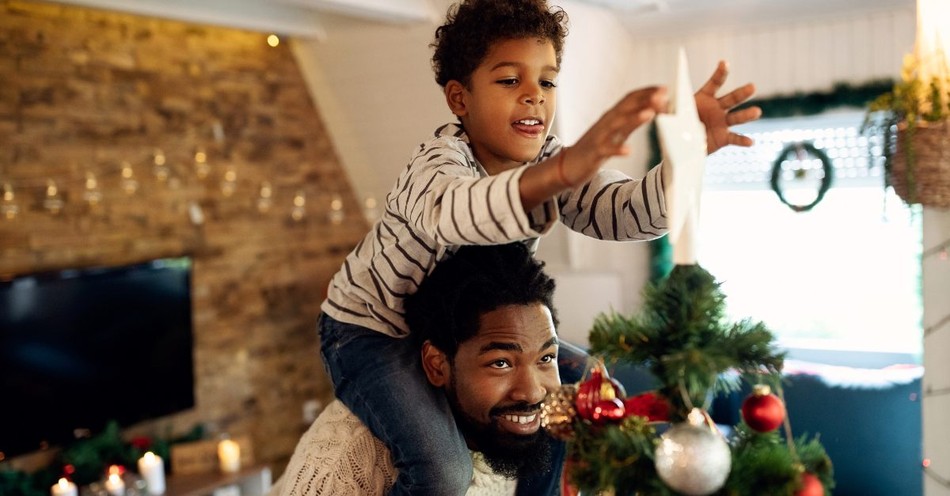
What Is the Origin and Meaning of the Christmas Tree?

It’s said that the symbolic uses of evergreen trees can be traced back to origin in ancient Egypt and Rome and that the German tradition of candle-lit trees was first introduced to America in the 19th century. It is fascinating to learn the history of the Christmas tree, from the first winter solstice to the present-day — with the most famous modern-day Christmas tree in Rockefeller Center in New York City.

Ancient Roots and Symbolism of Christmas Trees

There are several origins of usage of an evergreen tree for symbolic meaning. Before Christianity, people paid special attention to green plants and trees in the winter. While modern people decorate their homes with pine, spruce, and fir trees during the holiday season, people in the ancient world hung evergreen boughs over doors and windows. Evergreen trees were believed to keep witches, ghosts, and evil spirits away in many countries.

The longest day and shortest night of the year fall on December 21 or December 22 in the Northern Hemisphere. People used to believe that the sun was a god, and that winter came every year because he became ill and lost his strength (Ibid.).

In ancient times, the solstice meant that the sun god would finally get well. They thought the evergreen boughs reminded him of all the green plants that would grow again when the sun god was strong, and summer came back.

The ancient Egyptians worshiped a god named Ra, who had the head of a hawk and wore the sun as a blazing disk on his head. When Ra was recovering from his illness, at the solstice, the Egyptians threw palm rushes in their homes, symbolizing life’s triumph over death (Ibid.).

The early Romans celebrated Saturnalia, a festival of the solstice that celebrated the agricultural god Saturn. Farms and orchards were going to be green and fruitful as soon as the solstice hit. The Buddhists celebrated by decorating their temples and homes with evergreen boughs.

As a symbol of eternal life, the ancient Celt priests, known as the Druids from the now present-day United Kingdom, decorated their temples with evergreen boughs. As far as the Vikings were concerned, evergreens were a special gift from Balder, the sun god (Ibid.).

But the real origin of today’s Christian tree traditions can be traced back to Germany.

The German Origin of the Christmas Tree

The tradition of decorating Christmas trees has a rich history that is closely tied to Christian traditions, particularly in Germany during the 16th century. This practice played a significant role in shaping the Christmas tree tradition we know today.

In Germany, devout Christians began the tradition of decorating trees in their homes as part of their Christmas celebrations. The use of evergreen trees held symbolic meaning, representing the eternal life offered through faith in Jesus Christ. These early Christmas trees were adorned with decorations and sometimes even edible items like fruits and nuts.

As time went on, the popularity of Christmas trees grew, but there was a challenge. Wood, typically used for the trees, became increasingly scarce. In response to this scarcity, some people began constructing Christmas pyramids made of wood. These pyramids were decorated with evergreen branches and candles, creating a festive and visually striking display.

One of the legendary stories associated with the addition of candles to Christmas trees involves Martin Luther, the Protestant Reformer. According to the legend, as Luther was walking home one winter night, he was struck by the beauty of the starry sky through the evergreen trees. Inspired by this scene, he decided to recreate it for his family. He erected a tree in their main room and decorated it with lighted candles, symbolizing the stars. This act is said to be one of the earliest instances of candles being used on a Christmas tree, and it contributed to the tradition’s evolution (Ibid.).

How the Christmas Tree Tradition Came to America

Christmas trees were an odd commodity for most Americans in the 19th century. In the 1830s, German settlers in Pennsylvania had the first record of displaying one, though trees had been a tradition in many German homes before then.

There was a community of trees in the Pennsylvania German settlements as early as 1747. Even after the 1840s, Christmas trees were thought of as pagan symbols.

Comparatively, the Christmas tree was adopted late in America, as were many other Christmas customs. Christmas was sacred to New England Puritans. William Bradford, the second governor of the pilgrims, wrote that he did his best to stamp out “pagan mockery” of the observance, he even penalized anyone who did it frivolously (Ibid.).

In 1659, the General Court of Massachusetts issued a law making observing Christmas a penalty offense. People were fined for hanging Christmas decorations.

Oliver Cromwell preached against “the heathen traditions” of Christmas carols, decorated trees, and any expression of joy that desecrated “that sacred event.” However, in the 19th century, German and Irish immigrants undermined the Puritan legacy (Ibid).

Queen Victoria’s Christmas Tree

Queen Victoria and her husband Prince Albert, who was from Germany, were pictured with their children around a Christmas tree in 1846 in the Illustrated London News. The Christmas tree was here.

It was Victoria’s first reign, and everything she did was immediately fashionable, not only in Britain but among the fashion-conscious East Coast American society as well.

As early as the 1890s, Christmas ornaments arrived from Germany and Americans were getting into Christmas trees. Europeans like their Christmas trees to be about four feet tall, while Americans like theirs to reach from floor to ceiling.

American Christmas trees were usually decorated with homemade ornaments until the early 20th century, while German-American trees were decorated with apples, nuts, and marzipan cookies. In addition to popcorn, berries, and nuts were mixed in.

It’s thanks to electricity that Christmas trees can glow for days on end. As a result, Christmas trees appeared in town squares across the country, and decorating your own Christmas tree became a tradition.
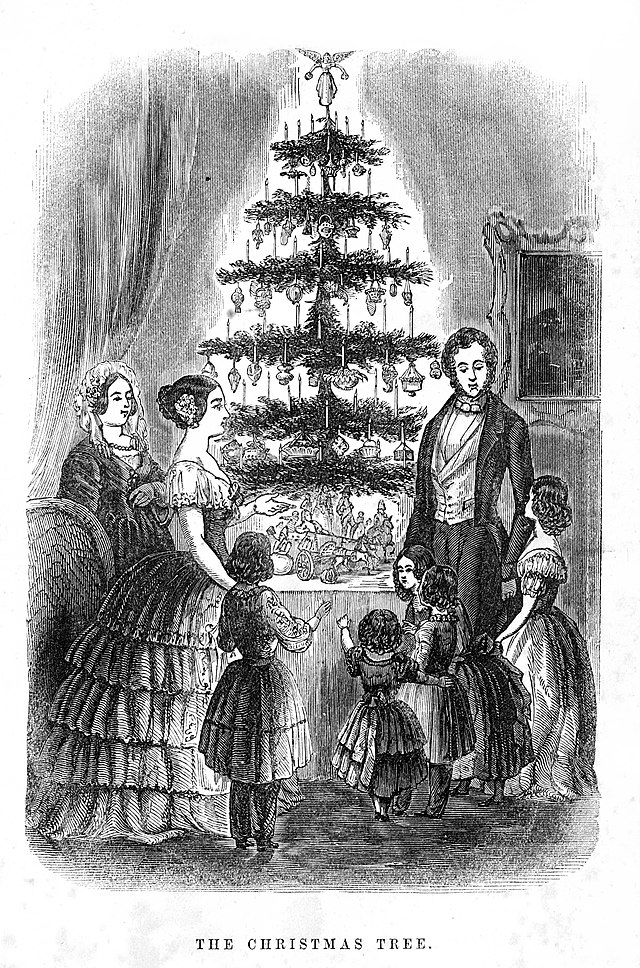
The Christmas Tree - Godeys Ladys Book, December 1850

*Source: The Christmas Tree – Godey’s Lady’s Book, December 1850, Public Domain

The Rockefeller Center Christmas Tree

Since the Depression, Rockefeller Center has had a Christmas Tree. In 1948, the tallest tree arrived at Rockefeller Center. From Killingworth, Connecticut, it was a huge Norway Spruce. The Rockefeller Center tree is on the west side of Fifth Avenue between 47th and 51st Streets in New York City.

Rockefeller Center planted its first tree in 1931. Construction workers placed a small, unadorned tree in the center of the construction site. A second tree was placed there two years later, this time with lights. Currently, the Rockefeller Center tree has over 25,000 lights.

Christmas Trees Traditions Around the World

Germany

Germans are often credited with popularizing the Christmas tree tradition. They decorate their trees with ornaments, lights, and tinsel. A common ornament is the “Christbaumschmuck,” which includes glass baubles, angels, and stars. Under the tree, there’s often a nativity scene.

Ireland

Irish families decorate their Christmas trees in the weeks leading up to Christmas, with many choosing December 8th, the Feast of the Immaculate Conception, as a significant date. Irish Christmas trees are decorated with ornaments, lights, and tinsel. It’s also common to place a star or angel atop the tree. The tradition of the “Wren Boys” involves young people visiting homes with a decorated holly bush or wren on St. Stephen’s Day (December 26th).

Greece

Greek Christmas trees are adorned with lights and ornaments. In Greece, the main Christmas decoration is a “kalikantzari” or “kallikantzari” – a small wooden vessel with a piece of a cross and holy water, believed to protect homes from mischievous goblins called “kallikantzari” during the Christmas season.

United Kingdom

British Christmas trees are decorated with ornaments, lights, and tinsel. A popular decoration is the Christmas cracker, a festive party favor that is often hung on the tree. In Scotland, it’s traditional to have shortbread and a piece of coal as tree decorations.

Sweden

Swedes typically decorate their Christmas trees on December 13th, St. Lucia’s Day. Swedish Christmas trees are adorned with small straw ornaments, wooden figures, and candles. One unique tradition is the “Julbock” or Christmas goat, which is sometimes included as a decoration.

Italy

Italians typically decorate their Christmas trees on December 8th, the Feast of the Immaculate Conception. In Italy, the “Presepio” or nativity scene is a significant part of Christmas decorations. Christmas trees are also popular and adorned with lights, ornaments, and tinsel.

Mexico

Mexicans celebrate the “Nochebuena” on December 24th and often decorate their Christmas trees during the holiday season. Mexican Christmas trees feature colorful ornaments, lights, and sometimes piñatas. The piñatas are broken on Christmas Eve, showering children with candies and small toys.

Australia

Given that Christmas falls during the Southern Hemisphere’s summer, some Australians decorate “Christmas bush” trees, which have small red flowers that resemble ornaments. Many also incorporate native Australian plants into their Christmas decorations.

Russia

Christmas trees in Russia are often decorated on New Year’s Eve, as it is a more significant holiday than Christmas in the Russian Orthodox tradition. Russian Christmas trees feature an array of ornaments, often including intricate, handcrafted decorations. Ded Moroz (Father Frost) and Snegurochka (the Snow Maiden) are traditional figures who bring gifts to children.

Philippines

Christmas tree decorations typically begin in September, the start of the Filipino Christmas season, and continue until early January. The Philippines is known for its extended Christmas celebrations. Christmas trees are commonly decorated with a combination of Western-style ornaments like lights, tinsel, and baubles, as well as traditional Filipino decorations like parols (star-shaped lanterns) and Belén (nativity scenes). Many homes and businesses participate in “parol” competitions to showcase their creative lantern designs.

Japan

Japan follows many Western traditions around Christmastime. Japanese Christmas trees are often adorned with lights, ornaments, and sometimes small origami decorations. While Christmas is not a traditional Japanese holiday, it has become an occasion for gift-giving and romantic dinners. In recent years, “Christmas cakes” have also become popular, and some families exchange gifts under the tree.

Africa

While some African countries have adopted Western-style Christmas tree customs, others may blend local traditions and symbols into their celebrations. Many people in South Africa and Nigeria include African-themed ornaments or decorations that reflect their cultural heritage. In some regions, palm trees may be used instead of evergreen trees. In Ethiopia, Christmas is celebrated on January 7th (according to the Ethiopian calendar), so Christmas tree traditions align with this date.

The Timeless Tradition of Christmas Trees and Christian Symbolism

So what should you do with the Christian tree tradition? The tradition of Christmas trees is a timeless and cherished practice that holds deep significance for Christians, offering a powerful way to symbolize their faith during the holiday season. At the heart of this tradition lies the evergreen tree, which retains its green foliage even in the depths of winter. This enduring characteristic serves as a poignant reminder of the eternal life offered through faith in Jesus Christ. Just as the evergreen tree remains vibrant and alive in the face of winter’s chill, so does the hope of eternal life persist for believers through Christ’s sacrifice and resurrection.

The lights adorning the Christmas tree further enhance its symbolism. These lights represent Jesus as the “Light of the World,” a reference made by Christ Himself in the Gospel of John. They serve as a reminder that through Jesus, the world receives the light of salvation, dispelling darkness and offering the path to spiritual illumination. The act of decorating the tree with ornaments, often including stars at the tree’s pinnacle, aligns with the Christian message of Jesus as the guiding star leading the way to salvation, as was the case for the Magi who followed the Star of Bethlehem to find the newborn Messiah.

The act of coming together as a family or community to decorate the Christmas tree fosters a sense of unity and joy, mirroring the unity and joy that the birth of Jesus brought to humanity. Christians can use the Christmas tree as a centerpiece for reflection and prayer, focusing on the profound spiritual message it conveys. It serves as a tangible reminder of the central message of Christianity: the gift of eternal life and the hope, light, and joy that Jesus brings to the world. In this way, the Christmas tree becomes not only a beautiful tradition but also a meaningful expression of faith, drawing believers closer to the heart of their Christian beliefs during the holiday season.

The Christmas tree is a wonderful and historic tradition that we don our homes with every Christmas to fill us with spirit and to lay our gifts underneath. However, it is the birth of our Lord and Savior, Jesus Christ on the very first Christmas that we celebrate.

So Joseph also went up from the town of Nazareth in Galilee to Judea, to Bethlehem the town of David, because he belonged to the house and line of David. He went there to register with Mary, who was pledged to be married to him and was expecting a child. While they were there, the time came for the baby to be born, and she gave birth to her firstborn, a son. She wrapped him in cloths and placed him in a manger, because there was no guest room available for them (Luke 2:4-7).

We wish you a very Merry Christmas and a Happy New Year!

For further reading:

Is the Origin of Christmas Truly Rooted in Pagan Traditions?

Is it Important to Know Jesus’ Family Tree at Christmas?

What Is the Origin of Beloved Christmas Traditions?

What Is the Meaning of Christmas?

https://www.christianity.com/wiki/holidays/what-is-the-origin-of-the-christmas-tree.html

Pilgrims, Presidents, and Proclamations of Thanksgiving | IFA

Every American knows the basic origin story of Thanksgiving.

English settlers known as the Pilgrims landed on Plymouth Rock in December 1620. Half of their group died in the first winter. In the Spring, Squanto, a Christian Native American, taught the Pilgrims how to plant and grow corn. In the Fall of 1621, they had a great harvest and decided to hold three days of feasting and thanksgiving. Massasoit, chief of the Wampanoag tribe, came with 90 of his men to celebrate with the Pilgrims. And that was the ‘First Thanksgiving.’

But how did such a small event held in Plymouth, Massachusetts, over 400 years ago become a National All-American Holiday celebrated on the fourth Thursday of November every year? Well, here’s that story.

From Plymouth to the Nation

Thanksgiving remained a New England regional holiday for 168 years. The Puritans settling Boston (Puritans are NOT Pilgrims) moved the Day of Thanksgiving into late November, which is far from early October harvest time. The Puritans used Thanksgiving as a stand-in for Christmas, which they did not celebrate, believing it to be pagan. Instead, the Puritans gave thanks to God for all the blessings of the prior year. It was a time of feasting before the long, cold New England winter set in.

As more settlers came and America’s colonies increased, each colony would declare its own Thanksgiving Day on different dates, usually in the Fall and always on a Thursday. During the Revolutionary War, Thanksgiving Days were declared ‘nationally’ for all Thirteen Colonies. The Continental Congress declared the First National Day of Thanksgiving for Thursday, December 18, 1777.

After the end of the Revolutionary War and the adoption of the United States Constitution in 1789, the first president, George Washington, declared the first nationwide Day of Thanksgiving to be celebrated in the brand-new country. There was no mention of the Pilgrims in the first Presidential Thanksgiving Proclamation.

President Washington’s Proclamation 1789

Whereas it is the duty of all Nations to acknowledge the providence of Almighty God, to obey His will, to be grateful for His benefits, and humbly to implore His protection and favor– and whereas both Houses of Congress have by their joint Committee requested me to recommend to the People of the United States a day of public thanksgiving and prayer to be observed by acknowledging with grateful hearts the many signal favors of Almighty God especially by affording them an opportunity peaceably to establish a form of government for their safety and happiness.

Now therefore I do recommend and assign Thursday the 26th day of November next to be devoted by the People of these States to the service of that great and glorious Being, who is the beneficent Author of all the good that was, that is, or that will be.’

Still Just a New England Holiday

After George Washington’s proclamation in 1789, no national Thanksgiving Day was declared again until 1815, when James Madison declared a Day of Thanksgiving for the end of the War of 1812. In New England, however, the states did continue the traditional Thanksgiving Day celebrations, although the dates from year to year and state to state often differed.

Thanksgiving took the place of Christmas as nearly no one in New England celebrated Christmas. During this time, there was also no historical connection to the Pilgrims. According to James Baker in his wonderful book, Thanksgiving: The Biography of an American Holiday, he writes…

“Holiday traditions were simple and unpretentious, focusing on the immediate basics of New England life: church, household, food, and domestic leisure. It was time to review the current year, reminisce about one’s personal past, and recall family members and friends who were not guests due to distance or death.”

Sarah Josepha Hale, the “Mother” of Thanksgiving

In 1837, Sarah Josepha Hale, the editor of a very prominent women’s publication called Godey’s Lady’s Book, began advocating for one national day of Thanksgiving to be held in every state and territory on the last Thursday of November.

She wrote numerous editorials on the subject in Godey’s, as well as writing to all the state governors every year, requesting they declare Thanksgiving on the same day. By 1860, she got her wish. Thanksgiving was declared by every governor for the last day of November in all 30 states and two territories.

She wrote, “We may now consider Thanksgiving a National Holiday… It is to be a regularly recurring Festival, appointed by the concert of the State Governments to be observed on the last day in November, may be established as the American Thanksgiving Day… the day would exemplify the joy of Christians and to our Great Republic… as one Brotherhood, will rejoice together, and give thanks to God for our National, State and Family blessings.”

There was still no mention or recognition of the Pilgrims’ ‘First Thanksgiving.’

Civil War and the National Adoption of Thanksgiving

In 1860, the Civil War broke out in the United States, and the first ‘national’ declaration of Thanksgiving was made. But it was President Jefferson Davis and the Confederate Congress that proclaimed a national day of Thanksgiving for the South for July 28, 1861 after their victory at the Battle of Bull Run. In 1862, President Abraham Lincoln declared a national day of Thanksgiving for the North after their victories. Back and forth the two sides went, declaring national days of Thanksgiving after battle victories.

On October 3, 1863, President Lincoln issued his Thanksgiving Proclamation officially declaring the last Thursday in November as a day of Thanksgiving. No longer would it be up to individual governors to declare the date.

President Lincoln’s Proclamation 1863

I do therefore invite my fellow citizens in every part of the United States… to set apart and observe the last Thursday of November next, as a day of Thanksgiving and Praise to our beneficent Father who dwelleth in the Heavens. And I recommend to them that while offering up the ascriptions justly due to Him for such singular deliverances and blessings, they do also, with humble penitence for our national perverseness and disobedience, commend to His tender care all those who have become widows, orphans, mourners or sufferers in the lamentable civil strife in which we are unavoidably engaged, and fervently implore the interposition of the Almighty Hand to heal the wounds of the nation and to restore it as soon as may be consistent with the Divine purposes to the full enjoyment of peace, harmony, tranquility and Union.”

The Pilgrim Story Becomes Popular

It wasn’t until the end of the 19th century that the Pilgrims’ First Thanksgiving story began to attract the attention of the entire nation. In 1889, a novel written by Jane G. Austin, Standish by Standish, romanticized the Pilgrims’ Thanksgiving as an outdoor feast between the Pilgrims and their Wampanoag neighbors. It was a bestseller.

In 1897, the Ladies Home Journal, featured a ‘historical’ description of the Pilgrims’ Thanksgiving relying heavily on Ms. Austin’s sentimental novel.

Still, there was no mention of the Pilgrims in presidential proclamations until Theodore Roosevelt in 1905, who referenced “the first settlers.”

President Theodore Roosevelt’s Proclamation 1905

“When nearly three centuries ago the first settlers came to the country which has now become this great Republic, they fronted not only hardship and privation, but terrible risk to their lives. In those grim years the custom grew of setting apart one day in each year for a special service of thanksgiving to the Almighty for preserving the people through the changing seasons. The custom has now become national and hallowed by immemorial usage…

Therefore, I now set apart Thursday, the thirtieth day of this November, as a day of thanksgiving for the past and of prayer for the future, and on that day I ask that throughout the land the people gather in their homes and places of worship, and in rendering thanks unto the Most High for the manifold blessings of the past year, consecrate themselves to a life of cleanliness, honor and wisdom, so that this nation may do its allotted work on the earth in a manner worthy of those who rounded it and of those who preserved it.”

A Change of Thursdays

It was in the next 50 years, after Teddy Roosevelt’s nod to the Pilgrims, that the American traditions of Thanksgiving came into focus –Pilgrims and Natives celebrating together, families returning home, turkeys, pumpkins, parades, football, and even the start of the Christmas holiday shopping.

But in 1939, Thanksgiving occurred on November 30th, the last Thursday of November. Retailers were worried that this would cut short the Christmas shopping season. The Retail Dry Goods Association appealed to President Franklin Roosevelt to change the date, and the president proclaimed the fourth Thursday as Thanksgiving Day.

Many states, however, were not happy with the break in tradition. Half of the states went with the last Thursday declared by President Lincoln. Half went with President Roosevelt’s new date, which was nicknamed ‘Franksgiving.’ But the earlier date did not improve Christmas sales. Even so, Congress went ahead and passed a law in 1941 declaring the fourth Thursday in November as Thanksgiving Day.

After the change, according to Plymouth Historian James Baker, “the Thanksgiving holiday quietly assumed its place in the regular round of American holidays. The holiday was at last as Mrs. Hale had wished, legally sanctified and nationally guaranteed. During this same period the association of Thanksgiving with Plymouth and the Pilgrims was fully realized.”

Presidential Proclamations and the Pilgrims

It’s customary for presidents to issue a Thanksgiving Proclamation asking the country to give thanks for our blessings. Some proclamations hearken back to the Pilgrims; most do not. Yet the legacy of the Pilgrims’ First Thanksgiving lives on today to give thanks for what God has done for us.

Here are four more Presidential Proclamations that honor the Pilgrims and their obedience in following God to a new land – “for the glory of God, and the advancement of the Christian faith” – as Elder William Brewster declared in the Mayflower Compact.

President Truman’s Proclamation 1951

“More than three centuries ago the Pilgrim fathers deemed it fitting to pause in their autumn labors and to give thanks to Almighty God for the abundant yield of the soil of their new homeland. In keeping with that custom, hallowed by generations of observance, our hearts impel us, once again in this autumnal season, to turn in humble gratitude to the Giver of our bounties.”

President Kennedy’s Proclamation 1962

“Over three centuries ago in Plymouth, on Massachusetts Bay, the Pilgrims established the custom of gathering together each year to express their gratitude to God for the preservation of their community and for the harvests their labors brought forth in the new land. Joining with their neighbors, they shared together and worshipped together in a common giving of thanks. Thanksgiving Day has ever since been part of the fabric which has united Americans with their past, with each other, and with the future of all mankind.

President Ronald Reagan, 1981

On this day of thanksgiving, it is appropriate that we recall the first thanksgiving, celebrated in the autumn of 1621. After surviving a bitter winter, the Pilgrims planted and harvested a bountiful crop. After the harvest they gathered their families together and joined in celebration and prayer with the native Americans who had taught them so much.

Let us renew the spirit of the Pilgrims at the first Thanksgiving, lonely in an inscrutable wilderness, facing the dark unknown with a faith borne of their dedication to God and a fortitude drawn from their sense that all men were brothers.”

President Donald Trump, 2019

On Thanksgiving Day, we remember with reverence and gratitude the bountiful blessings afforded to us by our Creator, and we recommit to sharing in a spirit of thanksgiving and generosity with our friends, neighbors, and families. Nearly four centuries ago, determined individuals with a hopeful vision of a more prosperous life and an abundance of opportunities made a pilgrimage to a distant land. These Pilgrims embarked on their journey across the Atlantic at great personal risk, facing unforeseen trials and tribulations, and unforetold hardships during their passage… and through their unwavering resolve and resilience, the Pilgrims enjoyed a bountiful harvest the following year. That first Thanksgiving provided an enduring symbol of gratitude that is uniquely sewn into the fabric of our American spirit.”

Happy Thanksgiving. God bless you!

Enter into His gates with thanksgiving, and into His courts with praise. Be thankful to Him and bless His name. For the Lord is good; His mercy is everlasting, and His truth endures to all generations. (Psalm 100:4-5)

Share your prayers of thanksgiving in the comments below.

Belinda Brewster lives in Plymouth, MA, America’s Hometown, with her husband, Wrestling, a 10th-generation direct descendant of Elder William Brewster, the spiritual leader of the Pilgrims. She and Wrestling attend Chiltonville Congregational Church, which is the third daughter church of the first church established by the Pilgrims. Belinda is a contributing writer for IFA. Photo Credit: Jean Leon Gerome Ferris.

Source: Pilgrims, Presidents, and Proclamations of Thanksgiving

Universities Call to ‘Decolonize’ Thanksgiving | IFA

Today is Thanksgiving, and Americans across the nation will celebrate with bountiful meals and family gatherings. However, while many are celebrating, educators and schools are lamenting, pushing to “decolonize” the holiday.

Visit your state page to pray.


From Fox News:

As families across the U.S. gather on Thanksgiving to celebrate one of the nation’s most cherished national holidays, some educators and schools are lamenting the day, pushing back on its “colonial” roots, and incorporating diversity, equality and inclusion DEI into the holiday.

At the University of California, Davis, the California History-Social Science Project, which describes itself as “Resources & professional learning for K-12 history-social science,” hosted a Zoom event called “Decolonizing Thanksgiving in the Classroom.”

“We will discuss reframing classroom practices and rituals about Thanksgiving,” the event description explained. “Centering perspectives from Turtle Island (a name for North America used by some indigenous people) will help us decolonize Thanksgiving and spark new conversations about how to authentically make meaning of this holiday with our students.”


UC Davis isn’t the only school to push back on Thanksgiving. Fox notes that Washington University in St. Louis, a school known for its controversial DEI policies, promoted an event to highlight “the way different cultures recognize and understand Thanksgiving.” According to the school the event is a way to actively contribute to inclusive and equitable practices that influence individual and systemic change.”

The Massachusetts Institute of Technology, meanwhile, invited students to a “Thanksgiving Myth-busting” event designed to explore the “narratives justifying land grabs via colonialism.” The school is also inviting students to attend a National Indigenous Day of Mourning rally at the location of the Mayflower’s landing.

Other schools are taking similar approaches. Across the nation, educational institutions are seeking to characterize Thanksgiving as a time of mourning, highlighting the day’s “painful legacy.” We know, however, that Thanksgiving is a day best spent remembering our nation’s proud history, enjoying time with family and friends, and thanking God for all He has done for us.

This Thanksgiving, let’s pray that Americans would put divisive politics aside and focus on the true meaning of the holiday.

How are you celebrating Thanksgiving this year? Share your prayers of thanksgiving below.

(Excerpt from Fox News. Photo Credit: Mys 721tx – Own work, CC BY-SA 3.0, https://commons.wikimedia.org/w/index.php?curid=101237507)

Source: Universities Call to ‘Decolonize’ Thanksgiving

Is Our Growing Fascination with Halloween Dangerous? | Public Discourse

The holiday season is in full swing. I don’t mean Christmas; that won’t begin until November starts (although it used to begin after Thanksgiving). I mean the Halloween season, which started sometime after Labor Day.  

I recognize its arrival when Home Depot starts selling Halloween decorations. These get more elaborate and grotesque each year: animated Chucky dolls (I hesitate to link to the scarface version); the best-selling twelve-foot-high skeletons (listed under the innocent heading “Home Accents Holiday”); or the macabre offerings in Gruesome Grounds. Not long after these mannequins appear in stores, they appear on many front lawns, more than a month in advance of Halloween—the day’s “Advent” period, you might say. For weeks I walk or drive by yards that are not simply tacky, like overdone Christmas decorations, but disturbing. 

Every generation of adults tends to exaggerate the differences between the present and their childhood, but I believe something has changed in my lifetime. Seeing Halloween decorations on lawns in September, or even the first half of October, was not a thing thirty or even twenty years ago. Decorations were certainly not as elaborate as these. My father said that, in the 1950s and ’60s of his youth, Halloween was an entirely “homemade” holiday. Decorations were little more than a few kitchen-carved jack-o’-lanterns. For a costume, take a white sheet and cut three holes for the eyes and mouth, and you could be a ghost; give a girl a blue jumper, a basket, and red shoes, and she could be Dorothy from the Wizard of Oz. But in 2025, Americans are expected to spend $13.1 billion (about $115 per reveler) on this once-minor holiday, between candy, store-bought costumes, parties, that ghastly decor, and even greeting cards

As Halloween comes around once again, we might consider why this once innocent, passing event is, for many people, becoming one of the most significant celebrations of the year. 

Looking for Reenchantment? 

An optimistic answer is that the easy “enchantment” (as many now call it) of Halloween is taking the place of the waning, more substantive enchantment of Christmas. 

The Christmas season, too, has expanded obnoxiously beyond its original length as its enchantment wanes. Macy’s now puts up red and gold decorations in October, catering to the fact that Christmas has become more about buying stuff than religious observance. Why the commercialization? Because fewer and fewer recall, or take an interest in, the deeply religious message behind Christmas: that God has become one of us, in the flesh: “Pleased as Man with men to dwell, / Jesus our Immanuel.” Some blame consumerist culture for the disappearance of Christmas’s religious aspect. Others blame governments for discouraging all public displays of religion. I tend to think that in large part the decline of Christmas has less to do with the “disenchantment” of the public square than with our own choices to live as though God were absent

Whatever the reason may be, as the religious spirit of Christmas declines, so has Christmas’s power to satisfy people’s desire for the enchantment of the supernatural. To fill the void, other, lesser forms of enchantment are sought: the warm feelings we get from receiving and giving gifts; the beauty of a winter snowscape or autumn’s colors; or in Halloween’s case, the enchantment of the non-divine supernatural—ghosts, witches, and magic.  

Because all these things lack the depth of mystery of the God-man, they cannot satisfy our souls. The pain of that dissatisfaction is stronger for the growing number of us who do not believe in the truth of the Christmas story, but who did believe in our youth, as did our families. That belief gave rise to real religious wonder and mutual self-giving in our homes, which were more soul-sustaining than any presents and decorations.  

To make up for ersatz enchantment’s lower quality, we increase its quantity. We spend more time buying things and keeping our lawns decorated, to dull our gnawing feeling of emptiness. And when one season (commercial Christmas) stopped satisfying our hearts (becoming so exhausting that some put Christmas trees to the curb on December 26th), we expanded another—Halloween. 

… Or Something More Insidious? 

But in light of a recent experience of mine, I cannot but think that something deeper is going on in a growing number of people. The burgeoning interest in Halloween, and in openly displaying “the dark side” of the supernatural, suggests that many hearts, impatient with the sentimentality of non-religious holidays, might want to return to religion—but not of the biblical kind.  

A few years ago, I spent the summer near Boston with friends. One day someone suggested an outing to Salem, Massachusetts. I was interested, having been there thirty years before as a boy, on vacation with my family. We did the same things that the group proposed to do this time, such as visit the House of the Seven Gables that inspired Nathaniel Hawthorne’s novel of the same name. (Returning to the house was worth it, and I recommend visiting.)  

But afterward someone suggested we go to the Salem Witch Museum. I was not opposed, since I had gone as a boy (although I cannot be certain it was the same museum). As I recall it was quite simple back in the ’90s: a single large, open, and well-lit floor, with stationary mannequin dioramas. They portrayed the historical events of the trials of the dozen or so women who were wrongly convicted of witchcraft by the then very Puritan Salem of the late 1600s. The trials are now infamous, sometimes used as an excuse to criticize religion—and Puritanism in particular—as necessarily leading to such abuses of justice, in which innocent people get killed. I was young at the time, so I can’t recall how severely the museum portrayed the Puritan magistrates. As I recall, we children thought the lifeless mannequins were a joke. 

So now (not having visited the museum’s informative website), I was unprepared for what awaited me thirty years later. Now the museum occupies a converted church sitting on a large square, its name displayed in bright yellow letters on the facade. The ticket sellers outside were kind, ordinary people, perhaps retired volunteers. We paid and went into the nave for the first presentation. As before, the church contained mannequin dioramas around the periphery, depicting the history of the trials. But they were high up, spanning two stories and wrapping around the vaulted chamber; some scenes were stacked on top of each other. They were in darkness, but there was light in the center where we summer vacationers expectantly sat. When all were in, a greeter politely welcomed us, turned to leave, and closed the door behind her.  

Then everything went black.  

A menacing, prerecorded narration boomed over loudspeakers, accompanied by eerie music. One by one the scenes lit up as the narrator told the history of Salem’s witch craze. We heard how in those times people believed in the existence of demons, especially the devil, who sought to ensnare souls. An enormous mannequin of Satan lit up—glowing red, with ram’s horns, smoke, and other typical and nightmarish features. A large circle on the floor lit up beneath us, with symbols and words printed on it. It felt like we were in hell.  

Not that the presentation suggested that demons and hell were real; it rather suggested the Puritans were fools for believing in all that. The trials were cast not as excessive fear of the devil, but as irrational hysteria. (The ghoulishness of everything was perhaps meant more to cater to visitors during Halloween season, one of the museum’s busiest times of the year.) 

I was glad when the lights came on and we were led out. The next part was not frightening—just more dioramas, but all well-lit, and in rooms of ordinary height. A tour guide led us, occasionally pushing a button to start a relatively short recorded narration. The tour related how people accused of witchcraft were treated throughout history, and how they were just ordinary people doing nothing bad. A wall diagram equated the Salem witch hunt to other embarrassing persecutions of marginalized groups in American history. The message was clear: the idea that bad witchcraft and bad occult practices existed was made up by deranged people who hurt the innocent. The Salem witch craze was yet another instance of the sort of oppression (this one born of the “false consciousness” of early modern Puritans) that critical Marxism has trained so many of us to see in the world.  

And yet the final diorama noted that there are people today who, as the website says, “find the title, mythology, and legacy of the witch to be a powerful spiritual, personal, and political identity,” except they worship nature deities and love peace. They are neo-pagans, like Wiccans, followers of the religion of the pre-Christian British Isles. Their calendar is in part the origin of Halloween (originally “Samhain,” a harvest festival), after which Christians placed All Saints’ Day (hence the name “All Hallows’ Eve”). Wiccans probably now have a role at the museum; you can even buy their books at the gift shop.  

They also have made much of Salem their colony. I recalled the town, when I was a child, as like any other in New England: calm, clean, and orderly. It still is in parts, but now many sections are crowded with Wiccan and other New Age shops, selling crystals, psychic and tarot readings, and other “ritual tools and services to help you … bring the healing energy into your everyday life” and discover “the beauty that lies within the process of nature.” The goal of these stores was to help people “be themselves”—to “illuminate your truth,” in one vendor’s words—not by raising their natural human desires to God’s level, to love as he does, but by being purely and only human, according to the occult ways of our nature, perhaps with the help of certain superhuman spirits.  

Here is a religion well suited to our secular times, similarly defined by self-affirmation and normalizing the “natural.” New Age cults appeal to modern man’s hunger for religious experience while affirming his aversion to religion’s substance: subjecting one’s mind and heart to one’s Creator. It is all very understandable, given our tendency to think that the only improving we need is to be more clever in using our nature, not to change our hearts. And yet how insidious such “spirituality” is, because it denies the truth that we tend to love ourselves too much—what Christians (like the Puritans) call original sin.  

Most people putting up outrageously ghoulish decorations are, we hope, not engaging in the occult. But perhaps not a few are expressing a kind of irreligious attitude that, in time, could lead in that direction.

To Find Yourself, Learn to Serve 

Could part of the surge in Halloween’s popularity be that people are itching for an encounter with something beyond ordinary experience, but without a moral and religious conversion? Most people putting up outrageously ghoulish decorations are, we hope, not engaging in the occult. But perhaps not a few are expressing a kind of irreligious attitude that, in time, could lead in that direction.  

Contemporary Salem shows that interest in the occult is growing (although New Agers still make up only 1 percent of the population). Anyone who thinks such interest is harmless should consider how similar Wicca’s self-affirming message is to that of another neo-pagan religion: the often violent Mexican cult of “Saint Death,” who “accepts you without judging you.” Saint Death provides money and physical protection to her devotees, who include drug traffickers and other outlaws. It sounds evil indeed … even demonic.  

Whether they condone violence or not, neo-pagans risk going through life rationalizing their own self-absorption and not preparing to enter eternal bliss. Heaven is only for those who learn to get out of themselves and generously serve truth and other souls, not merely their own “happiness.” Those of us who have not been seduced by the occult might consider what we can do to save our fellow men who have wandered down that path. It will lead only to unending agony that we should not wish anyone to experience; God certainly has no such wish.  

We all need to recover genuine religiosity, and a good place to start is living better according to the messages of the truly important year-end holidays, like Christmas, Thanksgiving, and All Saints’ Day: that God is with us, especially in our experiences of “disenchantment”; that he gives us every good thing we have, for which he deserves all our devotion; and that those who place their trust in him will receive an eternal reward more glorious than any other so-called “enchantment.”

Image licensed via Adobe Stock.

What Is the History of Halloween? | Christianity.com

It’s important that Christians understand the traditions they participate in, know what the Bible has to say, and approach every holiday and cultural practice with prayer and discernment. Knowing a bit of the history of Halloween can be an important step in that process.

Contributing Writer

Updated Oct 13, 2025

What Is the History of Halloween?

Halloween is one of the most popular holidays in the United States and certainly one of the most profitable. An article published in USA Today estimated that Americans spent over nine billion dollars on Halloween decorations, parties, and events in 2018.

October 31 has become synonymous with many popular traditions. Pumpkin carving, costumes, trick-or-treating, bonfires, carnival games, mazes, haunted houses, decorations, and candy are some of the more light-hearted and even family-friendly activities enjoyed during the month of October.

Other Halloween tropes and traditions, such as popular horror movies, a focus on witchcraft and the occult, and overt links to the demonic and supernatural, are much darker and more disturbing in nature.

Of course, Christians have debated for centuries whether or not to endorse, let alone participate in Halloween. Whether that involves parents letting their children dress up in fun costumes and collect candy from their neighbors, going to see the latest scary movie, attending a horror night at a local theme park, or a church hosting their own costumed event or gospel-centered outreach, how Christians view and approach Halloween will always be a topic of conversation and even debate.

The Bible, of course, doesn’t explicitly talk about Halloween. It didn’t exist when the Bible was written. It does, however, speak boldly and clearly on the subject of death, the supernatural, and the role Christians are called to play in combating spiritual forces of darkness and evil in the world.

God’s people are also instructed to flee from all forms of pagan worship, witchcraft, and idolatry. However, the nature of what exactly is being celebrated or practiced on Halloween can vary.

In fact, if we look closely at the long and storied history of Halloween, we find many instances where the church actively worked to reverse and even supplant the more pagan rituals of October 31 with traditions of its own, many of which have shaped the Halloween we know and many love today.

This is a time of year when countless Christian authors, bloggers, pastors, and radio hosts will offer their take on the subject. Unfortunately, we would be hard-pressed to find a unified Christian view of Halloween. Christian perspectives surrounding October 31 are as diverse as its history.

Therefore, it is largely up to the individual believer to determine, through prayer, spiritual discernment, pastoral guidance, and careful study of the Word of God, how best and how biblically to approach Halloween and its many traditions.

So maybe instead of offering a proscriptive view of Halloween for the believer, maybe the best approach to take is to trace the history of October 31 as a holiday, discussing the evolution of some of its popular traditions from where they began to what they’ve become today.

Halloween Origin

When it comes to the history of Halloween, the first place to start is the pagan tradition of Samhain, practiced by the ancient Celts from October 31 to November 1 in what is now Ireland, the United Kingdom, and northern France.

For the ancient Celts, who lived nearly 2000 years ago, Samhain marked the culmination of summer and the beginning of the harvest. It was the midpoint between the fall equinox and winter solstice and was treated as the day that ushered in the cold winter and darker half of the year, in which sickness and death were more prevalent.

According to History.com, the Celts and Druids believed that on Samhain, “The boundary between the worlds of the living and the dead became blurred.” Furthermore, on October 31, the Celts believed that the spirit world would become visible to humans, and the ghosts of the dead would return to earth to cause trouble, damage crops, and otherwise play tricks on the living.

For this reason, the Druids would often build large communal bonfires to offer sacrifices to the Celtic deities. The Celtic people also left token offerings outside of their village to appease the fairies, ghosts, and spirits.

There were even occasions where the Celts would also tell each other’s fortunes, share scary stories, and wear animal or monster costumes to try and trick the roaming spirits into leaving them alone.

Obviously, this isn’t the kind of pagan ritual or tradition the Bible would ever condone. However, in the centuries that followed, October 31 celebrations would begin to be enjoyed in a completely different context.

Historical Timeline of Halloween in the Church

By AD 43, the Roman Empire had conquered most of the Celtic territory in Europe, and for the next 400 years, various Roman holidays and festivals similarly designed to commemorate the passing of the dead and the harvest were combined with the Celtic Samhain.

It wasn’t until the Roman Catholic church gained a foothold in Celtic lands that Celtic traditions and rituals like Samhain were refashioned.

In fact, Pope Gregory I (AD 590 to 604) had advised missionaries to Ireland and England not to do away with the religious holidays of the Celts and non-Christian peoples of the region, but rather, to try and appropriate or transition them from their pagan roots into a more Christian context.

Subsequently, in AD 609, Pope Boniface dedicated the Pantheon in Rome in honor of Christian martyrs, establishing All Martyrs’ Day as a church holiday. Pope Gregory III later expanded the festival to include saints as well as martyrs, shifting the holiday from May 13 to November 1.

Now, what does all this have to do with October 31, which still hadn’t been given the name Halloween?

By the ninth century, Christianity had taken over Celtic lands, but rather than abolish the Celtic traditions of October 31 outright, the church shifted the focus of October 31 from a celebration of pagan deities, roaming spirits, and the dead to a more Christian emphasis on the soul, the supernatural, and the saints.

November 1 became known as All Saints’ Day in the Catholic church, and in AD 1000, the church made November 2 All Souls’ Day, with many of the same traditions of Samhain, including giant bonfires, parades, and costumes of saints, devils, and angels, still being practiced.

Furthermore, in preparation for All Saints’ Day on November 1, on which venerated saints, also known as “hallows,” were celebrated, the night before became known as the eve of all-hallows or All Hallows’ Eve. Eventually, the day was known as Halloween.

Thus, a once pagan festival was repurposed and refashioned into a church holiday to acknowledge the supernatural but celebrate the saints, not roaming spirits.

Of course, many Celtic traditions never truly died out even after the church Christianized Samhain and established Halloween. They just took on a new meaning.

For example, placing fire (representing the sun) in hollowed-out vegetables (representing the harvest) was a tradition established by the Celts and later adopted in future celebrations.

In the Middle Ages, carved turnips (later pumpkins) called Jack-O-Lanterns began to appear in commemoration of the Irish myth of Stingy Jack, who wandered the earth after being denied entry into both heaven and hell. Today, carved pumpkins are more decorative than anything.

Trick-or-treating also followed the Celtic tradition of giving token bits of the harvest to wandering spirits to keep them from interfering with the harvest or harming the home. Today, trick-or-treating is more communal and candy-driven than an attempt to placate ghosts, fairies, or spirits.

Halloween in America

In colonial America, large festivals and the telling ghost stories became common. It wasn’t until the Irish potato famine and subsequent migration of millions of Irish farmers to America in the mid 19th century that many of the traditional elements of Halloween practiced in Europe were popularized in America.

In the late 1800s, Halloween in America also began to shift away from a spiritual holiday focused on ghosts, witchcraft, and death to a more community-oriented festival, celebrating family and good things, in line with similar seasonal traditions like American Thanksgiving and Christmas.

Many have since latched onto Halloween and tried to make it their own. Halloween has come to mean many things to many different groups; some good, some evil. It is as much a day about family, community, and the harvest as it is a time to dabble in the horrors of death and darkness.

Should Christians Celebrate Halloween?

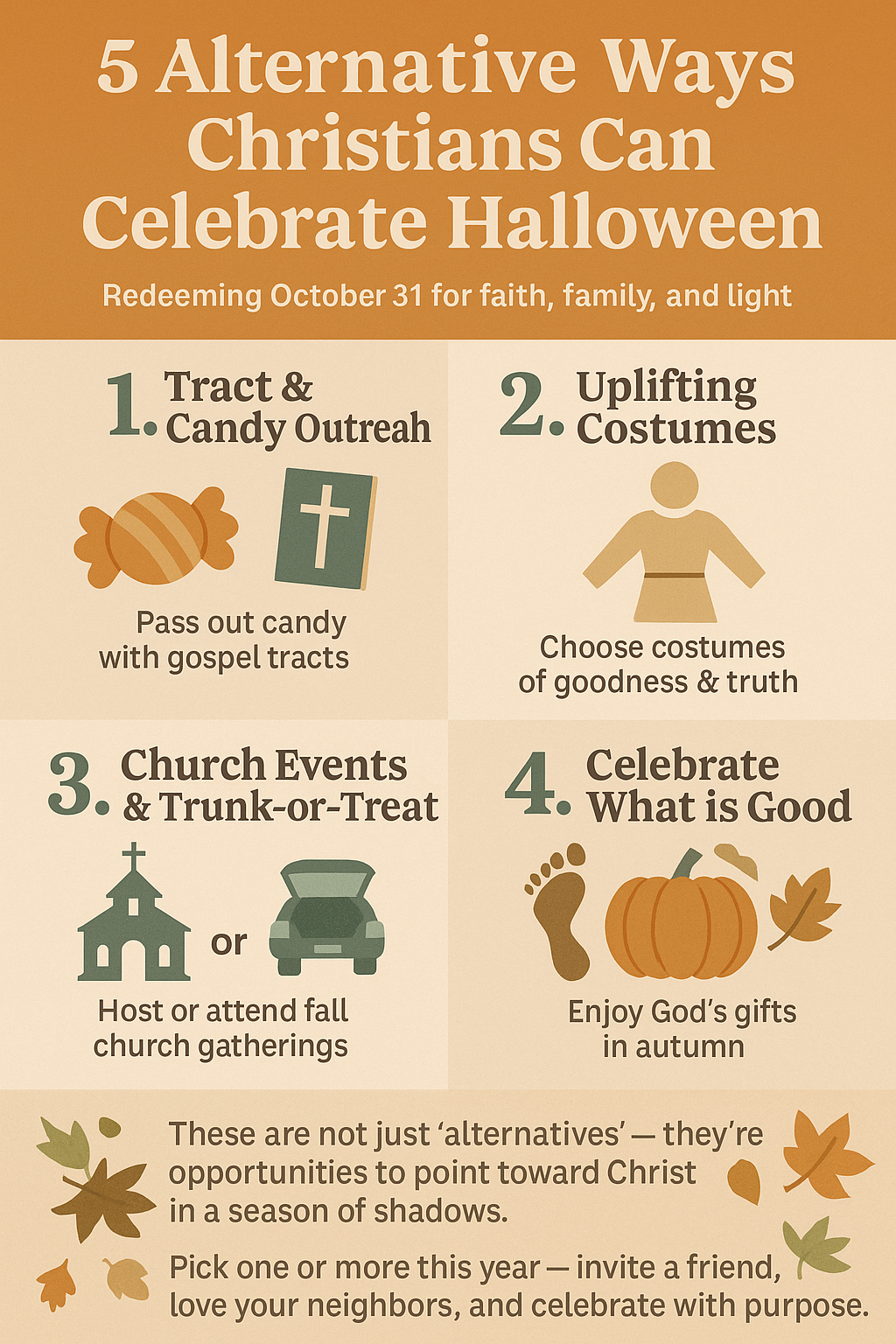
infographic of alternative ways to celebrate Halloween

Like many holidays, Halloween has plenty of good and even great traditions Christian families can enjoy. On the flip side, there is an abundance of awful, ugly, and evil practices at work on and around October 31 that Christians should swiftly avoid.

If you do want to take part in some kind of celebration on or around October 31st, you and your family could always opt for alternative ways to celebrate Halloween. Several ideas to inspire you can be found here.

What’s important is that Christians understand the traditions they participate in, know what the Bible has to say about these topics, and approach every holiday and cultural practice with prayer and discernment. Knowing a bit of the history of Halloween can be an important step in that process.

For further reading:

Why Was Evil Celebrated on Halloween?

Why Do We Celebrate Fear at Halloween?

What Does the Bible Say about Halloween?

Should Christians Really Celebrate Halloween?

https://www.christianity.com/wiki/holidays/what-is-the-history-of-halloween.html

Halloween: Origins, Traditions, and Whether Christians Should Celebrate It | Christianity.com

What does Halloween look like in our current culture, and how should we respond to it?

Regardless of the origins of Halloween, the more pressing question for today’s Christians is this: What does Halloween look like in our current culture, and how should we respond to it?

Halloween: Origins, Traditions, and Whether Christians Should Celebrate It

When I was growing up in the 1970s and 80s, I didn’t know anyone, except a Southern Baptist family, who didn’t “celebrate” Halloween. The hundreds of Catholic and Protestant kids in our grammar schools would dress up in costumes, have school parties, and go trick-or-treating. For weeks leading up to Halloween, we would have school projects that included traditional Halloween images: witches, black cats, jack-o-lanterns, bats, and more. Our parents never questioned if we “should” celebrate the holiday–there was never a belief that what we were doing was evil or unbiblical.

Yet when I became a follower of Jesus as a young adult and had my own child, I was challenged by many Christians who thought Halloween should be ignored. The two Christian schools that my daughter attended treated October 31 as any other day, and encouraged parents to study the history of Halloween (of which I was ignorant) and why it was a sin to take part in Halloween activities.

Additionally, Halloween has continued to grow in popularity over recent years, even spurring celebrations like “Summerween” that promote a focus on the holiday even outside of the fall season. With its increased popularity in our culture, Christians would do well to think through our response to this holiday.

So, what is the right approach as Christians: to let kids have their candy-coated fun, ignore the “holiday,” or come up with alternatives? It’s each parent’s decision, but let’s take a look at the history of Halloween and what the Bible has to say in order to make the best God-honoring decision.  

What Is the Origin and History of Halloween?

In a Library of Congress blog post, Heather Thomas writes, “… the Halloween holiday has its roots in the ancient Celtic festival of Samhain (a Gaelic word pronounced “SAH-win”), a pagan religious celebration to welcome the harvest at the end of summer, when people would light bonfires and wear costumes to ward off ghosts.” History.com adds that the Celts, who lived 2,000 years ago in Ireland, England, and Northern France, celebrated their new year on November 1. 

For them, this meant the end of the summer and its harvest–and was the beginning of a cold and dark winter. This season was often marked by death, as people would run out of food, freeze to death, and didn’t have the ability to treat illnesses common in winter. “Celts believed that on the night before the new year, the boundary between the worlds of the living and the dead became blurred. On the night of October 31 they…believed that the ghosts of the dead returned to earth.” People began wearing frightening costumes during Samhain to confuse the evil spirits.

But there was much more that developed from this belief in roaming spirits. Thomas also writes of the origin of the jack-o-lantern, which is a staple of Halloween celebrations. Legend has it that there was a man named Stingy Jack who trapped the devil, and only let him go if the devil promised Jack wouldn’t go to hell. But when Jack died, he was forced to wander the earth because heaven didn’t want him. “The Devil gave Jack a burning lump of coal in a carved-out turnip to light his way. Locals eventually began carving scary faces into their own turnips to frighten away evil spirits.” Turnips then became pumpkins with scary faces.

On the other hand, there are those who say that Halloween didn’t begin as a pagan tradition. In her article “Is Halloween a Pagan Holiday? Origin of Halloween,” Jessica Brodie writes, “Halloween is meant to refer to the evening before All Holies Day, also known as All Saints Day, a religious holiday in the Roman Catholic and many Protestant denominations of Christianity to honor Christians who have died (also called saints) and gone to heaven.” She contends that most scholars believe there is no tie between the Samhain festival and the Christian Halloween that was instituted in the Middle Ages.  “… it doesn’t seem likely that a church thousands of miles away, in Rome, would orchestrate a major religious festival simply to tie it to a seasonal celebration marked only by a handful of people in the Northern Celtic region of the world.”

Regardless of the origins of Halloween, the more pressing question for today’s Christians is this: What does Halloween look like in our current culture, and how should we respond to it?

I’ve seen a noticeable shift in the tone of Halloween in recent decades. In my own neighborhood, some families decorate with cheerful pumpkins, lights, and scarecrows—evoking a harvest theme. Others, however, create disturbing, grotesque displays that glorify death, horror, and darkness (and parents with young children refuse to go by these houses).

While I don’t know my neighbors’ intent, the focus on evil and fear raises valid concerns. Even if Halloween didn’t originate in paganism, the way it is often “done” today can contradict the values God calls His children to live by. 

And speaking of children, if you’ve raised yours in a Christian home, they may have questions about Halloween. You may choose to tell them something like:

“Halloween is a day when lots of people dress up in costumes, go trick-or-treating, and have fun. A long time ago, it was connected to a Celtic festival called Samhain which made up unbiblical, creepy stories and traditions. As Christians, we celebrate it as All Hallows Eve which is the night before All Saints Day, when we remember Christians who have died. Today, some people just treat it like a fun night for candy and costumes, but some things you see, like scary decorations, don’t honor God. So we choose to celebrate in a way that keeps our hearts focused on what’s good.”

What Does the Bible Say About Halloween?

You will not find the word Halloween in the Bible, but many of the themes associated with the contemporary, secular celebration—especially its glorification of evil, even if unintentional—are addressed clearly in the Bible. Some relevant Scripture passages are below:

“Let no one be found among you…who practices divination or sorcery, interprets omens, engages in witchcraft, or casts spells, or who is a medium or spiritist or who consults the dead. Anyone who does these things is detestable to the LORD…” (Deuteronomy 18:10-12).

“Finally, brothers and sisters, whatever is true, whatever is noble, whatever is right, whatever is pure, whatever is lovely, whatever is admirable—if anything is excellent or praiseworthy—think about such things” (Philippians 4:8).

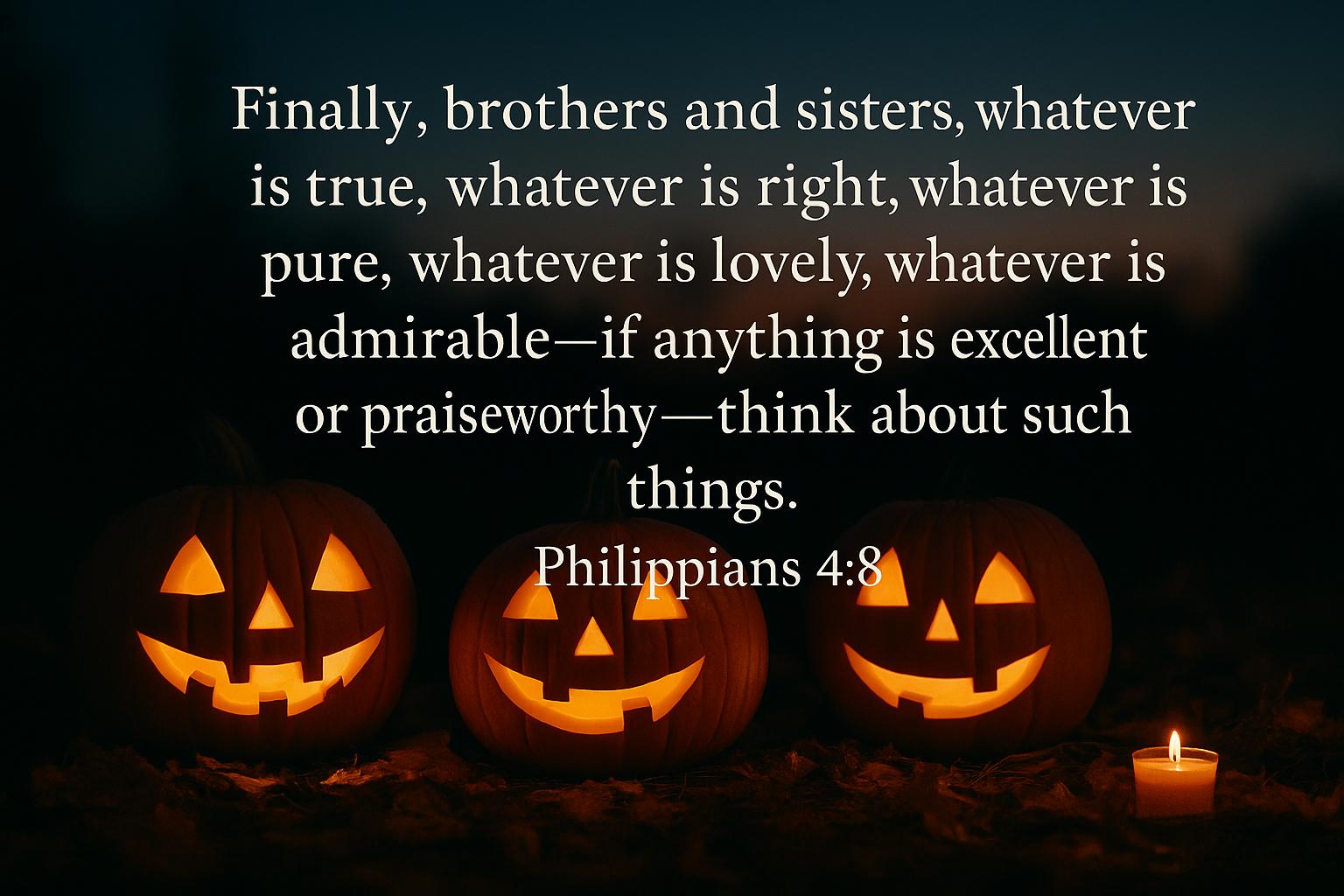
Glowing Halloween pumpkins with Bible verse: Finally, brothers and sisters, whatever is true, whatever is noble, whatever is right, whatever is pure, whatever is lovely, whatever is admirable—if anything is excellent or praiseworthy—think about such things. Philippians 4:8

“We demolish arguments and every pretension that sets itself up against the knowledge of God, and we take captive every thought to make it obedient to Christ” (2 Corinthians 10:5).

 “You will keep in perfect peace those whose minds are steadfast, because they trust in you” (Isaiah 26:3).

“Do not conform to the pattern of this world, but be transformed by the renewing of your mind. Then you will be able to test and approve what God’s will is—his good, pleasing and perfect will” (Romans 12:2).

“You were taught, with regard to your former way of life, to put off your old self, which is being corrupted by its deceitful desires; to be made new in the attitude of your minds; and to put on the new self, created to be like God in true righteousness and holiness” (Ephesians 4:22-24).

The Bible warns us that we have a very real enemy who wants to take our attention and affection away from the Lord and live like the world. At Halloween, we may be tempted to take part in scary or creepy activities, thinking it’s not a big deal, but it is a big deal to God. We need to remain aware that worshipers of Satan, wizards, witches, and Wiccans still celebrate a pagan, evil Halloween that includes occult practices. Some believe if Christians participate, they too are honoring Satan.

As Christians, we live “in the world,” but we are not “of the world” and are protected from the enemy by Jesus’ sacrifice. If we stay in the Word and focus on becoming more like Christ in what we do and think, then we can make God-honoring decisions about what to do with Halloween. And I believe there are ways to celebrate as Jesus followers.

Should Christians Celebrate Halloween?

You may be someone who believes that any recognition of Halloween is wrong. Choosing to abstain entirely may be what you feel called by God to do—and that’s a conviction that you should honor, without pressure from others. Perhaps you don’t want any association with a day that may have pagan origins, or you’re concerned about how Halloween has devolved over the years into something darker or more disturbing.

Or perhaps you believe that Christians can redeem holidays—days that were once truly “holy days,” such as Christmas, Easter, Thanksgiving, and even Halloween. Each of these has been, to some extent, co-opted by the world and reshaped into secular events driven by consumerism and the pressure to “keep up with the Joneses.”

Halloween presents a unique opportunity to show others that God is sovereign, and that He can be glorified in how we choose to celebrate—not just on traditional holy days, but every day, including October 31. What matters is staying true to God’s command to love Him with all our hearts, souls, minds, and strength–and to love our neighbors as ourselves. So, how can we keep Christ at the center of Halloween just as we try to do every other day?

Christian Alternatives to Halloween

By alternatives I mean what activities can Christians participate in on Halloween that are different from the mainstream? Let’s always keep in mind that we should consider our Halloween events as an outreach to those who are unbelievers. Here are a few ideas of what some Christians and churches can do on October 31:

Kids trick or treating, Can Christians celebrate Halloween?
  • In your neighborhood:
    • Welcome trick-or-treaters with decorations that emphasize harvest, such as pumpkins, hay bales, etc.
    • Sit outside of your house to greet trick-or-treaters so that you don’t miss anyone. Maybe have a fire pit going and have neighbor kids who are with their parents stop to make s’mores.
    • Engage in conversation with the kids. Ask why they chose the costume they did, what they wore last year, if their school had a Halloween party, what their favorite candy is, etc. Make them feel special, even if they are in a hurry to go out and collect candy. And give premium candy if you can afford it. 
    • Consider giving away something in addition to or instead of candy that will show you care, like glow sticks to help them see. Maybe these can have a sticker that says “Jesus lights our way home” for example. You can also make individual goodie bags that have candy, stickers, and a “God bless you–have a safe Halloween” message handwritten on a card inside.
    • There are other great ideas about engaging with trick-or-treaters in the article “10 Ways to Show Christ’s Love to Trick-or-Treaters This Year” 
  • In the community:
    • While this idea is done most often at churches, I believe it would be great to move it into the community. Why not gather with like-minded churches in your community and host a large “Trunk or Treat” event? Families create a game that can be played out of the trunk of their car, e.g. a ring toss game, a corn hole type game. Or they can just decorate their trunk with a clever theme. Children walk through the event playing games and getting candy. You can include in their goodie bags a short blurb about what churches participated and why. Be sure to emphasize how much you believe God calls you to care for your neighbors, and that you were so glad they came (including an invitation to church as well).
  • At your church: host a large-scale harvest festival (emphasis on harvest of foods that God provides). Celebrate with games such as:
    • Pumpkin bowling–using smaller pumpkins so even small kids can play (remove stems as much as possible) and make “pins” out of long gourds that are cut off at bottom to stand up;
    • Pumpkin decorating–painting or carving (if participants paint pumpkins, remind them not to leave outside as the paint may poison squirrels or other wildlife;
    • Corn Hole (bean bag toss)
    • Caramel apple decorating contest
    • Apple toss (into buckets)
    • Pumpkin ring toss (make sure pumpkins have their stems)
Harvest

For more ideas:

5 Halloween Activities that Point Kids to Jesus

5 Ways Christians Can Biblically Celebrate Halloween

Halloween: A Matter of Prayer, Discernment, and Boldness

In light of some of Halloween’s origins in paganism and occult practices, along with the Bible’s clear stance against witchcraft, idolatry, and celebrating evil, Christians should prayerfully consider participating in anything related to it. We need to ensure that if we choose to take part in the day, that we are claiming it for Christ and participating in His name. While many today see Halloween as harmless fun, it’s important to ask whether what we participate in aligns with God’s truth and glorifies Him. Rather than conforming to cultural norms, believers can use this time to offer Christ-centered alternatives—such as fall festivals, outreach events, and neighborhood ministry—that reflect God’s goodness and truth. Ultimately, the decision should be rooted in our desire to honor God in every area of our lives.

https://www.christianity.com/wiki/holidays/halloween-origins-traditions-and-whether-christians-should-celebrate-it.html

Merry Surveillance And A Happy New World | ZeroHedge

Via Off-Guardian,

Welcome to our third Christmas edition of This Week, where we pull out just the most seasonal, tinseliest headlines we can find, take a step back, and laugh at just what a clown world we’re all suddenly living in.

1. Wood Burning Stoves Cause Cancer

Anyone following British news or social media for the last two weeks has probably already seen this story – we mentioned it in our story on the Great Reset:

Terrifying cancer risk of trendy wood burning stoves – as experts warn they are UK’s biggest source of dangerous air pollution

Wood-burning stoves are “more polluting than cars” now, they cause cancer. And birth deformities. And asthma. And make “long covid” worse.

We need rules. And bans. And more rules. And more bans. Yes, OK, we already have regulations on wood burning, but they don’t enforce them enough, and “these people will only stop when they are made to”:

I just can’t believe we’ve lived to see a time where “these people” is being used to venomously describe people who…*checks notes*…burn wood to keep warm.

This is all about clean air, you understand, and not even slightly about the fact wood burning stoves offer energy and fuel independence. That’s just paranoia.

2. …and so do scented candles

Now, maybe you’re thinking, “OK, so maybe my woodburner is illegal now, at least my cinnamon candles make it feel like Christmas”. No such luck, because here comes the Conversation with their mood-killing candle-snuffer:

Scented candles and holiday fragrances may actually harm your home’s air quality

The research is one of those pieces of research which abandons logic in pursuit of some higher truth, and includes this gem of a sentence:

If equal weights of cigarette and incense sticks are burned, the incense sticks produce around four times as much particulate matter as the cigarettes

Wonderful exemplar of the madness of “The Science”, the juxtaposition of technical truth with complete abandonment of reason. Totally disregarding a) that equal weights of incense and cigarettes are not burned, b) the differing nature and composition of their “particulate” or c) the fact people don’t put incense sticks in their mouths.

Anyway, don’t even think about staying warm or smelling nice. You’ll get cancer. And die.

Look out for “improving our air quality” to be a major talking point in 2025. More bans coming.

3. Merry Surveillance and a Happy New World

In the spirit of giving this Holiday Season, the British government has decided to gift us all the long-term comfort of security by promoting their digital ID platform!

From their press release:

Christmas celebrations are set to get a digital upgrade next year, as the UK government plans to roll out a new law allowing pub and bar-goers, as well as shoppers, to use their phones to prove their age when buying alcohol, should they wish to do so. People can continue to use physical forms of ID if they prefer.

See how it’s going to work?

It’s just like the smoking ban, where each year the minimum age to buy cigarettes increases, except in reverse.

If digital ID is the easiest way for young people to prove their age and get drunk, they’ll never need to make it mandatory. Each year the next crop of 18-year-olds will volunteer to be cattle tagged so they can go out drinking with their friends.

Meanwhile, the physical ID that “people can continue to use if they prefer” will be increasingly expensive, subject to longer and longer waiting times to acquire, and probably expire more quickly. Not to mention how bad for the environment the Guardian will tell everyone it is.

4. A Very Climate Christmas

Speaking of the Guardian, did you know “average Briton produces 23 times more CO2 on Christmas Day”?

Of course you didn’t. That’s because the Guardian just paid some people to make it up. Sorry, they “commissioned researchers to write a report” which is totally different.

However it happened, the math exists and is vaguely described. It doesn’t really make any sense if you think about it for five minutes, but we don’t have five minutes. The author quickly rushes us past the numbers and into the opinions.

The Graun has rounded up a few people to talk about how bad Christmas is for the planet. That includes the appropriately named Melanie Nazareth, who warns that people are conditioned into mass consumerism at Christmas time:

“We have been deliberately sold a vision of Christmas that is based on material consumption. We are constantly bombarded by advertising and media that tells us that if we aren’t spending money on things, we are not doing Christmas properly…

Which, to be fair, is a more than reasonable point, if only she didn’t add:

…This is destroying the whole meaning of Christmas as well as destroying the planet.”

I just can’t shake the image of Klaus Schwab, the Ghost of Resets Past, hanging in the air, rattling his chains and wailing “yooouuuu will ooooown nothing and beeee happyyyyy!”

Makes it an uncomfortable read.

BONUS: Scary Turkey Germs

Just when you thought, maybe, you could have a meal or even an entire day without having to be frightened – here comes the Daily Mail to scream:

How your Christmas turkey leaves the kitchen smeared with food poisoning bugs: Grim photos reveal exactly where bacteria spreads – and will make you think twice about scoffing mince pies

The article itself is a joke. They smear blue stuff on someone’s hands, have them use the kitchen, then show the pictures of blue stuff everywhere and say “Imagine this was bacteria! It got everywhere!” like that means something.

*  *  *

All told a pretty hectic Holiday Season for our New Normal World, and we didn’t even mention the Christmas tree being burned in newly liberated Syria or racist dangers of confederate Christmas decorations.

Merry Christmas Everyone.

Source: Merry Surveillance And A Happy New World

December 25 | The Celebration of Christmas

Scripture Reading: Matthew 2:1–12

Key Verse: John 1:9

That was the true Light which gives light to every man coming into the world.

Has anyone ever given you a birthday party? Most likely, at some point in your life, you discovered the joy of having your friends and family gather together to celebrate your birth. How did that make you feel? By celebrating your birthday, they testified to the fact that your very existence has made their own lives somewhat better.

Now, a second question: Have you ever been to a birthday party to which the birthday boy or girl was not even invited? Of course not! What sense would it make to throw a party to celebrate someone and then fail to invite the guest of honor?

Today is Christmas. Chances are, you have already attended one or two Christmas parties, or maybe you have one scheduled for later today. Do you realize what a Christmas party is? Is it a simple gathering of friends? A chance to exchange presents? An hour of free time in the middle of a workday? If any of these describe the gathering that you attended, then you have not been to a real Christmas party.

A Christmas party is the ultimate birthday extravaganza! We celebrate Christmas because we want to testify that Jesus’ existence has made our own lives infinitely better. Was Jesus at your Christmas party this week? Take a moment right now to escape the hustle of the holiday and rejoice in your Savior’s birthday.

Lord, You came wrapped in rags so that I could have eternal life. If my wrappings and glitter are not about You, then help me to readjust my focus. Thank You for this great gift.1


1  Stanley, C. F. (2006). Pathways to his presence (p. 376). Thomas Nelson Publishers.

December 25 | The True Colors of God’s Nature

Scripture Reading: John 1:1–24

Key Verse: Matthew 5:16

Let your light so shine before men, that they may see your good works and glorify your Father in heaven.

For years, poinsettias have been a favorite plant at Christmas. But in order for their brilliant color to be revealed at just the right time, nursery growers make sure the plants spend a certain amount of time in darkness. When the plants grow to maturity, large amounts of light are then introduced into their environment.

The poinsettia is native to Florida, and many who have them in their yards tell how the poinsettia must be planted on a certain side of the house in order for the plant’s leaves to turn a brilliant color. Again, the secret lies in the amount of sunlight the plant receives. The more sun at the right time, the more brilliant the color.

God calls us to be lights in a world of darkness. However, we can never forget that He is our Source of light. Without the light of His presence we become dull and colorless. Christ said, “Let your light shine before men in such a way that they may see your good works, and glorify your Father who is in heaven” (Matt. 5:16 nasb).

The true colors of God’s nature are released within us by spending time in His Word. If we fail to read and study His principles, our lights will never reflect the brilliance of His love, forgiveness, and grace to others. We must have contact with the Father of Lights in order for our light to have purpose.

Precious heavenly Father, the true colors of Your nature were reflected in Your Son, who came to this earth to share Your light. Let my life be a reflection of Your divine gift of love.1


1  Stanley, C. F. (1999). On holy ground (p. 376). Thomas Nelson Publishers.

20 december (1857) | The first Christmas carol

“Glory to God in the highest, and on earth peace, good will toward men.” Luke 2:14

suggested further reading: Romans 14:5–9

I wish everybody that keeps Christmas this year, would keep it as the angels kept it. There are many persons who, when they talk about keeping Christmas, mean by that the cutting of the bands of their religion for one day in the year, as if Christ were the Lord of misrule, as if the birth of Christ should be celebrated like the orgies of Bacchus. There are some very religious people, that on Christmas would never forget to go to church in the morning; they believe Christmas to be nearly as holy as Sunday, for they reverence the tradition of the elders. Yet their way of spending the rest of the day is very remarkable; for if they see their way straight up stairs to their bed at night, it must be by accident. They would not consider they had kept Christmas in a proper manner, if they did not verge on gluttony and drunkenness. There are many who think Christmas cannot possibly be kept, except there be a great shout of merriment and mirth in the house, and added to that the boisterousness of sin. Now, my brethren, although we, as successors of the Puritans, will not keep the day in any religious sense whatever, attaching nothing more to it than to any other day: believing that every day may be a Christmas for ought we know, and wishing to make every day Christmas, if we can, yet we must try to set an example to others how to behave on that day; and specially since the angels gave glory to God: let us do the same. Once more the angels said, “Peace to men”: let us labour if we can to make peace next Christmas day.

for meditation: The unconverted cannot understand why Christians do not join them in their wild Christmas celebrations (1 Peter 4:3–4); those who celebrate the event without being able to give a sensible reason for doing so, are providing us with wonderful opportunities to give a reason for the hope that is within us (1 Peter 3:15).

sermon no. 1681


1  Spurgeon, C. H., & Crosby, T. P. (1998). 365 Days with Spurgeon (Volume 1) (p. 361). Day One Publications.

Kids correct Jill Biden’s “Happy Holidays” | Denison Forum

Pupils with teacher in Santa hats giving thumbs up By JackF/stock.adobe.com

On Friday, First Lady Jill Biden hosted the annual White House Marine Corps Reserve Toys for Tots campaign. She greeted everyone with “Happy Holidays,” to which multiple children shouted back emphatically, “Happy Christmas!”

Mrs. Biden then replied, “Happy Christmas. Yes!” and concluded her remarks with, “Merry Christmas and happy holidays.”

Why do we wish people a “Happy Birthday”?

My purpose is not to offer yet another commentary calling on our secularized culture to stop wishing each other “Happy Holidays” in a season that has been traditionally focused on Christ and Christmas. Even though such a call would be historically appropriate, I think there is an even deeper issue at work here.

Let’s start with a question: Why do we wish outcomes for people that neither they nor we can actually bring to pass?

We wish them a “Happy Birthday,” but the happiness of their birthday is less in their control than those who will (or will not) remember and celebrate their birth. Wishing them “Happy Holidays” is similarly unlikely to make them happier in any significant way.

In part, we do so simply to convey good wishes. To the degree that we think our words are actually changing reality, we feel empowered by speaking them.

Of course, being wished a “Happy Birthday” does make us feel recognized and appreciated, which can add to the happiness of the day. However, the effect is less so for other holidays.

Standing for our faith

I think something else is at work in this cultural phenomenon, a factor with significance far beyond the Christmas season.

On one hand, many who wish others “Happy Holidays” are being tolerant of all religions and worldviews in a way our postmodern culture requires and appreciates. The other person may be a nonbeliever, a Jew or Muslim, or someone who simply doesn’t want to participate in observing Christmas. Perhaps they lost a loved one during the season and experience Christmas as a time of grief rather than joy. 

Not to “impose” Christmas on them is therefore experienced as a sign of understanding and tolerance appreciated by our post-Christian culture.

On the other hand, many who wish others “Merry Christmas” are standing up for their Christian beliefs in a way our faith requires and appreciates. We are taught by word and example to make public our commitment to Christ whenever and however possible (cf. 1 Peter 3:15–16; Matthew 28:19). Calling out “Merry Christmas” feels like the least we can do to stand for Christ and against the relativism at war with our worldview and its commitments.

Cultural warriors or cultural missionaries?

In my view, both positions are right—and wrong.

“Happy Holidays” relativists are right in that more people than ever have no religious commitment and do not see Christmas as anything other than a secular holiday. “Merry Christmas” advocates are right in that standing publicly for Christ is even more urgent in a post-Christian culture that desperately needs to hear and respond to the gospel.

However, “Happy Holidays” relativists are wrong in secularizing what has been the Christian tradition of Christmas for many centuries. If they did the same with Hanukkah or Ramadan, Jews and Muslims would be justified in protesting. And “Merry Christmas” advocates are wrong if we respond to secularists in an antagonistic spirit that is more likely to alienate them than attract them to Jesus.

As I often say, we are not cultural warriors for whom the other side is evil but cultural missionaries for whom the other side is someone for whom Jesus died.

“The duty of every Christian”

The best approach, I think, is to wish others “Merry Christmas” with the humble grace that makes public our faith but without an antagonistic spirit that seeks to impose it on others. It is then a statement affirming our commitment to Christ that seeks to mirror his compassion.

The best way to make our wish a reality is to pray for the person with whom we are speaking and then seek an opportunity to share the Christ of Christmas. After all, our words will quickly be forgotten, but the spirit in which we share them, if led by the Spirit, can plant seeds of truth that change souls for eternity.

The greeting we use makes my point.

  • “Merry” is derived from the Proto-Germanic murgijaz, meaning “short-lasting.” The current sense comes from the notion of “something so pleasant that it makes the time fly.”
  • “Christmas” shortens the medieval phrase “Christ’s mass,” referring to worship services held to celebrate Jesus’ birth.

Taken together, we are pointing to the brief annual remembrance of Jesus’ birthday, hoping the person we greet will then meet the One whose birth we celebrate, experience the “new birth” for themselves (John 3:3), and be changed for all eternity (2 Corinthians 5:17).

Martin Luther stated,

“It is the duty of every Christian to be Christ to his neighbor.”

Will you do your “duty” today?

The post Kids correct Jill Biden’s “Happy Holidays” appeared first on Denison Forum.

December 17 | Christians and Christmas

He who observes the day, observes it to the Lord.

Romans 14:6

The Puritans in early America rejected Christmas celebrations altogether. They deliberately worked on December 25 to show their disdain. A law passed in England in 1644 reflected a similar Puritan influence; the law made Christmas Day an official working day. For a time in England it was literally illegal to cook plum pudding or mince pie for the holidays.

Christians today are generally not opposed to celebrating Christmas. The holiday itself is nothing, and observing it is not a question of right or wrong. As Paul wrote, “One man regards one day above another, another regards every day alike. Let each man be fully convinced in his own mind. He who observes the day, observes it for the Lord, and he who eats, does so for the Lord, for he gives thanks to God; and he who eats not, for the Lord he does not eat, and gives thanks to God” (Rom. 14:5–6). Every day—including Christmas—is a celebration for us who know and love Him.1


1  MacArthur, J. (2001). Truth for today : a daily touch of God’s grace (p. 378). J. Countryman.

Christmas—the Interrupter of Winter | Blog – Beautiful Christian Life

Photo by http://www.StillsByHernan.com

Disclosure: This post may contain affiliate links, meaning Beautiful Christian Life LLC may get a commission if you decide to make a purchase through its links, at no cost to you.

The month of December can feel magical. Strings of lights appear in our yards, twinkling in the darkness; trees light up our houses; our favorite Christmas songs play everywhere in the background; Christmas cookies bake in the oven; people host parties and buy gifts; and everyone is filled with a desire to give to others and care for those in need. It can feel like such a season of hope, of things made beautiful, of people coming together in oneness and joy, and of the needy being cared for.

Christmas Letdown

It is lovely and yet, a bit devastating—especially as you get older—to realize just how quickly the season passes and how long it takes to come back round again. You know that for every twinkly light and caroler, there will be a bag of used wrapping paper and a mostly dead tree left the day after Christmas; and you will feel sad and let down, because just like that, it’s gone again, over once more.

Maybe you’ll keep playing Christmas music in an attempt to keep the spirit going; but eventually, the Christmas cookies will be stale, no one will want to watch It’s a Wonderful Life again, and you’ll pack everything all up for next December.

It’s depressing when Christmas feels like the end—the end of the year, the season, the holiday spirit, the Christmas trees, family being together, and those beautiful twinkly lights. I’ve been struggling the last few years with this sense of being let down by Christmas. Everything I’m looking forward to enjoying is heaped up into a few short, extremely busy weeks—maybe into the one day of Christmas itself—and then it’s over and done, and I’m left disappointed.

A Better Perspective about Christmas

As Christmas approaches this year, I’ve been reflecting on the fact that I might be thinking about Christmas from the wrong perspective. As much as it feels like it, Christmas is not the end. It is the beginning! I don’t mean the beginning of the new year or the beginning of our better selves, but the beginning of real hope.

There’s a beautiful passage in The Lion, the Witch, and the Wardrobe by C.S. Lewis that has illustrated this for me. The curse the White Witch places on the country of Narnia is that it would be “always winter and never Christmas.” But after all four children in the story have made their way into this other world, hope awakens. Father Christmas appears!

The significance of this is declared by Father Christmas, himself: “‘I’ve come at last,” said he. “She has kept me out for a long time, but I have got in at last. Aslan is on the move. The Witch’s magic is weakening.’” Christmas signals Aslan’s return and the weakening of the Witch’s dark magic. Christmas stirs hope. The festivities that the animals experience speak to the hope they feel for the end of winter and perhaps an appearance of Aslan.

Christmas—the Interrupter of Winter

There is a very real sense in which Christmas is the interrupter of winter. It enters the bleakness and brings celebration. It brings hope for new beginnings, hope for an appearance of a savior. Just as the Israelites endured a long winter of exile, waiting, longing for the appearance of a Promised One, a joy that at times did not seem possible, we too are waiting, exiled in this winter of a world which is not our true home.

We are waiting for something better, something that at times seems so far off and so distant that we’re not sure it will ever break through. The pain, the loss, the sadness, the suffering of today feels much stronger, much more real. Today, every one of us has something that we’re grieving, someone we’re missing, fears we’re carrying, hurt we’re feeling, and it really seems like there’s no way out. The winter of all of that brokenness does not seem to have an end. But Christmas interrupts the winter and reminds us of what came and of what we are still waiting for.

We remember the arrival or “advent” of Christ thousands of years ago, and it’s beautiful because he came into a hopeless, lost world and gave it a new beginning. The Savior entered our story and gave himself so we could have a new story. As we round the corner of Christmas and all the lights are packed away, it’s tempting to think it’s over. But Christmas is not the end. As we’re celebrating Christ’s birth, we’re walking right into a time of remembering his life and death and resurrection. Christmas begins this period of remembrance and also reminds us that we’re waiting for another advent—the second one.

Christ came to give hope to a broken world, but that hope is not yet fully realized. We are waiting in a time of exile, like the Israelites, for another arrival to interrupt the winter. Christmas is just the beginning. As I put away the Advent calendar and take down the ornaments, that’s what I’ll be reminding myself of this year. Not that it’s all done, but that it’s begun. He has come! The world has been changed by his arrival, and he will come again. It will not always be winter.


This article was originally published on December 20, 2017.

Related Articles:

https://www.beautifulchristianlife.com/blog/christmas-the-interrupter-of-winter

Why do we have Christmas trees? How a “pagan symbol” became an integral part of our Christmas traditions | Denison Forum

A well-lit Christmas tree stands outside of the Coliseum in Rome, Italy, at night. © By Matteo Gabrieli/stock.adobe.com

Chances are, most of us have a tree—either real or fake—featured prominently in our homes this Christmas season. But have you ever wondered where that tradition came from?

After all, it’s kind of strange if you stop and think about it.

Turns out, people started putting up Christmas trees (or some derivation thereof) centuries before the very first Christmas, and understanding how that ancient practice came to be a featured part of our holiday experience has an important lesson to teach us about how we see and share our traditions today.

The origins of the Christmas tree

The first Christmas trees date all the way back to the ancient Egyptians, who believed that winter came because the sun god, Ra, got sick and weak during the cold months of the year.

The winter solstice—which always falls around December 25—marked the moment the days began to grow longer, which they took to coincide with their god starting to get healthy again. To celebrate, they would fill their homes with green palm rushes to symbolize the triumph of life over death.

The Romans had a similar tradition around the feast of Saturnalia. Saturn was the god of agriculture, so the winter solstice meant that the worst of the cold months had passed and their farms and orchards would soon start to flourish again. As part of the feast, they decorated their homes and temples with the boughs of evergreen trees.

However, the druids in Northern Europe are perhaps the most important for explaining the origins of our traditions today.

The druids were the priests of the ancient Celts and, like the Romans and Egyptians, they also decorated their temples with evergreen boughs as a symbol of everlasting life. When the Vikings invaded, they adopted the tradition and came to associate the evergreen tree with their sun god, Balder.

This association kept the evergreen tree as an important symbol of life throughout much of Europe during the middle ages, which brings us to Martin Luther, Germany, and the origins of our Christmas trees today.

From “heathen traditions” to a symbol of hope

Germany gets credit for starting the Christmas tree tradition in the 1500s when they began bringing the full trees, rather than just the branches, into their homes and decorating them. The practice hailed from a popular medieval play about Adam and Eve that used a “paradise tree” hung with apples. The play was performed every Christmas Eve—Adam and Eve’s feast day according to the Catholic calendar. Interestingly, this play is also where we get the idea that the fruit Adam and Eve ate in the garden was an apple.

Traditionally, Martin Luther is credited with being the first to add candles to the trees, which eventually morphed into the Christmas lights we use now. It’s said that, while preparing a sermon on his way home one night, he saw the stars shining through the forest of evergreens and wanted to replicate the scene at home. The candles eventually took on the added dimension of symbolizing Jesus as the Light of the World.

Later, German settlers brought the tradition to America, but it took a while for it to catch on. The Puritans, aware of the ancient origins of the Christmas tree, had rejected them as “pagan symbols” and “heathen traditions” that had no rightful place in the celebration of Christ’s birth. Eventually, though, the influx of German and Irish immigrants in the 1800s was large enough to outweigh the residual hesitations from Puritan times.

The turning point in the trees’ popularity, however, didn’t come until Queen Victoria and her German Prince, Albert, were sketched with their children around their family Christmas tree. Because people in Britain and along the eastern coast of America were big fans of the English monarch, they quickly adopted the practice as well, with the biggest difference being that American Christmas trees tended to be about twice as large as their British counterparts.

The most famous Christmas tree today is arguably found each year in Rockefeller Center. The first one was placed there in 1931 by construction crews at the site. The Great Depression was still going on, and the building had employed so many people who needed a job that the tree came to serve as a symbol of hope for the workers.

A Christmas call to prayer

While the traditions around Christmas trees have evolved quite a bit since the time of the ancient Egyptians, it’s interesting that themes like hope and the triumph of life over death remain prominent in our celebrations of the holiday. And the pagan origins of the Christmas tree remind us that those themes are important to all people rather than just Christians.

So what can we do to help people recognize Jesus as the ultimate fulfillment of that search for life and hope today? Who do you know that might be in need of those blessings?

As Christmas draws near, let your Christmas tree serve as a daily reminder to pray for the people who came to mind as you reflected on those questions. Every time you pass by it, take a moment to ask God to help you be a source of hope and a messenger of life in their lives.

And when the holiday ends and the trees go back up for another year, ask the Lord to help you remember those faces and to use you to help them come to know the Lord in the new year.

Christmas trees may have a pagan origin, but God can still use them to be a symbol of hope and life for the lost today.

Will yours serve that purpose this Christmas season?

The post Why do we have Christmas trees? How a “pagan symbol” became an integral part of our Christmas traditions appeared first on Denison Forum.

Christmas Resources from GotQuestions.org | Truthbomb

Here are some helpful and thought provoking articles dealing with Christmas from GotQuestions.org:

Should Christians celebrate Christmas?
What is the True Meaning of Christmas?

How Should Christians Respond to the “War on Christmas?”

Do some Christmas Traditions have Pagan Origins?

Should we have a Christmas Tree?

Does Giving Gifts take away from the True Meaning of Christmas?

Why is the Virgin Birth so Important?

Was Jesus born on December 25th?

What does the Bible say about the Three Wise Men?

What Should Parents tell their children about Santa Claus?

What is an Advent Calendar? How does it relate to Christmas?

What was the Star of Bethlehem?

Does Luke’s Claim that Jesus was born in Bethlehem at the time of Quirinius census match the historical record?

Why did the Maji bring gold, frankincense, and myrrh to Jesus?

Is it wrong to say “Xmas” instead of ‘Christmas?”

Courage and Godspeed,
Chad

Related Posts

Christmas – Pagan or Not?

Five Reasons You Can Trust the Story of Christmas is True by J. Warner Wallace

Using “Merry X-mas” to Witness

http://truthbomb.blogspot.com/2011/12/christmas-resources-from.html

Thanksgiving in the Midst of Hardship | Midwest Christian Outreach, Inc

If we said there is a great deal of angst and bitter division in our nation these days, I think most Americans would agree. Thankfully, Thanksgiving has arrived, and perhaps we may get a momentary reprieve from the never-ending cultural quarrel that besets us. It has always been one of our favorite holidays, a day originally set aside to thank God for all His myriad blessings, nationally and personally. But for many, Thanksgiving today may be seen as little more than a day off work, at least for those not responsible for preparing “Thanksgiving dinner.” As with many American celebrations — originally called Holy Days but known in modern times as holidays — Thanksgiving has lost much of its initial holy intent. As we consider The First Thanksgiving we see that:

The English colonists we call Pilgrims celebrated days of thanksgiving as part of their religion. But these were days of prayer, not days of feasting.

Initially, this was a time devoted to the corporate worship of God for His goodness and provision. What Did The Pilgrims And Wampanoag Indians Celebrate In 1621? rightly points out:

The First Thanksgiving: The Thanksgiving Feast. The English colonists we call Pilgrims celebrated days of thanksgiving as part of their religion. … Our national holiday really stems from the feast held in the autumn of 1621 by the Pilgrims and the Wampanoag to celebrate the colony’s first successful harvest.

The trip across the ocean was very difficult. When they landed, winter was already setting in, and the end of the voyage certainly wasn’t the end of their trials. At the end of the first brutal winter, only fifty of the one hundred people who made the trip had survived. The small band celebrated with their benefactors, the Wampanoag Indians or “Eastern People.” Despite the hardships and losses the Pilgrims suffered, they viewed this first Thanksgiving as a time of celebration and appreciating the blessings of God’s protection and provision. They had endured constant reminders of the precarious nature of human life, and out of great loss, there was great joy and thanksgiving.

The Pilgrims had a decidedly different outlook on life than most of us do today. They expected life to be very hard and were not surprised when it was exactly that. They did not expect ease and comfort, in part because they had never known anything close to the comforts and conveniences we enjoy today. They had great difficulties establishing themselves in a new land but likely had known great difficulties in their homeland as well. Being deeply persuaded that this life was short and mean, while eternity was long and satisfying was how they made it through the hardships of life. And so, they were thankful for their deliverance. That’s not to say they were superhuman, floating through life without ever experiencing emotional despair, frustration, or deep sorrow, but they had an eternal perspective that kept them going.

As we consider the history of this day, we are mindful of all that we should be thankful for on this particular Thanksgiving Day. Just for beginners, we don’t have to go out in the cold to track and kill an animal for our upcoming feast. Most of us have no experience hunting — we do our “hunting” in a climate-controlled environment where our biggest challenge may be the hordes of shoppers in the checkout line, especially if we need to shop on Wednesday.

In that way and so many others, most of us do have a much easier life than people in past generations. However, we are not being Pollyannish. We experience loss and frustration and sometimes great sadness in our own lives, and we personally know many Christians who are right now experiencing terrible illness or great loss. We must work, as do all Christians, to keep an eternal perspective on the trials we go through and remember that God is in control of things that are completely out of our control.

And, as Christians, we need to be able to identify the forces we are compelled to fight in this life, forces that aim to destroy us and our faith and witness. Our battle is not against flesh and blood, but against spiritual forces of evil in the heavenly realms. (Ephesians 6:12) Those spiritual forces seem to become more brazenly apparent every day, which is the result of vast numbers of people turning further and further away from God, leaving a spiritual vacuum to be filled, and it is being filled.

No matter the appearance to the contrary, the true division that matters for eternity is not about being black or white, rich or poor, bikers or drivers, but is between those who are adopted children of God vs those that reject Him. As God’s children, we are thankful for God’s many material blessings. We are also very thankful to God’s people from times past — like the Pilgrims and so many others — who made it their business to share the faith and pass it down to our generation. Their spiritual resilience — their determination to live as Christians despite hardship — is our blessed heritage. We can certainly be thankful for that.

We are personally thankful for the opportunity to be in ministry, and to share the gospel with those that God puts in our path. Yes, life even today is difficult and may become more difficult as our nation and indeed the whole world drifts further and further from the true God, but like our Christian forebearers, we know and strive to remain mindful that this life is short and mean and eternity is long and satisfying.

The apostle Paul experienced a few minor difficulties in his life. He recounted some of these to the Corinthians:

Five times I received at the hands of the Jews the forty lashes less one. Three times I was beaten with rods. Once I was stoned. Three times I was shipwrecked; a night and a day I was adrift at sea; on frequent journeys, in danger from rivers, danger from robbers, danger from my own people, danger from Gentiles, danger in the city, danger in the wilderness, danger at sea, danger from false brothers; in toil and hardship, through many a sleepless night, in hunger and thirst, often without food, in cold and exposure. And, apart from other things, there is the daily pressure on me of my anxiety for all the churches. (2 Corinthians 11:24-28)

Sounds pretty brutal… Yet he is also the one who wrote:

Rejoice always, pray without ceasing, give thanks in all circumstances; for this is the will of God in Christ Jesus for you. (1 Thessalonians 5:16-18)

God’s will for us is to give thanks for our blessings, both spiritual and material, despite whatever hard or contrary circumstances we may find ourselves in. Why? Because He is bigger than our circumstances and will carry us through until the day we meet Him face to face. Perhaps one of the most popular Thanksgiving songs we have was penned by Henry Smith:

Give thanks with a grateful heart
Give thanks to the Holy One
Give thanks because He’s given Jesus Christ, His Son

And now let the weak say, “I am strong”
Let the poor say, “I am rich
Because of what the Lord has done for us”

Our hope is that every person reading this will experience an interlude of peace and gladness this Thanksgiving. Our prayer is that we will all as Christians remember to pause and thank God for all our blessings. We also ask Him to help us maintain the eternal perspective we all need to live out Christian holiness in our lives and pass on our faith to our children and others. Happy Thanksgiving with love and blessed celebration of the incarnation in a few weeks…Ω

Don and Joy Signature 2

Source: https://midwestoutreach.org/2024/11/28/thanksgiving-in-the-midst-of-hardship/

Make Thanksgiving Great Again: Recovering America’s Forgotten Holiday | Standing for Freedom Center

Don’t let the mass media, the retail stores, or our secular culture steal away the opportunity to gather with family and friends and reverently thank Almighty God for all His good gifts — especially the supreme gift He has given us in Jesus Christ.


Over the last few years, I’ve noticed a troubling trend in the festive habits of my fellow countrymen.

On November 1, Halloween decorations come down and Christmas lights go up. Pumpkins are immediately replaced with Christmas trees. Musical selections skip from the “Monster Mash” to “Have a Holly Jolly Christmas.”

I played some chess growing up, but right now I’m not searching for Bobby Fischer. I’m searching for our forgotten American holiday: Thanksgiving.

What’s happened? Why has this cultural amnesia set in, leading Americans to skip over one of our most important, and quintessentially American, holidays?

First, the near disappearance of Thanksgiving from our celebratory liturgies is, in large part, due to the commercialization of the competing holidays that bookend our dedicated day of gratitude. Sandwiched between the profitable sales “giants” of Halloween and Christmas, media and retail marketers have decided that giving thanks just doesn’t sell.

Walk into any major retail store, and the scene is the same. Overnight, end caps go from bursting with candy to being flooded with stocking stuffers. Halloween, with its costumes and candy, sets the stage for a month-long shopping frenzy that culminates in the gift-giving extravaganza of Christmas. Walmart, Target, Costco, you name it, barely allow the leaves to turn before decorations shift from pumpkins to reindeer, blurring the lines between these distinct holidays. This rapid-shift pours gas on the fire of year-end spending — and sidelines Thanksgiving.

Second, the gradual disappearance of Thanksgiving from its traditional prominence in American culture can also be attributed, in part, to the ongoing secularization of the nation. As the U.S. has moved towards a more secular society, where religious observances are less emphasized in the public sphere, the inherently religious roots of Thanksgiving have been overshadowed. This holiday, with its historical ties to giving thanks to Divine Providence, has seen its spiritual essence diluted by a society increasingly focused on inclusivity.

Finally, what little attention is paid to Thanksgiving these days is almost always focused on “Black Friday” shopping details. Quite ironic (and sad), isn’t it? The one holiday we have in America dedicated to giving thanks and expressing gratitude to God for all that we already have has been co-opted by a consumer product sales agenda with one goal in mind: Getting you to buy more stuff.

Given this unfortunate development, I have a modest proposal: It’s time to make Thanksgiving great again.

But how? Three suggestions.

Remember the Christian Origins of Thanksgiving

Thanksgiving began as an explicitly Christian holiday, rooted in the Protestant faith and practice of the early European settlers in America. The first Thanksgiving in 1621 was not just a communal feast but also a religious observance, where the Pilgrims, who were devout Separatists seeking religious freedom, gave thanks to God for their survival and successful harvest following a harsh winter. This event mirrored the Christian tradition of giving thanks found in the Bible, notably in the Psalms, where thanksgiving is expressed through prayer and communal celebration.

Over the years, national days of thanksgiving were proclaimed during times of significance, often with direct references to God’s providence and mercy. For instance, George Washington’s first Thanksgiving proclamation in 1789 explicitly acknowledged the “many signal favors of Almighty God,” setting a precedent for viewing Thanksgiving as a day to recognize Divine blessings.

In 1863, amidst the Civil War, when President Lincoln made Thanksgiving an official national holiday, his proclamation was imbued with Christian sentiment, calling upon Americans “to set apart and observe the last Thursday of November next, as a day of Thanksgiving and Praise to our beneficent Father who dwelleth in the Heavens.” He invited the nation to not only give thanks for the blessings of the year but also to pray with “humble penitence for our national perverseness and disobedience.”

From its inception, Thanksgiving was founded on the recognition that everything we have has been given to us as a gift from God and that our posture in celebration should be one of gratitude towards the Lord.

When you gather with your families tomorrow, remember that. Acknowledge it. Don’t just “be thankful” in general. Give thanks to God.

Resist the Siren Song of Holiday Commercialization

If you’re not careful, our culture will lead you right from Halloween to Christmas, papering over the importance of Thanksgiving with some football games and Amazon Prime deals. Don’t let that happen.

Rebel against the commercialization of our holiday season however you can. Some might object to this but consider waiting until after Thanksgiving to hang the lights and blast the Christmas music. Use the month of November to reflect upon all the good things that God has given you: family, home, church, a job, your friends — whatever it may be.

Don’t let the allure of cheap TVs draw your mind away from meditating on what you already have. Consider making a list, writing down one new thing each day in November, and thanking God in prayer for that blessing in your life.

Work to focus on the spiritual and communal essence of the holiday rather than the consumer-driven aspects that often dominate the season. For example, you can incorporate Scripture readings, prayers of gratitude, and hymns into your Thanksgiving celebration.

While our culture might change, God does not. James 1:17 reminds us that “Every good and perfect gift is from above, coming down from the Father of the heavenly lights, who does not change like shifting shadows.”

Honor Christ Above All

Finally, as you celebrate Thanksgiving, with the food, fun, and festivities that are appropriate to the day, remember and honor Jesus Christ.

I add this because, as Christians, we should always go one step further when it comes to “Thanking God” for His gifts. Yes, celebrate the Divine providence and blessings of God, but not in some detached or deistic manner.

God has not just given us homes, families, and full tables. He has given us eternal salvation, the forgiveness of sins, and life everlasting in His Son, our Savior, Jesus Christ.

Let every bite of turkey, every laugh shared with a friend or family member, every embrace from a relative you haven’t seen for years remind you to lift your eyes to the throne of Christ, who ever lives to intercede for us.

Recall the words of the Apostle Paul in Romans 8:32, who joyfully proclaimed the goodness of God when he reminded his readers that “He who did not spare his own Son, but gave him up for us all—how will he not also, along with him, graciously give us all things?”

Even if your celebration is more meager than you wish it would be, or if you’ve had a rough year and when asked to list what you’re thankful for have a hard time saying anything more than “I guess just to be here,” if you are in Christ, you have everything you need. It might not be everything you want, but it is everything you need.

If we want to make Thanksgiving great again, we need to remember the reason for our thanks in the first place. We must acknowledge the Source of all of our good gifts — Almighty God — and the supreme gift He has given us in Jesus Christ.

Conclusion

I hope that tomorrow when you gather with friends and family, your household becomes a little platoon in a larger rebellion against the disappearance of Thanksgiving in American life.

Thanksgiving is a Christian holiday. It’s an American holiday. It’s on our calendars for a reason, because once, in our country, we knew how important it was to slow down, remember, and give thanks to God for His blessings.

Don’t let the mass media or the retail stores steal that away from you, your family, or our nation.

So, let’s make Thanksgiving great again — because giving thanks to God is one of the greatest things we can ever do.

9 Things Public Schools Won’t Tell You About The First Thanksgiving | Babylon Bee

It’s Thanksgiving week, which brings back memories of what you learned in school about the first Thanksgiving, where pilgrim settlers and natives gathered in peace to eat food, debate about who the land belonged to, and watch the Macy’s parade. But what about the things they didn’t teach you in school?

The Babylon Bee is here to fill in the gaps left by the things public school won’t tell you about the first Thanksgiving:

  1. The Patriots defeated the Redskins 42-3 in the first Thanksgiving Day football game: It was just the first of what would be many slaughters.
  2. The turkey was carved by none other than a young Joe Biden: Historian accounts tell of how young Joe enjoyed sniffing the hair of young Indian girls.
  3. Even though they were starving, the pilgrims politely passed on the Indians’ marshmallow jello salad: There are fates worse than death.
  4. French settlers in Canada got the date wrong and accidentally celebrated a month early: A tradition that continues to this day.
  5. Pilgrim wives rushed off following the meal to get doorbuster deals at Kohl’s: Bonnets and shoes with large silver buckles on them were going for half price.
  6. Indians were suspicious of the hot dish labeled “smallpox”: One Indian did politely end up taking some of it home, though no one is sure what happened after that.
  7. Scandal erupted after it was revealed that the pilgrims’ potato salad was store-bought: The tell-tale clear plastic clamshell container was reportedly found in the trash can.
  8. Several pilgrims still ended up dying of starvation after they got tired of eating leftover turkey sandwiches: Even the hungry can only eat so much turkey.
  9. The holiday was later named for the man who came up with the idea, Bob Thanksgiving: And for Bob, we are all truly thankful.

Your public school education may have robbed you of this valuable knowledge, but now you know the whole story. What other little-known facts about the first Thanksgiving have you heard about? Post them in the comments below.


Watch as Democrats try to figure out what went wrong this election.

What will they do differently?

https://babylonbee.com/news/9-things-public-schools-wont-tell-you-about-the-first-thanksgiving/

Thanksgiving: A Rich Heritage | VCY

2024 | Week of November 25 | Radio Transcript #1594

As with much of history these days, revisionists seek to erase or rewrite even the true history of Thanksgiving, often portraying the first pilgrims as genocidal white supremacists with no concern for the native peoples of the land. That couldn’t be further from the truth!

The educational organization PragerU does a great job at dispelling many of the myths surrounding the first Thanksgiving in America and showcasing its rich and uniquely American history.[i]

America’s first pilgrims on the Mayflower were headed toward Manhattan, but they were blown off course at sea, landing instead further north at a deserted Native American village, known as Plymouth, that still had reserves of corn, with no actual villagers in sight. Months after the pilgrims landed, one of the Native American survivors, a man named Squanto, returned to the village looking for his friends and family, who had sadly likely died due to smallpox before the newcomers ever arrived. Instead, he found the pilgrims.

Squanto, a former slave and an English-speaking Christian convert, willingly helped the pilgrims plant crops and work out an agreement with Massasoit, the area’s most important Native American chief. One of the pilgrim leaders, William Bradford, who eventually became their governor, referred to Squanto as “a special instrument sent of God for their good,” referencing Squanto’s enormous help.

The “First Thanksgiving” in the year 1621 was actually biblically inspired. It was a three-day harvest celebration in October which included 90 Native Americans and 53 pilgrims. The celebration was modeled after “The Feast of the Tabernacles” in the Old Testament. The hosts and guests shared vegetables, fish, deer, and possibly some wild turkeys while bonding over a shared interest in guns.

The pilgrims, a deeply religious group, truly felt that God had blessed them with this providential turn of events.  Over a century later, once again experiencing God’s providential hand in the forming of the United States of America, President George Washington declared Thursday, November 26, 1789, for “the People of the United States a day of public thanks-giving.”[ii]

Some individual states carried on the tradition of a day of thanksgiving in the years that followed, but it was often celebrated on different dates.[iii] Eventually, a nineteenth-century American poet, Sarah Josepha Hale, led a multi-decade campaign to make “Thanksgiving” a national holiday, petitioning many politicians and even a few presidents. Hale was often ignored, but her letter to President Lincoln is cited as one of the reasons he was convinced to issue the proclamation.[iv]

On October 3, 1863, exactly 74 years after George Washington issued his declaration and in the midst of the Civil War, Abraham Lincoln made a proclamation designating the last Thursday of November as a “day of Thanksgiving and Praise to our beneficent Father who dwelleth in the Heavens.”

During a time of intense national division, President Lincoln did not address his Thanksgiving Proclamation only to the Unionists while excluding the Rebels; he instead invited, “the whole American people…[his] fellow citizens in every part of the United States,” to participate in this national Thanksgiving.

The holiday of our American Thanksgiving has a beautiful history that should inspire every American, young and old alike. From the earliest celebration in Massachusetts, inspired by events in the Bible, we learn of the generosity and kinship between diverse groups of peoples, joyfully sharing in a bountiful harvest.

One hundred and sixty-eight years later, President George Washington, after more than a decade of tumultuous fighting against the Royal Crown and negotiating with factions domestically, made a point of noting, “the duty of all Nations to acknowledge the providence of Almighty God, to obey his will, to be grateful for his benefits, and humbly to implore his protection and favor.”

President Lincoln, instead of using the violent, divisive climate to further tear the nation apart, called the whole country to be grateful for “fruitful fields and healthful skies,” while imploring “the Almighty Hand to heal the wounds of the nation and to restore it.”

The history of Thanksgiving should remind us not only every year, but every day, of the sovereignty of God and the blessings which His hand has bestowed upon us, in times of peace and prosperity as well as in times of war and adversity. Happy Thanksgiving from all of us at Wisconsin Family Council. May you and your family acknowledge, reflect on, and enjoy God’s blessings!

For Wisconsin Family Council, this is Julaine Appling, reminding you that God, through the Prophet Hosea, said, “My people are destroyed for lack of knowledge.”

[i] https://www.prageru.com/video/whats-the-truth-about-the-first-thanksgiving

[ii] https://www.mountvernon.org/george-washington/the-first-president/thanksgiving#:~:text=On%20October%203%2C%201789%2C%20George,become%20commonplace%20in%20today’s%20households.

[iii] https://www.prageru.com/video/lincoln-thanksgiving

[iv] https://www.womenshistory.org/education-resources/biographies/sarah-hale

A Story of Persistence – Thanksgiving Devotional – Nov. 21 | Christianity.com

Here is a part of the Thanksgiving story you may not know!

Thanksgiving: A Story of Persistence
This devotional was written by Kelly McFadden

Brethren, I do not regard myself as having laid hold of it yet; but one thing I do: forgetting what lies behind and reaching forward to what lies ahead, I press on toward the goal for the prize of the upward call of God in Christ Jesus. —Philippians 3:12-14 

Here is a part of the Thanksgiving story you may not know. While the first Thanksgiving was celebrated in October of 1621, it was not until October of 1777 that all 13 colonies celebrated Thanksgiving, for the first time. At one point, our first president, George Washington, proclaimed a National Day of Thanksgiving, but conflict and difficulties among the colonies put an end to its observance.

It was a magazine editor, Sarah Josepha Hale, whose work led to the celebration of the Thanksgiving holiday we observe today. Hale wrote letters to governors and presidents, and editorials in magazines, books and newspapers, promoting the observance of Thanksgiving. In 1863, after 40 years of letter writing and campaigning (that’s not a typo, she really wrote letters for 40 years), Hale’s persistence paid off and President Abraham Lincoln proclaimed a National Day of Thanksgiving. Since then, every president has supported Thanksgiving. Forty years of dedication, persistence and passion, all to make sure that this country would celebrate a National Day of Thanksgiving each year. Impressive.

We can learn from Hale’s perseverance. It took her 40 years to accomplish what she set out to do. Just like her story, the Christian faith is often described as a marathon, not a sprint. Each day of our life is another day to choose between right and wrong, to help someone in need, to read our Bible and pray. As Paul reminds us in Philippians 3:12-14, Christians are called to persevere, to press on. Sometimes it can feel like an unrewarding task. It is hard, but important, to look to God for the BIGGER plan. What if Hale had chosen to give up after one year or ten years? Her goal would have been left unfinished. Press on towards the call of Christ! Endure! But be forewarned, just like Sara Josepha Hale, it may take 40 years to see the fruit of your labor!

GOING DEEPER:

1. What are some areas in your life that require perseverance?
2. Why is it important we don’t base our faith on feelings?

https://www.christianity.com/devotionals/todays-devotionals/a-story-of-persistence-thanksgiving-devotional-nov-2.html