
Tag Archives: jonathan-haidt

Why teens are growing up more anxious and depressed | Denison Forum

Close up of a line of high school students using mobile phones. By Monkey Business/stock.adobe.com

Last year, the US Surgeon General recommended that Congress place warnings on social media for children and teens (similar to the warnings on alcohol for pregnant women). I wrote about his op-ed last year. 

In that article, I wrote, “high social media use by teens strongly predicts higher rates of anxiety, depression, and sadness, as well as (ironically) lower sociality.” I hadn’t read Jonathan Haidt’s The Anxious Generation, which came out that year—but I wish I had. 

The problem runs deeper than I imagined, with stronger evidence of the connection than I thought existed. 

Jonathan Haidt is a social psychologist, whom The Denison Forum often references. Although a self-described atheist, his research into religion’s positive social and psychological effects has made him an ally in the modern era of hostility against Christians. 

What is “The Anxious Generation?” 

In, The Anxious Generation: How the Great Rewiring of Childhood is Causing an Epidemic of Mental Illness, Haidt argues convincingly that two primary factors have led to a worrying spike in mental illness: Social media (along with smartphone tech) and overprotective parenting (in the real-world). These factors create a perfect storm of fragility in Gen Z, causing a rise in internal psychological disorders (namely, depression and anxiety).

iGen, by Jean Twenge, discussed similar harms as far back as 2017, but there was much less research at the time of her book. Most studies pointed to correlation (smartphone/social media use rose at the same time mental illness did). Since then, more research points to causation, that high social media use in teens directly leads to mental health issues. 

That’s a massive problem, but it’s not the whole story. 

The four parts of The Anxious Generation

The book is divided into four parts. First, Haidt writes about the “surge of suffering,” outlining the massive effects of mental illness, the rapidly rising rates of depression, anxiety, suicide, and self-harm among children and teens. 

  • From 2010 to 2020, girls have seen a 188 percent increase in hospital visits for self-harm, and boys’ visits have increased by 48 percent. 
  • Anxiety prevalence has increased 139 percent in people ages 18-25 between 2010 and 2020.
  • Depression among teens has increased by around 150 percent between 2010 and 2020. 

What is going on? There are two leading causes for this surge of suffering: overprotective parenting and screen time. He tackles these in the following sections.  

In part two, Haidt discusses the decline in play-based childhood, due to what he calls “safetyism.” He develops his argument from the ‘90s, arguing that parents have become over-protective and taken away independence and space for adventuring. This prevents children from taking on responsibilities and growing in confidence, thereby stunting their growth. 

At appropriate ages, children should walk or bike to school, cross the street, and, most importantly, have lots of unstructured playtime, where they can explore, adventure, socialize with other kids, and, yes, even get hurt every so often. This section is a gold mine for parents.

Third, he unpacks “the great rewiring,” showing how social media and “phone-based childhoods” harm kids in four primary ways. 

  1. Social deprivation 
  2. Sleep deprivation
  3. Attention fragmentation
  4. Addiction 

These harms are deftly and rigorously explained, with research packed into every paragraph. 

Finally, in part four, he teamed up with Lenore Skenazy, author of Free Range Kids, to write the final chapters. In it, he gives recommendations to governments, tech companies, schools, and parents emphasizing the urgency of the research and the mental health crisis.

Worries for Christians?

As mentioned, Haidt is an atheist (although he believes in the benefits and importance of religious faith). Throughout, he discusses the influence of evolution in connection with psychology. Christians have different views on reconciling evolution and Scripture, but if those connections bother you, it may help to know that his research doesn’t depend on the validity of evolution. When he writes that “evolution made kids like ____,”  you can always insert “God designed kids to___,” and his work, in my view, maintains its force. 

As I’m not a parent, I can’t relate to how difficult it is to establish these boundaries. Only let your kids have two hours of leisure screen time a day—easy for me to say! Of course, Haidt is a parent, and demonstrates graciousness for parents throughout the work. 

Remember, it’s never too late. Jesus’ grace covers you parents who have a hard time battling anxiety about giving your kid freedom to roam, or who give your child an iPad too many times. His grace is sufficient. “Perfection is the enemy of progress” applies here if anywhere. 

The most important applications from The Anxious Generation

As you can probably tell, I can’t recommend this book enough. First, buy the book. Then, while it’s being shipped, you can listen to Dr. Mark Turman and Steph Thurling’s conversation about it. 

The skyrocketing rates of mental illness among children didn’t materialize out of thin air. We spend nearly every hour of every day in front of screens. Teens, on average, spend over seven hours a day on screens, four hours a day on social media. 

We didn’t have the internet two generations ago—doesn’t it make sense that such upheaval would change society, culture, and children’s upbringing?

Read this work, parents, teachers, ministers. . . . Just, everybody read it. I’ll leave you with his four most important action points. 

  1. “No smartphones before high school.” 
  2. “No social media before 16.” 
  3. “Phone-free schools.” (From start to end of the day, not just during class time.)
  4. “Far more unsupervised play and childhood independence.” 

For more resources, check out resources from Christian Parenting, our dedicated page to resources about Gen Z, and Haidt’s organization Free The Anxious Generation. 

Notable quotes 

‘People—and particularly adolescents—are often more concerned about the threat of “social death” than physical death.’ (pg. 29)

“People are more likely to become depressed when they become (or feel) more socially disconnected, and depression then makes people less interested and able to seek out social connection.” (pg. 29) 

“Alison Gopnik says that a better way to think about child-rearing is as a gardener. Your job is to ‘create a protected and nurturing space for plants to flourish.’ It takes some work, but you don’t have to be a perfectionist.” (pg. 268)

“[Tristan] Harris [has] noted that the products made by just three companies—Google, Apple, and Facebook—were shaping how most of humanity spent its limited attention, and they were draining it away carelessly or deliberately.” (pg. 229)

“… both sexes have been experiencing more internalizing disorders and fewer externalizing disorders since the early 2010s.” (pg. 25)

“Despite the enormous variation in human cultures and gender roles, there is a common structure to puberty rites because they are all trying to do the same thing: Transform girls into a woman or boys into a man who has the knowledge, skills, virtues, and social standing to be an effective member of the community, soon to be ready for marriage and parenthood.” (pg. 100)

“…religious injunctions to be slower to judge and quicker to forgive are good for maintaining relationships and improving mental health. Social media trains people to do the opposite: Judge quickly and publicly, lest ye be judged for not judging whoever it is that we are all condemning today. Don’t forgive, or your team will attack you as a traitor.” (pg. 211)

The post Why teens are growing up more anxious and depressed appeared first on Denison Forum.
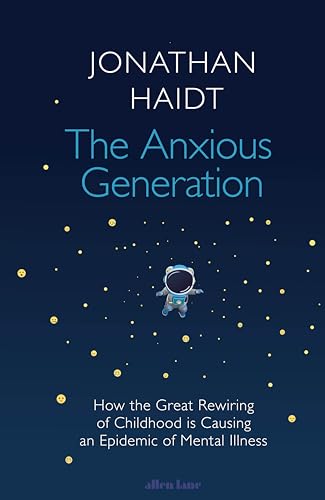
The Anxious Generation: How the Great Rewiring of Childhood Is Causing an Epidemic of Mental Illness – Review in Themelios | TheWeeFlea.com

The Anxious Generation: How the Great Rewiring of Childhood Is Causing an Epidemic of Mental Illness

Written by Jonathan HaidtReviewed By David Robertson

Ethics and Pastoralia

The lecture hall in Sydney University was packed with staff, lecturers, and administrators. There was a sense of anticipation as the American social psychologist, Jonathan Haidt, stood up to speak. What followed was one of the most riveting, stimulating, and challenging talks I have ever heard.

Fast forward four years and we now have the main thesis of that lecture in book form. The Anxious Generation is a tour de force of psychology, biology, philosophy, politics, religion, and culture. Occasionally you will hear of a book being “life changing,” but rarely of one that is “society changing.” However, I suspect that Haidt’s book will find a place in that latter category. For example, the work of Haidt and others has recently led the Australian government to announce that it is going to ban social media for children and younger teenagers.

Haidt’s thesis is straightforward. In 1994–1995 the Internet arrives. It is one of the biggest changes ever in human society and seems overwhelmingly positive. You can now know everything. (Remember Google’s mantra, “you won’t need memory” and motto, “do no evil”?) In 2007 we have the arrival of the smartphone and the thousands of apps. By 2012 there is a noticeable decrease in the mental health of teenagers, especially girls. Haidt links these directly.

There has been significant pushback. For example, Candice L. Odgers has argued that “there is no evidence that using these platforms is rewiring children’s brains or driving an epidemic of mental illness” (“The Great Rewiring: Is Social Media Really Behind an Epidemic of Teenage Mental Illness?,” Nature, 29 March 2024). Yet Haidt, while acknowledging that there were 64 correlational studies, lists a further 22 experimental studies, of which 16 found significant harm. Furthermore, although Haidt accepts that correlation is not necessarily causation, he also argues that there is no other explanation: “Social media use is a cause of anxiety, depression, and other ailments, not just a correlate” (p. 148).

He lists and discusses four significant harms: social deprivation, sleep deprivation, attention fragmentation, and addiction. The average child/teenager spends 7–9 hours a day on the internet—5 hours a day on social media alone. The consequences of this are enormous. Imagine taking seven hours out of your day. What would you have to give up? For teenagers, that includes talking to friends, losing sleep, losing attention (by developing a habit of continuous partial attention), and no real quality human connection.

You do not develop social skills. Your childhood has been transformed by technology from a play-based childhood to a phone-based childhood. There is no time for play, hobbies, face to face contact, and books. In fact, as regards reading, there is some evidence that excessive use of the Internet is rewiring our brains and making it far harder for us to concentrate on, and think, about books. (See, for example, Martin Korte, “The Impact of the Digital Revolution on Human Brain and Behavior: Where Do We Stand?” Dialogues in Clinical Neuroscience 22 [2020]: 101–11).

The overall effect of this, according to Haidt, is that people are not connecting, they are performing. When you play, there are lots of mistakes, but they are low-cost mistakes. But one false move online and your whole life could literally be ruined. Little wonder that this has become the anxious generation!

Chapter 6, on why social media harms girls more than boys, is particularly fascinating. As Haidt explains, girls are more affected by visual social comparison and perfectionism; girls’ aggression is more relational; girls more easily share emotions and disorders. In this regard, he points out, as does Abigail Shrier in her Irreversible Damage: The Transgender Craze Seducing Our Daughters (Washington, DC: Regnery, 2020), that the growth in diagnoses of gender dysphoria, especially among teenage girls, may at least be partially due to social contagion through social media.

Given these disturbing realities, you might expect that this is yet another doom and gloom book, with little hope. And yet Haidt has become more optimistic. More than that, he offers practical solutions—for government, the tech corporations, schools, and parents. He cites what he hopes will become the four norms: (1) no smart phone until 14; (2) no social media until 16; (3) phone-free schools; and (4) more independence and free play. He believes that collective action by schools and parents is more important than government laws and action by the tech corporations. Given that the latter are still deliberately recruiting underage children, it is unlikely that any change will be anything other than cosmetic.

In terms of schools, the real test is to get the whole school to act. FOMO (Fear of Missing Out) is a real problem. But it ceases to be one if no one is missing out. Perhaps churches also need to think in terms of collective action? Perhaps as part of our discipleship we could encourage Christians to read Tony Reinke’s brilliant and practical, 12 Ways Your Phone is Changing You? (Wheaton, IL: Crossway, 2017). At a personal level, I have found the arguments of both Haidt and Reinke to be so persuasive that I have taken all social media off my phone and just use them from my laptop.

One of the ironies of modern society is that the technology which was supposed to free us has ended up imprisoning us. As we have become more “aware,” we have become more anxious. At the Sydney University lecture, Haidt conducted an experiment—he asked members of the audience to shout out when we were first allowed to walk six blocks by ourselves. Most of us were of a generation which said ages 6 and 7. Haidt told us that the norm in the US today was 13 and 14. In order to protect our children from the world, we have imprisoned them and brought the world, in all its harmful forms, into their bedrooms. When I was a child, my mother sent me out to play on old disused fortifications on top of 100 metre cliffs. As a 16-year-old, I hitchhiked round Europe for six weeks. Today any parent permitting such activities would be in danger of being charged with neglect! However, Haidt insists that risk-free play and risk-averse parenting (ironically) lead to greater risk of harm, especially when parents/society do not recognise the harm that is being done when children’s minds are handed over to internet “influencers.”

One of the most challenging parts in the book is chapter 8: “Spiritual Elevation and Degradation.” Haidt’s verdict is confronting: “The phone-based life produces spiritual degradation, not just in adolescents but in all of us” (p. 199). As a pastor, if I had my way, I would ban smartphones from the pew as well as the dinner table, the bedroom, and the classroom!

Haidt argues that the best way to get rid of anxiety is by exposing yourself to what is causing it. In one sense he is right. But in another he misses the greatest antidote to anxiety—the certainty and security that comes from knowing Christ. Every child (and indeed every adult, too) needs to hear and take to heart the words of Jesus: “Therefore I tell you, do not worry about your life, what you will eat or drink; or about your body, what you will wear. Is not life more than food, and the body more than clothes? (Matt 6:25).

The Anxious Generation is a much-needed book, and Christians (especially parents and pastors) will be served well and will serve the emerging generations better by reading, marking, and learning from it. But let us never lose sight of the fact that what this anxious generation needs most of all is the peace of God which passes all understanding (Phil 4:6–7)—even the understanding of a psychologist as insightful as Haidt.

Pride: Identity and the Worship of Self – A review

Fault Lines: The Social Justice Movement and Evangelicalism’s Looming Catastrophe