Tag Archives: salvation

Justification: It’s Nature and Characteristics (Berkhof) | The Reformed Reader Blog

The Bible’s teaching on justification is one of the central points of the Christian faith. In Romans and Galatians, Paul labored to explain that a sinner is justified only by faith in Christ alone. Other Scriptures say the same thing. The 16th-century Protestant Reformers did not make up this doctrine. It is found in Scripture. And it highlights the work of Christ in salvation. For a helpful discussion of this doctrine, Louis Berkhof’s Systematic Theology is a valuable resource. Here’s a section from this ST about justification by faith alone. Take a few moments today to read it slowly. It’s a great gospel truth!

Justification is a judicial act of God, in which He declares, on the basis of the righteousness of Jesus Christ, that all the claims of the law are satisfied with respect to the sinner. It is unique in the application of the work of redemption in that it is a judicial act of God, a declaration respecting the sinner, and not an act or process of renewal, such as regeneration, conversion, and sanctification. While it has respect to the sinner, it does not change his inner life. It does not affect his condition, but his state, and in that respect differs from all the other principal parts of the order of salvation. It involves the forgiveness of sins, and restoration to divine favor.

The Arminian holds that it includes only the former (forgiveness), and not the latter (restoration to divine favor); but the Bible clearly teaches that the fruit of justification is much more than pardon. Those who are justified have “peace with God,” “assurance of salvation,” Rom. 5:1–10, and an “inheritance among them that are sanctified,” Acts 26:18.

The following points of difference between justification and sanctification should be carefully noted:

1. Justification removes the guilt of sin and restores the sinner to all the filial (familial) rights involved in his state as a child of God, including an eternal inheritance. Sanctification removes the pollution of sin and renews the sinner ever-increasingly in conformity with the image of God.

2. Justification takes place outside of the sinner in the tribunal of God, and does not change his inner life, though the sentence is brought home to him subjectively. Sanctification, on the other hand, takes place in the inner life of man and gradually affects his whole being.

3. Justification takes place once for all. It is not repeated, neither is it a process; it is complete at once and for all time. There is no more or less in justification; man is either fully justified, or he is not justified at all. In distinction from it sanctification is a continuous process, which is never completed in this life.

4. While the meritorious cause of both justification and sanctification lies in the merits of Christ, there is a difference in the efficient cause. Speaking economically (of the Trinity), God the Father declares the sinner righteous, and God the Holy Spirit sanctifies him.

 L. Berkhof, Systematic Theology (Grand Rapids, MI: Wm. B. Eerdmans publishing co., 1938), 513–514.

Shane Lems Covenant Presbyterian Church (OPC) Hammond, WI, 54015

Martin Luther: Grace Alone! | The Reformed Reader Blog


This is a repost from March 15, 2011.

Here are some great words from Martin Luther on salvation by grace alone.  These quotes are from a sermon on Titus 3:4-8 and can be found in volume 3 of Baker’s 7-volume set of Luther’s sermons (edited by J. N. Lenker and others).

“So he [Paul in Titus 3:5-7] discards all boasted free will, all human virtue, righteousness, and good works.  He concludes that they are all nothing and are wholly perverted, however brilliant and worthy they may appear, and teaches that we must be saved solely by the grace of God, which is effective for all believers who desire it from a correct conception of their own ruin and nothingness.”

“Yes, dear friend, you must first possess heaven and salvation before you can do good works.  Works never merit heaven; heaven is conferred purely of grace.”

“The delusive doctrine of works blinds the Christian’s eyes, perverts a right understanding of faith, and forces him from the way of truth and salvation.”

“He who does not receive salvation purely through grace, independently of all good works, certainly will never secure it.”

“Truly, then, we are saved by grace alone, without works or other merit.”

“Notice [from John 3:16], all who believe have eternal life.  That being true, believers certainly are just and holy without works.  Works contribute nothing to justification.  It is effected by pure grace richly poured out upon us.”

“We receive absolution [forgiveness] and grace at no cost or labor on our part, but not without cost and labor on the part of Christ.”

“Our salvation must exist, not in our righteousness, but…in Christ’s righteousness. …Let his righteousness and grace, not yours, be your refuge” (p. 3.2.142ff)

Luther’s words remind me of the great hymn by Horatius Bonar that we sometimes sing in worship after the assurance of pardon:

“Thy grace alone O God / to me can pardon speak; / thy power alone O Son of God / can this sore bondage break / No other work save thine / no other blood will do / no strength save that which is divine / can bear me safely through!”

Shane Lems Covenant Presbyterian Church (OPC) Hammond, WI, 54015

Rome is Dead Wrong | SHARPER IRON

The heart of the Protestant Reformation is that God declares you to be righteous by faith alone, in Christ alone. If you don’t believe this, then you do not have the true good news. This doctrine is often called “justification by faith.” It’s a churchy phrase that has lost some of its punch—many Christians know it’s “good,” but perhaps they can’t explain what it means. This article will show how the apostle Paul explains this vital truth. It’s a very big deal. Maybe the biggest deal ever.

The problem

We can trace the “Christian” family through three broad streams:

  1. Eastern Orthodoxy. This stream hails from the traditional Christian lands in modern-day Greece, Turkey, Syria, etc. It largely went its own way after the Western Roman Empire crumbled to bits. We won’t be discussing this tradition here.
  2. Roman Catholicism. This branch developed as a recognizable institution in the remnants of the western Roman Empire beginning from the late 6th century.
  3. Protestants. This is the variegated stream which broke away from the corruption of the Roman Catholic church beginning in the early 16th century, first in modern-day Germany, then in Switzerland, and beyond. If you’re a Christian in the West (that is, you’re not a convictional Roman Catholic and do not belong to a cult), then you’re in the “Protestant” stream—whether you know it or not.

Many churches celebrate “Reformation Sunday” on the Lord’s Day closest to 31 October to commemorate Martin Luther’s challenge to debate a series of theses about reforming the corrupt Roman Catholic church.

The Roman Catholic church believes good and true things about the trinity, about sin, about salvation, about Jesus, the virgin birth, our Savior’s life and death, his resurrection, his ascension, his return, and the new heavens and new earth.

So, what’s the problem?

  • The problem is about the sufficiency of God’s grace by Jesus Christ.
  • How, exactly, do we become Christians?

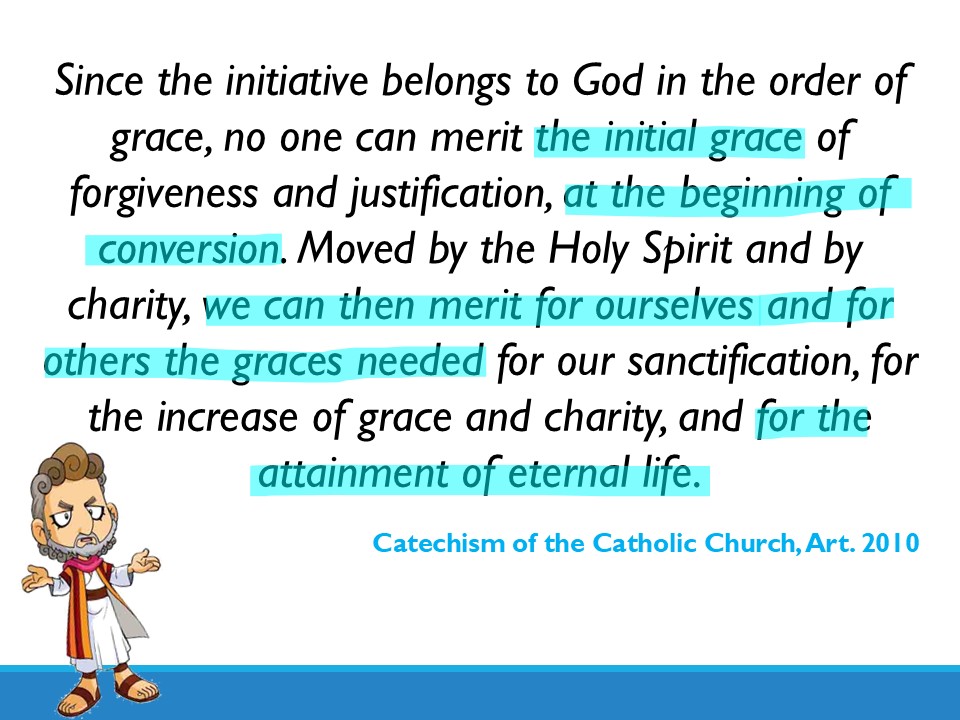
The Roman church teaches the equation: “Jesus + good works = merits eternal life.” It teaches that “Jesus + good works = forgiveness, reconciliation, and divine pardon.” Rome’s catechism explains (Art. 2010):

Rome speaks of “initial grace” and “the beginning of conversion.” There is no before and after. There is no bright line in the sand. Salvation is a cooperative process, not a divine event. Moved by the Spirit and by love, we must do good works to “merit for ourselves” the grace needed for eternal life.

This is heresy. It is false. It is wrong.

The truth is that we must trust in Jesus alone for salvation. God declares us to be righteous on the basis of what Jesus has already done. Based on that declaration, God gives his people legal pardon and personal reconciliation. Rome may speak of grace, charity, and conversion, but it means something very different.

Like all false religions, Rome teaches a version of “resume-ism,” which means trying, in any way, to earn salvation by doing things.

If you don’t believe God exists, then you’re not interested in submitting your resume to God. But, if you do believe he exists, then resume-ism will send you to hell—because it’s wrong.

  • You can talk about Jesus all you want, but in the end it’s about you—what you do, what you bring to the table.
  • The true faith is about Jesus, what he did, how he rescues you, and how God pardons you and declares you to be righteous if you trust in what Christ did for you.

The apostle Paul is against resume-ism. It’s his obsession. As we parachute into our passage at Romans 3:19-31, we learn from the first portion of the chapter that everyone is a sinner, without exception.

  • We’re all in trouble. We’re guilty before the King of the universe.
  • God’s old covenant law tells us how his people ought to act.
  • But we don’t act like that all the time, or even most of the time.
  • Most of us don’t want to act like it either.

So, most people don’t belong to God, because they don’t do what he says, nor do they want to. Now, to our passage.

Righteousness from God

The old covenant law tells God’s people how to live and love him. How to be different, weird, and separate from the world until the Messiah comes. This law speaks to people who are under its authority, “so that every mouth may be silenced and the whole world held accountable to God” (Rom 3:19).

He’s saying the old covenant law silences all excuses and acts as an immovable divine witness to which we are all accountable.

How does this accountability work? Why does it silence us as it confronts us?

Because by means of works of the law (ἐξ ἔργων νόμου) nobody will be declared to be righteous, in God’s sight (Rom 3:20). The word your English bible renders here as “righteous” or “justified” is a legal idea that means moral uprightness. You can’t achieve that by doing the works of the old covenant law—because you’ll keep messing up.

How do we know this? Because the law tells us so, because “through the law we become conscious of our sin” (Rom 3:20).

  • The law brings knowledge of sin.
  • It tells us we’ll always fall short of the mark—somehow, some way.
  • No matter what.
  • 100% guaranteed.

This isn’t good, obviously. If God left it there, some people might think he were cruel. But God is not toying with us. The law isn’t about salvation at all. It isn’t there to make us gnaw our fingernails and fear damnation. That’s just resume-ism talking.

  • Law-keeping does not earn us salvation. It never did.
  • Instead, the old covenant law tells us how to live while we wait for our Rescuer—King Jesus.
  • But this “resume-ism” idea had so infected and twisted the popular Jewish understanding of salvation by Paul’s day (and Jesus,’ too) that in many circles it had become the default gateway to a relationship with God.
  • Trust in the coming Messiah. Do law-keeping really well. Repeat (see Lk 18:9-14).

But, the apostle Paul says, that’s all wrong. It’s always been wrong. Now, separate from the old covenant law (χωρὶς νόμου), righteousness from God has now been made known—testified to by the law and the prophets (Rom 3:21). Resume-ism has nothing to do with the righteousness from God that’s on the table.

If this righteousness from God—the kind that can never come by means of works of the law—is testified to by the law and the prophets … is it a new thing?

Of course not. This isn’t new. It’s simply the re-presentation of something very old. Rome would do well to listen to Paul. If so, it wouldn’t speak of “meriting for ourselves” the grace needed for eternal life.

  • Well, how do you get this righteousness that God is offering? “This righteousness is given through faith in Jesus Christ …” (Rom 3:22). We trust in his faithfulness—that he has been perfect for us, as our delegate and representative.
  • Who can have it? Who is eligible? “… to all who believe” (Rom 3:22).
  • Why is this righteousness open to anyone? “Because there is no distinction [between people]—everyone sins and therefore lacks God’s glory” (Rom 3:22-23, my trans.).

The phrase often translated as “fallen short of the glory of God” means to be deficient—to be missing or lacking something. Without Jesus, we are each missing the righteousness and holiness and love for God he made us to have. Instead, we sin, so we’re broken, and so we “fall short of” (i.e., lack) God’s glory.

So, how does this righteousness from God happen? Why is it by faith alone and not works?

  • Because God declares us to be righteous as a gift, or freely, or gratis (Rom 3:24). This declaration is “on the house.” This means there is no “merit” we bring to the table. Rome is wrong. Dead wrong.
  • God issues this declaration to his people by means of his grace, through the liberation (“redemption”) that comes from Christ Jesus (Rom 3:24).

How so?

Well, “God displayed him publicly as the instrument of forgiveness by his shedding of blood, to be received by special faith. God did this to prove his justice because, due to his long-suffering patience, he had let the sins of the past go unpunished” (Rom 3:25, my trans.).

Jesus is the propitiation or sacrifice of atonement or instrument of forgiveness. How so? By means of his death (ἐν τῷ αὐτοῦ αἵματι).

  • This is a Federal, representative concept (see Rom 5:12f).
  • Like Adam, Jesus is the vicarious representative who acts on behalf of his people. Jesus lives the perfect life we cannot. He dies the criminal death we deserve. He defeats Satan and the curse of death on our behalf. He does this as our Federal representative.
  • Jesus takes our sins upon himself in the same manner as an employer that is legally, vicariously responsible for the actions of its employees.
  • The difference is, of course, that Jesus does this willingly and lovingly.

How do we receive this righteousness from God that Jesus achieves? By faith (Rom 3:24). Not by works. In fact, Jesus has retroactively paid for all the sins he had forgiven on credit from the old covenant days gone by (Rom 3:25).

God has done this as a demonstration or proof of his righteousness—his justice (Rom 3:26). I recently investigated a case in which adoptive parents sexually and physically tortured their adoptive children for years. It would have been evil if the state had opted to “forgive and forget” this. We instinctively know that. Crime demands punishment. Justice must be done. It’s the same with God, and so Jesus’ life—his death as our vicarious representative—is what satisfies the justice required. That’s why Jesus’ life and death demonstrates or proves that God is just.

And whom does God justify? Who does God declare to be righteous? The one with the best resume? The one who does more than the guy next to him? The one who does the most good works? No—it is “those who have faith in Jesus” (Rom 3:26).

The inevitable result of resume-ism is pride and self-satisfaction. But, because we now know that righteousness is a gift from God separate from works, we know that all boasting is excluded. It is shut out by the law of faith (Rom 3:27). It has nothing to do with being a Christian. “For we maintain that a person is justified by faith apart from the works of the law” (Rom 3:28). This is open to any person. Jew. Gentile. Azeri. Afghani. Japanese. God will declare anyone to be righteousness who trusts in Christ for salvation (Rom 3:29-30cp. Gal 3:28-29).

This whole thing (righteousness from God by faith alone, in Christ alone—nothing to do with resume-ism) is not new. The new covenant does not rip up and invalidate the old covenant law. Instead, the apostle Paul declares, it upholds it (Rom 3:31) because Jesus teaches us that the law is about how to live as believersnot how to become a believer.

Why being a Protestant matters

It matters because this is about how you become a Christian. Is Jesus’ grace enough to (a) give us permanent, legal pardon, and (b) permanently heal our broken relationship with God? Or do we need to stir in some resume-ism, too? The apostle Paul says that, because we have been justified by faith, we have peace with God through our Lord Jesus Christ (Rom 5:1).

We’re justified by God because we have faith … in what?

  • That Jesus died for you.
  • That he did it as your vicarious representative, in your place.
  • That resume-ism won’t get you there.
  • That it can’t get you there.

And so, the equation “Jesus + something else = salvation” is wrong. It will send you to hell, because it can’t get you this righteousness from God (Gal 2:21).

  • That means you’re still in trouble, no matter what label you put on yourself.
  • It means you don’t have peace with God through our Lord Jesus Christ, because you haven’t yet trusted in him alone for salvation.
  • You’re still trying to upload your resume to the website.

But God does not want your resume. He wants you to only trust in what his eternal Son has already done for you. He declares you to be righteousness by means of faith and trust in his Son—nothing else. That is the core issue of the Protestant Reformation, and of the true Christian faith.

https://sharperiron.org/article/rome-dead-wrong

What Does “Sola Gratia” Mean? | Ligonier Ministries

One of the mottos associated with the sixteenth-century Reformation is the Latin phrase post tenebras lux (“after darkness, light”). In contrast with the corruption of the Roman Catholic Church, the Reformers saw themselves as rediscovering the light of the gospel of Christ. This doctrine has been traditionally summarized under the five solas of the Reformation. One of these solas is the Latin term sola gratia (“grace alone”). For the Reformers, the doctrine of sola gratia was critical to a right and fully biblical understanding of salvation in Christ. For example, Martin Luther (1483–1546) put it quite clearly: “But no man can be thoroughly humbled until he knows that his salvation is utterly beyond his own powers, devices, endeavors, will, and works, and depends entirely on the choice, will, and work of another, namely, of God alone . . . then he has come close to grace, and can be saved.” In fact, for Luther and the rest of the Reformers, every corruption of the doctrine of sola gratia subtly smuggles human effort through the back door. It is for this reason that a proper understanding of sola gratia is extremely important for Christians today. The purity of the gospel hangs in the balance.

To understand what sola gratia is, we must first understand what sola gratia is not.

Sola gratia is not “grace alone, mostly.”

In other words, sola gratia does not mean that God has accomplished most of the work for our salvation, but there remains a little bit that we need to contribute. God’s grace does not bring us into a state which enables a neutral human response. To do so would put human works in the driver’s seat, since our salvation would then ultimately depend on human action.

Sola gratia does not mean that God accomplished salvation objectively but not subjectively.

To put it another way, sola gratia does not teach us that Christ purchased salvation separate from salvation for you. Redemption is always particular and personal. To deny this is a pious way of smuggling human works into salvation. “Salvation” in Scripture is not the purchase of a thing but the redemption of particular people.

Sola gratia does not mean that only part of salvation comes from grace alone.

Some Christians believe that people come to Christ by their own free choice, and then God sovereignly preserves them in the faith. Others argue that Christians are sovereignly drawn to the faith, but they can lose their salvation at a later point. In both cases, we have inadvertently smuggled human works into salvation. If a human choice (whether before or after conversion) is the determining factor for salvation, then salvation is fundamentally a result of human effort (i.e., works).

So, what does sola gratia mean?

God has accomplished everything necessary for your salvation.

Salvation is not an abstract action, but a gracious redemption accomplished for you. From all eternity, the triune God agreed in covenant to save a people for Himself. The Father chose to elect a people for the Son (Luke 22:29; Eph. 1:3–14), the Son agreed to merit salvation for that people (Ps. 2; John 3:35; 14:31; 15:9), and the Holy Spirit applies salvation to that people (Isa. 63:10–14; Ezek. 36:25–27; 37:14; John 3:5; 14:26; 15:26; 16:7–15; 20:21–23). In this way, salvation was decreed concerning you, earned for you, and applied to you.

Salvation is based on God’s sheer gracious love.

Sola gratia means that your salvation is purely on the basis of God’s sheer gracious love. Paul explains that the salvation of God’s elect is not based on human works or human decisions. Rather, this salvation is entirely credited to the gracious mercy of God distributed to whomever God wills (Rom. 9:15–16, 22–23; cf. Ex. 33:19).

Salvation is of the Lord.

Sola gratia means that from beginning to end, salvation is of the Lord (Ps. 3:8; 62:1; Rom. 8:29–30). God’s sovereign grace does not merely show up before conversion to transform you, nor does God’s sovereign grace merely show up after conversion to preserve you. Instead, from the foundation of the world until the never-ending age to come, God holds His little ones firmly in His hand, and Christ will raise all His people on the last day (John 6:41–46). From start to finish, from election to conversion to heaven, salvation is by God’s grace alone.

For Christians, sola gratia is one of the sweetest teachings in all of Scripture. As Luther explains,

If God works in us, the will is changed, and being gently breathed upon by the Spirit of God, it again wills and acts from pure willingness and inclination and of its own accord, not from compulsion, so that it cannot be turned another way by any opposition, nor be overcome or compelled even by the gates of hell, but it goes on willing and delighting in and loving the good, just as before it willed and delighted in and loved evil.

What shall we say then? How can we respond to such a great salvation? The only possible reply is to fall on our knees before our gracious God in humble awe at His eternal purpose. We ought to cry with thankful tongues, “Lord, why was I a guest?”


Editor’s Note: This article was originally published on November 8, 2022.

http://feeds.ligonier.org/~/926599229/0/ligonierministriesblog

What Was the Cause of the Protestant Reformation? | Ligonier Ministries

What was the matter with the Protestant Reformation? It might seem like a strange question. Some might say that there was nothing the matter with the Reformation, that it was the acme of spiritual recovery of biblical Christianity in church history and therefore was a sort of golden age of biblical faith. Others might say that the matter with the Reformation was that there was one at all, since it produced the largest schism in church history.

That’s not what I mean, however, when I ask about what was the matter with the Protestant Reformation. I’m not using the word matter in the normal way, which typically indicates that something is wrong. When we ask, “What’s the matter with you?” we are assuming that something is wrong or that we’re looking for fault. What I mean, by contrast, is this: What was the essence, the substance, or what is called in philosophy the material cause of the Protestant Reformation? Another way to ask it would be this: What was the chief issue that provoked such massive consequences as this split that occurred in the sixteenth century?

When historians consider the causes of the Protestant Reformation, they often use distinctions originally set forth by the philosopher Aristotle, and they distinguish between the formal cause and the material cause. The formal cause, the intellectual background to the issue, was a dispute over the seat of final authority that binds the Christian conscience. We’ll look at that under the heading of sola Scriptura. The material cause, however, the substantive issue that was the core point of dispute, was the doctrine of justification. The Protestant view of this matter is expressed in the shorthand of the Latin phrase sola fide.

This is the first of the Latin slogans of the Reformation known as the five solas. They are sola fide, justification is by faith alone; sola gratia, salvation is by grace alone; solus Christus, salvation is through Christ alone; sola Scriptura, the sole authority that binds the conscience of the Christian is the Bible alone; and then, finally, soli Deo gloria, to God alone belongs the glory.

Sola fide is shorthand for the central issue of the Reformation, the material cause, which was the question of justification. The Protestant Reformers set forth a doctrine that our justification is by faith and by faith alone without any mixture of good works or merit on our part.

To understand sola fide in its historical context, we have to understand something about the theological dispute based on the Roman Catholic understanding of justification. At the heart of this dispute was not a tangential debate over how many angels can dance on the head of a pin or a needless controversy over pedantic points of theology that only academics care about. Rather, this issue touched the very heart of the Christian faith because the question of justification is designed to answer this deeper question: How can an unjust person possibly survive the judgment of a just and holy God?

In our day, the doctrine of justification has been degraded in terms of its perceived importance. Historically, the differences among churches over how we obtain a right standing before God were considered significant; those differences have now been minimized as having no great weight. We’re living in a time of relativism, which says that there is no objective truth, and pluralism, which declares that there are many different approaches to truth and views of truth. Therefore, people assert, doctrinal issues should never divide us because what really counts are personal relationships, not doctrine. That notion is propounded even though the New Testament is replete with Apostolic concern about correct doctrine. Sadly, that’s not where the church is in this day and age, and sometimes we have to ask, Why?

Some people are in church Sunday after Sunday, are continually exposed to the preaching of the gospel, and are members of the church but have never really committed their lives to Christ. Such people, despite appearances, are under threat of the judgment of hell because they have not truly embraced the gospel of Christ. Those who reject the gospel of Christ stay in their sins and remain unjustified.

Think back to the Old Testament to David’s rhetorical question, “If you, O Lord, should mark iniquities, O Lord, who could stand?” (Ps. 130:3). It’s rhetorical because the answer is obvious: no one. The promise of God that a day of judgment is coming—that all men will be brought into His courtroom and will be judged according to the bar of His perfect righteousness, and that those who are found wanting will be sent into the abyss of hell—is a doctrine that many in the church don’t believe anymore. If the church did believe it, it would preach it, and if it did believe it, justification would be just as much a theological issue today as it was in the sixteenth century.

If we are going to understand the upheaval that came about in the sixteenth century, we have to understand that the church at that time believed in the last judgment. The church at that time believed in the wrath of God. The church at that time believed in the justice of God. The church at that time believed in hell. That’s why the central question was, How can I be saved?

People nowadays often think of being saved in terms of relationships and dynamics in this world. We are saved from bad habits, addictions, social failure, psychological deficiency, broken relationships, and so on. We are so concerned about the relationships that we have in this world that we don’t even worry about the relationship that we have with a just and holy God. But the Christian faith ultimately is not the restoration of human relationships; the Christian faith at its root has to do with the repair of our relationship to God. At the center are these questions: How can a sinner escape the judgment of God? How can a sinner possibly be accepted in God’s judgment?

Something about the Reformation may come as a surprise to many Protestants. The Roman Catholic Church, in the sixteenth century just as now, believed that justification is by faith, by grace, and by Christ. Three of the issues that are captured in the essence of Protestant thinking are sola fide, by faith alone; sola gratia, by grace alone; and solus Christus, through Christ alone. Because of these solas, many Protestants think that the Roman Catholic Church did not believe in justification by faith or in justification by grace or in justification by Christ—but that’s simply not true.

Very early, the church had to combat the heresy of Pelagius, an Irish monk who challenged Augustine of Hippo and taught that people can be saved without grace and that people can achieve lives of perfect righteousness without any assistance from God. According to Pelagius, people don’t need grace and they don’t need the help of Christ; he said that grace and Christ facilitate salvation—that is, they assist in the process—but that they’re not absolutely necessary because we have it in our own power to live lives of perfect righteousness.

We must understand that the Roman Catholic Church has roundly condemned Pelagianism, time and time again. The Roman Catholic Church emphatically does not believe that people can be saved by their own righteousness without any help from God. Rather, the Roman Catholic Church teaches that faith is a prerequisite and does three things for justification. First, faith is what Rome calls the initium—that is, the initiation or the beginning of justification. Second, faith is the fundamentum or the foundation of justification. Finally, faith is the radix or the root of justification. To say that the Roman Catholic Church doesn’t believe that faith is necessary for salvation is simply slanderous.

Further, the Roman Catholic Church has always taught that grace is necessary as a prerequisite for justification and that without the grace of God infused into the soul through the sacraments, we’d be without hope, having to try to earn our way into heaven on the ground and basis of our own righteousness and our own merit. Finally, the Roman Catholic Church affirms the necessity of the atonement of Christ and of the work of Christ to help us in our justification.

Rome believes that justification is by faith, by grace, and by Christ. But Rome does not believe that justification is by faith alone or by grace alone or by Christ alone. Rather, justification involves other elements. In the Roman Catholic view, faith plus works gives us justification; grace* plus* merit gives us justification; Christ plus our inherent righteousness gives us justification. The Reformers strenuously objected to these teachings, saying that our works do not count toward our justification, that we have no merit of our own of any kind that we bring before God. As the hymn writer Augustus Toplady wrote in “Rock of Ages,” “Nothing in my hand I bring, simply to thy cross I cling.”

According to the Roman Catholic Church, justification begins with baptism. Baptism is called the instrumental cause of justification. We earlier mentioned the distinctions that Aristotle made between different types of causes, and to illustrate these distinctions he talked about sculpting a statue. The material cause of the statue is the stone out of which the statue is made. The efficient cause is the sculptor. The instrumental cause is the chisel and the hammer, the tools that the sculptor uses. According to the Roman Catholic Church, the tool or instrument that God uses to bring justification to sinners is baptism. The person who is baptized receives an infusion of justifying grace, or the grace of the righteousness of Christ. That is, in baptism, something happens inwardly—the soul is infused with divine grace. If the person who is baptized cooperates with that infused or poured-in grace in baptism and assents to it, then he is in a state of justification.

In the Roman Catholic system, justification does not necessarily endure forever, however. A baptized and justified person will remain in the state of justification until or unless he commits a mortal sin. A mortal sin is so called because it kills the grace that is poured into the soul at baptism. The person who commits a mortal sin must then be justified again—but not through baptism. Justification is restored through the sacrament of penance. This sacrament is defined by the Roman Catholic Church as the second plank of justification for those who have made shipwreck of their souls. The first plank is baptism, and the second plank is penance.

According to the Roman Catholic Church, then, justification is acquired instrumentally through the sacraments. The Reformers responded that the instrumental cause of our justification is not baptism or penance; it is faith in Christ. Faith and faith alone is the tool or instrument that links us to Christ and all that He has done for us and by which we are made just in the sight of God.

http://feeds.ligonier.org/~/926509412/0/ligonierministriesblog

“Drunk on Their Own Virtue” | Cranach by Gene Veith

Self-righteousness can lead to unrighteousness.  Our conviction about how good we are can lead us to do evil things.

After all, we reason, I am a good person; therefore, what I do must be good.  A good end justifies evil means.

This has to be one of the most twisted phenomena of our fallen condition, that our very virtues can lead us to sin.

The thought came to me while reading John Noonan’s essay The Guillotine of Goodness.  Writing in the aftermath of Charlie Kirk’s murder, Noonan is complaining about the voices on social media that celebrated his killing on ostensibly moral grounds.  The same thing happened with the hero-worship of Luigi Mangione, murderer of the United Health Care executive.  This is the thinking that motivates terrorists and the people who approve of them.   Noonan writes,

Progressives have become prone to replacing the moral vacuum created by the departure of religion and civic allegiance with politics. They have become drunk on righteousness, high on their own ideological supply. They have assigned moral value to their political ideals, which can best be summarized as “my beliefs make me a good person and all behavior in pursuit of those beliefs is justified.”

This is nothing new, of course.  Noonan cites the wielders of the guillotine during the French Revolution:

The joyful exaltations of Too Online leftists, delighted by the violence and assured in the sanctity of their beliefs, invoke the Jacobins’ cheers that drowned the Place de la Révolution at each thump of the French guillotine. A mortified Englishman observed, “When the knife has done its work, they cry out, ‘Vive la République!’ as if some great victory had been won.”. . .

“Terror,” lectured Maximilien Robespierre after sending 1,300 people to the guillotine in a month, “is nothing other than prompt, severe, inflexible justice; it is therefore an emanation of virtue.”

They are all, Noonan says, “drunk on their own virtue.”

But progressives and left-wing revolutionaries are not the only ones guilty of this.  Conservatives sometimes slip into this mindset.  So do Christians.

This happens not just in the dramatic cases of killing people and approving of murder.  It is even more common in our everyday relationships, our virtue signaling, and our constant self-justifications.  Self-justification can indeed lead to our approval of oor participation in horrendous crimes, but it more normally leads to petty rationalizations and stupid arguments with people we care about.

The antidote to self-justification is, of course, justification by grace through faith in Christ and His atonement.  That kind of justification begins by acknowledging ourselves as a lost and desperate sinner.  Thus broken by the law, we can cling to the gospel, that Christ bore our sin and the sin of our adversaries, covering them with His blood.

In his book  Living by Faith Oswald Bayer, writes about our constant habit of self-justification.  From a post I wrote ten years ago on that book:

Bayer begins by showing that the concept of “justification” is not an arcane theological concept.  Rather, it’s something we are preoccupied with all the time.  We are always engaged in trying to justify ourselves.  We are always maintaining that we are right, particularly when other people say that we are wrong.  At work, in our casual conversations, in our relationships with others, we are always defending ourselves, making excuses, scoring points, and seeking approval. . . .

Underlying the need to be justified, Bayer says, is our yearning for approval, for affirmation, for thinking that our existence matters in some positive way, for our need to think that our life is worthwhile.

That we all are engaged in justifying ourselves is an understandable, normal facet of being human.  Of course, we are not always right and are often wrong–though we continue to justify ourselves–creating all kinds of inner turmoil.  The problem, though, is that we are trying to justify ourselves.

. . . .What if, instead of having to justify ourselves, we are justified by Christ?  What if Christ gives us approval, affirmation, assurance that our existence matters, that our life is worthwhile?

The grace of God–in the life, death, and resurrection of Christ–forgives our wrongdoing and makes us “right.”  Thus,  on the deepest level, we do not have to justify ourselves because Christ has justified us.  Believing in His Word of justification is faith.  And living in that realization is what it means to live by faith.


Illustration:  The Execution of Robespierre (1794) via Picryl, Public Domain

Source: “Drunk on Their Own Virtue”

Justifying Faith: Not Doing, but Receiving | The Reformed Reader Blog

(This was originally posted in March 2016.)

At its core, justifying faith is not defined by doing, working, performing, or earning.  Paul so clearly says that a sinner is justified by faith apart from works (Rom. 3:28, Gal. 2:16).  Salvation from sin, misery, and death is a divine gift of sovereign grace, not the reward for work done (Rom. 4:1-5).  A sinner is justified by receiving a gift – Christ and all his benefits.  We are justified by faith alone (apart from works) in Christ alone (in “no one” or “nothing else” at all).  J. G. Machen explains this well:

“That is the center of the Christian religion – the absolutely undeserved and sovereign grace of God, saving sinful men by the gift of Christ upon the cross. Condemnation comes by merit; salvation comes only by grace: condemnation is earned by man; salvation is given by God. The fact of the grace of God runs through the New Testament like a golden thread; indeed for it the New Testament exists. It is found in the words which Jesus spoke in the days of His flesh, as in the parables of the servant coming in from the field and of the laborers in the vineyard; it is found more fully set forth after the redeeming work was done, after the Lord had uttered his triumphant “It is finished” upon the cross. Everywhere the basis of the New Testament is the same — the mysterious, incalculable, wondrous, grace of God, “The wages of sin is death; but the gift of God is eternal life through Jesus Christ our Lord.

“The reception of that gift is faith: faith means not doing something but receiving something; it means not the earning of a reward but the acceptance of a gift. A man can never be said to obtain a thing for himself if be obtains it by faith; indeed to say that he obtains it by faith is only another way of saying that he does not obtain it for himself but permits another to obtain it for him. Faith, in other words, is not active but passive; and to say that we are saved by faith is to say that we do not save ourselves but are saved only by the one in whom our faith is reposed; the faith of man presupposes the sovereign grace of God.”

J. G. Machen, What Is Faith?, p. 194-195.

Shane Lems Covenant Presbyterian Church (OPC) Hammond, WI, 54015

WEEK 40 | IMITATING THE FAITH OF ABRAHAM

ROMANS 4:1-25

What then shall we say that Abraham, our forefather according to the flesh, has found? For if Abraham was justified by works, he has something to boast about, but not before God. For what does the Scripture say? “Abraham believed God, and it was credited to him as righteousness.” Now to the one who works, his wage is not credited as a favor, but as what is due. But to the one who does not work, but believes in Him who justifies the ungodly, his faith is credited as righteousness, just as David also speaks of the blessing on the man to whom God credits righteousness apart from works: “Blessed are those whose lawless deeds have been forgiven, and whose sins have been covered. Blessed is the man whose sin the Lord will not take into account.”
Is this blessing then on the circumcised, or on the uncircumcised also? For we say, “Faith was credited to Abraham as righteousness.” How then was it credited? While he was circumcised, or uncircumcised? Not while circumcised, but while uncircumcised; and he received the sign of circumcision, a seal of the righteousness of the faith which he had while uncircumcised, so that he might be the father of all who believe without being circumcised, that righteousness might be credited to them, and the father of circumcision to those who not only are of the circumcision, but who also follow in the steps of the faith of our father Abraham which he had while uncircumcised.
For the promise to Abraham or to his descendants that he would be heir of the world was not through the Law, but through the righteousness of faith. For if those who are of the Law are heirs, faith is made void and the promise is nullified; for the Law brings about wrath, but where there is no law, there also is no violation.
For this reason it is by faith, in order that it may be in accordance with grace, so that the promise will be guaranteed to all the descendants, not only to those who are of the Law, but also to those who are of the faith of Abraham, who is the father of us all, (as it is written, “A father of many nations have I made you”) in the presence of Him whom he believed, even God, who gives life to the dead and calls into being that which does not exist. In hope against hope he believed, so that he might become a father of many nations according to that which had been spoken, “So shall your descendants be.” Without becoming weak in faith he contemplated his own body, now as good as dead since he was about a hundred years old, and the deadness of Sarah’s womb; yet, with respect to the promise of God, he did not waver in unbelief but grew strong in faith, giving glory to God, and being fully assured that what God had promised, He was able also to perform. Therefore it was also credited to him as righteousness. Now not for his sake only was it written that it was credited to him, but for our sake also, to whom it will be credited, as those who believe in Him who raised Jesus our Lord from the dead, He who was delivered over because of our transgressions, and was raised because of our justification.

OUR FATHER, there are people who believe
some ritual, rite, ceremony, or moral act
will earn righteousness and reconciliation with You,
but Your Word is clear: that belief is false.
We learn this especially from the example of Abraham,
who received righteousness freely,
by imputation from You,
because he believed in the One who justifies the ungodly.

No one is godly apart from Your doing.
Abraham was blessed with the faith to take You at Your Word,
and it was credited to him as righteousness
before the rite of circumcision was established.

Thus in the opening chapters of Genesis
the way of salvation was set forth clearly for us.
It is always and only by grace through faith,
lest anyone should boast.

We acknowledge with gratitude that salvation is provided
fully and freely by grace
to those who put their faith in the Lord Jesus Christ.
Thank You for the grace that saves ungodly sinners like us
who, left to ourselves and our own efforts,
could never gain righteousness and would all perish in hell.
We come before You to celebrate Your grace
in the power of the gospel,
which has captured our souls for eternal life
and our hearts for joyful worship.

So we come as undeserving sinners
who have simply trusted Christ.
We look to Him alone for righteousness and reconciliation,
fully realizing we have no capacity
to satisfy Your holy standards on our own.

Work in us, we pray, a faith like Abraham’s
to take You at Your Word.
May it be steadfast and not marred by any doubts!
Confessing and setting aside our own sins and selves,
we praise You for the greatness of
Your mercy, grace, love, and pure goodness
that will bring us to glory through Christ our Savior.
Receive our worship, for we bring it in His name. Amen.

MacArthur, J. (2014). A Year of Prayer: Growing Closer to God Week After Week (pp. 187–189). Harvest House Publishers.

The Five Solas of the Reformation | Key Life

Roused to action by the corruption and abuses they saw in the Roman Catholic church of the time, visionary pastors and leaders like Martin Luther and John Calvin spearheaded a movement that transformed Christianity and eventually led to the emergence of the Protestant denominations that exist today.

The Reformers were guided by the conviction that the church of their day had drifted away from the essential, original teachings of Christianity, especially in regard to what it was teaching about salvation—how people can be forgiven of sin through the death and resurrection of Jesus Christ and receive eternal life with God. The Reformation sought to re-orient Christianity on the original message of Jesus and the early church.

The Five Solas are five Latin phrases (or slogans) that emerged during the Reformation to summarize the Reformers’ theological convictions about the essentials of Christianity.

The Five Solas are:

  1. Sola Scriptura (“Scripture alone”): The Bible alone is our highest authority.
  2. Sola Fide (“faith alone”): We are saved through faith alone in Jesus Christ.
  3. Sola Gratia (“grace alone”): We are saved by the grace of God alone.
  4. Solus Christus (“Christ alone”): Jesus Christ alone is our Lord, Savior, and King.
  5. Soli Deo Gloria (“to the glory of God alone”): We live for the glory of God alone.

Let’s have a brief look at each of these five statements.

SOLA SCRIPTURA

The Scriptures are our ultimate and trustworthy authority for faith and practice. This doesn’t mean that the Bible is the only place where truth is found, but it does mean that everything else we learn about God and his world, and all other authorities, should be interpreted in light of Scripture. The Bible gives us everything we need for our theology.

Every word of the 66 books of the Bible is inspired by God’s Holy Spirit. The Holy Spirit also helps us to understand and obey Scripture.

When rightly interpreted, the Bible is about Jesus Christ and his role as God and Savior. Additionally, Scripture is profitable for teaching, reproof, correction, and training in righteousness.

SOLA FIDE AND SOLA GRATIA 

We are saved solely through faith in Jesus Christ because of God’s grace and Christ’s merit alone. We are not saved by our merits or declared righteous by our good works. God grants salvation not because of the good things we do, and despite our sin.

As humans, we inherited (from our ancestor Adam) a nature that is enslaved to sin. Because of our nature, we are naturally enemies of God and lovers of evil. We need to be made alive (regenerated) so that we can even have faith in Christ. God graciously chooses to give us new hearts so that we trust in Christ and are saved through faith alone.

God graciously preserves us and keeps us. When we are faithless toward him, he is still faithful.

We can only stand before God by his grace as he mercifully attributes to us the righteousness of Jesus Christ and attributes to him the consequences of our sins. Jesus’ life of perfect righteousness is counted as ours, and our records of sin and failure were counted to Jesus when he died on the cross.

Sola fide and sola gratia express the teaching of Ephesians 2:8-10:

“For by grace you have been saved through faith. And this is not your own doing; it is the gift of God, not a result of works, so that no one may boast. For we are his workmanship, created in Christ Jesus for good works, which God prepared beforehand, that we should walk in them.”

SOLUS CHRISTUS

God has given the ultimate revelation of himself to us by sending Jesus Christ, the Son of God. Only through God’s gracious self-revelation in Jesus do we come to a saving and transforming knowledge of God.

Jesus Christ is the only mediator between God and humanity. Because God is holy and all humans are sinful and sinners, we need a Savior who mediates between us and God. Neither religious rituals nor good works mediate between us and God. There is no other name by which a person can be saved other than the name of Jesus. Jesus intercedes on our behalf, and his sacrificial death alone can atone for sin.

SOLI DEO GLORIA

Glory belongs to God alone. God’s glory is the central motivation for salvation, not improving the lives of people—though that is a wonderful by product. God is not a means to an end—he is the means and the end.

The goal of all of life is to give glory to God alone: “Whether you eat or drink, or whatever you do, do all to the glory of God” (1 Corinthians 10:31). As The Westminster Catechism says, the chief purpose of human life is “to glorify God and enjoy him forever.”

The post The Five Solas of the Reformation appeared first on Key Life.

The Augsburg Confession

Contents

Introduction

Preface to the Emperor Charles V

The Chief Articles of Faith

Article I: Of God

Article II: Of Original Sin

Article III: Of the Son of God

Article IV: Of Justification

Article V: Of the Ministry

Article VI: Of New Obedience

Article VII: Of the Church

Article VIII: What the Church Is

Article IX: Of Baptism

Article X: Of the Lord’s Supper

Article XI: Of Confession

Article XII: Of Repentance

Article XIII: Of the Use of the Sacraments

Article XIV: Of Ecclesiastical Order

Article XV: Of Ecclesiastical Usages

Article XVI: Of Civil Affairs

Article XVII: Of Christ’s Return to Judgment

Article XVIII: Of Free Will

Article XIX: Of the Cause of Sin

Article XX: Of Good Works

Article XXI: Of the Worship of the Saints

Articles in Which are Reviewed the Abuses which have been Corrected

Article XXII: Of Both Kinds in the Sacrament

Article XXIII: Of the Marriage of Priests

Article XXIV: Of the Mass

Article XXV: Of Confession

Article XXVI: Of the Distinction of Meats

Article XXVII: Of Monastic Vows

Article XXVIII: Of Ecclesiastical Power

Conclusion

Introduction

In 1530, Charles V, Emperor of the Holy Roman Empire, called together the princes and cities of his German territories in a Diet at Augsburg. He sought unity among them to fend off the attacks of Turkish armies in Eastern Austria. He called upon the Lutheran nobility to explain their religious convictions, with the hope that the controversy swirling around the challenge of the Reformation might be resolved. To this end, Philip Melanchthon, a close friend of Martin Luther and a Professor of New Testament at Wittenberg University, was called upon to draft a common confession for the Lutheran Lords and Free Territories. The resulting document, the Augsburg Confession was presented to the emperor on June 25, 1530.

PREFACE

to the Emperor Charles V.

Most Invincible Emperor, Caesar Augustus, Most Clement Lord: Inasmuch as Your Imperial Majesty has summoned a Diet of the Empire here at Augsburg to deliberate concerning measures against the Turk, that most atrocious, hereditary, and ancient enemy of the Christian name and religion, in what way, namely, effectually to withstand his furor and assaults by strong and lasting military provision; and then also concerning dissensions in the matter of our holy religion and Christian Faith, that in this matter of religion the opinions and judgments of the parties might be heard in each other’s presence; and considered and weighed among ourselves in mutual charity, leniency, and kindness, in order that, after the removal and correction of such things as have been treated and understood in a different manner in the writings on either side, these matters may be settled and brought back to one simple truth and Christian concord, that for the future one pure and true religion may be embraced and maintained by us, that as we all are under one Christ and do battle under Him, so we may be able also to live in unity and concord in the one Christian Church.

And inasmuch as we, the undersigned Elector and Princes, with others joined with us, have been called to the aforesaid Diet the same as the other Electors, Princes, and Estates, in obedient compliance with the Imperial mandate, we have promptly come to Augsburg, and — what we do not mean to say as boasting — we were among the first to be here.

Accordingly, since even here at Augsburg at the very beginning of the Diet, Your Imperial Majesty caused to be proposed to the Electors, Princes, and other Estates of the Empire, amongst other things, that the several Estates of the Empire, on the strength of the Imperial edict, should set forth and submit their opinions and judgments in the German and the Latin language, and since on the ensuing Wednesday, answer was given to Your Imperial Majesty, after due deliberation, that we would submit the Articles of our

Confession for our side on next Wednesday, therefore, in obedience to Your Imperial Majesty’s wishes, we offer, in this matter of religion, the Confession of our preachers and of ourselves, showing what manner of doctrine from the Holy Scriptures and the pure Word of God has been up to this time set forth in our lands, dukedoms, dominions, and cities, and taught in our churches.

And if the other Electors, Princes, and Estates. of the Empire will, according to the said Imperial proposition, present similar writings, to wit, in Latin and German, giving their opinions in this matter of religion, we, with the Princes and friends aforesaid, here before Your Imperial Majesty, our most clement

Lord are prepared to confer amicably concerning all possible ways and means, in order that we may come together, as far as this may be honorably done, and, the matter between us on both sides being peacefully discussed without offensive strife, the dissension, by God’s help, may be done away and brought back to one true accordant religion; for as we all are under one Christ and do battle under Him, we ought to confess the one Christ, after the tenor of Your Imperial Majesty’s edict, and everything ought to be conducted according to the truth of God; and this it is what, with most fervent prayers, we entreat of God.

However, as regards the rest of the Electors, Princes, and Estates, who constitute the other part, if no progress should be made, nor some result be attained by this treatment of the cause of religion after the manner in which Your Imperial Majesty has wisely held that it should be dealt with and treated namely, by such mutual presentation of writings and calm conferring together among ourselves, we at least leave with you a clear testimony, that we here in no wise are holding back from anything that could bring about Christian concord, — such as could be effected with God and a good conscience, — as also Your Imperial Majesty and, next, the other Electors and Estates of the Empire, and all who are moved by sincere love and zeal for religion, and who will give an impartial hearing to this matter, will graciously deign to take notice and to understand this from this Confession of ours and of our associates.

Your Imperial Majesty also, not only once but often, graciously signified to the Electors Princes, and Estates of the Empire, and at the Diet of Spires held A. D. 1526, according to the form of Your Imperial instruction and commission given and prescribed, caused it to be stated and publicly proclaimed that Your Majesty, in dealing with this matter of religion, for certain reasons which were alleged in Your Majesty’s name, was not willing to decide and could not determine anything, but that Your Majesty would diligently use Your Majesty’s office with the Roman Pontiff for the convening of a General Council. The same matter was thus publicly set forth at greater length a year ago at the last Diet which met at Spires.  There Your Imperial Majesty, through His Highness Ferdinand, King of Bohemia and Hungary, our friend and clement Lord, as well as through the Orator and Imperial Commissioners caused this, among other things, to be submitted: that Your Imperial Majesty had taken notice of; and pondered, the resolution of Your Majesty’s Representative in the Empire, and of the President and Imperial Counselors, and the Legates from other Estates convened at Ratisbon, concerning the calling of a Council, and that your Imperial Majesty also judged it to be expedient to convene a Council; and that Your Imperial Majesty did not doubt the Roman Pontiff could be induced to hold a General Council, because the matters to be adjusted between Your Imperial Majesty and the Roman Pontiff were nearing agreement and Christian reconciliation; therefore Your Imperial Majesty himself signified that he would endeavor to secure the said Chief Pontiff’s consent for convening, together with your Imperial Majesty such General Council, to be published as soon as possible by letters that were to be sent out.

If the outcome, therefore, should be such that the differences between us and the other parties in the matter of religion should not be amicably and in charity settled, then here, before Your Imperial Majesty we make the offer in all obedience, in addition to what we have already done, that we will all appear and defend our cause in such a general, free Christian Council, for the convening of which there has always been accordant  action and agreement of votes in all the Imperial Diets held during Your Majesty’s reign, on the part of the Electors, Princes, and other Estates of the Empire. To the assembly of this General Council, and at the same time to Your Imperial Majesty, we have, even before this, in due manner and form of law, addressed ourselves and made appeal in this matter, by far the greatest and gravest. To this appeal, both to Your Imperial Majesty and to a Council, we still adhere; neither do we intend nor would it be possible for us, to relinquish it by this or any other document, unless the matter between us and the other side, according to the tenor of the latest Imperial citation should be amicably and charitably settled, allayed, and brought to Christian concord; and regarding this we even here solemnly and publicly testify.

Article I

Of God

Our Churches, with common consent, do teach that the decree of the Council of Nicaea concerning the Unity of the Divine Essence and concerning the Three Persons, is true and to be believed without any doubting; that is to say, there is one Divine Essence which is called and which is God: eternal, without body, without parts, of infinite power, wisdom, and goodness, the Maker and Preserver of all things, visible and invisible; and yet there are three Persons, of the same essence and power, who also are co-eternal, the Father the Son, and the Holy Ghost. And the term “person” they use as the Fathers have used it, to signify, not a part or quality in another, but that which subsists of itself.

They condemn all heresies which have sprung up against this article, as the Manichaeans, who assumed two principles, one Good and the other

Evil-also the Valentinians, Arians, Eunomians, Mohammedans, and all such. They condemn also the Samosatenes, old and new, who, contending that there is but one Person, sophistically and impiously argue that the Word and the Holy Ghost are not distinct Persons, but that “Word” signifies a spoken word, and “Spirit” signifies motion created in things.

Article II

Of Original Sin

Also they teach that since the fall of Adam all men begotten in the natural way are born with sin, that is, without the fear of God, without trust in God, and with concupiscence; and that this

disease, or vice of origin, is truly sin, even now condemning and bringing eternal death upon those not born again through Baptism and the Holy Ghost.

They Condemn the Pelagians and others who deny that original depravity is sin, and who, to obscure the glory of Christ’s merit and benefits, argue that man can be justified before God by his own strength and reason.

Article III

Of the Son of God

Also they teach that the Word, that is, the Son of God, did assume the human nature in the womb of the blessed Virgin Mary, so that there are two natures, the divine and the human, inseparably enjoined in one Person, one Christ, true God and true man, who was born of the Virgin Mary, truly suffered, was crucified, dead, and buried, that He might reconcile the Father unto us, and be a sacrifice, not only for original guilt, but also for all actual sins of men

He also descended into hell, and truly rose again the third day; afterward He ascended into heaven that He might sit on the right hand of the Father, and forever reign and have dominion over all creatures, and sanctify them that believe in Him, by sending the Holy Ghost into their hearts, to rule, comfort, and quicken them, and to defend them against the devil and the power of sin.

The same Christ shall openly come again to judge the quick and the dead, etc., according to the Apostles’ Creed.

Article IV

Of Justification

Also they teach that men cannot be justified before God by their own strength, merits, or works, but are freely justified for Christ’s sake, through faith, when they believe that they are received into favor, and that their sins are forgiven for Christ’s sake, who, by His death, has made satisfaction for our sins. This faith God imputes for righteousness in His sight. Romans 3 and 4.

Article V

Of the Ministry

That we may obtain this faith, the Ministry of Teaching the Gospel and administering the Sacraments was instituted. For through the Word and Sacraments, as through instruments, the Holy Ghost is given, who works faith; where and when it pleases God, in them that hear the Gospel, to wit, that God, not for our own merits, but for Christ’s sake, justifies those who believe that they are received into grace for Christ’s sake.

They condemn the Anabaptists and others who think that the Holy Ghost comes to men without the external Word, through their own preparations and works.

Article VI

Of New Obedience

Also they teach that this faith is bound to bring forth good fruits, and that it is necessary to do good works commanded by God, because of God’s will, but that we should not rely on those works to merit justification before God. For remission of sins and justification is apprehended by faith, as also the voice of Christ attests: When ye shall have done all these things, say: We are unprofitable servants. Luke 17:10. The same is also taught by the Fathers. For Ambrose says: It is ordained of God that he who believes in Christ is saved, freely receiving remission of sins, without works, by faith alone.

Article VII

Of the Church

Also they teach that one holy Church is to continue forever. The Church is the congregation of saints, in which the Gospel is rightly taught and the Sacraments are rightly administered.

And to the true unity of the Church it is enough to agree concerning the doctrine of the Gospel and the administration of the Sacraments. Nor is it necessary that human traditions, that is, rites or ceremonies, instituted by men, should be everywhere alike. As Paul says: One faith, one Baptism, one God and Father of all, etc. Ephesians 4:5. 6.

Article VIII

What the Church Is

Although the Church properly is the congregation of saints and true believers, nevertheless, since in this life many hypocrites and evil persons are mingled therewith, it is lawful to use Sacraments administered by evil men, according to the saying of Christ: The Scribes and the Pharisees sit in Moses’ seat, etc. Matthew 23:2. Both the Sacraments and Word are effectual by reason of the institution and commandment of Christ, notwithstanding they be administered by evil men.

They condemn the Donatists, and such like, who denied it to be lawful to use the ministry of evil men in the Church, and who thought the ministry of evil men to be unprofitable and of none effect.

Article IX

Of Baptism

Of Baptism they teach that it is necessary to salvation, and that through Baptism is offered the grace of God, and that children are to be baptized who, being offered to God through Baptism are received into God’s grace.

They condemn the Anabaptists, who reject the baptism of children, and say that children are saved without Baptism.

Article X

Of the Lord’s Supper

Of the Supper of the Lord they teach that the Body and Blood of Christ are truly present, and are distributed to those who eat the Supper of the Lord; and they reject those that teach otherwise.

Article XI

Of Confession

Of Confession they teach that Private Absolution ought to be retained in the churches, although in confession an enumeration of all sins is not necessary. For it is impossible according to the Psalm: Who can understand his errors? Psalm 19:12.

Article XII

Of Repentance

Of Repentance they teach that for those who have fallen after Baptism there is remission of sins whenever they are converted and that the Church ought to impart absolution to those thus returning to repentance. Now, repentance consists properly of these two parts: One is contrition, that is, terrors smiting the conscience through the knowledge of sin; the other is faith, which is born of the Gospel, or of absolution, and believes that for Christ’s sake, sins are forgiven, comforts the conscience, and delivers it from terrors. Then good works are bound to follow, which are the fruits of repentance.

They condemn the Anabaptists, who deny that those once justified can lose the Holy Ghost. Also those who contend that some may attain to such perfection in this life that they cannot sin.

The Novatians also are condemned, who would not absolve such as had fallen after Baptism, though they returned to repentance.

They also are rejected who do not teach that remission of sins comes through faith but command us to merit grace through satisfactions of our own.

Article XIII

Of the Use of the Sacraments

Of the Use of the Sacraments they teach that the Sacraments were ordained, not only to be marks of profession among men, but rather to be signs and testimonies of the will of God toward us, instituted to awaken and confirm faith in those who use them. Wherefore we must so use the Sacraments that faith be added to believe the promises which are offered and set forth through the Sacraments.

They therefore condemn those who teach that the Sacraments justify by the outward act, and who do not teach that, in the use of the Sacraments, faith which believes that sins are forgiven, is required.

Article XIV

Ocalled.

Of Ecclesiastical Order

Of Ecclesiastical Order they teach that no one should publicly teach in the Church or administer the Sacraments unless he be regularly

Article XV

Of Ecclesiastical Usages

f Usages in the Church they teach that those ought to be observed which may be observed without sin, and which are profitable unto tranquillity and good order in the Church, as particular holy-days, festivals, and the like.

Nevertheless, concerning such things men are admonished that consciences are not to be burdened, as though such observance was necessary to salvation.

They are admonished also that human traditions instituted to propitiate God, to merit grace, and to make satisfaction for sins, are opposed to the Gospel and the doctrine of faith. Wherefore vows and traditions concerning meats and days, etc., instituted to merit grace and to make satisfaction for sins, are useless and contrary to the Gospel.

Article XVI

Of Civil Affairs

Of Civil Affairs they teach that lawful civil ordinances are good works of God, and that it is right for Christians to bear civil office, to sit as judges, to judge matters by the Imperial and other existing laws, to award just punishments, to engage in just wars, to serve as soldiers, to make legal contracts, to hold property, to make oath when required by the magistrates, to marry a wife, to be given in marriage.

They condemn the Anabaptists who forbid these civil offices to Christians.

They condemn also those who do not place evangelical perfection in the fear of God and in faith, but in forsaking civil offices, for the Gospel teaches an eternal righteousness of the heart. Meanwhile, it does not destroy the State or the family, but very much requires that they be preserved as ordinances of God, and that charity be practiced in such ordinances. Therefore, Christians are necessarily bound to obey their own magistrates and laws save only when commanded to sin; for then they ought to obey God rather than men. Acts 5:29.

Article XVII

Of Christ’s Return to Judgment

Also they teach that at the Consummation of the World Christ will appear for judgment and will raise up all the dead; He will give to the godly and elect eternal life and everlasting joys, but ungodly men and the devils He will condemn to be tormented without end.

They condemn the Anabaptists, who think that there will be an end to the punishments of condemned men and devils.

They condemn also others who are now spreading certain Jewish opinions, that before the resurrection of the dead the godly shall take possession of the kingdom of the world, the ungodly being everywhere suppressed.

Article XVIII

Of Free Will

Of Free Will they teach that man’s will has some liberty to choose civil righteousness, and to work things subject to reason. But it has no power, without the Holy Ghost, to work the righteousness of God, that is, spiritual righteousness; since the natural man receiveth not the things of the Spirit of God, 1 Corinthians 2:14; but this righteousness is wrought in the heart when the Holy Ghost is received through the Word. These things are said in as many words by Augustine in his Hypognosticon, Book III: We grant that all men have a free will, free, inasmuch as it has the judgment of reason; not that it is thereby capable, without God, either to begin, or, at least, to complete aught in things pertaining to God, but only in works of this life, whether good or evil. “Good” I call those works which spring from the good in nature, such as, willing to labor in the field, to eat and drink, to have a friend, to clothe oneself, to build a house, to marry a wife, to raise cattle, to learn divers useful arts, or whatsoever good pertains to this life. For all of these things are not without dependence on the providence of God; yea, of Him and through Him they are and have their being. “Evil” I call such works as willing to worship an idol, to commit murder, etc.

They condemn the Pelagians and others, who teach that without the Holy Ghost, by the power of nature alone, we are able to love God above all things; also to do the commandments of God as touching “the substance of the act.” For, although nature is able in a manner to do the outward work, (for it is able to keep the hands from theft and murder,) yet it cannot produce the inward motions, such as the fear of God, trust in God, chastity, patience, etc.

Article XIX

Of the Cause of Sin

Of the Cause of Sin they teach that, although God does create and preserve nature, yet the cause of sin is the will of the wicked, that is, of the devil and ungodly men; which will, unaided of God, turns itself from God, as Christ says John 8:44: When he speaketh a lie, he speaketh of his own.

Article XX

Of Good Works

Our teachers are falsely accused of forbidding good Works. For their published writings on the Ten Commandments, and others of like import, bear witness that they have taught to good purpose concerning all estates and duties of life, as to what estates of life and what works in every calling be pleasing to God. Concerning these things preachers heretofore taught but little, and urged only childish and needless works, as particular holy-days, particular fasts, brotherhoods, pilgrimages, services in honor of saints, the use of rosaries, monasticism, and such like. Since our adversaries have been admonished of these things, they are now unlearning them, and do not preach these unprofitable works as heretofore.

Besides, they begin to mention faith, of which there was heretofore marvelous silence. They teach that we are justified not by works only, but they conjoin faith and works, and say that we are justified by faith and works. This doctrine is more tolerable than the former one, and can afford more consolation than their old doctrine.

Forasmuch, therefore, as the doctrine concerning faith, which ought to be the chief one in the Church, has lain so long unknown, as all must needs grant that there was the deepest silence in their sermons concerning the righteousness of faith, while only the doctrine of works was treated in the churches, our teachers have instructed the churches concerning faith as follows: –

First, that our works cannot reconcile God or merit forgiveness of sins, grace, and justification, but that we obtain this only by faith when we believe that we are received into favor for Christ’s sake, who alone has been set forth the Mediator and Propitiation, 1 Timothy 2:6, in order that the Father may be reconciled through Him. Whoever, therefore, trusts that by works he merits grace, despises the merit and grace of Christ, and seeks a way to God without Christ, by human strength, although Christ has said of Himself: I am the Way, the Truth, and the Life. John 14:6.

This doctrine concerning faith is everywhere treated by Paul, Ephesians 2:8: By grace are ye saved through faith; and that not of yourselves; it is the gift of God, not of works, etc.

And lest any one should craftily say that a new interpretation of Paul has been devised by us, this entire matter is supported by the testimonies of the Fathers. For Augustine, in many volumes, defends grace and the righteousness of faith, over against the merits of works. And Ambrose, in his De Vocatione Gentium, and elsewhere, teaches to like effect. For in his De Vocatione Gentium he says as follows: Redemption by the blood of Christ would become of little value, neither would the preeminence of man’s works be superseded by the mercy of God, if justification, which is wrought through grace, were due to the merits going before, so as to be, not the free gift of a donor, but the reward due to the laborer.

But, although this doctrine is despised by the inexperienced, nevertheless God-fearing and anxious consciences find by experience that it brings the greatest consolation, because consciences cannot be set at rest through any works, but only by faith, when they take the sure ground that for Christ’s sake they have a reconciled God. As Paul teaches Romans 5:1: Being justified by faith, we have peace with God. This whole doctrine is to be referred to that conflict of the terrified conscience, neither can it be understood apart from that conflict. Therefore inexperienced and profane men judge ill concerning this matter, who dream that Christian righteousness is nothing but civil and philosophical righteousness.

Heretofore consciences were plagued with the doctrine of works, they did not hear the consolation from the Gospel. Some persons were driven by conscience into the desert, into monasteries hoping there to merit grace by a monastic life. Some also devised other works whereby to merit grace and make satisfaction for sins. Hence there was very great need to treat of, and renew, this doctrine of faith in Christ, to the end that anxious consciences should not be without consolation but that they might know that grace and forgiveness of sins and justification are apprehended by faith in Christ.

Men are also admonished that here the term “faith” does not signify merely the knowledge of the history, such as is in the ungodly and in the devil, but signifies a faith which believes, not merely the history, but also the effect of the history — namely, this Article: the forgiveness of sins, to wit, that we have grace, righteousness, and forgiveness of sins through Christ.

Now he that knows that he has a Father gracious to him through Christ, truly knows God; he knows also that God cares for him, and calls upon God; in a word, he is not without God, as the heathen. For devils and the ungodly are not able to believe this Article: the forgiveness of sins. Hence, they hate God as an enemy, call not upon Him, and expect no good from Him. Augustine also admonishes his readers concerning the word “faith,” and teaches that the term “faith” is accepted in the Scriptures not for knowledge such as is in the ungodly but for confidence which consoles and encourages the terrified mind.

Furthermore, it is taught on our part that it is necessary to do good works, not that we should trust to merit grace by them, but because it is the will of God. It is only by faith that forgiveness of sins is apprehended, and that, for nothing. And because through faith the Holy Ghost is received, hearts are renewed and endowed with new affections, so as to be able to bring forth good works. For Ambrose says: Faith is the mother of a good will and right doing. For man’s powers without the Holy Ghost are full of ungodly affections, and are too weak to do works which are good in God’s sight. Besides, they are in the power of the devil who impels men to divers sins, to ungodly opinions, to open crimes. This we may see in the philosophers, who, although they endeavored to live an honest life could not succeed, but were defiled with many open crimes. Such is the feebleness of man when he is without faith and without the Holy Ghost, and governs himself only by human strength.

Hence it may be readily seen that this doctrine is not to be charged with prohibiting good works, but rather the more to be commended, because it shows how we are enabled to do good works. For without faith human nature can in no wise do the works of the First or of the Second Commandment. Without faith it does not call upon God, nor expect anything from God, nor bear the cross, but seeks, and trusts in, man’s help. And thus, when there is no faith and trust in God all manner of lusts and human devices rule in the heart. Wherefore Christ said, John 16:6: Without Me ye can do nothing; and the Church sings: Lacking Thy divine favor, There is nothing found in man, Naught in him is harmless.

Article XXI

Of the Worship of the Saints

Of the Worship of Saints they teach that the memory of saints may be set before us, that we may follow their faith and good works, according to our calling, as the Emperor may follow the example of

David in making war to drive away the Turk from his country; For both are kings. But the Scripture teaches not the invocation of saints or to ask help of saints, since it sets before us the one Christ as the Mediator, Propitiation, High Priest, and Intercessor. He is to be prayed to, and has promised that He will hear our prayer; and this worship He approves above all, to wit, that in all afflictions He be called upon, 1 John 2:1: If any man sin, we have an Advocate with the Father, etc.

This is about the Sum of our Doctrine, in which, as can be seen, there is nothing that varies from the Scriptures, or from the Church Catholic, or from the Church of Rome as known from its writers. This being the case, they judge harshly who insist that our teachers be regarded as heretics. There is, however, disagreement on certain Abuses, which have crept into the Church without rightful authority. And even in these, if there were some difference, there should be proper lenity on the part of bishops to bear with us by reason of the Confession which we have now reviewed; because even the Canons are not so severe as to demand the same rites everywhere, neither, at any time, have the rites of all churches been the same; although, among us, in large part, the ancient rites are diligently observed. For it is a false and malicious charge that all the ceremonies, all the things instituted of old, are abolished in our churches. But it has been a common complaint that some abuses were connected with the ordinary rites. These, inasmuch as they could not be approved with a good conscience, have been to some extent corrected.

ARTICLES IN WHICH ARE REVIEWED THE ABUSES WHICH HAVE BEEN CORRECTED

Inasmuch, then, as our churches dissent in no article of the faith from the Church Catholic, but only omit some abuses which are new, and which have been erroneously accepted by the corruption of the times, contrary to the intent of the Canons, we pray that Your Imperial Majesty would graciously hear both what has been changed, and what were the reasons why the people were not compelled to observe those abuses against their conscience. Nor should Your Imperial Majesty believe those who, in order to excite the hatred of men against our part, disseminate strange slanders among the people. Having thus excited the minds of good men, they have first given occasion to this controversy, and now endeavor, by the same arts, to increase the discord. For Your Imperial Majesty will undoubtedly find that the form of doctrine and of ceremonies with us is not so intolerable as these ungodly and malicious men represent. Besides, the truth cannot be gathered from common rumors or the revilings of enemies. But it can readily be judged that nothing would serve better to maintain the dignity of ceremonies, and to nourish reverence and pious devotion among the people than if the ceremonies were observed rightly in the churches.

Article XXII

Of Both Kinds in the Sacrament

To the laity are given Both Kinds in the Sacrament of the Lord’s Supper, because this usage has the commandment of the Lord in Matthew 26:27: Drink ye all of it, where Christ has manifestly commanded concerning the cup that all should drink.

And lest any man should craftily say that this refers only to priests, Paul in 1 Corinthians 11:27 recites an example from which it appears that the whole congregation did use both kinds. And this usage has long remained in the Church, nor is it known when, or by whose authority, it was changed; although Cardinal Cusanus mentions the time when it was approved. Cyprian in some places testifies that the blood was given to the people. The same is testified by Jerome, who says: The priests administer the Eucharist, and distribute the blood of Christ to the people. Indeed, Pope Gelasius commands that the Sacrament be not divided (dist. II., De Consecratione, cap. Comperimus). Only custom, not so ancient, has it otherwise. But it is evident that any custom introduced against the commandments of God is not to be allowed, as the Canons witness (dist. III., cap. Veritate, and the following chapters). But this custom has been received, not only against the Scripture, but also against the old Canons and the example of the Church. Therefore, if any preferred to use both kinds of the Sacrament, they ought not to have been compelled with offense to their consciences to do otherwise. And because the division of the Sacrament does not agree with the ordinance of Christ, we are accustomed to omit the procession, which hitherto has been in use.

Article XXIII

Of the Marriage of Priests

There has been common complaint concerning the examples of priests who were not chaste. For that reason also Pope Pius is reported to have said that there were certain causes why marriage was taken away from priests, but that there were far weightier ones why it ought to be given back; for so Platina writes. Since, therefore, our priests were desirous to avoid these open scandals, they married wives, and taught that it was lawful for them to contract matrimony. First, because Paul says, 1 Corinthians 7:2, 9: To avoid fornication, let every man have his own wife. Also: It is better to marry than to burn. Secondly Christ says, Matthew 19:11: All men cannot receive this saying, where He teaches that not all men are fit to lead a single life; for God created man for procreation, Genesis 1:28. Nor is it in man’s power, without a singular gift and work of God, to alter this creation. [For it is manifest, and many have confessed that no good, honest, chaste life, no Christian, sincere, upright conduct has resulted (from the attempt), but a horrible, fearful unrest and torment of conscience has been felt by many until the end.] Therefore, those who are not fit to lead a single life ought to contract matrimony. For no man’s law, no vow, can annul the commandment and ordinance of God. For these reasons the priests teach that it is lawful for them to marry wives.

It is also evident that in the ancient Church priests were married men. For Paul says, 1 Timothy 3:2, that a bishop should be chosen who is the husband of one wife. And in Germany, four hundred years ago for the first time, the priests were violently compelled to lead a single life, who indeed offered such resistance that the Archbishop of Mayence, when about to publish the Pope’s decree concerning this matter, was almost killed in the tumult raised by the enraged priests. And so harsh was the dealing in the matter that not only were marriages forbidden for the future, but also existing marriages were torn asunder, contrary to all laws, divine and human, contrary even to the Canons themselves, made not only by the Popes, but by most celebrated Synods. [Moreover, many God-fearing and intelligent people in high station are known frequently to have expressed misgivings that such enforced celibacy and depriving men of marriage (which God Himself has instituted and left free to men) has never produced any good results, but has brought on many great and evil vices and much iniquity.]

Seeing also that, as the world is aging, man’s nature is gradually growing weaker, it is well to guard that no more vices steal into Germany.

Furthermore, God ordained marriage to be a help against human infirmity. The Canons themselves say that the old rigor ought now and then, in the latter times, to be relaxed because of the weakness of men; which it is to be wished were done also in this matter. And it is to be expected that the churches shall at some time lack pastors if marriage is any longer forbidden.

But while the commandment of God is in force, while the custom of the Church is well known, while impure celibacy causes many scandals, adulteries, and other crimes deserving the punishments of just magistrates, yet it is a marvelous thing that in nothing is more cruelty exercised than against the marriage of priests. God has given commandment to honor marriage. By the laws of all well-ordered commonwealths, even among the heathen, marriage is most highly honored. But now men, and that, priests, are cruelly put to death, contrary to the intent of the Canons, for no other cause than marriage. Paul, in 1 Timothy 4:3, calls that a doctrine of devils which forbids marriage. This may now be readily understood when the law against marriage is maintained by such penalties.

But as no law of man can annul the commandment of God, so neither can it be done by any vow. Accordingly, Cyprian also advises that women who do not keep the chastity they have promised should marry. His words are these (Book I, Epistle XI): But if they be unwilling or unable to persevere, it is better for them to marry than to fall into the fire by their lusts; they should certainly give no offense to their brethren and sisters.

And even the Canons show some leniency toward those who have taken vows before the proper age, as heretofore has generally been the ease.

Article XXIV

Of the Mass

Falsely are our churches accused of abolishing the Mass; for the Mass is retained among us, and celebrated with the highest reverence.

Nearly all the usual ceremonies are also preserved, save that the parts sung in Latin are interspersed here and there with German hymns, which have been added to teach the people. For ceremonies are needed to this end alone that the unlearned be taught [what they need to know of Christ]. And not only has Paul commanded to use in the church a language understood by the people 1 Corinthians 14:2, 9, but it has also been so ordained by man’s law. The people are accustomed to partake of the Sacrament together, if any be fit for it, and this also increases the reverence and devotion of public worship. For none are admitted except they be first examined. The people are also advised concerning the dignity and use of the Sacrament, how great consolation it brings anxious consciences, that they may learn to believe God, and to expect and ask of Him all that is good. [In this connection they are also instructed regarding other and false teachings on the Sacrament.] This worship pleases God; such use of the Sacrament nourishes true devotion toward God. It does not, therefore, appear that the Mass is more devoutly celebrated among our adversaries than among us.

But it is evident that for a long time this also has been the public and most grievous complaint of all good men that Masses have been basely profaned and applied to purposes of lucre. For it is not unknown how far this abuse obtains in all the churches by what manner of men Masses are said only for fees or stipends, and how many celebrate them contrary to the Canons. But Paul severely threatens those who deal unworthily with the Eucharist when he says, 1 Corinthians 11:27: Whosoever shall eat this bread, and drink this cup of the Lord, unworthily, shall be guilty of the body and blood of the Lord. When, therefore our priests were admonished concerning this sin, Private Masses were discontinued among us, as scarcely any Private Masses were celebrated except for lucre’s sake.

Neither were the bishops ignorant of these abuses, and if they had corrected them in time, there would now be less dissension. Heretofore, by their own connivance, they suffered many corruptions to creep into the Church. Now, when it is too late, they begin to complain of the troubles of the Church, while this disturbance has been occasioned simply by those abuses which were so manifest that they could be borne no longer. There have been great dissensions concerning the Mass, concerning the Sacrament. Perhaps the world is being punished for such long-continued profanations of the Mass as have been tolerated in the churches for so many centuries by the very men who were both able and in duty bound to correct them. For in the Ten Commandments it is written, Exodus 20:7: The Lord will not hold him guiltless that taketh His name in vain. But since the world began, nothing that God ever ordained seems to have been so abused for filthy lucre as the Mass.

There was also added the opinion which infinitely increased Private Masses, namely that Christ, by His passion, had made satisfaction for original sin, and instituted the Mass wherein an offering should be made for daily sins, venial and mortal. From this has arisen the common opinion that the Mass takes away the sins of the living and the dead by the outward act. Then they began to dispute whether one Mass said for many were worth as much as special Masses for individuals, and this brought forth that infinite multitude of Masses. [With this work men wished to obtain from God all that they needed, and in the mean time faith in Christ and the true worship were forgotten.]

Concerning these opinions our teachers have given warning that they depart from the Holy Scriptures and diminish the glory of the passion of Christ. For Christ’s passion was an oblation and satisfaction, not for original guilt only, but also for all other sins, as it is written to the Hebrews, 10:10: We are sanctified through the offering of Jesus Christ once for all. Also, 10:14: By one offering He hath perfected forever them that are sanctified. [It is an unheard-of innovation in the Church to teach that Christ by His death made satisfaction only for original sin and not likewise for all other sin. Accordingly it is hoped that everybody will understand that this error has not been reproved without due reason.]

Scripture also teaches that we are justified before God through faith in Christ, when we believe that our sins are forgiven for Christ’s sake. Now if the Mass take away the sins of the living and the dead by the outward act justification comes of the work of Masses, and not of faith, which Scripture does not allow.

But Christ commands us, Luke 22:19: This do in remembrance of Me; therefore the Mass was instituted that the faith of those who use the Sacrament should remember what benefits it receives through Christ, and cheer and comfort the anxious conscience. For to remember Christ is to remember His benefits, and to realize that they are truly offered unto us. Nor is it enough only to remember the history; for this also the Jews and the ungodly can remember. Wherefore the Mass is to be used to this end, that there the Sacrament [Communion] may be administered to them that have need of consolation; as Ambrose says: Because I always sin, I am always bound to take the medicine. [Therefore this Sacrament requires faith, and is used in vain without faith.]

Now, forasmuch as the Mass is such a giving of the Sacrament, we hold one communion every holy-day, and, if any desire the Sacrament, also on other days, when it is given to such as ask for it. And this custom is not new in the Church; for the Fathers before Gregory make no mention of any private Mass, but of the common Mass [the Communion] they speak very much. Chrysostom says that the priest stands daily at he altar, inviting some to the Communion and keeping back others. And it appears from the ancient Canons that some one celebrated the Mass from whom all the other presbyters and deacons received the body of he Lord; for thus the words of the Nicene Canon say: Let the deacons, according to their order, receive the Holy Communion after the presbyters, from the bishop or from a presbyter. And Paul, 1 Corinthians 11:33, commands concerning the Communion: Tarry one for another, so that there may be a common participation.

Forasmuch, therefore, as the Mass with us has the example of the Church, taken from the Scripture and the Fathers, we are confident that it cannot be disapproved, especially since public ceremonies, for the most part like those hitherto in use, are retained; only the number of Masses differs, which, because of very great and manifest abuses doubtless might be profitably reduced. For in olden times, even in churches most frequented, the Mass was not celebrated every day, as the Tripartite History (Book 9, chap. 33) testifies: Again in Alexandria, every Wednesday and Friday the Scriptures are read, and the doctors expound them, and all things are done, except the solemn rite of Communion.

Article XXV

Of Confession

Confession in the churches is not abolished among us; for it is not usual to give the body of the Lord, except to them that have been previously examined and absolved. And the people are most carefully taught concerning faith in the absolution, about which formerly there was profound silence. Our people are taught that they should highly prize the absolution, as being the voice of God, and pronounced by God’s command. The power of the Keys is set forth in its beauty and they are reminded what great consolation it brings to anxious consciences, also, that God requires faith to believe such absolution as a voice sounding from heaven, and that such faith in Christ truly obtains and receives the forgiveness of sins. Aforetime satisfactions were immoderately extolled; of faith and the merit of Christ and the righteousness of faith no mention was made; wherefore, on this point, our churches are by no means to be blamed. For this even our adversaries must needs concede to us that the doctrine concerning repentance has been most diligently treated and laid open by our teachers.

But of Confession they teach that an enumeration of sins is not necessary, and that consciences be not burdened with anxiety to enumerate all sins, for it is impossible to recount all sins, as the Psalm testifies, 19:13: Who can understand his errors? Also Jeremiah, 17:9: The heart is deceitful; who can know it; But if no sins were forgiven, except those that are recounted, consciences could never find peace; for very many sins they neither see nor can remember. The ancient writers also testify that an enumeration is not necessary. For in the Decrees, Chrysostom is quoted, who says thus: I say not to you that you should disclose yourself in public, nor that you accuse yourself before others, but I would have you obey the prophet who says: “Disclose thy self before God.” Therefore confess your sins before God, the true Judge, with prayer. Tell your errors, not with the tongue, but with the memory of your conscience, etc. And the Gloss (Of Repentance, Distinct. V, Cap. Consideret) admits that Confession is of human right only [not commanded by Scripture, but ordained by the Church]. Nevertheless, on account of the great benefit of absolution, and because it is otherwise useful to the conscience, Confession is retained among us.

Article XXVI

Of the Distinction of Meats

It has been the general persuasion, not of the people alone, but also of those teaching in the churches, that making Distinctions of Meats, and like traditions of men, are works profitable to merit grace, and able to make satisfactions for sins. And that the world so thought, appears from this, that new ceremonies, new orders, new holy-days, and new fastings were daily instituted, and the teachers in the churches did exact these works as a service necessary to merit grace, and did greatly terrify men’s consciences, if they should omit any of these things. From this persuasion concerning traditions much detriment has resulted in the Church.

First, the doctrine of grace and of the righteousness of faith has been obscured by it, which is the chief part of the Gospel, and ought to stand out as the most prominent in the Church, in order that the merit of Christ may be well known, and faith, which believes that sins are forgiven for Christ’s sake be exalted far above works. Wherefore Paul also lays the greatest stress on this article, putting aside the Law and human traditions, in order to show that Christian righteousness is something else than such works, to wit, the faith which believes that sins are freely forgiven for Christ’s sake. But this doctrine of Paul has been almost wholly smothered by traditions, which have produced an opinion that, by making distinctions in meats and like services, we must merit grace and righteousness. In treating of repentance, there was no mention made of faith; only those works of satisfaction were set forth; in these the entire repentance seemed to consist.

Secondly, these traditions have obscured the commandments of God, because traditions were placed far above the commandments of God. Christianity was thought to consist wholly in the observance of certain holy-days, rites, fasts, and vestures. These observances had won for themselves the exalted title of being the spiritual life and the perfect life. Meanwhile the commandments of God, according to each one’s calling, were without honor namely, that the father brought up his offspring, that the mother bore children, that the prince governed the commonwealth, — these were accounted works that were worldly and imperfect, and far below those glittering observances. And this error greatly tormented devout consciences, which grieved that they were held in an imperfect state of life, as in marriage, in the office of magistrate; or in other civil ministrations; on the other hand, they admired the monks and such like, and falsely imagined that the observances of such men were more acceptable to God.

Thirdly, traditions brought great danger to consciences; for it was impossible to keep all traditions, and yet men judged these observances to be necessary acts of worship. Gerson writes that many fell into despair, and that some even took their own lives, because they felt that they were not able to satisfy the traditions, and they had all the while not heard any consolation of the righteousness of faith and grace. We see that the summists and theologians gather the traditions, and seek mitigations whereby to ease consciences, and yet they do not sufficiently unfetter, but sometimes entangle, consciences even more. And with the gathering of these traditions, the schools and sermons have been so much occupied that they have had no leisure to touch upon Scripture, and to seek the more profitable doctrine of faith, of the cross, of hope, of the dignity of civil affairs of consolation of sorely tried consciences. Hence Gerson and some other theologians have grievously complained that by these strivings concerning traditions they were prevented from giving attention to a better kind of doctrine. Augustine also forbids that men’s consciences should be burdened with such observances, and prudently advises Januarius that he must know that they are to be observed as things indifferent; for such are his words.

Wherefore our teachers must not be looked upon as having taken up this matter rashly or from hatred of the bishops, as some falsely suspect. There was great need to warn the churches of these errors, which had arisen from misunderstanding the traditions. For the Gospel compels us to insist in the churches upon the doctrine of grace, and of the righteousness of faith; which, however, cannot be understood, if men think that they merit grace by observances of their own choice.

Thus, therefore, they have taught that by the observance of human traditions we cannot merit grace or be justified, and hence we must not think such observances necessary acts of worship. They add hereunto testimonies of Scripture. Christ, Matthew 15:3, defends the Apostles who had not observed the usual tradition, which, however, evidently pertains  to a matter not unlawful, but indifferent, and to have a certain affinity with the purifications of the Law, and says, 9: In vain do they worship Me with the commandments of men. He, therefore, does not exact an unprofitable service. Shortly after He adds: Not that which goeth into the mouth defileth a man. So also Paul, Romans 14:17: The kingdom of God is not meat and drink. Colossians 2:16: Let no man, therefore, judge you in meat, or in drink, or in respect of an holy-day, or of the Sabbath-day; also: If ye be dead with Christ from the rudiments of the world, why, as though living in the world, are ye subject to ordinances: Touch not, taste not, handle not! And Peter says, Acts 15:10: Why tempt ye God to put a yoke upon the neck of the disciples, which neither our fathers nor we were able to bear? But we believe that through the grace of the Lord Jesus Christ we shall be saved, even as they. Here Peter forbids to burden the consciences with many rites, either of Moses or of others. And in 1 Timothy 4:1, 3 Paul calls the prohibition of meats a doctrine of devils; for it is against the Gospel to institute or to do such works that by them we may merit grace, or as though Christianity could not exist without such service of God.

Here our adversaries object that our teachers are opposed to discipline and mortification of the flesh, as Jovinian. But the contrary may be learned from the writings of our teachers. For they have always taught concerning the cross that it behooves Christians to bear afflictions. This is the true, earnest, and unfeigned mortification, to wit, to be exercised with divers afflictions, and to be crucified with Christ.

Moreover, they teach that every Christian ought to train and subdue himself with bodily restraints, or bodily exercises and labors that neither satiety nor slothfulness tempt him to sin, but not that we may merit grace or make satisfaction for sins by such exercises. And such external discipline ought to be urged at all times, not only on a few and set days. So Christ commands, Luke 21:34: Take heed lest your hearts be overcharged with surfeiting; also Matthew 17:21: This kind goeth not out but by prayer and fasting. Paul also says, 1 Corinthians 9:27: I keep under my body and bring it into subjection. Here he clearly shows that he was keeping under his body, not to merit forgiveness of sins by that discipline, but to have his body in subjection and fitted for spiritual things, and for the discharge of duty according to his calling. Therefore, we do not condemn fasting in itself, but the traditions which prescribe certain days and certain meats, with peril of conscience, as though such works were a necessary service.

Nevertheless, very many traditions are kept on our part, which conduce to good order in the Church, as the Order of Lessons in the Mass and the chief holy-days. But, at the same time, men are warned that such observances do not justify before God, and that in such things it should not be made sin if they be omitted without offense. Such liberty in human rites was not unknown to the Fathers. For in the East they kept Easter at another time than at Rome, and when, on account of this diversity, the Romans accused the Eastern Church of schism, they were admonished by others that such usages need not be alike everywhere. And Irenaeus says: Diversity concerning fasting does not destroy the harmony of faith; as also Pope Gregory intimates in Dist. XII, that such diversity does not violate the unity of the Church. And in the Tripartite History, Book 9, many examples of dissimilar rites are gathered, and the following statement is made: It was not the mind of the Apostles to enact rules concerning holy-days, but to preach godliness and a holy life [, to teach faith and love].

Article XXVII

Of Monastic Vows

That is taught on our part concerning Monastic Vows, will be better understood if it be remembered what has been the state of the monasteries, and how many things were daily done in those very monasteries, contrary to the Canons. In Augustine’s time they were free associations. Afterward, when discipline was corrupted, vows were everywhere added for the purpose of restoring discipline, as in a carefully planned prison.

Gradually, many other observances were added besides vows. And these fetters were laid upon many before the lawful age, contrary to the Canons.

Many also entered into this kind of life through ignorance, being unable to judge their own strength, though they were of sufficient age. Being thus ensnared, they were compelled to remain, even though some could have been freed by the kind provision of the Canons. And this was more the case in convents of women than of monks, although more consideration should have been shown the weaker sex. This rigor displeased many good men before this time, who saw that young men and maidens were thrown into convents for a living. They saw what unfortunate results came of this procedure, and what scandals were created, what snares were cast upon consciences! They were grieved that the authority of the Canons in so momentous a matter was utterly set aside and despised. To these evils was added such a persuasion concerning vows as, it is well known, in former times displeased even those monks who were more considerate. They taught that vows were equal to Baptism; they taught that by this kind of life they merited forgiveness of sins and justification before God. Yea, they added that the monastic life not only merited righteousness before God but even greater things, because it kept not only the precepts, but also the so-called “evangelical counsels.”

Thus they made men believe that the profession of monasticism was far better than Baptism, and that the monastic life was more meritorious than that of magistrates, than the life of pastors, and such like, who serve their calling in accordance with God’s commands, without any man-made services. None of these things can be denied; for they appear in their own books. [Moreover, a person who has been thus ensnared and has entered a monastery learns little of Christ.]

What, then, came to pass in the monasteries? Aforetime they were schools of theology and other branches, profitable to the Church; and thence pastors and bishops were obtained. Now it is another thing. It is needless to rehearse what is known to all. Aforetime they came together to learn; now they feign that it is a kind of life instituted to merit grace and righteousness; yea, they preach that it is a state of perfection, and they put it far above all other kinds of life ordained of God. These things we have rehearsed without odious exaggeration, to the end that the doctrine of our teachers on this point might be better understood.

First, concerning such as contract matrimony, they teach on our part that it is lawful for all men who are not fitted for single life to contract matrimony, because vows cannot annul the ordinance and commandment of God. But the commandment of God is 1 Corinthians 7:2: To avoid fornication, let every man have his own wife. Nor is it the commandment only, but also the creation and ordinance of God, which forces those to marry who are not excepted by a singular work of God, according to the text Genesis 2:18: It is not good that the man should be alone. Therefore they do not sin who obey this commandment and ordinance of God.

What objection can be raised to this? Let men extol the obligation of a vow as much as they list, yet shall they not bring to pass that the vow annuls the commandment of God. The Canons teach that the right of the superior is excepted in every vow; [that vows are not binding against the decision of the Pope;] much less, therefore, are these vows of force which are against the commandments of God.

Now, if the obligation of vows could not be changed for any cause whatever, the Roman Pontiffs could never have given dispensation for it is not lawful for man to annul an obligation which is simply divine. But the Roman Pontiffs have prudently judged that leniency is to be observed in this obligation, and therefore we read that many times they have dispensed from vows. The case of the King of Aragon who was called back from the monastery is well known, and there are also examples in our own times. [Now, if dispensations have been granted for the sake of securing temporal interests, it is much more proper that they be granted on account of the distress of souls.]

In the second place, why do our adversaries exaggerate the obligation or effect of a vow when, at the same time, they have not a word to say of the nature of the vow itself, that it ought to be in a thing possible, that it ought to be free, and chosen spontaneously and deliberately? But it is not unknown to what extent perpetual chastity is in the power of man. And how few are there who have taken the vow spontaneously and deliberately! Young maidens and men, before they are able to judge, are persuaded, and sometimes even compelled, to take the vow. Wherefore it is not fair to insist so rigorously on the obligation, since it is granted by all that it is against the nature of a vow to take it without spontaneous and deliberate action.

Most canonical laws rescind vows made before the age of fifteen; for before that age there does not seem sufficient judgment in a person to decide concerning a perpetual life. Another Canon, granting more to the weakness of man, adds a few years; for it forbids a vow to be made before the age of eighteen. But which of these two Canons shall we follow? The most part have an excuse for leaving the monasteries, because most of them have taken the vows before they reached these ages.

Finally, even though the violation of a vow might be censured, yet it seems not forthwith to follow that the marriages of such persons must be dissolved. For Augustine denies that they ought to be dissolved (XXVII. Quaest. I, Cap. Nuptiarum), and his authority is not lightly to be esteemed, although other men afterwards thought otherwise.

But although it appears that God’s command concerning marriage delivers very many from their vows, yet our teachers introduce also another argument concerning vows to show that they are void. For every service of God, ordained and chosen of men without the commandment of God to merit justification and grace, is wicked, as Christ says Matthew 16:9: In vain do they worship Me with the commandments of men. And Paul teaches everywhere that righteousness is not to be sought from our own observances and acts of worship, devised by men, but that it comes by faith to those who believe that they are received by God into grace for Christ’s sake.

But it is evident that monks have taught that services of man’s making satisfy for sins and merit grace and justification. What else is this than to detract from the glory of Christ and to obscure and deny the righteousness of faith? It follows, therefore, that the vows thus commonly taken have been wicked services, and, consequently, are void. For a wicked vow, taken against the commandment of God, is not valid; for (as the Canon says) no vow ought to bind men to wickedness.

Paul says, Galatians 5:4: Christ is become of no effect unto you, whosoever of you are justified by the Law, ye are fallen from grace. To those, therefore, who want to be justified by their vows Christ is made of no effect, and they fall from grace. For also these who ascribe justification to vows ascribe to their own works that which properly belongs to the glory of Christ.

Nor can it be denied, indeed, that the monks have taught that, by their vows and observances, they were justified, and merited forgiveness of  sins, yea, they invented still greater absurdities, saying that they could give others a share in their works. If any one should be inclined to enlarge on these things with evil intent, how many things could he bring together whereof even the monks are now ashamed! Over and above this, they persuaded men that services of man’s making were a state of Christian perfection. And is not this assigning justification to works? It is no light offense in the Church to set forth to the people a service devised by men, without the commandment of God, and to teach that such service justifies men. For the righteousness of faith, which chiefly ought to be taught in the Church, is obscured when these wonderful angelic forms of worship, with their show of poverty, humility, and celibacy, are east before the eyes of men.

Furthermore, the precepts of God and the true service of God are obscured when men hear that only monks are in a state of perfection. For Christian perfection is to fear God from the heart, and yet to conceive great faith, and to trust that for Christ’s sake we have a God who has been reconciled, to ask of God, and assuredly to expect His aid in all things that, according to our calling, are to be done; and meanwhile, to be diligent in outward good works, and to serve our calling. In these things consist the true perfection and the true service of God. It does not consist in celibacy, or in begging, or in vile apparel. But the people conceive many pernicious opinions from the false commendations of monastic life. They hear celibacy praised above measure; therefore they lead their married life with offense to their consciences. They hear that only beggars are perfect; therefore they keep their possessions and do business with offense to  their consciences. They hear that it is an evangelical counsel not to seek revenge; therefore some in private life are not afraid to take revenge, for they hear that it is but a counsel, and not a commandment. Others judge that the Christian cannot properly hold a civil office or be a magistrate.

There are on record examples of men who, forsaking marriage and the administration of the Commonwealth, have hid themselves in monasteries. This they called fleeing from the world, and seeking a kind of life which would be more pleasing to God. Neither did they see that God ought to be served in those commandments which He Himself has given and not in commandments devised by men. A good and perfect kind of life is that which has for it the commandment of God. It is necessary to admonish men of these things.

And before these times, Gerson rebukes this error of the monks concerning perfection, and testifies that in his day it was a new saying that the monastic life is a state of perfection.

So many wicked opinions are inherent in the vows, namely, that they justify, that they constitute Christian perfection, that they keep the counsels and commandments, that they have works of supererogation. All these things, since they are false and empty, make vows null and void.

Article XXVIII

Of Ecclesiastical Power

There has been great controversy concerning the Power of Bishops, in which some have awkwardly confounded the power of the Church and the power of the sword. And from this confusion very great wars and tumults have resulted, while the Pontiffs, emboldened by the power of the Keys, not only have instituted new services and burdened consciences with reservation of cases and ruthless excommunications, but have also undertaken to transfer the kingdoms of this world, and to take the Empire from the Emperor. These wrongs have long since been rebuked in the Church by learned and godly men. Therefore our teachers, for the comforting of men’s consciences, were constrained to show the difference between the power of the Church and the power of the sword, and taught that both of them, because of God’s commandment, are to be held in reverence and honor, as the chief blessings of God on earth.

But this is their opinion, that the power of the Keys, or the power of the bishops, according to the Gospel, is a power or commandment of God, to preach the Gospel, to remit and retain sins, and to administer Sacraments. For with this commandment Christ sends forth His Apostles, John 20:21 sqq.: As My Father hath sent Me, even so send I you. Receive ye the Holy Ghost. Whosesoever sins ye remit, they are remitted unto them; and whosesoever sins ye retain, they are retained. Mark 16:15: Go preach the Gospel to every creature.

This power is exercised only by teaching or preaching the Gospel and administering the Sacraments, according to their calling either to many or to individuals. For thereby are granted, not bodily, but eternal things, as eternal righteousness, the Holy Ghost, eternal life. These things cannot come but by the ministry of the Word and the Sacraments, as Paul says,

Romans 1:16: The Gospel is the power of God unto salvation to every one that believeth. Therefore, since the power of the Church grants eternal things, and is exercised only by the ministry of the Word, it does not interfere with civil government; no more than the art of singing interferes with civil government. For civil government deals with other things than does the Gospel. The civil rulers defend not minds, but bodies and bodily things against manifest injuries, and restrain men with the sword and bodily punishments in order to preserve civil justice and peace.

Therefore the power of the Church and the civil power must not be confounded. The power of the Church has its own commission to teach the Gospel and to administer the Sacraments. Let it not break into the office of another; Let it not transfer the kingdoms of this world; let it not abrogate the laws of civil rulers; let it not abolish lawful obedience; let it not interfere with judgments concerning civil ordinances or contracts; let it not prescribe laws to civil rulers concerning the form of the Commonwealth. As Christ says, John 18:33: My kingdom is not of this world; also Luke 12:14: Who made Me a judge or a divider over you? Paul also says, Philippians 3:20: Our citizenship is in heaven; 2 Corinthians 10:4: The weapons of our warfare are not carnal, but mighty through God to the casting down of imaginations.

After this manner our teachers discriminate between the duties of both these powers, and command that both be honored and acknowledged as gifts and blessings of God. If bishops have any power of the sword, that power they have, not as bishops, by the commission of the Gospel, but by human law having received it of kings and emperors for the civil administration of what is theirs. This, however, is another office than the ministry of the Gospel.

When, therefore, the question is concerning the jurisdiction of bishops, civil authority must be distinguished from ecclesiastical jurisdiction. Again, according to the Gospel or, as they say, by divine right, there belongs to the bishops as bishops, that is, to those to whom has been committed the ministry of the Word and the Sacraments, no jurisdiction except to forgive sins, to judge doctrine, to reject doctrines contrary to the Gospel, and to exclude from the communion of the Church wicked men, whose wickedness is known, and this without human force, simply by the Word. Herein the congregations of necessity and by divine right must obey them, according to Luke 10:16: He that heareth you heareth Me. But when they teach or ordain anything against the Gospel, then the congregations have a commandment of God prohibiting obedience, Matthew 7:15: Beware of false prophets; Galatians 1:8: Though an angel from heaven preach any other gospel, let him be accursed; 2 Corinthians 13:8: We can do nothing against the truth, but for the truth. Also: The power which the Lord hath given me to edification, and not to destruction. So, also, the Canonical Laws command (II. Q. VII. Cap., Sacerdotes, and Cap. Oves). And Augustine (Contra Petiliani Epistolam): Neither must we submit to Catholic bishops if they chance to err, or hold anything contrary to the Canonical Scriptures of God.

If they have any other power or jurisdiction, in hearing and judging certain cases, as of matrimony or of tithes, etc., they have it by human right, in which matters princes are bound, even against their will, when the ordinaries fail, to dispense justice to their subjects for the maintenance of peace.

Moreover, it is disputed whether bishops or pastors have the right to introduce ceremonies in the Church, and to make laws concerning meats, holy-days and grades, that is, orders of ministers, etc. They that give this right to the bishops refer to this testimony John 16:12, 13: I have yet many things to say unto you, but ye cannot bear them now. Howbeit when He, the Spirit of Truth, is come, He will guide you into all truth. They also refer to the example of the Apostles, who commanded to abstain from blood and from things strangled, Acts 15:29. They refer to the Sabbath-day as having been changed into the Lord’s Day, contrary to the Decalog, as it seems. Neither is there any example whereof they make more than concerning the changing of the Sabbath-day. Great, say they, is the power of the Church, since it has dispensed with one of the Ten Commandments!

But concerning this question it is taught on our part (as has been shown above) that bishops have no power to decree anything against the Gospel. The Canonical Laws teach the same thing (Dist. IX). Now, it is against

Scripture to establish or require the observance of any traditions, to the end that by such observance we may make satisfaction for sins, or merit grace and righteousness. For the glory of Christ’s merit suffers injury when, by such observances, we undertake to merit justification. But it is manifest that, by such belief, traditions have almost infinitely multiplied in the Church, the doctrine concerning faith and the righteousness of faith being meanwhile suppressed. For gradually more holy-days were made, fasts appointed, new ceremonies and services in honor of saints instituted, because the authors of such things thought that by these works they were meriting grace. Thus in times past the Penitential Canons increased, whereof we still see some traces in the satisfactions.

Again, the authors of traditions do contrary to the command of God when they find matters of sin in foods, in days, and like things, and burden the Church with bondage of the law, as if there ought to be among Christians, in order to merit justification a service like the Levitical, the arrangement of which God had committed to the Apostles and bishops. For thus some of them write; and the Pontiffs in some measure seem to be misled by the example of the law of Moses. Hence are such burdens, as that they make it mortal sin, even without offense to others, to do manual labor on holy-days, a mortal sin to omit the Canonical Hours, that certain foods defile the conscience that fastings are works which appease God that sin in a reserved case cannot be forgiven but by the authority of him who reserved it; whereas the Canons themselves speak only of the reserving of the ecclesiastical penalty, and not of the reserving of the guilt.

Whence have the bishops the right to lay these traditions upon the Church for the ensnaring of consciences, when Peter, Acts 15:10, forbids to put a yoke upon the neck of the disciples, and Paul says, 2 Corinthians 13:10, that the power given him was to edification not to destruction? Why, therefore, do they increase sins by these traditions?

But there are clear testimonies which prohibit the making of such traditions, as though they merited grace or were necessary to salvation. Paul says, Colossians 2:16-23: Let no man judge you in meat, or in drink, or in respect of an holy-day, or of the new moon, or of the Sabbath-days. If ye be dead with Christ from the rudiments of the world, why, as though living in the world, are ye subject to ordinances (touch not; taste not; handle not, which all are to perish with the using) after the commandments and doctrines of men! which things have indeed a show of wisdom. Also in Titus 1:14 he openly forbids traditions: Not giving heed to Jewish fables and commandments of men that turn from the truth.

And Christ, Matthew 15:14, 13, says of those who require traditions: Let them alone; they be blind leaders of the blind; and He rejects such services: Every plant which My heavenly Father hath not planted shall be plucked up.

If bishops have the right to burden churches with infinite traditions, and to ensnare consciences, why does Scripture so often prohibit to make, and to listen to, traditions? Why does it call them “doctrines of devils”? 1 Timothy 4:1. Did the Holy Ghost in vain forewarn of these things?

Since, therefore, ordinances instituted as things necessary, or with an opinion of meriting grace, are contrary to the Gospel, it follows that it is not lawful for any bishop to institute or exact such services. For it is necessary that the doctrine of Christian liberty be preserved in the churches, namely, that the bondage of the Law is not necessary to justification, as it is written in the Epistle to the Galatians 5:1: Be not entangled again with the yoke of bondage. It is necessary that the chief article of the Gospel be preserved, to wit, that we obtain grace freely by faith in Christ, and not for certain observances or acts of worship devised by men.

What, then, are we to think of the Sunday and like rites in the house of God? To this we answer that it is lawful for bishops or pastors to make ordinances that things be done orderly in the Church, not that thereby we should merit grace or make satisfaction for sins, or that consciences be bound to judge them necessary services, and to think that it is a sin to break them without offense to others. So Paul ordains, 1 Corinthians 11:5, that women should cover their heads in the congregation, 1 Corinthians 14:30, that interpreters be heard in order in the church, etc.

It is proper that the churches should keep such ordinances for the sake of love and tranquillity, so far that one do not offend another, that all things be done in the churches in order, and without confusion, 1 Corinthians 14:40; comp. Philippians 2:14; but so that consciences be not burdened to think that they are necessary to salvation, or to judge that they sin when they break them without offense to others; as no one will say that a woman sins who goes out in public with her head uncovered provided only that no offense be given.

Of this kind is the observance of the Lord’s Day, Easter, Pentecost, and like holy-days and rites. For those who judge that by the authority of the Church the observance of the Lord’s Day instead of the Sabbath-day was ordained as a thing necessary, do greatly err. Scripture has abrogated the Sabbath-day; for it teaches that, since the Gospel has been revealed, all the ceremonies of Moses can be omitted. And yet, because it was necessary to appoint a certain day, that the people might know when they ought to come together, it appears that the Church designated the Lord’s Day for this purpose; and this day seems to have been chosen all the more for this additional reason, that men might have an example of Christian liberty, and might know that the keeping neither of the Sabbath nor of any other day is necessary. There are monstrous disputations concerning the changing of the law, the ceremonies of the new law, the changing of the Sabbath-day, which all have sprung from the false belief that there must needs be in the Church a service like to the Levitical, and that Christ had given  commission to the Apostles and bishops to devise new ceremonies as necessary to salvation. These errors crept into the Church when the righteousness of faith was not taught clearly enough. Some dispute that the keeping of the Lord’s Day is not indeed of divine right, but in a manner so. They prescribe concerning holy-days, how far it is lawful to work. What else are such disputations than snares of consciences? For although they endeavor to modify the traditions, yet the mitigation can never be perceived as long as the opinion remains that they are necessary, which must needs remain where the righteousness of faith and Christian liberty are not known.

The Apostles commanded Acts 15:20 to abstain from blood. Who does now observe it? And yet they that do it not sin not; for not even the

Apostles themselves wanted to burden consciences with such bondage; but they forbade it for a time, to avoid offense. For in this decree we must perpetually consider what the aim of the Gospel is.

Scarcely any Canons are kept with exactness, and from day to day many go out of use even among those who are the most zealous advocates of traditions. Neither can due regard be paid to consciences unless this mitigation be observed, that we know that the Canons are kept without holding them to be necessary, and that no harm is done consciences, even though traditions go out of use.

But the bishops might easily retain the lawful obedience of the people if they would not insist upon the observance of such traditions as cannot be kept with a good conscience. Now they command celibacy; they admit none unless they swear that they will not teach the pure doctrine of the Gospel. The churches do not ask that the bishops should restore concord at the expense of their honor; which, nevertheless, it would be proper for good pastors to do. They ask only that they would release unjust burdens which are new and have been received contrary to the custom of the Church Catholic. It may be that in the beginning there were plausible reasons for some of these ordinances; and yet they are not adapted to later times. It is also evident that some were adopted through erroneous conceptions. Therefore it would be befitting the clemency of the Pontiffs to mitigate them now, because such a modification does not shake the unity of the Church. For many human traditions have been changed in process of time, as the Canons themselves show. But if it be impossible to obtain a mitigation of such observances as cannot be kept without sin, we are bound to follow the apostolic rule, Acts 5:29, which commands us to obey God rather than men.

Peter, 1 Peter 5:3, forbids bishops to be lords, and to rule over the churches. It is not our design now to wrest the government from the bishops, but this one thing is asked, namely, that they allow the Gospel to be purely taught, and that they relax some few observances which cannot be kept without sin. But if they make no concession, it is for them to see how they shall give account to God for furnishing, by their obstinacy, a cause for schism.

CONCLUSION

These are the chief articles which seem to be in controversy. For although we might have spoken of more abuses, yet, to avoid undue length, we have set forth the chief points, from which the rest may be readily judged. There have been great complaints concerning indulgences, pilgrimages, and the abuse of excommunications. The parishes have been vexed in many ways by the dealers in indulgences. There were endless contentions between the pastors and the monks concerning the parochial right, confessions, burials, sermons on extraordinary occasions, and innumerable other things. Issues of this sort we have passed over so that the chief points in this matter, having been briefly set forth, might be the more readily understood. Nor has anything been here said or adduced to the reproach of any one. Only those things have been recounted whereof we thought that it was necessary to speak, in order that it might be  understood that in doctrine and ceremonies nothing has been received on our part against Scripture or the Church Catholic. For it is manifest that we have taken most diligent care that no new and ungodly doctrine should creep into our churches. The above articles we desire to present in accordance with the edict of Your Imperial Majesty, in order to exhibit our Confession and let men see a summary of the doctrine of our teachers. If there is anything that any one might desire in this Confession, we are ready, God willing, to present ampler information according to the Scriptures.

Your Imperial Majesty’s faithful subjects:

John, Duke of Saxony, Elector. George, Margrave of Brandenburg. Ernest, Duke of Lueneberg.

Philip, Landgrave of Hesse.

John Frederick, Duke of Saxony. Francis, Duke of Lueneburg. Wolfgang, Prince of Anhalt.

Senate and Magistracy of Nuremburg. Senate of Reutlingen.[1]


[1] Phillip Melancthon. (n.d.). THE AUGSBURG CONFESSIONS.

The Great Exchange: The Good News of Christ’s Passive and Active Obedience | The Log College

Brannon Ellis; MODERN REFORMATION; JULY 17TH 2025

An etching of a beautiful cut gem, in dusty purple on a sunflower yellow background.

In this edition of Modern Reformation, we’re talking about something exciting, something amazing—something at the very heart of the gospel itself.

Obedience.

Now, you might hear obedience and think, well, that’s not very exciting. It’s good. But is it good news?

What Is Obedience?

To obey, properly, biblically speaking, is to fulfill God’s revealed commands—his law—in thought, word, and deed. And this obedience must be perfect in God’s sight, because remember James’ warning: “Whoever keeps the whole law but fails in one point has become guilty of all of it” (Jas. 2:10). So of course Paul can confidently say in Romans that “all have sinned and fall short of the glory of God” (Rom. 3:23). Us trying to keep the law for righteousness is like an archer trying as hard as he can to score a perfect bullseye but never quite able to pull it off.

Obedience is excellent. But my life and your life have more or less been exercises in disobedience: failing to keep God’s law, falling short, missing the mark of loving him as he deserves and loving our neighbors as he commands. Always missing that bullseye, no matter how close we might get. And that’s you and me at our very best—if we’re honest with ourselves, most of us struggle even to show up for target practice!

So how is obedience good news? The answer is that it’s not our obedience that’s good news. It’s Jesus’ obedience. And it’s the best possible news.

Let’s look at two sides or aspects of Jesus’ obedience, which are really two beautiful faces of the same precious jewel.

Christ’s Passive Obedience

Passive probably isn’t the best word nowadays to use to refer to the first aspect—the first facet—of the jewel of Jesus’ obedience. When I hear “passive,” I think unintentional or disengaged. Sitting on the couch, flipping through the channels, not even noticing what’s on TV. When theologians talk about Jesus’ passive obedience, that’s not at all what we mean. Passive comes from Latin passio, meaning suffering or enduring. We refer to Jesus being passive in reference to the heavy burden of sin and its consequences he voluntarily carried. Passive obedience is Jesus’ suffering.

The Context of the Cross
by Harrison Perkins

Perkins defends the centrality of Christ’s penal substitution on the cross as our atoning sacrifice—especially the imputation of our sin to Christ—against modern views that challenge or modify this historic Reformation understanding of the atonement.

Jesus’ suffering certainly wasn’t unintentional or unfeeling. And it didn’t begin at the cross or in the garden of Gethsemane the night before his crucifixion, when he struggled so desperately in prayer with his Father. Isaiah, in his famous prophecy of the suffering servant, describes Jesus as “a man of sorrows, acquainted with grief” because of constant rejection and dishonor (Isa. 53:3). Isn’t it easy for us to think, when someone suffers, it must be because they did something to deserve it? But that’s not always the case. And for Jesus, perfectly sinless, totally innocent like a lamb without spot or blemish, his own sin had nothing at all to do with why he suffered. So why did Jesus suffer so much sorrow and grief? Isaiah tells us:

Surely he has borne our griefs and carried our sorrows; yet we esteemed him stricken, smitten by God, and afflicted. But he was pierced for our transgressions; he was crushed for our iniquities; upon him was the chastisement that brought us peace, and with his wounds we are healed (verses 4–5).

Jesus suffered for sin. But not his own.

We can’t only appreciate Jesus’ suffering as something that happened to Jesus. His suffering necessarily involves what was done to him, no doubt. Especially during his trial and crucifixion, he was falsely accused, insulted, abused, tortured, and murdered. But please don’t think that in all this everyone else was busy except Jesus. While the religious and political leaders were conspiring to pursue evil and harm against him, Jesus was—quietly, constantly—doing something too.

Paul says Jesus “humbled himself by becoming obedient to the point of death, even death on a cross” (Phil. 2:8). In other words, Jesus obeyed not just by being crucified but by being obedient to the very end, even to bearing the curse of crucifixion. “I gave my back to those who strike,” the suffering servant says, “and my cheeks to those who pull out the beard; I hid not my face from disgrace and spitting” (Isa. 50:6). In the midst of injustice and mistreatment, Peter says Jesus “continued entrusting himself to him who judges justly” (1 Pet. 2:23). The author of Hebrews says Jesus “endured the cross, despising the shame” (Heb. 12:2). Even at the end, at the point of death, Mark says Jesus “uttered a loud cry and breathed his last” and John says he “bowed his head and gave up his spirit,” so that “by this we know love, that he laid down his life for us” (Mark 15:37John 19:301 Jn. 3:16).

And when the Bible says Jesus laid his life down, it means all the way down. He suffered death, the grave, hell itself, drinking the cup of God’s wrath till it was empty. All these testimonies of Jesus’ suffering are full of terrible, wonderful activity. Suffering is something done to Jesus, but no less something done by Jesus.

“It is finished” is passive. But it’s also obedience.

Why Passive Isn’t Enough

This last point starts to get at why, theologically speaking, affirming Jesus’ passive obedience (as gracious and amazing as it is) still isn’t gracious and amazing enough to fully describe such a great salvation. It’s a beautiful face of the jewel, but not the only one. That’s because suffering condemnation and punishment, by itself, isn’t actually accomplishing the righteousness God requires.

Theologian Francis Turretin once remarked that there’s no halfway between being alive and being dead. You’re either one or the other. But it is possible to imagine being halfway between eternally condemned and possessing a full right to eternal life and glory. Such a halfway point, Turretin says, would be tragic: “a life of bondage in a state of pilgrimage … in which man is still bound to the performance of duty.” Stuck forever between heaven and hell. Forgiven for our sin, maybe, but lacking the righteousness and holiness without which no one will see the Lord, and never being good enough to attain it. Such a desolate place to imagine is where we would really be if Jesus had suffered punishment on our behalf, but offered us nothing more.

Imputation and the Gospel
by R. C. Sproul

Sproul critiques the Evangelicals and Catholics Together statements for the crucial ommision of the doctrine of imputation. He argues that justification by faith alone is unintelligible apart from the double reckoning of our guilt to Christ and his righteousness to us.

Turretin asks us to consider another situation: Who would ever say that a criminal kept the law because he was punished for breaking it? Justice might be served when he’s condemned for his crime, but that doesn’t mean by being punished he has earned a right to be praised or rewarded. “Life is promised by the law,” Turretin says, “not to him who suffers, but to him who performs.”

Jesus didn’t pay our debts just to place us on never-ending parole. He didn’t come to rescue us from punishment only to leave us to wander ceaselessly through the wilderness. Jesus sets the captives free. He brings us home.

Christ’s Active Obedience

You see, righteousness is properly obedience in the sense in which I started this essay: to fulfill the law of God perfectly—actively—in thought, word, and deed. Moses says in Leviticus and Deuteronomy that the person who keeps God’s commandments will live (Lev. 18:5Deut. 4:130:16). Moses even explicitly ties this obedience to righteousness: “It will be righteousness for us, if we are careful to do all this commandment before the LORD our God, as he has commanded us” (Deut. 6:25). The prophets repeat the same message (for example, Isa. 1:19–20Jer. 7:23Ezek. 20:1113).

In the New Testament, Jesus reiterates this promise of righteousness and life earned only by perfect obedience to the lawyer who asked him for a summary of the law, trying to justify himself. Jesus says the same thing to the rich young man who asks him what he must do to inherit everlasting life (Luke 10:28Matt. 19:17).

It’s no wonder Paul emphasizes that any life and righteousness that could come through keeping the law can’t belong to faith, but to works (Rom. 10:5Gal. 3:12). True righteousness requires perfect obedience.

A Dying Man’s Consolation
by Michael Horton

Horton explores the riches of the good news of Jesus’ active obedience for our righteousness and assurance before God in this life and the next.

Put all this biblical testimony together, and here’s what we’ve got: God’s word shouts to us that righteousness isn’t merely being punished for law-breaking, but being rewarded for law-keeping. For sinners to be forgiven, punishment for sin is absolutely necessary. And for sinners to be adopted into God’s family and made heirs of life, nothing short of perfect love for God and neighbor will do.

And it must belong to me personally.

The Great Exchange

Christians confess that on the cross Christ suffered for our sin. But how does his suffering take away my sin? If all he was doing was expressing solidarity with me in my brokenness and struggle, then I’m still on the hook—not only for my past sins, but for all the others I’m going to inevitably commit.

And how does his righteousness—however wonderful it might be—benefit me? It can’t be just as an example to inspire me or a model for me to follow. I’ll just keep missing the mark. When the standard is God’s justice, only perfection passes the test.

The Great Exchange
by Kate Treick

A beautiful and grounded overview of the biblical teaching that our sin is imputed to Christ and his righteousness is imputed to us—and how this understanding of justification is not only foundational to Christian faith but meaningful for all of life.

No, what we need is Christ’s own passive obedience (Christ’s perfect suffering) to take away ours. And we need Christ’s own active obedience (Christ’s perfect righteousness) to be given to us. We need Christ in our place and us in his. In other words, we need the great exchange.

The great exchange or the wonderful exchange is what the church fathers called the glorious mystery of Christ for us revealed in 2 Corinthians 5, which Paul calls “the ministry of reconciliation” proclaimed by the apostles:

In Christ God was reconciling the world to himself, not counting their trespasses against them, and entrusting to us the message of reconciliation. Therefore, we are ambassadors for Christ, God making his appeal through us. We implore you on behalf of Christ, be reconciled to God. For our sake he made him to be sin who knew no sin, so that in him we might become the righteousness of God (2 Cor. 5:19–21).

Church father Jerome reminds us to pay close attention to exactly what Paul says here: “‘That we might become the righteousness of God in him’: not our righteousness, nor in ourselves.” Jesus didn’t merely suffer because of our sin, but he became our sin. Jesus didn’t merely make us righteous, but made us righteousness. This is the doctrine of double imputation, in which what rightfully belongs to us is credited or reckoned to Jesus and what belongs to him is counted as truly ours.

Did Luther Invent Justification?
by Michael Horton

In this brief article, Horton invites us to realize that the Reformation commitment to justification by faith alone—especially the imputation of Christ’s righteousness—is not a Lutheran novelty but rooted in Scripture and the teaching of the church fathers.

The sin and shame that belonged to us was imputed to Jesus. Jesus was counted as condemned and hung on the cross as a cursed sinner (Gal. 3:131 Pet. 2:24). The entire legal record of all our debts against God and neighbor were credited to his account. They were nailed to the cross, Paul says (Col. 2:14). How can Paul say our debts were nailed to the cross? Because Jesus was.

In return, Jesus didn’t just give us righteousness but made us righteousness itself—even the endless riches of the righteousness of God. Instead of unpayable debt against our account, we now have untold wealth, because the faithful obedience that belongs to Jesus is imputed to us. Jesus doesn’t just help us to have better aim as we endlessly try to hit the target of God’s glory. In him, we’re the arrow striking the bullseye straight and true. How can Paul say you and I are the righteousness of God? Because we’re counted perfectly just in God’s sight by faith, possessing the perfect justice of Christ the Righteous.

Jesus, my friends, is personally your faithfulness—your living, breathing assurance—standing victorious in the throne room of heaven.

This is the good news of Jesus’ obedience: in his passive obedience, our sin is imputed to him so that he freely suffered to take away our bondage to death, and in his active obedience, his law-keeping is imputed to us so that he freely accomplished all righteousness to give us his own right to everlasting life.

This free, faultless obedience by Christ for us is our faith’s only sure foundation and our love’s only pure motivation for renewed obedience as we walk in God’s ways by his grace. As Peter put it while quoting Isaiah, “He himself bore our sins in his body on the tree, that we might die to sin and live to righteousness. By his wounds you have been healed” (1 Pet. 2:24).

Behold, the beautiful jewel of salvation in the great exchange! In Jesus’ death, we died, and in his life, we live. Christ made sin for our sake. Believers made righteousness for his sake. His death, our guiltlessness; his life, our glory. Our disobedience his heavy burden to bear once for all; his obedience our light yoke to carry—now and forever.

FOOTNOTES

  • Institutes of Elenctic Theology, trans. George Musgrave Giger, ed. James T. Dennison, Jr. (P&R, 1994), 2.448.Back
  • Institutes, 2.251. On Christ’s obedience, see further pages 446–53, 648–50.Back
  • As cited by Nick Needham, “Justification in the Early Church Fathers,” in Justification in Perspective: Historical Developments and Contemporary Challenges, ed. Bruce L. McCormack (Baker Academic, 2006), 35 n29. Needham’s whole chapter is a treasure trove of passages from the fathers on the great exchange and other related themes.Back
Photo of Brannon Ellis
Brannon Ellis

Brannon Ellis is the executive editor of Modern Reformation.

WHAT HAPPENS WHEN ‘KIND OF ATHEIST’ IS CONFRONTED WITH THE CROSS? | Fortis Institute

It’s Witness Wednesday!

Does being raised in a “religious” home guarantee that a child will continue in the faith once they go to college? The conversations you hear in this episode might shock you. Todd is back at Georgia Tech where he will encounter the unfortunate toll post-modernism has had on the minds of young adults. Todd also shares a strategy that proves helpful in evangelistic conversations.

Segment 1:

• The first student Todd talks with was raised around church but has drifted from Christianity due to friends, science, and disinterest.

• He claims to be a “good person”; Todd uses the 10 Commandments to show the student’s guilt before God.

• He hears the full gospel—Jesus paying his fine so he can be forgiven— and is challenged to decide if it’s true.

Segment 2:

• The next student Todd talks to identifies as Baptist but admits he doesn’t know if he’s going to heaven.

• Todd explains that being religious isn’t the same as being born again.

• The student is urged to repent, trust in Christ fully, and make his salvation certain by being pointed to Romans to see the truth.

Segment 3:

• Todd talks with a student that believes in a vague “parent-like” God who disciplines but doesn’t condemn.

• Todd uses the 10 Commandments to show guilt before a just Judge who must punish sin.

• The student hears the gospel—Jesus taking his punishment—and is challenged to determine if it’s true.

Segment 4:

• Kevin embraces postmodern thinking: Catholicism works for him, but “all truths” are valid.

• Another student calls himself Christian but doubts Jesus is the only way; breaks all 10 Commandments.

• Both students are urged to see Jesus as the only truth, repent, and trust Him alone for salvation.

B. B. Warfield: “Is Justification by Faith Out of Date?” | The Riddleblog

This short essay is a real gem. It was originally published in The Christian Irishman, Dublin, on May 1911. It is republished in Selected Shorter Writings, Vol. 2 , 283-284. An online version can be found here.

Sometimes we are told that justification by faith is “out of date.” That would be a pity, if it were true. What it would mean would be that the way of salvation was closed and “no thoroughfare” nailed up over the barriers. There is no justification for sinful men except by faith. The works of a sinful man will, of course, be as sinful as he is, and nothing but condemnation can be built on them. Where can he get works upon which he can found his hope of justification, except from another? His hope of justification, remember—that is, of being pronounced righteous by God. Can God pronounce him righteous except on the ground of works that are righteous? Where can a sinful man get works that are righteous? Surely, not from himself; for, is he not a sinner, and all his works as sinful as he is? He must go out of himself, then, to find works which he can offer to God as righteous. And where will he find such works except in Christ? Or how will he make them his own except by faith in Christ?

Justification by faith, we see, is not to be set in contradiction to justification by works. It is set in contradiction only to justification by our own works. It is justification by Christ’s works. The whole question, accordingly, is whether we can hope to be received into God’s favor on the ground of what we do ourselves, or only on the ground of what Christ does for us. If we expect to be received on the ground of what we do ourselves-that is what is called justification by works. If on the ground of what Christ has done for us-that is what is meant by Justification by Faith. Justification by faith means, that is to say, that we look to Christ and to him alone for salvation, and come to God pleading Christ’s death and righteousness as the ground of our hope to be received into his favor. If justification by faith is out of date, that means, then, that salvation by Christ is out of date. There is nothing, in that case, left to us but that each man must just do the best he can to save himself.

Justification by faith does not mean, then, salvation by believing things instead of by doing right. It means pleading the merits of Christ before the throne of grace instead of our own merits. It may be doing right to believe things, and doing right is certainly right. The trouble with pleading our own merits before God is not that merits of our own would not be acceptable to God. The trouble is that we haven’t any merits of our own to plead before God. Adam, before his fall, had merits of his own, and because he had merits of his own he was, in his own person, acceptable to God. He didn’t need another to stand between him and God, whose merits he could plead. And, therefore, there was no talk of his being justified by faith. But we are not like Adam before the fall; we are sinners and have no merits of our own. If we are to be justified at all, it must be on the ground of the merits of another, whose merits can be made ours by faith. And that is the reason why God sent his Only Begotten Son, that whosoever believeth on him should not perish but have everlasting life. If we do not believe in him, obviously we must perish. But if we believe in him, we shall not perish but have everlasting life. That is just justification by faith. Justification by faith is nothing other than obtaining everlasting life by believing in Christ. If justification by faith is out of date, then is salvation through Christ out of date. And as there is none other name under heaven, given among men, wherein we must be saved, if salvation through Christ is out of date then is salvation itself out of date. Surely, in a world of sinful men, needing salvation, this would be a great pity.

https://www.kimriddlebarger.com/the-riddleblog/b-b-warfield-is-justification-by-faith-out-of-date

Justification: Arminian, Rome, and Reformed (Berkhof) | The Reformed Reader Blog

(The following blog post was orginally published in December 2020)

Scripture teaches that a sinner is justified by faith alone apart from works (Gal. 2:16). This means our obedience, prayers, good deeds, or spiritual disciplines do not contribute to our standing before God’s throne. Instead, we receive Christ’s work with the open hand of faith (Romans 3:28). His obedience becomes ours by faith. We are washed by his blood when we believe in him. And so we are justified by faith alone in Christ alone. Here’s how Louis Berkhof stated it so well in talking about the ground of justification.

One of the most important points of controversy between the Church of Rome and the Reformers, and between Reformed theology and the Arminians, concerned the ground of justification. With respect to this the Reformers taught:

1. Negatively, that this cannot be found in any virtue of man, nor in his good works. This position must also be maintained at present over against Rome and the Pelagianizing tendencies of various Churches. Rome teaches that the sinner is justified on the basis of the inherent righteousness that has been infused into his heart, and which, in turn, is the fruit of the co-operation of the human will with prevenient grace. This applies to what is called the first justification; in all following justification the good works of man come into consideration as the formal cause or ground of justification. It is impossible, however, that the inherent righteousness of the regenerate man and his good works should constitute the ground of his justification, for (a) this righteousness is and remains during this life a very imperfect righteousness; (b) it is itself already the fruit of the righteousness of Christ and of the grace of God; and (c) even the best works of believers are polluted by sin. Moreover, Scripture teaches us very clearly that man is justified freely by the grace of God, Rom. 3:24, and that he cannot possibly be justified by the works of the law, Rom. 3:28; Gal. 2:16; 3:11.

2. Positively, that the ground of justification can be found only in the perfect righteousness of Jesus Christ, which is imputed to the sinner in justification. This is plainly taught in several passages of Scripture, such as Rom. 3:24; 5:9, 19; 8:1; 10:4; 1 Cor. 1:30; 6:11; 2 Cor. 5:21; Phil. 3:9. In the passive obedience of Christ, who became a curse for us (Gal. 3:13) we find the ground for the forgiveness of sins; and in His active obedience, by which He merited all the gifts of grace, including eternal life, the ground for the adoption of children, by which sinners are constituted heirs of life eternal. The Arminian goes contrary to Scripture when he maintains that we are accepted in favor by God only on the ground of our faith or evangelical obedience.

 L. Berkhof, Systematic Theology (Grand Rapids, MI: Wm. B. Eerdmans publishing co., 1938), 523.

Shane Lems Covenant Presbyterian Church (OPC) Hammond, WI, 54015

July 10 Morning Verse of the Day

PERSONS WHO MIGHT SEEM TO THREATEN OUR SECURITY

If God is for us, who is against us? He who did not spare His own Son, but delivered Him up for us all, how will He not also with Him freely give us all things? Who will bring a charge against God’s elect? God is the one who justifies; who is the one who condemns? Christ Jesus is He who died, yes, rather who was raised, who is at the right hand of God, who also intercedes for us. (8:31b–34)

Paul begins with an all-encompassing rhetorical question, If God is for us, who is against us? The word if translates the Greek conditional particle ei, signifying a fulfilled condition, not a mere possibility. The meaning of the first clause is therefore “Because God is for us.”
The obvious implication is that if anyone were able to rob us of salvation they would have to be greater than God Himself, because He is both the giver and the sustainer of salvation. To Christians Paul is asking, in effect, “Who could conceivably take away our no-condemnation status?” (see 8:1). Is there anyone stronger than God, the Creator of everything and everyone who exists?
David declared with unreserved confidence, “The Lord is my light and my salvation; whom shall I fear? The Lord is the defense of my life; whom shall I dread?” (Ps. 27:1). In another psalm we read, “God is our refuge and strength, a very present help in trouble. Therefore we will not fear, though the earth should change, and though the mountains slip into the heart of the sea; though its waters roar and foam, though the mountains quake at its swelling pride.… The Lord of hosts is with us; the God of Jacob is our stronghold” (Ps. 46:1–3, 11).
Proclaiming the immeasurable greatness of God, Isaiah wrote,

It is He who sits above the vault of the earth, and its inhabitants are like grasshoppers, who stretches out the heavens like a curtain and spreads them out like a tent to dwell in.… Lift up your eyes on high and see who has created these stars, the One who leads forth their host by number, He calls them all by name; because of the greatness of His might and the strength of His power not one of them is missing.… Do you not know? Have you not heard? The Everlasting God, the Lord, the Creator of the ends of the earth does not become weary or tired. His understanding is inscrutable. (Isa. 40:22, 26, 28)

In Romans 8:31 Paul does not specify any particular persons who might be successful against us, but it would be helpful to consider some of the possibilities.
First of all, we might wonder, “Can other people rob us of salvation?” Many of Paul’s initial readers of this epistle were Jewish and would be familiar with the Judaizing heresy promulgated by highly legalistic Jews who claimed to be Christians. They insisted that no person, Jew or Gentile, could be saved or maintain his salvation without strict observance of the Mosaic law, and especially circumcision.
The Jerusalem Council was called to discuss that very issue, and its binding decision was that no Christian is under the ritual law of the Mosaic covenant (see Acts 15:1–29). The major thrust of Paul’s letter to the churches in Galatia was against the Judaizing heresy and is summarized in the following passage:

If you receive circumcision, Christ will be of no benefit to you. And I testify again to every man who receives circumcision, that he is under obligation to keep the whole Law. You have been severed from Christ, you who are seeking to be justified by law; you have fallen from grace. For we through the Spirit, by faith, are waiting for the hope of righteousness. For in Christ Jesus neither circumcision nor uncircumcision means anything, but faith working through love. (Gal. 5:2–6; cf. 2:11–16; 3:1–15)

The Roman Catholic church teaches that salvation can be lost by committing so-called mortal sins and also claims power for itself both to grant and to revoke grace. But such ideas have no foundation in Scripture and are thoroughly heretical. No person or group of persons, regardless of their ecclesiastical status, can bestow or withdraw the smallest part of God’s grace.
When Paul was bidding farewell to the Ephesian elders who had come to meet him at Miletus, he warned, “Be on guard for yourselves and for all the flock, among which the Holy Spirit has made you overseers, to shepherd the church of God which He purchased with His own blood. I know that after my departure savage wolves will come in among you, not sparing the flock; and from among your own selves men will arise, speaking perverse things, to draw away the disciples after them” (Acts 20:28–30). Paul was not suggesting that true believers can be robbed of salvation but was warning that they can be seriously misled, confused, and weakened in their faith and that the cause of the gospel can be greatly hindered. Although false teaching cannot prevent the completion of a believer’s salvation, it can easily confuse an unbeliever regarding salvation.
Second, we might wonder if Christians can put themselves out of God’s grace by committing some unusually heinous sin that nullifies the divine work of redemption that binds them to the Lord. Tragically, some evangelical churches teach that loss of salvation is possible. But if we were not able by our own power or effort to save ourselves—to free ourselves from sin, to bring ourselves to God, and to make ourselves His children—how could it be that by our own efforts we could nullify the work of grace that God Himself has accomplished in us?
Third, we might wonder if God the Father would take away our salvation. It was, after all, the Father who “so loved the world, that He gave His only begotten Son, that whoever believes in Him should not perish, but have eternal life” (John 3:16). If anyone could take away salvation, it would have to the One who gave it. We might argue theoretically that, because God is sovereign and omnipotent, He could take away salvation if He wanted to. But the idea that He would do that flies in the face of Scripture, including the present text.
In answer to such a suggestion, Paul asks, He who did not spare His own Son, but delivered Him up for us all, how will He not also with Him freely give us all things? How could it possibly be that God would sacrifice His own Son for the sake of those who believe in Him and then cast some of those blood-bought believers out of His family and His kingdom? Would God do less for believers after they are saved than He did for them prior to salvation? Would He do less for His children than He did for His enemies? If God loved us so much while we were wretched sinners that He delivered up His own Son … for us, would He turn His back on us after we have been cleansed from sin and made righteous in His sight?
Isaac was an Old Testament picture of Christ. When God commanded Abraham to sacrifice Isaac, the only son of promise, both Abraham and Isaac willingly obeyed. Abraham’s willingness to sacrifice Isaac is a beautiful foreshadow of God the Father’s willingness to offer up His only begotten Son as a sacrifice for the sins of the world. Isaac’s willingness to be sacrificed foreshadows Christ’s willingness to go to the cross. God intervened to spare Isaac and provided a ram in his place (Gen. 22:1–13). At that point, however, the analogy changes from comparison to contrast, because God did not spare His own Son, but delivered Him up for us all.
Isaiah extolled the wondrous love of both God the Father and God the Son when he wrote,

Surely our griefs He Himself [Christ, the Son] bore, and our sorrows He carried; yet we ourselves esteemed Him stricken, smitten of God [the Father], and afflicted. But He was pierced through for our transgressions, He was crushed for our iniquities; the chastening for our well-being fell upon Him, and by His scourging we are healed. All of us like sheep have gone astray, each of us has turned to his own way; but the Lord has caused the iniquity of us all to fall on Him.… But the Lord [the Father] was pleased to crush Him [the Son], putting Him to grief; if He would render Himself as a guilt offering. (Isa. 53:4–6, 10)

Jesus’ sacrifice on the cross not only is the foundation of our salvation but also of our security. Because the Father loved us so much while we were still under condemnation, “He made Him who knew no sin to be sin on our behalf, that we might become the righteousness of God in Him” (2 Cor. 5:21). Because the Son loved us so much while we were still under condemnation, He “gave Himself for our sins, that He might deliver us out of this present evil age, according to the will of our God and Father” (Gal. 1:4; cf. 3:13).
Jesus promises all those who belong to Him: “In My Father’s house are many dwelling places; if it were not so, I would have told you; for I go to prepare a place for you. And if I go and prepare a place for you, I will come again, and receive you to Myself; that where I am, there you may be also” (John 14:2–3). The Lord makes no allowance for any of His people to be lost again, but promises each one of them an eternal home in His eternal presence. Jesus also assures us that the Holy Spirit will be with us forever (John 14:16), again making no allowance for exceptions. What power in heaven or earth could rob the Godhead of those who have been divinely saved for eternity?
Beginning in verse 8 of chapter 12, Paul speaks almost entirely in the first and second persons, referring to himself and to fellow believers. It is the same spiritual brethren (us) he speaks of twice in verse 32. If the Father delivered up His Son for us all, he argues, how will He not also with Him freely give us all things? In his letter to Ephesus the apostle is also speaking of fellow believers when he says, “Blessed be the God and Father of our Lord Jesus Christ, who has blessed us with every spiritual blessing in the heavenly places in Christ” (Eph. 1:3). If God blesses all of us, His children, with “every spiritual blessing in the heavenly places in Christ,” loss of salvation is clearly impossible. All believers receive that eternal inheritance.
Freely give translates charizomai, which means to bestow graciously or out of grace. In some of Paul’s other letters the same word carries the idea of forgiveness (see 2 Cor. 2:7, 10; 12:13; Col. 2:13; 3:13). It therefore seems reasonable to interpret Paul’s use of charizomai in Romans 8:32 as including the idea of God’s gracious forgiveness as well as His gracious giving. If so, the apostle is also saying that God freely forgives us all things (cf. 1 John 1:9). God’s unlimited forgiveness makes it impossible for a believer to sin himself out of God’s grace.
In order to assure His people of their security in Him, “in the same way God, desiring even more to show to the heirs of the promise the unchangeableness of His purpose, interposed with an oath, in order that by two unchangeable things, in which it is impossible for God to lie, we may have strong encouragement, we who have fled for refuge in laying hold of the hope set before us” (Heb. 6:17–18). The two unchangeable features of God’s unchangeable purpose are His promise and His oath to honor that promise. What greater proof of security could we have than the unchangeable purpose of God to save and keep His elect, the heirs of promise?
Fourth, we might wonder if Satan can take away our salvation. Because he is our most powerful supernatural enemy, if anyone other than God could rob us of salvation, it would surely be the devil. He is called “the accuser of [the] brethren” (Rev. 12:10), and the book of Job depicts him clearly in that role:

And the Lord said to Satan, “Have you considered My servant Job? For there is no one like him on the earth, a blameless and upright man, fearing God and turning away from evil.” Then Satan answered the Lord, “Does Job fear God for nothing? Hast Thou not made a hedge about him and his house and all that he has, on every side? Thou hast blessed the work of his hands, and his possessions have increased in the land. But put forth Thy hand now and touch all that he has; he will surely curse Thee to Thy face.” (Job 1:8–11)

Satan accused Job of worshiping God out of selfishness rather than out of reverence and love. Although Job at one point questioned God’s wisdom and was divinely rebuked (chaps. 38–41), he repented and was forgiven. From the beginning to the end of Job’s testing, the Lord affectionately called him “My servant” (see 1:8; 42:7–8). Although Job’s faith was not perfect, it was genuine. The Lord therefore permitted Satan to test Job, but He knew Satan could never destroy Job’s persevering faith or rob His servant of salvation.
In one of his visions, the prophet Zechariah reports: “Then he [an angel] showed me Joshua the high priest standing before the angel of the Lord, and Satan standing at his right hand to accuse him. And the Lord said to Satan, ‘The Lord rebuke you, Satan! Indeed, the Lord who has chosen Jerusalem rebuke you! Is this not a brand plucked from the fire?’ ” (Zech. 3:1–2). Although “Joshua was clothed with filthy garments” (v. 3), that is, was still living with the sinful flesh, he was one of the Lord’s redeemed and was beyond Satan’s power to destroy or discredit.
Satan also tried to undermine Peter’s faith, and Jesus warned him of that danger, saying, “Simon, Simon, behold, Satan has demanded permission to sift you like wheat.” He then assured the apostle, “but I have prayed for you, that your faith may not fail” (Luke 22:31–32).
Because every believer has that divine protection, Paul asks, Who will bring a charge against God’s elect? God is the one who justifies; who is the one who condemns? The world and Satan are continually bringing charges against God’s elect, but those charges amount to nothing before the Lord, because He is the one who justifies, the one who decides who is righteous before Him. They have been declared eternally guiltless and are no longer under the condemnation of God (8:1), the only one who condemns. God conceived the law, revealed the law, interprets the law, and applies the law. And through the sacrifice of His Son, all the demands of the law have been met for those who trust in Him.
That great truth inspired Count Zinzendorf to write the following lines in the glorious hymn “Jesus, Thy Blood and Righteousness,” translated by John Wesley:

     Bold I shall stand in that great day,
     For who ought to my charge shall lay?
     Fully absolved through Thee I am
     From sin and fear, from guilt and shame.

It is not that the accusations made against believers by Satan and the unbelieving world are always false. The fact that we are not yet sinless is obvious. But even when a charge against us is true, it is never sufficient grounds for our damnation, because all our sins—past, present, and future—have been covered by the blood of Christ and we are now clothed in His righteousness.
Fifth, we might wonder if our Savior Himself would take back our salvation. Anticipating that question, Paul declares, Christ Jesus is He who died, yes, rather who was raised, who is at the right hand of God, who also intercedes for us. It is because Jesus makes continuous intercession for all believers, God’s elect, that “they shall never perish” and that “no one shall snatch them out of [His] hand” (John 10:28). For Christ to take away our salvation would be for Him to work against Himself and to nullify His own promise. Christ offers no temporary spiritual life but only that which is eternal. He could not grant eternal life and then take it away, because that would demonstrate that the life He had granted was not eternal.
In verse 34 Paul reveals four realities that protect our salvation in Jesus Christ. First, he says that Christ Jesus … died. In His death He took upon Himself the full penalty for our sins. In His death He bore the condemnation that we deserved but from which we are forever freed (8:1). The death of the Lord Jesus Christ on our behalf is the only condemnation we will ever know.
Second, Christ was raised from the dead, proving His victory over sin and over its supreme penalty of death. The grave could not hold Jesus, because He had conquered death; and His conquest over death bequeaths eternal life to every person who trusts in Him. As Paul has declared earlier in this letter, Christ “was delivered up because of our transgressions, and was raised because of our justification” (Rom. 4:25). His death paid the price for our sins and His resurrection gave absolute proof that the price was paid. When God raised Jesus from the dead, He demonstrated that His Son had offered the full satisfaction for sin that the law demands.
Third, Christ is at the right hand of God, the place of divine exaltation and honor. Because “He humbled Himself by becoming obedient to the point of death, even death on a cross, … God highly exalted Him, and bestowed on Him the name which is above every name” (Phil. 2:8–9). David foretold that glorious event when he wrote, “The Lord says to my Lord: ‘Sit at My right hand, until I make Thine enemies a footstool for Thy feet’ ” (Ps. 110:1).
There were no seats in the Temple, because the sacrifices made there by the priests were never finished. They were but pictures of the one and only true sacrifice that the Son of God one day would make. The writer of Hebrews explains that “every priest stands daily ministering and offering time after time the same sacrifices, which can never take away sins; but He [Christ], having offered one sacrifice for sins for all time, sat down at the right hand of God” (Heb. 10:11–12; cf. 1:3).
Fourth, Christ also intercedes for us. Although His work of atonement was finished, His continuing ministry of intercession for those saved through His sacrifice will continue without interruption until every redeemed soul is safe in heaven. Just as Isaiah had prophesied, “He poured out Himself to death, and was numbered with the transgressors; yet He Himself bore the sin of many, and interceded for the transgressors” (Isa. 53:12). Jesus Christ “is able to save forever those who draw near to God through Him, since He always lives to make intercession for them” (Heb. 7:25).
If we understand what Christ did on the cross to save us from sin, we understand what it means to be secure in His salvation. If we believe that God loved us so much when we were wretched and ungodly that He sent His Son to die on the cross to bring us to Himself, how could we believe that, after we are saved, His love is not strong enough to keep us saved? If Christ had power to redeem us out of bondage to sin, how could He lack power to keep us redeemed?
Christ, the perfect Priest, offered a perfect sacrifice to make us perfect. To deny the security of the believer is therefore to deny the sufficiency of the work of Christ. To deny the security of the believer is to misunderstand the heart of God, to misunderstand the gift of Christ, to misunderstand the meaning of the cross, to misunderstand the biblical meaning of salvation.
Even when we sin after we are saved, “if we confess our sins, He is faithful and righteous to forgive us our sins and to cleanse us from all unrighteousness,” because in Him “we have an Advocate with the Father, Jesus Christ the righteous” (1 John 1:9; 2:1). When we sin, our Lord intercedes on our behalf and comes to our defense against Satan and any others who might bring charges against us (see Rom. 8:33). “God is able to make all grace abound to you,” Paul assured the believers at Corinth (2 Cor. 9:8). Through our remaining days on earth and throughout all eternity, our gracious Lord will hold us safe in His everlasting love by His everlasting power.

MacArthur, J. F., Jr. (1991). Romans (Vol. 1, pp. 502–509). Moody Press.


Our Wonderful Mediator

Romans 8:34

Who is he that condemns? Christ Jesus, who died—more than that, who was raised to life—is at the right hand of God and is also interceding for us.

Up to this point our study of the last part of Romans 8 has taught the doctrine of eternal security by presenting what God the Father has done on our behalf. This was particularly clear in verses 28–30, where it was a case of God’s working, God’s choosing, God’s predestining, God’s calling, God’s justifying and God’s glorifying. It was also the case in the following three verses in which Paul began to ask his unanswerable questions: (1) “If God is for us, who can be against us?” (2) “He who did not spare his own Son, but gave him up for us all—how will he not also, along with him, graciously give us all things?” and (3) “Who will bring any charge against those whom God has chosen?”
Even when the death of Jesus was mentioned, as it is in question two, it was mentioned from the viewpoint of God’s giving up his Son.
With the fourth of these five questions, Paul’s approach changes, as the work of Jesus Christ himself is suddenly brought forward. “Who is he that condemns?” Paul asks. Again there is no answer, because “Christ Jesus, who died—more than that, who was raised to life—is at the right hand of God and is also interceding for us.”
In other words, having just said that God justified his people, Paul now speaks of the ground of that justification and offers four reasons why those who have been justified can be assured that they are forever free from condemnation. These reasons, all of which have to do with Jesus Christ’s work, both past and present, are: (1) Christ’s death, (2) Christ’s resurrection, (3) Christ enthronement at the right hand of God, and (4) Christ’s continuing intercession for us.

Christ’s Death for Sin

As soon as we reflect on the teaching in this verse we are immediately impressed with how much doctrine Paul has compressed into it. He has done this with an economy of words, and nowhere is this more evident than in the first of his four statements. “Christ Jesus, who died” is all he says.
Why did he not elaborate on this a little bit?
The answer surely is that he has already done so in the earlier parts of the letter. In those earlier chapters we learn that Jesus died for sin, making an atonement for it. By means of his atonement he propitiated or turned aside the wrath of God, which sin deserved. Moreover, since Jesus had no sin of his own for which to atone, we learn that he did this on our behalf, or vicariously. Some years ago the great Swiss theologian Karl Barth was asked what was the most important word in the Bible, the questioner no doubt thinking that Barth would say “love” or some such godly quality. But instead Barth answered, “Hyper.” In Greek, Hyper is a preposition, meaning “on behalf of” or “in place of” another. Barth called this the most important word because it signifies that the death of Jesus was in our place and for us. He died so that we might not have to die spiritually.
I suppose the most common response to this, particularly from a Christian congregation, is that we already know all about it. Indeed, we have known it for a long time. Why do we have to keep saying it again and again? Why repeatedly bring up the death of Jesus Christ?
Well, if you really do know this and really do live by faith in Christ and his atonement, there probably is no need to keep on repeating it, although those who know it best generally are those who love hearing it most often. Katherine Hankey’s hymn says rightly, “I love to tell the story, for those who know it best/Seem hungering and thirsting to hear it like the rest.”
But I suggest that we do need to hear it (and often), for the very reason Paul is repeating himself in Romans. Remember, he is writing about assurance. And the reason he is writing about assurance and at such length is that we tend to waver on this subject and doubt our salvation. This is particularly true when we fall into sin, whether outright sins of commission or those more subtle sins of the mind or spirit, perhaps even the sin of doubting God’s word about salvation. In such a frame of mind we find ourselves wondering whether we really are saved or are still saved, assuming that we were saved once but have perhaps fallen away.
If you find yourself thinking like this, you need to hear that “old, old story” again. You need to hear what Jesus did for your sin, bearing the punishment of God upon it in your place.
“But suppose I sin?” you ask. Don’t say “suppose.” You have sinned and will continue to sin. That is not the right question. The question is rather, “Did Jesus die for my sin or did he not?” If he did, then the punishment for that sin has been undertaken by Jesus in your place, and there is no one (not even God) who can condemn you for it. Jesus took your condemnation.
“But suppose I question this?”
This questioning of yours—is it a sin or isn’t it? If it is not a sin, if it is only a mere intellectual puzzling over the full meaning of what Jesus Christ has done and why, there is no problem. Christians are free to ask God questions and state what they do not understand. If it is a sin, that is, if it is outright disbelief of God’s Word, even then why should this sin more than any other separate you from God’s love and condemn you—if Jesus has, in fact, died for it?
I do not mean by this that your sin is covered by Christ’s blood if you are among those who reject his atonement and scorn it. That is an unbelief that has never known faith. If you do this, you are not regenerate. I am speaking to those who are born again and love Jesus but who have doubts concerning their salvation. To them I say, as Paul does, “Christ died.” He died for you.
When he hung on the cross, Jesus said of his atoning work, “It is finished” (John 19:30). And it was! It was finished forever. There is nothing that can ever be added to it or be taken away.

Christ’s Resurrection

The second reason why we can be assured of our salvation on the basis of Jesus work for us is his resurrection, which Paul introduces with the words “more than that, who was raised to life.”
That is a strange way of introducing the doctrine of the resurrection, because it is linked to Christ’s death as if it adds something to it. And how can that be, if the atonement is a finished work, as I just said? Once again, this is something Paul explained earlier in Romans when he was dealing with the work of Jesus more extensively. Think back to what the apostle said at the end of chapter four, as he brought the first great section of the book to a close and prepared to move on into the second great section, which we are now studying: “He [Jesus] was delivered over to death for our sins and was raised to life for our justification” (Rom. 4:25).
What does that mean, “raised to life for our justification”? As the Bible describes them, both the resurrection and justification are works of God. So the verse is saying that God raised Jesus from the dead in some way that relates to his work of justification. Since justification is based on Christ’s propitiation, the connection between resurrection and justification is not one of cause and effect. Rather, it must be one of demonstration. The point of the resurrection is to verify the justification, which is based upon the death. It is God’s way of showing that Jesus’ death was a true atonement and that all who believe on him are indeed justified from all sin.
Let me put it this way. When Jesus was alive on earth he said that he was going to die for sin, becoming a ransom for many. In time he did die and was placed in a tomb where he lay for three days.
Had he died for sin? He said that was what he was going to do, but the words alone do not prove his death was an atonement. Suppose Jesus was deluded? What if he only thought he was the Son of God and the Savior? Or again, suppose he was not sinless? He claimed to have been sinless. He seemed to be. But suppose he had sinned, even a little bit? In that case, he would have been a sinner himself, and his death could not have atoned even for his own sin, let alone for the sin of others. The matter would remain in doubt.
But then the morning of the resurrection comes. The body of Jesus is raised, and the stone is rolled back from the opening of the tomb so the women and later others can see and verify that he has indeed been raised. Now there is no doubt, for it is inconceivable that God the Father should thus verify the claims of Jesus if he was not his unique Son and was not therefore a true and effective Savior of his people.
As the great Bible teacher Reuben A. Torrey said in one of his writings, “I look at the cross of Christ, and I know that atonement has been made for my sins; I look at the open sepulcher and the risen and ascended Lord, and I know that the atonement has been accepted. There no longer remains a single sin on me, no matter how many or how great my sins may have been. My sins may have been as high as the mountains, but in the light of the resurrection the atonement that covers them is as high as heaven. My sins may have been as deep as the ocean, but in the light of the resurrection the atonement that swallows them up is as deep as eternity.”
“Who is he that condemns?”—who could possibly condemn us if Jesus has died for us and has been raised as proof of our justification?

Christ’s Enthronement at God’s Right Hand

We are climbing a grand staircase in studying these four phrases that speak of the saving work of Christ, both past and present. But we are likely to miss a step at this point if we are not very careful, because the third step deals with the ascension and enthronement of the Lord Jesus Christ, and this is not something heard a great deal about in most churches. (In the more liturgical churches there is a special day known as Ascension Day on which the doctrines associated with Jesus’ return to heaven are often noted.)
There are two chief teachings involved. The first is Jesus’ glorification. This was God’s answer to the prayer Jesus uttered just before his arrest and crucifixion, recorded in John 17. He said, “I have brought you glory on earth by completing the work you gave me to do. And now, Father, glorify me in your presence with the glory I had with you before the world began” (John 17:4–5). Jesus laid this glory aside in order to become man to accomplish the work of redemption. But now, contemplating the end of his work, he asks for that glory to be restored.
And it has been! According to Acts, at the moment of his martyrdom Stephen saw the glorified Jesus “standing at the right hand of God” (Acts 7:56), and Paul was stopped and redirected by Jesus’ voice while on the way to Damascus to persecute the early Christians (Acts 9:3–5). The apostle John later had similar visions of Jesus, according to the Book of Revelation.
The other teaching associated with Ascension Day is the one Paul seems chiefly to be concerned with here. It is Christ’s “session,” his being seated at God’s right hand. Since the “right hand” was considered the place of honor, for Jesus to be seated there involves his exultation. That alone is significant in regard to our eternal security, for it means that the One who has achieved it for us by his death has been honored for precisely that achievement.
But there is more to the doctrine than even this. The most important thing about Jesus’ being seated is that sitting implies a finished work. As long as a person is standing, there is still work to do. But once it is finished, the person rests from that work, as God rested from his “work of creating” (Gen. 2:2).
This point is developed carefully in the letter to the Hebrews, where a comparison is made between the work of Israel’s earthly priests, according to the pattern of temple worship that had been given by God, and the work of Jesus, who was the high priest to come. This theme dominates Hebrews, beginning as early as chapter 4 and continuing as far as chapter 10. The point is that Jesus’ priestly work is superior to and replaces the preparatory work done by earthly priests.
Then comes this important statement in chapter 10: “Day after day every priest stands and performs his religious duties; again and again he offers the same sacrifices, which can never take away sins. But when this priest [Jesus Christ] had offered for all time one sacrifice for sins, he sat down at the right hand of God. Since that time he waits for his enemies to be made his footstool, because by one sacrifice he has made perfect forever those who are being made holy” (Heb. 10:11–14, emphasis added). The Jewish temple had no chairs in it, though there were other articles of furniture. This signified that the work of the priests was never done. Indeed, even the great sacrifice offered on the Day of Atonement had to be repeated year by year. But when Christ offered himself as a sacrifice, that sacrifice was the perfect fulfillment of the prior types and a true and utterly sufficient atonement for sin. It did not have to be repeated. Therefore, when Jesus had offered this sacrifice and it was accepted by God the Father, he showed that the work was completed by sitting down at God’s right hand.
Where is Jesus now? He is seated at God’s right hand. So whenever you doubt your salvation and are becoming disturbed by such thoughts, look to Jesus at the right hand of the Father, realize that he is there because his work of sacrifice is completed, that nothing can ever add to it or take away from it, and that you are therefore completely secure in him.
What would have to happen for you to lose your salvation, once you have been foreknown, predestined, called, justified, and glorified by God? For that to happen, God would have to throw the entire plan of salvation into reverse. Jesus would have to rise from his throne, go backward through the ascension (now a descension), enter the tomb again, be placed upon the cross, and then come down from it. For you to perish, the atonement would have had never to have happened. Only then could you be lost. But it has happened, according to the plan of God. And the fact that Jesus has been raised from the dead, brought to heaven, and been seated on the right hand of God the Father is proof that it has been accomplished. Your security is now as certain as the Lord’s enthronement, which means that it is as unshakable as Jesus himself.

Christ’s Present Intercession

The final reason why the believer in Christ can be assured of his salvation based on the work of Christ is Jesus’ present intercession. Paul says that Jesus “is also interceding for us.”
In light of the ideas of accusation, judgment, and acquittal that have appeared throughout this section, it is natural to see this intercession as Jesus’ pleading the benefits of his death on our behalf in the face of Satan or any other individual’s accusations. Bible teachers have often spoken of the verse that way, and I have done so myself on occasion. But this is probably not quite the right idea. Why? Because Paul has introduced the verse with the question “Who is he that condemns?” and the answer to that is “no one,” as long as Jesus has died, been raised, and is now seated at the right hand of God and making intercession for us. There is no need for that kind of intercession, because in view of Christ’s finished work and God’s judgment no one is able to accuse us.
D. Martyn Lloyd-Jones says, “There is no need … for our Lord to defend the believer. He has already done so, ‘once and for ever.’ But, in any case, it is God the Father himself who sent his Son to do the work. There can never be any query or question in God’s mind with regard to any of his children.”
In view of that, what does intercession mean here? In this context it must refer to Jesus’ prayers for his people, much like his great prayer of John 17, in which he prays for and receives all possible benefits of his death for them for the living of their Christian lives.
It means that there is no need you can possibly have to which the Lord Jesus Christ is indifferent.
It means that there is no problem to which he will turn a deaf ear or for which he will refuse to entreat his Father on your behalf.
Let me share a paragraph on this subject from the writing of Donald Grey Barnhouse, which has blessed me:

You do not have a problem too great for the power of Christ. You do not have a problem too complicated for the wisdom of Christ. You do not have a problem too small for the love of Christ. You do not have a sin too deep for the atoning blood of Christ. One of the most wonderful phrases ever spoken about Jesus is that which is found on several occasions in the gospels. It is that “Jesus was moved with compassion.” He loved men and women. He loves you. [Do] you have a problem? He can meet it, it does not matter what it is. The moment that the problem comes to you in your life, he knows all about it.… If there is a fear in your heart, it is immediately known to him. If there is a sorrow in your heart, it is immediately a sorrow to his heart. If there is a grief in your heart, it is immediately a grief to his heart. If there is a bereavement in your life or any other emotion that comes to any child of God, the same sorrow, grief or bereavement is immediately written on the heart of Christ. We find written in the Word of God, “In all their afflictions he was afflicted” (Is. 63:9).

Jesus intercedes for us in precisely those things. Moreover, he is heard in his intercession, and he ministers to you out of the inexhaustible treasure house of his glory. That is why Paul was able to write to the Philippians, “And my God will meet all your needs according to his glorious riches in Christ Jesus” (Phil 4:19).
Bobby McFerrin, the popular singer and entertainer, has a little song called “Don’t worry; be happy.” It made him famous. I like the song, even though I know it is misleading for anyone whose sin is not atoned for by the blood of Christ. A person in his or her sin should worry. There is no happiness for one who stands under God’s dreadful condemnation. But “there is now no condemnation for those who are in Christ Jesus”! That first verse of Romans 8 tells us what the chapter is all about. There can be none because Jesus has died in our place, been raised for our justification, is seated at the right hand of God, and is even now carrying on a work of intercession for us.
Should people with such an intercessor worry? In their case, “don’t worry” is a proper thing to say. And so is “be happy,” though those words are undoubtedly too weak. We should rejoice with joy unspeakable.

Boice, J. M. (1991–). Romans: The Reign of Grace (Vol. 2, pp. 975–982). Baker Book House.

What Is TULIP? | Ligonier Ministries

What do tulips, the love of God, and a centuries-old understanding of salvation have in common? They are all reflected in what has come to be known as the five points of Calvinism.

How are these things interconnected? The word tulip forms an acrostic that summarizes a particular understanding of salvation that has at its center the love of God. Let’s see how this works.

Total Depravity

T stands for total depravity, which describes how sin affects human beings. But to understand this, we have to start before sin entered the world. Our triune God from all eternity has existed as Father, Son, and Holy Spirit, equal in power and glory, enjoying a never-beginning and never-ending relationship of holy love. This holy love motivated God’s free decision to create the universe and to create man and woman in His own image to love Him and each other. However, Adam chose to reject our Creator, and, through Adam’s disobedience, humanity fell into sin (Gen. 3; Rom. 5:12–21). Total depravity says that sin has so twisted us that apart from grace, we love other things more than we love God. Our minds, our bodies, our affections, our spirits—every part of us has been affected by sin, and of our own accord, we cannot escape this predicament. God has not stopped loving His creation, however (John 3:16). And in His love, He restrains sin, keeping us from being as bad as we possibly could be. Thus, even those who do not know Christ can do things that are outwardly good. They can be good neighbors, love their children, and so on. However, outside of grace, none of us does these things with the right motivation to love and glorify God.

Unconditional Election

U stands for unconditional election, which is part of God’s solution to our total depravity. The fall into sin, of course, did not surprise God. He knows the end from the beginning and has ordained history as part of the outworking of His plan and purposes for all things (Isa. 46:8–11; Eph. 1:11). The Lord would have been just to keep us in our state of sin and estrangement from Him, but He decided to set His special love on His people, choosing to redeem them and restore to them their status as God’s children. Unconditional election is God’s loving choice of specific sinners for salvation without respect to any good in them(Rom. 9:1–29). His saving love for us is not conditioned on our intelligence, our looks, our kindness, our social status, or anything else. He loves His people not because they are less sinful than others. Every descendant of Adam and Eve (except for Christ) is a sinner. Unconditional election says that God chooses to save some people and to pass over others. He has a love for some people that He does not have for others. If you are a Christian, it is because in eternity past, long before you were born, God chose to love you with His saving love. He did not choose you because you were better than others. He did not choose you because He knew you would choose Him if He gave you the chance. He simply chose to love you, and since His love is not conditioned on anything in you, He will never stop loving you.

Limited Atonement

L stands for limited atonement, which describes God’s intent behind the death of Christ in providing salvation. The question is, Did Christ intend to atone for the sins of all people who have ever lived, or did He intend to atone for the sins of the elect only? Another way of putting it: Did God love people generally, without reference at all to them as individuals, and send Christ to die to provide a possibility of salvation? Or did God love specific individuals, sending His Son to die for them specifically, perfectly atoning for their sin such that the death of Christ actually guarantees the salvation of a particular people?

Limited atonement is necessitated by God’s justice. If sin has been atoned for, it has been judged and God no longer holds it against us. But unbelief is a sin, so if Christ died for all sinners, how could God hold unbelief against anyone? Christ atoned for it, after all. But God sends unbelievers to hell, and if their sin has been atoned for, this is unjust. He is holding sin against them that cannot be held against them because Christ atoned for it.

Limited atonement is also taught explicitly in Scripture. Under the old covenant, on the Day of Atonement, the high priest of Israel offered an atoning sacrifice only for the people of Israel, not for everyone on the planet (Lev. 16). In the new covenant, Jesus tells us that He lays His life down for His sheep and only for His sheep (John 10:1–18). Some people are not His sheep but are goats. Jesus died not for the goats but for the sheep—His people. We should note that some people have objected to limited atonement because of texts such as 1 John 2:2, which says Jesus is the propitiation not for our sins only but “for the sins of the whole world.” Yet, that text is not talking about the intent of the atonement; rather, it refers to the way of salvation more generally. God has provided only one way of salvation—through Christ (John 14:6). If anyone in the world is going to be saved, it is going to be through Him. There is no other way. The point of 1 John 2:2 is that Christ is the only atonement that can save anyone, not that He has atoned for the sins of every individual.

Irresistible Grace

I stands for irresistible grace, which refers to God’s loving power in salvation. Essentially, it says that if God loves you and wants you in His family, He is going to get you. He loves you so much that He will ensure that you come to faith, and He is powerful enough to guarantee your faith. So often in life, we see people we love going down the wrong path and we cannot convince them to turn from it. We are powerless to ensure that they make the right choice. God’s love is powerful enough to ensure that we make the right choice. He can overcome all resistance we might offer and He never fails to persuade the elect to trust in Him. Certainly, we may resist Christ for a time. We might reject the gospel for years before we believe it. That’s why it might be better to speak of finally irresistible grace or of effectual grace. Yet, when all is said and done, God will bring all of His children to faith.

You can probably see how this is required by unconditional election. If God chooses some for salvation and this will cannot be thwarted, then His grace must be finally irresistible. It must be effectual to bring us to faith. But we also find evidence for it in texts such as John 6:37–40, where we are told that everyone given to Christ by the Father for salvation actually comes to Him. Ephesians 2:1–10 also tells us that God makes people who are dead in sin alive. Resurrection requires an effectual power because dead people cannot respond in faith. God must act effectually to give us new hearts before we believe because we cannot cooperate with Him while dead in sin. Other texts that point to God’s finally irresistible grace include Genesis 12:1–3, where God commands Abram to go up out of Ur and the patriarch does not at all hesitate to leave. God decreed it and it happens.

In sum, irresistible grace preserves the truth that God is not just all-loving but He is all-powerful. His love is strong enough to guarantee the salvation of all those He wants to save. His love for His people is omnipotent.

Perseverance of the Saints

P refers to the perseverance of the saints, which teaches God’s permanent saving love for His people. The Lord never stops loving His people with a saving, effectual love; consequently, all those who have truly believed in Him will not finally fall away from faith. True believers in Christ might seem to abandon Him for a time, but if they have truly believed in Him, they will always come back to Him. Those who profess faith but then fall away finally never actually believed in Christ in the first place. They go out from us because they were never truly of us (1 John 2:19).

Again, other theological points such as unconditional election require perseverance. If God chooses to save the elect, the elect must persevere. We also find the teaching explicitly stated in Scripture. Christ says that no one can snatch us out of the Father’s hand (John 10:28). “No one” includes even us—even we cannot snatch ourselves out of His hand. Romans 8:28–30 says that everyone whom God justifies He also glorifies. Since justification comes by faith alone (Rom. 4), if God glorifies all whom He justifies, He glorifies all who come to saving faith. In short, God loves us too much to let us fall out of His grace. He simply will not let us.

As you can see, TULIP, or the five points of Calvinism, summarizes God’s work of salvation, and it highlights the omnipotent love of God. Christians can rest assured that if they believe, it is because of the work of God, and that work cannot fail because His love cannot fail.


This article was originally published on August 30, 2021.

http://feeds.ligonier.org/~/921449915/0/ligonierministriesblog

WEEK 23 | CLINGING TO THE CROSS OF CHRIST

PSALM 118:14-29

 The LORD is my strength and song,
 And He has become my salvation.
 The sound of joyful shouting and salvation is in the tents of the righteous;
 The right hand of the LORD does valiantly.
 The right hand of the LORD is exalted;
 The right hand of the LORD does valiantly.
 I will not die, but live,
 And tell of the works of the LORD.
 The LORD has disciplined me severely,
 But He has not given me over to death.

 Open to me the gates of righteousness;
 I shall enter through them, I shall give thanks to the LORD.
 This is the gate of the LORD;
 The righteous will enter through it.
 I shall give thanks to You, for You have answered me,
 And You have become my salvation.

 The stone which the builders rejected
 Has become the chief corner stone.
 This is the LORD’s doing;
 It is marvelous in our eyes.
 This is the day which the LORD has made;
 Let us rejoice and be glad in it.
 O LORD, do save, we beseech You;
 O LORD, we beseech You, do send prosperity!
 Blessed is the one who comes in the name of the LORD;
 We have blessed you from the house of the LORD.
 The LORD is God, and He has given us light;
 Bind the festival sacrifice with cords to the horns of the altar.
 You are my God, and I give thanks to You.
 You are my God, I extol You.
 Give thanks to the LORD, for He is good;
 For His lovingkindness is everlasting.

DEAR GOD AND HEAVENLY FATHER,
You are our Deliverer, our shield and our refuge,
the horn of our salvation.
We praise You and offer our everlasting thankfulness
because You sent Your son,
the Lord Jesus Christ,
to offer His life for our sake on the cross.
He is our strength and our song,
and He has become our salvation.
Thus the stone that the builders rejected
has become the cornerstone of our salvation
and the Savior of the world—
for no one in this world will ever find salvation
in any other,
nor can anyone come to You, Father, except through Him.
We add our own personal testimony to what Your Word declares:
In the consummation of all things,
those who have trusted in Christ will not be dismayed.

We acknowledge, gracious Father, that our salvation is all Your work.
We are utterly helpless to save ourselves
or contribute any merit of our own toward gaining Your favor.
But You took the initiative; You made the overture;
You reconciled us to Yourself through Christ.
You made Him who had no sin to be sin for us,
so that we might become the righteousness of God in Him.
You, the offended party, acted first on our behalf
while we were still enemies.

We were willfully rebellious.
Our appetites were evil.
Our conduct was contrary to Your law.
Our hearts were occupied with unworthy thoughts.
Our motives were self-serving.
Our attitudes were arrogant and smug.
Our minds were hostile to You.
We refused to submit to Your authority.
We were hopelessly in bondage to sin
and therefore unable to serve You as we ought.
In all those ways we proved ourselves to be enemies
of everything holy.

But You sent Your Son to redeem us from that bondage.
He purchased us from the slave-house of sin
by offering Himself as a Substitute.
He took our place and carried our guilt to the cross.
He bore for our sakes the just punishment of sin.

Now we are slaves of righteousness, and it is our delightful duty
to embrace Christ wholeheartedly as our rightful Master.
He is not only our Lord to rule over us.
He is also our Messiah and Deliverer;
our Rabbi and Teacher;
our Shepherd and Caretaker;
our Great High Priest and Intercessor;
and the spotless Lamb of God
who made everlasting atonement once for all.
He thus put away our sins forever by the sacrifice of Himself.

We embrace Him alone as our Savior,
trusting His work as fully sufficient.
We forego any effort to gain our own righteousness,
supplement the work of Christ,
earn fresh merit in Your eyes,
or fit ourselves for heaven through our own efforts.
We thus come by faith to the One who
has already done everything for us—and even in that,
we know that the only hope we have of abiding in Christ
lies in the grace that made us alive to Him in the first place.

And so we cling with penitent faith,
asking that You keep us always near the cross.
In the name of the One crucified there we pray. Amen.

MacArthur, J., Jr. (2014). A year of prayer: growing closer to god week after week (pp. 115–118). Harvest House Publishers.

Maintaining Salvation in Roman Catholicism | CARM

Salvation, in Roman Catholicism, is a process with many steps:  Actual Grace, Faith, Good Works, Baptism, Participation
in the Sacraments, Penance, Indulgences, and Keeping the Commandments.  Basically, salvation is attained through baptism and good works.  It is
maintained by good works and participation in the sacraments.  If lost, it is regained through the sacrament of Penance which only a Roman Catholic priest
can administer.  Add to this purgatorial cleansing after a person dies, and you can see that salvation is an arduous process.

In Catholicism, a person can gain salvation and lose it many times depending on the number of sins committed, their severity, and how much of the sacraments
they participate in – in order to regain grace which enables them to do good works by which they are justified. Furthermore, justifying grace is infused into the
Catholic upon baptism and via the sacraments.  This grace can be gradually lost through venial sins or forfeited all together with mortal sins.

In light of all of this, I’ve written three interrelated articles:

Maintaining Salvation, Part 2 of 3

According to Roman Catholicism, after receiving initial justification in baptism, which removes original sin, grace is also infused into a person (Catechism
of the Catholic Church, herein referred to as CCC, par. 1999).  However, with each sin a person commits after baptism,
there is a loss of justifying grace.  The more a person sins, the more grace he loses.  Venial sins (lesser
sins) result in incremental losses of this grace, but mortal sins (greater sins) bring an instantaneous loss of all grace – if a person dies after committing
mortal sin, he goes to hell.  In order to replace the grace that was lost, he must participate in the sacraments (mainly penance) administered by a properly
ordained priest in the Roman Catholic Church.  This regaining of grace enables him to do good works and keep himself in a state of justification before God.
This is how the Roman Catholic maintains his salvation.

The infused grace must be maintained through a series of sacraments.

  • Infused grace: “The grace of Christ is the gratuitous gift that God makes to us of his own life,
    infused by the Holy Spirit into our soul to heal it of sin and to sanctify it. It is the sanctifying or deifying
    grace received in Baptism,” (CCC 1999)
  • Infused grace: “Sanctifying grace is the gratuitous gift of his life that God makes to us; it is infused by the Holy Spirit into the soul
    to heal it of sin and to sanctify it,” (CCC 2023)
  • Sacraments necessary for salvation: “The Church affirms that for believers the sacraments of
    the New Covenant are necessary for salvation,” (CCC, par. 1129).
  • Obtaining grace: “The principal ways of obtaining grace are prayer and the sacraments, especially the Holy Eucharist,” (The New Saint Joseph
    Baltimore Catechism, No. 2, Answer to Question 117).

As you can see, grace is infused into a person via the sacraments.  This is necessary in order to regain the justifying grace if lost so that a sufficient
level of justifying grace can be maintained which enables the person to remain justified.  Penance is one of the main sacraments used to maintain a person’s
salvation.  What is important is that being right with God is not by faith alone but by faith and penance.

  • Penance necessary for salvation: “And this sacrament of Penance is, for those who have
    fallen after baptism, necessary unto salvation,” (Council of Trent, Session 14, Chapter 2).
  • Regain justification through penance:  “As regards those who, by sin, have fallen from the
    received grace of Justification, they may be again justified, when, God exciting them, through the sacrament
    of Penance they shall have attained to the recovery, by the merit of Christ, of the grace lost: for this manner of Justification is of the fallen the
    reparation: which the holy Fathers have aptly called a second plank after the shipwreck of grace lost,” (Council of Trent, Session 6, Decree on Justification,
    Chapter 14).
  • Regaining justification is not by faith alone:  “If anyone saith, that he, who has fallen
    after baptism, is not able by the grace of God to rise again; or, that he is able indeed to recover the justice which he has lost but by faith alone without
    the sacrament of Penance, contrary to what the Holy Roman and universal Church-instructed by Christ and his Apostles-has hitherto professed, observed,
    and taught; let him be anathema,” (Council of Trent, On Justification, Canon 29).

Penance is necessary for salvation – for the regaining of justifying grace which cannot be regained by faith alone in Christ’s work alone.  Because of this,
Catholicism teaches that good works are necessary in order to persevere so as to maintain sufficient grace so as to remain saved.

  • Grace of final perseverance: “The children of our holy mother the Church rightly hope for the
    grace of final perseverance and the recompense of God their Father for the good works accomplished with his grace in communion with Jesus,” (CCC 2016).

Persevering in the faith, keeping commandments, and participating in the sacraments are all part of the salvation process.  This is why salvation is never
guaranteed in Catholicism for the average Catholic.  It can’t be because it depends on a person’s faithfulness and effort.  In Romanism, infused grace
is necessary because it produces good works which in turn are necessary for maintaining one’s salvation.

  • “The authority of the Magisterium extends also to the specific precepts of the natural law, because their observance, demanded by the Creator, is
    necessary for salvation,” (CCC 2036).
  • “The Decalogue contains a privileged expression of the natural law. It is made known to us by divine revelation
    and by human reason,” (CCC 2080).
  • “…the Second Vatican Council confirms: ‘The bishops, successors of the apostles, receive from the Lord… the mission of teaching all peoples,
    and of preaching the Gospel to every creature, so that all men may attain salvation through faith, Baptism and the
    observance of the Commandments,’” (CCC, par 2068).

Two Kinds of Sin:  Venial and Mortal

There are two main kinds of sin in Roman Catholicism:  Venial and Mortal.  Since venial sins don’t forfeit salvation but mortal sins do, we’ll discuss
venial sins in this article and mortal sins in the article Regaining Salvation in Roman Catholicism

Venial Sins are such sins as drunkenness, lying about something trivial, etc. Venial sin is a lesser sin against the Law of God, committed accidentally
and/or without full consent of the will.  Venial sins do not damn
a person.  But, they result in the loss of some justifying grace.  If enough venial sin is committed it can lead to mortal sin and the loss of
sanctifying grace (salvation).  So, venial sins can be repaired and grace can be regained through the sacraments – mentioned above.  Let’s take a look.

  • Venial sin is sin without complete knowledge:  “One commits venial sin when in a
    less serious matter, he does not observe the standard prescribed by the moral law, or when he disobeys the moral law in a grave matter, but
    without full knowledge or without complete consent,” (CCC, par. 1862).
  • Venial sin does not remove sanctifying grace: “However venial sin does not break the covenant
    with God. With God’s grace it is humanly reparable. “Venial sin does not deprive the sinner of sanctifying
    grace, friendship with God, charity, and consequently eternal happiness,” (CCC, par. 1863).
  • The Eucharist forgives venial sins:  “Communion with the Body and Blood of Christ increases
    the communicant’s union with the Lord, forgives his venial sins, and preserves him from grave sins. Since receiving this sacrament strengthens the bonds
    of charity between the communicant and Christ, it also reinforces the unity of the Church as the Mystical Body of Christ,” (CCC 1416).
  • Perfect contrition remits venial sins:  “When it arises from a love by which God is loved above all else, contrition is called “perfect”
    (contrition of charity). Such contrition remits venial sins; it also obtains forgiveness of mortal sins if
    it includes the firm resolution to have recourse to sacramental confession as soon as possible,” (CCC 1452).
  • Penance restores to us God’s grace: “The whole power of the sacrament of Penance consists in
    restoring us to God’s grace and joining us with him in an intimate friendship.” Reconciliation with God is thus the purpose and effect of this sacrament,”
    (CCC 1468).
  • Regain justification through penance:  “The spiritual effects of the sacrament of Penance are: reconciliation with God by which the
    penitent recovers grace,” (CCC 1496).

We can see that in the process of maintaining one’s salvation, participation in the Eucharist (CCC 1416), having proper contrition (CCC 1452), and participating
in penance (CCC 1468, 1496) are means by which the proper level of sanctifying grace is maintained so that salvation is not lost.

Biblical Response

As is the case in the first of the three related articles (Attaining Salvation in Roman Catholicism), the response is
the same.  Therefore, I’ve reproduced the biblical response here.  But, we must again make it clear that salvation is a free gift of God (Eph. 2:8), that
is by faith (Rom. 5:1), and is apart from our works (Rom. 3:284:5Gal. 2:16).

  • “For we maintain that a man is justified by faith apart from works of the Law. 29 Or is God the God of
    Jews only? Is He not the God of Gentiles also? Yes, of Gentiles also, 30 since indeed God who will justify the circumcised by faith and the uncircumcised through
    faith is one,” (Rom. 3:28-30).
  • “What then shall we say that Abraham, our forefather according to the flesh, has found? 2 For if Abraham was justified by works, he has something to boast
    about; but not before God. 3 For what does the Scripture say? “And Abraham believed God, and it was reckoned to him
    as righteousness.” 4 Now to the one who works, his wage is not reckoned as a favor, but as what is due. 5 But
    to the one who does not work, but believes in Him who justifies the ungodly, his faith is reckoned as righteousness,”
    (Rom. 4:1-5).
  • “Nevertheless knowing that a man is not justified by the works of the Law but through faith in Christ Jesus,
    even we have believed in Christ Jesus, that we may be justified by faith in Christ, and not by the works of the Law; since by the works of the Law shall no
    flesh be justified,” (Gal. 2:16).

So we can see that salvation is by faith alone in Christ alone.  Did you also know that adding works to salvation is condemned in scripture?

  • “You foolish Galatians, who has bewitched you, before whose eyes Jesus Christ was publicly portrayed as crucified? 2 This is the only thing I want to find
    out from you: did you receive the Spirit by the works of the Law, or by hearing with faith? 3 Are you so foolish? Having begun by the Spirit, are you now being
    perfected by the flesh?” (Gal. 3:1-3).
  • “Behold I, Paul, say to you that if you receive circumcision, Christ will be of no benefit to you. 3 And I testify again to every man who receives circumcision,
    that he is under obligation to keep the whole Law. 4 You have been severed from Christ, you who are seeking to be justified by law; you have fallen from grace,”
    (Gal. 5:2-4).
  • “Many will say to Me on that day, ‘Lord, Lord, did we not prophesy in Your name, and in Your name cast out demons, and in Your name perform many miracles?’
    23 “And then I will declare to them, ‘I never knew you; depart from Me, you who practice lawlessness,’” (Matt. 7:22-23).

In Gal. 3:1-3 above, Paul is clearly teaching that the Galatians were fools.  Why?  They were adding works to the work of the Holy Spirit.  In
Gal. 5:2-4, Paul tells them that if they received circumcision, that they would not be under grace.  Circumcision represented the works of the Law, and Paul
clearly tells them that just getting circumcised (not doing good works) would damn them.  Why?  Because it was a symbol of keeping the Law.  That
is why Paul had previously said in Gal. 3:10, “For as many as are of the works of the Law are under a curse; for it is written, “Cursed is everyone who does not
abide by all things written in the book of the law, to perform them.”  Finally, in Matt. 7:22-23 we see an account where Jesus condemns people on the day of
judgment. Why would they be condemned? They were appealing to their faith in Christ and their works for their salvation on “bad day.” By adding any works into the
active salvation, it means that the work of God is not sufficient; but that it needs to be perfected – completed by human effort. This is why salvation is by grace
alone through faith alone in Christ alone. It cannot be by faith and any of our works.

https://carm.org/roman-catholicism/maintaining-salvation-in-roman-catholicism/

Attaining Salvation in Roman Catholicism | CARM

Salvation, in Roman Catholicism, is a process with many steps: Actual Grace, Faith, Good Works, Baptism, Participation in the Sacraments, Penance, Indulgences, and Keeping the Commandments.  Basically, salvation is attained through baptism and good works.  It is maintained by good works and participation in the sacraments.  If lost, it is regained through the sacrament of Penance which only a Roman Catholic priest can administer.  Add to this purgatorial cleansing after a person dies, and you can see that salvation is an arduous process.

In Catholicism, a person can gain salvation and lose it many times depending on the number of sins committed, their severity, and how much of the sacraments they participate in – in order to regain grace which enables them to do good works by which they are justified. Furthermore, justifying grace is infused into the Catholic upon baptism and via the sacraments.  This grace can be gradually lost through venial sins or forfeited all together with mortal sins.

In light of all of this, I’ve written three interrelated articles:

Attaining Salvation, Part 1 of 3

Actual grace

Actual Grace is the first step in the process of attaining salvation in Roman Catholicism.  Actual grace is what God gives to a person to enable the person to seek and respond to God’s call of faith. It helps the person move towards God–where he then freely chooses to accept or reject God’s work in Christ.

  • Actual grace is “A supernatural help of God for salutary [beneficial] acts granted in consideration of the merits of Christ,” (Catholic Encyclopedia, “Actual Grace”).
  • “Habitual grace, the permanent disposition to live and act in keeping with God’s call, is distinguished from actual graces which refer to God’s interventions, whether at the beginning of conversion or in the course of the work of sanctification,” (Catechism of the Catholic Church, herein referred to as CCC, par. 2000).

With actual grace working on a person, he is then able to have faith which is necessary for salvation.  But this faith is not a simple faith in Christ’s work on the cross, so that we are justified by faith alone in Christ’s work alone (Rom. 4:5; 5:1; Gal. 2:16).  On the contrary, according to Catholicism, the faith that is necessary for salvation must be a faith that also affirms what the Roman Catholic Church teaches.

  • “Faith is necessary for salvation. The Lord himself affirms: ‘He who believes and is baptized will be saved, but he who does not believe will be condemned,’ (Mk 16:16),” (CCC 183).
  • “Faith is the theological virtue by which we believe in God and believe all that he has said and revealed to us, and that Holy Church proposes for our belief, because he is truth itself,” (CCC 1814).
  • “Basing itself on Scripture and Tradition, the Council teaches that the Church, a pilgrim now on earth, is necessary for salvation,” (CCC 846).

Baptism

Once actual grace has done its work and the person believes the gospel (and in the Roman Catholic Church), baptism is a necessary element for salvation in Roman Catholicism.  It is where sins are removed and a person is justified before God.

  • “. . . Baptism is the first and chief sacrament of forgiveness of sins because it unites us with Christ, who died for our sins and rose for our justification, so that ‘we too might walk in newness of life,’” (CCC 977).
  • “Baptism is necessary for salvation for those to whom the Gospel has been proclaimed and who have had the possibility of asking for this sacrament. The Church does not know of any means other than Baptism that assures entry into eternal beatitude…” (CCC 1257).
  • “Justification has been merited for us by the Passion of Christ. It is granted us through Baptism. It conforms us to the righteousness of God, who justifies us. It has for its goal the glory of God and of Christ, and the gift of eternal life. It is the most excellent work of God’s mercy,” (CCC 2020).

At baptism, a person is restored to a state of innocence before God by erasing original sin.  Justification occurs in baptism, and sanctifying grace (the grace that saves) is infused into him.

  • “Baptism, by imparting the life of Christ’s grace, erases original sin…” (CCC  405).
  • “Justification is conferred in Baptism, the sacrament of faith. It conforms us to the righteousness of God, who makes us inwardly just by the power of his mercy,” (CCC 1992).
  • “The grace of Christ is the gratuitous gift that God makes to us of his own life, infused by the Holy Spirit into our soul to heal it of sin and to sanctify it. It is the sanctifying or deifying grace received in Baptism,” (CCC 1999).

Good Works

According to Roman Catholicism, once a person is baptized and his original sin is removed, he must perform good works because they are also necessary for salvation.

  • ”The specific precepts of the natural law, because their observance, demanded by the Creator, is necessary for salvation,” (CCC, par. 2036).
  • “The Decalogue [the Ten Commandments] contains a privileged expression of the natural law. It is made known to us by divine revelation and by human reason,” (CCC 2080).
  • ” . . . the Second Vatican Council confirms: ‘The bishops, successors of the apostles, receive from the Lord . . . the mission of teaching all peoples, and of preaching the Gospel to every creature, so that all men may attain salvation through faith, Baptism and the observance of the Commandments,’” (CCC 2068).

Good works are necessary because Roman Catholicism denies justification by faith alone.  Justification is the declaration of righteousness.  It is where the righteousness of Christ is reckoned to the believer (Phil. 3:9) by faith (Rom. 5:1).  It is not by faith and something but by faith alone (Rom. 4:1-5).  But, Roman Catholicism declares that if anyone believes in justification by faith alone in Christ alone, then he is to be cursed.

  • “If any one saith, that by faith alone the impious is justified; in such wise as to mean, that nothing else is required to co-operate in order to the obtaining the grace of Justification, and that it is not in any way necessary, that he be prepared and disposed by the movement of his own will; let him be anathema,” (Council of Trent, Canons on Justification, Canon 9).
  • “If any one saith, that man is truly absolved from his sins and justified, because he assuredly believed himself absolved and justified; or, that no one is truly justified but he who believes himself justified; and that, by this faith alone, absolution and justification are effected; let him be anathema,” (Council of Trent, Canons on Justification, Canon 14).
  • “If any one saith, that the justice [righteousness] received is not preserved and also increased before God through good works; but that the said works are merely the fruits and signs of Justification obtained, but not a cause of the increase thereof; let him be anathema.” (Council of Trent, Canons on Justification, Canon 24).

So in Roman Catholicism, attaining salvation is a process that includes faith, baptism, and good works.  Therefore, in Roman Catholicism, attaining salvation and being justified (being right in God’s eyes) is not an instantaneous event received by faith.  It is a long process.

Biblical Response

Salvation in Roman Catholic Salvation is a system of works combined with faith. But, what does the Bible say about salvation when it comes to faith and works?   It separates them and clearly says that works are not part of becoming saved.

  • “For we maintain that a man is justified by faith apart from works of the Law. 29 Or is God the God of Jews only? Is He not the God of Gentiles also? Yes, of Gentiles also, 30 since indeed God who will justify the circumcised by faith and the uncircumcised through faith is one,” (Rom. 3:28-30).
  • “What then shall we say that Abraham, our forefather according to the flesh, has found? 2 For if Abraham was justified by works, he has something to boast about; but not before God. 3 For what does the Scripture say? “And Abraham believed God, and it was reckoned to him as righteousness.” 4 Now to the one who works, his wage is not reckoned as a favor, but as what is due. 5 But to the one who does not work, but believes in Him who justifies the ungodly, his faith is reckoned as righteousness,” (Rom. 4:1-5).
  • “Nevertheless knowing that a man is not justified by the works of the Law but through faith in Christ Jesus, even we have believed in Christ Jesus, that we may be justified by faith in Christ, and not by the works of the Law; since by the works of the Law shall no flesh be justified,” (Gal. 2:16).

So we can see that salvation is by faith alone in Christ alone.  Did you also know that adding works to salvation is condemned in scripture?

  • “You foolish Galatians, who has bewitched you, before whose eyes Jesus Christ was publicly portrayed as crucified? 2 This is the only thing I want to find out from you: did you receive the Spirit by the works of the Law, or by hearing with faith? 3 Are you so foolish? Having begun by the Spirit, are you now being perfected by the flesh?” (Gal. 3:1-3).
  • “Behold I, Paul, say to you that if you receive circumcision, Christ will be of no benefit to you. 3 And I testify again to every man who receives circumcision, that he is under obligation to keep the whole Law. 4 You have been severed from Christ, you who are seeking to be justified by law; you have fallen from grace,” (Gal. 5:2-4).
  • “Many will say to Me on that day, ‘Lord, Lord, did we not prophesy in Your name, and in Your name cast out demons, and in Your name perform many miracles?’ 23 “And then I will declare to them, ‘I never knew you; depart from Me, you who practice lawlessness,’” (Matt. 7:22-23).

In Gal. 3:1-3 above, Paul is clearly teaching that the Galatians were fools.  Why?  They were adding works to the work of the Holy Spirit.  In Gal. 5:2-4, Paul tells them if they received circumcision, that they would not be under grace.  Circumcision represented the works of the Law, and Paul clearly tells them that just getting circumcised (not doing good works) would damn them.  Why?  Because it was a symbol of keeping the Law.  That is why Paul had previously said in Gal. 3:10, “For as many as are of the works of the Law are under a curse; for it is written, “Cursed is everyone who does not abide by all things written in the book of the law, to perform them.”  Finally, in Matt. 7:22-23 we see an account where Jesus condemns people on the day of judgment. Why would they be condemned? They were appealing to their faith in Christ and their works for their salvation on “bad day.” By adding any works into the active salvation, it means that the work of God is not sufficient, but that it needs to be perfected–completed by human effort. This is why salvation is by grace alone through faith alone in Christ alone. It cannot be by faith and any of our works.

“But if it is by grace, it is no longer on the basis of works, otherwise grace is no longer grace,” (Rom. 11:6).

https://carm.org/roman-catholicism/attaining-salvation-in-roman-catholicism/

Is Roman Catholicism Biblical? | GTY

Grace to You Resources

In today’s spirit of ecumenism, many evangelicals have called for the Protestant Church to lay aside its differences with Rome and pursue unity with the Catholic Church. Is that possible? Is Roman Catholicism simply another facet of the body of Christ that should be brought into union with its Protestant counterpart? Is Roman Catholicism simply another Christian denomination?

While there are many errors in the teaching of the Catholic Church (for example its belief in the transubstantiation of the communion wafer and its view of Mary), two rise to the forefront and call for special attention: its denial of the doctrine of sola Scriptura and its denial of the biblical teaching on justification. To put it simply, because the Roman Catholic Church has refused to submit itself to the authority of God’s Word and to embrace the gospel of justification taught in Scripture, it has set itself apart from the true body of Christ. It is a false and deceptive form of Christianity.

The Doctrine of Sola Scriptura

In the words of reformer Martin Luther, the doctrine of sola Scriptura means that “what is asserted without the Scriptures or proven revelation may be held as an opinion, but need not be believed.” Roman Catholicism flatly rejects this principle, adding a host of traditions and Church teachings and declaring them binding on all true believers—with the threat of eternal damnation to those who hold contradictory opinions.

In Roman Catholicism, “the Word of God” encompasses not only the Bible, but also the Apocrypha, the Magisterium (the Church’s authority to teach and interpret divine truth), the Pope’s ex cathedra pronouncements, and an indefinite body of church tradition, some formalized in canon law and some not yet committed to writing. Whereas evangelical Protestants believe the Bible is the ultimate test of all truth, Roman Catholics believe the Church determines what is true and what is not. In effect, this makes the Church a higher authority than Scripture.

Creeds and doctrinal statements are certainly important. However, creeds, decisions of church councils, all doctrine, and even the church itself must be judged by Scripture—not vice versa. Scripture is to be accurately interpreted in its context by comparing it to Scripture—certainly not according to anyone’s personal whims. Scripture itself is thus the sole binding rule of faith and practice for all Christians. Protestant creeds and doctrinal statements simply express the churches’ collective understanding of the proper interpretation of Scripture. In no sense could the creeds and pronouncements of the churches ever constitute an authority equal to or higher than Scripture. Scripture always takes priority over the church in the rank of authority.

Roman Catholics, on the other hand, believe the infallible touchstone of truth is the Church itself. The Church not only infallibly determines the proper interpretation of Scripture, but also supplements Scripture with additional traditions and teaching. That combination of Church tradition plus the Church’s interpretation of Scripture is what constitutes the binding rule of faith and practice for Catholics. The fact is, the Church sets itself above Holy Scripture in rank of authority.

The Doctrine of Justification

According to Roman Catholicism, justification is a process in which God’s grace is poured forth into the sinner’s heart, making that person progressively more righteous. During this process, it is the sinner’s responsibility to preserve and increase that grace by various good works. The means by which justification is initially obtained is not faith, but the sacrament of baptism. Furthermore, justification is forfeited whenever the believer commits a mortal sin, such as hatred or adultery. In the teaching of the Roman Catholic Church, then, works are necessary both to begin and to continue the process of justification.

The error in the Catholic Church’s position on justification may be summed up in four biblical arguments. First, Scripture presents justification as instantaneous, not gradual. Contrasting the proud Pharisee with the broken, repentant tax-gatherer who smote his breast and prayed humbly for divine mercy, Jesus said that the tax-gatherer “went down to his house justified” (Luke 18:14). His justification was instantaneous, complete before he performed any work, based solely on his repentant faith. Jesus also said, “Truly, truly, I say to you, he who hears My word, and believes Him who sent Me, has eternal life, and does not come into judgment, but has passed out of death into life” (John 5:24). Eternal life is the present possession of all who believe—and by definition eternal life cannot be lost. The one who believes immediately passes from spiritual death to eternal life, because that person is instantaneously justified (see Romans 5:198:1).

Second, justification means the sinner is declared righteous, not actually made righteous. This goes hand in hand with the fact that justification is instantaneous. There is no process to be performed—justification is purely a forensic reality, a declaration God makes about the sinner. Justification takes place in the court of God, not in the soul of the sinner. It is an objective fact, not a subjective phenomenon, and it changes the sinner’s status, not his nature. Justification is an immediate decree, a divine “not guilty” verdict on behalf of the believing sinner in which God declares him to be righteous in His sight.

Third, the Bible teaches that justification means righteousness is imputed, not infused. Righteousness is “reckoned,” or credited to the account of those who believe (Romans 4:3-25). They stand justified before God not because of their own righteousness (Romans 3:10), but because of a perfect righteousness outside themselves that is reckoned to them by faith (Philippians 3:9). Where does that perfect righteousness come from? It is God’s own righteousness (Romans 10:3), and it is the believer’s in the person of Jesus Christ (1 Corinthians 1:30). Christ’s own perfect righteousness is credited to the believer’s personal account (Romans 5:1719), just as the full guilt of the believer’s sin was imputed to Christ (2 Corinthians 5:21). The only merit God accepts for salvation is that of Jesus Christ; nothing man can ever do could earn God’s favor or add anything to the merit of Christ.

Fourth and finally, Scripture clearly teaches that man is justified by faith alone, not by faith plus works. According to the Apostle Paul, “If it is by grace, it is no longer on the basis of works, otherwise grace is no longer grace” (Romans 11:6). Elsewhere Paul testifies, “By grace you have been saved through faith; and that not of yourselves, it is the gift of God; not as a result of works, that no one should boast” (Ephesians 2:8-9, emphasis added; see Acts 16:31 and Romans 4:3-6). In fact, it is clearly taught throughout Scripture that “a man is justified by faith apart from works of the Law” (Romans 3:28; see Galatians 2:16Romans 9:31-3210:3).

In contrast, Roman Catholicism places an undue stress on human works. Catholic doctrine denies that God “justifies the ungodly” (Romans 4:5) without first making them godly. Good works therefore become the ground of justification. As thousands of former Catholics will testify, Roman Catholic doctrine and liturgy obscure the essential truth that the believer is saved by grace through faith and not by his own works (Ephesians 2:8-9). In a simple sense, Catholics genuinely believe they are saved by doing good, confessing sin, and observing ceremonies.

Adding works to faith as the grounds of justification is precisely the teaching that Paul condemned as “a different gospel” (see 2 Corinthians 11:4Galatians 1:6). It nullifies the grace of God, for if meritorious righteousness can be earned through the sacraments, “then Christ died needlessly” (Galatians 2:21). Any system that mingles works with grace, then, is “a different gospel” (Galatians 1:6), a distorted message that is anathematized (Galatians 1:9), not by a council of medieval bishops, but by the very Word of God that cannot be broken. In fact, it does not overstate the case to say that the Roman Catholic view on justification sets it apart as a wholly different religion than the true Christian faith, for it is antithetical to the simple gospel of grace.

As long as the Roman Catholic Church continues to assert its own authority and bind its people to “another gospel,” it is the spiritual duty of all true Christians to oppose Roman Catholic doctrine with biblical truth and to call all Catholics to true salvation. Meanwhile, evangelicals must not capitulate to the pressures for artificial unity. They cannot allow the gospel to be obscured, and they cannot make friends with false religion, lest they become partakers in their evil deeds (2 John 11).


Adapted from John MacArthur, Reckless Faith: When the Church Loses Its Will to Discern (Wheaton: Crossway Books, 1994).

https://www.gty.org/library/articles/A190/is-roman-catholicism-biblical