Tag Archives: samhain

What Is the History of Halloween? | Christianity.com

It’s important that Christians understand the traditions they participate in, know what the Bible has to say, and approach every holiday and cultural practice with prayer and discernment. Knowing a bit of the history of Halloween can be an important step in that process.

Contributing Writer

Updated Oct 13, 2025
What Is the History of Halloween?

Halloween is one of the most popular holidays in the United States and certainly one of the most profitable. An article published in USA Today estimated that Americans spent over nine billion dollars on Halloween decorations, parties, and events in 2018.

October 31 has become synonymous with many popular traditions. Pumpkin carving, costumes, trick-or-treating, bonfires, carnival games, mazes, haunted houses, decorations, and candy are some of the more light-hearted and even family-friendly activities enjoyed during the month of October.

Other Halloween tropes and traditions, such as popular horror movies, a focus on witchcraft and the occult, and overt links to the demonic and supernatural, are much darker and more disturbing in nature.

Of course, Christians have debated for centuries whether or not to endorse, let alone participate in Halloween. Whether that involves parents letting their children dress up in fun costumes and collect candy from their neighbors, going to see the latest scary movie, attending a horror night at a local theme park, or a church hosting their own costumed event or gospel-centered outreach, how Christians view and approach Halloween will always be a topic of conversation and even debate.

The Bible, of course, doesn’t explicitly talk about Halloween. It didn’t exist when the Bible was written. It does, however, speak boldly and clearly on the subject of death, the supernatural, and the role Christians are called to play in combating spiritual forces of darkness and evil in the world.

God’s people are also instructed to flee from all forms of pagan worship, witchcraft, and idolatry. However, the nature of what exactly is being celebrated or practiced on Halloween can vary.

In fact, if we look closely at the long and storied history of Halloween, we find many instances where the church actively worked to reverse and even supplant the more pagan rituals of October 31 with traditions of its own, many of which have shaped the Halloween we know and many love today.

This is a time of year when countless Christian authors, bloggers, pastors, and radio hosts will offer their take on the subject. Unfortunately, we would be hard-pressed to find a unified Christian view of Halloween. Christian perspectives surrounding October 31 are as diverse as its history.

Therefore, it is largely up to the individual believer to determine, through prayer, spiritual discernment, pastoral guidance, and careful study of the Word of God, how best and how biblically to approach Halloween and its many traditions.

So maybe instead of offering a proscriptive view of Halloween for the believer, maybe the best approach to take is to trace the history of October 31 as a holiday, discussing the evolution of some of its popular traditions from where they began to what they’ve become today.

Halloween Origin

When it comes to the history of Halloween, the first place to start is the pagan tradition of Samhain, practiced by the ancient Celts from October 31 to November 1 in what is now Ireland, the United Kingdom, and northern France.

For the ancient Celts, who lived nearly 2000 years ago, Samhain marked the culmination of summer and the beginning of the harvest. It was the midpoint between the fall equinox and winter solstice and was treated as the day that ushered in the cold winter and darker half of the year, in which sickness and death were more prevalent.

According to History.com, the Celts and Druids believed that on Samhain, “The boundary between the worlds of the living and the dead became blurred.” Furthermore, on October 31, the Celts believed that the spirit world would become visible to humans, and the ghosts of the dead would return to earth to cause trouble, damage crops, and otherwise play tricks on the living.

For this reason, the Druids would often build large communal bonfires to offer sacrifices to the Celtic deities. The Celtic people also left token offerings outside of their village to appease the fairies, ghosts, and spirits.

There were even occasions where the Celts would also tell each other’s fortunes, share scary stories, and wear animal or monster costumes to try and trick the roaming spirits into leaving them alone.

Obviously, this isn’t the kind of pagan ritual or tradition the Bible would ever condone. However, in the centuries that followed, October 31 celebrations would begin to be enjoyed in a completely different context.

Historical Timeline of Halloween in the Church

By AD 43, the Roman Empire had conquered most of the Celtic territory in Europe, and for the next 400 years, various Roman holidays and festivals similarly designed to commemorate the passing of the dead and the harvest were combined with the Celtic Samhain.

It wasn’t until the Roman Catholic church gained a foothold in Celtic lands that Celtic traditions and rituals like Samhain were refashioned.

In fact, Pope Gregory I (AD 590 to 604) had advised missionaries to Ireland and England not to do away with the religious holidays of the Celts and non-Christian peoples of the region, but rather, to try and appropriate or transition them from their pagan roots into a more Christian context.

Subsequently, in AD 609, Pope Boniface dedicated the Pantheon in Rome in honor of Christian martyrs, establishing All Martyrs’ Day as a church holiday. Pope Gregory III later expanded the festival to include saints as well as martyrs, shifting the holiday from May 13 to November 1.

Now, what does all this have to do with October 31, which still hadn’t been given the name Halloween?

By the ninth century, Christianity had taken over Celtic lands, but rather than abolish the Celtic traditions of October 31 outright, the church shifted the focus of October 31 from a celebration of pagan deities, roaming spirits, and the dead to a more Christian emphasis on the soul, the supernatural, and the saints.

November 1 became known as All Saints’ Day in the Catholic church, and in AD 1000, the church made November 2 All Souls’ Day, with many of the same traditions of Samhain, including giant bonfires, parades, and costumes of saints, devils, and angels, still being practiced.

Furthermore, in preparation for All Saints’ Day on November 1, on which venerated saints, also known as “hallows,” were celebrated, the night before became known as the eve of all-hallows or All Hallows’ Eve. Eventually, the day was known as Halloween.

Thus, a once pagan festival was repurposed and refashioned into a church holiday to acknowledge the supernatural but celebrate the saints, not roaming spirits.

Of course, many Celtic traditions never truly died out even after the church Christianized Samhain and established Halloween. They just took on a new meaning.

For example, placing fire (representing the sun) in hollowed-out vegetables (representing the harvest) was a tradition established by the Celts and later adopted in future celebrations.

In the Middle Ages, carved turnips (later pumpkins) called Jack-O-Lanterns began to appear in commemoration of the Irish myth of Stingy Jack, who wandered the earth after being denied entry into both heaven and hell. Today, carved pumpkins are more decorative than anything.

Trick-or-treating also followed the Celtic tradition of giving token bits of the harvest to wandering spirits to keep them from interfering with the harvest or harming the home. Today, trick-or-treating is more communal and candy-driven than an attempt to placate ghosts, fairies, or spirits.

Halloween in America

In colonial America, large festivals and the telling ghost stories became common. It wasn’t until the Irish potato famine and subsequent migration of millions of Irish farmers to America in the mid 19th century that many of the traditional elements of Halloween practiced in Europe were popularized in America.

In the late 1800s, Halloween in America also began to shift away from a spiritual holiday focused on ghosts, witchcraft, and death to a more community-oriented festival, celebrating family and good things, in line with similar seasonal traditions like American Thanksgiving and Christmas.

Many have since latched onto Halloween and tried to make it their own. Halloween has come to mean many things to many different groups; some good, some evil. It is as much a day about family, community, and the harvest as it is a time to dabble in the horrors of death and darkness.

Should Christians Celebrate Halloween?
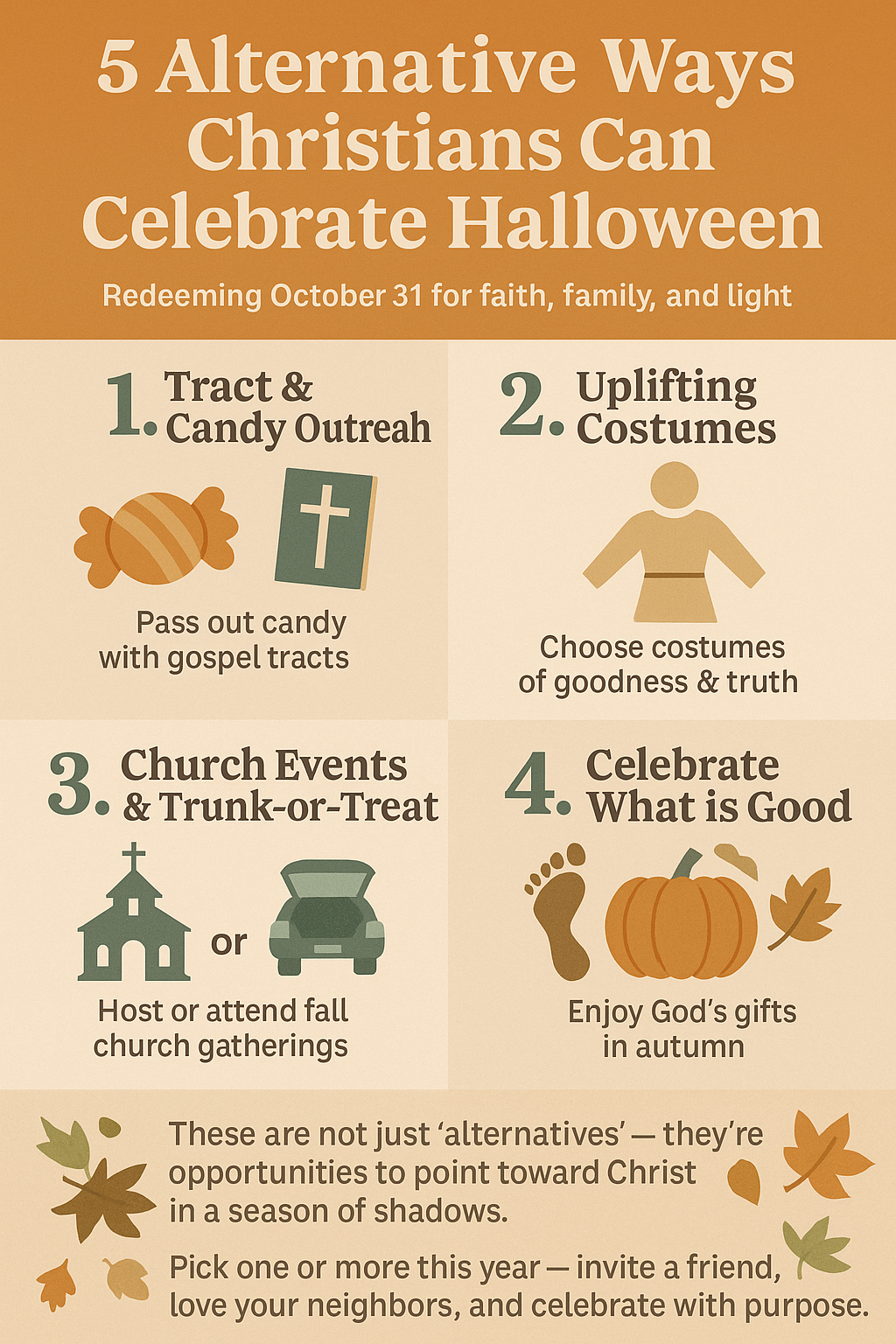
infographic of alternative ways to celebrate Halloween

Like many holidays, Halloween has plenty of good and even great traditions Christian families can enjoy. On the flip side, there is an abundance of awful, ugly, and evil practices at work on and around October 31 that Christians should swiftly avoid.

If you do want to take part in some kind of celebration on or around October 31st, you and your family could always opt for alternative ways to celebrate Halloween. Several ideas to inspire you can be found here.

What’s important is that Christians understand the traditions they participate in, know what the Bible has to say about these topics, and approach every holiday and cultural practice with prayer and discernment. Knowing a bit of the history of Halloween can be an important step in that process.

For further reading:

Why Was Evil Celebrated on Halloween?

Why Do We Celebrate Fear at Halloween?

What Does the Bible Say about Halloween?

Should Christians Really Celebrate Halloween?

https://www.christianity.com/wiki/holidays/what-is-the-history-of-halloween.html
Halloween: Origins, Traditions, and Whether Christians Should Celebrate It | Christianity.com

What does Halloween look like in our current culture, and how should we respond to it?

Regardless of the origins of Halloween, the more pressing question for today’s Christians is this: What does Halloween look like in our current culture, and how should we respond to it?

Halloween: Origins, Traditions, and Whether Christians Should Celebrate It

When I was growing up in the 1970s and 80s, I didn’t know anyone, except a Southern Baptist family, who didn’t “celebrate” Halloween. The hundreds of Catholic and Protestant kids in our grammar schools would dress up in costumes, have school parties, and go trick-or-treating. For weeks leading up to Halloween, we would have school projects that included traditional Halloween images: witches, black cats, jack-o-lanterns, bats, and more. Our parents never questioned if we “should” celebrate the holiday–there was never a belief that what we were doing was evil or unbiblical.

Yet when I became a follower of Jesus as a young adult and had my own child, I was challenged by many Christians who thought Halloween should be ignored. The two Christian schools that my daughter attended treated October 31 as any other day, and encouraged parents to study the history of Halloween (of which I was ignorant) and why it was a sin to take part in Halloween activities.

Additionally, Halloween has continued to grow in popularity over recent years, even spurring celebrations like “Summerween” that promote a focus on the holiday even outside of the fall season. With its increased popularity in our culture, Christians would do well to think through our response to this holiday.

So, what is the right approach as Christians: to let kids have their candy-coated fun, ignore the “holiday,” or come up with alternatives? It’s each parent’s decision, but let’s take a look at the history of Halloween and what the Bible has to say in order to make the best God-honoring decision.  

What Is the Origin and History of Halloween?

In a Library of Congress blog post, Heather Thomas writes, “… the Halloween holiday has its roots in the ancient Celtic festival of Samhain (a Gaelic word pronounced “SAH-win”), a pagan religious celebration to welcome the harvest at the end of summer, when people would light bonfires and wear costumes to ward off ghosts.” History.com adds that the Celts, who lived 2,000 years ago in Ireland, England, and Northern France, celebrated their new year on November 1. 

For them, this meant the end of the summer and its harvest–and was the beginning of a cold and dark winter. This season was often marked by death, as people would run out of food, freeze to death, and didn’t have the ability to treat illnesses common in winter. “Celts believed that on the night before the new year, the boundary between the worlds of the living and the dead became blurred. On the night of October 31 they…believed that the ghosts of the dead returned to earth.” People began wearing frightening costumes during Samhain to confuse the evil spirits.

But there was much more that developed from this belief in roaming spirits. Thomas also writes of the origin of the jack-o-lantern, which is a staple of Halloween celebrations. Legend has it that there was a man named Stingy Jack who trapped the devil, and only let him go if the devil promised Jack wouldn’t go to hell. But when Jack died, he was forced to wander the earth because heaven didn’t want him. “The Devil gave Jack a burning lump of coal in a carved-out turnip to light his way. Locals eventually began carving scary faces into their own turnips to frighten away evil spirits.” Turnips then became pumpkins with scary faces.

On the other hand, there are those who say that Halloween didn’t begin as a pagan tradition. In her article “Is Halloween a Pagan Holiday? Origin of Halloween,” Jessica Brodie writes, “Halloween is meant to refer to the evening before All Holies Day, also known as All Saints Day, a religious holiday in the Roman Catholic and many Protestant denominations of Christianity to honor Christians who have died (also called saints) and gone to heaven.” She contends that most scholars believe there is no tie between the Samhain festival and the Christian Halloween that was instituted in the Middle Ages.  “… it doesn’t seem likely that a church thousands of miles away, in Rome, would orchestrate a major religious festival simply to tie it to a seasonal celebration marked only by a handful of people in the Northern Celtic region of the world.”

Regardless of the origins of Halloween, the more pressing question for today’s Christians is this: What does Halloween look like in our current culture, and how should we respond to it?

I’ve seen a noticeable shift in the tone of Halloween in recent decades. In my own neighborhood, some families decorate with cheerful pumpkins, lights, and scarecrows—evoking a harvest theme. Others, however, create disturbing, grotesque displays that glorify death, horror, and darkness (and parents with young children refuse to go by these houses).

While I don’t know my neighbors’ intent, the focus on evil and fear raises valid concerns. Even if Halloween didn’t originate in paganism, the way it is often “done” today can contradict the values God calls His children to live by. 

And speaking of children, if you’ve raised yours in a Christian home, they may have questions about Halloween. You may choose to tell them something like:

“Halloween is a day when lots of people dress up in costumes, go trick-or-treating, and have fun. A long time ago, it was connected to a Celtic festival called Samhain which made up unbiblical, creepy stories and traditions. As Christians, we celebrate it as All Hallows Eve which is the night before All Saints Day, when we remember Christians who have died. Today, some people just treat it like a fun night for candy and costumes, but some things you see, like scary decorations, don’t honor God. So we choose to celebrate in a way that keeps our hearts focused on what’s good.”

What Does the Bible Say About Halloween?

You will not find the word Halloween in the Bible, but many of the themes associated with the contemporary, secular celebration—especially its glorification of evil, even if unintentional—are addressed clearly in the Bible. Some relevant Scripture passages are below:

“Let no one be found among you…who practices divination or sorcery, interprets omens, engages in witchcraft, or casts spells, or who is a medium or spiritist or who consults the dead. Anyone who does these things is detestable to the LORD…” (Deuteronomy 18:10-12).

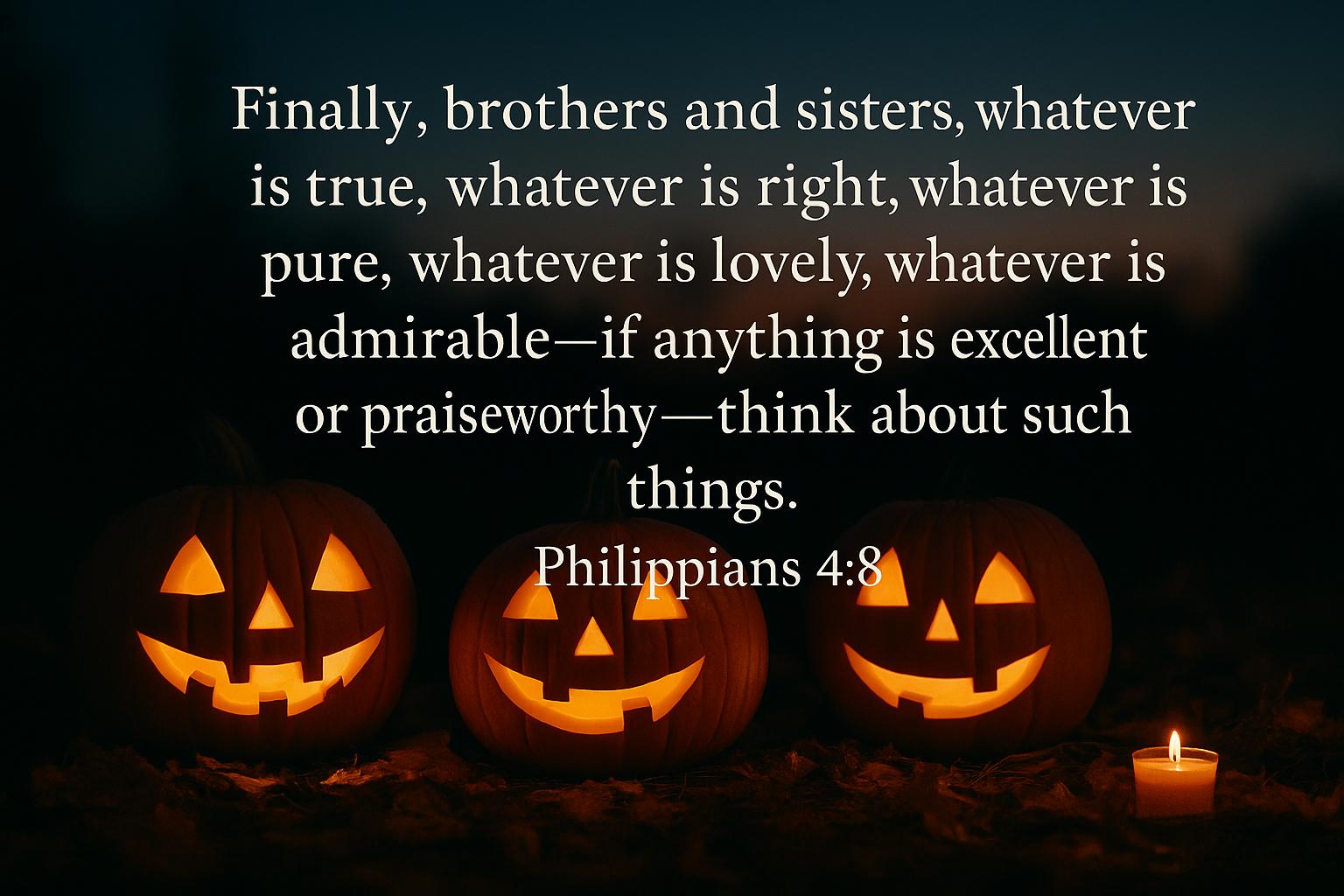
“Finally, brothers and sisters, whatever is true, whatever is noble, whatever is right, whatever is pure, whatever is lovely, whatever is admirable—if anything is excellent or praiseworthy—think about such things” (Philippians 4:8).

Glowing Halloween pumpkins with Bible verse: Finally, brothers and sisters, whatever is true, whatever is noble, whatever is right, whatever is pure, whatever is lovely, whatever is admirable—if anything is excellent or praiseworthy—think about such things. Philippians 4:8

“We demolish arguments and every pretension that sets itself up against the knowledge of God, and we take captive every thought to make it obedient to Christ” (2 Corinthians 10:5).

 “You will keep in perfect peace those whose minds are steadfast, because they trust in you” (Isaiah 26:3).

“Do not conform to the pattern of this world, but be transformed by the renewing of your mind. Then you will be able to test and approve what God’s will is—his good, pleasing and perfect will” (Romans 12:2).

“You were taught, with regard to your former way of life, to put off your old self, which is being corrupted by its deceitful desires; to be made new in the attitude of your minds; and to put on the new self, created to be like God in true righteousness and holiness” (Ephesians 4:22-24).

The Bible warns us that we have a very real enemy who wants to take our attention and affection away from the Lord and live like the world. At Halloween, we may be tempted to take part in scary or creepy activities, thinking it’s not a big deal, but it is a big deal to God. We need to remain aware that worshipers of Satan, wizards, witches, and Wiccans still celebrate a pagan, evil Halloween that includes occult practices. Some believe if Christians participate, they too are honoring Satan.

As Christians, we live “in the world,” but we are not “of the world” and are protected from the enemy by Jesus’ sacrifice. If we stay in the Word and focus on becoming more like Christ in what we do and think, then we can make God-honoring decisions about what to do with Halloween. And I believe there are ways to celebrate as Jesus followers.

Should Christians Celebrate Halloween?

You may be someone who believes that any recognition of Halloween is wrong. Choosing to abstain entirely may be what you feel called by God to do—and that’s a conviction that you should honor, without pressure from others. Perhaps you don’t want any association with a day that may have pagan origins, or you’re concerned about how Halloween has devolved over the years into something darker or more disturbing.

Or perhaps you believe that Christians can redeem holidays—days that were once truly “holy days,” such as Christmas, Easter, Thanksgiving, and even Halloween. Each of these has been, to some extent, co-opted by the world and reshaped into secular events driven by consumerism and the pressure to “keep up with the Joneses.”

Halloween presents a unique opportunity to show others that God is sovereign, and that He can be glorified in how we choose to celebrate—not just on traditional holy days, but every day, including October 31. What matters is staying true to God’s command to love Him with all our hearts, souls, minds, and strength–and to love our neighbors as ourselves. So, how can we keep Christ at the center of Halloween just as we try to do every other day?

Christian Alternatives to Halloween

By alternatives I mean what activities can Christians participate in on Halloween that are different from the mainstream? Let’s always keep in mind that we should consider our Halloween events as an outreach to those who are unbelievers. Here are a few ideas of what some Christians and churches can do on October 31:

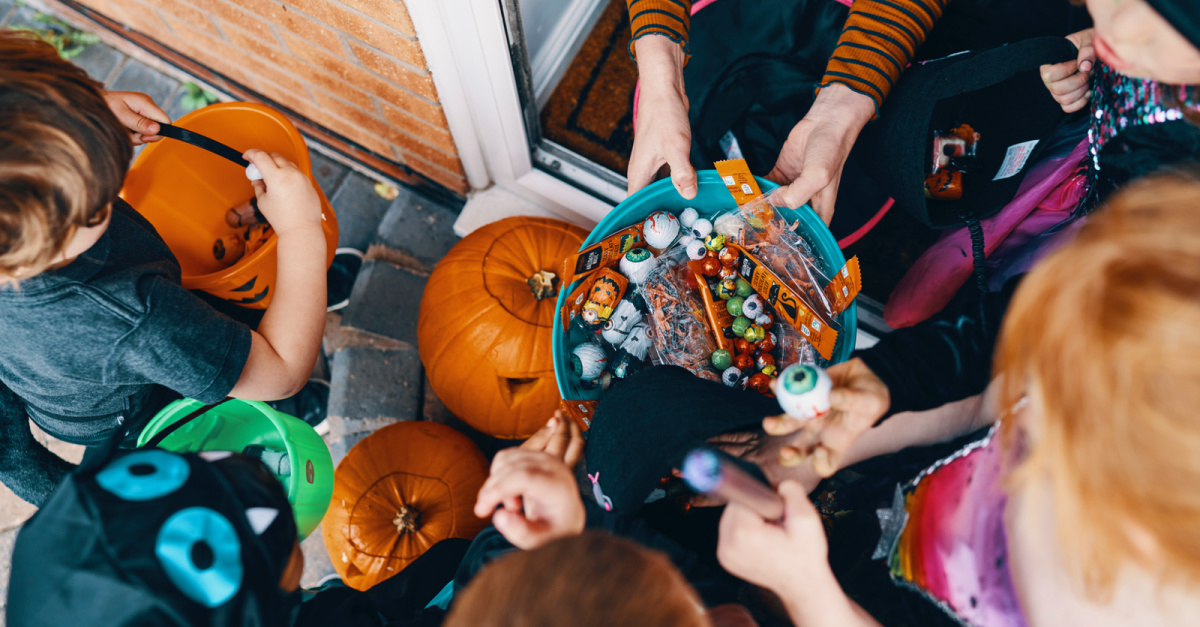
Kids trick or treating, Can Christians celebrate Halloween?
  • In your neighborhood:
    • Welcome trick-or-treaters with decorations that emphasize harvest, such as pumpkins, hay bales, etc.
    • Sit outside of your house to greet trick-or-treaters so that you don’t miss anyone. Maybe have a fire pit going and have neighbor kids who are with their parents stop to make s’mores.
    • Engage in conversation with the kids. Ask why they chose the costume they did, what they wore last year, if their school had a Halloween party, what their favorite candy is, etc. Make them feel special, even if they are in a hurry to go out and collect candy. And give premium candy if you can afford it. 
    • Consider giving away something in addition to or instead of candy that will show you care, like glow sticks to help them see. Maybe these can have a sticker that says “Jesus lights our way home” for example. You can also make individual goodie bags that have candy, stickers, and a “God bless you–have a safe Halloween” message handwritten on a card inside.
    • There are other great ideas about engaging with trick-or-treaters in the article “10 Ways to Show Christ’s Love to Trick-or-Treaters This Year” 
  • In the community:
    • While this idea is done most often at churches, I believe it would be great to move it into the community. Why not gather with like-minded churches in your community and host a large “Trunk or Treat” event? Families create a game that can be played out of the trunk of their car, e.g. a ring toss game, a corn hole type game. Or they can just decorate their trunk with a clever theme. Children walk through the event playing games and getting candy. You can include in their goodie bags a short blurb about what churches participated and why. Be sure to emphasize how much you believe God calls you to care for your neighbors, and that you were so glad they came (including an invitation to church as well).
  • At your church: host a large-scale harvest festival (emphasis on harvest of foods that God provides). Celebrate with games such as:
    • Pumpkin bowling–using smaller pumpkins so even small kids can play (remove stems as much as possible) and make “pins” out of long gourds that are cut off at bottom to stand up;
    • Pumpkin decorating–painting or carving (if participants paint pumpkins, remind them not to leave outside as the paint may poison squirrels or other wildlife;
    • Corn Hole (bean bag toss)
    • Caramel apple decorating contest
    • Apple toss (into buckets)
    • Pumpkin ring toss (make sure pumpkins have their stems)
Harvest

For more ideas:

5 Halloween Activities that Point Kids to Jesus

5 Ways Christians Can Biblically Celebrate Halloween

Halloween: A Matter of Prayer, Discernment, and Boldness

In light of some of Halloween’s origins in paganism and occult practices, along with the Bible’s clear stance against witchcraft, idolatry, and celebrating evil, Christians should prayerfully consider participating in anything related to it. We need to ensure that if we choose to take part in the day, that we are claiming it for Christ and participating in His name. While many today see Halloween as harmless fun, it’s important to ask whether what we participate in aligns with God’s truth and glorifies Him. Rather than conforming to cultural norms, believers can use this time to offer Christ-centered alternatives—such as fall festivals, outreach events, and neighborhood ministry—that reflect God’s goodness and truth. Ultimately, the decision should be rooted in our desire to honor God in every area of our lives.

https://www.christianity.com/wiki/holidays/halloween-origins-traditions-and-whether-christians-should-celebrate-it.html

Do You Know The Real History Of Halloween? | End Of The American Dream

Most people gleefully celebrate Halloween without ever thinking about how it originated or what our Halloween traditions really mean.  They just assume that it must be okay since almost everyone else is doing it.  Today, Halloween is celebrated all over the world, but that hasn’t always been the case.  In fact, there was a time when most Americans did not celebrate it.  It was only during the 20th century that it actually became a nationwide holiday that was celebrated on a widespread basis, and only within the past few decades has it really taken off as a truly global holiday.

To find the original roots of Halloween, one must go back approximately 2,000 years to the ancient Celtic festival of Samhain

Halloween’s original roots trace back to Samhain (pronounced “sow-in”—because of course the Celts couldn’t make it easy), an ancient Celtic festival that marked the end of the harvest season in Ireland. The Celts believed that on October 31st, the boundary between the living and the dead became, shall we say, a little thin. To keep any wandering spirits at bay, they’d light massive bonfires and don costumes—probably doubling as a solid excuse for some much-needed group bonding (what else was there to do in ancient Ireland, really?).

This is where the tradition of “Halloween costumes” began.

Some revelers apparently wore costumes to ward off spirits, but others apparently wore them “to allow for communication with the spirit world”

Besides the reasons given above, Halloween masks and costumes were used to hide one’s attendance at pagan festivals or—as in traditional shamanism (mediated by a witch doctor or pagan priest) and other forms of animism—to change the personality of the wearer to allow for communication with the spirit world. Here, costumes could be worn to ward off evil spirits. On the other hand, the costume wearer might use a mask to try to attract and absorb the power of the animal represented by the mask and costume worn. According to this scenario, Halloween costumes may have originated with the Celtic Druid ceremonial participants, who wore animal heads and skins to acquire the strength of a particular animal.

Today, some of the most popular Halloween costumes are of ghosts, witches, vampires and fallen angels.

But most people are entirely convinced that there is absolutely no danger in dressing up as such entities.

According to the History Channel, during Samhain the Celts would also “burn crops and animals as sacrifices to the Celtic deities”…

In addition to causing trouble and damaging crops, Celts thought that the presence of the otherworldly spirits made it easier for the Druids, or Celtic priests, to make predictions about the future. For a people entirely dependent on the volatile natural world, these prophecies were an important source of comfort during the long, dark winter.

To commemorate the event, Druids built huge sacred bonfires, where people gathered to burn crops and animals as sacrifices to the Celtic deities. During the celebration, the Celts wore costumes, typically consisting of animal heads and skins, and attempted to tell each other’s fortunes.

That is quite alarming.

And there are also some ancient documents that indicate that humans were often sacrificed in massive Samhain fires as well

According to old documents, in its most primitive guise, Samhain would have featured many sacrifices to the Celtic gods of death, with both animals and humans thrown in to huge firepits as offerings.

People claimed the ancient Druids ate their first born children on Samhain, or collected the blood of their sacrificial humans in cauldrons and drank it.

But nobody does such things anymore, right?

Well, Pastor John Ramirez says that when he was a practicing Satanist he actually participated in the sacrifice of animals on Halloween…

Ramirez, now a pastor, knows all about the dark reality of Halloween. He once sacrificed animals as part of satanic rituals and his friends even knew him as “Lucifer’s son.”

Now as a born again believer, he strongly warns Christians against celebrating Halloween and participating in harvest festivals.

“The only harvest we should celebrate is the harvest of souls,” he adds.

Those that are obsessed with spiritual darkness take these things very seriously.

Many of them even still call this holiday “Samhain” even though most of us call it Halloween.

So how did it come to be called Halloween?

Well, it all started when the Celts were invaded by the Roman Empire

However, when the Roman Empire took over the majority of the Celtic region, two ancient Roman festivals merged with the festival of Samhain over the 400 years the Romans occupied the territory. These festivals were Feralia, a day honoring the dead, and a day celebrating Pomona, the Roman goddess of fruit and trees who is primarily symbolized with an apple.

It was not until roughly the 9th through 11th centuries when early Christianity was spreading throughout the Celtic territory that we finally obtained the name we all know and love. The Christian (specifically Catholic) holiday of All Saints’ Day was very similar to the festival of Samhain with bonfires and costumes, though it was celebrated in early November. It was also called All-Hallows and the festival of Samhain—celebrated the night before—became known as All-Hallows Eve and eventually Halloween.

From that time forward, “Halloween” was primarily a Catholic celebration.

That is why the Puritans that settled in early America were steadfastly against it.  The following comes from Wikipedia

Lesley Bannatyne and Cindy Ott write that Anglican colonists in the southern United States and Catholic colonists in Maryland “recognized All Hallow’s Eve in their church calendars”,[141][142] although the Puritans of New England strongly opposed the holiday, along with other traditional celebrations of the established Church, including Christmas.[143] Almanacs of the late 18th and early 19th century give no indication that Halloween was widely celebrated in North America.[26]

It was not until after mass Irish and Scottish immigration in the 19th century that Halloween became a major holiday in America.[26] Most American Halloween traditions were inherited from the Irish and Scots,[27][144] though “In Cajun areas, a nocturnal Mass was said in cemeteries on Halloween night. Candles that had been blessed were placed on graves, and families sometimes spent the entire night at the graveside”.[145] Originally confined to these immigrant communities, it was gradually assimilated into mainstream society and was celebrated coast to coast by people of all social, racial, and religious backgrounds by the early 20th century.[146] Then, through American influence, these Halloween traditions spread to many other countries by the late 20th and early 21st century, including to mainland Europe and some parts of the Far East.[28][16][147]

Today, Halloween has become one of our biggest holidays.

In fact, it is being projected that Americans will spend more than 11 billion dollars on Halloween this year alone

Americans are projected to spend $11.6 billion on Halloween decorations, costumes, candy and other festive purchases this October, according to an annual survey from the National Retail Federation.

When broken down, that $11.6 billion translated to $3.8 billion spent on costumes, $3.8 billion dedicated to decorations, $3.5 billion allocated to purchasing candy and $0.5 billion spent on greeting cards, per the survey.

If you can believe it, Americans even spend approximately 700 million dollars on costumes for their pets each year.

Can you believe that?

One survey found that 93 percent of Americans celebrate Halloween in some way.

Needless to say, this makes certain people very happy.  The founder of the Church of Satan, Anton LaVey, once made the following statement: “I am glad that Christian parents let their children worship the devil at least one night out of the year. Welcome to Halloween.”

Like I noted earlier, most people celebrate Halloween without ever even thinking about it.

In fact, many people don’t know why they believe what they believe about most things.

If we are going to do something, we need to understand why we are doing it.

As for where Halloween originally came from, now you know the truth.

Michael’s new book entitled “Why” is available in paperback and for the Kindle on Amazon.com, and you can subscribe to his Substack newsletter at michaeltsnyder.substack.com.

About the Author: Michael Snyder’s new book entitled “Why” is available in paperback and for the Kindle on Amazon.com. He has also written eight other books that are available on Amazon.com including “Chaos”“End Times”“7 Year Apocalypse”“Lost Prophecies Of The Future Of America”“The Beginning Of The End”, and “Living A Life That Really Matters”.  When you purchase any of Michael’s books you help to support the work that he is doing.  You can also get his articles by email as soon as he publishes them by subscribing to his Substack newsletter.  Michael has published thousands of articles on The Economic Collapse BlogEnd Of The American Dream and The Most Important News, and he always freely and happily allows others to republish those articles on their own websites.  These are such troubled times, and people need hope.  John 3:16 tells us about the hope that God has given us through Jesus Christ: “For God so loved the world, that he gave his only begotten Son, that whosoever believeth in him should not perish, but have everlasting life.”  If you have not already done so, we strongly urge you to invite Jesus Christ to be your Lord and Savior today.

The post Do You Know The Real History Of Halloween? appeared first on End Of The American Dream.

What Christians Should Know About Halloween | Key Life

This festive day also carries a lot of baggage, however. Scholars Ralph and Adelin Linton write:

Among all the festivals which we celebrate today, few have histories stranger than that of Halloween. It is the eve of All Hallows—or Hallowmas or All Saints’ Day—and as such it is one of the most solemn festivals of the church. At the same time, it commemorates beings and rites with which the church has always been at war. It is the night when ghosts walk and fairies and goblins are abroad… We cannot understand this curious mixture unless we go back into history and unravel the threads from which the present holiday pattern has been woven.

The Origins of Halloween

Generally, it is agreed upon that Halloween has its origins in the Celtic festival of Samhain, which marked the end of summer. Typical popular folklore suggests that Samhain was a festival based on human sacrifice. Recent scholarship, however, suggests that this is a caricature, based on Roman writers who had little evidence of actual Celtic practices and were more interested in decrying them as “barbarians” who needed to be “civilized” by the Romans.

According to historian Nicholas Rogers, “the pagan origins of Halloween” arise not from rumors of human sacrifice but from “the notion of Samhain as a festival of the dead and as a time of supernatural intensity heralding the onset of winter.”

Halloween has been rejected as demonic and pagan, subsumed into (medieval) Christian ritual, and accepted unthinkingly as harmless fun.

He continues, “In marking the onset of winter, Samhain was closely associated with darkness and the supernatural. In Celtic lore, winter was the dark time of the year when ‘nature is asleep, summer has returned to the underworld, and the earth is desolate and inhospitable.’”

In addition,

What was especially noteworthy about Samhain was its status as a borderline festival. It took place between the autumn equinox and the winter solstice. In Celtic lore, it marked the boundary between summer and winter, light and darkness. In this respect, Samhain can be seen as a threshold, or what anthropologists would call a liminal festival. It was a moment of ritual transition and altered states. It represented a time out of time, a brief interval ‘when the normal order of the universe is suspended’ and ‘charged with a peculiar preternatural energy.’ These qualities would continue to resonate through the celebration of Halloween.

Halloween in the British Isles

According to Rogers, while Halloween derives its original “supernatural intensity” and “spookiness” from Samhain, most of the actual traditions and practices of the holiday developed out of the medieval Christian holy days of All Souls’ and All Saints’ Day. Early Christians in the 4th century began the practice of celebrating the martyrs of the early Roman persecutions. By the 9th century, these festivals were beginning to shift focus to celebrating the lives of saints instead. This festival was held on November 1 in England, but on April 20 in Ireland (disproving the popular view that a November date was picked to “Christianize” the pagan festival of Samhain). 

By the end of the twelfth century, the linked festivals of All Saints’ and All Souls’, Todos Santos or Tots Sants in Spanish, or Hallowtide in English, were well-established liturgical moments in the Christian year. At the end of the Middle Ages they were among the most important. The feast of All Saints’ and All Souls’ was one of the six days of obligation, marked by high masses and prayers. It was a holiday that affirmed the collective claims that the dead had on the living. Its requiem masses also served as insurance against hauntings, for ghosts were generally ‘understood to be dead relatives who visited their kin to rectify wrongs committed against them while alive and to enforce the obligations of kinship.’ As night fell and All Souls’ Day arrived, bells were also rung for the souls in purgatory. These were people who were in a spiritual suspension, in an intermediary space between heaven and hell, for whom prayers and penance could be made for their sins before the day of judgment. In preparation for Hallowtide, churches made sure that their bells were in good shape, for in some places they were rung all night to ward off demonic spirits. (Rogers)

Over time, other rituals were added to the celebration of the Mass. For instance, “In England, many churches purchased extra candles or torches for the ecclesiastical processions of Hallowtide. Bonfires were also built in graveyards to ward off malevolent spirits.”

After the Reformation in the sixteenth century, the rituals of Hallowtide in England came under attack from Protestants because of its association with the doctrines of purgatory, saints, and prayers for the dead. Reformers “denounced purgatory as a popish doctrine” and “deplored the idea that the living could influence the condition of the dead through their prayers and rejected the belief that the saints could function as intermediaries between humans and Christ.” A back-and-forth ensued for decades as Protestant leaders such as Thomas Cranmer tried to abolish Hallowtide rituals and Catholic leaders attempted to revive them.

By the end of Elizabeth’s reign, the official practices surrounding Hallowmass had been eliminated. Yet the more popular customs associated with the holiday did survive in some areas. . . [Around] 1783, Catholics continued to light fires on hilltops on All Saints’ Night. In the more remote areas of the Pennines there were torchlight ceremonies to commemorate the dead. At Whalley, in Lancashire, near the forest of Pendle, families formed a circle and prayed for the souls of the departed until the flames burned out…

If many of the religious customs associated with All Hallows and All Souls had died out by the middle of the seventeenth century, it is nonetheless clear the days were still regarded as a time of supernatural intensity. On Halloween, as it came to be known in the eighteenth century, ghosts, spirits, and witches were likely to be abroad. (Rogers)

Over time, Halloween traditions developed apart from any religious connotation, though the initial religious celebration influenced the developments. Rogers explains, “The diversity of names associated with Halloween did not connote the declining fortunes of the holiday. In Scotland, Ireland, and even in some of the remoter areas of England and Wales, Halloween was robustly observed throughout the nineteenth century and into the twentieth. At the time of substantial Irish and Scottish immigration to North America, Halloween had a strong tradition of guising and pranks, a fundamental aura of supernatural intensity, and a set of games and rituals that often addressed the fortunes of love rather than the prospect of death, or life beyond death.”

There is a big difference between kids dressing up in cute costumes for candy and Mardi-Gras-like Halloween parties, offensive costumes, and uninhibited excess.

It is important to note that this secular account of the history of Halloween seeks to vindicate the holiday from its Satanic and barbaric origins. While it may be the case that the dark side of Halloween has been overemphasized, Christians will still want to affirm that the holiday originated (at least) in pagan and mythical practices. The extent to which such practices can be categories as “Satanic” is a debate of semantics. Is Roman mythology “Satanic”? Perhaps, or perhaps not. Regardless, the origin of Halloween is certainly in the realm of non-Christian spiritualism. As such, Christians should be thoughtful in their approach to Halloween.

Halloween for Christians

Halloween has an uneasy history with the church; Christians have not always been sure what to do with a holiday of apparently pagan origins. Is Halloween unredeemable, such that any Christian participating in the holiday will necessarily compromise their faith? Is it something Christians can participate in as a cultural celebration with no religious ramifications? Or is there the opportunity for Christians to emphasize certain aspects of our own faith within the holiday?

1. Should Christians Renounce Halloween as “the Devil’s Day”?

One of the most famous recent examples of Christian interaction with Halloween comes from Pat Robertson, who called Halloween the “festival of the Devil.” As such, he claimed that participating in Halloween was a mistake for Christians and therefore wrong.

In renouncing this holiday outright, Robertson fails to ask the following question: To what extent does something’s evolution from pagan roots entail that its present practice is tainted? As Albert Mohler notes, there has been a shift in Halloween from pagan ritual to merely commercial fascination with the dark side. What Pat Robertson misses is that for most people in America, Halloween is about candy. A quarter of all candy sold annually in the US is for Halloween night!

Granted, dressing up as witches and goblins can be a tricky issue, but to think that putting on a scary mask or makeup opens you up to the dark side is a bit naïve.

In addition, there are two built-in problems with a blanket rejection position. One is that those who insist on rejecting certain holidays are not being consistent. Should we reject other holidays because there is a propensity toward excess? In other words, if people are inclined toward gluttony on Thanksgiving or Christmas, shouldn’t those holidays be renounced as well? After all, gluttony is a sin. Second, many times the reject position assumes that the evil of the extrinsic world will taint the faith of a Christian. The idea is, “garbage in, garbage out.” But Jesus says the exact opposite is true (Mark 7:21-23). The fruit of our lives (whether in holiness or sin) is always inextricably tied to the root of our hearts. If our hearts are prone toward sin in certain ways, we will find a way to sin. Sin indeed corrupts but the sin is not so much “out there in the world” as much as it is in the heart of every person. The reject position falsely assumes sin is mostly what we do rather than who we are.

2. Can Christians Participate in Halloween Wisely?

The Christian church has tried to deal with Halloween in many ways throughout the centuries. It has been renounced as demonic and pagan, subsumed into (medieval) Christian ritual, and accepted unthinkingly as harmless fun.

An informed understanding of the history of Halloween and the biblical freedom Christians have to engage cultural practices (1 Cor. 10:23-33) leads to the conclusion that Christians can follow their conscience in choosing how to approach this holiday.

Just how Christians ought to go about relating to or participating in Halloween is still a tricky subject. In order to navigate the waters successfully, one must always distinguish between the merely cultural aspects of Halloween and the religious aspects of the holiday. In the past the church has tried to subsume the religious aspects of Halloween by adding a church holiday. But again, this is a questionable area. It seems that Christians can easily participate in (with wisdom) some cultural aspects of the holiday, and there is some potential for the pagan cultural practices to be enjoyed—but care must be taken. There is a big difference between kids dressing up in cute costumes for candy and Mardi-Gras-like Halloween parties, offensive costumes, and uninhibited excess. Therefore it’s naïve to make a blanket judgment to reject or accept  Halloween as a whole. There should be no pressure to participate, but for those Christians whose conscience permits we should view it as an opportunity to engage wisely with our culture.

For those who are still bothered by Halloween’s historical association with evil spirits, Martin Luther has some advice on how to respond to the devil: “The best way to drive out the devil, if he will not yield to texts of Scripture, is to jeer and flout him for he cannot bear scorn.” Perhaps instead of fleeing the darkness in fear, we should view Halloween as an opportunity to mock the enemy whose power over us has been broken.

The post What Christians Should Know About Halloween appeared first on Key Life.