Tag Archives: teaching

What In The World Is Going On In Our Public Schools? | End Of The American Dream

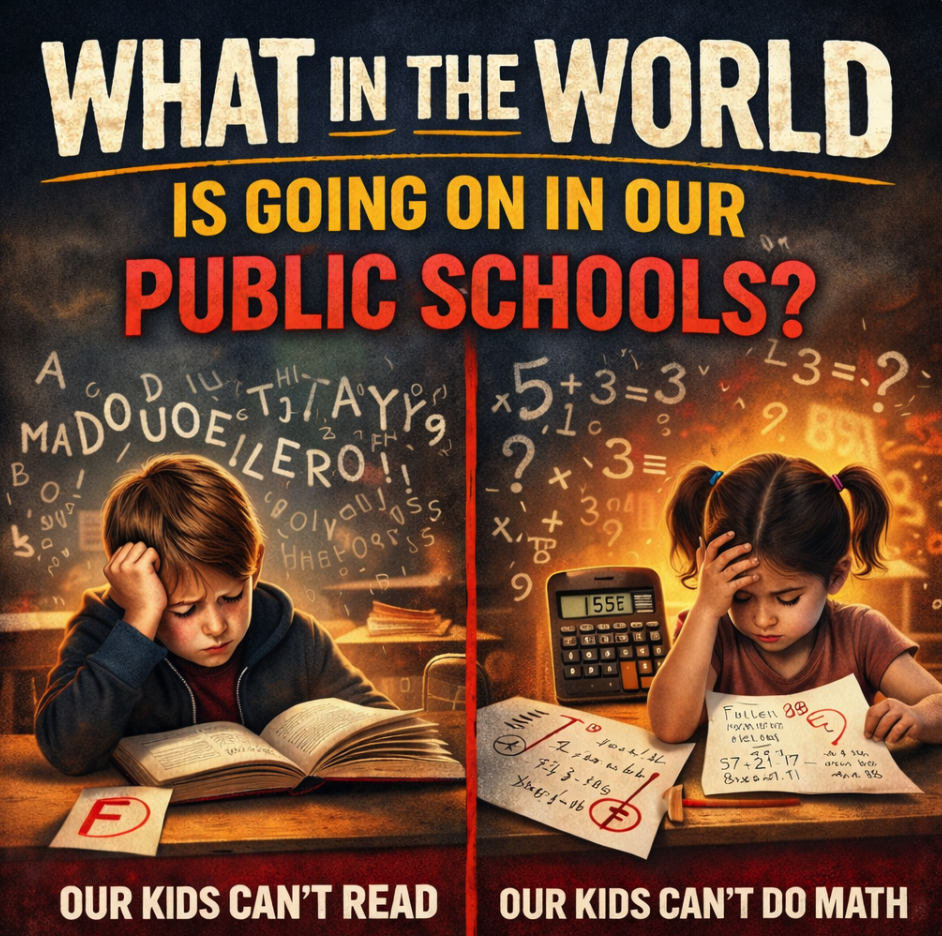
The quality of the education that our children are receiving in America’s public schools just continues to go down. At one time, the concern was that not enough students were taking advanced courses. But now we have reached a point where a very large portion of our high school graduates cannot read effectively, cannot write effectively and cannot do basic math effectively. If you think that I am exaggerating, please keep reading. We have never faced an education crisis of this magnitude in the entire history of our nation, and that has enormous implications for our future.

Dr. Kent Ingle is the president of Southeastern University, and he recently authored an excellent piece in which he warned that reading levels among incoming college students are so bad that many are struggling “to understand basic text on a page”

A stunning report revealed that many university professors now find themselves teaching students who struggle to read, not just to interpret literature or write essays, but to understand basic text on a page. According to Fortune, a growing number of Gen Z students enter college unable to “read effectively,” forcing professors to break down even simple passages line by line.

That trend should alarm every parent, employer and policymaker in this country. It is not just an academic concern. It is a cultural crisis.

This is not some random guy that is making these claims.

This is the president of a major university.

I don’t understand how it is possible for millions upon millions of students to enter college without even being able to read on a basic level, but it is happening.

Sadly, the same thing is true for math skills.

Large numbers of students that are entering our colleges must take remedial math courses that teach concepts that should have been taught in elementary and middle school

Five years ago, about 30 incoming freshmen at UC San Diego arrived with math skills below high-school level. Now, according to a recent report from UC San Diego faculty and administrators, that number is more than 900—and most of those students don’t fully meet middle-school math standards. Many students struggle with fractions and simple algebra problems. Last year, the university, which admits fewer than 30 percent of undergraduate applicants, launched a remedial-math course that focuses entirely on concepts taught in elementary and middle school. (According to the report, more than 60 percent of students who took the previous version of the course couldn’t divide a fraction by two.) One of the course’s tutors noted that students faced more issues with “logical thinking” than with math facts per se. They didn’t know how to begin solving word problems.

The university’s problems are extreme, but they are not unique. Over the past five years, all of the other University of California campuses, including UC Berkeley and UCLA, have seen the number of first-years who are unprepared for precalculus double or triple. George Mason University, in Virginia, revamped its remedial-math summer program in 2023 after students began arriving at their calculus course unable to do algebra, the math-department chair, Maria Emelianenko, told me.

If students in our public schools are not being taught basic reading skills and basic math skills, what are they being taught?

That is a very good question.

In many states, there always seems to be plenty of classroom time to discuss gender, the latest politically-correct pronouns and social justice issues.

But that isn’t why we send our kids to school.

We send them to school so that they will learn the basic skills that will enable them to successfully function as adults.

And in so many cases, that just isn’t happening.

We have millions upon millions of high school kids that are unable to read a contract or multiply three digit numbers without a calculator, but virtually all of them know about the “6-7” meme

“6-7,” pronounced “six-seveeeeen,” is haunting school halls across the country (including South Park Elementary), making it the Gen Alpha nonsense phrase of the moment. Kids are shouting it in classrooms when a teacher turns to page 67, when lunchtime is 6 to 7 minutes away or for no reason at all. It’s become so ubiquitous that Dictionary.com named it the word of the year.

“It’s like a plague — a virus that has taken over these kids’ minds,” said Gabe Dannenbring, a seventh-grade science teacher in Sioux Falls, South Dakota. “You can’t say any iteration of the numbers 6 or 7 without having at least 15 kids yell, ‘6-7!’”

It’s a joke without a punchline (or a setup, for that matter). 6-7 means nothing, but using it can make a student feel like a member of a bigger, cooler group of their peers.

We have failed our young people.

It takes an extraordinary amount of self-discipline to be successful in our society today, but millions upon millions of them are being allowed to slide through grade level after grade level without being forced to put in the hard work that will enable them to develop that self-discipline.

When I was growing up, I had a number of teachers that made sure that I worked hard.

But these days, many school officials are far more interested in preying on their students.

In Indiana, a high school secretary has just been charged with having sex with two different students

An Indiana high school secretary has been accused of having sex with two students after her husband caught her with one of them and allegedly ‘battered’ her.

Alicia Hughes was arrested Saturday after an investigation unveiled her alleged sexual relationship with two teenagers.

The 31-year-old was caught by her husband while she was with an 18-year-old Randolph Eastern School Corporation student on Friday night, Union City police said.

And in Florida, a band teacher has been arrested for having sex with “multiple students”

A North Miami Beach band teacher has been arrested after he was accused of inappropriate relationships with multiple students.

Jose Francisco Montes-Guedez, 40, was arrested Friday on two counts of offenses against students by authority figures, two counts of battery – touch or strike, and three counts of contributing to the delinquency of a child, Miami-Dade jail records showed.

According to an arrest report, Montes is a band teacher at Alonzo and Tracy Mourning Senior High Biscayne Bay School in North Miami Beach.

There are stories like this in the news every single day.

But because none of the teachers is named “Epstein”, those stories don’t get much notice.

Our system of public education needs to be rebuilt from the ground up.

If we don’t prepare our young people for the real world, they will fail.

At this stage, many of our young people are so unprepared for the real world that they actually need their parents to go to job interviews with them

Over 50% of college-age job seekers had their parents sit with them at an in-person interview, a January survey by Resume Templates found. What’s more, over 35% of surveyed individuals reported parents either writing a cover letter or performing a test assignment for them.

Julia Toothacre, a career coach and chief career strategist at the survey group, said she had never seen parents this involved in their child’s job searches in the past.

“When I was doing career development at the college level, we would see parents come in to talk about majors and sometimes career choices, but they weren’t sitting in on interviews or communicating with managers,” Toothacre told The College Fix in a recent interview via email.

A couple of decades ago, it would have been unthinkable for a parent to accompany a college graduate to a job interview.

Now it happens all the time.

But at least our young people are happy, right?

Well, actually that is not the case at all.

In fact, suicide rates among Gen Z adults have been absolutely soaring

Suicide rates among Gen Z adults have unnaturally increased in the U.S. over the past ten years according to new figures.

Axios Notes that there has been a 16.4 percent increase in suicides among the demographic between 2014-2024.

The locations where the rise is most prominent, the report notes are in the South and the Midwest, with black and Hispanic men, accounting for a huge 85 percent of the increase.

A Stateline analysis of data also shows that Georgia experienced the largest increase in suicide rates over the past decade, among 18 to 27-year-olds, with the state’s suicide rate in the age group increasing by a massive 64.9 percent.

Reading those statistics should break your heart.

The system has failed an entire generation of Americans.

If we don’t get it fixed, things will only get worse.

Michael’s new book entitled “10 Prophetic Events That Are Coming Next” is available in paperback and for the Kindle on Amazon.com, and you can subscribe to his Substack newsletter at michaeltsnyder.substack.com.

About the Author: Michael Snyder’s new book entitled “10 Prophetic Events That Are Coming Next” is available in paperback and for the Kindle on Amazon.com. He has also written nine other books that are available on Amazon.com including “Chaos”“End Times”“7 Year Apocalypse”“Lost Prophecies Of The Future Of America”“The Beginning Of The End”, and “Living A Life That Really Matters”.  When you purchase any of Michael’s books you help to support the work that he is doing.  You can also get his articles by email as soon as he publishes them by subscribing to his Substack newsletter.  Michael has published thousands of articles on The Economic Collapse BlogEnd Of The American Dream and The Most Important News, and he always freely and happily allows others to republish those articles on their own websites.  These are such troubled times, and people need hope.  John 3:16 tells us about the hope that God has given us through Jesus Christ: “For God so loved the world, that he gave his only begotten Son, that whosoever believeth in him should not perish, but have everlasting life.”  If you have not already done so, we strongly urge you to invite Jesus Christ to be your Lord and Savior today.

The post What In The World Is Going On In Our Public Schools? appeared first on End Of The American Dream.

How Liberals Broke Education | The Gateway Pundit

Teacher presenting a rainbow flag to students in a classroom, promoting inclusivity and LGBTQ+ awareness.
Image courtesy of the University of Minnesota

Over the past six years, students in much of the United States, particularly in blue cities and states, have experienced significant educational interruptions. First, the COVID lockdowns kept kids out of school entirely or in part for as many as four years in some states. As a result, by the end of the 2024–2025 school year, students were still half a year behind.

This disruption was compounded in states that prioritize DEI, ethnic and gender studies, and other social-engineering classes, which consume valuable class time that would otherwise be spent on math and science. Currently, some schools are dismissing students so they can protest against ICE rather than complete their lessons. Protests and walkouts, coupled with teacher strikes and activism, are forms of disruption that negatively impact educational outcomes, particularly skill development.

Certain school subjects, such as mathematics, music, and foreign languages, are skill-based. If a student does not practice, the skills cannot be mastered. These skills must also be learned chronologically. If you have not completed chapter seven of the math book, you cannot do chapter eight because the knowledge builds as you progress.

Once a student has missed a significant percentage of the material, there is no real way to catch up without repeating the grade. However, schools generally lack any structured means of making up the lost learning.

To further compound the issue, No Child Left Behind and similar “everyone gets a pass” programs advance students to the next grade level even when they do not possess the required skills. The simple logic these policies ignore is that a student who did not pass seventh grade cannot pass eighth grade, and by ninth grade will be so far behind that they stop trying.

Allen Epstein, author of The Handbook to Educational Reality Manuscript, is a veteran teacher and university professor in the California education system. In an interview with the Gateway Pundit, he explained that “lost instructional time breaks continuity, and mastery collapses. And schools almost never repair it once students are promoted by age rather than completion.”

The liberalization of education is holding students back. One of the most common examples cited by parents is the rejection of the idea that there is one right way to solve a problem. In some classrooms, teachers give partial or even full credit for a creative but mathematically incorrect explanation. The emphasis is placed on a student’s “mathematical identity” or “sense-making” rather than accuracy. Critics argue this produces math illiteracy. When students are taught that their process matters more than the correct answer, they struggle in fields such as engineering or medicine, where a single decimal error can have serious consequences.

Another shift has been the de-emphasis on automaticity, including memorization of basic math facts. Timed tests and rote learning, such as memorizing multiplication tables, are sometimes described as stressful or harmful to a child’s confidence. Instead, students are encouraged to use strategies such as drawing dots or relying on calculators rather than memorizing that 7 × 8 = 56. The result is a cognitive load problem. By the time students reach high school algebra without having automated basic arithmetic, their brains are still occupied with simple calculations, leaving less capacity to understand abstract variables. This contributes to higher failure rates in advanced math.

Grading practices have also changed in the name of equity. Some schools use group grades, avoid penalizing late work, or adopt “no-zero” policies in which the lowest possible grade is 50 percent even if no work is submitted. Critics argue this weakens accountability and fosters learned helplessness. High-achieving students may feel their effort is devalued, while struggling students are advanced without mastering the material.

In California, a related push allowed “data science” courses to substitute for Algebra II, framed as more relevant than abstract algebra. However, universities, including the University of California system in 2024, began rejecting such substitutions because they did not provide the functions and rigor required for calculus. Students who take the softer path often find themselves blocked from STEM majors later because they lack the necessary mathematical foundation.

In some school districts, students are being taught that math is racist.

Educators attempt to approach science and STEM subjects in the same way as the social sciences, allowing multiple answers, claiming there is no wrong answer, or suggesting it is racist to say that two plus two is always four. These attitudes and the corresponding modified lesson plans are further disruptions.

“There’s a curriculum that needs to be covered,” said Epstein, explaining why these modifications are disruptive. He added that the curriculum does not get taught when “you start sliding in other things. It encourages these breaks, and learning continuity needs to flow without interruption.”

Epstein also described how he dealt with tardy students. He said he used to lock the doors because certain classes would intentionally arrive late, sometimes making a dramatic entrance. He recalled arguments with the administration, which questioned whether locking the door was discriminatory.

He explained that some students were seated in the front row with their books open, ready to begin exactly when class was scheduled to start. When others came in late, throwing their books down and interrupting the lesson, it broke the learning flow. “When other people come in and throw books down or whatever, it breaks the learning,” he said, adding that he would have to start over because the momentum had been lost.

It seems that in the United States, the momentum in education has been lost. Epstein is hopeful that his book outlines a means of recovering it. But whether through his work or the work of other dedicated teachers and parents, the political will must be there, or there is no path toward recovery.

The post How Liberals Broke Education appeared first on The Gateway Pundit.

GREGORY LYAKHOV: Public Schools Must Stop Stifling Students’ Political Views | The Gateway Pundit

Students and community members march in winter attire holding signs advocating for social change on a snowy street.
Students across Minnesota walked out of school to protest ICE. Photo courtesy of Minnesota Public Radio.

In school districts across the country, controversy has become something to manage rather than teach. Student journalists describe prior review policies that allow administrators to pull articles before publication.

Classroom discussions on immigration enforcement, abortion law, policing policy, or foreign affairs are redirected, softened, or shut down entirely. Administrators rarely deny the pattern.

The reasoning is predictable: controversy generates parent complaints, school board conflict, and reputational risk. In a politically polarized environment, stability becomes the primary goal.  

K–12 schools, however, cannot function as public relations entities whose main objective is avoiding phone calls from parents. For too long, education has revolved around the vested interests of adults—administrators protecting district image, teachers protecting contracts, parents protecting political comfort—rather than the intellectual development of students. That structure must change.

It is easy to blame teachers for indoctrinating students, a charge often made by conservatives against progressive educators. There are certainly isolated cases in which political bias shapes instruction.

I have not experienced systemic indoctrination in my own education, and my school district has treated me well. I have had strong teachers, serious coursework, and an environment that allowed me to grow. I am grateful for that.

At the same time, gratitude does not absolve one of the obligation to criticize structural problems when they exist.

The deeper issue is not that politics is being aggressively taught, but that because parents are intensely reactive to politics in schools, politics is often not taught at all.

I live in a predominantly Jewish, largely pro-Israel community. During the Israel-Gaza war, a student newspaper published an article discussing the devastation in Gaza. The image accompanying the piece sparked backlash. Parents objected to the photo selection, framing it as biased. The controversy escalated quickly.

Instead of using the moment to teach students how media framing works, how images shape perception, and how to analyze war reporting critically, the message that followed was clear: certain topics are too sensitive.

Politics shifted from debate to avoidance.

Later, when I attempted to publish a pro-ICE article in a school setting, the response was not that my argument lacked evidence or balance. Rather, the topic itself—immigration enforcement—was too controversial.

Whether someone supported or opposed ICE became irrelevant. The entire subject was treated as radioactive.

Civic education does not improve when controversial topics disappear. Students cannot learn to evaluate arguments they are never permitted to hear. They cannot practice disagreement if disagreement is institutionally discouraged.

From an administrative standpoint, the calculation makes sense. District leaders face public pressure, social media scrutiny, and potential backlash from the board. Avoiding controversy protects stability. Yet stability achieved through avoidance produces intellectual stagnation.

Schools exist to educate, not to neutralize.

I would rather sit in a classroom where I strongly disagree with the prevailing viewpoint than sit in one where no viewpoint is allowed. Exposure to arguments forces students to sharpen their own reasoning. Silence prevents that sharpening process entirely.

When administrators prevent discussion because the topic might generate complaints, they replace intellectual rigor with risk management.

The effects are visible beyond the classroom. When I watch ICE protests organized by high school students across the country, I see energy but not depth. I see slogans but not statutory analysis. I see passion but not understanding of how federal authority is structured, how immigration law is written, or how executive agencies operate.

That is not entirely the students’ fault. It is the predictable outcome of an education system that avoids the substance of controversial policy debates.

Civic engagement without civic literacy becomes performance. Students march, chant, and post, but many cannot explain the legal framework they are protesting.

If immigration enforcement, policing authority, or foreign policy discussions are considered too controversial for classrooms, students will form opinions without structured guidance.

A functioning democracy requires citizens who can analyze arguments they oppose, understand legal structures they criticize, and articulate positions grounded in fact rather than impulse. That capacity must begin in K–12 education. Schools cannot prepare students for civic life while shielding them from civic substance.

If controversy is inevitable in public life, then controversy must be part of public education. The alternative is a generation fluent in outrage but unfamiliar with the foundations of the policies they debate.

The post GREGORY LYAKHOV: Public Schools Must Stop Stifling Students’ Political Views appeared first on The Gateway Pundit.

Why Are Teachers Pushing Activism Instead of Academics? | Standing for Freedom Center

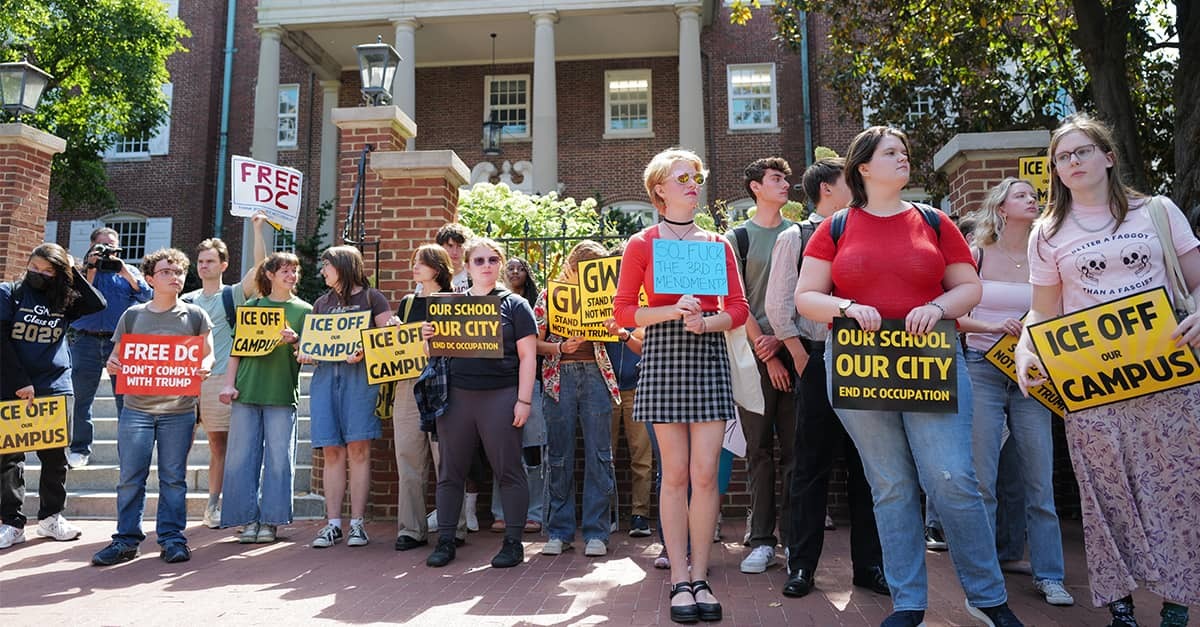
Students stand on the sidewalk out their school holding signs like "ICE Out" and "Free DC."
Students across Washington, D.C., staged a walkout over ICE and the National Guard last fall. CREDIT: Shutterstock

When those entrusted to teach the next generation abandon their own classrooms and encourage children to protest for left-wing causes, the question is no longer whether this is happening but why anyone still pretends it’s about education.


Across the country, teachers are facilitating student walkouts to protest federal immigration enforcement. In some classrooms, teachers help students make protest signs during class time. In San Diego, a first-grade teacher posted video of herself flipping the American flag upside down in her classroom and hanging an “Abolish ICE” sign on the wall. In California, teachers led second-graders down sidewalks carrying anti-ICE signs and chanting slogans.

Meanwhile, hundreds of school districts have seen students walk out of class — some with teacher support, others with administrative indifference. School grounds have been repurposed as political theaters. Children who cannot read at grade level are being trained to stage protests over policies they cannot explain.

Texas Gov. Greg Abbott and Attorney General Ken Paxton have threatened to investigate school districts for “facilitating” these protests, warning that teachers who encourage walkouts could lose their teaching certificates and districts could face state takeover.

The threats reveal the obvious: Teachers and administrators are enabling this political mobilization.

The question demands a direct answer: Why do teachers promote student walkouts and protests over politics?

Because political mobilization serves their ideological goals, creates the illusion of grassroots legitimacy for positions that cannot withstand scrutiny when debated by adults, and distracts from their own catastrophic failure to educate. Children chanting slogans they cannot defend provide cover for teachers who cannot teach them to read.

This did not happen by accident. For decades, ideological actors moved deliberately through teacher-training programs, administrative offices, and curriculum committees. What once required college-level immersion is now introduced in elementary schools, normalized faster, and celebrated as moral courage before students are old enough to understand the consequences of what they’re repeating.

Children are no longer being taught how to reason. They are being trained what to feel. They are not equipped to weigh competing claims, understand trade-offs, or appreciate how fragile ordered societies actually are. Instead, they are shaped into a worldview that treats the nation as an oppressor, borders as immoral, law enforcement as inherently suspect, and authority as something to be resisted rather than respected.

That worldview did not arise naturally. Teachers installed it.

The deeper contradiction exposes the fraud. None of these students would apply their ideology to their own lives. Not one would leave their front door unlocked for all comers. They understand boundaries instinctively. Teachers taught them to reject boundaries ideologically. That contradiction does not come from reason. It comes from training.

Proverbs 22:6 teaches, “Train up a child in the way he should go; even when he is old he will not depart from it.”

Although they may not be Bible scholars, teachers understand this principle intuitively. That is why they work so deliberately to control formation, knowing that what fills a child’s mind shapes how they see the world, what they value, and how they respond to authority.

Academic Failure by Design

While students are trained to chant slogans and stage walkouts, they are increasingly unable to read complex texts, reason through arguments, perform elementary math, or compete academically with their peers around the world. A generation is being mobilized politically while being hollowed out intellectually.

Oregon provides the clearest evidence of this deliberate failure. The state suspended graduation requirements that students demonstrate basic proficiency in reading, writing, and mathematics. Teachers and administrators claimed that expecting students to read, write, and perform basic math was causing “harm” to “historically marginalized communities.”

Dan Farley, assistant superintendent of research for Oregon’s Department of Education, stated that the old requirements produced outcomes that “could all be predicted by race, ethnicity, IEP status, multilingual learner status. We have to do what we can to disrupt those basically racist outcomes.”

The suspension was extended for five years. Test scores remain well below pre-pandemic levels, with just 44 percent of 11th graders proficient in English language arts, compared to 71 percent in 2018, and only 20 percent proficient in math, down from 34 percent in 2018.

In Chicago, hundreds of public school teachers recently abandoned their classrooms — on the taxpayer’s dime — to lobby state lawmakers for a contract that would secure nearly $50 billion in taxpayer funds. The demands included funding for abortion and surrogacy, “LGBTQ+” training, gender-neutral bathrooms, and salary increases to nearly $150,000 annually.

Meanwhile, three out of four Chicago public school students cannot read at grade level. Nearly 83 percent fail to meet math proficiency standards.Poll: Do you think young people are becoming more conservative?(Required)Poll: Do you think young people are becoming more conservative?(Required)Poll: Do you think young people are becoming more conservative?(Required)Do you think young people are becoming more conservative?(Required)YesNoEmail(Required)

Completing this poll entitles you to receive communications from Liberty University free of charge.  You may opt out at any time.  You also agree to our Privacy Policy.

Chicago Teachers Union President Stacy Davis Gates sends her own son to private school. Nearly 40 percent of Chicago public school teachers do the same — four times the rate of average American families. They know what these schools produce. They simply choose not to fix it.

Politics Over Safety, Ideology Over Students

The hypocrisy extends even to student safety. When the Department of Transportation announced emergency rules cracking down on granting commercial driver’s licenses to unqualified or illegal immigrants — prompted by fatal accidents caused by illiterate CDL holders — the American Federation of Teachers immediately sued to block the regulation.

Their reasoning? Some teachers hold non-domiciled licenses and drive school buses.

Teachers’ unions went to court to fight highway safety rules designed to protect the very children they claim to serve. AFT President Randi Weingarten called the safety regulation “spiteful” and accused the administration of trying to “hurt hundreds of thousands of lawful immigrants.”

She did not mention families of those killed by drivers who could not read road signs. She did not acknowledge that, in a Florida crash, an illegal immigrant trucker answered just 2 of 12 questions correctly on an English proficiency test before causing a crash that killed three people. She didn’t extend condolences to the family of the California high school basketball coach who was killed after his car was rear-ended by an illegal truck driver who was high and traveling well beyond the speed limit.

Romans 13 establishes that legitimate government authority exists “for your good” and serves as “an avenger who carries out God’s wrath on the wrongdoer.” When teachers and their union presidents actively work to undermine laws designed to protect children, they are not just violating professional ethics. They are resisting God-ordained authority meant to preserve order and protect the innocent.

The Church Cannot Remain Silent

The battle is not primarily academic, it’s spiritual, as Ephesians 6:12 remind us:

“For we do not wrestle against flesh and blood, but against the rulers, against the authorities, against the cosmic powers over this present darkness, against the spiritual forces of evil in the heavenly places.”

What we are witnessing is the deliberate dismantling of ordered society through the corruption of student formation. Children are taught to despise their inheritance. Patriotism is reframed as oppression. Gratitude gives way to grievance. Authority is delegitimized.

This is what happens when adults abdicate their responsibility to teach truth and cede formation to ideologues who promise compassion while delivering chaos. Parents outsourced discipleship. Teachers abandoned instruction. Unions and political activists filled the vacuum.

The result is a generation taught to hate the structures that protect them. And when young people are taught to despise what shields them from chaos, they will cheer its erosion — at least until the consequences arrive.

Every child trained to reject biblical authority, despise ordered society, and embrace chaos as justice is a soul being formed for rebellion against God Himself.

Teachers are not just failing to educate — they are actively working to ensure students cannot recognize truth when they encounter it.

The Church must reclaim the responsibility it surrendered. This means parents refusing to outsource discipleship to institutions that oppose Christ. It means Christians speaking truth in the public square without apology. It means local congregations equipping families to educate and form children in biblical truth rather than abandoning them to ideologues who promise enlightenment while producing illiteracy.

This is not the moment to retreat into private faithfulness while the culture collapses. It is the moment to advance — boldly, clearly, and with full confidence in the authority of Scripture and the ultimate victory of Christ over every competing ideology.

The question is no longer how this happened. The question is whether the Church has the courage to fight for the children being sacrificed on the altar of left-wing political activism and whether we will stand before God having done everything we could to rescue this generation from those who would destroy them.

The teachers have made their choice. What will the Church do?

Source: https://www.standingforfreedom.com/2026/02/12/why-are-teachers-pushing-activism-instead-of-academics/

Ideology Over Education: Why California’s Schools Are Failing | The Gateway Pundit

Person reading a blue book at a table with a stack of colorful books and a tablet nearby.

California’s educational outcomes rank among the worst in the nation when compared with other large states.

Blue states spend far more time on DEI-related lessons than red states, experience more student walkouts and protests, and have seen more strike activity in recent years, resulting in lost instructional days.

Large amounts of classroom time are wasted on ideological nonsense instead of academics.

Approved curricula in blue states prioritize many courses that conservative parents would view as a waste of time.

These programs also exist in red states, largely because cities in red states tend to be blue, but they are far more common and entrenched in blue states.

Social-emotional learning exists in both red and blue states, but blue states impose formal frameworks and statewide standards, while red states apply it more loosely or locally.

Climate change education shows a clear divide, with blue states mandating strong standards and providing state funding, while red states vary widely and mostly offer limited courses.

Ethnic studies is largely unique to California, with no comparable statewide equivalent in red states.

Discipline policies also differ sharply. Blue states emphasize restorative justice and reduced suspensions, while red states retain traditional discipline approaches.

Some blue districts have adopted “equitable grading” that deemphasizes tests, deadlines, and penalties, while red states rely on traditional grading systems.

To illustrate the difference between red and blue states, this article compares California with Florida and Indiana.

Florida was selected because both Florida and California have large Latino populations, yet conservative Florida scores significantly higher across many educational outcomes while spending less money.

This demonstrates that outcomes are not determined by race or funding, but by focus and hard work.

The data reflects this gap clearly. In the 2024 NAEP assessments, only 31 percent of California fourth graders achieved reading proficiency, a lower rate than both Florida and Indiana.

In eighth-grade math, California recorded just 23 percent proficiency, compared with 27 percent in Indiana and 26 percent in Florida.

California’s high school graduation rate stands at 84.8 percent, the lowest among the three states, while its dropout rate of 8.9 percent is nearly triple Florida’s 3.1 percent.

California students lose a massive amount of instructional time to nonacademic coursework. Ethnic studies alone consumes approximately 90 to 180 hours, the equivalent of a full semester to a year-long course.

When combined with formal social-emotional learning programs at roughly 30 to 40 hours per year, enhanced climate education beyond basic science instruction at 15 to 20 hours, and restorative justice practices consuming another 20 to 30 hours, the total reaches approximately 200 to 250 or more hours annually.

This is instructional time that students in red states spend on traditional academics.

That loss is equivalent to one to one-and-a-half full-year courses not spent on mathematics, reading, science depth, history, or foreign languages.

This displacement is especially damaging for California’s English Learner population, which makes up roughly 19 percent of the state’s students and urgently needs maximum time devoted to core academics and English language development, not ethnic studies and ideological coursework.

This instructional imbalance helps explain why red states such as Mississippi and Alabama recovered more effectively from pandemic learning loss and are now outperforming blue states like California and Oregon on NAEP assessments.

Students in red states receive more actual academic instruction time, while California diverts hundreds of hours away from core subjects that students, especially English Learners, need most.

As bad as California’s official numbers are, the reality is worse. California uses accountability exclusions that affect how student scores are counted in public reporting.

Under federal accountability rules in ESSA, students must be enrolled in a school for at least one full year, from Census Day in October through testing in May, for their scores to count toward that school’s or district’s performance rating.

Migrant and some newcomer students move frequently and often remain in a school for only three to six months, which means their scores are often excluded from School Dashboard ratings. Those scores still exist in the state database, but they do not count toward a school’s public performance grade.

Under California’s Assembly Bill 714, passed in 2024, newcomer pupils who have been in the United States for less than three years are eligible for exemptions from certain local graduation requirements and may be granted a fifth year of high school.

As a result, students who take longer to complete graduation requirements are not immediately counted as dropouts.

Even when it comes to migrants, California fails. California’s migrant students perform significantly worse than migrant students in other states.

Migrant students are children whose families move for agricultural or fishing work and represent a small subset of the total student population. Among migrant students, California achieves only 12.1 percent math proficiency, compared with 18.5 percent in Florida and 15.2 percent in Indiana.

California’s migrant students also have higher dropout rates at 17.8 percent, compared with 10.2 percent in Florida and 11.1 percent in Indiana.

Chronic absenteeism among California’s migrant students reaches 34.2 percent, compared with 29.1 percent in Florida and 26.5 percent in Indiana. These comparisons reflect migrant student populations only, not overall statewide performance.

In California, students are often placed in grades based on chronological age rather than prior academic completion. Research from the Public Policy Institute of California confirms that many immigrant students enter the system with interrupted formal education.

Because of federal and state laws, a 15-year-old who may have only completed fourth grade in their home country is often placed directly into ninth or tenth grade in a U.S. high school.

This results in lower scores because students are tested on high-school-level material such as Algebra or Biology without having completed foundational fifth through eighth grade coursework.

Yes, California scores are lower as a result, but liberals believe diversity is our strength.

The post Ideology Over Education: Why California’s Schools Are Failing appeared first on The Gateway Pundit.

Chicago Public Schools Blew $23.6 Million on Luxury Trips. The Full Story Is Far Worse. | The Gateway Pundit

Chicago city officials gather for a press conference, featuring a speaker at the podium with the city seal, surrounded by flags and community members.

WATCH: Chicago Public Schools Blew $23.6 Million on Luxury Trips

Public school districts exist for one purpose: educating children. They are entrusted with public dollars, charged with preparing the next generation for citizenship and the workforce, and expected to manage resources responsibly. 

But in many major districts, that mission has collapsed under political control, financial irresponsibility, and a refusal to prioritize students. Few places illustrate this breakdown more clearly than Chicago Public Schools.

As The Gateway Pundit previously reported, a recent report from the CPS Office of Inspector General detailed $23.6 million in improper or wasteful travel spending—dollars that should have gone directly toward recovering from historic learning losses. 

Instead, district employees used public funds for high-end hotel suites, airport limousines, first-class airfare, and “professional development” conferences that resembled vacations more than training. One staff member extended a four-day seminar into a weeklong stay at a Hawaiian resort costing nearly $5,000

Another principal booked a luxury suite on the Las Vegas Strip and quietly extended the trip to celebrate an anniversary. In one school alone, 24 employees billed taxpayers $50,000 to attend a single Las Vegas conference.

The abuses extended overseas. CPS employees charged more than $142,000 for travel to South Africa, Egypt, Finland, and Estonia—complete with hot-air balloon rides and game-park safaris. These trips took place while Chicago families were told that there wasn’t enough money to fully address learning gaps or chronic absenteeism.

Most troubling, the waste accelerated when federal pandemic relief funds flooded district budgets. 

Of the $23.6 million identified, $14.5 million was spent in just 2023 and 2024. 

The money had been intended to repair the academic devastation caused by the Chicago Teachers Union’s decision to keep classrooms closed for 78 weeks—one of the longest shutdowns in the nation. 

Instead of investing in tutoring, extended learning time, or literacy interventions, district officials treated the funds as a travel account.

The consequences are measurable. Only about 40% of CPS students can read at grade level, and just 25% meet math standards. In certain neighborhoods, proficiency rates sink into the single digits. 

Nearly half of the district’s students—and an outright majority of high schoolers—are chronically absent. A school system cannot prepare students for college or employment when tens of thousands no longer attend regularly.

The connection between chronic absenteeism and public safety is well-documented. 

Communities struggle when an entire generation is disconnected from education and opportunity. No city with academic outcomes this low can realistically expect improvements in long-term safety or economic mobility.

The issue is not confined to Chicago. Across the country, elected officials have redirected money toward political initiatives instead of classroom instruction. 

In New York, lawmakers used the 2025 “People’s Budget” to expand ideologically driven personnel programs rather than academic recovery. They proposed $8 million to increase teacher-diversity pipelines—even though New York City’s teaching workforce is already 42% black, far above the city’s black population share. 

They spent hundreds of thousands for cultural-inclusivity initiatives and educator conventions while 154,000 New York City students are homeless and nearly half of students statewide fail basic reading exams. 

New York spends more per pupil than any state—over $39,000—yet performance continues to decline.

If funding alone determined outcomes, New York would be the best school system in America. Instead, it reflects a national crisis of priorities.

That is why school choice has become so compelling to families. Charter schools provide 30-50% more instructional time than traditional public schools and consistently show stronger achievement gains. 

A study in North Carolina found that entering a charter high school reduced a student’s likelihood of committing a crime by roughly 30%. Milwaukee’s long-running voucher program produced similar declines in criminal behavior among participating students. 

When families have options, they choose learning environments where expectations are higher, engagement is stronger, and resources reach classrooms instead of bureaucracy.

Chicago’s financial abuse and New York’s budget decisions highlight a simple truth: families—not systems—should control educational decisions.

The post Chicago Public Schools Blew $23.6 Million on Luxury Trips. The Full Story Is Far Worse. appeared first on The Gateway Pundit.

America Stopped Teaching Children. YouthVote Fights for School Choice. | The Gateway Pundit

Woman speaking into a microphone at a Turning Point event, gesturing with her hand, wearing a beige outfit against a vibrant pink background.
Former Small Business Administration Administrator Linda McMahon speaking with attendees at the 2021 Young Women’s Leadership Summit hosted by Turning Point USA at the Gaylord Texan Resort & Convention Center in Grapevine, Texas.

America’s public education system is collapsing under the weight of politics and bureaucracy.

Students are graduating without understanding how their government functions, what rights they possess, or why those rights exist. According to the National Assessment of Educational Progress, only 22% of eighth-graders are proficient in U.S. history, and barely half can identify the role of Congress.

Behind those numbers lies a system that traps students in failing schools while denying families the freedom to choose better ones.

YouthVote was founded by The Gateway Pundit’s Gregory Lyakhov to challenge that system. Its mission is not just to educate but to empower—by promoting school choice as the foundation of academic freedom. 

When I founded YouthVote—with help from many dedicated people and, more recently, support from The Gateway Pundit—I had the opportunity to speak with Charlie Kirk a few weeks before his passing about how the left is indoctrinating students and why education reform matters.

Following our conversation, he emphasized the importance of advancing school choice nationwide, a mission that remains central to YouthVote and a lasting part of his legacy.

When families have the ability to select where and how their children learn, accountability rises, innovation flourishes, and the monopoly of mediocrity begins to break. 

YouthVote advocates for policies that expand charter schools, vouchers, and education savings accounts, ensuring that every student—not just the privileged—can access quality instruction.

Across much of the country, parents have no control over their child’s education. Students are often confined to schools defined by their ZIP code rather than their potential. 

The result is a generation of young Americans who memorize slogans but cannot explain the First Amendment, repeat political narratives but cannot engage in open debate. 

School choice directly confronts that failure by providing students with environments that foster curiosity, civic literacy, and critical thinking.

YouthVote takes that vision further. Through investigative journalism, classroom partnerships, and civic workshops, it introduces students to the real-world implications of policy—showing how education funding, local elections, and curriculum standards shape their lives. 

Each report or multimedia project highlights examples of states where school choice is working, such as Florida’s scholarship programs, Arizona’s universal Education Savings Accounts, and the charter networks that consistently outperform district schools in reading and math. 

These models prove that success comes not from centralization, but from competition and parental involvement.

The need for reform extends beyond academics. When public schools downplay American history or neglect Holocaust education, they erode the moral foundation of civic responsibility. 

A 2020 survey found that 63% of young Americans were unaware that six million Jews were murdered in the Holocaust. Such ignorance stems from a system that treats history as optional. School choice enables communities to preserve cultural and moral education, ensuring that lessons about freedom, faith, and humanity are not lost to ideology.

YouthVote believes education should serve truth, not politics. By giving families the freedom to choose, it helps build a generation capable of reasoned thought rather than partisan obedience. 

Tens of thousands of students now engage with YouthVote, drawn to an alternative that values independence over indoctrination. 

They come from different schools, states, and backgrounds, united by one conviction—that education should prepare them to think critically, not conform blindly.

If America’s youth are to lead this nation twenty-five years from now, they must first learn in schools that encourage leadership. 

School choice is not merely a policy debate—it is a fight for the country’s survival. 

Without it, students remain hostages to a system that long ago stopped teaching. With it, they gain the power to learn, to question, and to build the future that public education forgot.

WATCH: More on how school choice should be implemented in the U.S. on this week’s episode of The Patriot Perspective.

The post America Stopped Teaching Children. YouthVote Fights for School Choice. appeared first on The Gateway Pundit.

Reading and Math Test Scores for American 12th Graders Hit 20 Year Low, Despite Massive Spending on Education | The Gateway Pundit

Screencap of YouTube video.

The reading and test scores for American 12th graders have hit a 20 year low, new analysis has found.

This is despite the fact that the United States spends more on education than most countries. New York City is currently poised to spend up to $42,000 per student this school year.

The closure of schools during Covid can be blamed in part for this, but there has to be more to the story than that.

NBC News in Chicago reported:

Nationwide test scores show U.S. high school students falling behind in math and reading

A decade-long slide in high schoolers’ reading and math performance persisted during the COVID-19 pandemic, with 12th graders’ scores dropping to their lowest level in more than 20 years, according to results released Tuesday from an exam known as the nation’s report card.

Eighth-grade students also lost significant ground in science skills, according to the results from the National Assessment of Education Progress.

The assessments were the first since the pandemic for eighth graders in science and 12th graders in reading and math. They reflect a downward drift across grade levels and subject areas in previous releases from NAEP, which is considered one of the best gauges of the academic progress of U.S. schools.

“Scores for our lowest-performing students are at historic lows,” said Matthew Soldner, the acting commissioner of the National Center for Education Statistics. “These results should galvanize all of us to take concerted and focused action to accelerate student learning.”

Trump’s Education Secretary Linda McMahon spoke about this recently and explained that this is one of the reasons why the Trump administration wants to return education authority to the states, so that parents and local communities can get more involved in fixing the problem.

When cities and states are spending tens of thousands of dollars per student and getting these kinds of results, parents who are also the taxpayers supporting these schools, have every right to be outraged. School choice must be an option.

The post Reading and Math Test Scores for American 12th Graders Hit 20 Year Low, Despite Massive Spending on Education appeared first on The Gateway Pundit.

Half Of American Schools Require ‘Equitable’ Grading And Most Teachers Are Opposed: Survey | ZeroHedge

Lackluster student performance has plagued the Schenectady, N.Y., city school district for years.

The school district, like many others, implemented a “grading for equity” policy in response to dismal test scores.

However, as Aaron Gifford reports below for The Epoch Times, a recent national survey indicates that most teachers feel grade equity actually hurts students long term, although more than half of the schools and districts across the nation engage in the practice.

Schenectady’s 2022-2023 academic report said 95 percent of its high school freshmen were behind in math by three or more grade levels.

A year later, the district reported that in the first quarter of the 2022-2023 school year, more than half of its middle school students (grades 6-8) were three or more grade levels behind in both reading and math, while the daily attendance rate for high schoolers had dipped below 79 percent.

In response to these disappointing results, district leaders implemented a “grading for equity” policy whereby students are not penalized for handing in assignments late, and are allowed to retake tests with continuous guidance from teachers until their scores reflect proficiency levels. Incomplete grades for the semester require authorization from school principals. The policy took effect last fall.

“It’s almost academic fraud,” Christopher Ognibene, Schenectady High School social studies teacher, told The Epoch Times. He recalled a student who was given B’s all year but failed the end-of-the-year New York State Regents assessment with a score of 43.

“Watered-down report cards and transcripts mean nothing if you are left unprepared academically for college. And there are due dates in the real world—it doesn’t matter where you go after high school,” he said.

Most teachers agree with Ognibene’s assessment of the widely used approach, according to the recent survey by the Thomas B. Fordham Foundation and Rand Corporation education team members.

The Aug. 20 report, “Equitable Grading Through the Eyes of Teachers,” summarized responses from 967 teachers from K-12 districts across the country in late 2024.

“Turns out, teachers don’t like it when the powers that be take a sledgehammer to their few sources of leverage over student motivation and effort. Nor do they like giving students grades they don’t deserve,” the report says.

The report identifies five equitable grading practices—unlimited retakes, no late penalties, no zeroes, no homework, and no required participation.

More than half of those surveys identified at least one of those practices in their school, while a quarter noted that their district allows three of them, most commonly unlimited retakes, no late penalties, and no zeros.

Eighty-one percent of the teachers surveyed said they are particularly opposed to requirements for partial credit awarded on late assignments.

The survey included an open-ended response section, where teachers indicated that a guaranteed grade of 50 or higher is a common practice.

“We have gone to the ‘do nothing, get a 50’ grade policy,” one teacher wrote. The report did not identify respondents. “Students have figured out that, if they work hard for a quarter (usually the first), they can coast the rest of the year and get a D.”

This practice received negative national attention in Hartford, Connecticut, last year after an illiterate high school senior graduated and was accepted to college. The student, Aleysha Ortiz, later sued the district, noting that she completed assignments by using a talk-to-text function on her phone.

Carol Gale, president of the Hartford Federation of Teachers, previously told The Epoch Times that in addition to the automatic 50 score entitlement, her district only requires a 60 score to pass a grade level, and some students pass with 40 or 50 absences in a year.

“It seems to me this is allowed simply to embellish graduation rates,” she said.

The Fordham Foundation report doesn’t list the districts represented in the survey, but it does note that policies were hotly contested before their adoption in Schenectady, in Portland, Oregon, and San Leandro, California. It also said education leaders in Atlanta and Las Vegas are “reversing course” on grading for equity due to negative results.

Schools implement grade equity practices to counter low state test scores, bolster graduation rates, and address academic achievement gaps based on race and socioeconomic status.

Respondents said their school adopted policies from a 2023 book, “Grading for Equity: What it is, Why it Matters, and How it Can transform Schools and Classrooms.”  The author, Joe Feldman, a former teacher and principal, consults with schools across the country to implement those policies.

“Anything that has to do with equity and diversity for city schools, people eat it up,” Ognibene told The Epoch Times. “Everybody wants a silver bullet, but no book is going to fix what’s happening.”

The Epoch Times reached out to the Schenectady City School District for comment.

Gherian Foster, an activist with the Albany-based Black Abolitionist Directive who previously worked for the Schenectady City School District, said she believes grading for equity is a viable solution to improve student performance over time.

She said it encourages engaging classroom activities and discussions over what she called outdated and ineffective methods of instruction: drilling students to regurgitate information for the sake of high test scores.

“If [students] are just looking at their Chromebooks for every lesson, that’s not engaging instruction,” Foster told The Epoch Times. “That just stresses the teachers and the students out. Do we have to test them so much, or are there other ways?”

Source: Half Of American Schools Require ‘Equitable’ Grading And Most Teachers Are Opposed: Survey

How Many of Today’s Public School Teachers Could Pass This 8th Grade Exam from 1899? | The Gateway Pundit

One X user recently posted an 8th grade graduation exam from California in 1899, and there is a vast difference between then and now.

An image is going viral on the social media platform X, showing a test for 8th graders from 1899. It demonstrates how dumbed-down our education system has become — with many believing that most high school students, and even public school teachers, probably would not pass it.

An image of the test was posted to X Tuesday with the caption that this was for 8th graders in rural California.

A quick glance shows subjects like Math, English, Music, Geography, and U.S. History.

Another 8th grade graduation exam—this one from rural California in 1899. These were not elite prep school kids, but farm children. pic.twitter.com/j1HgnVB1aa

— Jeremy Wayne Tate (@JeremyTate41) August 19, 2025

One English question asked students to write a biography of Henry Wadsworth Longfellow, with a minimum of six quotations.

Math questions had students working with fractions, decimals, and ratios, as well as a number of word problems, while the music section tested students’ knowledge of scales and time.

One geography question asked students to compare the climates of different American cities. It also tested their knowledge of South America and Europe.

Although cut off the page, the U.S. History section appeared to ask about the division between the North and South, with one abolishing slavery and the other utilizing it. Another question asked about the functions of the executive branch of government.

The New Republic posted another 8th grade exam from 1895 with similarly challenging questions.

Heads Up posted images of a test from 1912 for 8th graders, with questions like defining nouns, personal pronouns, longitude and latitude and asking students to “Describe the heart” and locate specific organs and describe their functions in the section of physiology.

Compare this to more recent images from commentator LibsofTikTok, showing how dramatic the shift has been in educational standards.

A 10th grade English class in October 2023 was probably too busy telling white students how awful they are to teach them any of the things 8th graders used to learn.

.@PburgSchools is reportedly teaching white students that they’re privileged because they’re white and that power structures which white people dictate, marginalize people of color.

.@PburgSchools is teaching kids that they’re guilty simply for being white pic.twitter.com/nEj9ZEeZmu

— Libs of TikTok (@libsoftiktok) October 30, 2023

Another post indicated middle schoolers were being taught about radical gender ideology, which, again, was probably too time consuming to teach them anything useful that children from over 100 hundred years ago were learning.

Sent to me by a follower. A middle school in Alberta. They’re teaching kids about sexuality and genders using animals.

Homeschool your kids pic.twitter.com/SZOEdVqWzh

— Libs of TikTok (@libsoftiktok) October 20, 2023

Another school brought in a drag queen to educate children about changing their name and gender in a legal sense.

SCOOP: Logan Memorial School (@LMECSD) in the @sdschools district brought an LGBTQ activist and dr@g queen to talk to students about how to file with the State to change their name and gender marker on legal forms.

They’re transing your kids in schools. pic.twitter.com/2cn2UnpQPI

— Libs of TikTok (@libsoftiktok) May 23, 2024

Never mind today’s students. Could even 20 percent of today’s teachers pass any of the tests shown here? It’s doubtful if they’re spending classroom time exposing children to backwards race and gender ideology.

Education used to be a means of equipping youth with the tools to be successful.

Now it is about indoctrinating them to become activists for social causes.

This article appeared originally on The Western Journal.

The post How Many of Today’s Public School Teachers Could Pass This 8th Grade Exam from 1899? appeared first on The Gateway Pundit.

The Liberality of Liberal Education | The Log College

Jennifer Frey @ FUSION

There used to be a distinction that signaled the difference between study for the sake of acquiring the knowledge and skills necessary for some specific line of work or trade and a higher form of study that was undertaken because it was thought worthy in itself. I am speaking, of course, of the traditional division between the servile and the liberal arts. For example, Aquinas, in his commentary on Aristotle’s Metaphysics, calls liberal or free those arts which are concerned with knowledge for its own sake, and servile those arts which are concerned with utility, where the knowledge sought is for the sake of some already pre-determined, practical end.

This traditional distinction has been all but lost to contemporary discourse. At a recent talk that I gave on liberal learning, an alarming number of members of the audience thought it must mean the teaching of progressive doctrine to impressionable young minds. This assumption is not completely off-base. It is a fact that professors have too often treated the classroom as a space of left-wing activism rather than a space of searching inquiry into the truth. In reaction to this, some conservatives have pushed back by using liberal education for explicitly conservative political ends. And it is a fact that young conservatives are too often silenced, bullied, or in more subtle forms ostracized on our campuses.

But in its original sense, the distinction has nothing to do with partisan politics. That we cannot grasp this is part of the situation we find ourselves in. We are in a strange state where we retain the language of higher and liberal education, but we no longer recognize that its true meaning presumes a distinction between two different states of mind: work and leisure.

The servile arts—what today we would call professional schools and majors—dominate today’s academy. In spite of all the hysteria around gender studies or critical race theory, very few students are pursuing these or other humanistic modes of inquiry—including traditional liberal arts, such as mathematics, music, and philosophy. Even natural sciences like physics and chemistry seem increasingly pointless.

The reason has nothing to do with politics: it is simply not obvious what the practical goal of such study might be. Unless there is an answer to the question of utility, study seems vain or empty. But this has things exactly backward. If all one’s study is for the sake of making oneself useful and productive, what gets lost is the most essential task: the formation of the person who must grasp the ends their productivity serves. A person who has not been trained to do this will exhaust themselves on a hamster wheel; they will realize, at some point, that they never bothered to ask where they are going or what their efforts are ultimately for.

No one denies that the servile arts are necessary and important for human society, or that they have a place in the higher education landscape. We need bright young people who can design and build bridges, run successful businesses, and write code for our computers. But surely we also want these people to have some sense of the good of these endeavors beyond the works themselves. Where is the bridge taking people? What product is the business making and are its effects on those who consume it good or bad? How does the algorithm change how we think and live, and are these changes desirable? The technical arts are not aimed at asking or answering these latter questions, but we dismiss or retreat at the cost of our deepest human needs and aspirations.

As a culture, we seem to have forgotten that utility as a measure of value piggybacks on something higher than it. Money is perhaps the most useful good in our market economy, but if we are rational, we pursue it only insofar as it helps us get other things we want. What is useful and instrumentally valuable in human life and society—at least in a society that is well-ordered—is always for the sake of what is highest or ultimately choice-worthy in human life or society. I want money for a car, and I want a car for transportation, but where do I want to go and why? This final question does not ask for means but for an end or goal—it asks what the means is for. If there is no vision of what is ultimately valuable and choice-worthy for individuals and societies—then something is deeply amiss.

It follows that an education that is primarily directed towards preparation for work is lacking something essential for human fulfillment. For it is obvious that no matter what career you choose in life, you still have to know what your work is for, what your money is for, and what you are living for. If our minds are only trained to reason instrumentally, then we will only be able to carve out for ourselves an empty and vain existence—one in which we work, for the sake of making money, so that we have the things we need in life and can have a modicum of rest, so that we can get back to work, for the sake of making money, and so on until we die, thus breaking the unending cycle of being useful for someone else. If we are never trained to ask and answer the question of what our work is for, because we have only ever been slaves to the purposes of others, then we are not truly free. And our so-called free time is nothing more than a brief restorative period that allows us to work more efficiently for someone else.

For our highest achieving students, those who are most likely to be the next generation of leaders, the most important question they face concerns ends rather than means. Liberal learning is designed to prepare students to face such questions and to have the sort of cultivated mind that has a fighting chance of answering them with clarity and depth of vision. The university used to be the place where liberal learning was honored, valued, and thrived. As Allan Bloom so aptly put it, “a great university presented another kind of atmosphere, announcing that there are questions that ought to be addressed by everyone but are not asked in the ordinary life of work and are not expected to be answered there.”

Bloom was right. Every university student faces these questions of ultimate value, meaning, and purpose, because all equally suffer from the human condition. Every student will experience anger, rage, grief, and yes, death. Every student will want loving friendships, encounters with awe and beauty, and experience the thirst for knowledge and understanding. In short, every student will need to be equipped to face their own humanity and to help others face it.

But we are no longer investing in this project. It is no surprise that as serious liberal learning has been eclipsed on our campuses, the mental health of our students has deteriorated. Students today, even those who are materially quite well off, who study on beautiful campus grounds that offer every luxury and distraction, are full of anxiety and lacking in purpose. While there is no single cause of the mental health crisis in young people today, universities are weirdly unable to see that the more existential needs of their students are going unmet. Another student life professional is not going to redress these needs.

I remember well my own freshman year in college, because it was the first time in my life that my fundamental convictions were genuinely held up for careful and systematic reflection. I realized, to both my horror and excitement, that none of my most deeply held beliefs were truly mine, because I could give no account of why I held them. Upon reflection, it turned out that I was politically liberal because my parents and friends were politically liberal. It was the atmosphere I lived and breathed in, rather than a political point of view whose principles I understood or could defend against honest and careful objections. This recognition of how little I understood about what matters spurred me to study philosophy, history, literature, and a variety of old languages so that I could read the tradition in a serious way. I began to realize that just because something is repeated by people in power and isn’t questioned does not mean that it is true. I learned that the search for truth is far more complicated and demanding because it requires not only the desire to know but a certain kind of training and habituation, that, in the end, leads to a deep change in the kind of person one is. This process is rightfully characterized as a kind of liberation—from ignorance and confusion about who and what one is, to some modicum of knowledge and clarity of vision.

Even humanists have lost, or stopped believing, the value of liberal learning as an education in freedom. Consider, for example, a recent piece by Louis Menand, distinguished professor of English at Harvard and staff writer for The New Yorker, in which he disparages the idea that liberal education has anything to do with discovering a vision of what is true, good, and beautiful. In his review of Roosevelt Montas’s book, Rescuing Socrates: How Great Books Changed My Life and Why They Matter for a New Generation, Menand argues that a liberal education should have nothing to do with “ruminations on the state of souls” or “the nature of the good life”. A liberal education, he writes, is just the “free and disinterested” pursuit of some form of expertise—no more and no less. Menand only cares that students are free to produce “scholarship” that is value neutral and he seems to think that the only proper guides to classic texts are those who have produced such scholarship themselves, at the appropriate critical distance. That students might want to read Shakespeare or Dante (or learn from the past generally) in order to grow in self-knowledge and wisdom appears to him to be fundamentally misguided, if not faintly embarrassing.

Menand’s condescending takedown of Montas’s passionate and deeply personal defense of liberal learning shows the need to be clear about the sense of “liberality” we invoke when we do (or do not) commit ourselves to liberal learning. Menand clearly means to champion a liberty of indifference—a mere license to pursue expertise in any of its forms and towards any end, so long as it is done in a way that meets the formal standards of the academy. With Montas, I take a different view. Liberal learning is a genuinely higher form of learning in that it meets our highest aspirations as human beings: our desire to know what is true, seek what is good, and to appreciate what is beautiful. This is a freedom that is cultivated to the end of human flourishing; it is not an unfettered, value neutral freedom to pursue scholarship as a mode of intellectual work. Our universities are not first and foremost knowledge production or scholarship factories. Their essential task is not to produce any kind of works but to form young people so that they are more free. Universities are institutions dedicated to the pursuit of truth, yes, but they are essentially places dedicated to learning and teaching.

It is notable that Menand casts such a critical eye on any attempt to suggest that a university education should be deeply formative—that he is so wedded to the model that a university is a factory of “knowledge production” rather than the one institution in our society that is dedicated to leisure: to the cultivation of minds and hearts so that, once we graduate, we are more free to carve out meaningful and fulfilling lives and to contribute more creatively to the common good. While it is heartwarming that poor, enslaved, or otherwise alienated people have been genuinely liberated over the centuries through the study of classic texts—it seems to Menand somehow beneath the seriousness of purpose of the university to encourage this.

Menand seems most worried that humanists might claim the mantel of freedom over any other discipline, like chemical engineering or computer science. He does not take seriously the idea that there are different modes of study—that one can be undertaken for the sake of its utility, while the other is conducted in the mode of leisure. For Menand, it is all about the works produced, which are all the same and can be equally measured when it comes to the serious business of tenure and promotion. Teaching is an afterthought and mentorship of students doesn’t even rise to the level of discussion.

Yet only 8% of incoming freshman at Harvard express any desire to major in a discipline that we would call liberal or humanistic. If our young elites yearn to be free , it seems not to be in Menand’s constricted sense. By contrast to Harvard, though, liberal learning is thriving in places where students are actively encouraged to understand their studies as aimed at cultivating an interior, spiritual freedom. Many of them, such as Baylor’s Honors College, or the University Honors Program at Villanova, are general education programs that offer students an integrated liberal arts education as the proper foundation for more specialized forms of study. Their success suggests that the dichotomy between research and liberal learning is a false one, and we should try to avoid it. It is possible to do both.

As the inaugural Dean of a new Honors College that focuses on liberal learning through the study of classic texts, my own view is that the path forward for higher education is not to force students to choose between liberal learning and the more practical arts, but to help them understand why a liberal arts education is the necessary foundation for any major or concentration—whether this be in liberal arts such as philosophy or mathematics, or the more practical arts of mechanical engineering, international business, or finance. In the Honors College at the University of Tulsa, we offer students an excellent and accelerated liberal arts education, focused on the study of classic texts, with an eye on cultivating wisdom, virtue, and friendship among in our students. These are our ends because we recognize that liberal education is personal formation, that growth in wisdom and self-knowledge is not achieved as a lonely or competitive endeavor, and that our ability to enter into serious and sustained conversation with the mighty dead and one another takes certain traits of mind and character that we will need to work to develop and that will serve us well beyond the classroom and our university years.

While we do not believe that education is value neutral, we also do not want to ban certain ideas or programs of study. Rather, we want to train students to think more deeply together and to help them enter conversation with one another across deep difference of experience and perspective. We recognize that this takes humility, patience, generosity, civility, and a shared purpose.

It’s worth the effort, though. What good is a journalist who doesn’t understand history or literature? What good is a robotics engineer who has not thought deeply about what good or evil ends a robot might be used for? Liberal education is a serious endeavor because it takes seriously the task of the university as providing a genuinely higher education. Meeting the highest needs and aspirations of our students starts with the recognition that they are made for more than a life of work.

Jennifer Frey is Inaugural Dean of the Honors College at the University of Tulsa. She has written widely on topics in moral philosophy.

100 Years Since the Scopes “Monkey Trial” | Around the World with Ken Ham

This past Thursday, July 10, 2025, was the 100th anniversary of the infamous Scopes Trial that took place in Dayton, Tennessee. Now, a 100-year-old trial might not seem that significant to us today, but this event basically put Christianity and the truth of God’s Word on trial—and we’re still feeling the effects of it!

I shared about this trial, what happened, and why it still matters in this video our social media team filmed for my YouTube channel. I encourage you to watch and share it this anniversary month.

Watch the video on YouTube.

Now, as you learned in the video, this trial took place because the ACLU wanted teachers to be able to teach human evolution in the classroom. And today, of course, that does indeed happen in public school classrooms (and, sadly, even in some Christian schools) across the nation every day—but that’s not what’s happening in every school! We’re so grateful for the faithful teachers, even in public schools, but also in private and Christian schools, who are teaching the truth of God’s Word beginning in Genesis.

And if you are one of those teachers, I encourage you to join us for Answers for Educators, July 21–22, 2025, at our beautiful Answers Academy facility and the Ark Encounter in Northern Kentucky. It’s sponsored by our friends at the Herzog Foundation (I encourage you to check them out—they offer so much for free for Christian schools!). At this event, you’ll enjoy:

  • Quality academic professional development from a biblical worldview, given by seasoned AiG educators, including our very own educators from Answers Academy.
  • Encouragement in the world of education as we endeavor to leave a lasting godly legacy.
  • Multiple tracks to choose from within primary and secondary education categories, as well as general education tracks for any type of educator.

Answers for Educators

You’ll also receive a 3-Day Bouncer Pass to the Ark Encounter and Creation Museum, along with a catered dinner on Monday, a concert, door prizes, lunch on Tuesday, and more. Registration will close soon, so don’t miss out! This is a wonderful and unique opportunity for Christian teachers.

Thanks for stopping by and thanks for praying,
Ken

This item was written with the assistance of AiG’s research team.

https://answersingenesis.org/blogs/ken-ham/2025/07/12/100-years-since-the-scopes-monkey-trial/

Preparing Your Children Academically to Live in a Walmart World | FORGET NONE OF HIS BENEFITS

FORGET NONE OF HIS BENEFITS 
volume 24, number 26, June 26, 2025

These words, which I am commanding you today, shall be on your heart. And you shall repeat them diligently to your sons and speak of them when you sit in your house, when you walk on the road, when you lie down, and when you get up. You shall also tie them as a sign to your hand, and they shall be as frontlets on your forehead. You shall also write them on the doorposts of your house and on your gates, Deuteronomy 6:6-9.

Several years ago I remember reading a testimony from a public school teacher in New York City who had been named the Public School Teacher of the Year in both New York state and the city of New York. He attended a banquet in his honor to receive his city award and was asked to give an acceptance speech. He said something like this, “We public school teachers and administrators are often told that public education does not work. Well, I am hear to say to you that it in fact works perfectly well. We are very much succeeding in our efforts. We are preparing our children to be greeters at Walmart.” I am pretty sure those words did not go down very well with those in attendance.  

The dumbing down of modern education in the west is frightening. I remember reading the 1890 required entrance examination for Penn State University and I am pretty sure very few of us, including myself, could pass the exam. You have read the statistics. The U.S. lags far behind many countries in math and science scores. If you have ever witnessed high school or college age kids on television being asked very basic questions on current events, or who the Colonies fought in the American Revolutionary War, or even basic questions about our form of government and our Constitution then you know how stupid and uninformed so many kids are today. 

There are many reasons for the decline in educational standards but without a doubt the greatest reason is whether or not parents are directly engaged in the education of their children. In his book Wealth, Poverty, and Politics Thomas Sowell points out that Asian parents have far more books at home than do White parents who have far more books at home than Black parents. If kids are not reading at an early age then this will not bode well for them in the future. Sowell also says kids in a two parent home in a ghetto who are encouraged by their parents to study and do their homework are testing better than lazy rich kids from Shaker Heights. The color of one’s skin has nothing to do with IQ or academic success and everything to do with parental oversight. Dr. Ben Carson famously has said that his mom made him as a child read numerous books and provide her with a written report on each one. He later found out she could not read but demanded that he work hard and you no doubt know that he became a famous and highly successful brain surgeon.   

We now know that cell phones and hour after hour of screen time are robbing people, especially kids, of the ability to focus their attention. Years ago, when calculators became available, some schools decided no longer to require students to memorize their multiplication and division tables. After all, calculators can do the work for them. I was shocked to hear a few years ago that many schools no longer require students to learn to write cursive. Again, why should they bother to learn it? After all, communication is now on a screen where we simply type. And then there is the growing problem of college and graduate students using Artificial Intelligence (AI) and falling into plagiarism, and the inability to think critically and solve problems in one’s research and writing. This tendency is particularly prevalent in ChatGPT which is used to generate essays and assignments which furthers the tendency toward plagiarism and academic dishonesty. Students are not being taught how to think, how to research, or how to put their thoughts on paper and in their speech in a cogent way others can follow intelligently. In short, there is a dumbing down process in education which is yielding an entire culture of intellectual zombies, useful idiots, who will do the bidding of the intellectual elites of our day.  

Perhaps I am going further than I should, but I cannot help but wonder if modern, public education is purposely dumbing down our children so that the intellectual elites can more easily control us and keep us in an intellectual and moral stupor. 

Well, how shall you prepare your children to live in a dumbed down world where the highest motivation is too often to aspire to become a Walmart greeter?

First you must own your children’s education. If you have the money to place them in a challenging Christian or secular private school, do not think your work is done. You must be involved. You must set a culture of learning at home. You must make sure they “grind” and do all their homework. Get them reading at an early age. Yeah, it would be great if they have an appetite for literary classics but even if they do not, get them reading what they like. Their desire to read will stay with them through adulthood and their interests in reading will change too. I loved to read as a kid but I was into sports and read almost nothing but books on baseball or football. Later my reading appetites changed to theology, history, and contemporary social and Christian issues. 

Limit their screen time. Studies are pretty conclusive. Too much time on one’s iPhone causes attention deficits. It becomes difficult to focus. We are prone to move quickly from one thought to another, making it difficult for people to follow our line of thinking. This is especially true with children. Some parents are giving their children Apple watches which allow them to text or call a limited number of people without internet access. Do young kids really need an iPhone? And then there is the problem of pornography which is literally a few clicks away for everyone. This stuff can truly hinder the brain’s development, not to mention do great harm to their souls.  

And even if you do not have your children in a school using the ancient Trivium (teaching children with the grain of child development, ie. grammar, logic, and rhetoric) when your kids reach grade seven, you really should augment their education by teaching them informal logic. Informal logic has to do with fallacious arguments which people make all the time, like ad hominem, ipse dixit, post hoc ergo proper hoc, ad captandum vulgus, and non sequitur.[1] Kids need to be able to spot these and also learn not to use them in arguing their position. And then in grade eight you should teach them formal logic, how to make use of the categorical, hypothetical, disjunctive, and conditional syllogism as well as a modus ponens, modus tollens, or sorites.[2] I taught formal and informal logic years ago and our youngest son and his buddies say it is the most important thing they learned in school. Knowing how to think and make cogent, logical arguments is a skill your child will use for the rest of his life. 

There is so much more I could say here but I will close with this. Maybe your child does not need to go to college. I know. I have been talking about intellectual development but many people are waking up to realize that much of the college experience is a sham. Almost without exception the public colleges and universities are controlled by leftists, Marxists, and atheists who want to indoctrinate your kids. I am also hearing that since Covid professors are far less frequently using lectures and are simply putting their information online and expecting their students to learn it with minimal interaction. And the cost of a college education has grown far more than the annual inflation rate. That’s because these institutions of “higher learning” have layers and layers of administrative personnel which all garner lucrative salaries. Many of the Christian colleges are not much better. Kids are coming out of these colleges doubting the authority of Scripture and six day creationism, not to mention being indoctrinated with a “woke” ideology.

I am not saying college is altogether a waste of time and money. Some disciplines like architecture and premed where the study of science is vital, are obviously necessary. Some kids are more wired toward a trade using their hands. Obviously they don’t need college though a trade school would probably be beneficial. But even if your son wants to go into the business world companies are increasingly not requiring a college degree. Some kids just don’t like school. There are plenty of examples of people who never went to college or dropped out and have been very successful professionally and financially. I have a few friends who are multi millionaires and they hated college and barely graduated with a low C average. One’s level of education guarantees nothing. 

If your child has a passion for education and if he is firmly rooted in the faith and Christian worldview, then he or she should make it through college without much difficulty. But if your child comes to you during his senior year of high school and says, “I don’t really want to go to college,” don’t panic. Don’t feel like a failure. Don’t be embarrassed when your friends want to know where your boy is going off to college next year. It’s okay. Don’t let your ego get in the way. If a kid does not like school and still has a passion for the business world, I suggest he may be far better off finding a low paying job with a company as an apprentice, learning all the “ropes” of the trade, finding what he really likes and is good at doing. Maybe in the long run he will learn more and be farther ahead of a peer who hangs out in the fraternity house for four years, drinking beer, and working summers at the local country club.  
________________________

  1. ad hominem- attacking a person instead of the issue at hand, ipse dixit-they said it so it must be true, post hoc ergo propter hoc-after this therefore because of this, like saying, “I noticed the sun comes up every morning after I shave. Therefore my shaving must be the cause for the daily sunrise”, ad captandum vulgus- it the people believe it then it must be true, non sequitur- it does not follow. 
  2. Syllogism Types to Know for Formal Logic I. This explains what each of these concepts mean. 

The new ‘one-room schoolhouse’: Millions of kids are joining America’s microschool movement | Business Insider

Millions of America’s kids have joined the microschool movement.KenWiedemann/Getty Images/iStockphoto

  • Millions of kids in the US are in microschools, which typically educate 20 students or fewer.
  • Interest in microschools surged during the pandemic as parents looked for alternate ways to educate their kids.
  • Some education policy analysts said the lack of regulations for microschools raises concerns.

Mary Jo Fairhead felt that something was missing at the South Dakota public schools where she taught for over a decade, so she quit and started one in her home.

The main challenge she’s working to solve at her school, Onward Learning, which launched in 2022, is individual attention. She said each teacher has about 10 students. Schools nationally, by contrast, have an average of 15 students per instructor.

“We know every one of our kids on a very personal basis,” Fairhead said. “I know when they walk through the door if something’s off, and I need to check in with them.”

Onward Learning is part of the growing “microschool” movement in the US. These schools have fewer than 20 students total on average and tend to employ an alternative learning environment that focuses on personalized lessons for each student. Demand for them is growing due to parents’ desires to have a greater say in their kids’ educations and have more options beyond the public schools in their district.

Their popularity comes as the Trump administration is seeking to expand school voucher programs and has proposed redirecting federal funds from public schools to private schools, which could boost microschools’ resources.

Critics worry that the category is poorly defined — it could encompass a homeschool or a group facilitated by a teacher in a church, allowing for minimal state and federal regulation. Microschool advocates said kids learn best when education is tailored to best suit their needs.

“It’s my opinion that this type of learning could be beneficial for any child, but especially those kids that just need a little more space, either space to learn, space to run, and just a little less pressure,” Fairhead said. “If you’re the type of parent who wants a very structured day, lots of testing, and all of that, then my type of school is probably not the right fit.”

‘A new version of a one-room schoolhouse’

Given the lack of definition, it’s difficult to predict the number of students enrolled in a microschool at any given time. The RAND Corporation, a nonpartisan research organization, said in a March report that “the best currently available estimate” for the number of kids enrolled in a microschool full-time is between 1 million and 2 million, with “many more” enrolled part-time. Some microschools partner with religious institutions for funding and other resources.

Fairhead said that her school enrolled 12 kids in its first year, and she just finished the third school year with 37 students from kindergarten through 8th grade and a “pretty long” waitlist. The days are typically structured with a few hours of learning core subjects in the morning, like science and math, and the rest of the day is focused on “experiential learning,” like art, music, and outdoor activities.

She also incorporates Lakota language — the indigenous language of the reservation near the school — into the students’ curriculum.

“If a child’s struggling and they need something more personalized, we find it for them,” Fairhead said. “Or if they’re excelling and they need something that’s going to challenge them more, we find that for them.”

Children at Onward Learning

Fairhead’s microschool dedicates part of the school day to experiential learning.Courtesy of Mary Jo Fairhead

Interest in microschools started to grow during the pandemic as families looked for ways to keep students together while schools were closed, Paige Shoemaker DeMio, a senior analyst for K-12 education policy at the left-leaning Center for American Progress, told BI. She called it “a new version of a one-room schoolhouse.”

The National Microschooling Center — a nonprofit that works to advance the microschool movement — released an analysis of the sector in May. Using data from interviews and online questionnaires with 800 microschools across all 50 states and the District of Columbia, the analysis said that 74% of microschools have annual tuition and fees at or below $10,000. It also said that 41% of microschools rely on state-provided school choice funds to operate.

Fairhead said that she partners with the local tribe for funding. She also received a $200,000 grant as a semifinalist of the Yass Prize, founded by billionaire Jeff Yass to award high-impact education initiatives.

Onward Learning microschool

Fairhead’s microschool enrolled 37 students in the most recent school year.Courtesy of Mary Jo Fairhead

Don Soifer, CEO of the National Microschooling Center, told BI that the majority of microschool founders and teachers also have certified teaching experience.

“Microschool leaders come from a background as experienced educators themselves who are excited at the opportunity for professional growth in no longer being bound by the requirements of the rigidities of a public school system,” Soifer said.

Soifer added that the goal of microschools is not to replace the public school system. Rather, it’s to give families another option where their kids can be in a much smaller setting, and parents can be more clued into what their child is doing on a day-to-day basis.

“We all have friends who are working in the public schools, making important progress on improving them, and more power to them for having the patience to do that,” Soifer said, adding that he spent years doing the same. “But there are families that can’t wait 20 years, 25 years for the public schools to make the improvements that are going to be able to help our kids who are in school right now.”

Different regulations from state to state

Regulations for microschools vary by state. An analysis by the National Microschooling Center found that over half of microschools follow their state’s homeschooling requirements, while the rest either follow their state’s nonpublic school guidelines or operate in a state with a defined microschool statute.

West Virginia, for example, codified the legal definition of a microschool in 2022, which says that one or more teachers can create a school that charges tuition and is an alternative to public, private, and homeschool enrollment. Georgia codified the legal definition of a learning pod one year prior, which could include a microschool structure.

Having those legal definitions allows regulators to ensure microschools are meeting the necessary requirements, Shoemaker DeMio said — and the lack of definitions from other states raises concerns on how to best hold those schools accountable. Lack of accountability could give rise to misuse of funds and inability to track whether kids are effectively learning the curriculum, she said.

“If we have a way that we can categorize certain schools as microschools, then we’re able to actually break down the data and we’re able to better understand who these students are serving and what quality of education they’re receiving or how they’re achieving,” she said.

Some microschools have been investigated for accusations of misusing funds. Arizona’s attorney general launched an investigation in 2021 into a microschool company, accusing it of collecting charter school funding from the state without actually providing any curriculum. In West Virginia, the state’s treasurer included a microschool in an investigation following complaints from parents that their tuition was not being used to teach their children.

Fairhead said that she doesn’t think more regulations are necessary and that they could diminish teachers’ passion. She said that parents hold her accountable: “They ask questions. They want to know what we’re teaching and what our kids are learning. And I prefer them to be my accountability over somebody who doesn’t know my kids, doesn’t know our area, and doesn’t know me.”

Shoemaker DeMio said that absent clear guidelines, data on microschools and student outcomes will remain minimal.

“If we can get specific regulations and guidance at the state level, that would be really helpful. It can provide us with data so that we could better track the schools,” she said. “But at the same time, it would also be helpful for people interested in starting microschools if they have a better understanding, if they have better guidance from the state on how to go about this.”

Do you have experience with microschooling or alternative forms of education? Share your story with this reporter at asheffey@businessinsider.com.

Read the original article on Business Insider

Source: The new ‘one-room schoolhouse’: Millions of kids are joining America’s microschool movement

A Mentally and Morally Lazy Generation | CultureWatch

So many indications of Western decline:

For decades now experts and non-experts alike have bemoaned the fact that in the West educational standards and outcomes are plummeting, and there are also corresponding declines in basic behaviours, such as hard work, personal responsibility, accountability and striving for excellence.

We are getting more and more dumbed down, irresponsible, and just plain lazy. As to falling educational standards, and disillusionment with it, let me mention two recent articles. A 2004 piece says this:

In recent years, many of America’s public institutions have suffered a loss of credibility. However, according to recent surveys, perhaps no institution has suffered a steeper decline in confidence than our public education system.

In 2023, Gallup found that nearly two-thirds of Americans (63%) were dissatisfied with our public schools. In fact, parents have been withdrawing from public schools with mounting concerns over academics, safety, and woke indoctrination. In 2012, almost 91% of all K-12 students were enrolled in public schools. One decade later, that number had fallen to 87% — a loss of nearly two million students. In its forecast for 2031, the National Center for Education Statistics expects the loss of another 2.9 million students in public schools.

Meanwhile, enrollment in private schools and charter schools is swelling. https://institutefc.org/the-collapse-of-american-education-pt-1/

And an Australia piece penned late in 2023 said the following:

Late last night, the OECD released its 2022 Programme for International Student Assessment (PISA) scores. PISA measures 15-year-olds’ ability to use reading, mathematics, and science knowledge and skills to meet real life challenges. The latest PISA data on Australian students shows:

-Scores in mathematics declined from 524 points in 2000 to 487 points in 2022, equivalent to students being approximately 16 months in learning behind where they were in 2000.

-Scores in reading declined from 528 points in 2000 to 498 points in 2022, equivalent to students being over a year behind in learning where they were in 2000.

-Scores in science declined from 527 points in 2006 to 507 points in 2022, equivalent to students being ten months behind where they were since Australia first participated in that test in 2006. https://ipa.org.au/publications-ipa/media-releases/latest-pisa-rankings-confirm-long-term-decline-in-australian-student-achievement

So much more evidence can be presented here. But as others have said – some many years ago now – we are in big trouble. Three quotes will suffice:

“Public education has not produced an educated public.” G. K. Chesterton

“In 100 years, we have gone from teaching Latin and Greek in high school to teaching remedial English in college.” Joseph Sobran

“The problem isn’t that Johnny can’t read. The problem isn’t even that Johnny can’t think. The problem is that Johnny doesn’t know what thinking is; he confuses it with feeling.” Thomas Sowell

And that is something Christians need to be concerned about as well. Let me share a few stories here. When I was a lecturer years ago the bane of my existence was to mark undergraduate papers and assignments. If things were not so great back then, I cringe to think how much worse they are today.

This general dumbing down impacts everything. We keep lowering standards for things like admission to universities or getting a job. Instead of trying to reverse these bad trends, too many are just going with the flow. This cannot end well.

A social media friend, academic and author – Douglas Groothuis – recently posted this online: “Another publisher wants me to really simplify a book manuscript–add stories, shorten paragraphs, simplify sentences. This never used to happen to me and it’s not easy to accommodate.”

I posted this comment in response:

Sadly, most Christians in the West are being dumbed down like everyone else. People often ask me what this or that means, or what a word means, etc. I usually will explain it, but I would rather say: ‘Educate yourself, buy a dictionary, look it up, and so on.’ Too many believers are unable or unwilling to educate themselves. They want to be spoon-fed. Reminds me of what we read in Hebrews 5:12: “For though by this time you ought to be teachers, you need someone to teach you again the basic principles of the oracles of God. You need milk, not solid food.”

Excellence in every area should be the aim of all Christians. The greatest commandment we have says that we should love God with our minds, along with the rest of our being. How many believers break that commandment of Jesus every single day?

Go with the flow or resist?

How all this can be turned around is the million-dollar question. As for our ongoing mental meltdown in the West, how we respond will in part depend on what our calling or career is. If some are writing scholarly books and articles for scholarly publishers and journals only, then no, they do not want to offer dumbed-down material for the average Joe. They will need to keep upholding high academic standards.

My work is a bit different. My wife would often say that I was good at explaining complex or difficult material to ordinary folks. And there is a place for that. Hopefully what I offer on my website contains enough easy-to-follow writing that all can benefit from, but it is hoped that academics and scholars might find some useful articles here as well.

So in my CultureWatch articles at least I will keep trying to present things on a popular level, but with enough meat on the bones that other folks can also be assisted by it. But things are even harder to deal with now that the internet, social media, AI and the like are all the rage. The dumbing down and laziness I find there is quite alarming.

Thus I understand full well the concerns that Groothuis has. How much more do we dumb things down? Making things accessible and easily understandable is one thing, but where do we draw the line? Will some publishers soon be telling him that he needs to add more pictures to his books as well?

As I mentioned in my reply above, I am often asked by folks what something means, what some event is all about, what a definition of a word is, or even what a certain acronym stands for. A few decades ago one could spend a minute or so and find most answers in a good dictionary or encyclopedia. Today we can simply google it, and within seconds we will get our answer.

But too many folks are either too lazy or too unwilling to do even that. Yes, I know, we are all busy. But if you do not have an extra 10 seconds to do a quick search, then maybe you are too busy. And the value of self-education and continuous learning cannot be overstated. We should all want to excel in learning and knowledge, as in other areas.

So many folks – Christians included – have gone through a modern education system that makes little or no demands on them. It does not teach them how to think nor how to critically analyze and assess things. As standards keep on being lowered, our schools keep on turning out uneducated and increasingly dumber students. Many cannot even read and write!

And with the social media we find other examples of either laziness or folks being way too busy. In my case at least, when I post a quick quote or remark, I will almost always post a link to the article where it comes from in a comment immediately below my post.

Yet on a regular basis I get some folks getting all bent out of shape in what I had shared, and it is 100 per cent clear that they did not bother to look at the article. If they had, it would have explained things, clarified things, and likely answered 95 per cent of their concerns or queries.

But many of these folks seem to prefer to just run with knee-jerk reactions. Every text has a context, and had they taken a few minutes to read the piece, a lot of problems and confrontations could have been avoided. But in our instant-everything age, folks seem to be too impatient to do what is required in this regard.

It shows up in so many other ways. Folks will complain that they cannot ‘share’ some of my posts. I remind them that copy and past works just as well, even if it takes five more seconds. Or they will get offended by something that is clearly satire. Yes, satire can be harder to pick online, but often the meme or whatever informs the reader that it is satire!

Given that these and other things occur so often on my social media pages, every now and then I need to add a post like this:

Four things that I seem to say the most here:

-Try to ‘copy and paste’!

-It is satire.

-Read the article linked to in the first comment to see the context.

-If you only comment here when you want to argue or pick a fight, you might want to go elsewhere.

No wonder so many folks leave social media. It can be so frustrating at times. But when your aim is to get truth out in the public arena, using as many outlets as possible is worth the effort. Sure, you have to put up with a lot of grief and abuse, but that just seems to go with the territory.

An article like this does nothing to offer solutions to these mega-problems we find in the west: educational and intellectual decline, laziness, the instant-everything mentality, and so on. But the sort of question Doug has asked will be heard more and more.

What do we do in a situation like this? Yes, we want to be accessible to average folks, but we also want them to be encouraged to lift their game a bit. Not everyone is a reader, but many of us can read a bit more. Not everyone is an academic, but most of us should be willing to stretch ourselves mentally.

Not all of us fast readers, quick thinkers, or experts in logic and they like, but most of us can get a bit of help here if we want it. And some of this does sadly come down to being a bit lazy. Whether we quickly google to get a definition of an uncertain term or actually buy a few good books on a topic we are not too well-versed in, but want to be, there is so much that we can do.

Are we willing to put in the effort? The truth is, we can either just go with the flow and see the dumbing down of our culture get worse, or we can stand against the flow and seek to make a difference in this regard. In many ways, the choice is up to us.

A closing quote by C. S. Lewis nicely ties some of these concerns together: “God is no fonder of intellectual slackers than He is of any other slacker.”

[1836 words]

The post A Mentally and Morally Lazy Generation appeared first on CultureWatch.

Test Scores Plummet for Low-Income Students as Woke Agenda Ruins U.S. Schools – “Five Alarm Fire” | The Gateway Pundit

NAEP test scores for America’s most vulnerable students have collapsed — and the timeline tells the story mainstream media won’t: the “Great Awokening” is failing the very kids it claimed it was trying to help.

A recent New York Times article accidentally admits what conservative education reformers and frustrated parents have long warned: academic standards in America are collapsing — and it’s the poor, working-class, and disadvantaged kids who are being hurt the most.

In a piece titled “The Pandemic Is Not the Only Reason U.S. Students Are Losing Ground”, the Times finally acknowledges that the nation’s lowest-performing students began falling behind years before COVID — right around 2013. That timeline is key, because it coincides not only with the decline of the Bush-era No Child Left Behind legislation but also the rise of radical progressive dogma in public education — a cultural shift critics have called the “Great Awokening.”

NAEP, the National Assessment of Educational Progress, data show that from 2003 to 2013, even the bottom 10% of test takers — the kids most in need of educational support — were slowly gaining ground. But starting around 2013, that trend reversed. Since then, the lowest scorers on math and reading tests in both 4th and 8th grade have steadily declined, with the drop accelerating after 2020.

“Today, the country’s lowest-scoring students are in free fall,” the Times concedes.

The American Enterprise Institute says this data represents a “five alarm fire” about America’s educational progress.

Leftists are dismissing the data as reflecting nothing more than racial differences and cheating on the NAEP tests and aren’t worth worrying about.

This isn’t about kids in the top percentile doing marginally worse. It’s the bottom quartile — disproportionately made up of students with disabilities, English-language learners, and children from low-income families — who are bearing the brunt of the educational collapse. According to the data, even as higher-achieving students began to stabilize post-pandemic, these students continued to lose ground.

The top-scorers are treading water during the woke era’s schooling, but the bottom-scorers are watching their scores fall off a cliff.

“Equity” in Practice: Woke Policy, Declining Academic Performance

While the New York Times scrambles to blame factors like the Great Recession, smartphone use, and the expiration of Bush-era school accountability laws, it refuses to confront the elephant in the classroom: the sweeping transformation of public education into a laboratory for progressive social experiments.

Since 2013, public schools have been rapidly reengineered to prioritize equity over excellence, activism over academics, and “lived experience” over logic and literacy. Standardized testing, discipline, gifted programs, and even math instruction have been attacked as “racist.” Phonics and factual history have been replaced by feelings, narratives, and DEI training sessions.

As author and writer Steve Sailer noted in his Substack commentary on the same NAEP trends, the decline isn’t random: “White collar kids do okay going to school on Zoom, but blue collar kids benefit from going to school in person and being talked at by middle class grown-ups.”

That’s two years after 2013 — just when schools began fully embracing identity politics, anti-merit ideology, and cultural radicalism under the guise of “inclusive education.”

The shift from teaching core subjects to indoctrinating students with gender theory, racial resentment, and anti-American narratives didn’t just waste classroom time — it has eroded the structure and authority that vulnerable students rely on to succeed.

Collapse by Design?

Under No Child Left Behind, schools had to show results. Teachers were pressured to produce gains in reading and math, and test scores were scrutinized by parents and administrators alike. That model may have been stressful and controversial — but according to the standardized scores it worked, particularly for kids who lacked academic resources and other support structures at home.

When that system collapsed — first under Obama-era waivers and later through bipartisan neglect — schools were cut loose from accountability just as the “equity” movement took over. The new focus? Group identity, social justice, “anti-racism,” and vague “trauma-informed” teaching. And what followed?

A measurable, decade-long collapse in performance — felt most acutely by the very children the Left claims to champion.

The bottom 10% didn’t just lose ground. They were left behind by design, as public education stopped being about equal opportunity and started being about ideological conformity.

The current collapse in academic performance among low-income students also eerily echoes the Cloward-Piven strategy, a radical political theory developed in the 1960s by sociologists Richard Cloward and Frances Fox Piven. Their idea was to overwhelm and destabilize public systems — like welfare — by deliberately increasing dependency and pushing those systems to a breaking point, thereby creating a crisis that could be used to justify sweeping federal intervention and structural transformation. In today’s education system, a similar pattern has emerged: discipline is dismantled, academic standards are eroded, and merit is decried as oppressive — all under the guise of “equity.” As a result, schools fail the very students they’re meant to uplift, fueling a larger political agenda of centralization, dependency, and permanent grievance. Whether intentional or not, the net effect resembles Cloward and Piven’s original vision: a failed system that paves the way for radical change under crisis conditions.

Mainstream Media Catches On — But Still Misses the Point – And Protect the Left-Wing Agenda at Work

The Times article, to its credit, documents the trend. But like so many left-wing corporate media outlets, refuses to say the quiet part out loud. Instead, it tiptoes around the decline and tosses out generic explanations:

“Researchers point to a number of educational and societal changes over the past decade, including a retrenchment in school accountability, the lasting effects of the Great Recession and the rise of smartphones…”

But none of those factors explain the intensity of the drop after 2013. Nor do they account for why scores among high-achieving students have remained relatively steady while only the bottom performers plummeted.

What does explain it? A loss of structure. A loss of rigor. A classroom environment now hostile to objective standards, discipline, and academic excellence.

The Great Awokening’s Real Legacy: Failing the Poor & Needy

The real tragedy here isn’t just statistical. It’s generational. A full decade of failed educational ideology — imposed top-down by activists, bureaucrats, and DEI consultants — has robbed an entire cohort of students of their chance to succeed.

And while elites send their kids to prep schools and STEM camps, low-income children are being experimented on with race essentialism, TikTok therapy sessions, and Critical Theory disguised as compassion.

The “Great Awokening” was never about helping the poor. It was about seizing cultural power — and now, the consequences are being measured in test scores, dropout rates, and shattered futures.

These reports are further proof that President Trump’s efforts last month to dismantle the Department of Education were long overdue.

The post Test Scores Plummet for Low-Income Students as Woke Agenda Ruins U.S. Schools – “Five Alarm Fire” appeared first on The Gateway Pundit.

FCC Chair Launches Investigation into Disney Over Diversity, Equity, and Inclusion Practices | The Gateway Pundit

An image of Disney characters dancing in front of Sleeping Beauty's Castle.
Disneyland is having an “After Dark: Pride Nite” event in June at Disneyland in Anaheim, California. (@Disney / Twitter)

The Federal Communications Commission (FCC) has announced the launch of an investigation into The Walt Disney Company and its ABC subsidiary, focusing on the company’s Diversity, Equity, and Inclusion (DEI) practices.

FCC Chairman Brendan Carr said the probe aims to determine whether Disney’s DEI initiatives comply with FCC equal employment opportunity regulations.

Chairman Carr’s investigation centers on concerns that Disney’s DEI efforts may constitute what he referred to as “invidious forms of discrimination.”

In a letter to Disney CEO Bob Iger, posted publicly on X, Carr wrote, “I want to ensure that Disney and ABC have not been violating FCC equal employment opportunity regulations by promoting invidious forms of DEI discrimination.”

“Although your company recently made some changes to how it brands certain efforts, it is not clear that the underlying policies have changed in a fundamental manner — nor that past practices complied with relevant FCC regulations,” Carr continued.

Carr’s letter further noted, “In order to aid the FCC’s investigation into these matters, the Commission’s Enforcement Bureau will be engaging with your company to obtain an accounting of Disney and ABC’s DEI programs, policies, and practices.”

The investigation follows Disney’s recent scaling back of certain DEI initiatives, including the termination of its “Reimagine Tomorrow” program, which aimed to “amplify underrepresented voices.”

Despite some changes, Carr pointed to an alleged creation of “racially-segregated affinity groups and spaces” and ABC’s “inclusion standards” which mandate that 50 percent of regular characters must be from “underrepresented groups.”

In February, Carr initiated similar investigations into Comcast, the parent of NBCUniversal, and Verizon.

Disney issued a brief statement in response to the FCC letter, which read as follows: “We are reviewing the Federal Communications Commission’s letter, and we look forward to engaging with the commission to answer its questions.”

The post FCC Chair Launches Investigation into Disney Over Diversity, Equity, and Inclusion Practices appeared first on The Gateway Pundit.

Beware progressive teachers bearing advice for discussing current events | The College Fix

When current policy ‘leads us to xenophobia, racism, and colonial displacement, students often have questions’

Regular Education Week columnist Larry Ferlazzo, a teacher and former Alinskyite community organizer (who isn’t very good at predicting things), has been writing about various teachers’ ideas on how to “thoughtfully navigate the challenges of our current national political environment.”

The latest entry on “strategies for teaching social studies in turbulent times” (weird how things become “challenging” and “turbulent” when a Republican is in the White House) includes those from Christie Nold, a high school teacher on “unceded Abenaki land” in Vermont.

(Land acknowledgments appear on virtually every reference to Ms. Nold, by the way.)

Nold was a “core member and later board member for the Education Justice Coalition of Vermont,” facilitated the group Students Organizing Against Racism, and helps students “develop critical literacy skills through both media and disciplinary literacy.”

It may not surprise you that Nold noted (in a blog called “Teaching While White“) that the “structure, name, and foundation” of Students Organizing Against Racism, aka SOAR, comes from Glenn Singleton’s “Courageous Conversations About Race.” For background, check out my own experience with “Courageous Conversations” which occurred over 20 years ago; I had to wait over a decade to write about it.

It also may not surprise you that Nold (pictured), who’s white and was “educated in predominantly white public schools” that “centered the voices of white men who had ‘conquered’ foreign land and offered no critical interpretation of theimplications of that conquest,” also is worried the new presidential administration “might attempt to place limits on a teacher’s ability to pull at certain events.”

(Like the land acknowledgments, the word “critical” often pops up in Nold’s writings.)

If white students feel shame when teachers give their “critical interpretations” of the past, Nold essentially shrugs her shoulders: “[F]or me, shame only came from not knowing the truth and in having to unlearn a history that had been wrongfully constructed.”

Do not fret, however — Nold will be there to assist students to “thoughtfully examine and integrate” that shame:

Instead of getting “stuck” in their shame, students can integrate new and troubling knowledge about our nation’s history while developing a more complete understanding and deeper sense of self. To teach a more complete history is to bring back the voices of those who have been intentionally silenced. It is this more full, complete, and honest history that has the power to rehumanize our education system and ourselves.

MORE: Worried about your kids’ politics? Just look at what our English teachers do.

When it comes to examining current events, Nold suggests “tugging,” or “exploring contemporary issues [by] tracing their historical roots.” Regarding Trump’s executive order regarding birthright citizenship, she says “When the threads of contemporary policy lead us to xenophobia, racism, and colonial displacement, students often have questions.”

For her classes, Fridays are reserved for current events where Nold “work[s] to integrate essential media literacy lessons and allow students to follow stories of choice, pausing when there is a direct connection to a current unit.”

“In each of these discussions, it is not about telling students what to think but encouraging them to consider how to think,” Nold says. “To pull, build connections, and witness how our understanding of the past can help inform the present.”

That’s why she had students watch the sermon by Episcopal Bishop Mariann Edgar Budde (below), who chided President Trump at the National Prayer Service the day after his inauguration, and then analyze the latter’s response and how media outlets covered both.

Nold’s Holocaust Studies class considers questions such as “What does it mean that ethnic cleansing is in the headlines?” “When was the term first used?” and “How are German papers reporting on Musk’s support for the right-wing AfD party?”


Consider that “Encouraging them to consider how to think.” It’s a carefully worded, yet loaded, statement.

How does Nold get her charges to “consider how to think”? How did she “encourage” students “how to think” about why, despite two impeachments and numerous subsequent (politically charged) legal entanglements, Trump managed to win not only the electoral, but popular vote?

Did she cover the noted debate about birthright citizenship as adequately and thoroughly as this? What comprises her “essential media literacy lessons”?

I could go on and on and on.

Perhaps Nold is balanced in how she presents and discusses current events and related historical ties. However, given what she chose to highlight and promote in Ed Week, her past writings, her fascination with oppression-based programs like “Courageous Conversations,” and the political leanings of public school educators in general (especially in blue states), I am skeptical.

MORE: Over half of American teachers oppose the teaching of critical race theory

IMAGES: StopAntisemitism, Christie Nold/X

Source: Beware progressive teachers bearing advice for discussing current events

30 Classic Quotes on Education by Thomas Sowell | CultureWatch

Sowell at his best in critiquing modern education:

Let me begin by saying that if you do not know who Thomas Sowell is, you need to be educated on this matter! The 94-year-old Black American economist, educator and social commentator is one of the best minds around. The author of nearly four dozen books, he has written on all sorts of subjects, but education is quite often in his sights. He has penned a number books on this topic, including these important titles:

Black Education: Myths and Tragedies (1972)
Education: Assumptions Versus History (1986)
Inside American Education (1993)
Charter Schools and Their Enemies (2020).

Being an American, much of his discussion on education focuses on the scene in America, but he is well-versed in what is happening around the globe, and much of what he says is quite appropriate to other nations, including Australia. Here then are 30 key quotes, many taken from the books mentioned above, but others from his columns and the like. I offer them in a rather random fashion, and sadly without references.

“The problem isn’t that Johnny can’t read. The problem isn’t even that Johnny can’t think. The problem is that Johnny doesn’t know what thinking is; he confuses it with feeling.”

“Parents who send their children to school with instructions to respect and obey their teachers may be surprised to discover how often these children are sent back home conditioned to disrespect and disobey their parents. While psychological-conditioning programs may not succeed in producing the atomistic society, or the self-sufficient and morally isolated individual which seems to be their ideal, they may nevertheless confuse children who receive very different moral and social messages from school and home. In short, too many American schools are turning out students who are not only intellectually incompetent but also morally confused, emotionally alienated, and socially maladjusted.”

“The purpose of education is to give the student the intellectual tools to analyze, whether verbally or numerically, and to reach conclusions based on logic and evidence.”

“The idea that taxpayers owe it to you to pay for what you want suggests that much of today’s education fails to instill reality, and instead panders to a self-centered sense of entitlement to what other people have earned.”

“Our schools and colleges are laying a guilt trip on those young people whose parents are productive, and who are raising them to become productive. What is amazing is how easily this has been done, largely just by replacing the word ‘achievement’ with the word ‘privilege’.”

“When all else fails, spokesmen and apologists for the education establishment blame a lack of money—often expressed as a lack of ‘commitment’ by the public or the government—for their problems. The issue is posed as how ‘serious’ the public, or its political leaders, are about ‘investing’ in the education of the next generation. This cleverly turns the tables on critics and loads guilt onto the tax-paying public for the failures of American schools and colleges. Implicit in all this is the wholly unsupported assumption that more money means better education. Neither comparisons among states, comparisons over time, nor international comparisons, lend any credence to this arbitrary (and self-serving) assumption.”

“One of the painful signs of years of dumbed-down education is how many people are unable to make a coherent argument. They can vent their emotions, question other people’s motives, make bold assertions, repeat slogans– anything except reason.”

“A recently reprinted memoir by Frederick Douglass has footnotes explaining what words like ‘arraigned,’ ‘curried,’ and ‘exculpate’ meant, and explaining who Job was. In other words, this man who was born a slave and never went to school educated himself to the point where his words now have to be explained to today’s expensively under-educated generation.”

“It tells us a lot about academia that the president of Smith College quickly apologized for saying, ‘All lives matter,’ after being criticized by those who are pushing the slogan, ‘Black lives matter.’ If science could cross breed a jellyfish with a parrot, it could create academic administrators.”

“Apparently almost anyone can do a better job of educating children than our so-called ‘educators’ in the public schools. Children who are home-schooled by their parents also score higher on tests than children educated in the public schools…. Successful education shows what is possible, whether in charter schools, private schools, military schools or home-schooling. The challenge is to provide more escape hatches from failing public schools, not only to help those students who escape, but also to force these institutions to get their act together before losing more students and jobs.”

“Our whole educational system, from the elementary schools to the universities, is increasingly turning out people who have never heard enough conflicting arguments to develop the skills and discipline required to produce a coherent analysis, based on logic and evidence.”

“Outside the world of education, few would be confident, or even comfortable, claiming that it is a lack of self-esteem which leads to felonies or its presence which leads to Nobel Prizes. Yet American schools are permeated with the idea that self-esteem precedes performance, rather than vice-versa. The very idea that self-esteem is something earned, rather than being a pre-packaged handout from the school system, seems not to occur to many educators.”

“That educators who have repeatedly failed to do what they are hired to do, and trained to do, should take on sweeping roles as amateur psychologists, sociologists, and social philosophers seems almost inexplicable—except that they are doing it with other people’s money and experimenting on other people’s children.”

“Someone once said that the most important knowledge is knowledge of our own ignorance. Our schools are depriving millions of students of that kind of knowledge by promoting ‘self-esteem’ and encouraging them to have opinions on things of which they are grossly ignorant, if not misinformed.”

“Today’s educators believe it is their job to introduce children to sex when and in whatever manner they see fit, regardless of what the children’s parents might think. Raw movies of both heterosexuals and homosexuals in action are shown in elementary schools. Weaning children away from their parents’ influence in general is a high priority in many schools.”

“The responses of the educational establishment to the academic deficiencies of their students today include (1) secrecy, (2) camouflage, (3) denial, (4) shifting the blame elsewhere, and (5) demanding more money.”

“Education is not merely neglected in many of our schools today, but is replaced to a great extent by ideological indoctrination.”

Image of Education: Assumptions versus History: Collected Papers (Hoover Institution Press Publication)
Education: Assumptions versus History: Collected Papers (Hoover Institution Press Publication) by Sowell, Thomas (Author)

“If there is one common denominator among public school teachers and administrators, it is that the very idea of testing their beliefs against evidence never seems to occur to them. The educational dogmas of the day simply reign supreme until new dogmas come along.”

“The phrase ‘I feel’ is often used by American students to introduce a conclusion, rather than say ‘I think,’ or ‘I know,’ much less ‘I conclude.’ Unfortunately, ‘I feel’ is often the most accurate term—and is regarded as sufficient by many teachers, as well as students. The net result, as in mathematics, is that many students are confident incompetents, whether discussing social issues, world events, or other subjects. The emphasis is on having students express opinions on issues, and on having those opinions taken seriously (enhancing self-esteem), regardless of whether there is anything behind them.”

“Too much of what is called ‘education’ is little more than an expensive isolation from reality.”

“Whether blatant or subtle, brainwashing has become a major, time-consuming activity in American education at all levels. Some zealots have not hesitated to use the traditional brain-washing technique of emotional trauma in the classroom to soften up children for their message. Gruesome and graphic movies on nuclear war, for example, have reduced some school children to tears—after which the teacher makes a pitch for whatever movement claims to reduce such dangers. Another technique is the ambush shock: A seventh-grade teacher in Manhattan, for example, innocently asked her students to discuss their future plans—after which she said: ‘Haven’t any of you realized that in this world with nuclear weapons no one in this class will be alive in the year 2000?’”

“Although educators have been quick to blame the failures of the schools on factors outside the schools, there has been remarkably little critical examination of these claims. It is unquestionably true that the home backgrounds of children influence how well they do in school, and that these backgrounds vary by social class and by race. However, to say that an influence exists is not to say that it explains the particular pattern that we see.”

“Academics are a special-interest group. Their special interest is to get their production costs paid for by other people [notably the taxpayers] and to give their product a good image so that it will sell. Whether their product actually helps the consumer afterwards is secondary, at best.”

“Just as any moron can destroy a priceless Ming vase, so the shallow and ill-educated people who run our political parties can undermine and destroy from within a great civilization that took centuries of dedicated effort to create and maintain.”

“Whenever people talk glibly of a need to achieve educational ‘excellence,’ I think of what an improvement it would be if our public schools could just achieve mediocrity.”

“Virtually no idea is too ridiculous to be accepted, even by very intelligent and highly educated people, if it provides a way for them to feel special and important. Some confuse that feeling with idealism.”

“American education is undermined by numerous dogmas and numerous hidden agendas. The dogmas fall into two general categories—dogmas about education and dogmas about the larger society. ‘Self-esteem,’ ‘role models,’ ‘diversity,’ and other buzzwords dominate educational policy—without evidence being either asked or given to substantiate the beliefs they represent. Sweeping beliefs about the general society, or about how life ought to be lived, likewise become prevalent among educators without empirical verification being required. More important, world-saving crusades based on such beliefs have increasingly intruded into the classroom, from kindergarten to college, crowding out the basic skills that American students lack. Some of this represents changing views among educators as to the role of education. Behind much of the world-saving curriculum, however, are the organized efforts of outside interests and movements, determined to get their special messages into the classroom.”

“So long as public schools are treated as places that exist to provide guaranteed jobs to members of the teachers’ unions, do not be surprised to see American students continuing to score lower on international tests than students in countries that spend a lot less per pupil than we do.”

“If you want to see the poor remain poor, generation after generation, just keep the standards low in their schools and make excuses for their academic shortcomings and personal misbehavior. But please don’t congratulate yourself on your compassion.”

“Ours may become the first civilization destroyed, not by the power of our enemies, but by the ignorance of our teachers and the dangerous nonsense they are teaching our children. In an age of artificial intelligence, they are creating artificial stupidity.”

[1845 words]

The post 30 Classic Quotes on Education by Thomas Sowell appeared first on CultureWatch.

Texas Adopts Classical Christian Curriculum | IFA

Texas’s new Bluebonnet curriculum will bring many changes to education in the state. How will those changes impact our teachers and students?

From Texas ScorecardToday, the Texas State Board of Education (SBOE) made a significant decision by approving the Bluebonnet curriculum, a move that will have a lasting impact on the state’s educational landscape. While this decision has sparked considerable debate, it represents an important step forward in addressing the challenges facing our education system and in preserving the historical and cultural foundations that have shaped our nation. As both a parent and a concerned Texan, I commend this bold initiative, believing that the Bluebonnet curriculum will better prepare our students and teachers for future success.

This content is supported by your donations.
Give today.

However, this decision is not without controversy. The inclusion of biblical texts and Christian themes in the curriculum has raised concerns, particularly around the role of religion in public education. While some view this as a positive step in honoring cultural values, it naturally leads to questions about how faith-based content aligns with the principles of separation of church and state. As a parent, my concerns extend beyond traditional subjects like math or history, focusing instead on the broader implications this curriculum may have for our children’s education and the values it promotes.

Anytime religion is introduced into a public school curriculum, controversy is inevitable. However, it’s important to recognize the foundation and intent of the Bluebonnet curriculum. This is a classical education approach, a model that has been proven to work. Classical education emphasizes critical thinking, logic, and a well-rounded understanding of literature, history, and philosophy, often incorporating texts like the Bible to explore their historical and cultural significance.

The State of Education in Texas

With only 20 to 50 percent of Texas students performing at grade level, this is completely unacceptable. Whatever is currently in place within our education system is clearly not working. We owe it to our children to develop something better—something that can improve academic outcomes across the state and provide every student with a solid foundation for success.

On Monday, I had the opportunity to voice my concerns with public comments at the State Board of Education, sharing my testimony in favor of the Bluebonnet curriculum. I represent anywhere from 15,000 to 20,000 people here in Texas, and the message from them is clear: We need change, and we need it now. It’s unacceptable by any standard to have more than 50 percent of our kids failing to meet grade-level expectations. This is not just a statistic—it’s a crisis, and it demands immediate action.

Understanding Our Roots

It’s also critical to understand that the Texas Education Code 28.002 already requires public schools to teach content from both the Old Testament and the New Testament. This isn’t a new idea—it’s an acknowledgment of our nation’s heritage. The United States was founded on Judeo-Christian values, and Texas is no exception. These values have shaped our history, laws, and culture.

If the Bluebonnet curriculum leans more toward Christianity, then it reflects these historical truths. We are a Christian nation, and it’s important for students to have an opportunity to engage with these foundational texts in an academic setting.

Supporting Teachers and Students

Another significant benefit of the Bluebonnet curriculum is that it comes with fully developed lesson plans for teachers. This feature is a game-changer, saving teachers valuable time and reducing the overwhelming stress they often face.

It’s no secret that teachers are overworked, balancing the demands of their classrooms during the day and spending countless hours at home creating lesson plans late into the night—sometimes until 10, 11, or even midnight. This workload is not only unfair but also unsustainable. By providing ready-made lesson plans, the Bluebonnet curriculum allows educators to focus on what truly matters: teaching and connecting with their students.

This approach benefits students as well. By alleviating the burden on teachers, we create a more supportive environment where educators can thrive, and students receive the high-quality education they deserve. Every child in Texas should have access to the tools and resources needed for success, and every teacher should have the support they need to do their jobs effectively.

A Vision for the Future of Texas

Texas has always been a leading state across the United States. Our history of innovation and leadership sets the standard for others to follow. It is only fitting that we offer the best curriculum to our public school system, ensuring the next generation thrives in a fast-moving world.

We need a curriculum that inspires students to create, innovate, and achieve. The Bluebonnet curriculum can play a pivotal role in preparing students to become the engineers, professors, teachers, doctors, lawyers, and other professionals who will drive our state’s and nation’s future success. It has the potential to spark the imagination of students, inspiring them to believe they can achieve more.

Moving Forward

The Bluebonnet curriculum represents an opportunity to revitalize public education, honor our nation’s heritage, and support both students and teachers. While controversy is unavoidable, we must not lose sight of the bigger picture: improving outcomes for our children and ensuring every student in Texas has access to a quality education.

As I said in my testimony earlier this week, we cannot accept the current state of education. The time for change is now. Our children deserve better, our teachers deserve better, and Texas deserves better. By implementing a curriculum that works, supports educators, and prepares students for the future, we can ensure our state continues to lead the way in innovation, education, and success for generations to come.

What do you think of the new Bluebonnet curriculum? Share your thoughts and prayers below.

This article was originally published at Texas Scorecard. Republished with the author’s permission. Photo Credit: Ivan Aleksic on Unsplash.

Source: https://ifapray.org/blog/texas-adopts-classical-christian-curriculum/