The holiday season is in full swing. I don’t mean Christmas; that won’t begin until November starts (although it used to begin after Thanksgiving). I mean the Halloween season, which started sometime after Labor Day.
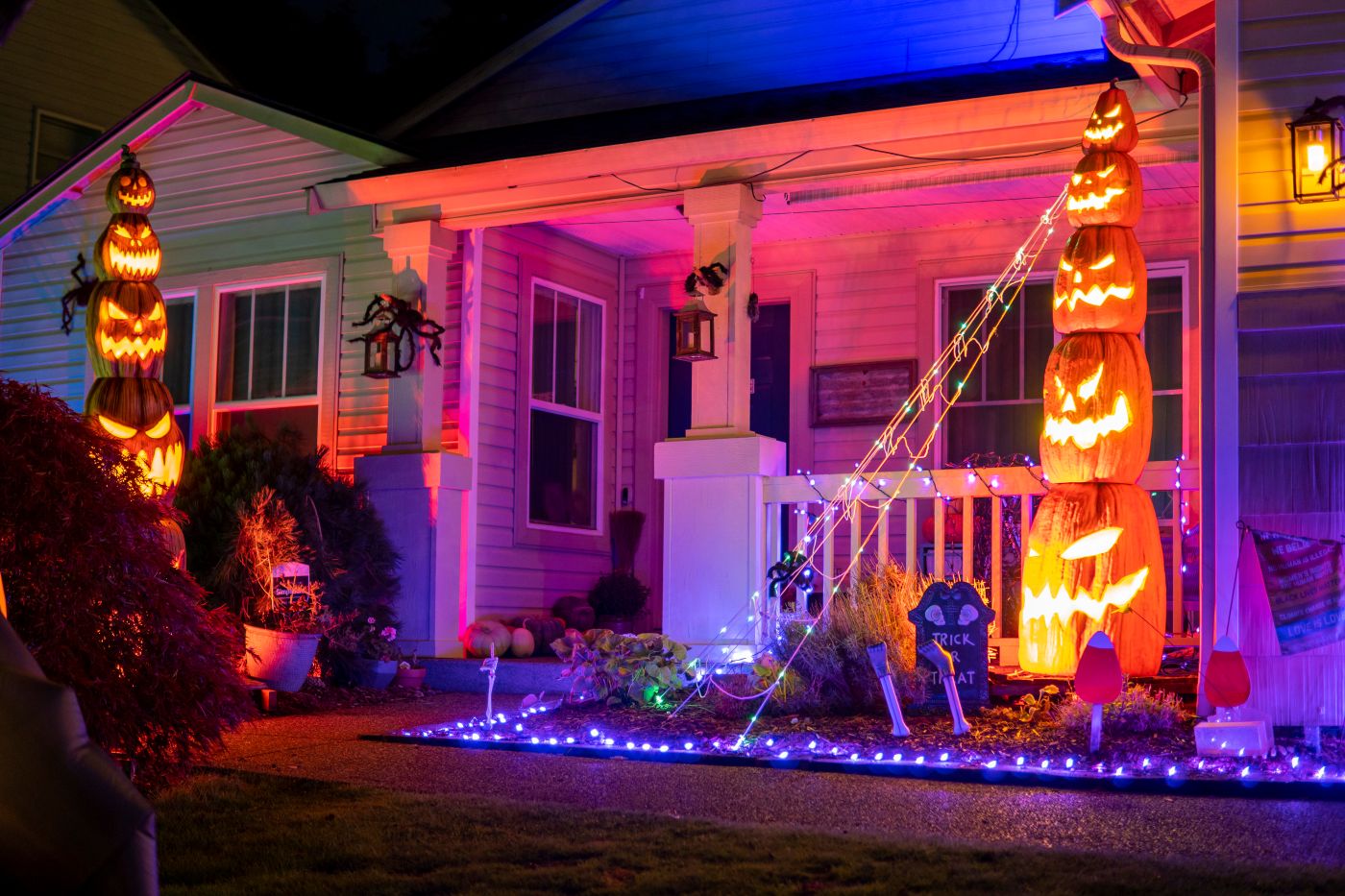
I recognize its arrival when Home Depot starts selling Halloween decorations. These get more elaborate and grotesque each year: animated Chucky dolls (I hesitate to link to the scarface version); the best-selling twelve-foot-high skeletons (listed under the innocent heading “Home Accents Holiday”); or the macabre offerings in Gruesome Grounds. Not long after these mannequins appear in stores, they appear on many front lawns, more than a month in advance of Halloween—the day’s “Advent” period, you might say. For weeks I walk or drive by yards that are not simply tacky, like overdone Christmas decorations, but disturbing.
Every generation of adults tends to exaggerate the differences between the present and their childhood, but I believe something has changed in my lifetime. Seeing Halloween decorations on lawns in September, or even the first half of October, was not a thing thirty or even twenty years ago. Decorations were certainly not as elaborate as these. My father said that, in the 1950s and ’60s of his youth, Halloween was an entirely “homemade” holiday. Decorations were little more than a few kitchen-carved jack-o’-lanterns. For a costume, take a white sheet and cut three holes for the eyes and mouth, and you could be a ghost; give a girl a blue jumper, a basket, and red shoes, and she could be Dorothy from the Wizard of Oz. But in 2025, Americans are expected to spend $13.1 billion (about $115 per reveler) on this once-minor holiday, between candy, store-bought costumes, parties, that ghastly decor, and even greeting cards.
As Halloween comes around once again, we might consider why this once innocent, passing event is, for many people, becoming one of the most significant celebrations of the year.
Looking for Reenchantment?
An optimistic answer is that the easy “enchantment” (as many now call it) of Halloween is taking the place of the waning, more substantive enchantment of Christmas.
The Christmas season, too, has expanded obnoxiously beyond its original length as its enchantment wanes. Macy’s now puts up red and gold decorations in October, catering to the fact that Christmas has become more about buying stuff than religious observance. Why the commercialization? Because fewer and fewer recall, or take an interest in, the deeply religious message behind Christmas: that God has become one of us, in the flesh: “Pleased as Man with men to dwell, / Jesus our Immanuel.” Some blame consumerist culture for the disappearance of Christmas’s religious aspect. Others blame governments for discouraging all public displays of religion. I tend to think that in large part the decline of Christmas has less to do with the “disenchantment” of the public square than with our own choices to live as though God were absent.
Whatever the reason may be, as the religious spirit of Christmas declines, so has Christmas’s power to satisfy people’s desire for the enchantment of the supernatural. To fill the void, other, lesser forms of enchantment are sought: the warm feelings we get from receiving and giving gifts; the beauty of a winter snowscape or autumn’s colors; or in Halloween’s case, the enchantment of the non-divine supernatural—ghosts, witches, and magic.
Because all these things lack the depth of mystery of the God-man, they cannot satisfy our souls. The pain of that dissatisfaction is stronger for the growing number of us who do not believe in the truth of the Christmas story, but who did believe in our youth, as did our families. That belief gave rise to real religious wonder and mutual self-giving in our homes, which were more soul-sustaining than any presents and decorations.
To make up for ersatz enchantment’s lower quality, we increase its quantity. We spend more time buying things and keeping our lawns decorated, to dull our gnawing feeling of emptiness. And when one season (commercial Christmas) stopped satisfying our hearts (becoming so exhausting that some put Christmas trees to the curb on December 26th), we expanded another—Halloween.
… Or Something More Insidious?
But in light of a recent experience of mine, I cannot but think that something deeper is going on in a growing number of people. The burgeoning interest in Halloween, and in openly displaying “the dark side” of the supernatural, suggests that many hearts, impatient with the sentimentality of non-religious holidays, might want to return to religion—but not of the biblical kind.
A few years ago, I spent the summer near Boston with friends. One day someone suggested an outing to Salem, Massachusetts. I was interested, having been there thirty years before as a boy, on vacation with my family. We did the same things that the group proposed to do this time, such as visit the House of the Seven Gables that inspired Nathaniel Hawthorne’s novel of the same name. (Returning to the house was worth it, and I recommend visiting.)
But afterward someone suggested we go to the Salem Witch Museum. I was not opposed, since I had gone as a boy (although I cannot be certain it was the same museum). As I recall it was quite simple back in the ’90s: a single large, open, and well-lit floor, with stationary mannequin dioramas. They portrayed the historical events of the trials of the dozen or so women who were wrongly convicted of witchcraft by the then very Puritan Salem of the late 1600s. The trials are now infamous, sometimes used as an excuse to criticize religion—and Puritanism in particular—as necessarily leading to such abuses of justice, in which innocent people get killed. I was young at the time, so I can’t recall how severely the museum portrayed the Puritan magistrates. As I recall, we children thought the lifeless mannequins were a joke.
So now (not having visited the museum’s informative website), I was unprepared for what awaited me thirty years later. Now the museum occupies a converted church sitting on a large square, its name displayed in bright yellow letters on the facade. The ticket sellers outside were kind, ordinary people, perhaps retired volunteers. We paid and went into the nave for the first presentation. As before, the church contained mannequin dioramas around the periphery, depicting the history of the trials. But they were high up, spanning two stories and wrapping around the vaulted chamber; some scenes were stacked on top of each other. They were in darkness, but there was light in the center where we summer vacationers expectantly sat. When all were in, a greeter politely welcomed us, turned to leave, and closed the door behind her.
Then everything went black.
A menacing, prerecorded narration boomed over loudspeakers, accompanied by eerie music. One by one the scenes lit up as the narrator told the history of Salem’s witch craze. We heard how in those times people believed in the existence of demons, especially the devil, who sought to ensnare souls. An enormous mannequin of Satan lit up—glowing red, with ram’s horns, smoke, and other typical and nightmarish features. A large circle on the floor lit up beneath us, with symbols and words printed on it. It felt like we were in hell.
Not that the presentation suggested that demons and hell were real; it rather suggested the Puritans were fools for believing in all that. The trials were cast not as excessive fear of the devil, but as irrational hysteria. (The ghoulishness of everything was perhaps meant more to cater to visitors during Halloween season, one of the museum’s busiest times of the year.)
I was glad when the lights came on and we were led out. The next part was not frightening—just more dioramas, but all well-lit, and in rooms of ordinary height. A tour guide led us, occasionally pushing a button to start a relatively short recorded narration. The tour related how people accused of witchcraft were treated throughout history, and how they were just ordinary people doing nothing bad. A wall diagram equated the Salem witch hunt to other embarrassing persecutions of marginalized groups in American history. The message was clear: the idea that bad witchcraft and bad occult practices existed was made up by deranged people who hurt the innocent. The Salem witch craze was yet another instance of the sort of oppression (this one born of the “false consciousness” of early modern Puritans) that critical Marxism has trained so many of us to see in the world.
And yet the final diorama noted that there are people today who, as the website says, “find the title, mythology, and legacy of the witch to be a powerful spiritual, personal, and political identity,” except they worship nature deities and love peace. They are neo-pagans, like Wiccans, followers of the religion of the pre-Christian British Isles. Their calendar is in part the origin of Halloween (originally “Samhain,” a harvest festival), after which Christians placed All Saints’ Day (hence the name “All Hallows’ Eve”). Wiccans probably now have a role at the museum; you can even buy their books at the gift shop.
They also have made much of Salem their colony. I recalled the town, when I was a child, as like any other in New England: calm, clean, and orderly. It still is in parts, but now many sections are crowded with Wiccan and other New Age shops, selling crystals, psychic and tarot readings, and other “ritual tools and services to help you … bring the healing energy into your everyday life” and discover “the beauty that lies within the process of nature.” The goal of these stores was to help people “be themselves”—to “illuminate your truth,” in one vendor’s words—not by raising their natural human desires to God’s level, to love as he does, but by being purely and only human, according to the occult ways of our nature, perhaps with the help of certain superhuman spirits.
Here is a religion well suited to our secular times, similarly defined by self-affirmation and normalizing the “natural.” New Age cults appeal to modern man’s hunger for religious experience while affirming his aversion to religion’s substance: subjecting one’s mind and heart to one’s Creator. It is all very understandable, given our tendency to think that the only improving we need is to be more clever in using our nature, not to change our hearts. And yet how insidious such “spirituality” is, because it denies the truth that we tend to love ourselves too much—what Christians (like the Puritans) call original sin.
Most people putting up outrageously ghoulish decorations are, we hope, not engaging in the occult. But perhaps not a few are expressing a kind of irreligious attitude that, in time, could lead in that direction.
To Find Yourself, Learn to Serve
Could part of the surge in Halloween’s popularity be that people are itching for an encounter with something beyond ordinary experience, but without a moral and religious conversion? Most people putting up outrageously ghoulish decorations are, we hope, not engaging in the occult. But perhaps not a few are expressing a kind of irreligious attitude that, in time, could lead in that direction.
Contemporary Salem shows that interest in the occult is growing (although New Agers still make up only 1 percent of the population). Anyone who thinks such interest is harmless should consider how similar Wicca’s self-affirming message is to that of another neo-pagan religion: the often violent Mexican cult of “Saint Death,” who “accepts you without judging you.” Saint Death provides money and physical protection to her devotees, who include drug traffickers and other outlaws. It sounds evil indeed … even demonic.
Whether they condone violence or not, neo-pagans risk going through life rationalizing their own self-absorption and not preparing to enter eternal bliss. Heaven is only for those who learn to get out of themselves and generously serve truth and other souls, not merely their own “happiness.” Those of us who have not been seduced by the occult might consider what we can do to save our fellow men who have wandered down that path. It will lead only to unending agony that we should not wish anyone to experience; God certainly has no such wish.
We all need to recover genuine religiosity, and a good place to start is living better according to the messages of the truly important year-end holidays, like Christmas, Thanksgiving, and All Saints’ Day: that God is with us, especially in our experiences of “disenchantment”; that he gives us every good thing we have, for which he deserves all our devotion; and that those who place their trust in him will receive an eternal reward more glorious than any other so-called “enchantment.”
Image licensed via Adobe Stock.
.JPG)
 Truth2Freedom's Blog